Aggregate Analysis Beyond Price: Glassnode Global Metrics

insights.glassnodeОпубліковано о 2026-06-03Востаннє оновлено о 2026-06-03

Анотація

Glassnode Global Metrics introduce a suite of aggregated on-chain and market metrics designed to analyze the dynamic crypto market without the distortions caused by asset reclassifications. The framework offers two data types: Raw Aggregates (original units) and scaled, base-100 Indices for continuous trend analysis. The article demonstrates the power of these indices through three examples. First, they reveal a dramatic 2024 small-cap rally invisible in raw data, where "winner" assets leaving the basket bias the raw series. Second, they provide a clearer view of profit-taking sentiment across market-cap cohorts, showing that small-cap holder sentiment is more stable than raw SOPR data suggests. Third, they isolate leverage behavior in derivatives, highlighting the higher volatility of open interest in mid- and small-cap assets during speculative phases. Currently live metrics include Total Market Cap, Median SOPR, Total Open Interest, and others, calculated for All Coins, Large, Mid, and Small Cap baskets with weekly rebalancing. The data is accessible via dedicated API endpoints for both raw and indexed series, bringing the continuity of traditional finance indices to multi-asset crypto analytics.

Aggregate market analysis has become a challenge since the digital asset space has fragmented into thousands of assets, sectors, and rapidly changing market-cap cohorts. As assets appreciate, decline, launch, or disappear, aggregate metric series develop structural discontinuities that make long-term analysis difficult.

Previously, we showcased the power of global views that aggregate metrics across the market using our Multi-Asset Explorer. We have now extended this framework with Glassnode Global Metrics — a suite of formally rebalanced aggregate metrics with continuous index normalization, available via API.

In this article, we introduce the framework, examine several examples across market capitalization, profitability, and derivatives positioning, and show what continuity-adjusted indices reveal relative to raw aggregates.

What are Glassnode Global Metrics?

Global Metrics are aggregated on-chain and market metrics computed across multiple cryptocurrencies, organized into configurable baskets. Baskets can be defined by market capitalization thresholds, top-N rankings (by any metric), or asset tags (sectors, categories). They solve a fundamental challenge in crypto analytics: how to track on-chain and market metrics across a highly dynamic group of assets over time without artificial discontinuities caused by basket composition changes, in contrast to indices that focus on price alone.

We provide two output types for each metric:

  • Raw Aggregates: True values in original units preserving economic meaning (e.g., USD for market cap, counts for active addresses)
  • Indices: Scaling-factor-adjusted, base-normalized time series for trend analysis and cross-basket comparison

What the indices reveal

Market structure: the 2024 small-cap surge

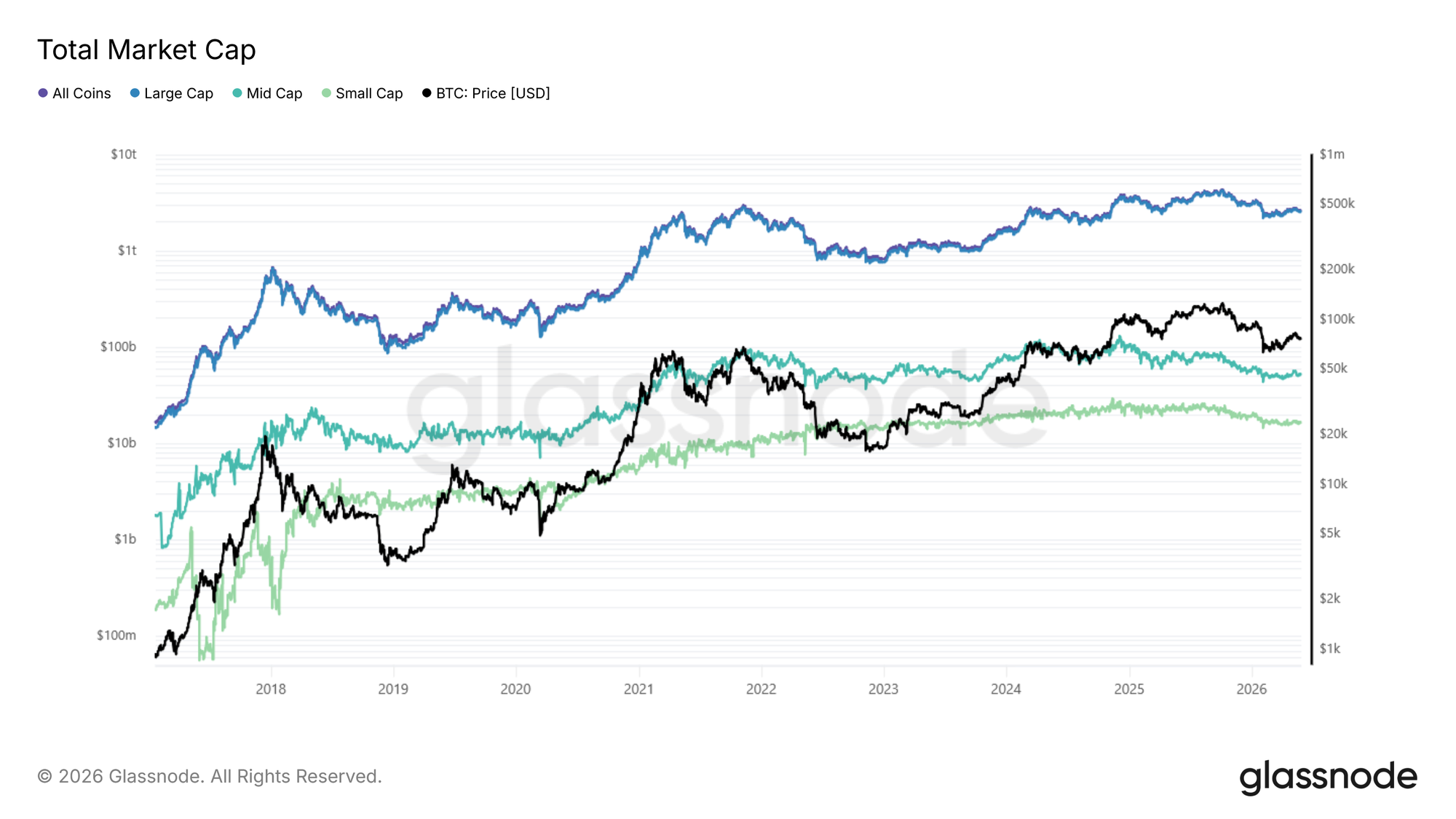
The clearest demonstration of why continuity-adjusted indices matter is the small-cap tier in 2024. The below figure presents Total Market Cap: Raw aggregate (USD, log scale) across all four baskets: All Coins, Large, Mid and Small Cap, with BTC price overlaid.
View Live Metric

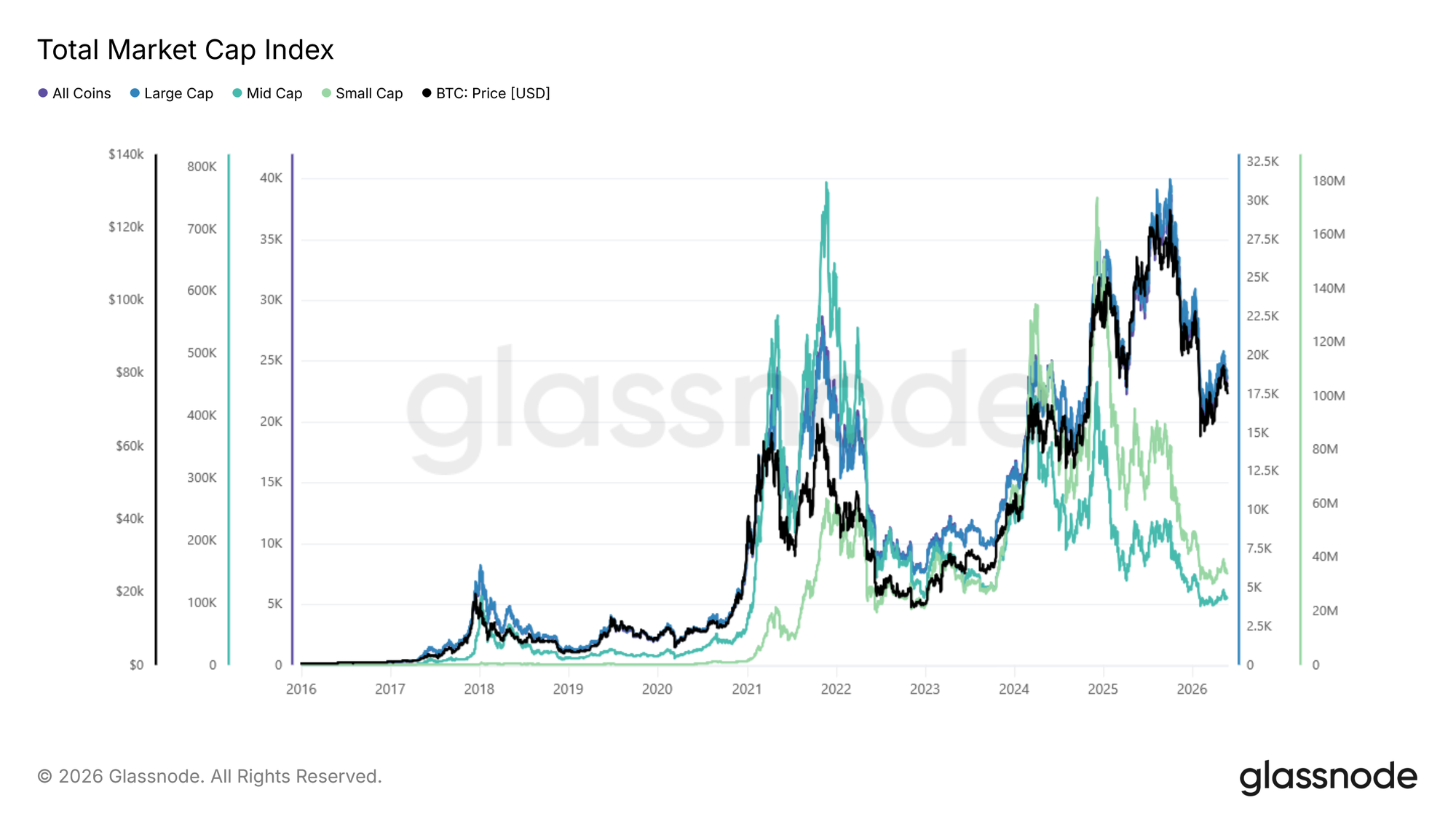
Compare to the Total Market Cap Index: scaled index (base 100) across the same four baskets. Each tier starts at 100, hence the lines are directly comparable as growth multiples.
View Live Metric

The raw small-cap series contains a structural bias: whenever a small-cap asset performs well, it eventually crosses the $100M threshold and leaves the basket, taking its gains with it. In other words, "winners leave". The raw aggregate is, by design, incapable of capturing a small-cap rally.

The index neutralizes this effect. Small-cap shot up dramatically in 2024, a move largely invisible in the raw series, driven by near-instant token creation platforms and the memecoin mania that followed.

The same chart also highlights the divergence across tiers: while large caps held up relatively well, altcoin tiers entered a prolonged drawdown. Both halves only become legible in the index.

Profit-taking Sentiment: Altcoin SOPR vs BTC SOPR

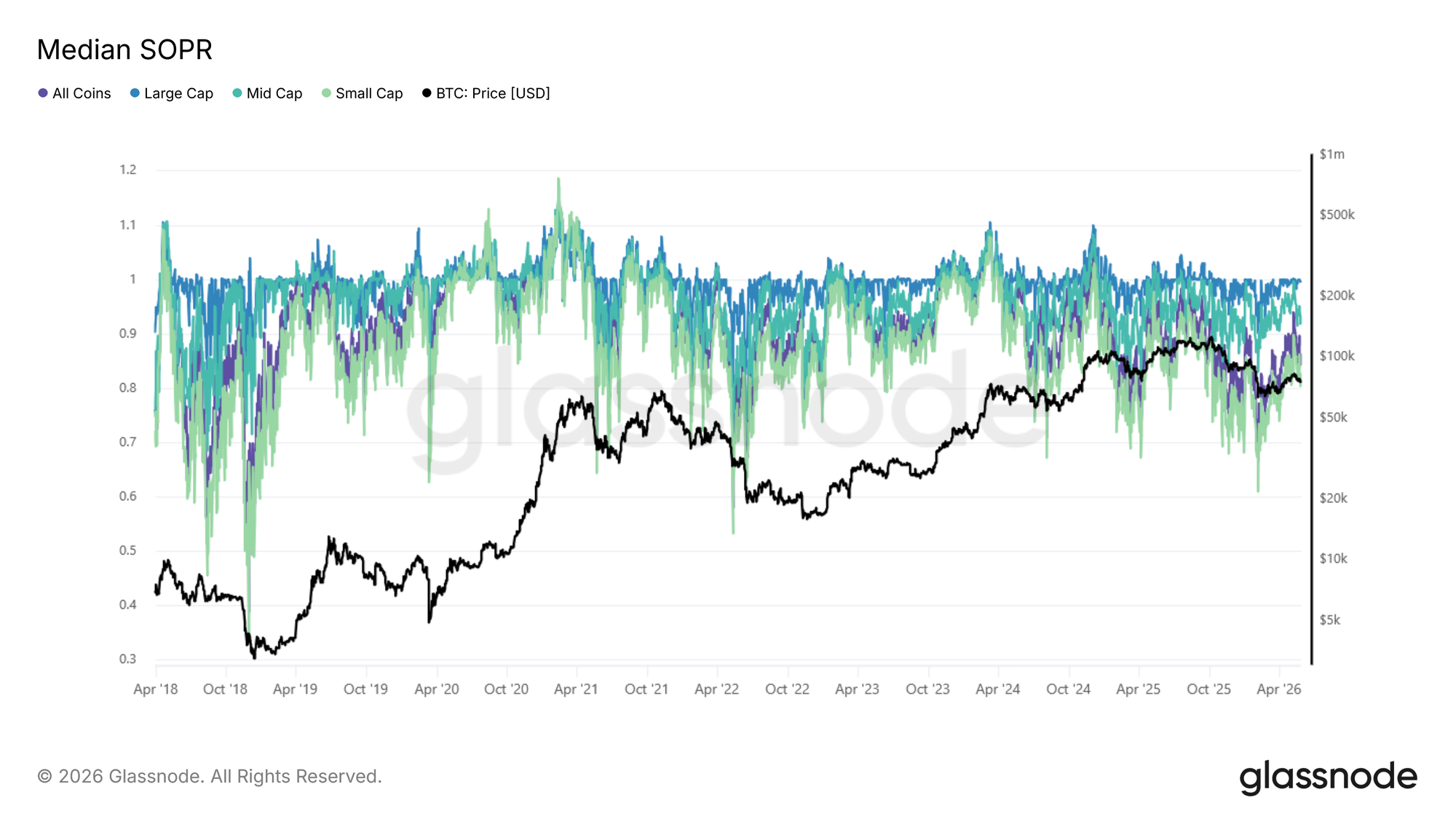
Spent Output Profit Ratio (SOPR), which measures whether coins moving on-chain are being spent at a profit (above 1) or a loss (below 1), is one of the clearest cases where a global metric adds value beyond the single-asset version. BTC SOPR and the median SOPR across altcoin baskets frequently diverge, and the spread between them becomes a signal in itself.

The following figure shows Median SOPR: Raw aggregate across all four baskets, BTC price overlaid. SOPR oscillates around 1.
View Live Metric

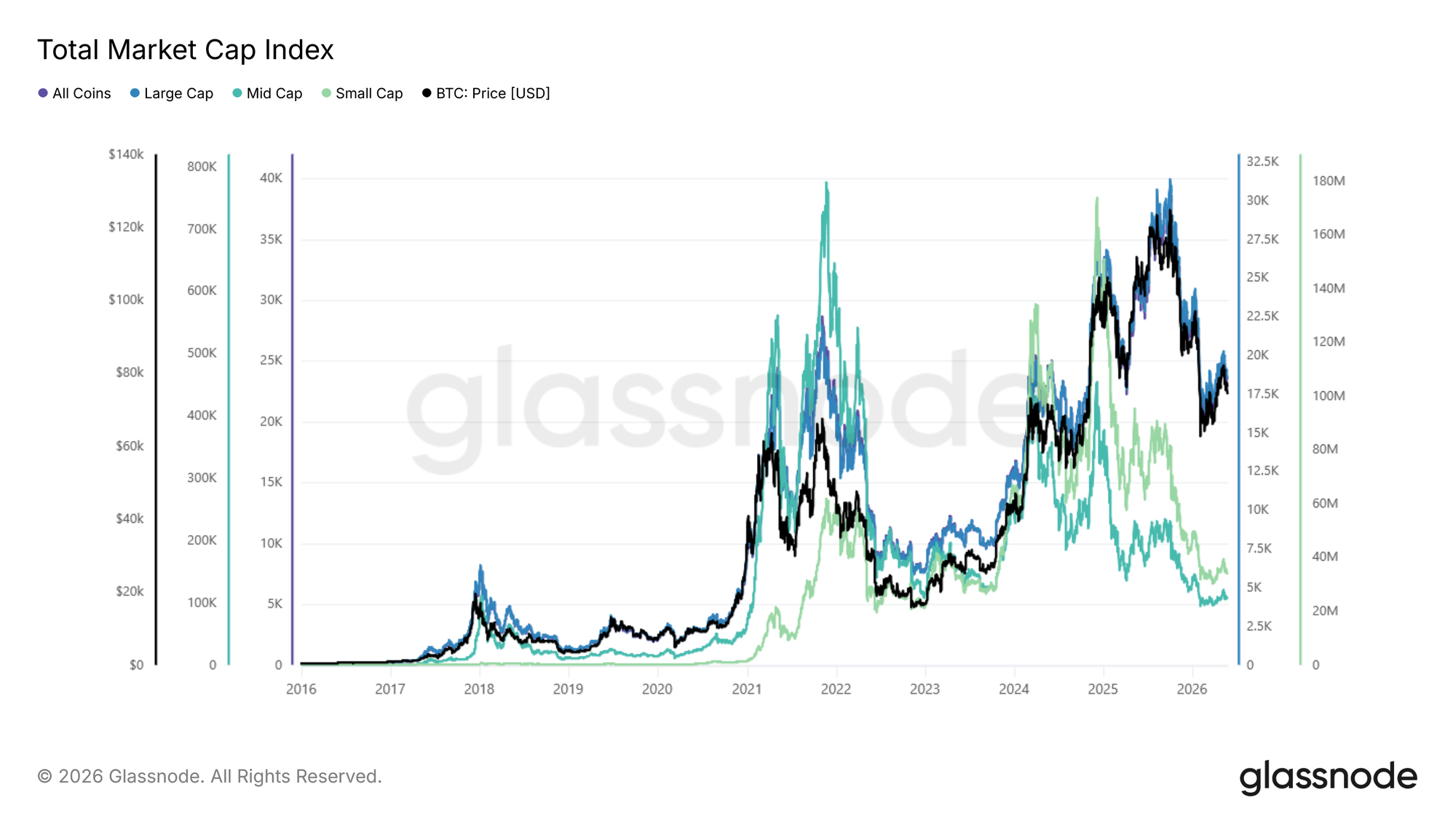
Compare to the Median SOPR: scaled index (base 100), across the same four baskets.
View Live Metric

The raw series tells the following story: small-cap SOPR crashes to levels comparable to the 2018 and 2022 bear markets, while large and mid caps have held up better in recent cycles. The index adds an additional nuance: because appreciated small-cap coins keep leaving the basket as they grow into higher tiers, the raw series overstates how bad sentiment is for the assets that actually remain.

Adjusted for this, small-cap sentiment is more stable than it appears. For large and mid caps no such correction applies, and what the index reveals is a genuine long-term trend: each cycle, the average holder in established assets extracts slightly less profit than the one before. As more supply locks into long-term holding, less of it cycles through at a profit.

Rather than relying on selected tokens as proxies for altcoin sentiment, the global SOPR index provides a cohort-level read directly. No need to cherry-pick individual tokens.

Derivatives Positioning: Open Interest

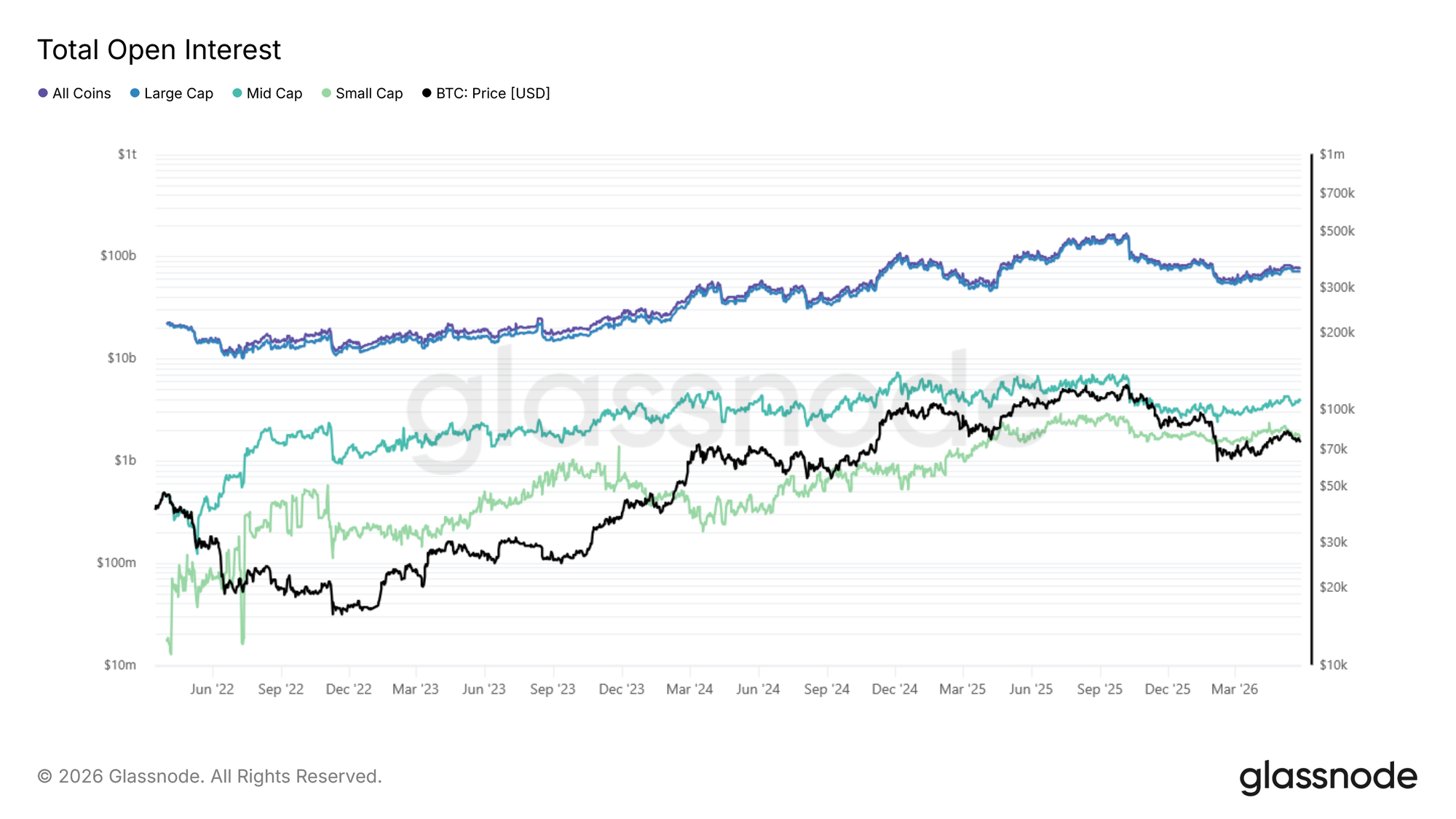
Open Interest (OI) measures the total value of outstanding perpetual futures contracts and provides a useful proxy for leverage concentration across the market.

The below figure presents Total Open Interest: Raw aggregate (USD, log scale) across all four baskets, data from 2022.
View Live Metric

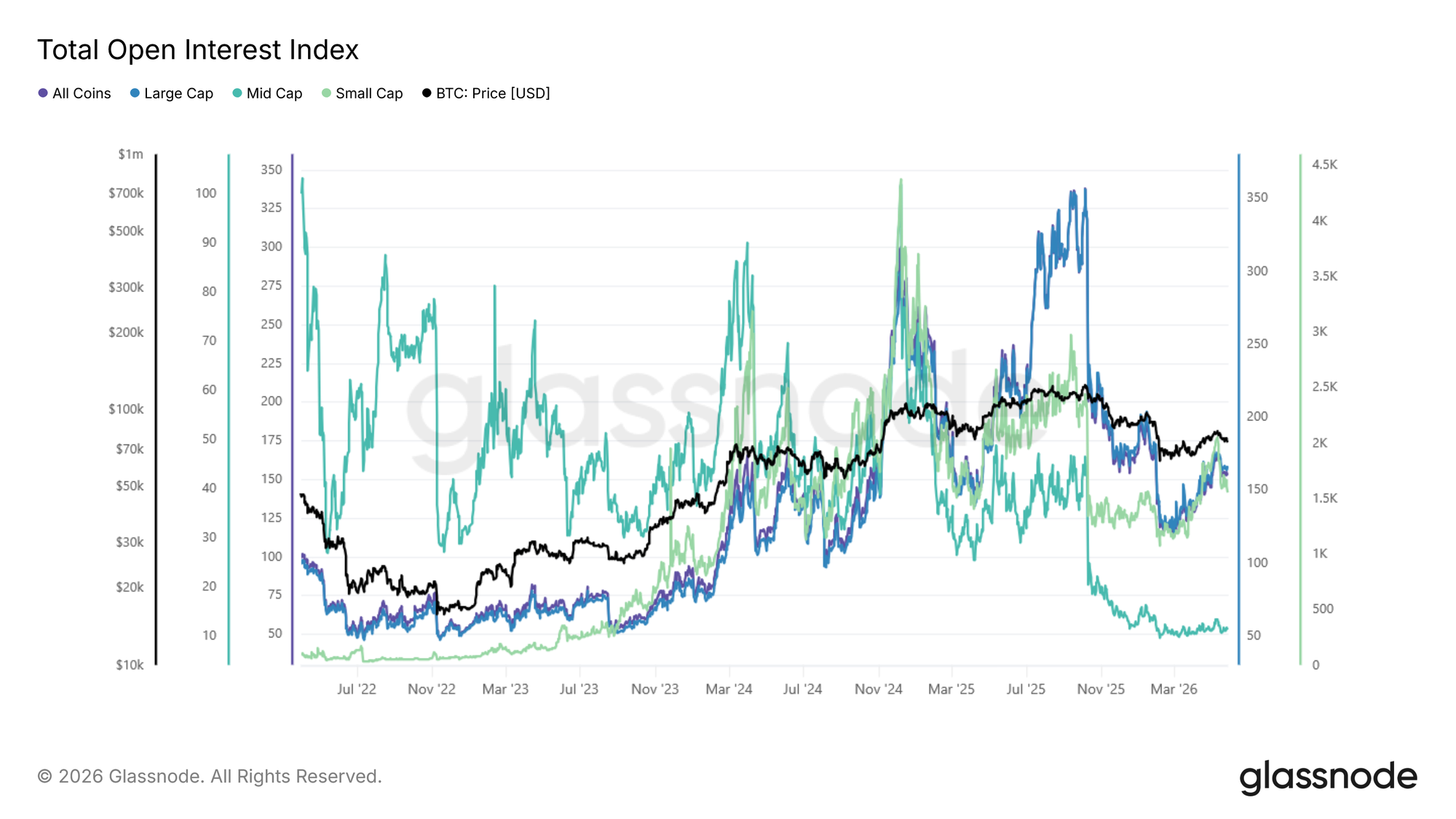
Compare to the Total Open Interest Index: scaled (base 100) across the same four baskets.
View Live Metric

Large cap dominates open interest in absolute terms; most leverage sits on the biggest, most liquid assets. The index, however, makes the behavior of the smaller tiers comparable: mid- and small-cap open interest is far more volatile, spiking sharply during speculative episodes and unwinding just as fast. These spikes are a useful early-warning signal for cascade risk in the more fragile parts of the market.

The continuity-adjusted framework makes these shifts easier to isolate by separating changes in leverage behavior from changes in cohort composition.

The Glassnode Global Metric Suite

Four metrics are live with this release, each computed for all four baskets, sixteen time series in total. All use weekly rebalancing and equal weighting.
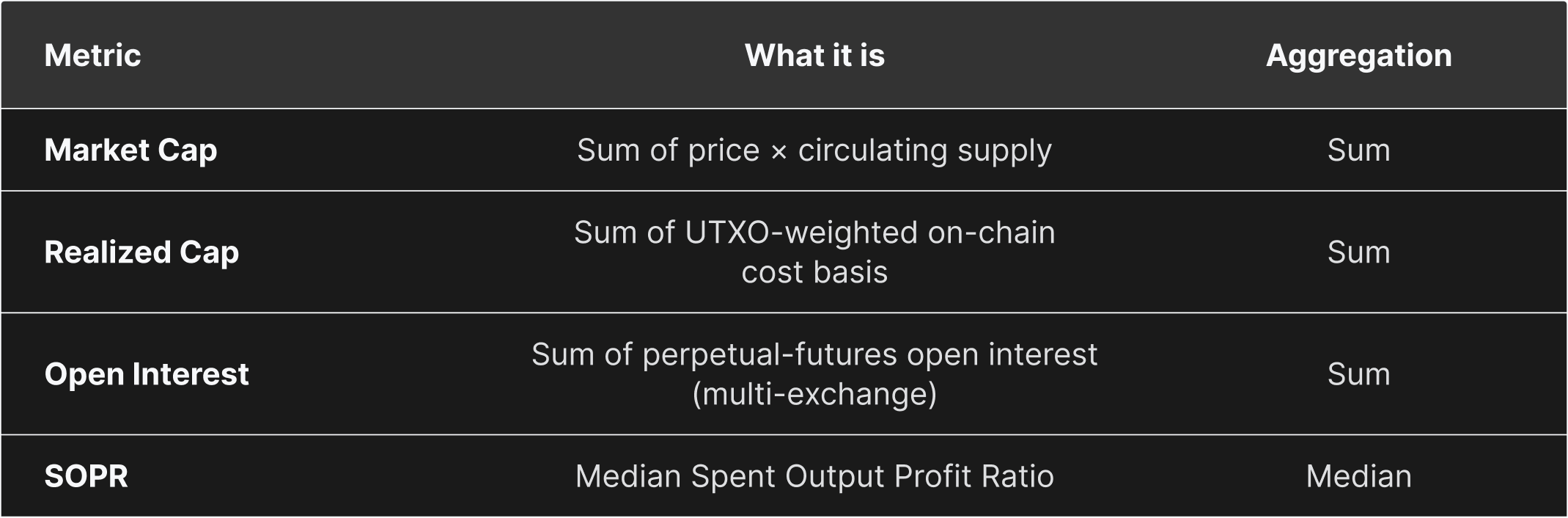
The baskets are the market-cap tiers used throughout this paper:

  • All Coins (no filter)
  • Large Cap (≥$1B)
  • Mid Cap ($100M–$1B)
  • Small Cap (<$100M).

Eligibility filtering, start dates, and the choice of sum versus median aggregation are covered in the appendix.

Accessing the Data via API

Each metric is published in two forms. 1) The raw aggregate preserves the original units (discontinuous at rebalances) and is intended to use for absolute sizing and point-in-time snapshots. 2) The index is scaled, base-100, and continuous, making it more suitable for trend analysis and cross-basket comparison.

Raw and index versions are served from separate endpoints, and each endpoint returns all baskets for that metric:

https://api.glassnode.com/v1/metrics/global/{metric}_{aggregation}_{rebalancing}_{weighting}_raw
https://api.glassnode.com/v1/metrics/global/{metric}_{aggregation}_{rebalancing}_{weighting}_index
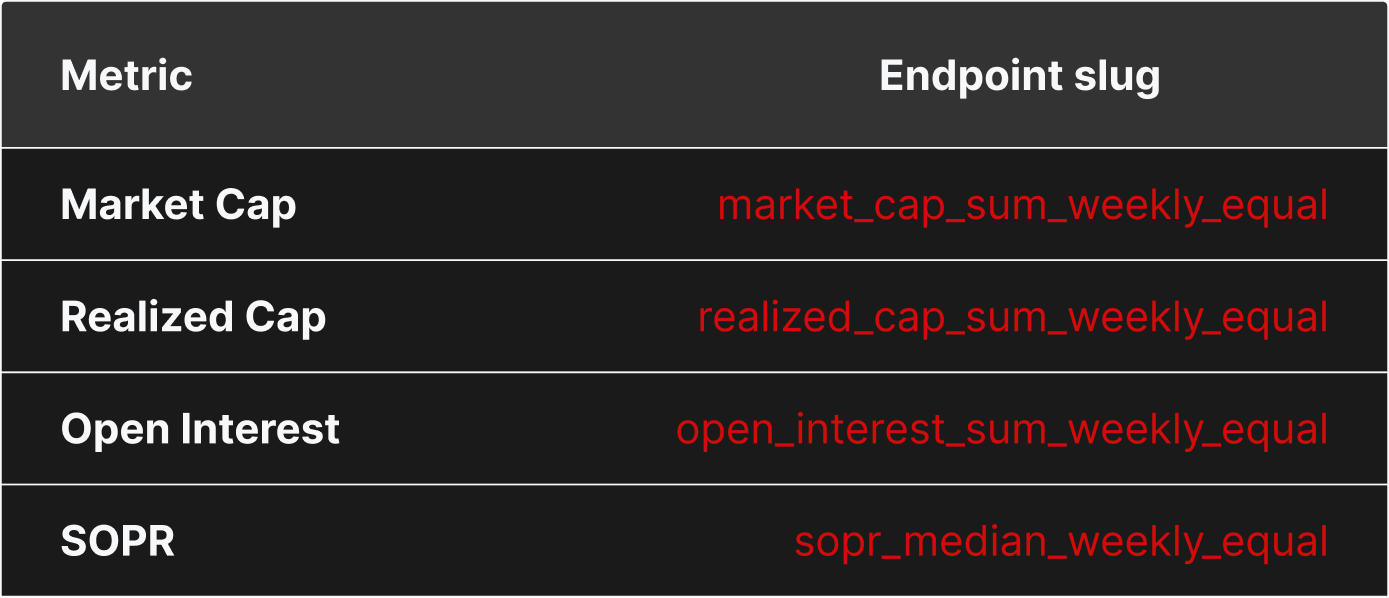
For full request details, please see the Glassnode API documentation. The framework is extensible (additional metrics, alternative weightings, and tag-based sector baskets are planned), but the four metrics above are live today, and they already bring the continuity discipline of traditional price indices to on-chain and market data for a market that is increasingly multi-asset.

Methodology

Full details on basket selection, eligibility filtering, scaling-factor formulas, and index normalization, please reach out to your account manager for access.


  • Follow us on X for timely market updates and analysis
  • Join our Telegram channel for regular market insights
  • For on-chain metrics, dashboards, and alerts, visit Glassnode Studio

Disclaimer: This report is for informational and educational purposes only. The analysis represents a limited case study with significant constraints and should not be interpreted as investment advice or definitive trading signals. Past performance patterns do not guarantee future results. Always conduct thorough due diligence and consider multiple factors before making investment decisions.


Пов'язані питання

QWhat is the core challenge that Glassnode Global Metrics aim to solve in crypto analytics?

AGlassnode Global Metrics aim to solve the fundamental challenge of tracking on-chain and market metrics across a highly dynamic group of assets over time without artificial discontinuities caused by basket composition changes. This is in contrast to indices that focus solely on price.

QExplain the key difference between the 'Raw Aggregates' and 'Indices' provided by Glassnode Global Metrics.

AThe 'Raw Aggregates' provide true values in original units (e.g., USD for market cap), preserving economic meaning but potentially containing structural discontinuities. The 'Indices' are scaling-factor-adjusted, base-normalized (to 100) time series designed for continuous trend analysis and cross-basket comparison, as they neutralize the effect of assets entering or leaving the basket.

QUsing the 2024 small-cap market cap example from the article, why does the raw aggregate series fail to capture a genuine small-cap rally, and how does the index correct for this?

AThe raw small-cap market cap series suffers from a 'winners leave' structural bias. When a small-cap asset appreciates and crosses the $100M threshold, it leaves the small-cap basket, taking its gains with it. Therefore, the raw aggregate cannot capture sustained gains. The index corrects for this by applying a continuity adjustment that neutralizes the effect of composition changes, allowing the true performance of the small-cap tier to be visible.

QAccording to the analysis of the Median SOPR (Spent Output Profit Ratio) index, what long-term trend does it reveal for large and mid-cap assets?

AThe analysis of the Median SOPR index reveals a genuine long-term trend for large and mid-cap assets: in each market cycle, the average holder in these established assets extracts slightly less profit than in the cycle before. This is attributed to more supply being locked into long-term holding, resulting in less of it cycling through at a profit.

QHow does the Global Open Interest index help identify risk, particularly for smaller market cap tiers?

AThe Global Open Interest index helps identify risk by making the *behavior* of different market cap tiers comparable. It shows that open interest for mid- and small-cap assets is far more volatile than for large caps, spiking sharply during speculative episodes and unwinding rapidly. These spikes serve as an early-warning signal for cascade risk in the more fragile, less liquid parts of the market.

Пов'язані матеріали

A Nation Blocks Chips, a Giant Buys a Nuclear Power Plant: Why It's Time to Seriously Consider DeAI

**Title: Great Powers Blockade Chips, Giants Buy Nuclear Plants: Why It's Time to Seriously Consider DeAI** In May 2026, the US closed loopholes for Chinese firms to acquire advanced NVIDIA chips via overseas subsidiaries. That same month, Kenya halted a $1B geothermal data center project involving Microsoft, fearing its immense energy consumption. Meanwhile, Huawei announced mass production of its Ascend AI chip. These disparate events underscore a new reality: the competition for computing power ("compute") has escalated beyond the tech industry, becoming a geopolitical and infrastructural battleground. A new era of oligopoly is forming, with control over the AI stack—from GPU chips (NVIDIA) and cloud platforms (AWS, Azure, Google Cloud) to foundational models (OpenAI, Anthropic)—concentrating in a few Western "AI Octopus" corporations. This centralization creates systemic risks: pricing power and platform lock-in for users, infrastructure fragility, and a widening "compute divide" that threatens to marginalize nations without independent AI capacity. An "AI Iron Curtain" is deepening through export controls. In response, some nations like Saudi Arabia and the UAE are investing heavily to buy compute power, aiming to transition from oil to AI economies. The EU seeks to triple its compute capacity by 2030 to reduce dependency. However, the spending gap is vast, with four US tech giants alone planning ~$750B in AI capex for 2026. The race is increasingly constrained by energy, with AI tasks consuming up to 1000x more power than web searches, pushing firms to even acquire nuclear plants. This landscape is fueling interest in Decentralized AI (DeAI). It proposes a third way: using open protocols to coordinate a global network of idle GPUs, independent developers, and data centers, creating an AI infrastructure without a single controlling entity. Leveraging blockchain and cryptographic verification, DeAI aims to break market concentration, disperse energy demands, reduce geopolitical dependencies, and enhance transparency. While still nascent in performance and stability, DeAI's core promise is not immediate superiority but providing a crucial alternative architecture to resist monopoly, censorship, and centralized power. As specialized AI hardware costs fall and open-source models flourish, the window to build this foundation is open. The very existence of such competition serves as a vital check against the inevitable abuse of concentrated power.

marsbit46 хв тому

A Nation Blocks Chips, a Giant Buys a Nuclear Power Plant: Why It's Time to Seriously Consider DeAI

marsbit46 хв тому

Outpoll Review: A Prediction Market Platform Built for Active Traders

Outpoll Review: A Prediction Market Platform Built for Active Traders In recent years, prediction markets have grown from a niche sector to a mainstream arena, attracting billions in trading volume and institutional capital. However, the user experience and tools for traders have not kept pace. Outpoll, a new global prediction market platform, aims to fill this gap by providing enhanced trading infrastructure for active and professional traders. Built on standard prediction market principles, Outpoll allows users to trade on the outcome of specific events. It uses fully collateralized contracts with USDC settlement, charges a competitive 0.1% fee per trade, and provides clear settlement rules upfront to minimize disputes. A key focus for Outpoll is its professional-grade trading tools. The platform supports limit and market orders, as well as take-profit and stop-loss orders for open positions—features uncommon in prediction markets. For automated trading, Outpoll offers comprehensive REST and WebSocket APIs, enabling portfolio management, price arbitrage, and integration with existing tools. The platform also features a creator-led market model, where approved experts and community leaders can create and manage markets for niche topics under platform supervision. Its integrated interface combines news feeds directly with trading functions, allowing users to monitor events and manage positions seamlessly. Outpoll launched with a native Android app (available on Google Play) and plans an iOS version later this year. In summary, Outpoll distinguishes itself with trader-focused tools, practical APIs, transparent and collateralized markets, integrated news, and an expanding creator program. For active traders, its advanced order types and API access alone make it a platform worth watching. Outpoll is now globally accessible via outpoll.com and Google Play.

marsbit54 хв тому

Outpoll Review: A Prediction Market Platform Built for Active Traders

marsbit54 хв тому

Bitwise: Crypto Becomes a Contrarian Investment, Three Logics to Understand the Current Market

**Summary** Matt Hougan, Bitwise's CIO, analyzes the current crypto market through three key lenses, arguing it has shifted from a momentum-driven to a contrarian investment. **1) Crypto Becomes a Contrarian Play:** The market is weak, with major assets like Bitcoin and Ethereum down significantly. Capital has moved to hot sectors like AI, leaving crypto as an "unloved" asset class. This transforms crypto investing from trend-following to a test of patience and fundamental analysis. Investors now favor projects with solid fundamentals (e.g., Hyperliquid) over speculative ones. **2) Regulatory Overhang:** The uncertain fate of the U.S. CLARITY Act, a major crypto regulatory framework, is a key headwind. With its passage in 2024 seen as far from guaranteed (estimates range from 30-55%), institutional capital remains on the sidelines, choosing less risky alternatives like AI stocks. The market needs clarity—whether the bill passes or fails—more than any specific outcome to move decisively. **3) Capital Rotates to New Fundamentals:** This cycle differs from past bear markets where money fled to Bitcoin. Now, capital seeks smaller assets with strong use cases. While major cryptos fell in May 2024, tokens like Hyperliquid (+72%), Zcash (+50%), and XLM (+44%) rallied on their specific fundamentals. This rotation confirms the new contrarian, fundamentals-driven logic and signals the bear market may be in its later stages. **Conclusion:** Short-term pressure persists due to regulatory uncertainty and competition from AI narratives. Investing in crypto now requires a contrarian mindset—acting against the crowd and focusing on fundamental value. Patience and targeting high-quality projects based on their merits are essential for capturing long-term gains.

marsbit1 год тому

Bitwise: Crypto Becomes a Contrarian Investment, Three Logics to Understand the Current Market

marsbit1 год тому

Торгівля

Спот
Ф'ючерси
活动图片