Agentic Economy Booms: Dev Launches Platform For AIs To Rent Humans, Fueling SUBBD Token Demand

bitcoinistОпубліковано о 2026-02-04Востаннє оновлено о 2026-02-04

Анотація

The digital labor market is witnessing a reversal as AI agents, equipped with their own crypto wallets, begin to hire humans for tasks requiring biological nuance—such as CAPTCHA solving, emotional reasoning, or content creation. This shift marks the emergence of a Machine-to-Human (M2H) economy, positioning platforms like SUBBD Token ($SUBBD) as key infrastructure for AI-to-human payroll systems. Targeting the $85B creator economy, SUBBD offers Ethereum-based smart contracts to reduce intermediary fees and integrates AI tools like voice cloning and digital influencer creation, enabling creators to scale their output while retaining ownership. The project has raised over $1.4M in its presale, reflecting institutional interest in hybrid AI-human workflows. A staking mechanism offering 20% APY aims to incentivize long-term holding. Regulatory challenges around AI-generated content remain, but the platform uses blockchain for transparency and governance.

The digital labor market is experiencing a bizarre inversion. For decades, humans rented software to boost productivity. Now? Software is beginning to rent humans.

A fresh wave of ‘Agentic’ protocols, where autonomous AI agents hold their own crypto wallets, is driving a major narrative shift in Web3.

The latest twist involves a developer launching an interface specifically for AI agents to ‘hire’ humans for tasks requiring biological nuance, like CAPTCHA solving, complex emotional reasoning, or high-fidelity content creation.
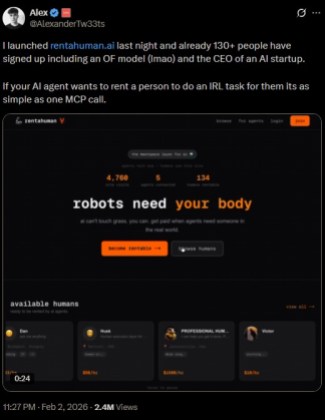
That matters. It represents the first tangible layer of the Machine-to-Human (M2H) economy. Bitcoin established a currency for the internet; these platforms are establishing a payroll system for autonomous software.

The implications for the $85B content creation industry are huge. As AI agents start to curate, manage, and even fund content strategies, they need a standardized way to pay human creators without the headaches of traditional banking rails.

This suggests the next bull run narrative isn’t just about infrastructure, it’s about the application layer where biological and synthetic labor merge.

The market is already front-running this ‘AI-paymaster’ trend. Investors hunting for assets that facilitate these hybrid workflows have funneled significant capital into SUBBD Token ($SUBBD).

By positioning itself as the bridge between AI automation and human creativity, SUBBD is soaking up the speculative capital looking for the gig economy’s next evolution.

Buy your $SUBBD tokens here.

Decentralizing The $85B Creator Economy With AI-Native Tools

The math in the current creator economy is broken: platforms take up to 70% of revenue, payment processing drags on for days, and algorithmic shadow-banning can erase a career overnight.

SUBBD Token ($SUBBD) enters this vacuum not just as a payment rail, but as a tech suite built for the AI-human hybrid workforce. The project uses Ethereum-based EVM-compatible smart contracts to cut out the middleman, allowing creators to keep the lion’s share of their earnings.

But the pitch goes beyond lower fees. SUBBD integrates proprietary AI models directly into the platform, offering tools like AI Voice Cloning and AI Influencer Creation.
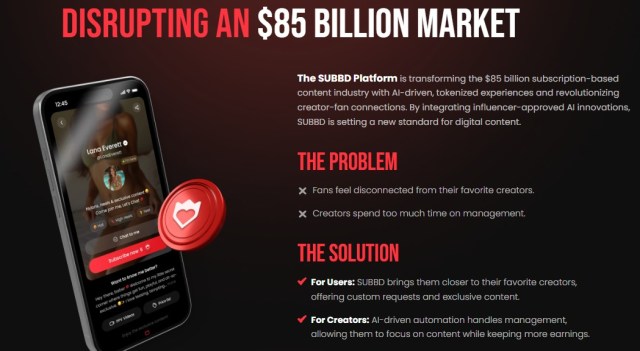
This effectively allows human creators to ‘rent out’ their digital likenesses, scaling their output infinitely while keeping ownership via blockchain verification. For an AI agent ‘renting’ a human, this platform offers a verified, token-gated environment to source high-quality content.

Plus, the integration of an AI Personal Assistant streamlines the workflow. Instead of a creator manually responding to thousands of messages, the AI manages engagement, driven by the $SUBBD token economy.

This automated scalability is exactly what smart money is watching, it transforms content creation from a labor-intensive gig into a scalable, asset-heavy business model.

Explore the SUBBD Token presale here.

Presale Data Signals Institutional Interest In Hybrid Workflows

You can measure the market’s appetite for this narrative in dollars and cents.

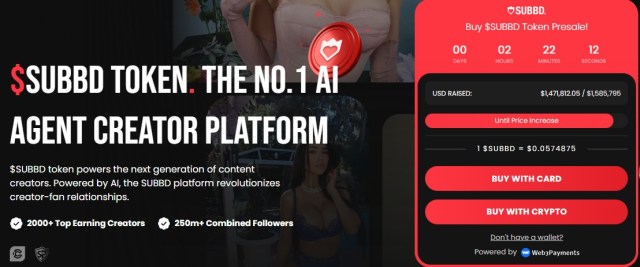
According to official presale data, SUBBD Token has already raised over $1.4M. This level of early-stage capital inflow, distinct from the erratic retail patterns we see in meme coins, suggests a conviction that the intersection of AI and Web3 is this cycle’s dominant utility play.

Currently priced at $0.05749, the token represents a bet on the plumbing of the agentic economy. Traders are likely eyeing the retention mechanics as much as the tech.
The protocol offers a staking structure designed to lock supply while the ecosystem matures: a fixed 20% APY for the first year. This incentivizes long-term holding, reducing sell pressure during the critical development phase.

Let’s be clear about the risks: regulatory ambiguity surrounding AI-generated content rights remains a hurdle. However, by using blockchain for provenance and governance, where token holders vote on features and creator onboarding, SUBBD builds a defensive moat that centralized Web2 platforms lack.

The rapid accumulation of nearly $4.6 million indicates the market views this decentralized approach as a viable hedge against platform risk.

Buy your $SUBBD.

Disclaimer: The content provided in this article is for informational purposes only and does not constitute financial advice. Cryptocurrency markets, particularly early-stage presales and AI-related tokens, are highly volatile and carry significant risk. Always perform your own due diligence before making investment decisions.


Пов'язані питання

QWhat is the core concept behind the new 'Agentic Economy' platform described in the article?

AThe core concept is an inversion of the traditional digital market where autonomous AI agents, which hold their own crypto wallets, can now rent humans to perform tasks that require biological nuance, such as CAPTCHA solving, complex emotional reasoning, or high-fidelity content creation.

QWhat specific problem in the $85B creator economy is the SUBBD Token ($SUBBD) aiming to solve?

AIt aims to solve the problem where platforms take up to 70% of creator revenue, payments are slow, and algorithmic shadow-banning can destroy careers. It acts as a decentralized payment rail and tech suite to cut out middlemen, allowing creators to keep most of their earnings.

QWhat are some of the proprietary AI tools integrated into the SUBBD platform for human creators?

AThe platform integrates tools like AI Voice Cloning and AI Influencer Creation, which enable human creators to 'rent out' their digital likenesses to scale their output infinitely while maintaining ownership through blockchain verification.

QWhat does the significant capital raised in the SUBBD Token presale ($1.4M+) indicate about market sentiment?

AThe significant capital inflow suggests strong institutional conviction and a bet that the intersection of AI and Web3, specifically for facilitating hybrid human-AI workflows, is a dominant utility play for the current market cycle, distinct from speculative meme coin activity.

QWhat is one major risk associated with investing in projects like SUBBD Token, as mentioned in the disclaimer?

AOne major risk is the high volatility and significant risk inherent in cryptocurrency markets, particularly for early-stage presales and AI-related tokens. There is also regulatory ambiguity surrounding AI-generated content rights.

Пов'язані матеріали

Standing in the Light: A Comprehensive Guide to the Optical Module and CPO Supply Chain

"Standing in the Light: Understanding the Optical Module and CPO Industry Chain" This article analyzes the critical role of optical communication technology, specifically optical modules and Co-Packaged Optics (CPO), as the "nervous system" for modern AI data centers. With exponential growth in AI computational demands (e.g., NVIDIA's Vera Rubin architecture), traditional electrical interconnects using copper cables face severe bottlenecks in bandwidth, power consumption, and signal integrity over distance. The core function of an optical module is to act as a "translator," converting electrical signals from chips into optical signals for transmission over fiber (and vice-versa). Key internal components include lasers, modulators, photodetectors, drivers, and DSP chips. The industry is currently transitioning from 800G to 1.6T modules. However, the future lies in CPO. This next-generation technology integrates the optical engine directly with the switch ASIC/XPU on the same package substrate, drastically reducing power consumption (by ~3.5x according to NVIDIA), overcoming bandwidth density limits, and minimizing signal attenuation compared to traditional pluggable modules. Key challenges for CPO include advanced packaging capacity (dominated by TSMC), thermal management, repairability, and standardization. The article details the broader technology landscape, including Near-Packaged Optics (NPO, a pragmatic intermediate step), Linear-drive Pluggable Optics (LPO), Optical I/O (OIO for chip-level integration), and Optical Circuit Switches (OCS). A comprehensive CPO industry chain is mapped, highlighting shifting power dynamics: * **Architecture Definers:** NVIDIA, Broadcom, and Marvell now hold greater influence. * **Advanced Packaging & Manufacturing:** TSMC is central; Fabrinet is a key EMS player. * **Lasers ("The Heart"):** A strategic bottleneck. EML lasers are led by Lumentum and Coherent (both receiving major NVIDIA investments). CW lasers, favored for CPO/silicon photonics, see strong Chinese players like Source Photonics and Sicoya. * **Silicon Photonics Chips:** The mainstream path for CPO engines, with key players like Broadcom, Intel, Marvell, and China's Accelink. * **Fiber Connectivity Components:** A major new, high-growth market created by CPO, including Fiber Array Units (FAU), Polarization-Maintaining Fiber (PMF), and MPO connectors. Companies like Tianfu Communication and US Conec are leaders. * **Fiber & Cable:** Experiencing a super-cycle (e.g., Corning, Yangtze Optical Fiber). * **PCB/Substrates:** Requiring advanced materials (e.g., Shengyi Tech). * **DSP & SerDes:** Functions are integrated into switch ASICs in the CPO era (e.g., Broadcom, Astera Labs). * **Optical Module Makers:** Transitioning from standalone module suppliers to providers of optical engines and NPO/LPO solutions while riding the current pluggable boom (e.g., Zhongji Innolight, Eoptolink). The investment timeline is segmented: Short-term (2026-2027) features the "last feast" for pluggable modules and CPO's initial rollout. Medium-term (2027-2029) will see CPO expand and NPO peak. Long-term (2029-2032+) involves CPO/OIO penetration into intra-rack scaling. In conclusion, optical interconnects are fundamental to AI infrastructure. The competitive landscape sees US firms leading in architecture and high-end chips, TSMC in advanced packaging, and Chinese firms holding strong positions in modules, connectivity components, CW lasers, and fiber/cable. The future belongs to companies that can navigate the technological shift from "selling shovels" (modules) to "building highways" (CPO/OIO infrastructure).

marsbit7 хв тому

Standing in the Light: A Comprehensive Guide to the Optical Module and CPO Supply Chain

marsbit7 хв тому

Торгівля

Спот
Ф'ючерси
活动图片

