Agentic Economy Booms: Dev Launches Platform For AIs To Rent Humans, Fueling SUBBD Token Demand

bitcoinistОпубліковано о 2026-02-04Востаннє оновлено о 2026-02-04

Анотація

The digital labor market is witnessing a reversal as AI agents, equipped with their own crypto wallets, begin to hire humans for tasks requiring biological nuance—such as CAPTCHA solving, emotional reasoning, or content creation. This shift marks the emergence of a Machine-to-Human (M2H) economy, positioning platforms like SUBBD Token ($SUBBD) as key infrastructure for AI-to-human payroll systems. Targeting the $85B creator economy, SUBBD offers Ethereum-based smart contracts to reduce intermediary fees and integrates AI tools like voice cloning and digital influencer creation, enabling creators to scale their output while retaining ownership. The project has raised over $1.4M in its presale, reflecting institutional interest in hybrid AI-human workflows. A staking mechanism offering 20% APY aims to incentivize long-term holding. Regulatory challenges around AI-generated content remain, but the platform uses blockchain for transparency and governance.

The digital labor market is experiencing a bizarre inversion. For decades, humans rented software to boost productivity. Now? Software is beginning to rent humans.

A fresh wave of ‘Agentic’ protocols, where autonomous AI agents hold their own crypto wallets, is driving a major narrative shift in Web3.

The latest twist involves a developer launching an interface specifically for AI agents to ‘hire’ humans for tasks requiring biological nuance, like CAPTCHA solving, complex emotional reasoning, or high-fidelity content creation.
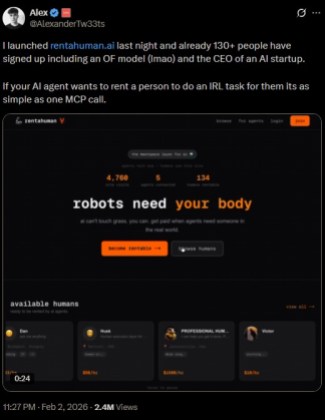
That matters. It represents the first tangible layer of the Machine-to-Human (M2H) economy. Bitcoin established a currency for the internet; these platforms are establishing a payroll system for autonomous software.

The implications for the $85B content creation industry are huge. As AI agents start to curate, manage, and even fund content strategies, they need a standardized way to pay human creators without the headaches of traditional banking rails.

This suggests the next bull run narrative isn’t just about infrastructure, it’s about the application layer where biological and synthetic labor merge.

The market is already front-running this ‘AI-paymaster’ trend. Investors hunting for assets that facilitate these hybrid workflows have funneled significant capital into SUBBD Token ($SUBBD).

By positioning itself as the bridge between AI automation and human creativity, SUBBD is soaking up the speculative capital looking for the gig economy’s next evolution.

Buy your $SUBBD tokens here.

Decentralizing The $85B Creator Economy With AI-Native Tools

The math in the current creator economy is broken: platforms take up to 70% of revenue, payment processing drags on for days, and algorithmic shadow-banning can erase a career overnight.

SUBBD Token ($SUBBD) enters this vacuum not just as a payment rail, but as a tech suite built for the AI-human hybrid workforce. The project uses Ethereum-based EVM-compatible smart contracts to cut out the middleman, allowing creators to keep the lion’s share of their earnings.

But the pitch goes beyond lower fees. SUBBD integrates proprietary AI models directly into the platform, offering tools like AI Voice Cloning and AI Influencer Creation.
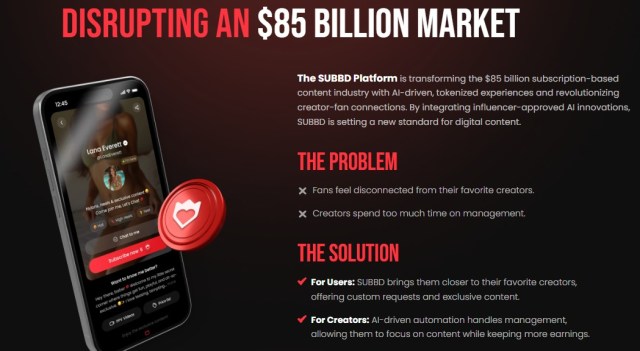
This effectively allows human creators to ‘rent out’ their digital likenesses, scaling their output infinitely while keeping ownership via blockchain verification. For an AI agent ‘renting’ a human, this platform offers a verified, token-gated environment to source high-quality content.

Plus, the integration of an AI Personal Assistant streamlines the workflow. Instead of a creator manually responding to thousands of messages, the AI manages engagement, driven by the $SUBBD token economy.

This automated scalability is exactly what smart money is watching, it transforms content creation from a labor-intensive gig into a scalable, asset-heavy business model.

Explore the SUBBD Token presale here.

Presale Data Signals Institutional Interest In Hybrid Workflows

You can measure the market’s appetite for this narrative in dollars and cents.

According to official presale data, SUBBD Token has already raised over $1.4M. This level of early-stage capital inflow, distinct from the erratic retail patterns we see in meme coins, suggests a conviction that the intersection of AI and Web3 is this cycle’s dominant utility play.

Currently priced at $0.05749, the token represents a bet on the plumbing of the agentic economy. Traders are likely eyeing the retention mechanics as much as the tech.
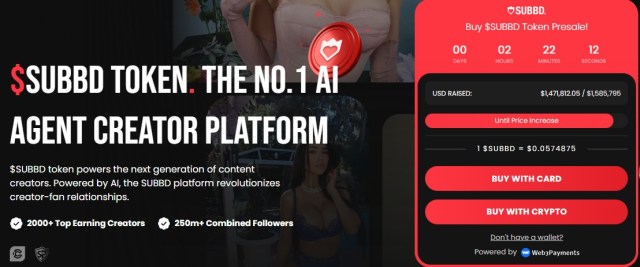
The protocol offers a staking structure designed to lock supply while the ecosystem matures: a fixed 20% APY for the first year. This incentivizes long-term holding, reducing sell pressure during the critical development phase.

Let’s be clear about the risks: regulatory ambiguity surrounding AI-generated content rights remains a hurdle. However, by using blockchain for provenance and governance, where token holders vote on features and creator onboarding, SUBBD builds a defensive moat that centralized Web2 platforms lack.

The rapid accumulation of nearly $4.6 million indicates the market views this decentralized approach as a viable hedge against platform risk.

Buy your $SUBBD.

Disclaimer: The content provided in this article is for informational purposes only and does not constitute financial advice. Cryptocurrency markets, particularly early-stage presales and AI-related tokens, are highly volatile and carry significant risk. Always perform your own due diligence before making investment decisions.


Пов'язані питання

QWhat is the core concept behind the new 'Agentic Economy' platform described in the article?

AThe core concept is an inversion of the traditional digital market where autonomous AI agents, which hold their own crypto wallets, can now rent humans to perform tasks that require biological nuance, such as CAPTCHA solving, complex emotional reasoning, or high-fidelity content creation.

QWhat specific problem in the $85B creator economy is the SUBBD Token ($SUBBD) aiming to solve?

AIt aims to solve the problem where platforms take up to 70% of creator revenue, payments are slow, and algorithmic shadow-banning can destroy careers. It acts as a decentralized payment rail and tech suite to cut out middlemen, allowing creators to keep most of their earnings.

QWhat are some of the proprietary AI tools integrated into the SUBBD platform for human creators?

AThe platform integrates tools like AI Voice Cloning and AI Influencer Creation, which enable human creators to 'rent out' their digital likenesses to scale their output infinitely while maintaining ownership through blockchain verification.

QWhat does the significant capital raised in the SUBBD Token presale ($1.4M+) indicate about market sentiment?

AThe significant capital inflow suggests strong institutional conviction and a bet that the intersection of AI and Web3, specifically for facilitating hybrid human-AI workflows, is a dominant utility play for the current market cycle, distinct from speculative meme coin activity.

QWhat is one major risk associated with investing in projects like SUBBD Token, as mentioned in the disclaimer?

AOne major risk is the high volatility and significant risk inherent in cryptocurrency markets, particularly for early-stage presales and AI-related tokens. There is also regulatory ambiguity surrounding AI-generated content rights.

Пов'язані матеріали

Has Hook Summer Truly Arrived? sato, Lo0p, FLOOD Ignite the New Uniswap v4 Narrative

With the broader market showing signs of recovery, a new wave of interest has emerged around Ethereum-based meme coins. Following ASTEROID, tokens like sato, sat1, Lo0p, and FLOOD, built upon the Uniswap v4 Hook protocol, are capturing market attention. Their market capitalizations range from millions to tens of millions of dollars, injecting much-needed focused liquidity into a market lacking narratives. This article explores whether this trend signifies an incoming "Hook Summer" and its potential impact on UNI's price. Hooks are essentially plug-in smart contracts for Uniswap v4 liquidity pools, allowing developers to inject custom logic at key points in a pool's lifecycle (like initialization, adding/removing liquidity, swaps). This transforms the AMM into programmable building blocks. Key highlighted projects include: * **sato**: Peaked over $38M market cap. It utilizes a v4 curve for minting/burning; buying locks ETH as reserve to mint new tokens, while selling redeems ETH from the reserve and burns tokens. * **sat1**: Market cap briefly exceeded $10M, promoted as an "optimized sato," but later declined significantly. * **Lo0p**: Reached nearly $6.6M. It's a lending AMM protocol where buying LO0P tokens locks them as collateral, allowing users to borrow ETH from the pool reserve at 40% LTV, aiming to improve capital efficiency for idle ETH in LPs. * **FLOOD**: Peaked near $6M. Its mechanism directs asset reserves from buys into Aave v3 to generate yield, with fees and interest retained in the pool to potentially influence the token's price long-term. In the long term, the development of the Hook ecosystem can attract users and liquidity to Uniswap v4, benefiting UNI's fundamentals—especially combined with the recent activation of the protocol fee switch, where a portion of fees is used to burn UNI. However, in the short term, these Hook-based tokens are unlikely to directly drive significant UNI price appreciation. Their impact is moderated by factors like token sustainability, price volatility, and broader market and regulatory conditions. Currently, Uniswap v4's TVL ($595M) still trails behind v2 and v3, indicating adoption and growth will take time. The article concludes that while the Hook ecosystem provides long-term "nourishment" for UNI, its short-term role is more of a "catalyst" than a "booster." Readers are cautioned that these are early-stage experimental tokens and may carry unknown risks.

Odaily星球日报5 хв тому

Has Hook Summer Truly Arrived? sato, Lo0p, FLOOD Ignite the New Uniswap v4 Narrative

Odaily星球日报5 хв тому

Interview with Michael Saylor: I Did Say I Would Sell Bitcoin, But Never a Net Sale

Interview with Michael Saylor: I Said We'd Sell Bitcoin, But Never Be a Net Seller In a recent podcast, MicroStrategy Executive Chairman Michael Saylor clarified the company's stance on potentially selling Bitcoin. Following MicroStrategy's earnings call statement about being prepared to sell BTC to fund dividends for its STRC (Strategic) credit product, Saylor emphasized the distinction between selling and being a "net seller." Saylor explained the core business model: MicroStrategy sells credit instruments like STRC and uses the proceeds to buy Bitcoin, which is viewed as "digital capital" expected to appreciate around 30-40% annually. A portion of these capital gains can then be used to pay the dividends on the credit products. He stressed that even if the company sells some Bitcoin for dividends, it simultaneously buys much more with new credit issuance. For example, after raising $3.2 billion from STRC sales in April, the dividend obligation was only $80-90 million, making the company a net buyer. The clarification aims to counter market narratives questioning the value of Bitcoin on MicroStrategy's balance sheet if it were never sold, and to dismiss claims of a "Ponzi scheme." Saylor reiterated his personal philosophy for investors: "Don't be a net seller of bitcoin" and ensure your Bitcoin holdings increase each year. Saylor also discussed Bitcoin's role as the foundation for "digital credit," noting that STRC has become the largest and most liquid preferred stock issue in the U.S., offering high risk-adjusted returns (Sharpe ratio). He highlighted Bitcoin's deep liquidity, stating that even large purchases by MicroStrategy do not move the market significantly, which is driven by macro factors, geopolitical tensions, and capital flows from ETFs and credit products. Finally, Saylor reflected on his early inspiration from sci-fi books, which motivated his path to MIT, and maintained his fundamental thesis on Bitcoin remains unchanged: it is superior digital capital enabling superior digital credit.

链捕手9 хв тому

Interview with Michael Saylor: I Did Say I Would Sell Bitcoin, But Never a Net Sale

链捕手9 хв тому

Beaten SK Hynix Employees in China: Year-end Bonus Less Than 5% of Korean Staff's

"SK Hynix Chinese Staff Hit Hard: Bonuses Less Than 5% of Korean Counterparts" Driven by the AI boom, South Korea's SK Hynix is experiencing record performance, with media reports predicting massive year-end bonuses for its employees, making them highly desirable in the matchmaking market. However, this prosperity starkly contrasts with the situation for the company's Chinese employees. According to reports, SK Hynix operates under a rule allocating 10% of operating profit for employee bonuses. While projections suggest Korean employees could receive bonuses reaching millions of RMB, a Chinese employee with over a decade of technical experience revealed the disparity: "If they get 3 million, Chinese staff get less than 5% of that." After adjustments based on KPI ratings, this employee's highest bonus was slightly over 100,000 RMB. Bonuses are paid annually in Korea but semi-annually in China. During the industry downturn in 2023-2024, Chinese employees received no bonus at all. The gap extends beyond bonuses. Recruitment posts for SK Hynix's Chinese factories (in Wuxi, Dalian, Chongqing) show engineer monthly salaries ranging from 10,000 to 35,000 RMB, with a 13th-month salary promised. Chinese employees also receive standard benefits like annual leave but lack stock incentives, which are reportedly unavailable to them. Furthermore, management positions in China are predominantly held by Korean personnel, though industry observers note a gradual increase in local middle managers over time. SK Hynix has confirmed the 10% bonus rule but cautioned that specific future bonus amounts remain unpredictable. The company forecasts strong demand for HBM and other high-value enterprise products for the next 2-3 years, driven by AI infrastructure investment. This focus on business-to-business markets may continue to constrain supply for consumer products, potentially prolonging price increases for components like memory.

链捕手23 хв тому

Beaten SK Hynix Employees in China: Year-end Bonus Less Than 5% of Korean Staff's

链捕手23 хв тому

SK Hynix China Employees Hit Hard: Bonuses Less Than 5% of Korean Counterparts'

"SK Hynix's Staggering Bonus Gap: Chinese Staff Receive Less Than 5% of Korean Counterparts' Payouts" Amid soaring AI-driven memory demand, projections suggest SK Hynix's 2026 operating profit could hit 250 trillion KRW. Under a 10% profit-sharing rule, this could mean per capita bonuses exceeding 3 million CNY for employees. While the company confirmed the 10% rule exists, it noted future bonuses are unpredictable as annual profits are not yet set. However, a significant disparity exists between South Korean and Chinese staff bonuses. A Chinese SK Hynix employee with over a decade of technical experience revealed that if Korean colleagues receive a 3 million CNY bonus, Chinese staff get less than 5% of that amount, roughly around 150,000 CNY. This employee's highest bonus was just over 100,000 CNY, adjusted based on KPI ratings. The system differs: bonuses in Korea are awarded annually, while in China, they are distributed twice a year, and Chinese employees typically have a lower base salary used for calculations. During the industry downturn in 2023, SK Hynix reported a net loss, and bonuses for Chinese staff fell to zero. Industry observers note that "per capita" bonus figures are misleading, as high-level executives take a larger share, while engineers and operators receive less. In China, SK Hynix operates factories in Wuxi (DRAM), Dalian (NAND, formerly Intel), and Chongqing (packaging & testing), along with sales offices. Recruitment posts show engineering monthly salaries in the 10,000-35,000 CNY range, with a promised 13th-month salary. Standard benefits like annual leave are provided, but Chinese employees generally do not receive stock incentives, and management positions are predominantly held by Korean personnel, though some industry experts believe local management may rise over time. Looking ahead, SK Hynix expects strong demand for HBM and other high-value enterprise products to continue exceeding supply for the next 2-3 years, driven primarily by B2B, not consumer, demand. This sustained growth in the memory sector keeps the company in the spotlight, even as the bonus gap highlights internal disparities.

marsbit43 хв тому

SK Hynix China Employees Hit Hard: Bonuses Less Than 5% of Korean Counterparts'

marsbit43 хв тому

Торгівля

Спот
Ф'ючерси
活动图片




