Agentic Design Patterns: A Book That Made Me Re-Understand "What Is an Agent, Really?"

链捕手Опубліковано о 2026-05-25Востаннє оновлено о 2026-05-25

Анотація

"Agentic Design Patterns" is a 2025 book by Antonio Gullí, a Google engineering director, which offers a systematic framework for AI Agent development through 21 design patterns. A core contribution is the "Four Levels of Agency": Level 0 (bare LLMs) are not true agents. Level 1 agents actively decide when and how to use tools. Level 2 agents engage in strategic planning, context engineering (curating and filtering information), and self-reflection. Level 3 involves multi-agent collaboration with defined communication topologies. The book introduces **Context Engineering** as a superset of prompt engineering, managing four layers of information for the agent: system prompts, external data, implicit context (user history, environment), and feedback loops for automated optimization. A key pattern is **Reflection (Producer-Critic)**, where two distinct agents with different prompts collaborate iteratively—one produces output, the other critiques it—until quality is satisfactory or a max iteration limit is reached. For **Memory**, a three-layer model is proposed: Session (ephemeral conversation context), State (temporary task data), and Memory (persistent, long-term storage). Regarding **Multi-Agent Systems**, the book advises against unnecessary complexity, recommending simple topologies like Supervisor or Peer-to-Peer based on task needs. It emphasizes perfecting a single Level 2 agent before moving to multi-agent setups. The author concludes with three actionable takeawa...

Author: Yanhua

Antonio Gullí is an Engineering Director at Google. He wrote a 453-page book, breaking down AI Agent development into 21 design patterns.

But this is not a book review. My motivation for reading this book was specific: I've written about Harness Engineering, shared my experience with pitfalls in Clawdbot, and written "AI Agents Are Not Magic" about the seven turning points from burning tokens to becoming truly usable. After each piece, there remained an unanswered question: Is there an underlying, reusable logic behind all these things?

This book gave me an answer, and it went deeper than I expected.

What You're Writing Might Not Be an Agent At All

The most incisive judgment in the book is hidden in the prologue.

The "AI" most people are using is just Level 0: a bare LLM, with no tools, no memory, and no ability to act. You ask it which film won Best Picture at the 2025 Oscars, and it guesses. The book is blunt: Level 0 stuff is not an Agent.

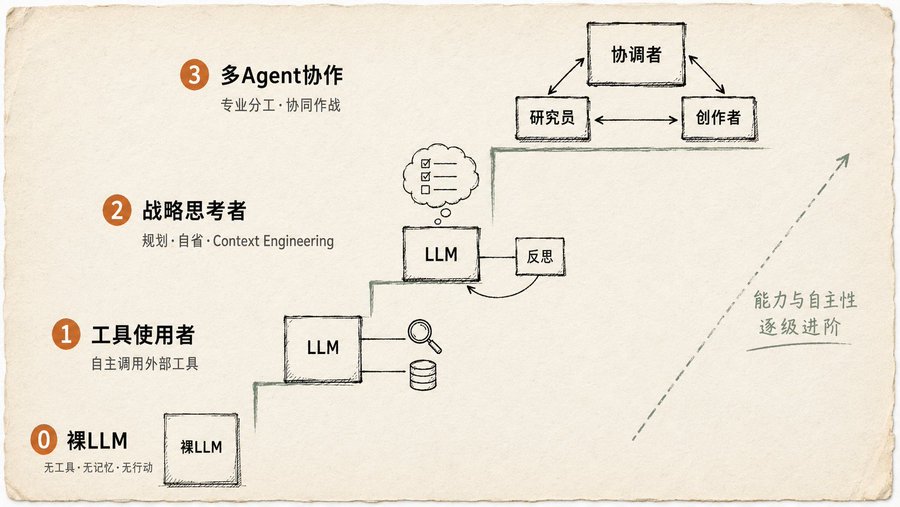
Only the higher levels are true Agents:

  • Level 1: Tool User

    The Agent starts using tools: search, APIs, databases. But it's not just "able to call an interface"; it must decide *when* to call, *what* to call, and *how* to use the result. The book gives a concrete example: a user asks "What are some new TV shows?" The Agent realizes on its own that this information isn't in its training data, actively calls a search tool to find it, then synthesizes the results. The key step is "realizing on its own." It's not a human telling it "go search for this"; it judges *for itself* that a search is needed. This judgment ability is the threshold for Level 1.

  • Level 2: Strategic Thinker

    Adds two more things: Planning and Context Engineering. The book defines Context Engineering: it's not about dumping information, but about carefully selecting, trimming, and packaging context. A great example: a user wants to find a coffee shop between two locations. The Agent first calls a mapping tool to get a bunch of data, then judges that "only street names are needed for the next step," trims the map output into a short list, and feeds it to a local search tool. Every step is about reducing information noise.

    There's a sentence in the book I read several times: "To achieve the highest accuracy from AI, you must give it short, focused, and powerful context." Context Engineering is exactly about doing this.

    At this level, the Agent can also self-reflect. It reviews its own work after finishing, identifies issues, and makes corrections itself. I'll talk about this in more detail later.

  • Level 3: Multi-Agent Collaboration

    The book's stance is clear: stop trying to build one all-powerful super agent. The reliable approach is to build a team: a Project Manager Agent + a Researcher Agent + a Designer Agent + a Copywriter Agent. The example given is for a new product launch: a "Project Manager Agent" coordinates overall, assigning tasks to "Market Research Agent," "Product Design Agent," and "Marketing Agent." The key is communication: how Agents pass data, synchronize state, and handle conflicts. This chapter diagrams six communication topologies, from the simplest single Agent to the most flexible custom hybrids, with explanations for each scenario.

After reading these four levels, I suddenly understood why many people say "my Agent doesn't work well." The model isn't the problem; the problem is you're using it like a chatbot, and it might not even be at Level 1.
Context Engineering: The Book's Most Underrated Concept

I wrote an article about Harness Engineering, discussing how the design of the racetrack is more important than the engine's horsepower. After reading this book, I realized that Context Engineering is the mapping of Harness Engineering at the prompt level.

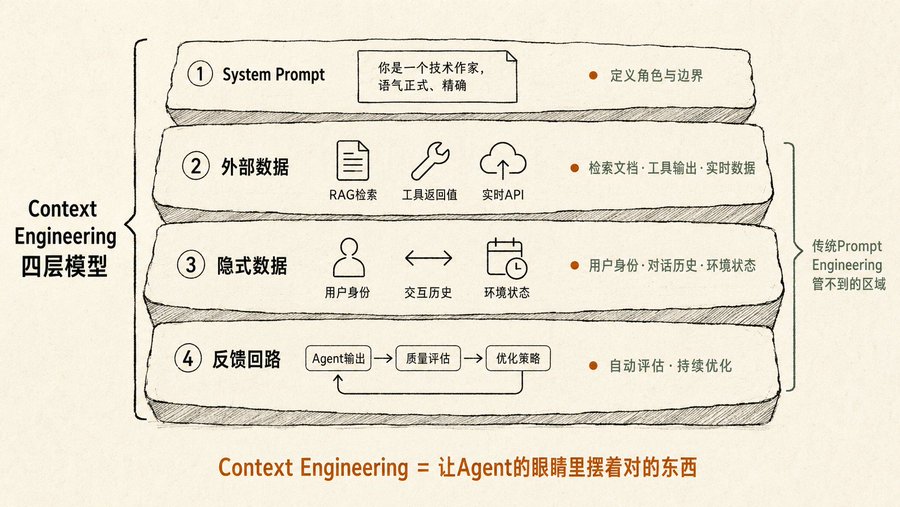
Traditional Prompt Engineering only cares about "how you ask." Context Engineering in the book cares about "what the Agent sees in front of it before it's asked." It includes four layers of information:

  1. First layer, the system prompt. Defines who the Agent is, its tone, its boundaries. Most people only write this layer.

  2. Second layer, external data. Documents retrieved via RAG, return values from tool calls, real-time API data. This is where most people get stuck: they know they need to feed data, but not how to do it without overwhelming the model.

  3. Third layer, implicit data. User identity, interaction history, environmental state. Things you don't explicitly state but the Agent should know. For example, if you tell the Agent, "Help me email John to confirm tomorrow's meeting," it should know what tomorrow's meeting in your calendar is and what your relationship with John is.

  4. Fourth layer, the feedback loop. After each output, the Agent automatically evaluates quality and adjusts the context strategy for next time. The book calls this "automated context optimization." Google's Vertex AI Prompt Optimizer is the engineering implementation of this idea.

When I read this part, I remembered my article "AI Agents Are Not Magic," which included the insight: "Your Agent needs rules, and a lot of them." Looking back now, those rules were essentially a manual version of Context Engineering; the book systematizes it.
Reflection: Two Agents Are Truly Better Than One

This is the pattern with the most practical value for me in the entire book.

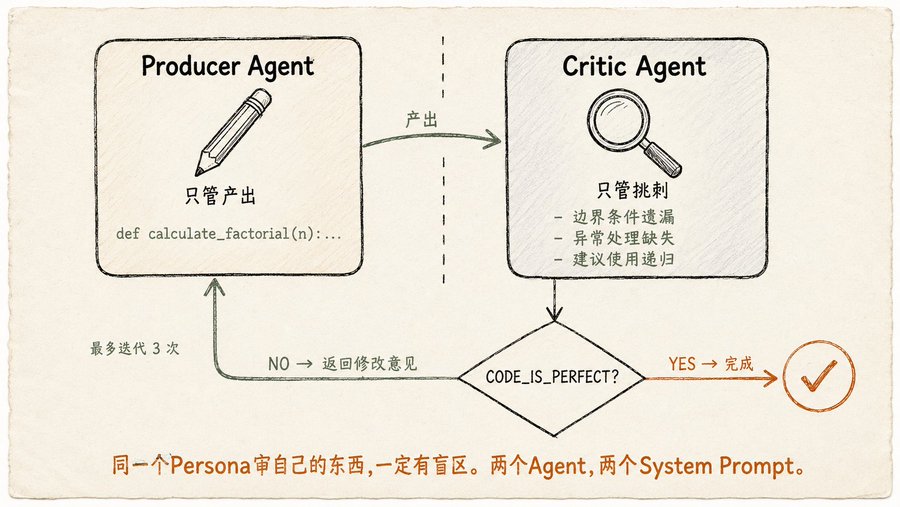
The core of Reflection is simple: after finishing work, the Agent reviews itself, finds problems, and corrects them. But the implementation matters. The book states clearly: The Producer and the Critic must be two different Agents, with different system prompts. The same persona reviewing its own work will always have blind spots. If you let the same LLM write code and then review the code it just wrote, it will most likely say, "It's fine."

The book provides a complete code example.

  • The Producer's prompt is: "You are a Python developer. Write a function to calculate factorial, handle edge cases and exceptions."

  • The Critic's prompt is: "You are a nitpicking senior engineer. Review the code line by line, check for bugs, style, missed edge cases, and areas for improvement. If perfect, output CODE_IS_PERFECT, otherwise list all issues."

  • Then there's a for loop: Producer writes code → Critic reviews → Producer revises based on feedback → Critic reviews again → until Critic says CODE_IS_PERFECT or the maximum iteration count is reached.

It's that simple. But the book warns about a cost issue easily overlooked: each reflection loop is a new LLM call; the more iterations, the more expensive. Also, as the conversation history expands, the context window gets filled with earlier versions and criticisms, reducing the actual reasoning space available. So the best practice for Reflection is: set a reasonable maximum number of iterations (the book uses 3), stop once the Critic is satisfied, don't pursue perfection.

Its uses go far beyond writing code. Writing articles, making plans, summarizing documents, solving logic puzzles—the Producer-Critic model applies everywhere. The book lists seven application scenarios, with the same core logic: produce, review, revise.
Multi-Agent Isn't About Being More Complex

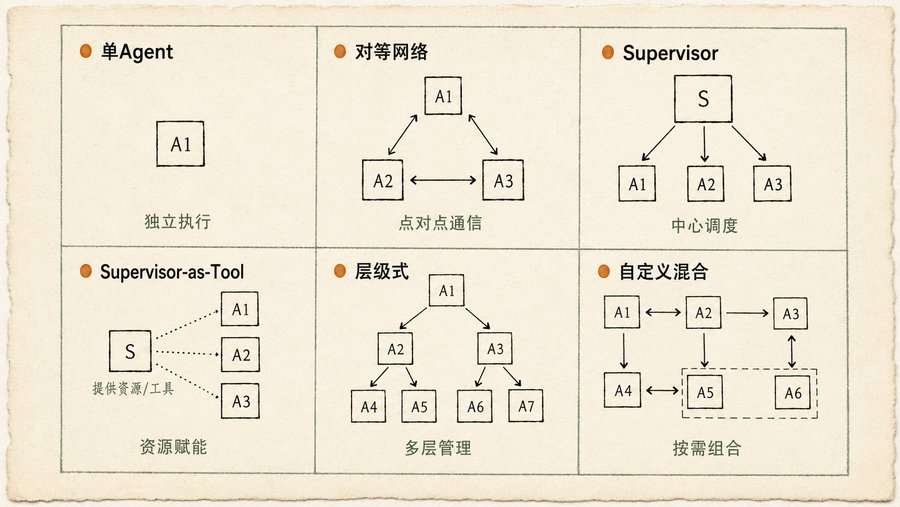
In the Multi-Agent Collaboration chapter, my favorite part is the six communication topology diagrams. Many people start with complex structures, but in reality, three are sufficient for most scenarios:

  1. Single Agent (Independent Execution): The task can be broken down into independent sub-problems, each handled by its own Agent. Simple, easy to maintain.

  2. Peer-to-Peer Network: Agents communicate directly with each other, with no central control node. Decentralized, good fault tolerance—if one Agent fails, it doesn't affect the whole. But coordination costs are high, and it can get chaotic.

  3. Supervisor (Centralized Orchestration): A Supervisor Agent manages a group of Worker Agents. Assigns tasks, collects results, resolves conflicts. Clear hierarchy, easy to manage. But the Supervisor is a single point of failure and a performance bottleneck.

The other three (Supervisor-as-Tool, Hierarchical, Custom Hybrid) are variations and combinations of the first three. The book is very practical: the topology you need depends on your task complexity. The more fragmented the task, the higher the communication cost. At a certain point, the Supervisor pattern becomes more efficient than the hierarchical one.

My takeaway is that many people building Multi-Agent systems spend 80% of their time on communication protocols, forgetting to ask a more fundamental question: does this task *really* need multiple Agents? The book is clear: a single Level 2 Agent with Reflection is often sufficient. Level 3 is for scenarios where a single Agent genuinely can't handle it.
The Three-Layer Memory Model: I Felt It Vaguely But Never Named It

I resonated most with the Memory chapter because when I wrote those two articles about Obsidian + Claude, I kept wondering: how should an Agent's memory be layered?

The book provides the answer:

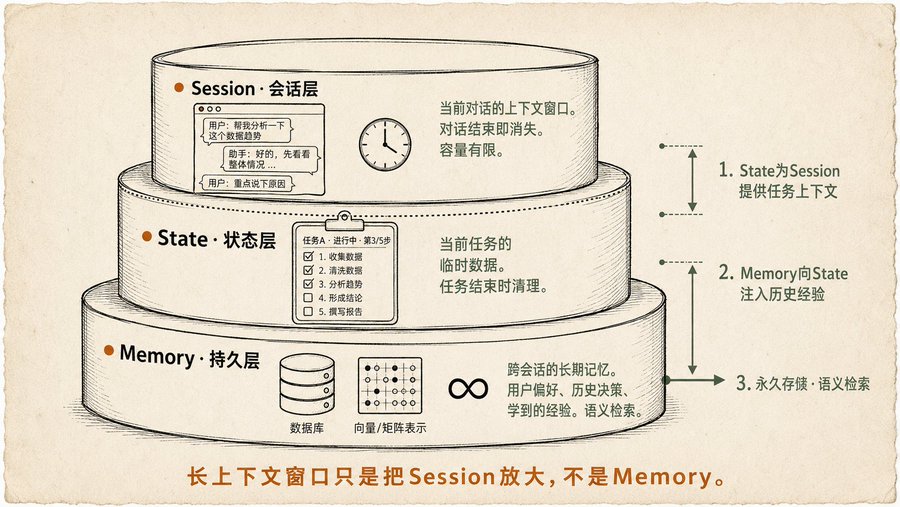
  1. Session (Conversation Layer): The context window for the current conversation. This is the shortest memory; it's gone when the conversation ends. Long-context models simply enlarge this window, but it's still temporary, and each inference has to process the entire window, which is expensive and slow.

  2. State (State Layer): Temporary data during the current task. For example, "what is the ongoing task," "what step has been completed," "what intermediate data has been generated." Longer than Session, but cleaned up when the task ends. The book provides a complete example using Google ADK's State mechanism.

  3. Memory (Persistent Layer): Long-term memory across sessions and tasks. User preferences, learned experiences, important historical decisions, stored in databases or vector stores, retrieved semantically. The book emphasizes an important point: Memory isn't just about storing; you must design a full strategy for *what* to store, *when* to store it, and *how* to retrieve it. Store too much, noise increases; store too little, it's insufficient.

In my previous article about Clawdbot, I mentioned "state files" and "workspace documents," which were essentially handcrafting the State and Memory layers. The book has framed this.
Five Hypotheses, the Fifth Is the Most Outlandish

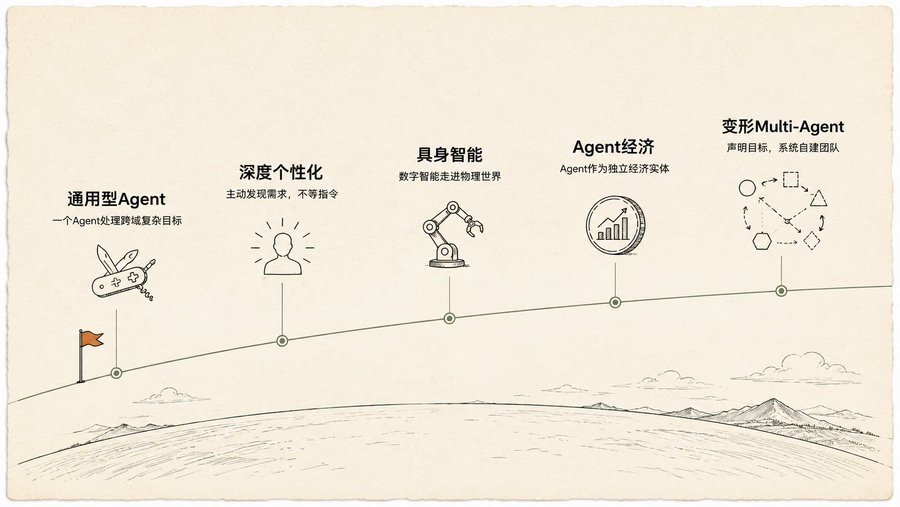
At the end of the book, it presents five hypotheses about the future of Agents. The first four are within reasonable speculation: General-purpose Agents evolve from writing code to managing projects; Deep Personalization proactively discovers your needs; Embodied Intelligence moves from screens into the physical world; Agents become independent economic entities.

The fifth one stunned me: Shape-Shifting Multi-Agent.

You only declare a goal, like "start a premium coffee e-commerce business." The system automatically decides: first create a "Market Research Agent" and a "Brand Agent." After running a round of data, it judges that the Brand Agent is no longer needed, splitting it into three new ones: "Logo Design Agent," "Website Builder Agent," "Supply Chain Agent." If the Website Builder Agent becomes a bottleneck, the system automatically replicates three parallel Agents to work on different pages simultaneously. Throughout the process, the system continuously auto-tunes each Agent's prompts and constantly restructures the team architecture.

The book calls this a "goal-driven, self-transforming multi-agent system." It's not executing a plan you wrote; it's generating the plan itself, adjusting the plan itself, and reorganizing the execution team itself.

This reminds me of Karpathy's AutoResearch: write a program.md, define goals, metrics, boundaries, and press "Launch." Humans are outside the loop. But this book pushes further: even how the Agent team is formed and restructured is left for the system to decide. Humans only declare "what they want."
Three Things You Can Do Immediately

After reading this book, I have three actionable items to implement immediately:

  • First, add a Critic to your current Agent. Whether you use Claude Code, CrewAI, or your own framework, add one step at the end of your existing workflow: have another Agent (with a different system prompt) review the previous step's output. Code generation + code review, article writing + fact-checking, plan creation + feasibility assessment. It's one more LLM call, but the quality improvement is often doubled. The book's Producer-Critic pattern is plug-and-play.

  • Second, start doing Context Engineering, not just Prompt Engineering. Go back and look at your instruction files for the Agent. If they are all rules about "how you should do things" but lack the context of "what environment you are currently facing," add it. Tell the Agent which project it's in, what decisions it made before, what the user's preferences are. The Context Engineering chapter in the book and your AGENTS.md are two expressions of the same thing.

  • Third, don't rush into Multi-Agent yet. Get your single Agent to Level 2 first: with tools, Reflection, and Memory. The book repeatedly emphasizes that a Level 2 single Agent with Producer-Critic and Context Engineering can cover the vast majority of practical scenarios. Level 3 is for truly cross-domain, multi-stage tasks requiring parallel division of labor. Most people's problem isn't having too few Agents; it's that they haven't even tuned one Agent properly.

This book is 453 pages, published by Springer in 2025. Code examples cover LangChain/LangGraph, Google ADK, CrewAI, and the OpenAI API. The foreword is written by Google Cloud AI VP, and there's a surprising and engaging recommendation preface from a Goldman Sachs CIO.

But my reason for recommending it isn't "comprehensive." It's because you'll realize something after reading: the pitfalls you've encountered with Agents in the past six months have been organized into patterns. You don't need to reinvent Reflection, guess how Memory should be layered, or experiment with which communication topology to use for Multi-Agent.

Someone has drawn the map for you. The rest is just walking.

Are you using AI Agents for development? What Level is your current Agent at?

Пов'язані питання

QWhat are the four levels of AI Agent maturity described in the book 'Agentic Design Patterns'?

AThe book describes four levels: Level 0 (Bare LLM, not a real Agent), Level 1 (Tool User), Level 2 (Strategic Thinker with planning and Context Engineering), and Level 3 (Multi-Agent Collaboration).

QAccording to the article, what is the core difference between Prompt Engineering and Context Engineering?

APrompt Engineering focuses on 'how you ask,' while Context Engineering manages 'what is in front of the Agent before it asks.' It involves structuring four layers of information: system prompt, external data, implicit data, and feedback loops to provide the Agent with focused, actionable context.

QWhat is the 'Reflection' pattern, and what is a key practical implementation detail highlighted in the book?

AThe Reflection pattern involves having an Agent review and revise its own work. A key implementation detail is that the Producer (who creates) and the Critic (who reviews) must be two different Agents with different system prompts to avoid blind spots. The process involves iterative loops until the Critic approves or a maximum iteration limit (e.g., 3) is reached.

QWhat are the three main memory layers defined for AI Agents in the book's model?

AThe three memory layers are: 1) Session (the current conversation's context window), 2) State (temporary data for an ongoing task), and 3) Memory (the persistent, long-term storage for cross-session and cross-task information like user preferences and learned experiences).

QWhat are the three actionable recommendations the article author suggests after reading the book?

AThe three recommendations are: 1) Add a Critic Agent to your current workflow for review. 2) Start doing Context Engineering, not just Prompt Engineering, by providing environmental context. 3) Focus on perfecting a single Level 2 Agent with tools, reflection, and memory before rushing into Multi-Agent systems.

Пов'язані матеріали

Three Years Later: Looking Back on My 2023 Predictions for ChatGPT

Looking Back After Three Years: Revisiting My 2023 Predictions on ChatGPT In March 2023, shortly after ChatGPT's debut and before GPT-4's release, I made over twenty predictions about AI's future based on limited information and intuition. Now, in May 2026, I revisited those forecasts using an AI-driven analysis with 41 Opus 4.8 agents to cross-reference them with the latest data. The assessment used symbols: ✅ Correct, 🟢 Mostly Correct, 🟡 Partially Correct, ❌ Incorrect. Overall, the directional judgments held up well, with only one major factual error regarding GPT-4's rumored parameter size (incorrectly cited as 100T). However, nuances and degrees of accuracy revealed more. **What Was Largely Correct:** Predictions about mechanisms and directions proved accurate. The rise of RAG (Retrieval-Augmented Generation) as the standard architecture for combating AI hallucination was confirmed, as was the transformative potential of LUI (Language User Interface) in creating a new industry layer atop GUIs. The emergence of "robot networks" (agent-to-agent communication protocols) and China's rapid catch-up in developing capable large models (closing the performance gap with top models to ~2.7%) were also on point. The analysis affirmed that LLMs lack consciousness and that the Turing Test merely measures perceived intelligence. **What Was Off Target:** Errors often involved specific numbers, over-optimistic timelines, or misjudged distributions. The prediction that value would primarily accrue to the application layer was half-right but missed NVIDIA's dominance as the profitable infrastructure layer. Forecasts about AI circumventing copyright issues and fostering a "global common ground" by averaging human viewpoints were incorrect; instead, major copyright settlements occurred and AI personalization is increasing. Estimates for model training costs ("$5-10 billion cap") were significantly off, underestimating frontier costs and overestimating replication costs. The notion that LLMs could never do complex math without tools was disproven by later models winning IMO gold. **Key Patterns from the Review:** 1. **Direction over precision:** Judgments about mechanisms and trends were more reliable than specific numbers or definitive statements. 2. **Timing bias:** There was a tendency to overestimate short-term speed but underestimate long-term magnitude and transformation. 3. **The distribution blind spot:** Aggregate-level correctness often masked uneven impacts (e.g., on young professionals' employment). 4. **The value of qualifiers:** Predictions framed with caution (e.g., "reportedly," "for now," "prototype in 2-3 years") aged better. 5. **Some debates continue:** Issues like the nature of "emergent abilities" or machine consciousness remain unresolved. This three-year review highlights that while seeing the big picture is crucial, humility regarding specifics, timelines, and disparate impacts is essential for future forecasting.

链捕手16 хв тому

Three Years Later: Looking Back on My 2023 Predictions for ChatGPT

链捕手16 хв тому

AI Bubble Warning: AI Investments Are Negative Returns for Most Tech Giants

The article issues a stark warning about a potential AI investment bubble. It notes that while the AI boom shares similarities with the TMT bubble of the late 1990s, its scale is vastly larger, currently driving 93% of U.S. GDP growth. Major hyperscale cloud providers like Microsoft, Alphabet, Amazon, Meta, and Oracle are planning to invest trillions in AI data centers over the coming years. However, calculations based on analyst projections for 2025-2030 reveal a concerning math problem: expected capital expenditure growth far outpaces projected revenue growth. Even under an extremely optimistic scenario of zero costs, the implied return on investment for most of these tech giants (except Amazon) is deeply negative. This suggests that the current trajectory could lead to one of history's largest shareholder value destruction events. The piece outlines two potential escapes: AI generating vastly more revenue than currently anticipated—a near-impossible task—or a significant cutback in the planned investment splurge. The latter scenario could trigger a domino effect, severely impacting the entire tech supply chain (from Nvidia to TSMC), potentially pushing the U.S. economy into recession, and causing a major stock market downturn. The author suggests upcoming high-profile IPOs by companies like OpenAI and Anthropic might represent a transfer of risk from early investors to public market participants. While the peak of the hype cycle might sustain investment through 2026, the fundamental financial dilemma remains unresolved, setting the stage for a potential market correction in 2027 or 2028, similar to the years following Alan Greenspan's "irrational exuberance" warning.

marsbit1 год тому

AI Bubble Warning: AI Investments Are Negative Returns for Most Tech Giants

marsbit1 год тому

From Tokens to Machine Labor: AI is Shifting from Tool to "Worker"

The article "From Token to Machine Labor: AI is Evolving from Tool to 'Worker'" argues that the business model for AI is shifting beyond simply selling computational resources (tokens, GPU hours) or model access. Instead, a new "machine labor market" is emerging, where the core economic transaction is the purchase of economically useful work directly performed by software. The central thesis is that AI pricing will evolve through four stages: 1) raw tokens, 2) standardized LLM capabilities (e.g., text generation), 3) industry-specific labor markets (e.g., legal review, radiology), and finally 4) a programmable results market where tasks like resolving a support ticket are bid on and priced based on outcome. In this future, buyers will care less about *which* model or GPU completes a task and more about whether the work meets specified standards for accuracy, latency, and cost. This transition reframes the impact of AI on human labor. Rather than simple replacement, it suggests a re-coordination where machines handle standardized, verifiable work, freeing humans for roles involving oversight, context management, responsibility, and final judgment. In some cases, this "last 1%" of human input becomes more valuable as it enables the other 99% to be automated. Furthermore, as AI reduces the cost of work, demand may expand, creating larger markets (e.g., 24/7 customer service) rather than just cheaper versions of existing ones. The article concludes that while infrastructure (GPUs, models, tokens) remains crucial upstream, the market is converging on a simpler, tradeable unit: machine labor that can be defined, measured, priced, and procured based on contractible specifications.

marsbit1 год тому

From Tokens to Machine Labor: AI is Shifting from Tool to "Worker"

marsbit1 год тому

Xiaomi MiMo's 99% Price Cut is Not Marketing! Luo Fuli Posts on X to Refute Critics

The price of Xiaomi's MiMo-V2.5 series API has been permanently reduced by up to 99%, specifically for the "Input (Cache Hit)" cost, which covers users re-reading historical context in long conversations. MiMo's head, Luo Fuli, published a detailed technical blog to clarify that this drastic price cut stems from genuine engineering breakthroughs, not a marketing stunt or a simple price war. The core of the achievement lies in six key engineering optimizations. First, the model architecture adopts a Hybrid Sliding Window Attention (SWA), reducing the memory footprint (KVCache) to 1/7th of a traditional model. Second, a dual-pool memory management system actually utilizes these savings, allowing a single GPU to handle over 5 times more concurrent users. Third, an upgraded prefix caching mechanism achieves a cache hit rate of 93-95% for repeated reads, meaning most such requests bypass GPU computation entirely. Fourth, a self-developed distributed cache (GCache) utilizes idle SSD space on existing GPU servers, eliminating additional storage costs. Fifth, an intelligent scheduling system (LLM-Router) efficiently routes requests to maximize cache reuse and performance. Sixth, Multi-Token Prediction (MTP) accelerates the model's text generation ("output") side. Together, these systemic optimizations dramatically lower the real computational cost per request, enabling the 99% price reduction for cached inputs while reportedly maintaining positive gross margins. Luo Fuli's disclosure aims to shift the narrative from "price war" to a demonstration of substantive AI engineering progress.

marsbit3 год тому

Xiaomi MiMo's 99% Price Cut is Not Marketing! Luo Fuli Posts on X to Refute Critics

marsbit3 год тому

$26 Billion: An 'All-Chinese Team' Backs the World's Highest-Valued AI Programming Company

Cognition AI, the company behind the AI programmer "Devin," has raised over $1 billion in new funding at a valuation of $26 billion, just eight months after reaching a $10.2 billion valuation. The round was led by Lux Capital, General Catalyst, and 8VC. Founded by three young Chinese entrepreneurs with strong competitive programming backgrounds, Cognition initially gained fame with Devin, marketed as the world's first AI software engineer capable of handling tasks from start to finish. While its early demos were impressive, real-world usage revealed reliability and cost-effectiveness issues, leading to a significant price cut for Devin in 2025. A pivotal moment came when Cognition acquired the assets of AI IDE company Windsurf after a failed acquisition by OpenAI. This move gave Cognition a crucial developer-facing tool, allowing it to pursue a two-pronged strategy: Devin for autonomous task execution and Windsurf for integrated, collaborative coding within an IDE. This shift helped the company move away from the controversial "AI replacement" narrative towards a model of augmenting human engineers, particularly for repetitive or maintenance tasks. This strategic pivot is backed by strong commercial metrics. The company reports a 10x increase in enterprise usage this year, with an annual revenue run-rate of $492 million and a 50% month-over-month growth in enterprise Devin usage over the past six months. Its client list now includes major corporations like Goldman Sachs and Mercedes-Benz, as well as government agencies like NASA and the U.S. Army. Investors are betting on Cognition becoming a foundational piece of next-generation software engineering infrastructure, positioning it at the center of a hybrid future where AI agents and human developers work in tandem.

marsbit3 год тому

$26 Billion: An 'All-Chinese Team' Backs the World's Highest-Valued AI Programming Company

marsbit3 год тому

Торгівля

Спот
Ф'ючерси
活动图片





