After UFO Files Released, Why Does Prediction Market Only Price Alien Existence Probability at 20%?

marsbitОпубліковано о 2026-05-09Востаннє оновлено о 2026-05-09

Анотація

Following the official release of over 160 declassified UFO/UAP files by the U.S. Department of Defense, featuring videos, photos, and historical reports from NASA, FBI, and other agencies, public discussion has surged. However, the prediction market platform predict.fun shows measured skepticism. The probability for the event "Will the US confirm that aliens exist before 2027?" remains at only 20%. This is because the market does not trade on the philosophical question of extraterrestrial existence, but specifically on whether the U.S. government will officially and explicitly acknowledge it by the end of 2026. While the document release increases transparency and provides compelling, unexplained cases—like a jellyfish-shaped object over the UAE or anomalies near Apollo missions—it presents historical data without official interpretation or confirmation. The market views this as expanding the pool of evidence rather than providing a definitive conclusion that would compel a governmental statement. The 20% probability reflects a time-discounted assessment, acknowledging potential for future disclosures while doubting a conclusive official acknowledgment within the tight deadline. Thus, the event highlights how prediction markets concretize abstract mysteries into tradable contracts based on verifiable outcomes and specific timelines.

Author | Asher(@Asher_ 0210)
Last night, the U.S. Department of Defense officially launched a UFO archive disclosure website and released the first batch of government documents related to UAPs, unidentified flying objects, and suspected extraterrestrial life. According to public reports, this initial release consists of over 160 documents, including videos, photos, mission records, sighting reports, communication logs, and historical archives, involving multiple U.S. federal agencies such as NASA, the FBI, and the Department of Defense.

This batch of documents is not just abstract government reports; it contains a large amount of specific imagery and historical records. Among them, an Apollo mission spacecraft once captured three anomalous light points suspended above the Moon from lunar orbit, and Apollo 17 communication logs also contain discussions among astronauts about a mysterious object approaching the spacecraft. Another set of materials indicates that unexplained unidentified objects have appeared in places like the United Arab Emirates, Greece, and Iraq.

Even more widely disseminated are the unresolved cases in the files with specific visuals. A jellyfish-like object once appeared over the UAE; some materials document suspected luminous spheres and unidentified flying objects with shapes resembling an eight-pointed star; the U.S. Federal Bureau of Investigation also once captured an anomalous target near a U.S. military aircraft. A picture released by the U.S. Department of Defense also shows that an unidentified object appeared over the western U.S. in September 2025.
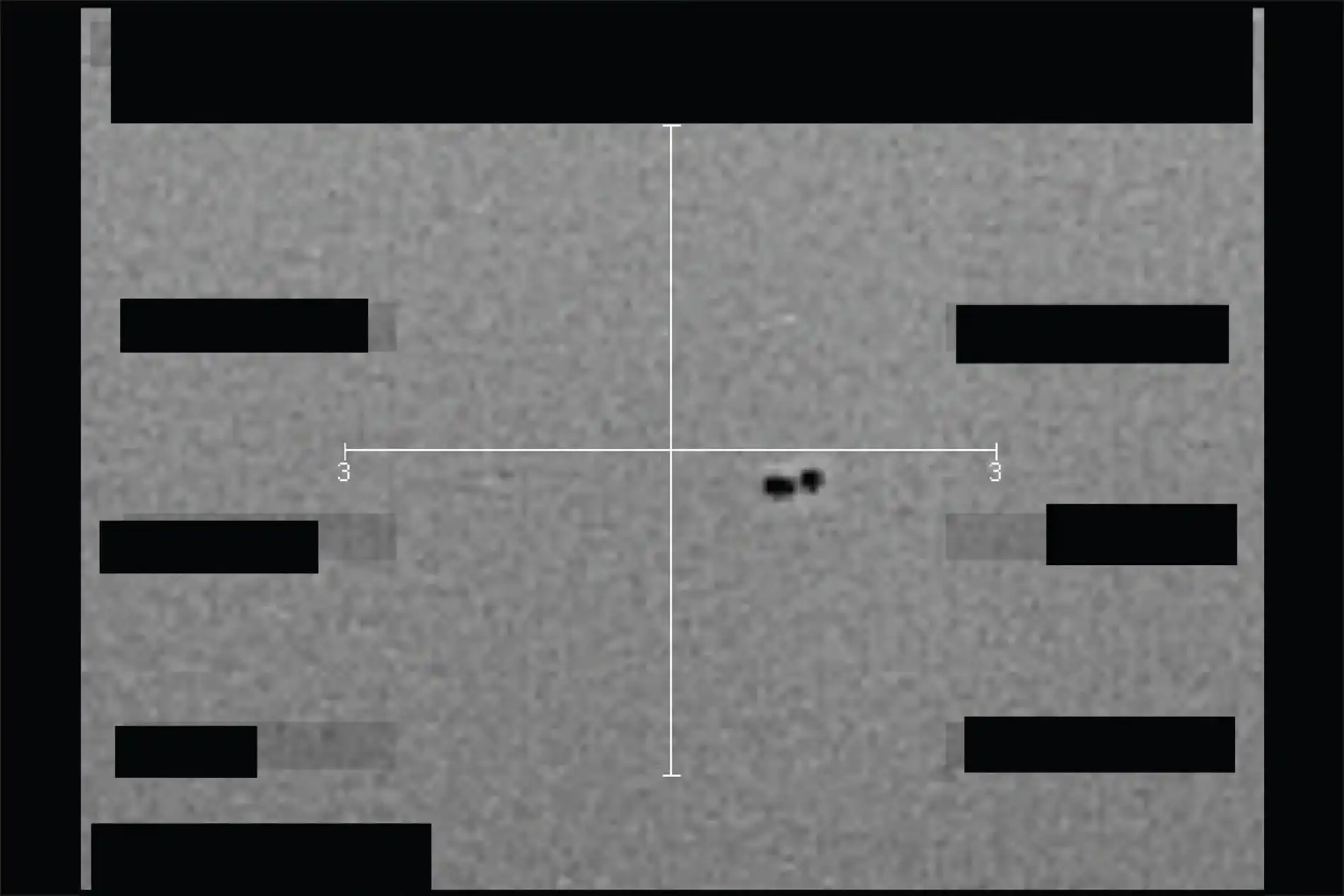
A picture released by the U.S. Department of Defense claims to show an unidentified object appearing over the western U.S. in September 2025 (Source: U.S. Department of Defense)

Compared to mere text reports, these images and eyewitness records are more likely to cause UFO discussions to spread rapidly, making this release appear more like a concentrated display of "declassified archives."

However, the answer given by the prediction market is much cooler than social media. After the initial UFO files were released, the event probability for "Will the U.S. confirm the existence of aliens by December 31, 2026" on the prediction market predict.fun did not surge significantly due to this explosive news. The market did not directly interpret this disclosure as "the U.S. is about to confirm the existence of aliens." The probability remains only 20%.
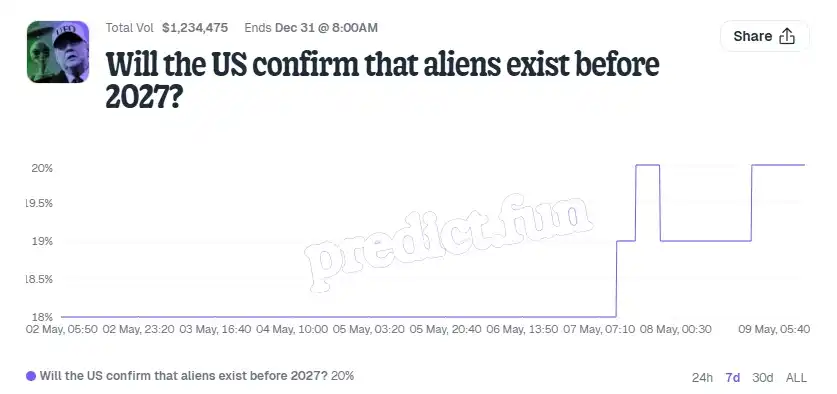
Source: https://predict.fun/market/will-the-us-confirm-that-aliens-exist-before-2027

So, why did this UFO file release not significantly change the prediction market's judgment?

The Prediction Market Bets Not on Whether Aliens Exist, But on Whether the U.S. Government Will Acknowledge It

Upon seeing the 20% probability, many people's first reaction might be that the prediction market believes the probability of aliens existing is only 20%. But this misunderstands the market itself.

Markets like predict.fun do not actually trade on whether extraterrestrial life exists in the universe, but on whether the U.S. government will explicitly confirm the existence of extraterrestrial life or alien technology before 11:59 PM EST on December 31, 2026. According to the market's settlement rules, only if the U.S. President, a member of the U.S. Cabinet, the Joint Chiefs of Staff, or a U.S. federal agency explicitly makes such a statement will the market settle to Yes; otherwise, it will settle to No. The primary settlement sources are official U.S. government information, with reference also made to consensus formed by credible media reports.

This rule is crucial. It means that a video of an unidentified flying object is not enough, a blurry photo is not enough, an astronaut communication log is not enough, and even military acknowledgment that some phenomena are temporarily unexplained is not enough. What can truly trigger a Yes is the U.S. government stating clearly enough, acknowledging that extraterrestrial life or alien technology indeed exists.

File disclosure merely places more materials before the public; official confirmation means the government is endorsing the conclusion. The former generates discussion, the latter triggers settlement. Between them lies a line that is very difficult to cross.

Archive Disclosure Is Not Answer Announcement

This UFO file release is indeed not an ordinary information update. The U.S. Department of Defense concentratedly released relevant materials through a dedicated website and indicated that more files will continue to be released in batches subsequently. For the public, this means that UFO and UAP materials previously scattered across different agencies, eras, and archival systems are being reorganized into an official portal. It makes the discussion more centralized and makes it easier for outsiders to track what materials the U.S. government actually possesses.

However, judging from the currently disclosed content, this batch of files seems more like placing historical sightings, anomalous imagery, mission records, and old archives before the public, rather than providing a unified explanation for these materials. The U.S. Department of Defense did not directly tell the world "what this is," but released more unresolved cases, leaving the judgment space to the public.

This places the release in a subtle position. It increases transparency but does not change the nature of the events. UFO discussions thus gain more material, but these materials primarily expand the questions themselves rather than pushing unexplained phenomena toward extraterrestrial confirmation.

For the prediction market, this file release is more like a new starting point for observation, rather than evidence sufficient to change the odds. It brings the UFO issue back to the main stage and gives subsequent file updates trading value; but the initial materials are still dominated by historical records, sighting reports, and unexplained imagery. What the market is truly waiting for are higher-level, harder-to-ignore signals closer to an official conclusion.

Is 20% an Underestimation or an Overestimation?

From an emotional perspective, 20% might seem low. After all, the release of UFO files has entered an official cadence, with more materials still to be released. If clearer military videos, higher-level internal records appear in the future, or a federal agency provides a more direct judgment, the Yes price could still be rapidly reassessed.

But from a market pricing perspective, 20% is not that low. Because this market trades not on an open-ended question, but one with a clear deadline. What the market must judge is not just whether the U.S. will confirm the existence of extraterrestrial life or alien technology, but also whether such confirmation will happen before the end of 2026.

Time itself is a threshold. Even if files continue to be released, even if more unresolved cases enter public view, it does not mean the U.S. government will complete evidence review, internal coordination, political assessment, and deliver a sufficiently clear conclusion within a few months. For an official system, continuing to disclose materials is one thing; completing a definitive statement within a short timeframe is another.

Therefore, the current 20% probability is more like a tail-priced assessment with a time discount. It does not deny that subsequent files may continue to create volatility, but it also indicates that the market does not believe the initial release materials have fundamentally changed the judgment of the event. For traders, the file disclosure itself is not scarce; what is truly scarce are the key signals that could push for an official conclusion before the end of this year. Before such signals appear, the Yes price is unlikely to be significantly pushed up by archive updates alone.

When UFOs Enter the Prediction Market, Truth Begins to Have a Price

The most noteworthy aspect of this event is no longer just a particular photo, a video clip, or some jellyfish-shaped object. UFO discussions have long lingered between emotion, belief, and conspiracy narratives. Believers see more clues in every file release, while skeptics continue to emphasize insufficient evidence, misidentification, and technical noise. The two sides have argued for years but can hardly truly persuade each other, because they are often not discussing the same question.

The prediction market pulls this issue one step closer to reality. It does not try to answer whether other life exists in the universe, but narrows the question to a more specific level—will the U.S. government explicitly acknowledge the existence of extraterrestrial life or alien technology before the end of this year? It turns what was originally a difficult-to-ground imagination into an event that can be traded, settled, and constantly adjusted with changing information.

So, this ~20% probability is not a final judgment on whether extraterrestrial life exists, but the market's judgment on whether U.S. officials will relent before the end of the year. It truly reflects traders' comprehensive assessment of the evidence chain, official statements, and the time window.

When humanity's oldest mystery enters the prediction market, truth is no longer just awaited and discussed; it also begins to be priced. UFOs may still hang in the sky, but the question of when they will be officially confirmed, when they will turn from unexplained phenomena into factual conclusions, has landed in the betting pool.


Пов'язані питання

QWhat is the event being traded on predict.fun regarding UFOs and aliens?

AThe market is trading on whether the US government will officially confirm the existence of extraterrestrial life or alien technology by December 31, 2026.

QWhy did the market probability only stay at 20% after the initial release of UFO documents by the U.S. Department of Defense?

AThe market distinguishes between the release of historical records and unexplained materials, which expands public discussion, and an official government confirmation, which would trigger a 'Yes' settlement. The release itself did not constitute the required official statement.

QAccording to the article, what specific criteria must be met for the prediction market to settle as 'Yes'?

AFor a 'Yes' settlement, the confirmation must come directly from high-level US officials like the President, a Cabinet member, a member of the Joint Chiefs of Staff, or a federal agency, stating explicitly that extraterrestrial life or technology exists.

QFrom a market pricing perspective, why is a 20% probability for a 'Yes' outcome by the end of 2026 not considered low?

AThe 20% probability factors in a time discount. While more documents may be released, the market assesses that achieving the necessary internal government consensus and definitive public confirmation within a few months is a significant hurdle, making 20% a meaningful 'tail risk' price.

QHow does the article suggest prediction markets change the nature of the UFO discussion?

APrediction markets reframe the abstract debate about alien existence into a specific, tradable event based on verifiable government action. This shifts the focus from personal belief to collective, market-based judgment on the likelihood and timing of an official announcement.

Пов'язані матеріали

Fei-Fei Li's Team Clarifies the Concept of 'World Models', Sora Merely a Renderer

"World Models" has become a widely used yet confusing term in AI. To address this, a team led by Fei-Fei Li and World Labs proposed a functional taxonomy based on the Partially Observable Markov Decision Process framework. This taxonomy categorizes systems called "world models" into three distinct projections: Renderers, Simulators, and Planners. Renderers, like OpenAI's Sora and other video generation models, focus on producing photorealistic visual outputs for human perception. They prioritize visual fidelity over physical accuracy. Simulators, such as NVIDIA Omniverse, aim to compute precise future environmental states for computational tasks like engineering analysis or digital twins. Planners, like Vision-Language-Action models, take in observations and goals to output executable actions for robots or agents. The article clarifies that most current "world models," including Sora, are primarily Renderers. They generate convincing visuals but lack the core ability to simulate state transitions based on actions, a key requirement for a true world model in classic reinforcement learning definitions. This conceptual confusion has practical implications, leading to potential misalignment in technology selection, investment, and public understanding of AI capabilities. Clear categorization is crucial. It helps enterprises avoid costly mistakes (e.g., using a renderer for robot training), allows investors to accurately assess markets, and enables researchers to build comparable benchmarks. While future systems may integrate these functions, recognizing current boundaries is essential for honest assessment and progress.

marsbit21 хв тому

Fei-Fei Li's Team Clarifies the Concept of 'World Models', Sora Merely a Renderer

marsbit21 хв тому

Bloomberg Uncovered: How Do China's Wealthy Circumvent the Annual $50,000 Limit to Transfer Assets?

**Summary: How Wealthy Chinese Circumvent $50,000 Annual Foreign Exchange Limits** Despite China's strict capital controls, including an annual $50,000 per person foreign exchange quota, an estimated $150 billion in funds still leaves the country annually via various gray and underground channels. This report outlines the evolution of China's "capital wall" and the methods used to bypass it. **The Evolving Capital Controls:** * **Foundation (1994):** The system of "current account convertibility with strict capital account controls" was established. * **Quota Set (2007):** The $50,000 individual annual forex purchase limit was formalized. * **Crackdown Begins (2015-2017):** Following market volatility, enforcement tightened. Banks were required to scrutinize transactions, and channels like using UnionPay cards for Hong Kong insurance premiums or buying overseas property were blocked. * **Digital & Legal Upgrades (2024-2026):** Enhanced algorithms now flag suspicious patterns (e.g., "smurfing"). The Common Reporting Standard (CRS) provides Chinese tax authorities with data on citizens' offshore accounts. Unlicensed cross-border brokers have been targeted. **Five Primary Methods for Moving Capital:** 1. **Underground Banking / "Hawala" (Duiqiao):** The largest-scale method. No money crosses borders. Clients pay RMB to a domestic account; an overseas associate deposits equivalent foreign currency into the client's offshore account. Risks include high fees, account freezes, and legal penalties. 2. **"Smurfing" or "Ant Moving":** Using multiple individuals' $50,000 quotas to pool funds for one offshore recipient. Increasingly detected by anti-money laundering algorithms. 3. **Trade Invoice Manipulation:** Businesses over-invoice imports or under-invoice exports via offshore shell companies, creating a pretext to transfer excess funds abroad under the guise of trade. 4. **Channel Migration:** After a crackdown on internet brokers, funds flow toward more compliant but costly channels like major banks' cross-border wealth management services or Qualified Domestic Institutional Investor (QDII) quotas. 5. **Structural Arrangements:** High-net-worth individuals use complex, high-cost legal structures involving offshore trusts, insurance, and investment migration programs to transfer asset ownership. **Regulatory Response: Focusing on People, Not Just Money** The current strategy extends oversight from enterprises to **individual residents**. Tools like CRS allow retroactive visibility into offshore assets. Cryptocurrencies, once seen as a potential loophole, are now actively monitored and prosecuted as an illegal channel. The underlying driver remains: with significant wealth concentrated among millions of affluent households seeking diversification amid domestic economic shifts, the incentive to move assets offshore persists despite regulatory barriers.

marsbit40 хв тому

Bloomberg Uncovered: How Do China's Wealthy Circumvent the Annual $50,000 Limit to Transfer Assets?

marsbit40 хв тому

Торгівля

Спот
Ф'ючерси

Популярні статті

Як купити NIGHT

Ласкаво просимо до HTX.com! Ми зробили покупку Midnight (NIGHT) простою та зручною. Дотримуйтесь нашої покрокової інструкції, щоб розпочати свою криптовалютну подорож.Крок 1: Створіть обліковий запис на HTXВикористовуйте свою електронну пошту або номер телефону, щоб зареєструвати обліковий запис на HTX безплатно. Пройдіть безпроблемну реєстрацію й отримайте доступ до всіх функцій.ЗареєструватисьКрок 2: Перейдіть до розділу Купити крипту і виберіть спосіб оплатиКредитна/дебетова картка: використовуйте вашу картку Visa або Mastercard, щоб миттєво купити Midnight (NIGHT).Баланс: використовуйте кошти з балансу вашого рахунку HTX для безперешкодної торгівлі.Треті особи: ми додали популярні способи оплати, такі як Google Pay та Apple Pay, щоб підвищити зручність.P2P: Торгуйте безпосередньо з іншими користувачами на HTX.Позабіржова торгівля (OTC): ми пропонуємо індивідуальні послуги та конкурентні обмінні курси для трейдерів.Крок 3: Зберігайте свої Midnight (NIGHT)Після придбання Midnight (NIGHT) збережіть його у своєму обліковому записі на HTX. Крім того, ви можете відправити його в інше місце за допомогою блокчейн-переказу або використовувати його для торгівлі іншими криптовалютами.Крок 4: Торгівля Midnight (NIGHT)Легко торгуйте Midnight (NIGHT) на спотовому ринку HTX. Просто увійдіть до свого облікового запису, виберіть торгову пару, укладайте угоди та спостерігайте за ними в режимі реального часу. Ми пропонуємо зручний досвід як для початківців, так і для досвідчених трейдерів.

1.2k переглядів усьогоОпубліковано 2025.12.08Оновлено 2026.06.02

Як купити NIGHT

Обговорення

Ласкаво просимо до спільноти HTX. Тут ви можете бути в курсі останніх подій розвитку платформи та отримати доступ до професійної ринкової інформації. Нижче представлені думки користувачів щодо ціни NIGHT (NIGHT).

活动图片












