After the Secret Meeting, Why Did Trump Aim His Fire at Banks?

比推Опубліковано о 2026-03-05Востаннє оновлено о 2026-03-05

Анотація

President Trump met privately with Coinbase CEO Brian Armstrong, after which he publicly criticized major banks on Truth Social. Trump accused the banks of trying to undermine the pro-crypto GENIUS Act and called for the advancement of the CLARITY Act, arguing that Americans should earn more from their money and that the crypto agenda should not be blocked. The meeting, first reported by Politico, occurred shortly before Trump's social media post, revealing a direct link between the private discussion and his public stance. The key legislative conflict involves a stalled crypto market structure bill. Banks warn that interest-bearing stablecoins could erode deposits and lending capacity, while crypto firms, including Coinbase, argue that the GENIUS Act rightly allows consumers to earn rewards from stablecoin holdings. JPMorgan CEO Jamie Dimon stated that stablecoin issuers paying interest should be regulated like banks, a claim countered by crypto advocates who emphasize that the GENIUS Act prohibits such issuers from lending or rehypothecating underlying funds. Following these developments, crypto-related stocks, including Coinbase (COIN), saw significant gains amid a broader market rally.

Author: CoinDesk

Compiled by: Deep Tide TechFlow

Original Title: Before Trump Slammed Banks, Coinbase CEO Had Just Met with Him Secretly


Deep Tide Introduction: CoinDesk exclusively confirmed a key timeline: Coinbase CEO Armstrong first met privately with Trump, after which Trump publicly criticized banks on Truth Social for obstructing crypto legislation.

This clue directly reveals the lobbying path behind Trump's statement, making the legislative battle between the crypto industry and the banking sector clearer.

Full Text Below:

Key Points:

  • Before publicly accusing banks of undermining the pro-crypto GENIUS Act and calling for the advancement of the CLARITY Act, Trump had a private meeting with Coinbase CEO Brian Armstrong.

  • The meeting was first disclosed by Politico and occurred shortly before Trump posted on Truth Social, stating that banks "need to make a good deal with the crypto industry" to push forward stalled digital asset legislation on Capitol Hill.

  • The crypto market structure bill has stalled because banks warn that interest-bearing stablecoins could erode deposits and lending capacity, while crypto companies argue that the GENIUS Act reasonably allows consumers to earn rewards from stablecoin holdings.

CoinDesk confirmed that U.S. President Trump held a closed-door meeting with Coinbase CEO Brian Armstrong, shortly after which Trump posted on Truth Social, stating that banks are trying to undermine the GENIUS Act.

"America needs market structure legislation done ASAP. Americans should be making more money from their money," Trump wrote in a post on Tuesday. "The big banks are making historic profits, and we won’t allow them to undermine our strong crypto agenda—if we don’t advance the CLARITY Act, all of this will go to China and other countries."

Politico first reported the meeting between Armstrong and Trump. Since then, Trump has publicly supported Coinbase's stance in the "ongoing lobbying battle with banks," a conflict that has stalled a major crypto bill.

The media cited "two people familiar with the matter" as sources, who spoke anonymously to discuss the closed-door event. The report also noted that it remains unclear what exactly the two discussed during the meeting.

However, the report reiterated that "the meeting took place shortly before Trump posted on social media, stating that banks 'need to make a good deal with the crypto industry,'" which is a key point in pushing forward the stalled digital asset legislation on Capitol Hill.

The White House and Coinbase did not respond to CoinDesk's requests for comment.

The market structure bill has been in limbo since the Senate Banking Committee originally scheduled a debate and vote. The core disagreement blocking the bill's passage is that banks believe stablecoin interest rates could impact bank deposits, thereby affecting their lending capacity; crypto exchanges argue that users should have the right to earn rewards from stablecoin holdings, which the GENIUS Act explicitly allows.

JPMorgan Chase CEO Jamie Dimon said on Tuesday that stablecoin issuers paying interest on customer deposit balances should be regulated like banks. Patrick White, Executive Director of the Presidential Digital Asset Advisory Committee, countered this, stating, "What truly requires bank-like regulation is not the act of paying yields on balances itself, but the act of lending or rehypothecating the underlying dollars that make up the balances." White also noted that the GENIUS Act "explicitly prohibits stablecoin issuers from engaging in the latter. Stablecoins ≠ deposits."

Crypto-related stocks surged significantly on Wednesday amid a broad crypto market rebound, with COIN breaking above $200, reaching its highest price since late January.


Twitter: https://twitter.com/BitpushNewsCN

BitPush TG Discussion Group: https://t.me/BitPushCommunity

BitPush TG Subscription: https://t.me/bitpush

Original Link: https://www.bitpush.news/articles/7617080

Пов'язані питання

QWhat was the key sequence of events involving Trump and Coinbase CEO Brian Armstrong?

ACoinbase CEO Brian Armstrong had a private meeting with Donald Trump, shortly after which Trump publicly criticized banks on Truth Social for obstructing the pro-crypto GENIUS Act and called for advancing the CLARITY Act.

QWhat is the main legislative conflict between banks and the crypto industry as described in the article?

ABanks warn that interest-bearing stablecoins could erode deposits and lending capacity, while crypto firms argue that the GENIUS Act reasonably allows consumers to earn rewards from stablecoin holdings.

QHow did Trump's public statement on Truth Social frame the issue between banks and the crypto industry?

ATrump stated that banks are trying to undermine the strong crypto agenda, that Americans should earn more from their money, and that without advancing the CLARITY Act, crypto innovation would move to China and other countries.

QWhat was Jamie Dimon's position on stablecoin regulation, and how was it countered?

AJamie Dimon argued that stablecoin issuers paying interest on customer deposits should be regulated like banks. Patrick White countered that the real need for bank-like regulation is not for paying yield on balances, but for lending or rehypothecating the underlying dollars, which the GENIUS Act explicitly prohibits.

QWhat was the market reaction following the news of Trump's meeting and statements?

ACrypto-related stocks, including COIN (Coinbase), saw significant gains, with COIN surpassing $200, reaching its highest price since late January, amid a broad crypto market rally.

Пов'язані матеріали

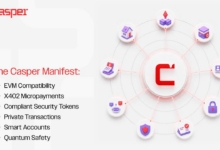
Casper Network Publishes the Casper Manifest, a Multi-Year Roadmap to Power Regulated Real-World Assets and the Machine Economy

The Casper Association has published "The Casper Manifest," a multi-year technical roadmap for Casper Network. Introduced at the Digital Finance Forum in Bermuda, the roadmap outlines nine coordinated initiatives designed to position the layer-1 blockchain as the infrastructure for regulated real-world asset (RWA) tokenization and the machine-to-machine economy. Key initiatives focus on: 1. **Developer Access:** Adding full Ethereum Virtual Machine (EVM) compatibility alongside its existing WebAssembly (Wasm) execution layer. 2. **User Experience:** Implementing gasless transactions, batch operations, and smart accounts with biometric authentication. 3. **Institutional Compliance & Privacy:** Building compliant security tokens aligned with the ERC-3643 standard and a multi-phase roadmap for confidential transactions with built-in audit tools. 4. **Machine Economy:** Implementing the X402 open payment standard to enable AI agents and machines to make autonomous, programmatic micropayments. 5. **Token Infrastructure:** Creating a Native Token Registry to give all tokens protocol-level status with fixed, predictable costs. 6. **Quantum Safety:** Developing hybrid accounts with both classical and quantum-resistant keys. The first initiative, X402 micropayments, is expected within weeks. Subsequent releases through 2026 and 2027 will include EVM compatibility, compliant security tokens, the Native Token Registry, gasless transactions, and quantum-safe features. The goal is to create a blockchain that is frictionless for users, trusted by institutions, and native for machines.

TheNewsCrypto37 хв тому

Casper Network Publishes the Casper Manifest, a Multi-Year Roadmap to Power Regulated Real-World Assets and the Machine Economy

TheNewsCrypto37 хв тому

TechFlow Intelligence: Trump-Linked Companies Transfer $12 Million in Assets Before China Visit, 'The Big Short' Protagonist Warns of Stock Market Bubble Again

The article reports multiple developments across tech, crypto, and finance. In AI, Mozilla used AI for large-scale code review, Google confirmed hackers used AI to find zero-day exploits, and OpenAI deployed GPT-5.5 to find errors in math benchmarks. A court ruled Anthropic's scanning and destroying books for AI training as fair use, while its Claude platform launched on AWS. Google's new video model 'Omni' was leaked. In crypto/Web3, Trump-linked companies transferred $12M in crypto assets before a China visit. BlackRock chose Ethereum for tokenized funds, and a hacker stole $174k via a malicious NFT that tricked an AI. Jack Dorsey's first tweet NFT plummeted from $2.9M to under $5. In chips/hardware, TSMC approved an additional $20B for its Arizona plant. Apple's Tim Cook and Elon Musk will accompany Trump to China, while Nvidia's Jensen Huang is notably absent. For markets, Michael Burry warned of parabolic stock rises and suggested near-total sell-offs, with online discussions comparing current sentiment to the 1999 bubble. Other notes include WTI oil surpassing $100, a 20% price hike for Beijing-Shanghai high-speed rail, and new products like Unitree's $26.9k humanoid robot. The underlying theme suggests AI is becoming infrastructure, creating pressure on old systems while a new order is not yet ready, leaving investors anxious.

marsbit1 год тому

TechFlow Intelligence: Trump-Linked Companies Transfer $12 Million in Assets Before China Visit, 'The Big Short' Protagonist Warns of Stock Market Bubble Again

marsbit1 год тому

Торгівля

Спот
Ф'ючерси
活动图片