After semiconductors lead the gains, are funds buying into AI orders or a macroeconomic rebound?

marsbitОпубліковано о 2026-06-19Востаннє оновлено о 2026-06-19

Анотація

After US-Iran talks led to a temporary ceasefire and framework for reopening the strategic Strait of Hormuz, U.S. stocks rose on June 18, with the Nasdaq gaining 1.9%. The semiconductor and AI hardware sectors outperformed. This rally stemmed primarily from reduced geopolitical risk, which lowered oil prices and inflation expectations, easing discount rate pressure on high-valuation growth stocks like tech. The key question is not whether tech rebounded, but the nature of the rebound. The market appears to be selectively repricing AI infrastructure plays rather than broadly chasing AI narratives. Gains were concentrated in chips, optical interconnects, memory, and domestic manufacturing—segments tied to tangible data center build-outs and capital expenditure. Intel's ~10% surge, fueled by a Trump statement about potential Apple collaboration, exemplifies this mixed dynamic. It reflects policy catalysts and domestic manufacturing sentiment more than confirmed fundamentals. Meanwhile, strong earnings from companies like Astera Labs (revenue up 93% YoY) provided concrete evidence of AI-driven demand in hardware. In essence, the rally represents a risk-premium recalibration. Lower Middle East tensions opened a valuation repair window, and capital flowed first into AI infrastructure segments with visible near-term revenue streams. The sustainability of this move hinges on upcoming Q2 earnings, specifically continued strength in cloud provider capex, AI server orders, and hardwa...

TL;DR

According to reports from AP and Axios, following the framework arrangement reached between the U.S. and Iran regarding the ceasefire extension and the passage of oil tankers through the Strait of Hormuz, U.S. stocks rose on June 18, with the Nasdaq gaining 1.9%. The semiconductor and AI hardware supply chain performed even stronger.

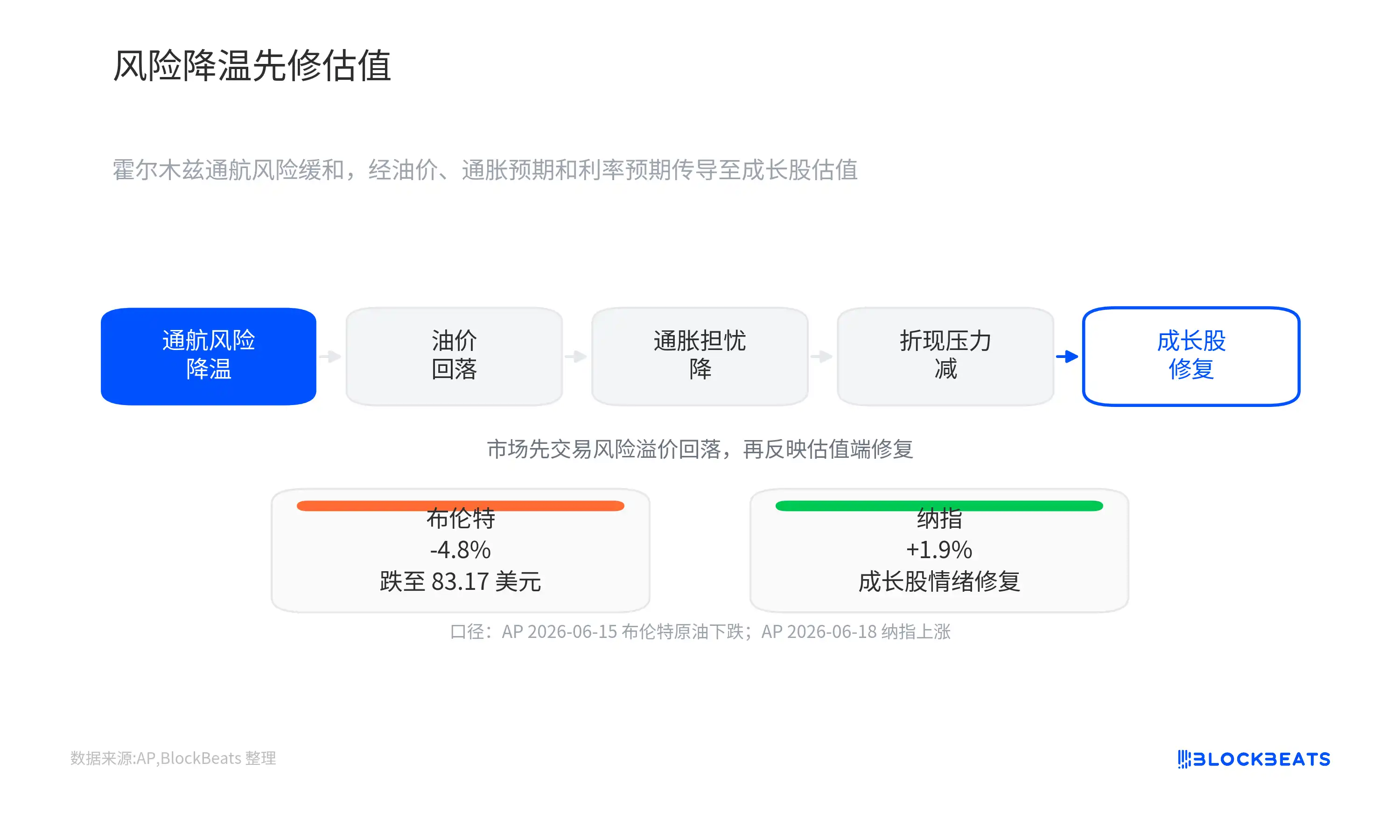
Such geopolitical news impacts technology stocks primarily through oil prices and interest rate expectations. The Strait of Hormuz is a crucial global artery for oil transportation; any disruption can quickly drive up oil prices and inflation expectations. Conversely, if the market trades on 'resumed passage and de-escalating conflict,' the discounting pressure on high-valuation growth stocks will ease.

Easing Middle East risks does not equate to a sudden improvement in AI fundamentals. What it opens up first is a window for valuation repair. What's truly worth watching is which directions funds choose after this window opens. The gains on June 18 were more concentrated not in broad technology stocks, but in chips, optical interconnects, memory, and some domestic manufacturing targets.

Intel was one of the most conspicuous trades that day. According to a Reuters report, Trump stated that Apple would collaborate with Intel to design and manufacture chips in the U.S. Influenced by this, Intel's stock price surged approximately 10%-11%. However, no formal disclosures regarding contract scale, product categories, or mass production timelines have been seen from Apple or Intel yet. This resembles more of an elasticity release driven by policy catalysts and the domestic manufacturing narrative.

Therefore, the core question of this rally is not 'whether tech stocks have rebounded,' but the nature of the rebound. Is the market buying back into AI infrastructure orders, or is it conducting a selective valuation repair by leveraging the de-escalation of geopolitical risks?

Declining Energy Risks First Repair Growth Stock Valuations

For general investors, the Strait of Hormuz can be understood as the 'chokepoint' for global oil transport. Any risk of blockade in this passage can drive up oil prices, pushing inflation expectations higher, and also affecting the Federal Reserve's path and corporate costs. High-valuation technology stocks are particularly sensitive to this chain because their valuations rely more heavily on cash flows many years into the future.

According to an AP report on June 15, Brent crude oil fell 4.8% to $83.17, returning to early March levels. Kiplinger mentioned the same day that WTI crude fell 4.9% to $80.75, its lowest settlement price since early March. Falling oil prices do not mean inflation pressure has been eliminated, but they are enough to reduce market tail-end concerns about energy shocks.

This explains why the Nasdaq and semiconductors gained greater elasticity after the news. They did not rise because of sudden profit changes at individual companies, but were prioritized for rebalancing by funds after the decline in risk premiums.

However, this chain cannot be simply described as 'Hormuz eases, therefore semiconductors rise.' A more accurate statement is that the de-escalation of geopolitical risks provided the external conditions for a rebound in growth assets. Which segments within the tech sector are favored by funds still depends on whether their fundamentals can be verified.
Ranking Within Tech Favors the Hardware Chain

This rally more resembles a re-ranking within technology stocks.

Semiconductors leading the gains indicate the market is not just buying a single leader, but is re-pricing the AI infrastructure chain. However, if one only sees 'chips are up,' it's easy to misjudge it as a full-fledged return of AI trading. More importantly, fund preferences are more concentrated in chip manufacturing, optical interconnects, memory, equipment, and domestic manufacturing.

The underlying change is that AI trading has moved from the early stage of 'the bigger the model, the better; the more GPUs, the better' to a more selective phase. Investors are now asking not whether AI has imagination space, but who can capture real revenue from data center construction.

The attention on optical interconnects and memory is also related to this stage. Large AI clusters cannot run on GPUs alone. Tens of thousands of chips require high-speed data transfer between them; optical interconnects (high-speed transmission in data centers) are akin to building highways for AI clusters. As training and inference demands expand, memory bandwidth, storage capacity, and data movement efficiency will also become bottlenecks.

Astera Labs' earnings report provided the market with a more concrete anchor. The company's Q1 2026 revenue was $308.4 million, up 93% year-over-year and 14% quarter-over-quarter. The company stated that growth was driven by demand for its PCIe 6 product portfolio and AI interconnect-related products. Such data makes it easier for investors to believe that the AI hardware chain is not just about long-term narratives but is already translating into orders and revenue from data center construction.
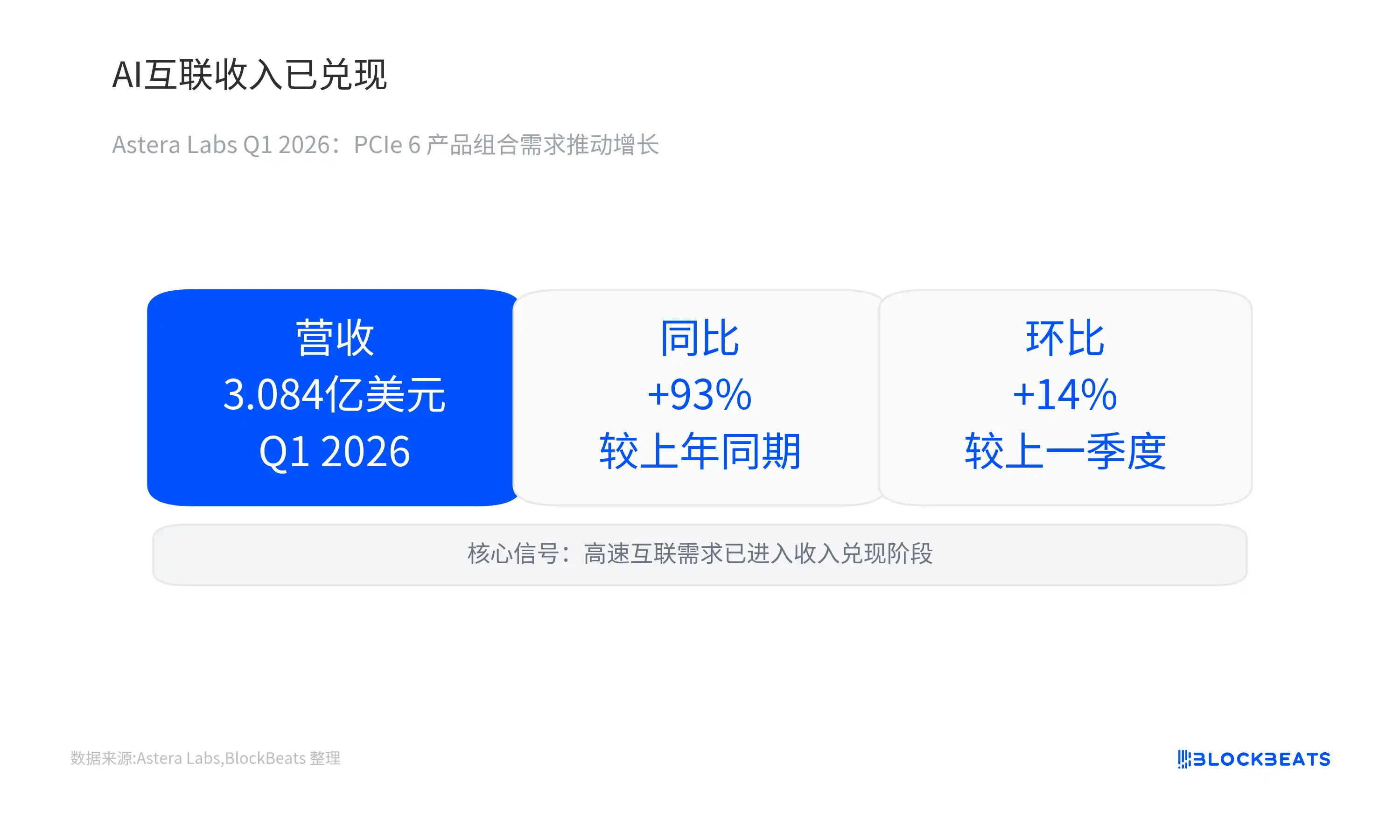
This is also the difference between this round of trading and purely forward-looking tech stories. Public market performance can support chips and tech-related directions leading the gains, but 'which segments funds prioritize buying' remains a market generalization that requires a nuanced understanding. At least from the market action, the recovery in risk appetite has not turned into indiscriminate chasing of all high-valuation assets. Funds seem more inclined to first buy segments that can be verified by earnings reports and capital expenditure.

The Intel Trade Mixes Policy and Fundamental Imagination

Intel's surge is the most prone to misinterpretation.

According to Reuters, Trump stated that Apple would collaborate with Intel to design and manufacture chips in the U.S. This statement directly placed Intel into the narrative of domestic chip manufacturing. For the market, it is not an ordinary customer partnership news but a convergence point of supply chain security, manufacturing reshoring, and U.S. chip policy.

However, this does not mean Intel's fundamentals have already been turned around by the Apple partnership. A more prudent understanding currently is that Trump's remarks provided a policy catalyst which, combined with the recovery in semiconductor risk appetite, amplified the elasticity of Intel as a domestic manufacturing target. How much revenue this collaboration can bring, whether it enters advanced node mass production, the timeline, and gross margin improvements all require clearer information from Apple, Intel, or subsequent financial reports.

This precisely illustrates the divergence in this round of AI hardware revaluation. Policy catalysts can boost attention, orders and revenue can support valuation, and capital expenditure can verify cycle strength. When all three appear simultaneously, stock price elasticity is greatest. However, if there is only policy rhetoric without contract scale and financial contribution, the trade is more easily re-priced as short-term sentiment.

Intel, optical interconnects, and memory correspond to three verification paths respectively. Intel needs to see if policy and customer cooperation can translate into genuine foundry revenue. Optical interconnects depend on whether the scaling of AI clusters continues to push bandwidth demand higher. Memory and storage rely on whether AI server orders continue to drive prices and shipments.
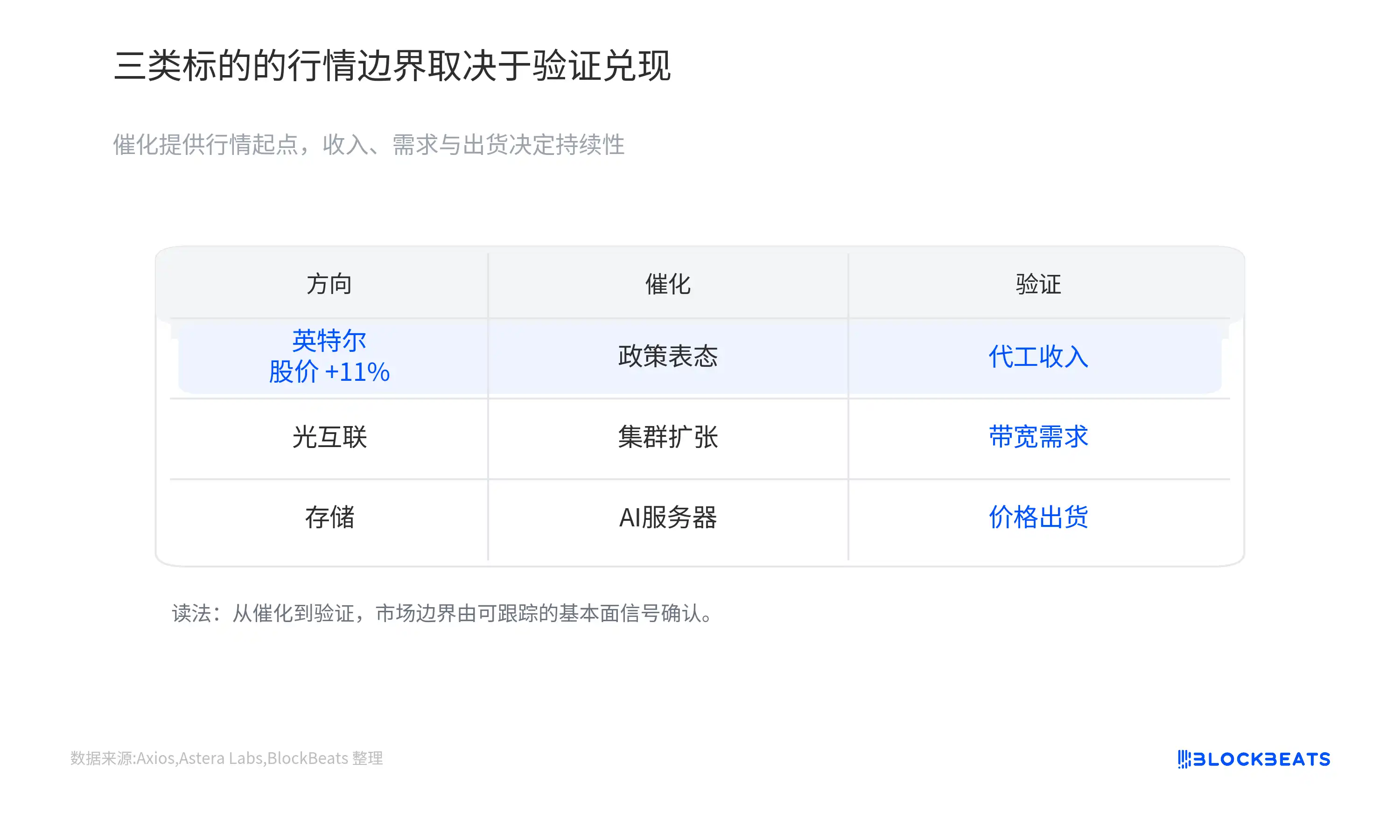
If Q2 earnings reports continue to show robust cloud provider capital expenditure, AI server orders remain high, and revenue guidance from optical interconnect and memory companies continues to grow, this rally will more closely resemble a continuation of the AI infrastructure cycle. If data falls short of expectations, the market may redefine it as a valuation repair following the easing of geopolitical risks.

Orders and Negotiation Progress Determine the Rally's Limits

The biggest misjudgment to avoid now is prematurely writing a short-term window as confirmation of a long-term trend.

The U.S.-Iran framework is still in the preliminary arrangement stage. According to Axios, both sides agreed to a 60-day ceasefire extension framework and may reopen the Strait of Hormuz. The market can trade on risk easing, but this does not mean the Hormuz risk has disappeared. Whether the ceasefire can be sustained, whether passage arrangements are stable, and whether sanctions and nuclear issues disrupt negotiations again will all impact oil prices and risk appetite.

The verification for the AI hardware chain is also straightforward. In the upcoming Q2 earnings reports, investors need to see whether large cloud providers continue to revise capital expenditure upwards, whether AI server order intensity is maintained, and whether revenue guidance from optical interconnect and memory companies continues to show growth. Once capital expenditure begins to be questioned, the elasticity of high-valuation hardware chains will conversely become a source of volatility.

Intel has an additional layer of verification. Trump's remarks are sufficient to trigger trading, but what truly affects valuation is contract scale, product categories, mass production timelines, and profit margins, not the 'Made in America' narrative itself. Policy can provide a pricing window but cannot substitute for financial realization.

This rally is better understood as a selective recovery in risk appetite: the easing of macro risks opened a window, and funds prioritized buying back the AI hardware chain. It weakens the extreme judgment that 'AI trading is over,' but it is not yet sufficient to prove that the AI infrastructure cycle is re-accelerating. The answer is not in a single day's gains but in whether capital expenditure, orders, and profit margins can continue to keep up.


Пов'язані питання

QAccording to the article, what is the core issue behind the rise of semiconductor and AI hardware stocks on June 18th?

AThe core issue is not whether tech stocks rebounded, but the nature of the rebound. The key question is whether the market is buying back into actual AI infrastructure orders or is merely performing a selective valuation repair based on cooling geopolitical risks.

QWhy does a de-escalation of tensions in the Middle East, specifically regarding the Strait of Hormuz, benefit high-valuation growth stocks like semiconductors?

AThe Strait of Hormuz is a critical choke point for global oil transport. Reduced risk there lowers oil prices and inflation expectations, which in turn reduces the discounting pressure on high-valuation growth stocks whose valuations rely heavily on future cash flows. This provides an external condition for a rebound in growth assets.

QWhat specific shift in AI investment focus does the article highlight as occurring in the market?

AThe focus has shifted from the early stage of 'bigger models and more GPUs are better' to a more selective phase. Investors are now asking who can actually generate real revenue from data center construction for AI, leading to increased attention on specific hardware chains like chip manufacturing, optical interconnects, memory, storage, and equipment.

QWhat are the three verification paths mentioned for the re-rating of AI hardware stocks, as illustrated by Intel, optical interconnects, and memory/storage?

A1. Intel: Verification depends on whether policy catalysts and customer cooperation translate into real foundry revenue. 2. Optical Interconnects: Verification depends on whether the scaling of AI clusters continues to drive higher bandwidth demand. 3. Memory/Storage: Verification depends on whether AI server orders continue to drive prices and shipments.

QWhat key information does the article suggest investors should look for in upcoming Q2 earnings to determine if the recent rally is sustainable?

AInvestors should look for whether large cloud providers continue to raise their capital expenditure guidance, whether AI server order strength is maintained, and whether revenue guidance from optical interconnect and memory companies continues to show growth. Capital expenditure trends, orders, and profit margins are crucial for sustainability.

Пов'язані матеріали

Former CFTC Chairman, Circle President Tarbert: Preaching Long-Termism While Cashing Out $30 Million Himself

Former CFTC Chairman and Circle President Heath Tarbert has consistently advocated for a long-term vision in public, urging patience from investors as Circle’s stock price has fallen significantly from its peak. However, it has been revealed that since Circle’s IPO, Tarbert has continuously sold his CRCL shares through pre-arranged trading plans, cashing out approximately $30 million, without making any public market purchases. This contrast between his public messaging and personal actions has drawn criticism. Tarbert joined Circle in July 2023 as Chief Legal Officer, leveraging his regulatory experience to help guide the company through its IPO and expansion. Despite promoting stablecoins as long-term infrastructure, he established a 10b5-1 trading plan just before Circle went public, leading to substantial stock sales over the following year. In March 2026, he initiated another plan to sell more shares. His career trajectory highlights a pattern of moving between high-level regulatory roles and influential positions in the financial sector. After resigning as CFTC Chairman in early 2021, he joined Citadel Securities as Chief Legal Officer just 27 days later, during a period of intense regulatory scrutiny for the firm. He later joined Circle, aiding its efforts to navigate regulatory challenges for its public listing. While Tarbert's expertise in policy and compliance is valuable to companies like Circle, his actions—advocating long-term confidence while personally divesting—raise questions about the alignment between his public statements and his private financial decisions, leaving investors who followed his advice to bear the market risks.

marsbit16 хв тому

Former CFTC Chairman, Circle President Tarbert: Preaching Long-Termism While Cashing Out $30 Million Himself

marsbit16 хв тому

Gate Research Institute: The 'Wall Street-ization' Wave of Crypto Financial Products – Competition or Integration?

The article titled "Gate Research Institute: Are Crypto Financial Products Sparking a 'Wall Street' Wave—Competition or Convergence?" explores the evolving relationship between the crypto ecosystem and traditional finance (TradFi). The piece begins by reflecting on Bitcoin's original 2009 vision of decentralization, disintermediation, and moving away from banks. It then contrasts this with the 2024 landscape, where key crypto assets like Bitcoin are increasingly held through Wall Street products like ETFs issued by giants like BlackRock. The article questions whether this signifies that TradFi is systematically taking over the rights to issue, price, custody, and distribute crypto financial assets. The core argument is that this is not a zero-sum takeover but rather a bidirectional convergence where each side addresses the other's weaknesses. Crypto offers 24/7 global markets, programmable settlement, and open access but lacks compliant channels, institutional-grade custody, deep fiat liquidity, and mainstream distribution. TradFi possesses these but is constrained by legacy systems, limited operating hours, and slow settlement. Two primary convergence paths are highlighted: * **Path A (CEX to TradFi):** Exemplified by Gate, which has progressed from offering tokenized stocks and CFDs to providing direct, real stock trading (US, Hong Kong, South Korea) within its platform, using USDT. * **Path B (TradFi to Crypto):** Exemplified by Robinhood, which has integrated crypto trading, acquired exchanges like Bitstamp, and is moving traditional assets like stocks onto the blockchain via tokenization and its own Layer 2. Both paths are ultimately competing to become the next-generation, unified financial account—a "super account" where users can seamlessly trade cryptocurrencies, stocks, ETFs, RWA (Real World Assets), and tokenized treasury products in one interface. The growth of RWA and tokenized treasuries (e.g., BlackRock's BUIDL) is presented as the asset-layer fusion, providing stable, yield-bearing assets on-chain and acting as a bridge between the two worlds. In conclusion, the "Wall Street-ization" of crypto is framed as a mutual transformation. Decentralized ideals persist in the protocol layer, while at the application layer, a more efficient, global, and accessible unified capital market is emerging from this convergence. The future competition lies not between crypto exchanges and stockbrokers, but between platforms vying to offer the most comprehensive asset coverage, liquidity, and user experience within a single account.

marsbit20 хв тому

Gate Research Institute: The 'Wall Street-ization' Wave of Crypto Financial Products – Competition or Integration?

marsbit20 хв тому

Claude's Major New Feature: Screen Recording + Voice, Distilling Your Skills into AI Tasks in One Click

Claude has introduced a major new feature called "Record a Skill," available for Pro, Max, and Team users. This function, found in the Claude desktop app's CoWork menu, allows users to create reusable AI skills simply by recording their screen and providing voice narration while performing a task. Claude then automatically analyzes the recording and generates a functional Skill. A hands-on test confirmed the feature works seamlessly. Users start recording via the Skills manager, perform their workflow while verbally explaining the steps and logic, and avoid including sensitive information. After recording, Claude processes the content and creates the Skill, which can be saved and later invoked with a slash command (/). This eliminates the need for manual adjustments or writing complex instruction files. The innovation goes beyond mere efficiency. Previously, creating a Skill required writing a detailed SKILL.md file in Markdown—a significant barrier for non-technical users. "Record a Skill" bypasses this by directly capturing both actions and the implicit reasoning shared in the narration. This lowers the barrier to knowledge transfer and automation, addressing a core challenge in corporate knowledge management: the difficulty of getting experts to write and maintain documentation. However, the feature also highlights a shift in the nature of work. A case study from March 2026 showed a freelancer whose five-year client relationship was effectively replaced by a hand-coded Claude Skill automating their content workflow. With the even lower barrier of screen recording, the ability to distill personal expertise into automatable skills accelerates this trend. The "moat" for work is moving from simply knowing how to do a task to mastering tasks that are difficult or impossible to automate.

marsbit25 хв тому

Claude's Major New Feature: Screen Recording + Voice, Distilling Your Skills into AI Tasks in One Click

marsbit25 хв тому

Feeding AI "Noise" Can Also Boost Scores, This Work Enables Positive Transfer with Noise

Feeding "Noise" to AI Can Improve Performance: A Method Enables Positive Transfer from Noise This work, Semi-Supervised Noise Adaptation (SSNA), introduces a Noise Adaptation Framework (NAF) that challenges traditional transfer learning. Instead of requiring a labeled source domain of real data (e.g., images, text), NAF uses randomly generated Gaussian noise as the source. For a target task with C classes, it constructs C noise clusters by sampling from Gaussian distributions. Although this synthetic noise contains no semantic meaning, NAF trains it to form a discriminative class structure in a shared representation space—clustering same-class noise and separating different classes. The key is aligning this learned structure from the noise domain to the real, sparsely labeled target domain. A small number of target labels are still essential to establish the correspondence between noise clusters and actual classes. The training objective combines: 1) supervised loss on the few labeled target samples, 2) classification loss for the noise to build its structure, and 3) a distribution alignment loss (using Negative Domain Similarity) to minimize the gap between the noise and target domains in the shared space. Experiments show significant gains in few-label settings. With just 4 labels per class, NAF with a ResNet-18 backbone improves accuracy over a standard supervised baseline (ERM) by +12.35% on CIFAR-10, +7.61% on CIFAR-100, +4.38% on DTD-47, and +2.74% on Caltech-101. It also benefits fine-grained datasets and scales to ImageNet-1K (with 100 labels/class) and text classification (AG News). NAF can be integrated into existing semi-supervised methods like FixMatch for further gains. Ablation studies confirm the transferred benefit comes from the discriminative structure of the noise, not randomness itself. Collapsing all noise into a single point causes negative transfer, while increasing separation between noise cluster centers improves performance. The amount of noise per class is less critical once a basic structure forms. In conclusion, this work demonstrates that for positive transfer, the semantic content of source data may not be necessary. What can be effectively transferred is the *organizational structure* of categories within a representation space. This offers a promising alternative for scenarios where real source data is unavailable due to privacy, copyright, or procurement constraints.

marsbit26 хв тому

Feeding AI "Noise" Can Also Boost Scores, This Work Enables Positive Transfer with Noise

marsbit26 хв тому

Торгівля

Спот
活动图片