After Privacy Coins Surge, Does It Mean a Bear Market Is Coming?

marsbitОпубліковано о 2026-01-31Востаннє оновлено о 2026-01-31

Анотація

The article explores the sharp rise in privacy coins like ZEC and XMR as a potential signal of an impending bear market in the crypto cycle. Historically, privacy tokens tend to surge when other narratives—such as DeFi or NFTs—lose momentum, often marking a final speculative push before a downturn. In 2017, coins like ZEC and XMR gained attention as "better Bitcoin" alternatives, fueled by technological appeal and hype. By late 2021 and early 2022, privacy projects like Aleo attracted massive investments, though they ultimately failed to deliver practical, mainstream adoption. The recent surge in late 2025, with ZEC rising 20x in three months, lacked clear catalysts but may reflect growing unease with increasing regulatory scrutiny and reduced financial privacy in crypto. While figures like Arthur Hayes and firms like a16z promoted "privacy-as-a-service," the author suggests this may have been a tactic to facilitate sell-offs rather than genuine growth. The piece argues that extreme privacy features—such as Monero’s fully anonymous transactions—often cater to illicit use cases rather than mainstream needs, making them a target for regulators and exchanges. Most users and regulators seek balanced privacy—protection without complete anonymity—which current privacy tokens fail to provide. Without addressing real-world utility and acceptable levels of privacy, these coins may remain the last resort in cyclical market pumps, often leaving investors at a loss.

Author: Eric, Foresight News

Every bull market has its signs of ending. Looking back, among these signs, the sudden explosion of privacy tokens has never been absent.

This recurring phenomenon has the same reason each time: there's nothing left to hype. After all concepts and narratives have been exhausted, the final dance of capital usually chooses "privacy," a topic that has persisted since 2014.

Hype around privacy at the end of a bull market has logical rationality. After experiencing the noise, many people often suddenly realize, in the void of the bull-to-bear transition, what the original intention of Web3 was, then shout about making privacy and decentralization great again—but the result is just another round of speculation.

Although the process is the same, the triggers each time are not entirely identical.

2017 was the heyday of privacy tokens because there were no impressive DApps, and the sector was still in a phase of finding direction. Back then, ZEC, XMR, and DASH were absolute "hot stars," with discussion levels even surpassing Bitcoin. ZEC and XMR were launched with the "technological innovations" of zero-knowledge proofs and ring signatures, respectively, while DASH combined PoW and PoS.
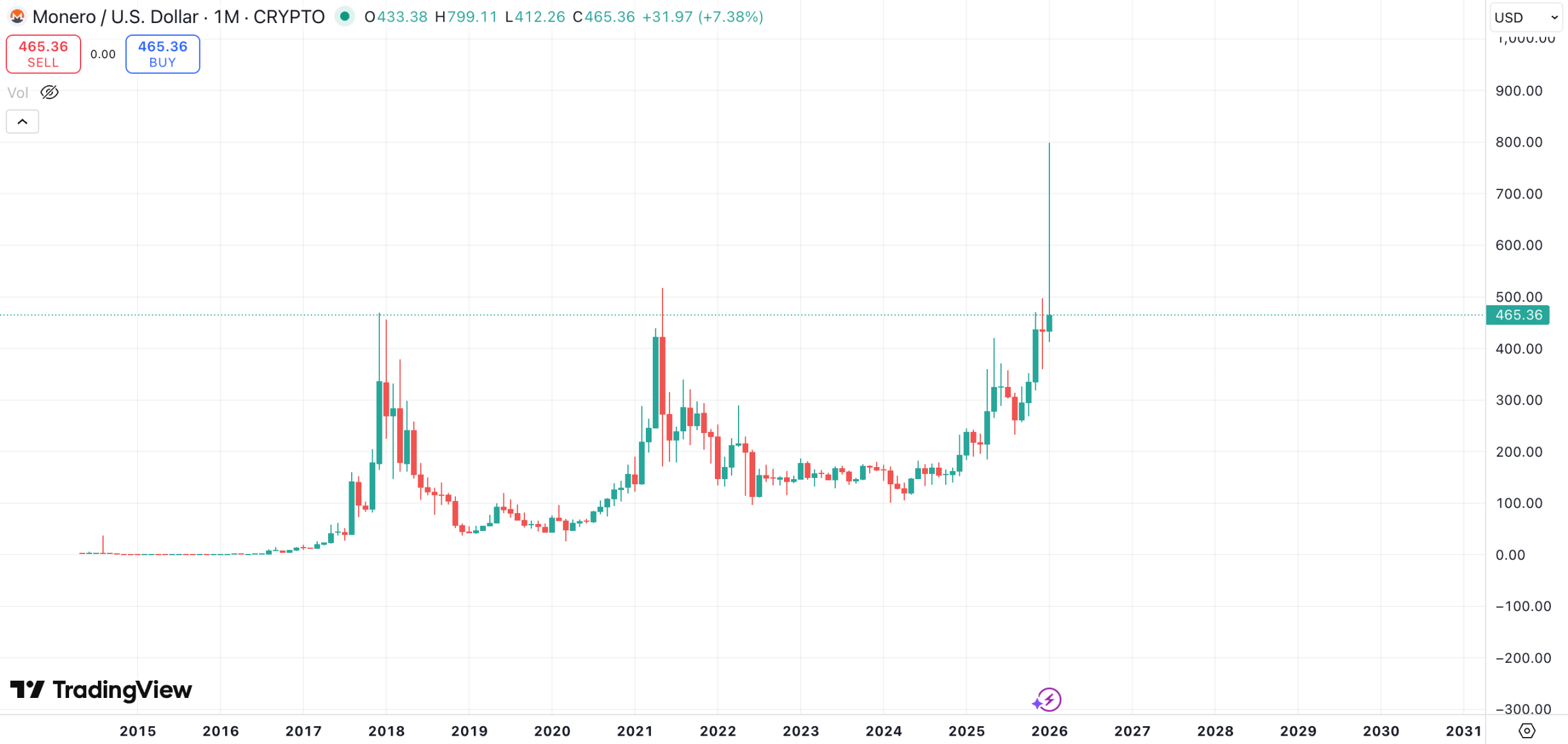
Readers who didn't experience that period might not understand the market's fervor for such tokens at the time. Back then, whether Bitcoin was the absolute core of cryptocurrency was controversial; many such tokens charged ahead under the banner of "better Bitcoin." ZEC's price once surged to $30,000 in early 2018, while Bitcoin's peak price in that cycle was less than $20,000.

Late 2021 and early 2022 were purely about forcing the privacy concept. After experiencing DeFi, NFT, and the metaverse, projects including Aleo received hundreds of millions in funding, with SoftBank, a16z, and Tiger Fund among the investors. The market at that time briefly believed that after the application explosion, privacy could finally move from concept to practical implementation.

Perhaps because everyone was making money and was euphoric, no one truly cared whether privacy was a mass need, or even if there was demand, whether demanders were willing to bear significant costs just to ensure privacy. The result was that it landed—but face-first.

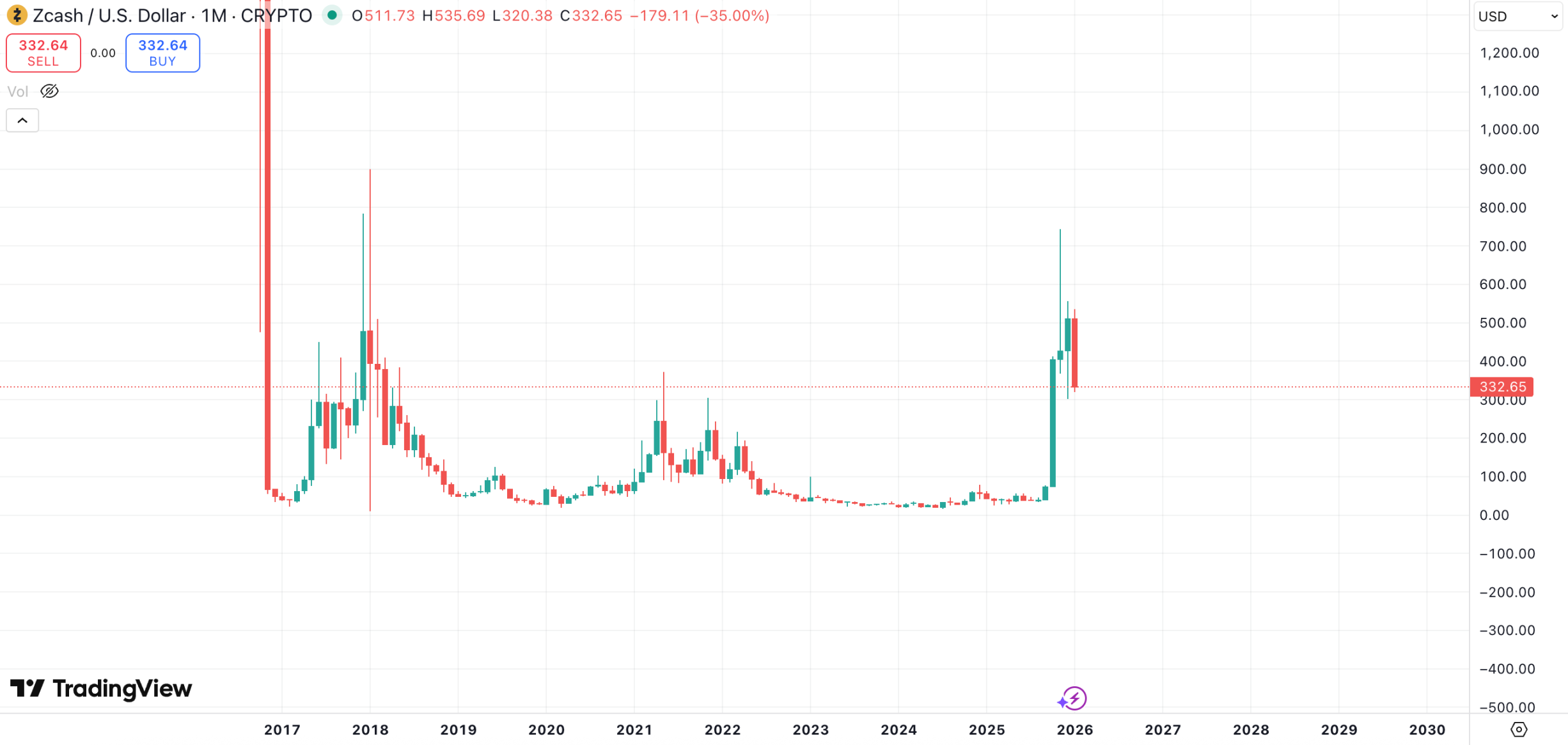
In this cycle, the rise of privacy tokens represented by ZEC began in September 2025. Looking back, it's hard to pinpoint any specific reason at that time to explain why it rose 20 times in three months. If we must find a reason, it might be because it was "not so compliant."
2025 can be said to be the year cryptocurrency was fully legitimized. Multiple countries in Europe and America successively introduced regulatory laws. Even supporting cryptocurrency development couldn't escape scrutiny under regulations like identity verification and anti-money laundering—DeFi was no exception. Thus, although cryptocurrency was no longer considered a security, it essentially wasn't much different from trading securities. Government scrutiny of individuals didn't relax at all; it only temporarily eased regulations on projects and institutions to avoid hindering innovation.

Additionally, the arrest of fraudster Qian Zhimin in the UK, and later the exposure of Chen Zhi whose Bitcoin was confiscated, revealed an open secret: although only you hold the private key, it's not difficult for law enforcement to make you hand it over. When this fact is laid bare again, it might trigger some investors to switch to privacy tokens.

But including BitMEX co-founder Arthur Hayes's shilling and a16z's mention of "privacy as a service" all happened after November. Judging from the price trend, this seems more like cover for dumping rather than driving the rise. XMR might have held on for two more months due to reasons like Iranian officials fleeing with funds or hackers who stole hundreds of millions in Bitcoin converting it to XMR, but it also peaked and fell rapidly.

Although we can't definitively say the bull market is over now, at least at the end of the last bull market, there were no shortage of well-known figures and institutions shilling privacy. The extremely similar plot should at least make us more vigilant.

The privacy concept has persisted from 2014 to today without dying out because it genuinely meets some gray demands, but it conflicts with actual "privacy" needs. In reality, what most people recognize as privacy protection isn't making data completely untraceable, but more about not being easily exposed. In financial transactions, dark pools exist to prevent large capital actions from affecting the market or being targeted by other funds, but this doesn't mean the transaction information itself can't be verified.

The privacy concept in Web3 is sometimes overly extreme. Zcash's privacy transactions are optional, while XMR is private by default—sender, receiver, and amount can't be verified on-chain, which is also the core reason XMR was delisted by over 70 global cryptocurrency exchanges in 2025. For most people, there seems to be insufficient reason to use XMR to hide traces. Moreover, the process of buying XMR itself is traceable; when you buy XMR, you might be suspected of engaging in illegal activities.

Simply put, most people just want their behavioral records protected and respected, not completely hidden; regulatory agencies especially cannot accept channels almost tailor-made for money laundering. With current technology, anonymous on-chain transfers of USDT are also achievable, so there's really not much reason to use a targeted asset just for privacy.

Web3 has been talking about privacy for over 10 years but seems to always avoid the question: "What level of privacy do we actually need?" Without finding real scenarios, privacy tokens may forever be the last bagholders in sector rotation.


Пов'язані питання

QAccording to the article, what is a common sign that a bull market in cryptocurrency might be ending?

AThe article states that a sudden surge in privacy coins is a common sign that a bull market might be ending, as it often represents the 'last dance' for capital when other narratives have been exhausted.

QWhat was the primary reason given for the rise of privacy coins like ZEC in September 2025?

AThe article suggests the main reason was that privacy coins were 'less compliant' with the increasing regulatory scrutiny on mainstream cryptocurrencies, which led some investors to seek assets that offered more anonymity.

QWhy does the author believe the 'privacy' narrative in Web3 is problematic?

AThe author argues that the Web3 privacy narrative is often too extreme, focusing on complete anonymity which is at odds with what most people and regulators actually want—protection and respect for data, not complete untraceability, which is often associated with illicit activities.

QWhat historical example does the article use to show the market's past enthusiasm for privacy coins?

AThe article cites the 2017 bull market where ZEC's price briefly reached $30,000, surpassing Bitcoin's price at the time, due to intense market speculation and the belief that these coins were 'better versions of Bitcoin'.

QWhat fundamental question does the article claim the Web3 privacy space has avoided for over a decade?

AThe article states that the space has avoided the crucial question: 'What degree of privacy do we actually need?', leading to a lack of real-world use cases and making privacy coins the last resort in market cycles.

Пов'язані матеріали

The AI Agent Era Accelerates Its Arrival: Questflow Defines a New Paradigm of Financial Intelligence with On-Chain AI Brokerage

The AI Agent era is accelerating, with the CB Insights AI 100 list highlighting global investment confidence. The focus has shifted from whether AI works to its speed of deployment and ability to manage complex workflows, with autonomous AI Agents driving this transformation. At the forefront is Questflow, a Singapore-based startup redefining financial intelligence through its on-chain AI brokerage. Unlike tools that merely provide data dashboards, Questflow deploys AI Agents that proactively scan markets, form judgments, and execute trades via a conversational interface—operating 24/7 without requiring manual confirmation for each decision. This embodies the new AI paradigm of agents capable of executing multi-step workflows autonomously. Questflow's mission is to democratize institutional-grade trading intelligence. Historically reserved for the ultra-wealthy, this capability is now accessible starting from just $1 through Questflow's "AI Clone + Copy Trade" model. The platform charges only a 1% execution fee, aligning its incentives directly with users and eliminating traditional management or performance fees. The timing is opportune, aligning with key trends identified by CB Insights: the scalable deployment of AI Agents, accelerated AI adoption in financial services, and the maturation of on-chain infrastructure. With robust liquidity on platforms like Hyperliquid and Polymarket, alongside advancements in AI reasoning and non-custodial wallet security, Questflow is positioned to merge the roles of broker, fund, and exchange into a single, accessible platform for millions.

链捕手21 хв тому

The AI Agent Era Accelerates Its Arrival: Questflow Defines a New Paradigm of Financial Intelligence with On-Chain AI Brokerage

链捕手21 хв тому

Why Pricing Social Interactions is Doomed to Fail?

Titled "Why Putting a Price on Social Interaction Is Doomed to Fail," this article critiques attempts to monetize social networks directly through SocialFi models, arguing their inevitable failure stems from a fundamental misunderstanding of media dynamics. Using Marshall McLuhan's theory of "hot" and "cold" media, the author posits that social networks are inherently "cold" media. Their value isn't contained in individual posts but is co-created through user participation, interpretation, and fragmented, ongoing interaction (e.g., replies, shares). This ambiguity and need for user involvement are core to their function. The article asserts that SocialFi projects like Friend.tech failed because introducing real-time, tradable financial pricing (a definitive "hot" signal) into this "cold" environment doesn't add a layer—it replaces the medium's essence. The unambiguous price signal overshadows and nullifies the nuanced, participatory social signal. Users become traders, not participants, and when speculative profits vanish, the underlying social ecosystem—never genuinely cultivated—collapses entirely. This principle extends beyond crypto. The author argues platforms like Twitter have gradually "heated up" through metrics (likes, retweets counts, algorithmically defined value), shifting users from participants to performers and eroding organic engagement. The solution isn't to abandon capital but to manage its entry point. Successful models like Substack, Patreon, or Bandcamp allow capital to "condense" at specific, isolated nodes (e.g., subscriptions, one-time payments) without permeating and "heating" every social interaction. They preserve the core "cold," participatory medium while enabling monetization at designated boundaries. The NFT boom and bust serves as a stark parallel: the ancient "cold" medium of collecting (valued for story, community, gradual accumulation) was rapidly destroyed by platforms that introduced real-time floor prices, rarity scores, and trading dashboards, transforming collectors into speculators and vaporizing cultural value when prices fell. The core lesson: "Liquidity equals heat." Injecting high liquidity and definitive pricing into a "cold" participatory medium doesn't optimize it; it fundamentally alters and destroys its value-creating mechanism. The future lies not in pricing every social gesture but in finding precise, non-invasive points for capital to condense without overheating the entire ecosystem.

marsbit29 хв тому

Why Pricing Social Interactions is Doomed to Fail?

marsbit29 хв тому

Jensen Huang's CMU Speech: In the AI Era, Don't Just Watch, Build

Jensen Huang, CEO of NVIDIA and a first-generation immigrant, delivered the commencement address to Carnegie Mellon University's class of 2026. He shared his personal journey from a humble background to founding NVIDIA, emphasizing resilience, learning from failure, and the responsibility that comes with leadership. Huang framed the present moment as the dawn of the AI revolution, a shift he believes is more profound than previous computing waves. He described AI as fundamentally resetting computing—moving from human-written software to machines that understand, reason, and use tools. This will create a new industry for generating intelligence and transform every sector. While acknowledging AI's potential to automate tasks and displace some jobs, Huang distinguished between the *tasks* of a job and its core *purpose*. He argued AI will augment human capability, not replace humans. The real risk, he stated, is not AI itself, but people being left behind by those who effectively use AI. He presented AI as a generational opportunity for massive infrastructure investment—in chip factories, data centers, energy grids, and advanced manufacturing—that could re-industrialize nations like the U.S. and bridge the digital divide by making computing and intelligent tools accessible to all. Huang called for a balanced approach: advancing AI safely and responsibly, establishing prudent policies, ensuring broad access, and encouraging universal participation. He urged the graduates not to fear the future but to engage with optimism and ambition, reminding them of CMU's motto, "My heart is in the work." His core message was clear: this is their moment to actively build and shape the AI-powered future, not merely observe it.

marsbit1 год тому

Jensen Huang's CMU Speech: In the AI Era, Don't Just Watch, Build

marsbit1 год тому

Торгівля

Спот
Ф'ючерси
活动图片