After Laying Off 30,000 Employees, Oracle Hires a CFO Who Managed Power Plants

marsbitОпубліковано о 2026-04-08Востаннє оновлено о 2026-04-08

Анотація

Oracle, the global enterprise database giant, laid off approximately 30,000 employees, sparking widespread discussion. Shortly after, the company appointed Hilary Maxson as its new CFO with a compensation package of $297 million. Maxson’s background is notable: she spent nearly a decade as group CFO at Schneider Electric, a major energy management firm, and previously worked for 12 years at AES Corporation, a U.S. power company. Her entire career has revolved around the energy sector—managing power plants, grids, and data center energy solutions. This appointment signals a strategic shift for Oracle. After 12 without a dedicated CFO, the company is pivoting from its traditional software business toward cloud and AI infrastructure. Oracle’s cloud infrastructure revenue surged 84% year-over-year, with a capital expenditure budget of around $50 billion this year—almost entirely allocated to AI data center construction. The company has secured massive contracts, including one with OpenAI exceeding $300 billion, contributing to a total backlog of $553 billion. Data centers, especially at the gigawatt scale, require enormous power—equivalent to a nuclear power plant’s output—making energy management critical. Oracle is no longer just a software company; it’s transforming into an energy-intensive infrastructure provider. While Wall Street remains optimistic, the stock has fallen about 24% this year, reflecting investor concerns over this high-cost, capital-intensive transitio...

Author: Curry, Deep Tide TechFlow

The most talked-about layoff news in the tech world recently involves Oracle, the world's largest enterprise database company; most banks and airlines worldwide run its software in their backend systems.

According to CNBC, the company laid off approximately 30,000 employees. A few days later, it appointed a new CFO with a total compensation package of $29.7 million.

30,000 people out, one person in.

Those leaving received severance pay equivalent to a few months' salary on average, while the newcomer's contract alone is worth a year's wages for a thousand people.

This sparked heated discussions on Reddit, with over 6,000 comments. Most are angry that one executive's salary equals that of many workers, feeling the new CFO is overpaid.

Executive pay being multiples or even tens of times higher than that of ordinary employees at major companies is not a new topic. But beyond the compensation itself, what caught my attention is the resume of this new CFO.
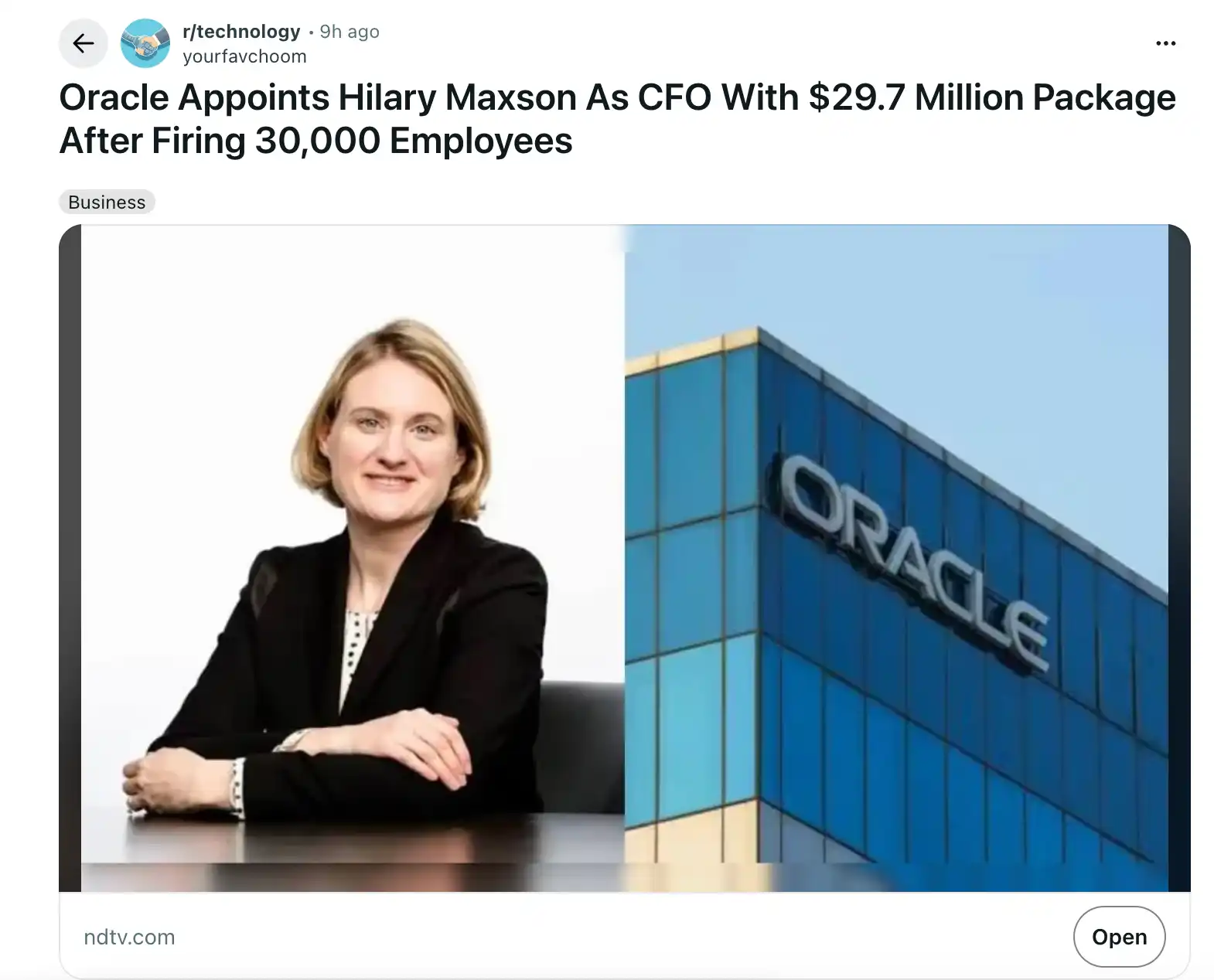
The new CFO is Hilary Maxson.

Before joining Oracle, she was the group CFO at Schneider Electric for nearly a decade. Schneider Electric is one of the world's largest energy management companies, with core businesses in power supply solutions for data centers and grids, generating over $45 billion in annual revenue.

Prior to that, she worked at AES Corporation for 12 years. AES is a longstanding U.S. power company focused on building and managing power plants and grids.

In other words, Oracle spent $29.7 million to hire someone whose entire career has revolved around electricity. She has managed power plants, grids, and companies that supply power to data centers... and now she's been hired as CFO by a company that has sold database software for 47 years?

There's another little-known fact about this choice.

Oracle has not had a dedicated CFO for the past 12 years; finances were managed concurrently by former CEO Safra Catz. According to CNBC, after Catz transitioned to executive vice chairman in late 2025, an interim financial officer temporarily filled the role for half a year.

The fact that the company is now specifically reinstating this position and recruiting from the energy industry is more significant than the salary figure itself.

Bloomberg Intelligence analysts interpret this appointment as a sign that Oracle's growth focus has shifted from databases and software to cloud infrastructure, hence hiring a CFO from an industrial company.

The numbers tell the same story.

According to Oracle's latest earnings report, the company's cloud infrastructure revenue increased by 84% year-over-year. This year's capital expenditure budget is about $50 billion, almost entirely allocated to AI data center construction, more than double last year's amount. To raise funds, the company plans to secure $50 billion through debt and equity financing. The total value of pending contracts has surged to $553 billion, with one deal with OpenAI alone exceeding $300 billion, according to public information.

A company lays off 30,000 people maintaining old businesses and then entrusts money and authority to someone from the power industry. Reading this move, Oracle's management likely no longer sees itself as purely a software company.

But the capital market isn't buying it yet. Oracle's stock has fallen about 24% this year.

Investors' concerns are specific. Oracle historically made money by selling database software and enterprise applications, with high profit margins where people were the biggest cost. But AI is rewriting the business logic; large models can automatically write SQL and manage databases, gradually eroding the technological barrier Oracle has relied on for 47 years.

Oracle's response is to completely change tracks.

Instead of just selling software, it's turning to building data centers for AI companies. According to public information, Oracle previously signed an infrastructure contract with OpenAI exceeding $300 billion, part of the Stargate data center plan; similar agreements exist with Meta and xAI, pushing the total value of pending contracts to $553 billion.

This year's capital expenditure budget is about $50 billion, almost entirely poured into data center construction.
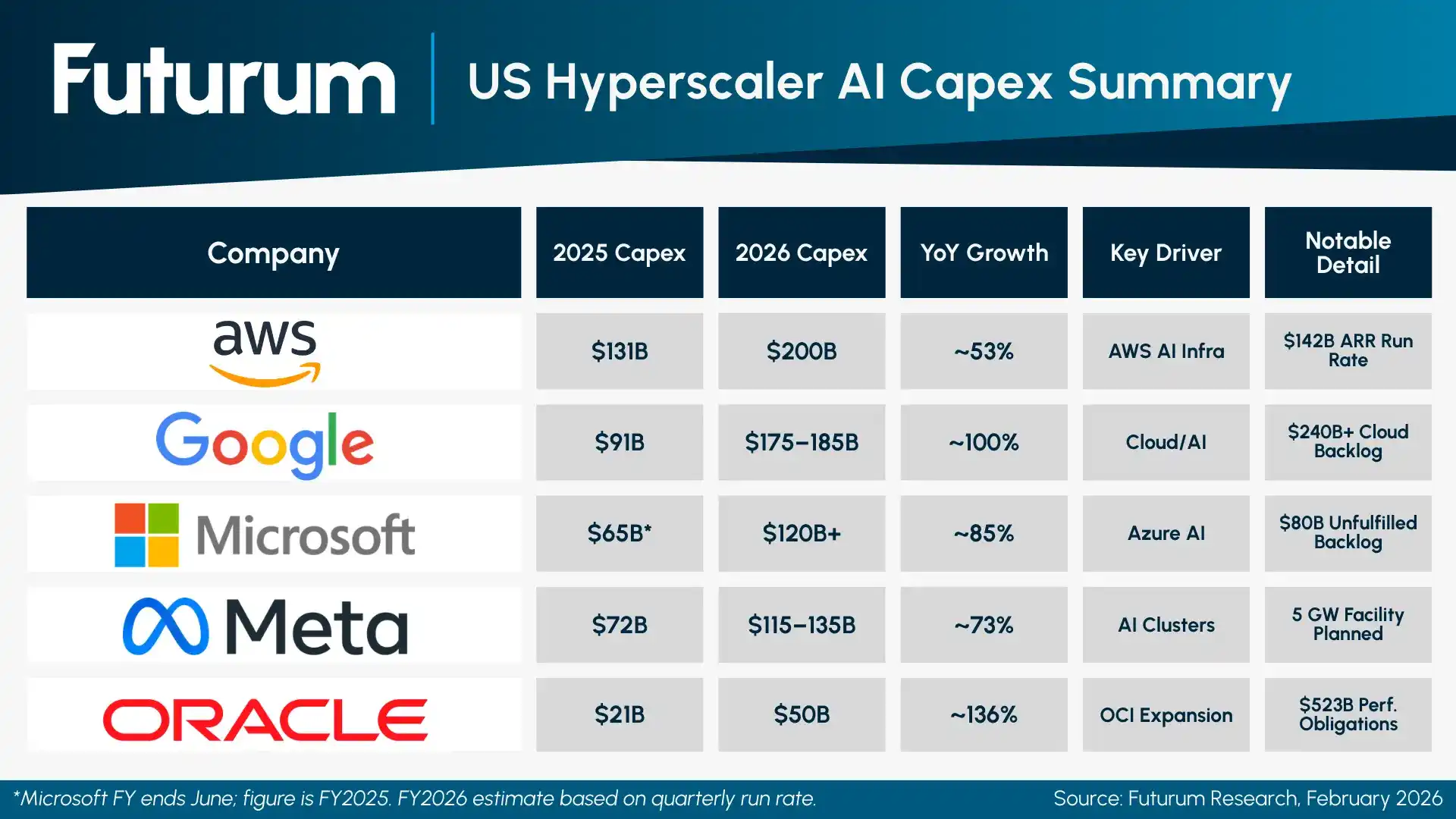
The two biggest expenses for data centers are chips and electricity. Cooling requires electricity, GPU operations require electricity; the annual electricity bill for a large AI data center can reach hundreds of millions of dollars.

Oracle is now building "gigawatt-scale" data center clusters. What is a gigawatt? Roughly equivalent to the output of a nuclear power plant.

This explains why they're hiring from the power industry.

The new CFO has managed power plants, grids, and companies that supply power to data centers. Oracle no longer needs a financial leader who understands software profit rates, but someone who knows how to spend tens of billions building power infrastructure and ultimately make these investments profitable.

Wall Street analysts are currently optimistic; 27 have given buy ratings, with an average target price of $245, implying about a 70% upside potential. But the gap between a 25% stock drop and analysts predicting a doubling hinges on the same question: whether Oracle can truly transform from a software company into an energy infrastructure company.

At least, they've taken a step in terms of personnel structure. Those leaving are people who wrote code for decades; those entering are people who managed electricity for twenty years.

Sometimes, to understand where a company is heading, you don't need to翻 its strategy PPT. Just see who it hires.


Пов'язані питання

QWhy did Oracle hire a CFO from the energy industry, specifically with a background in managing power plants and grids?

AOracle is shifting its focus from traditional software to cloud and AI infrastructure, which requires massive data centers with enormous power demands. The new CFO, Hilary Maxson, has expertise in managing large-scale energy infrastructure and costs, which aligns with Oracle's need to build and operate energy-intensive data centers efficiently.

QWhat is the significance of Oracle's new CFO having worked at companies like Schneider Electric and AES Corporation?

AHer experience at Schneider Electric (managing power supply for data centers and grids) and AES Corporation (building and managing power plants) provides her with critical skills in handling the high energy costs and infrastructure requirements of Oracle's new AI data center projects, which consume power at a scale comparable to nuclear plants.

QHow does Oracle's shift to AI data centers impact its financial strategy and capital expenditure?

AOracle plans to spend approximately $50 billion in capital expenditures, mostly on AI data center construction, doubling last year's budget. This shift requires massive funding through debt and equity financing, reflecting a move from high-margin software to capital-intensive infrastructure investments.

QWhat are the market and investor reactions to Oracle's strategic changes and new CFO appointment?

AOracle's stock has fallen about 24% this year, as investors are concerned about the transition from profitable software to lower-margin infrastructure. However, analysts are optimistic, with 27 giving a 'buy' rating and an average target price of $245, suggesting potential upside if Oracle succeeds in its transformation.

QHow does the appointment of Hilary Maxson reflect Oracle's broader business transformation?

AHiring a CFO from the energy sector, after laying off 30,000 employees mostly from traditional software roles, signals that Oracle is prioritizing infrastructure and energy management over its legacy database business. This aligns with its large contracts with AI companies like OpenAI and Meta, focusing on building power-hungry data centers.

Пов'язані матеріали

Why Bitcoin Holds Above $64,000 After Fed's Hard Pause

**Bitcoin Stabilizes Near $64,000 Following Hawkish Fed Pause** The cryptocurrency market, led by Bitcoin, remained stable around $64,000 despite a volatile reaction to the latest U.S. Federal Reserve meeting. The Fed paused interest rates but signaled a hawkish stance, with three committee members voting for an increase—the highest dissent since 2016. This limits risk appetite but hasn't triggered panic selling. Key market highlights include Bitcoin ETFs seeing a net inflow of $32.1 million, breaking a streak of outflows, while Ethereum ETFs experienced outflows of $18.65 million. Liquidations affected about 90,000 traders. Technically, Bitcoin finds support around $63,000-$63,500, with major resistance near $66,000. While its price is about 49% below its all-time high, institutional demand via ETFs and the absence of mass capitulation support a potential recovery scenario in the second half of the year. Major altcoins showed mixed movements, with Solana attracting capital while Ethereum faced selling pressure despite strong on-chain metrics like a growing staking queue. Regulatory news took a pause as the U.S. Senate delayed the CLARITY Act vote until at least autumn. For the final trading day of July, U.S. inflation and consumer spending data will be crucial. Bitcoin's key levels to watch are $63,000 support and $66,000 resistance. Sustained ETF inflows and Bitcoin holding above $63,000 are seen as positive signs for a potential market recovery later in the year.

cryptonews.ru1 год тому

Why Bitcoin Holds Above $64,000 After Fed's Hard Pause

cryptonews.ru1 год тому

Participants in XRP Fraud Scheme That Stole $9 Million from 71 Investors Arrested

South Korean police have arrested three individuals accused of operating a fraudulent investment platform that stole approximately 3.4 million XRP (worth about $9 million) from 71 investors between October 16 and 23. The suspects promoted the site Fxrpntwork.com through blogs, online articles, and YouTube videos, promising guaranteed principal and monthly returns of 1.5% to 1.8%. Investors were instructed to transfer XRP from Korean exchanges to overseas platforms and then to wallets controlled by the group before the site was shut down. The scammers copied the branding of legitimate projects Flare Network and FXRP to appear credible. Authorities warn that such impersonation frauds, which use familiar branding and urgent promises of guaranteed profits, are a common red flag. Legitimate companies do not solicit cryptocurrency transfers through unsolicited promotions. Seoul police have issued an Interpol Red Notice for a fourth suspect abroad and are investigating others involved in creating and promoting the fraudulent website. While investigators froze 17.3 billion won in assets, approximately 10 billion won was moved during the probe, with wallet analysis revealing transfers totaling 27.3 billion won, suggesting there may be additional unidentified victims and accomplices. The case underscores the organized, cross-border nature of crypto investment fraud.

cryptonews.ru1 год тому

Participants in XRP Fraud Scheme That Stole $9 Million from 71 Investors Arrested

cryptonews.ru1 год тому

Торгівля

Спот
活动图片




