After Analyzing 231 Prediction Markets, We Uncovered the Harsh Truth About ICOs

比推Опубліковано о 2026-01-29Востаннє оновлено о 2026-01-29

Анотація

Analyzing 231 prediction markets on Polymarket for 29 token launches reveals that these markets are not reliable predictive tools but rather contrarian indicators of market sentiment. Despite claims of near-perfect accuracy, the true predictive accuracy one week before market close is only 66.7%, with systematic over-optimism bias. Markets consistently overestimated fundraising amounts and valuations, with FDV predictions averaging a +35% overestimation. High trading volume on Polymarket (>$50M) is a strong bearish signal, often correlating with significant post-ICO price declines. In contrast, conservative predictions and lower trading volume (<$5M) are relatively bullish signals, though most tokens still underperform. Overall, 75% of tokens fell in the first 24 hours, and the average return since ICO is -32.2%, indicating that extreme optimism in prediction markets often precedes poor performance.

Source: LEGION (@legiondotcc)

Original Title: What prediction markets reveal about ICOs

Compiled and Edited by: BitpushNews


Prediction Markets in the Token World

Polymarket's token launch prediction markets have cumulatively processed nearly $2.5 billion in trading volume, with the platform claiming an astonishing prediction accuracy rate—100% for fundraising size predictions and over 90% for valuation predictions. However, in-depth analysis reveals that these figures are severely misleading: the true market signal lies not in "what was predicted correctly" but in "how much was predicted incorrectly."

By analyzing data from 231 prediction markets across 29 token launch events and comparing it with actual token performance from CoinGecko, we found that these markets are not reliable prediction tools but rather contrarian indicators reflecting market sentiment.

Key Findings:

One week before the prediction markets closed, the true prediction accuracy rate was only 66.7%. At critical moments, the crowd was wrong one out of every three times, and the errors systematically showed excessive optimism.

24-Hour Volatility Issue: Using CoinGecko's hourly data, we found that PM's "FDV exceeding X 24 hours after listing" markets were betting on extreme volatility.

Average 24-hour change: ±23% | Best Case: Monad +54.8% | Worst Case: Trove -38.7%.

75% of tokens saw their prices drop within the first 24 hours of listing. PM's 24-hour FDV prediction accuracy rate: only 62.5%.

The Fallacy of Accuracy

When we track how market probabilities change over time, rather than just looking at the final outcome, a different picture emerges. The promise markets appear "100% accurate" because the final data leaks as the sale progresses. Insiders and observers update prices accordingly; this is merely price discovery after the fact.
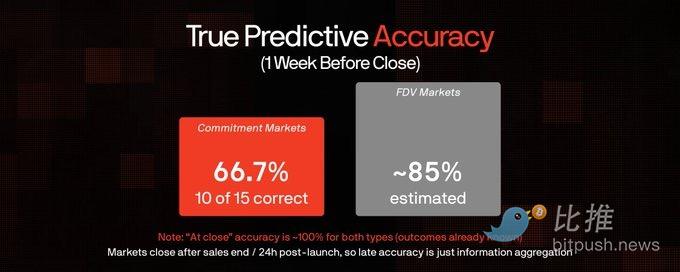
Key Finding:

Both promise markets and FDV markets tend to approach ~100% accuracy at closing because they settle after the outcome is known. Promise markets close after the sale ends; FDV markets close after the 24-hour post-listing period ends. The only meaningful predictive metric is the accuracy rate one week before closing, when genuine uncertainty still exists. The 66.7% promise accuracy rate indicates that, at critical moments, the market was wrong one-third of the time.

Where User Judgment Went Wrong

We examined every market where users had over 60% confidence in an unrealized outcome. In every case, the error was consistently in the same direction: excessive optimism. The crowd consistently believed the fundraising size would be larger and the valuation higher than they actually were.
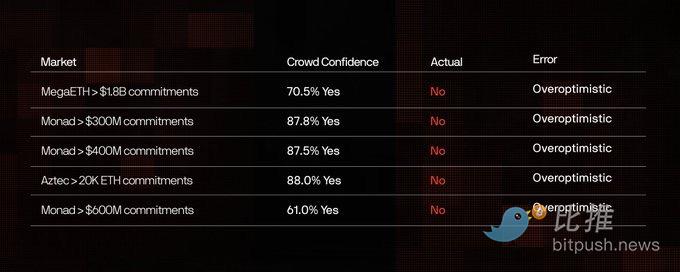
This systematic bias suggests that the participants in these markets are optimistic speculators who are drawn there precisely because they are bullish on the token sales.

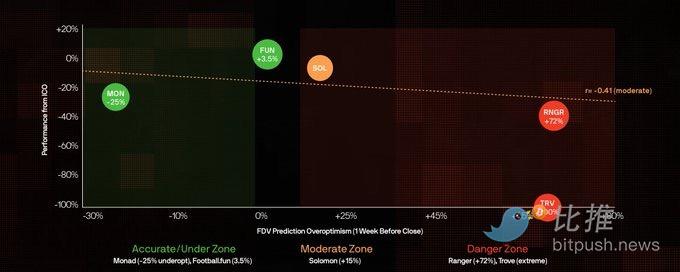
Excessive Optimism vs. Token Performance (Since ICO)

Methodology: This analysis only includes markets that had a public ICO and have issued tokens, using PM odds from one week before closing. Degree of Excessive Optimism = (PM Predicted FDV – Actual 24h FDV) / Actual 24h FDV. The Y-axis shows performance (return) since the ICO.

The data shows a moderate negative correlation (r=-0.41) between the degree of excessive optimism and ICO returns. Monad was undervalued (-25%) but has still fallen -24% since its ICO. Ranger was the most over-optimistically predicted (+72%) and has fallen -32% since its ICO. Only Football.fun remains above its ICO price (+1%).
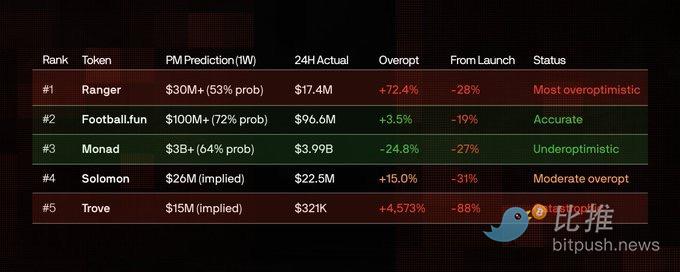
Token Performance Ranking

The table below uses historical PM odds from one week before closing, revealing the true prediction accuracy.

The pattern is clear: extreme excessive optimism foretells disaster, and high PM trading volume is a contrarian indicator even when its predictions are accurate.
ICO FDV vs. Listing Performance

Key Finding: Among tokens with ICO data, 40% listed at a price below their ICO valuation. Average return since ICO: -32.2%. Only Football.fun is trading above its ICO price.
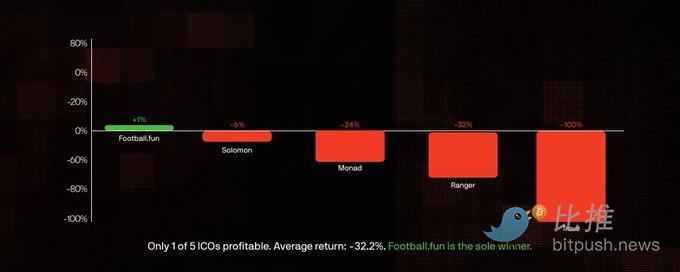
The pattern is starkly clear: Even tokens that listed above their ICO valuation (Monad, Solomon) eventually fell below the ICO price. Among the 5 ICO tokens in this dataset, only Football.fun is currently trading above its ICO price (+1%), making it the sole winner.

Key Conclusions

After analyzing 231 markets, $241.5 million in trading volume, and 8 listed tokens with verified 24-hour FDV data, several conclusions clearly emerge:

1. "100% accuracy" is meaningless. Markets close after the outcome is known (promise markets after the sale, FDV markets after 24 hours), so late-stage accuracy is trivially close to ~100%. One week before closing, the true prediction accuracy of promise markets was only 66.7%. At critical moments, the crowd was wrong one-third of the time.

2. Systematic excessive optimism. Among the top 15 markets, 5 markets showed over 60% confidence in thresholds that were not met. Average FDV overestimation: +35%.

3. High PM trading volume is a contrarian indicator. Monad ($89M) and MegaETH ($67M) had the highest degrees of excessive optimism. The more money the crowd pours in, the more confident they become, and the more wrong they tend to be.

4. Conservative predictions = Better outcomes. Tokens where PM predictions were accurate (Monad, Football.fun) fell less. Low hype and accurate predictions appear to be bullish signals.

Trading Signals

Based on the analysis, we can extract actionable signals for evaluating future token sales. These are not absolutely precise, but they represent patterns that appeared repeatedly in our dataset.
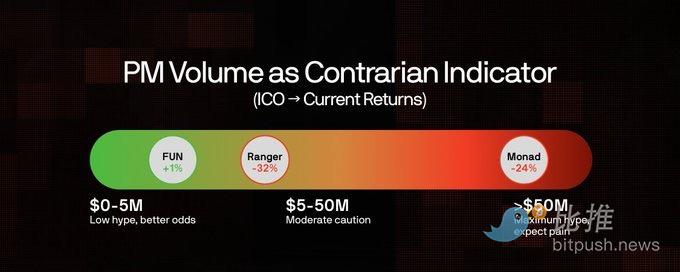
Bearish Signals

  • PM Trading Volume > $50 Million

  • FDV Excessive Optimism > 50%

  • All FDV thresholds likely won't be met

  • Promise Amount Excessive Optimism > 30%

Bullish Signals (Relatively)

  • PM Trading Volume < $5 Million

  • FDV Prediction Error within 20%

  • Multiple FDV thresholds will be met

  • Crowd expectations are conservative

This asymmetry is crucial. Bearish signals are strong indicators of poor outcomes, while bullish signals are relatively weaker—only suggesting that a token might "fall less" than its hyped counterparts. In a market where token prices have generally fallen from their highs, "falling less" is already the best-case scenario.

Ultimately: Polymarket's token sale markets are essentially hype gauges. The true signal lies not in the prediction itself, but in the deviation between the predicted outcome and the actual performance. When public money floods in, betting that valuations will continue to climb, it is wise to be cautious.

History repeatedly proves: when market consensus peaks, it is often the moment when investors experience the most pain.

Data sources in the article: Polymarket CLOB API, CoinGecko, CMC (cross-verified), price data as of January 27, 2026.


Twitter:https://twitter.com/BitpushNewsCN

Bitpush TG Discussion Group:https://t.me/BitPushCommunity

Bitpush TG Subscription: https://t.me/bitpush

Original article link:https://www.bitpush.news/articles/7607105

Пов'язані питання

QWhat is the main finding regarding the accuracy of prediction markets for ICOs one week before closing?

AThe true prediction accuracy of commitment markets one week before closing is only 66.7%, meaning the crowd was wrong one out of every three times during critical periods of uncertainty.

QWhat systematic bias did the analysis discover in the prediction markets?

AThe analysis found a systematic bias of excessive optimism, where participants consistently predicted higher fundraising amounts and higher valuations than what actually occurred.

QAccording to the article, what does high trading volume on Polymarket indicate for an ICO?

AHigh Polymarket trading volume (e.g., over $50 million) is a bearish signal and acts as a reverse indicator, suggesting that the more money the crowd invests, the more confidently wrong they tend to be.

QWhat percentage of tokens in the dataset traded below their ICO valuation at listing?

A40% of the tokens with ICO data in the dataset listed at a price below their ICO valuation.

QWhat is the key takeaway about the relationship between prediction market forecasts and actual ICO performance?

AThe key takeaway is that prediction markets are not reliable forecasting tools but rather gauges of hype. The true signal lies not in the predictions themselves, but in the deviation between those predictions and actual performance.

Пов'язані матеріали

From South Korea to the United States: Blue-Collar Jobs Are Becoming Increasingly Popular, Thanks to AI

AI is reshaping the labor market's value proposition. The traditional four-year college degree is losing its appeal as a guaranteed career path, while skilled blue-collar trades like electricians, welders, and plumbers are experiencing historic demand and wage premiums. This shift is driven by dual pressures: AI's displacement of certain white-collar roles and a booming need for physical infrastructure and data center construction. Data confirms the trend. In the U.S., vocational school revenue surged, and a significant portion of recent layoffs are AI-related. Surveys show a majority of Gen Z adults plan to pursue blue-collar work, citing better job security against AI automation. Vocational education interest has exploded recently. Experts cite a psychological shift as younger generations seek tangible, AI-resistant careers and avoid high student debt. In many cases, salaries for skilled trades now match or exceed those requiring a bachelor's degree. In South Korea, semiconductor vocational high schools boast near-total employment, with graduates securing high-paying roles at companies like Samsung. The shortage is structural, exacerbated by a retiring baby boomer workforce and massive infrastructure projects. Companies like JPMorgan Chase, Meta, and Lowe's are investing heavily in training programs. However, overcoming historical stigma and a "perception gap" around trade careers remains a key challenge to closing the talent gap.

marsbit42 хв тому

From South Korea to the United States: Blue-Collar Jobs Are Becoming Increasingly Popular, Thanks to AI

marsbit42 хв тому

Qualcomm: AI Hype Subsides, When Will Smartphones Emerge from the Gloom?

Qualcomm reported its Q3 FY2026 results (ending June 2026), with revenue of $9.95B, down 4% YoY but above expectations. Gross margin declined to 53.1%, pressured by rising costs across manufacturing and memory. Key business segments showed mixed performance: Handset revenue fell 19.6% YoY to $5.09B, dragged by an 11% decline in non-Apple Android shipments and weaker high-end mix. Conversely, Automotive revenue surged 61% to $1.59B, and IoT grew 9% to $1.83B. Core operating profit dropped 41% YoY due to margin compression and higher expenses. Management's Q4 FY2026 guidance projects revenue of $9.7B-$10.5B, in line with consensus, but Non-GAAP EPS guidance of $2.05-$2.25 fell short of expectations. Amidst persistent weakness in its core handset market, Qualcomm is pursuing growth in AI, focusing on Edge AI (smartphones, PCs, automotive) and Data Center AI. Its data center strategy includes four pillars: AI accelerators (e.g., AI200), commercial CPUs (Dragonfly C1000), custom silicon, and connectivity solutions. While these initiatives initially boosted its stock, concerns over AI capital expenditure sustainability have since erased those gains. The company targets $5B in data center revenue for FY2027 and $15B for FY2029. The report concludes that with the traditional handset business still under pressure, the data center opportunity is currently viewed as a longer-term option, and a more conservative valuation based on core operations may be warranted until AI contributions materialize.

marsbit46 хв тому

Qualcomm: AI Hype Subsides, When Will Smartphones Emerge from the Gloom?

marsbit46 хв тому

From TPU to Self-Evolving Agents: How Jeff Dean Predicts the Next Step in AI

At the 2026 YC Startup School, Jeff Dean outlined his vision for AI's next phase, shifting focus from simply scaling models to building intelligent, autonomous systems. He believes AI's progress is no longer just about creating smarter models, but about integrating them into systems capable of long-term, iterative work, automated experimentation, and continuous learning. This evolution moves the competition from "who has the bigger model" to "who can best organize intelligence." Dean suggests AI capabilities are now comparable to a junior engineer, enabling the automation of complex workflows. However, the true challenge and opportunity lie in managing these AI "workers" at scale. He emphasizes the importance of **context engineering**—structuring tools, memory, and feedback loops—over raw model power. For startups, this means building deep expertise in niche domains where general models currently fail (near 0-1% success rates), leveraging proprietary data, specialized tools, and domain-specific evaluators. A recurring theme is re-examining fundamental constraints. Dean's past work, like moving Google's search index to memory or creating the TPU, stemmed from questioning outdated assumptions about hardware and cost. He sees similar inflection points today, particularly in **specialized inference hardware** to drastically reduce latency and energy consumption for real-time Agent operation. Notably, he points out that in modern AI systems, the dominant cost is often not computation but **data movement**. Reliable, long-running Agents require robust system design, borrowing concepts from distributed computing like checkpointing, state management, and parallel exploration to handle failures and maintain progress over days or weeks. As AI automates execution, the scarcest human skills will shift to **defining clear specifications**, **judging what problems are worth solving** (taste), and designing effective feedback loops. Ultimately, Dean's framework prioritizes understanding the problem deeply, identifying the true bottlenecks, and systematically building closed-loop systems where AI can not only perform tasks but also improve AI itself.

marsbit46 хв тому

From TPU to Self-Evolving Agents: How Jeff Dean Predicts the Next Step in AI

marsbit46 хв тому

Торгівля

Спот
活动图片





