Ads During the American Super Bowl Look Like Scams

marsbitОпубліковано о 2026-02-12Востаннє оновлено о 2026-02-12

Анотація

The 2026 Super Bowl, often called the "American Super Bowl," was a spectacle of sports, entertainment, and high-stakes marketing. This year’s event featured three notable incidents that highlight the intersection of prediction markets, insider information, and viral marketing. First, a newly created account on the prediction market Polymarket placed nearly $80,000 in bets—with 17 out of 19 wagers correctly predicting details of the halftime show, including appearances by Lady Gaga and the absence of Travis Scott. The account’s near-perfect accuracy led to suspicions of insider trading, possibly linked to the event’s production team. Second, a trader named Alex Gonzalez ran onto the field during the game with promotional messages painted on his body. Reports indicate he had previously bet on such a field invasion occurring, after accounting for legal fees and bail, netted around $70,000. His actions blurred the line between predicting and creating events for profit. Finally, a viral “leaked” video showed influencer Logan Paul apparently betting $1 million on Polymarket during the game. It was later revealed to be a marketing stunt orchestrated by Polymarket itself, in which Paul has investment ties. Together, these events illustrate how prediction markets can be manipulated through insider knowledge, performative acts, and staged publicity—raising questions about authenticity in high-profile events.

This year's "American Super Bowl" once again captured the world's attention, much like previous years. The game itself, Mr. Beast's one-million-dollar bounty puzzle game, the halftime show... A sports event that was originally popular only in the United States has attracted global attention thanks to numerous entertainment and cultural elements.

Before we begin, let's experience just how lively the American Super Bowl is from a first-person perspective:

Amidst this density of attention, three viral events perfectly illustrate our expectations for prediction markets: an insider with a perfect winning rate betting on the halftime show performers on the prediction market Polymarket, a "fanatic fan" arrested on the spot, and a viral video of a major influencer secretly filmed using a prediction market that was later revealed to be a marketing stunt.

The "Perfect Win Rate" of Prediction Markets: New Account Achieves Extremely High Win Rate Betting on Halftime Show Lineup

Approximately 48 hours before the Super Bowl kickoff, nearly $80,000 was deposited into a newly registered account on the prediction market Polymarket. Subsequently, this account concentrated all its funds on bets related to the halftime show performers and setlist events, covering multiple specific predictions such as Lady Gaga performing and Travis Scott not performing, totaling 19 prediction bets.

After the halftime show concluded, 17 of these 19 bets hit, yielding a profit of $17,600. A new account, heavily concentrated on a single event, with a near-perfect hit rate. This goes far beyond just good luck.
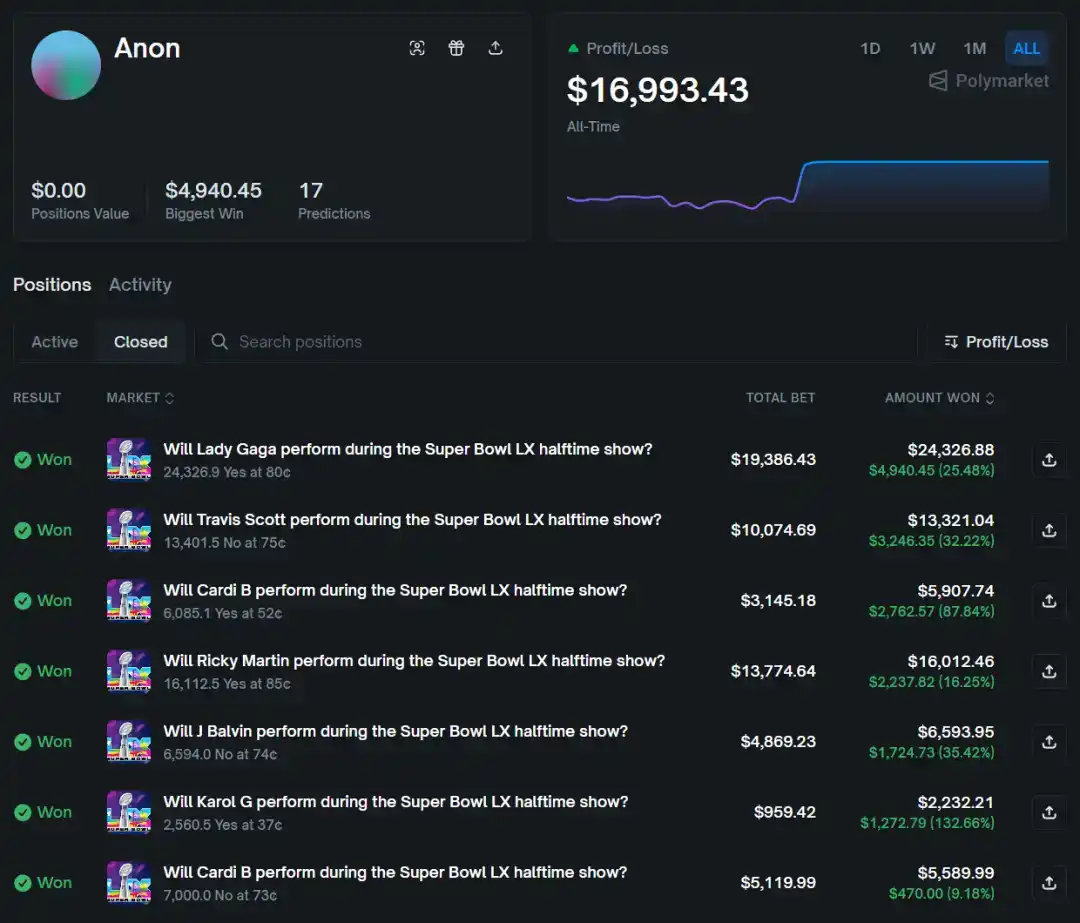
Since the Super Bowl halftime show has long been planned and produced by the company Roc Nation, the community quickly began to speculate that the account holder likely had access to insider information, or was even connected to the production team. In an event with trading volume exceeding ten million dollars, while ordinary traders were placing blind bets, this insider was perhaps holding the setlist in their left hand and locking in profits with their phone in their right.

However, the anonymous nature of blockchain also means this remains merely speculation. This transaction has become another classic case study defining prediction markets as a means for insiders to monetize information asymmetry.

Trader Bets "Someone Will Rush the Field" and Then Rushes the Field

If the insider trader was profiting from information asymmetry in the shadows, then the move by a "fan" during the game was an open stratagem. He is also the protagonist in the video at the beginning of our article.

In the fourth quarter of the game, a shirtless fan climbed over the barrier and rushed onto the Super Bowl field. Instantly, all cameras and the television broadcast focused on this intruder. His bare chest was painted with body paint, his front reading "Trade in the blind spot," and his back displaying his account ID "@fxalexg" and the advertisement "Trade with Athena."
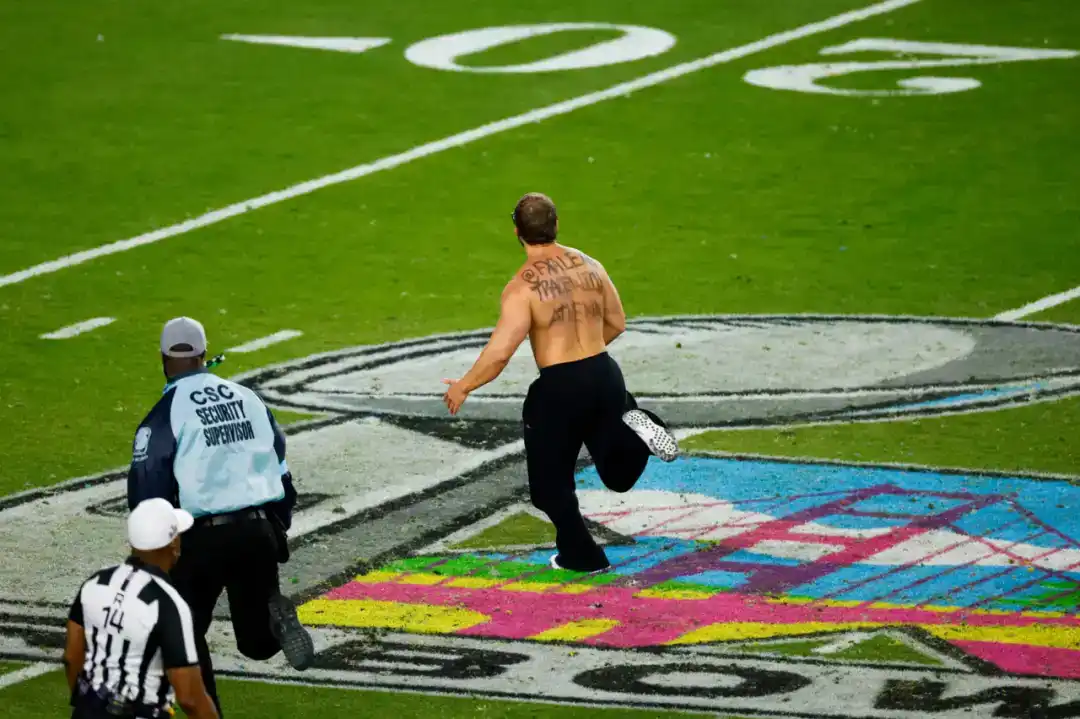
From the moment he stepped onto the field until he was tackled by security, he ran for 30 seconds. The going rate for a 30-second ad spot during the Super Bowl is $7 million.

When viewers took out their phones to search for his account, they discovered this "fan" was not an ordinary spectator but a trader—Alex Gonzalez. The slogans on his body were essentially a moving advertisement.

Even more intriguingly, according to Sportscasting, Gonzalez had performed a similar stunt back in 2024. He reportedly bet $5,000 that "someone would rush the field during the Super Bowl," then rushed the field himself during the game, ultimately profiting about $110,000; after deducting bail and legal fees, his net gain was still around $70,000.

In other words, he not only creating the event on the field but potentially also betting on the event he himself would create in the prediction market.

When the odds are high enough, some people stop predicting the future and instead create it themselves. This is also our most extreme, and most ironic, expectation for prediction markets.

The "Secretly Filmed" Video of an Influencer Betting a Million Dollars Was Actually a Marketing Stunt

Another video from this Super Bowl that went viral across the internet came from top influencer Logan Paul—in the footage, his phone screen is lit up with the Polymarket betting interface, showing him placing a one-million-dollar bet on which team would win. The image is blurry, the angle is tilted, very much like a casual shot taken by a spectator in the back seat.

Soon after this 12-second "secretly filmed" video spread, it was reposted by the official Polymarket account, and the heat and traffic came as expected. However, this transaction never appeared in the information flow of PolyBeats, which focuses on monitoring prediction market trades.

After in-depth research, it was found that the so-called "million-dollar bet" never actually occurred. This seemingly explosive "behind-the-scenes moment," which satisfied the public's voyeuristic desires, was nothing more than a carefully packaged marketing performance: as early as December 2025, Logan Paul joined the venture capital firm Anti Fund as a partner, and this firm was one of the investors in Polymarket's Series B round in 2025.

When a globally watched sporting event simultaneously overlaps with probability markets, advertising markets, and attention markets, the boundaries of the game are no longer confined to just the two teams on the field. Beyond the odds, there's the pricing of exposure; beyond the betting lines, there's narrative design.

Driven by money and attention, the "viral moments" we scroll past on social media might not be spontaneous but the result of months of planning.


Пов'язані питання

QWhat was the 'American Super Bowl' event mentioned in the article, and why is it attract global attention?

AThe 'American Super Bowl' refers to the annual championship game of the National Football League (NFL). It attracts global attention not just for the sport itself, but due to its heavy integration of entertainment culture, such as the high-profile halftime show, celebrity appearances, and major advertising events, which collectively draw a worldwide audience.

QHow did a new Polymarket account achieve a near-perfect prediction rate for the Super Bowl halftime show, and what does this suggest?

AA new Polymarket account deposited nearly $80,000 and placed 19 concentrated bets on specific halftime show details, like Lady Gaga appearing and Travis Scott not appearing, with 17 of them being correct. This near-perfect success rate, far beyond luck, strongly suggests the account owner had insider information, likely connected to the show's production company Roc Nation, exploiting information asymmetry for profit on the prediction market.

QWho was Alex Gonzalez, and how did he allegedly profit from the Super Bowl event according to the article?

AAlex Gonzalez was a trader who ran onto the field during the Super Bowl with painted advertisements on his body. The article suggests he had previously placed a $5,000 bet on the prediction market that 'someone would rush onto the field during the Super Bowl' and then created the event himself by doing so. He reportedly profited approximately $110,000 from that bet, with a net gain of around $70,000 after legal fees and bail.

QWhat was revealed about the viral 'secretly recorded video' of Logan Paul placing a million-dollar bet on Polymarket?

AThe viral 12-second 'secretly recorded' video of Logan Paul apparently placing a million-dollar bet on Polymarket was revealed to be a staged marketing campaign. The bet never actually placed on the market, and the video was a carefully orchestrated promotion. This was because Logan Paul is a partner in Anti Fund, a venture capital firm that was an investor in Polymarket's Series B funding round.

QWhat overarching point does the article make about prediction markets, advertising, and major events like the Super Bowl?

AThe article argues that during globally watched events like the Super Bowl, prediction markets, advertising markets, and attention economies converge. This creates an environment where what appears to be spontaneous moments—such as an insider making profitable trades, a fan rushing the field, or a viral video—are often the result of months of planning and manipulation for financial gain and exposure, blurring the lines between gambling, advertising, and narrative creation.

Пов'язані матеріали

South Korean Exchanges 'Battle' Regulators, Challenging the Boundaries of Enforcement and Legislation

South Korea's cryptocurrency industry is engaged in a rare, direct confrontation with regulators. The Financial Intelligence Unit (FIU), the primary anti-money laundering (AML) watchdog, has recently imposed heavy penalties on major exchanges like Upbit and Bithumb for alleged violations involving unregistered overseas VASPs and AML procedures. However, exchanges are now actively challenging these actions in court and through industry associations. In a significant shift, the Seoul Administrative Court ruled in favor of Upbit's operator, Dunamu, overturning part of an FIU-ordered business suspension. The court found the FIU's penalty criteria and justification insufficiently clear. Similarly, the court suspended the enforcement of a six-month business suspension against Bithumb pending a final ruling, citing potential irreversible harm to the exchange. Beyond legal battles, the industry is contesting proposed legislative amendments. The Digital Asset eXchange Alliance (DAXA) strongly opposes a draft rule that would mandate Suspicious Transaction Reports (STRs) for all crypto transfers over 10 million KRW (~$6,800). DAXA argues this "poison pill" clause violates legal principles and would overwhelm the STR system, increasing reports from 63,000 to an estimated 5.45 million annually for major exchanges, thereby crippling effective AML monitoring. This conflict highlights a structural tension in South Korea's crypto governance: comprehensive digital asset laws are still developing, while regulators rely heavily on AML enforcement. The industry's move from passive compliance to active legal and legislative challenges signifies a new phase, pressing for clearer rules and more proportionate enforcement. While short-term disputes may intensify, this clash could ultimately lead to a more mature and sustainable regulatory framework for South Korea's vibrant crypto market.

marsbit9 хв тому

South Korean Exchanges 'Battle' Regulators, Challenging the Boundaries of Enforcement and Legislation

marsbit9 хв тому

After 50x Storage Surge, Justin Sun Always Looks to the Next Decade

Sun Yuchen, known for his controversial stunts like a $30 million lunch with Warren Buffett (canceled due to a kidney stone) and eating a $6.2 million duct-taped banana, is often overshadowed by a significant fact: his decade-long track record of spotting major investment trends. In 2016, he famously advised young people to invest in Bitcoin, Nvidia, Tesla, and Tencent instead of buying property. A hypothetical $20,000 investment in Nvidia and Tesla from that list would now be worth over 50 million RMB. His latest major call was on November 6, 2025, predicting a "50x storage opportunity" tied to the AI boom, which materialized with Sandisk's stock surging nearly 50-fold by 2026. Looking ahead, Sun now focuses on the next frontier: Physical AI. He identifies four key areas: 1. **Embodied AI/Robotics**: He sees this reaching its "iPhone moment," with companies like UBTech and Galaxy General leading in commercialization. 2. **Drones**: Viewed as the first commercially viable form of Physical AI, revolutionizing sectors from warfare (e.g., AeroVironment's Switchblade) to logistics. 3. **Spatial Computing**: Beyond VR, it's about AI understanding physical space, a foundational technology for robotics and autonomous systems, exemplified by Apple's Vision Pro. 4. **Space Exploration**: After a 2025 suborbital flight with Blue Origin, Sun advocates for space as the ultimate frontier, discussing blockchain's potential role in space asset management and data transactions. His investment philosophy involves betting on entire, inevitable trends rather than single companies. For robotics, he sees Tesla (the body/manufacturer) and Nvidia (the brain/AI platform) as complementary plays. In defense drones, he highlights companies making tanks obsolete (AeroVironment) and those augmenting fighter jets (Kratos). For space, he participated in Blue Origin's flight and anticipates SpaceX's potential IPO to redefine the sector's valuation. Sun Yuchen's vision frames the next two decades not as a revolution in information flow (like the internet), but in the fundamental operation of the physical world through AI-powered robots, autonomous systems, and spatial intelligence, ultimately extending human and AI activity into space. While many still focus on conventional assets, he continues to look toward the next technological horizon.

marsbit1 год тому

After 50x Storage Surge, Justin Sun Always Looks to the Next Decade

marsbit1 год тому

The Billionaires Behind the Most Expensive Midterm Election in History

"The Most Expensive Midterm Elections and Their Billionaire Backers" This analysis details the unprecedented scale of spending in the 2026 midterm elections, highlighting the key billionaire donors shaping the political landscape. Jeff Yass, founder of Susquehanna International Group, has contributed over $81 million, ranking third among individual donors behind George Soros ($102.6M) and Elon Musk ($84.8M). Yass is a major donor to Trump's MAGA Inc. and supports school choice and various candidates. Overall, federal committees have raised over $4.7 billion this cycle, with political ad spending projected to reach $10.8 billion. Republican-aligned groups are significantly out-raising their Democratic counterparts. "Dark money" from undisclosed sources continues to grow. The core stakes involve control of Congress and policy direction for Trump's final term. Donors are also motivated by specific issues: Sergey Brin and Chris Larsen are funding opposition to a proposed California wealth tax and supporting crypto-friendly policies. Other top donors include OpenAI's Greg Brockman and his wife Anna ($50M total to MAGA Inc. and an AI-focused PAC), Richard Uihlein ($45.3M to conservative causes), venture capitalists Marc Andreessen and Ben Horowitz (each over $44M to crypto/AI PACs and MAGA Inc.), Miriam Adelson ($42.6M to GOP leadership PACs), Paul Singer ($33.9M), and Diane Hendricks ($25.8M to MAGA Inc.). The article notes that the peak fundraising period is still ahead, with major primaries approaching.

marsbit1 год тому

The Billionaires Behind the Most Expensive Midterm Election in History

marsbit1 год тому

The Largest IPO in History Is Approaching, Surpassing SpaceX, 28 Years of AI Self-Iteration, Countdown to Intelligence Explosion

"Anthropic Nears Trillion-Dollar IPO, Fueled by Explosive Growth and 2028 'Intelligence Explosion' Warning Anthropic is considering a deal valuing the AI company near $1 trillion, potentially leading to one of the largest IPOs ever and surpassing SpaceX. Its revenue has skyrocketed, with Annual Recurring Revenue (ARR) reaching $45 billion in May 2026—a 500% increase in just five months. This vertical growth curve is attributed to its key products, Claude Code and Cowork, dominating AI coding and enterprise collaboration. Beyond commercial success, co-founder Jack Clark issued a pivotal warning in an interview: there is a greater than 50% chance that by the end of 2028, AI systems will achieve recursive self-improvement—the ability to autonomously build a 'better version' of themselves, initiating an 'intelligence explosion.' This prophecy underpins the company's astronomical valuation, as the market prices in the potential for transformative and disruptive AI. Further signaling its ambition, Anthropic formed a $1.5 billion joint venture with Goldman Sachs and Blackstone, aiming to disrupt traditional consulting firms like McKinsey by deploying Claude AI for complex strategic work. This move tests AI's capacity to replace high-level cognitive labor, a precursor to its predicted autonomous evolution. The narrative presents a dual future: unprecedented economic opportunity alongside significant risks like economic restructuring and security threats. Anthropic's meteoric rise and Clark's 2028 prediction frame the coming years as a countdown to a potential technological singularity."

marsbit1 год тому

The Largest IPO in History Is Approaching, Surpassing SpaceX, 28 Years of AI Self-Iteration, Countdown to Intelligence Explosion

marsbit1 год тому

Торгівля

Спот
Ф'ючерси

Популярні статті

Як купити SUPER

Ласкаво просимо до HTX.com! Ми зробили покупку SuperFarm (SUPER) простою та зручною. Дотримуйтесь нашої покрокової інструкції, щоб розпочати свою криптовалютну подорож.Крок 1: Створіть обліковий запис на HTXВикористовуйте свою електронну пошту або номер телефону, щоб зареєструвати обліковий запис на HTX безплатно. Пройдіть безпроблемну реєстрацію й отримайте доступ до всіх функцій.ЗареєструватисьКрок 2: Перейдіть до розділу Купити крипту і виберіть спосіб оплатиКредитна/дебетова картка: використовуйте вашу картку Visa або Mastercard, щоб миттєво купити SuperFarm (SUPER).Баланс: використовуйте кошти з балансу вашого рахунку HTX для безперешкодної торгівлі.Треті особи: ми додали популярні способи оплати, такі як Google Pay та Apple Pay, щоб підвищити зручність.P2P: Торгуйте безпосередньо з іншими користувачами на HTX.Позабіржова торгівля (OTC): ми пропонуємо індивідуальні послуги та конкурентні обмінні курси для трейдерів.Крок 3: Зберігайте свої SuperFarm (SUPER)Після придбання SuperFarm (SUPER) збережіть його у своєму обліковому записі на HTX. Крім того, ви можете відправити його в інше місце за допомогою блокчейн-переказу або використовувати його для торгівлі іншими криптовалютами.Крок 4: Торгівля SuperFarm (SUPER)Легко торгуйте SuperFarm (SUPER) на спотовому ринку HTX. Просто увійдіть до свого облікового запису, виберіть торгову пару, укладайте угоди та спостерігайте за ними в режимі реального часу. Ми пропонуємо зручний досвід як для початківців, так і для досвідчених трейдерів.

190 переглядів усьогоОпубліковано 2024.12.11Оновлено 2025.03.21

Як купити SUPER

Обговорення

Ласкаво просимо до спільноти HTX. Тут ви можете бути в курсі останніх подій розвитку платформи та отримати доступ до професійної ринкової інформації. Нижче представлені думки користувачів щодо ціни SUPER (SUPER).

活动图片












