Adam Back slams Bitcoiner VC for ‘uninformed noise’ about quantum risk

cointelegraphОпубліковано о 2025-12-20Востаннє оновлено о 2025-12-20

Анотація

Blockstream CEO Adam Back criticized Castle Island Ventures' Nic Carter for amplifying concerns about quantum computing threats to Bitcoin, calling it "uninformed noise." Carter defended his firm's investment in quantum-resistant startup Project Eleven, stating he was "quantum pilled" and believes Bitcoin is vulnerable. He argues governments are preparing for quantum risks and Bitcoin is a "bug bounty" for quantum attacks. While some, like Capriole Investments' Charles Edwards, warn the threat could emerge in 2-9 years, Back contends quantum technology is still decades away from being a real threat. Others, like Kevin O’Leary, doubt attacking Bitcoin would be a practical use of quantum computing.

Blockstream CEO Adam Back has criticized Castle Island Ventures founding partner Nic Carter for amplifying concerns about quantum computing threats to Bitcoin.

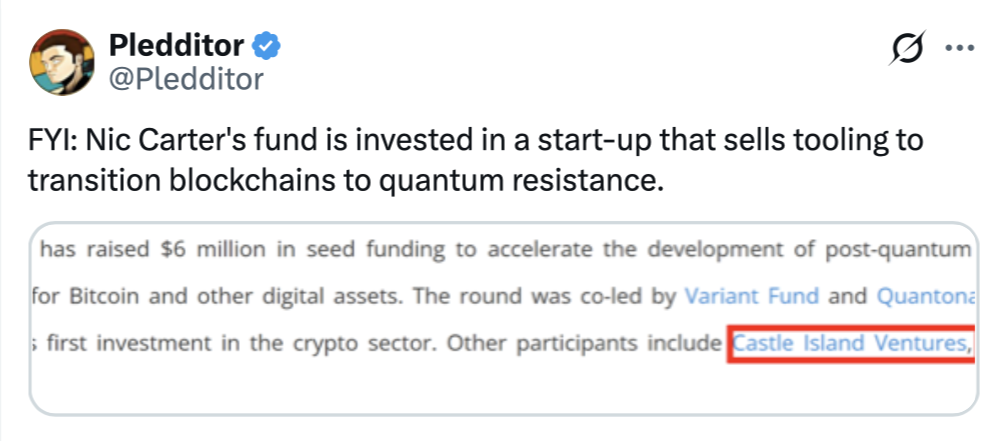
“You make uninformed noise and try to move the market or something. You’re not helping,” Back said in an X post on Friday, after Carter explained in an X post why Castle Island Ventures invested in Project Eleven, a startup focused on protecting Bitcoin and other crypto assets from the threat of quantum computing.

Back said the Bitcoin community is not in denial about the need to research and develop protections against potential quantum computing threats, but is instead doing that work “quietly.” However, Carter refuted Back’s comment, arguing that many Bitcoin developers are still in “total denial” about the risk of quantum computing to Bitcoin.
Source: Pledditor

While Castle Island Ventures’ investment only recently resurfaced on social media within the Bitcoin community, Carter first disclosed it in a Substack post on Oct. 20. “I disclosed this in the first sentence of my main article on quantum. Can’t get more transparent than that,” Carter said.

Carter says he was “quantum pilled”

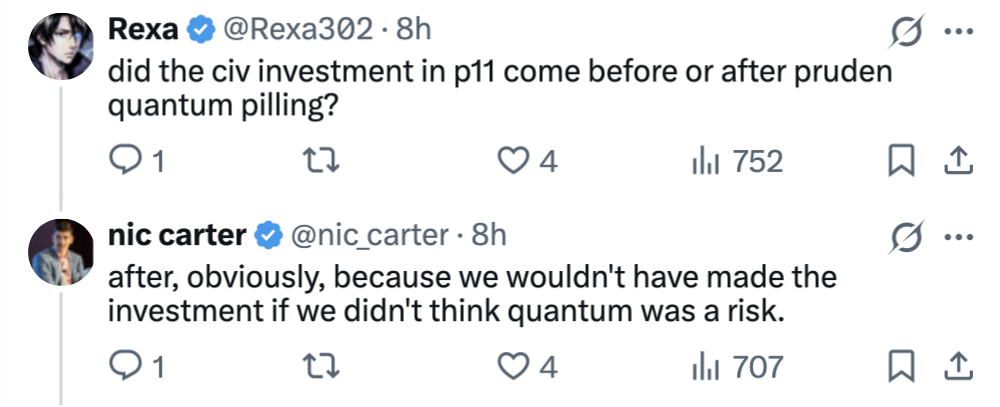
Carter said that he invested in the project because Project Eleven CEO Alex Pruden “quantum pilled” him. “I became extremely concerned about quantum threats to blockchains. I put capital behind my convictions, always have,” he said.
Source: Nic Carter

“I knew the bad faith criticisms would come, so I made absolutely sure to be crystal clear about my financial exposure here,” Carter added.

Carter raised several points why quantum computing poses a risk to Bitcoin, including governments planning for a post-quantum world, Bitcoin itself being “a bug bounty” for quantum supremacy, and the increasing amount of investment in quantum firms.

Carter isn’t the only prominent Bitcoin figure to have recently stepped up public warnings about the potential quantum computing threat to Bitcoin.

Some warn the threat could emerge in as little as two years

Capriole Investments founder Charles Edwards warned in a post on X on Thursday that quantum computing could pose a genuine threat to Bitcoin within the next two to nine years unless the network upgrades to quantum-resistant cryptography.

However, others are less concerned.

Related: Anxiety of quantum risk to Bitcoin is weighing on its price: Execs

Multimillionaire entrepreneur Kevin O’Leary recently told Cointelegraph Magazine that using quantum computing to break Bitcoin’s security wouldn’t be the most effective use of the technology, arguing it would be far more valuable in areas like AI-driven medical research.

Meanwhile, Back recently said it is good for Bitcoin to be “quantum ready,” but it won’t be a threat for the next few decades, as the technology is still “ridiculously early,” and has research and development issues.

Magazine: Big questions: Would Bitcoin survive a 10-year power outage?

Пов'язані питання

QWhat is Adam Back's criticism of Nic Carter regarding quantum computing threats to Bitcoin?

AAdam Back criticized Nic Carter for making 'uninformed noise' and trying to move the market, arguing that the Bitcoin community is already working 'quietly' on quantum protections rather than being in denial.

QWhy did Nic Carter invest in Project Eleven?

ANic Carter invested in Project Eleven because its CEO Alex Pruden 'quantum pilled' him, making him extremely concerned about quantum threats to blockchains, and he wanted to put capital behind his convictions.

QWhat are some reasons Carter believes quantum computing poses a risk to Bitcoin?

ACarter cited governments planning for a post-quantum world, Bitcoin being 'a bug bounty' for quantum supremacy, and increasing investments in quantum firms as reasons for the risk.

QHow soon does Charles Edwards believe quantum computing could threaten Bitcoin?

ACharles Edwards warned that quantum computing could pose a genuine threat to Bitcoin within the next two to nine years unless the network upgrades to quantum-resistant cryptography.

QWhat is Adam Back's timeline for when quantum computing might become a threat to Bitcoin?

AAdam Back stated that quantum computing won't be a threat to Bitcoin for the next few decades, as the technology is still 'ridiculously early' and has research and development issues.

Пов'язані матеріали

In Such a Crowded Cross-border Payment Track, Where Does the Next Stop Lie in the Future?

The crowded cross-border payments industry faces a paradox: intense competition above water with financing and narratives, while beneath, price wars and shrinking margins in basic PSP services are common. The path forward lies not in simple "cross-border" solutions but in deep **localization**. Success requires mastering the fragmented and tightening regulations of fiat currencies in each market—the "last mile" of compliance, banking, and settlement. Many Chinese PSPs have succeeded by following Chinese merchants overseas but have not deeply penetrated mainstream local merchant ecosystems abroad. Their strong product capabilities need to be applied to new, complex markets. The future belongs to companies that evolve from single-channel providers to **cross-border capital network operators**. This means moving beyond competing on transaction fees to creating internal networks that optimize capital efficiency through multi-directional matching, netting, and position reuse across countries and currencies. For Web3 and stablecoins, the key is integration, not replacement. Stablecoins offer efficiency gains but cannot bypass the foundational trust, compliance, and legal frameworks of traditional finance. The realistic path is the gradual adoption and "taming" of Web3 technologies by established financial institutions. The ultimate solution is a **dual clearing infrastructure** combining deep local fiat capabilities (local accounts, compliance, banking) with lightweight stablecoin-native capabilities (on-chain settlement, wallets). The biggest opportunity lies not in oversaturated mainstream corridors but in complex, underserved regional corridors (e.g., specific CIS, Middle East-Southeast Asia, or Latin American trade pairs). The winners will be those who build hard-to-replicate, deep capabilities in these areas—acting as the essential "clearing shovels" or infrastructure providers. The future keywords are **more local, more networked, and more stablecoin-native**. High-profit opportunities remain in the non-standardized, difficult-to-replicate deep waters of the industry, requiring genuine on-the-ground presence and long-term patience.

链捕手15 хв тому

In Such a Crowded Cross-border Payment Track, Where Does the Next Stop Lie in the Future?

链捕手15 хв тому

Lightning Fast Five-Whip Combo! Strategy's Self-Rescue Plan Officially Released

Strategy, amidst the STRC de-pegging crisis, has unveiled its "Digital Credit Capital Framework" self-rescue plan. The five-part framework includes: 1) **Cash Reserves**: Management of ~$2.55B in USD reserves, dedicated solely to covering ~17.4 months of preferred stock dividends and debt interest, with a 12-month minimum coverage floor. 2) **Dividend Policy**: STRC's dividend yield rises to 12% from July 1st, with monthly reviews. Strategy clarifies de-pegging does not automatically trigger further hikes. 3) **Preferred Stock Buyback**: A $1B authorization, prioritizing STRC repurchases to support its price, reduce future dividend obligations, and signal commitment, using funds separate from dividend reserves. 4) **Common Stock Buyback**: A separate $1B authorization for MSTR stock, aimed at creating shareholder value when the stock is deemed undervalued, establishing a two-way capital management mechanism. 5) **Bitcoin Monetization**: Formal authorization to sell BTC (up to $1.25B earmarked) to build USD reserves, cover dividends/interest, or fund buybacks, marking a strategic shift where BTC becomes a managed asset rather than a strictly "hold-only" reserve. Market reaction saw MSTR and STRC shares rise pre-market, while BTC remained stable. The plan aims to restore confidence in STRC, ensure dividend sustainability, and reopen Strategy's funding channels.

Odaily星球日报1 год тому

Lightning Fast Five-Whip Combo! Strategy's Self-Rescue Plan Officially Released

Odaily星球日报1 год тому

The Sword of Damocles Over the AI Bull Market: Not Just in South Korea, Leverage in U.S. Stocks Is Equally Staggering

Global equity markets are hitting new highs driven by the AI boom, but the fuel behind this rally is becoming increasingly dangerous. From the US to South Korea, margin debt and leveraged ETF assets have soared to historical extremes, with their pro-cyclical nature amplifying tail risks in market volatility. In the US, margin debt rose 54% year-over-year in May, reaching a record $1.4 trillion. Simultaneously, leveraged ETF assets nearly doubled in under 70 days to over $220 billion by early June, with intense focus on tech, semiconductor indices, and single stocks like NVIDIA and Tesla. A warning sign appeared in South Korea, where the KOSPI index experienced extreme volatility, plunging 10% to trigger a circuit breaker, then sharply rebounding before halting again, partly driven by concentrated, highly leveraged positions in chip stocks. Analysts are raising alarms. Barclays warns that leveraged funds have accumulated roughly $300 billion in equity-linked derivatives since late March, creating a major source of non-discretionary risk. Morgan Stanley notes an unprecedented reliance on leveraged financing by marginal buyers, with financing becoming more expensive and scarce. Charles Schwab has tightened margin requirements. The core risk lies in the mechanics: leveraged ETFs and derivatives can create a "tail wags the dog" effect, where fund flows force market makers to buy underlying stocks, amplifying gains. This process reverses in a downturn, triggering a self-reinforcing selling spiral as funds deleverage. Additionally, the cost of borrowing to buy stocks has spiked to multi-year highs. Morgan Stanley warns this sets up a nonlinear risk: high financing costs stall momentum, a price decline triggers forced deleveraging, and selling pressure is multiplied by leverage, potentially leading to outsized declines. The current market breadth is narrow, with gains heavily concentrated in tech, making the rally vulnerable to a pullback in leveraged positions. In summary, the AI-fueled bull market is increasingly propped up by record leverage. When this trend reverses, the deleveraging process could magnify losses, posing a significant threat to financial stability.

marsbit1 год тому

The Sword of Damocles Over the AI Bull Market: Not Just in South Korea, Leverage in U.S. Stocks Is Equally Staggering

marsbit1 год тому

Торгівля

Спот
活动图片