Aave governance vote sparks backlash over rushed escalation

cointelegraphОпубліковано о 2025-12-22Востаннє оновлено о 2025-12-22

Анотація

A governance vote at Aave has sparked significant backlash after a proposal regarding control of the protocol's brand assets was escalated to a snapshot vote, despite unresolved community discussions. The proposal seeks to transfer ownership of domains, social handles, and other intellectual property to AAVE token holders via a DAO-controlled legal structure. Aave founder Stani Kulechov defended the move, stating the community was ready for a decision after five days of discussion. However, critics, including former Aave Labs CTO Ernesto Boado and Aave Chan Initiative lead Marc Zeller, accused the team of rushing the vote without proper consent or dialogue. Zeller described the action as a "hostile takeover attempt," criticizing the timing during the holiday period, which limited participation and mobilization. The controversy highlights ongoing governance challenges within the DeFi protocol concerning control over proposal escalation and decision-making processes.

A governance vote at decentralized finance (DeFi) lending protocol Aave sparked a backlash from key stakeholders after a proposal on ownership of Aave's brand assets was escalated to a snapshot vote amid unresolved discussion.

The proposal asks the community whether Aave (AAVE) token holders should regain control over the protocol’s brand assets, including domains, social handles, naming rights and other intellectual property through a DAO-controlled legal vehicle.

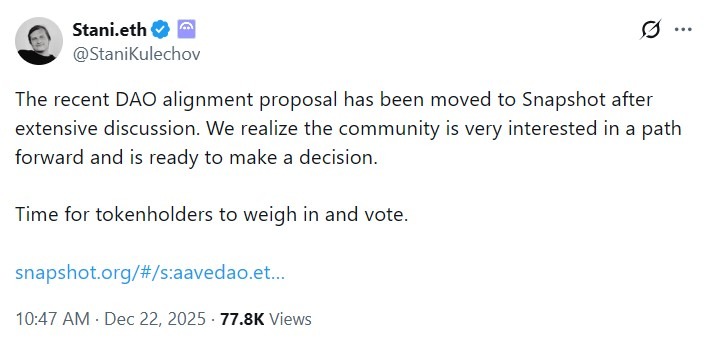
Aave founder Stani Kulechov said the community was interested in a decision, announcing that the proposal had been moved to a vote.

“We realize the community is very interested in a path forward and is ready to make a decision,” Kulechov wrote.

While Kulechov said it was time for tokenholders to vote, other community members argued that the proposal was pushed to a vote prematurely, bypassing governance norms.
Source: Stani Kulechov

Related: SEC ends probe into Aave after four years, CEO Kulechov says

Aave Labs faces “hostile takeover” accusations

Former Aave Labs chief technology officer Ernesto Boado, whose name appears as the proposal’s author, said the vote was escalated without his consent or knowledge.

“This is not, in ethos, my proposal,” Boado wrote on X, saying that he would not have approved the submission for a vote while community discussion was still ongoing. He said the escalation breaks the code of trust in the community.

Marc Zeller, who leads the Aave Chan Initiative (ACI), said the proposal was “unilaterally escalated” despite unresolved questions from delegates and token holders.

In a public statement, Zeller said that the timing and process choices materially reduced community participation, adding that the ability of late-informed participants to mobilize or redelegate was being limited.

“What started as a push for clarity and a more fair relationship between token holders and the current stewards,” Zeller said, “is now turning into a hostile takeover attempt by Labs.”

Zeller criticized the decision of pushing the vote during the holiday period, which large stakeholders, investors and institutions have flagged as one of the “worst windows” for high-stakes governance votes.

Responding to the criticisms, Kulechov said that the discussion has been going on for five days, with many comments, and claimed that the vote complies with all the requirements.

“People are tired of this discussion and getting into a vote is the best way to resolve, this is governance end of the day,” he wrote.

The dispute highlighted deeper governance questions for Aave, one of the biggest DeFi protocols in the space.

While the proposal focuses on “soft” asset ownership, the backlash underscores how much influence can stem from control over escalation, timing and information flow.

Magazine: Bitcoin whale Metaplanet ‘underwater’ but eyeing more BTC: Asia Express

Пов'язані питання

QWhat is the main reason for the backlash in the Aave governance vote?

AThe backlash occurred because a proposal on ownership of Aave's brand assets was escalated to a snapshot vote prematurely, bypassing governance norms and without resolving ongoing community discussions.

QWho is the author of the controversial proposal, and what was his reaction?

AThe proposal's author is former Aave Labs chief technology officer Ernesto Boado, who stated the vote was escalated without his consent or knowledge, breaking the community's code of trust.

QWhat did Marc Zeller of the Aave Chan Initiative accuse Aave Labs of attempting?

AMarc Zeller accused Aave Labs of attempting a 'hostile takeover' by unilaterally escalating the vote despite unresolved questions and limiting community participation during the holiday period.

QHow did Aave founder Stani Kulechov justify moving the proposal to a vote?

AStani Kulechov claimed the community was tired of the five-day discussion and that moving to a vote was the best way to resolve the issue, asserting it complied with all governance requirements.

QWhat broader governance issue did the dispute highlight for Aave?

AThe dispute highlighted how control over escalation timing and information flow can significantly influence governance outcomes, even for proposals focused on 'soft' asset ownership.

Пов'язані матеріали

Why Hasn't the U.S. Seen the Rise of 'Huabei' or 'Jiebei'?

The article explores why the U.S. lacks large-scale consumer credit products like China's "Huabei" and "Jiebei," despite having a developed financial sector. Key reasons include: 1. **Structural Barriers**: A fragmented federal and state regulatory system, reinforced by post-2008 reforms like the Dodd-Frank Act, raises compliance costs and protects traditional banks, stifling fintech innovation. 2. **Credit Card Dominance**: Credit cards, used by 70-80% of adults, form a $1.28 trillion debt market with high APRs (avg. 22.3%). This system cross-subsidizes users who pay in full with those carrying balances, creating a predatory yet entrenched ecosystem. 3. **Data Privacy Laws**: Strict regulations (e.g., FCRA, CCPA) prevent tech giants from leveraging behavioral data for credit scoring, unlike in China where such data fuels fintech models. 4. **Capital Market Disincentives**: Wall Street penalizes tech firms entering finance due to lower valuations associated with heavy regulation and risk, as seen in Apple’s failure with Apple Card. 5. **Banking Oligopoly**: Major banks control consumer lending, leveraging lobbying power and consumer habits to maintain high-cost credit, while alternatives like payday loans (400% APR) or "unbanked" services remain niche or exploitative. Ultimately, regulatory, structural, and corporate interests collectively block the emergence of accessible, low-cost digital lending in the U.S.

Odaily星球日报42 хв тому

Why Hasn't the U.S. Seen the Rise of 'Huabei' or 'Jiebei'?

Odaily星球日报42 хв тому

More and More 'Model Supermarkets' Are Opening: ByteDance, Alibaba, and Tencent Compete to Integrate

Chinese tech giants like ByteDance, Alibaba, and Tencent are accelerating the rollout of integrated AI model subscription services—dubbed “model supermarkets”—to provide developers with bundled access to multiple leading domestic large language models (LLMs). ByteDance’s Volcengine recently upgraded its "Coding Plan" by adding newer models like GLM-5.1, Minimax M2.7, and Kimi k2.6, allowing subscribers to use various top models under a single monthly fee starting at ¥40. However, user feedback reveals significant issues, including rapid consumption of usage limits (e.g., hitting caps within hours), frequent server errors (like HTTP 429), and slow response times during peak hours. Complaints about misleading deduction rates—where calls to advanced models consume more quota—are also common. The trend is industry-wide: Alibaba, Tencent, and Baidu have all launched similar multi-model coding plans. While these platforms reduce trial costs for developers, they also expose challenges in balancing affordability with service quality and computational stability. Amid this shift, independent AI companies like Zhipu, MiniMax, and Moonlight Face (Kimi) are developing strategies to avoid becoming mere “pipes” in this ecosystem—focusing on vertical applications, autonomous agents, and long-context models to retain competitiveness. Analysts suggest that, while platform aggregation may pressure model firms in the short term, specialized and vertical AI capabilities will remain differentiated in the long run.

marsbit46 хв тому

More and More 'Model Supermarkets' Are Opening: ByteDance, Alibaba, and Tencent Compete to Integrate

marsbit46 хв тому

Торгівля

Спот
Ф'ючерси

Популярні статті

Як купити AAVE

Ласкаво просимо до HTX.com! Ми зробили покупку Aave Protocol (AAVE) простою та зручною. Дотримуйтесь нашої покрокової інструкції, щоб розпочати свою криптовалютну подорож.Крок 1: Створіть обліковий запис на HTXВикористовуйте свою електронну пошту або номер телефону, щоб зареєструвати обліковий запис на HTX безплатно. Пройдіть безпроблемну реєстрацію й отримайте доступ до всіх функцій.ЗареєструватисьКрок 2: Перейдіть до розділу Купити крипту і виберіть спосіб оплатиКредитна/дебетова картка: використовуйте вашу картку Visa або Mastercard, щоб миттєво купити Aave Protocol (AAVE).Баланс: використовуйте кошти з балансу вашого рахунку HTX для безперешкодної торгівлі.Треті особи: ми додали популярні способи оплати, такі як Google Pay та Apple Pay, щоб підвищити зручність.P2P: Торгуйте безпосередньо з іншими користувачами на HTX.Позабіржова торгівля (OTC): ми пропонуємо індивідуальні послуги та конкурентні обмінні курси для трейдерів.Крок 3: Зберігайте свої Aave Protocol (AAVE)Після придбання Aave Protocol (AAVE) збережіть його у своєму обліковому записі на HTX. Крім того, ви можете відправити його в інше місце за допомогою блокчейн-переказу або використовувати його для торгівлі іншими криптовалютами.Крок 4: Торгівля Aave Protocol (AAVE)Легко торгуйте Aave Protocol (AAVE) на спотовому ринку HTX. Просто увійдіть до свого облікового запису, виберіть торгову пару, укладайте угоди та спостерігайте за ними в режимі реального часу. Ми пропонуємо зручний досвід як для початківців, так і для досвідчених трейдерів.

290 переглядів усьогоОпубліковано 2024.12.11Оновлено 2025.03.21

Як купити AAVE

Обговорення

Ласкаво просимо до спільноти HTX. Тут ви можете бути в курсі останніх подій розвитку платформи та отримати доступ до професійної ринкової інформації. Нижче представлені думки користувачів щодо ціни AAVE (AAVE).

活动图片