a16z: Will AI Really Bring an Employment Apocalypse?

marsbitОпубліковано о 2026-05-08Востаннє оновлено о 2026-05-08

Анотація

This article challenges the widespread fear that AI will lead to mass unemployment, framing it as a modern version of the "lump of labor fallacy"—the mistaken belief that the total amount of work in society is fixed. The author argues that history shows transformative technologies like tractors, electricity, and spreadsheets didn't destroy jobs overall; instead, they eliminated specific tasks while creating entirely new industries and occupations (e.g., shifting from agriculture to manufacturing and services, or from bookkeeping to financial analysis). The core argument is that AI is primarily a productivity tool that will redefine work rather than eliminate it. While AI will automate some repetitive tasks, it acts as a "force multiplier," making roles like software engineers, product managers, and systems designers more efficient and valuable. Data indicates that corporate discussions focus far more on AI as an enhancement tool than a replacement, and demand for tech roles is growing. The article concludes that technological progress expands the economic pie, creating new demands and jobs we can't yet imagine. The real impact of AI won't be an employment apocalypse but a reorganization of the labor market, driving higher productivity and new forms of work.

Editor's Note: Whether AI will cause mass unemployment is one of the most common technological anxieties today.

This article argues that this 'AI employment apocalypse narrative' is not new. It essentially follows the old logic of 'fixed total amount of work,' suggesting there is a fixed amount of work in society, and the more AI does, the less humans can do.

The author counters that history hasn't unfolded this way. Tractors reduced the number of farmers but gave rise to manufacturing, services, and software industries; electricity replaced older power sources but reorganized factories and consumer goods industries; Excel didn't eliminate finance jobs but instead spawned more financial analyst positions. Technology does eliminate certain tasks and jobs, but the larger result has often been the creation of new demands and new jobs.

Applied to AI, what truly deserves attention is not 'will humans be completely replaced' but 'which jobs will be redefined by AI.' AI will compress some repetitive labor, but it will also make roles like software engineers, product managers, and systems designers more efficient and important. In other words, AI is more like a productivity tool than a mere job killer.

The core judgment of this article is: AI will not bring the economy to a halt; it will only force a reallocation in the labor market. Doomsayers only see the jobs being replaced but ignore how technological revolutions have consistently created new industries, new professions, and new spaces for growth.

The original text follows:

The panic over a 'permanent underclass' touted by AI pessimists is not a compelling narrative. It's not even a new story. It's merely a repackaged version of the 'lump of labor fallacy.'

The 'lump of labor fallacy' refers to the view that the total amount of work needed in society is fixed. It assumes a zero-sum competition between existing workers and any agent that might perform similar work—whether that's other workers, machines, or this time, AI. If the total amount of useful work is fixed, then the more AI does, the less there must be for humans to do.

The problem with this premise is that it contradicts our basic understanding of people, markets, and economies. Human desires and needs have never been fixed. About a century ago, Keynes famously predicted that automation would lead to a 15-hour workweek, but history proved Keynes wrong. He was right about one thing: automation did create a 'labor surplus'; but instead of lying back to enjoy leisure, we consistently found new, different productive activities to fill our time.

Of course, AI will definitely eliminate some tasks and compress some job roles—and there is already some evidence suggesting this change may be underway. The shape of the labor market will change, just as it has with every transformative technology unleashed. But claiming that AI will cause economy-wide, permanent unemployment is unhelpful marketing rhetoric, poor economic judgment, and a misreading of history. On the contrary, productivity gains should increase the demand for labor because labor itself becomes more valuable.

Here is our argument.

Humans, Checkmated?

We agree with the doomsayers' assessment—frankly, anyone with their eyes open can see it—the price of cognition is collapsing. AI is becoming increasingly adept at handling tasks that, until very recently, were considered the exclusive domain of the human brain.
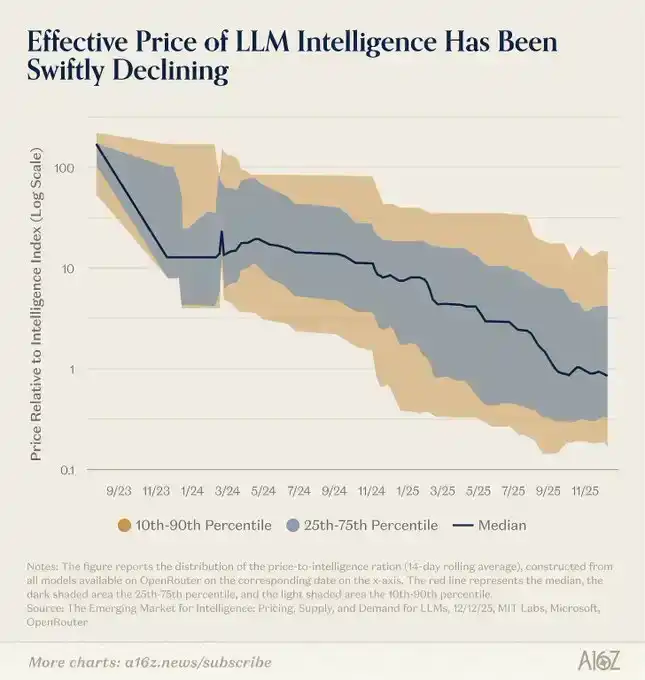
The doomsayer's logic is: 'If AI can think for us, then humanity's 'moat' disappears, and our terminal value goes to zero.' Checkmate, humans. As if we have completed all the thinking we need and want to do; and now, since AI will shoulder an increasing share of the cognitive load, humans can only slide towards obsolescence and uselessness.

But the problem is: both historical precedent and intuition tell us that when the cost of a powerful input falls, the economy doesn't politely stand still. Costs fall, quality improves, speed increases, new products become viable, and demand curves shift outward. Jevons' Paradox still holds here. When fossil fuels initially made energy cheap and abundant, we didn't just put whalers and lumberjacks out of work; we also invented plastic.

Contrary to the doomsayers, we have every reason to expect a similar effect from AI. Since AI will shoulder an increasing share of the cognitive load, humans can instead free up their hands to explore frontiers more ambitious than ever before.
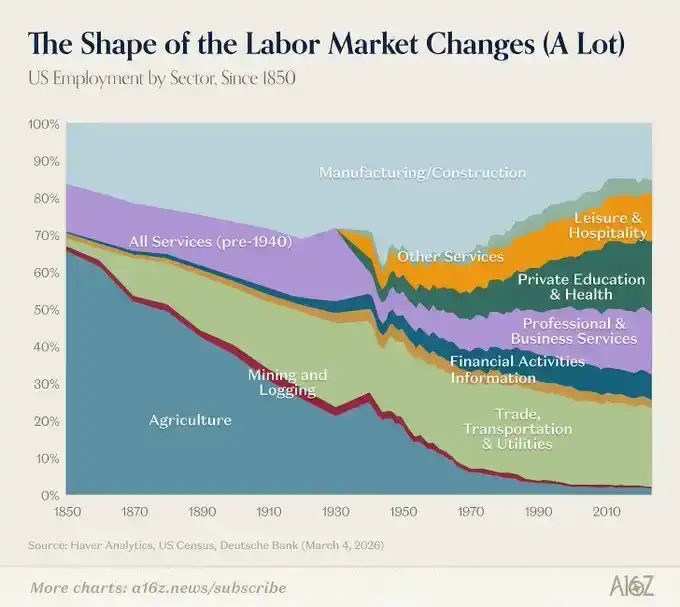
If historical experience remains instructive, then we can expect technological change to make the entire economic pie larger.

Every once-dominant economic sector has eventually given way to a larger successor; which in turn further propelled the overall economy to become even larger.
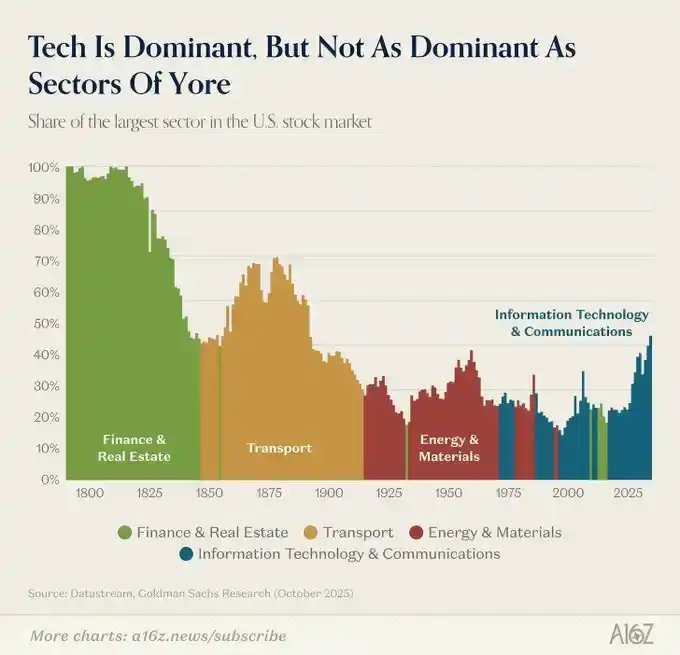
Today, the tech industry's scale already exceeds that once achieved by finance, railroads, or the industrial sector, yet its share of the entire economy or the entire market is still smaller. Productivity gains are far from a zero-sum game; they are an immensely amplified positive-sum force. After we handed over so much labor to machines, the ultimate result was not a shrinking economy and labor market, but ones that became larger, more diverse, and more complex.

Doomsayers want you to ignore the history of innovation, focus only on the single frame of 'cognition costs are collapsing,' and present it as the entire movie. They see task replacement and stop there.

'Our cognitive output will increase tenfold, but we won't think about more things as a result; we'll pat our stomachs and go to lunch early; so will everyone else.' This idea not only reveals a significant lack of imagination but also a failure to observe basic reality. Doomsayers call this 'realism,' but this is not what has truly happened in history—never.

The Failure of Luddism

Let's look at what actually happens when a great leap in productivity sweeps through the economy.

Agriculture

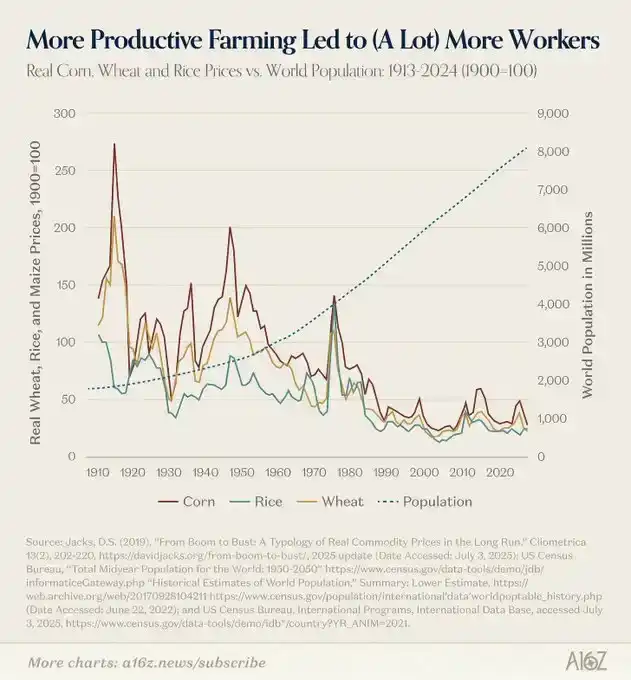
Before the widespread adoption of agricultural mechanization in the early 20th century, about one-third of the US working population was engaged in agriculture. By 2017, this proportion had fallen to about 2%.

If automation caused permanent unemployment, tractors should have already destroyed the labor market. Yet the opposite happened: agricultural output nearly tripled, supporting massive population growth; and those workers who left the farms did not become permanently unemployed but flowed into previously unimaginable new industries—factories, shops, offices, hospitals, laboratories, and eventually into the service and software sectors.

So, of course, it can be said that technology did disrupt the career prospects of the average farmworker; but it was precisely in this process that it unleashed a global surplus of labor and resources and ushered in a whole new economic system.
Electrification

The story of electricity is similar.

Electrification wasn't just about swapping one power source for another. It replaced central line shafts and belts with individual electric motors, forcing factories to reorganize around entirely new workflows and creating entirely new categories of consumer and industrial goods.
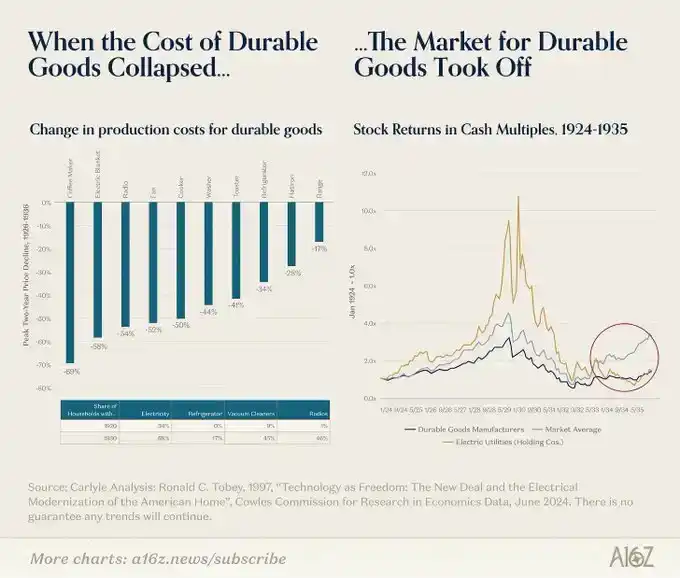
This is a typical feature of how technological revolutions unfold in different phases. Carlota Perez documented this process in 'Technological Revolutions and Financial Capital': a phase of massive investment and intense interest from financial capital appears early on, the cost of durable goods plummets, followed by a generational growth cycle for durable goods manufacturers.

Electricity also took a considerable time to truly unleash its productivity magic. At the turn of the 20th century, only 5% of US factories used electricity to drive machinery, and less than 10% of homes were electrified.
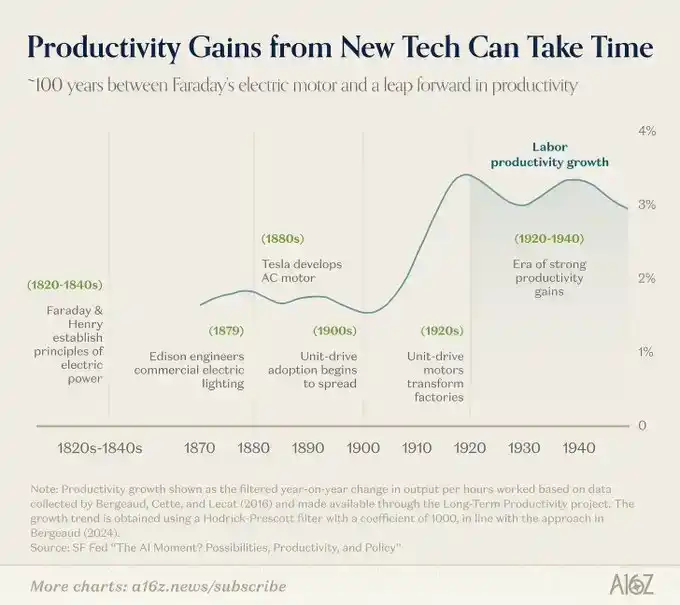
By 1930, electricity supplied nearly 80% of the power for US manufacturing, and labor productivity growth rates doubled in the following decades.

It did not destroy the demand for labor. On the contrary, higher productivity meant more manufacturing activity, more salespeople, more credit issuance, and more commercial activity. Not to mention the second-order effects of labor-saving devices like washing machines and cars—they both freed more people from previously inefficient labor, allowing them to enter higher-value activities that were impossible before.
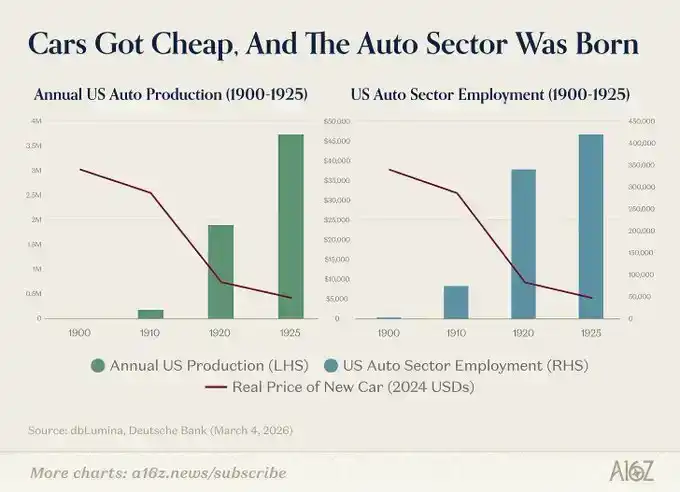
As car prices fell, both car production and employment saw explosive growth. This is the result of a true general-purpose technology: it reorganizes the economy and expands the boundaries of 'useful work.'

We have seen this time and again. Did VisiCalc and Excel spell doom for bookkeepers? Clearly not. Computational technology that drastically improved efficiency actually led to an expansion in bookkeeping positions and created the entire FP&A (Financial Planning & Analysis) industry.
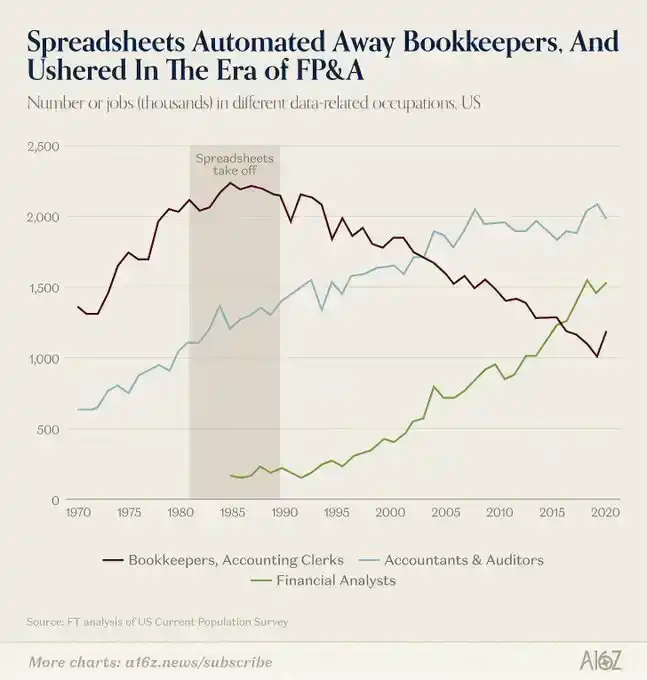
We lost roughly 1 million 'bookkeeper' jobs but gained about 1.5 million 'financial analyst' jobs.

Those New Service Jobs

Of course, task substitution doesn't always lead to job growth in adjacent areas of the economy. Sometimes, the surplus released by productivity manifests as entirely new employment growth in a completely unrelated sector.

But what if AI means some people become extremely wealthy while others are left behind?

At the very least, those extremely wealthy people will have to spend their money somewhere, creating brand-new services from scratch. This is precisely what happened in the past:
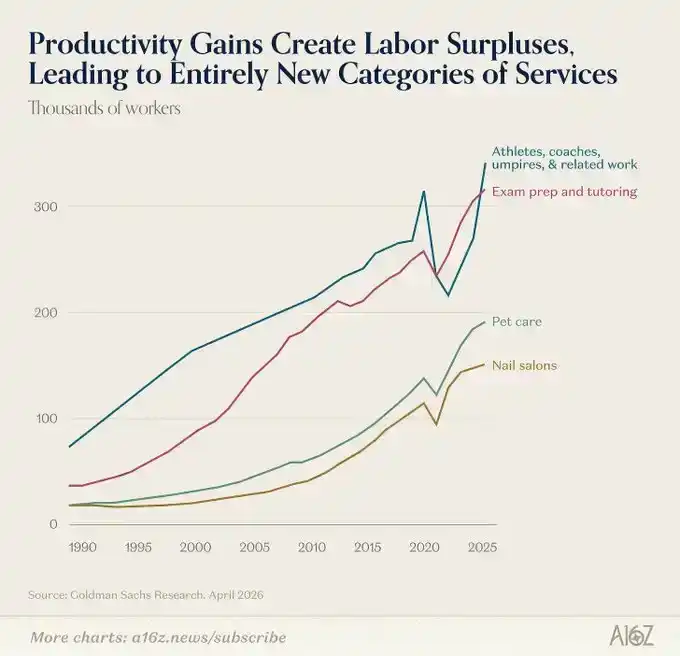
Massive productivity gains and the subsequent wealth creation they brought forth gave rise to many entirely new job types. Without rising incomes and increased labor availability, these jobs might never have truly emerged—even if they were technically feasible before the 1990s. Regardless of how one views service jobs for the wealthy, the end result was that everyone became better off: higher demand drove a significant rise in median wages, thereby creating more 'wealthy' people.

Stripe's internal economist, Ernie Tedeschi, provides a very interesting 'synthetic case': how a job can be impacted, transformed, and reshaped by technology—the travel agent.

Did technology reduce the demand for travel agents? Yes, certainly:
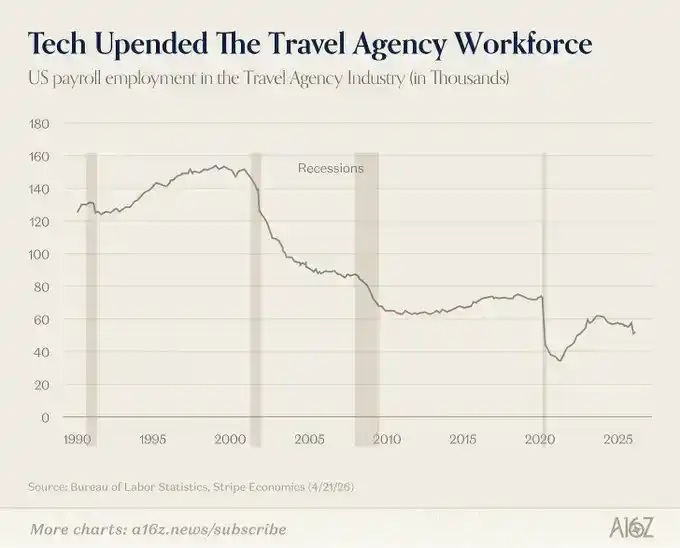
Today, travel agency employment is about half what it was at the turn of the century, almost certainly due to technology.

So, does this mean technology is a job killer? The answer is still no. Because travel agents didn't become permanently unemployed. They found work elsewhere in the economy; overall, the age-adjusted employment-to-population ratio today is roughly the same as in 2000.

Meanwhile, for those travel agents who remain in this now technology-empowered industry, productivity gains mean their wages are higher than before:
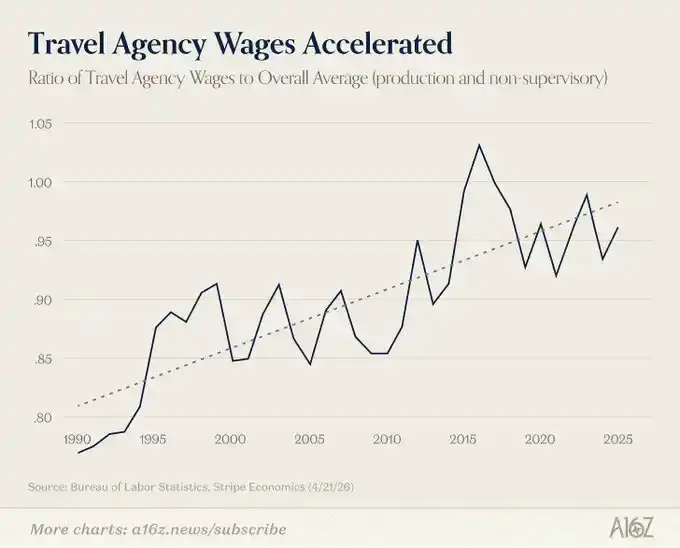
'In the golden era of 2000, the average weekly salary for a travel agent was equivalent to 87% of the overall average weekly salary. By 2025, this ratio had reached 99%, meaning travel agent wages grew faster than the overall private sector during this period.'

So, even in this case where technology did severely impact the scale of travel agent employment, overall employment among the working-age population remained as stable as before, and the travel agents who remained are actually better off than ever.

Augmentation > Substitution, and the Jobs That Don't Exist Yet

This last point is crucial and again shows that doomsayers only tell a very small part of the whole story.

For some jobs, AI is indeed an existential threat. That's true. But for other jobs, AI is a force multiplier that will make these roles more valuable. Next to every job at risk of AI substitution, there are other jobs that might benefit from AI:
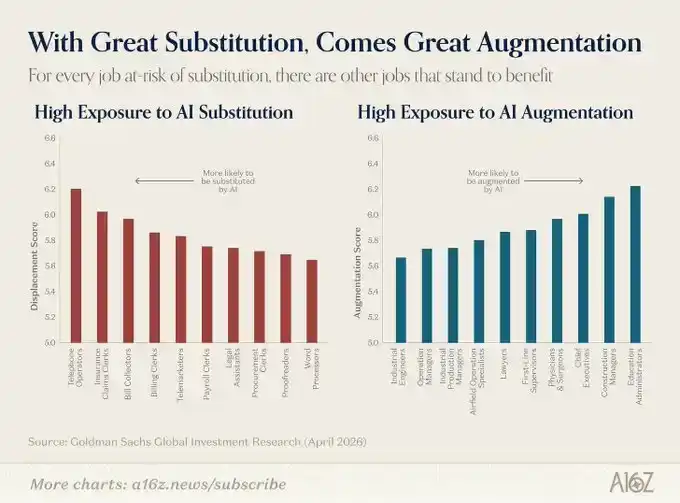
Goldman Sachs's estimated 'AI substitution' effect has been offset, and even overshadowed, by the 'AI augmentation' effect. Management also seems to be focusing more on 'augmentation' than 'substitution'—a point equally worth noting:
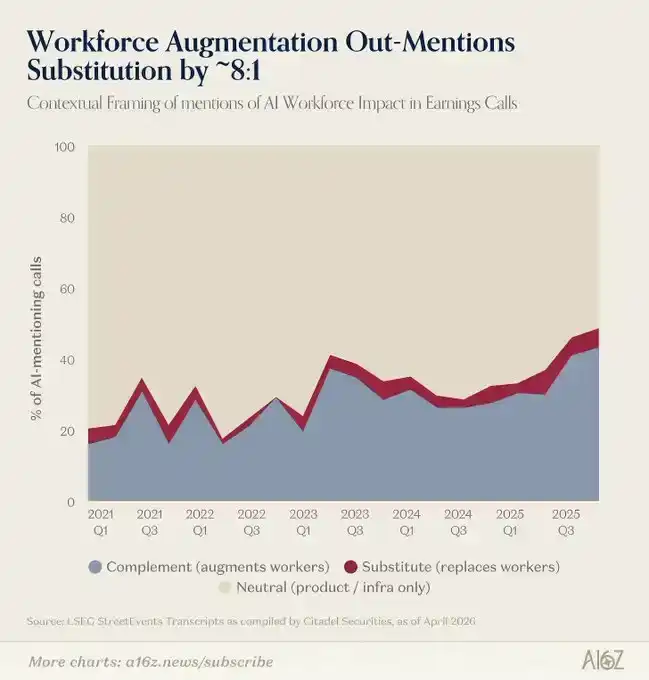
To date, mentions of 'AI as an augmentation tool' on corporate earnings calls are about 8 times more frequent than mentions of 'AI as a substitution tool.'

Although Goldman Sachs didn't even include software engineers on its 'augmentation' list, software engineers are likely the best example of an AI-augmented role. AI is a force multiplier for writing code. Not only are Git commits soaring, but the number of new applications and new companies is increasing, and the demand for software engineers appears to be on an upward inflection:
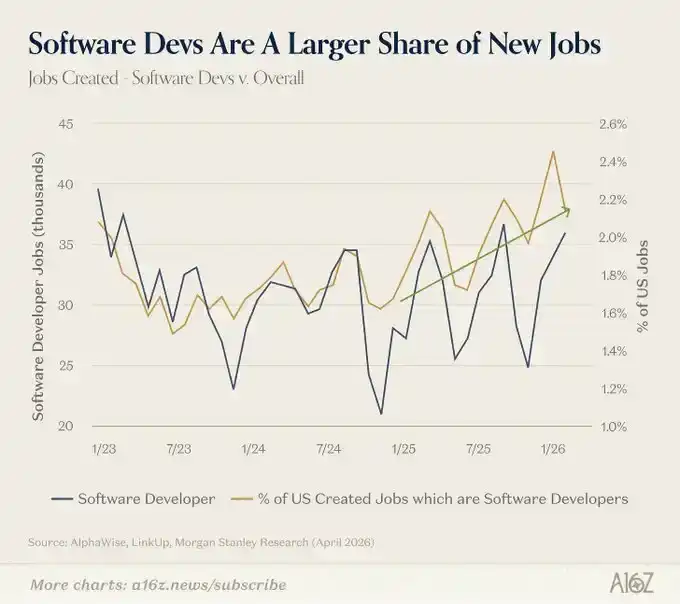
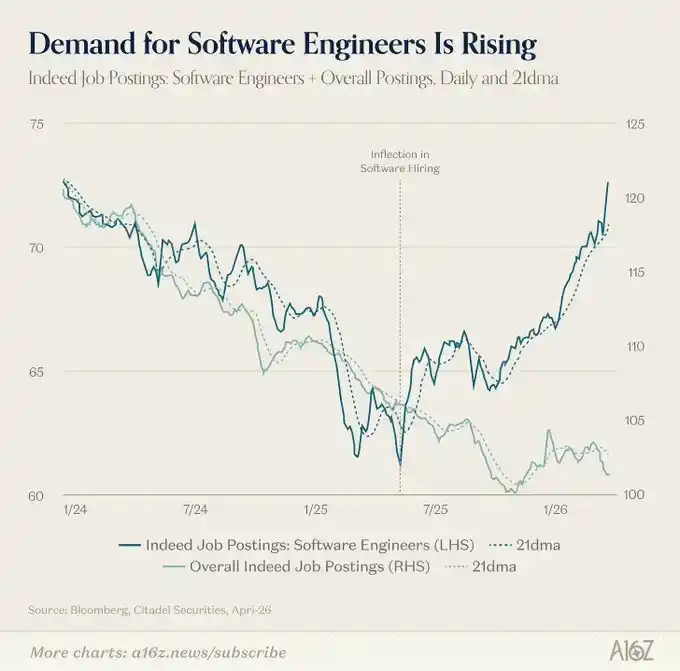
Whether measured by the number of job openings or their share of the overall job market, software development roles have been increasing since early 2025.

Is this because of AI? Honestly, it might still be too early to conclude definitively. But there's no doubt that AI enhances software engineering capabilities, not to mention that AI has become a top concern for every company and every executive.

When everyone is trying to figure out how to integrate AI into their business, companies naturally have reason to hire heavily to achieve this goal. This makes certain employees more valuable, not less:
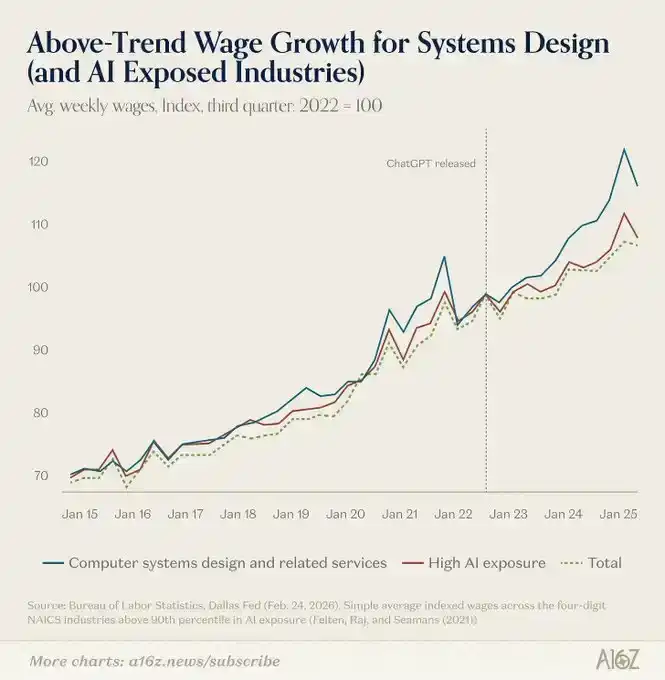
Jobs with higher AI exposure seem to be driving above-trend wage growth; this is particularly evident in systems design roles.

These gains may still be relatively concentrated for now, but it's still very, very early. As professional capabilities diffuse, opportunities will spread accordingly. In any case, this is not the data doomsayers want you to see.

Meanwhile, according to Lenny Rachitsky—author of Lenny's Newsletter and a key insider in the tech community—open product manager roles continue to rise, having recovered from the interest rate-driven collapse and reached their most abundant level since 2022:
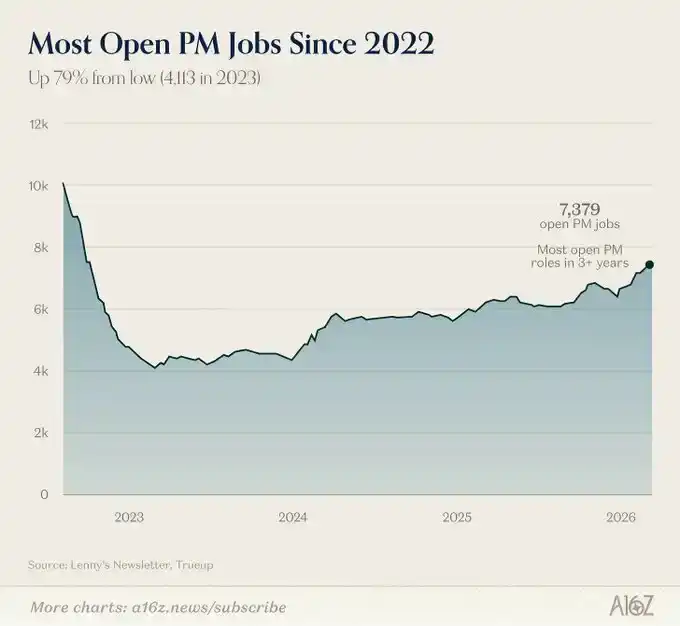
The simultaneous growth in hiring for software engineers and product managers is a concise example of why the 'lump of labor fallacy' is wrong. If AI substituted for thinking in a 1:1 manner, you might reasonably expect: 'product managers need fewer engineers,' or conversely, 'engineers need fewer product managers.' But that's not the reality we see. What we see is that demand for both types of roles continues to rebound because what truly matters is: people can accomplish more work.

This is why the doomsayers' failure is, at its core, a failure of imagination. They only stare at the tasks being automated away but ignore a new demand frontier—one that will create jobs we haven't even imagined yet:
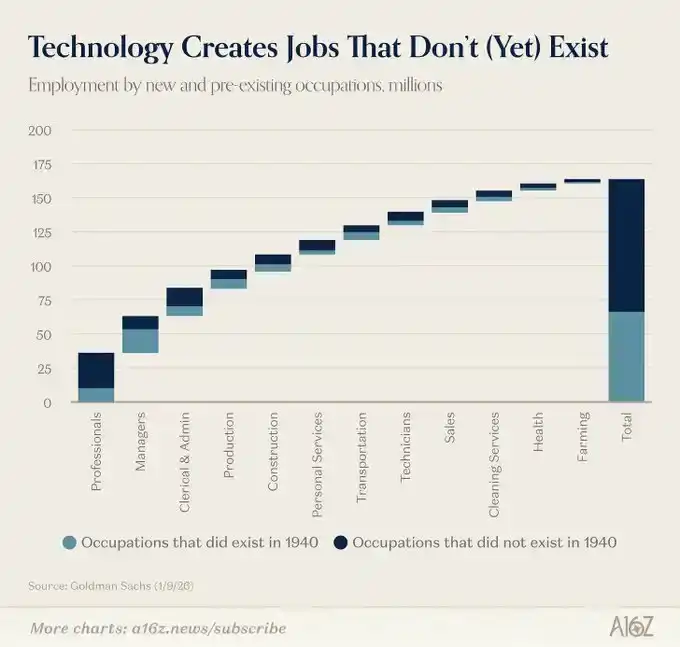
Most new jobs created since 1940 didn't even exist in 1940. By 2000, it was easy to imagine many travel agents losing their jobs, but it was probably hard to imagine then that a mid-market tech services industry built around 'cloud migration' would emerge—after all, the true rise of cloud computing was still over a decade away.


Пов'язані питання

QWhat is the 'Lump of Labor Fallacy' that the author mentions in the article, and how is it related to AI job fears?

AThe 'Lump of Labor Fallacy' is the mistaken belief that the total amount of work available in an economy is fixed. This leads to the zero-sum view that if machines or AI perform more tasks, there will be less work left for humans. The article argues that this fallacy underpins the 'AI job apocalypse' narrative. Historically, this premise is false because technological progress doesn't just destroy jobs; it creates new demands, industries, and types of work, expanding the economic pie rather than just dividing a fixed one.

QAccording to the article, how did past technological revolutions like agricultural mechanization and electrification affect the labor market in the long run?

APast technological revolutions like agricultural mechanization and electrification did displace specific jobs and tasks in the short term. For example, tractors drastically reduced the number of farmers. However, in the long run, they dramatically increased overall productivity, lowered the cost of goods, and freed up labor and resources. This led to the creation of entirely new, larger industries (like manufacturing, services, and software) and new categories of jobs that were previously unimaginable. The economy and the labor market became larger, more diverse, and more complex as a result.

QWhat is the article's main distinction between AI as a 'replacement' tool and AI as an 'augmentation' tool?

AThe article argues that the dominant narrative focuses too much on AI as a 'replacement' tool that eliminates jobs. However, evidence suggests AI often acts as an 'augmentation' or 'force multiplier' tool. It enhances human productivity in existing roles, making certain jobs (like software engineers, product managers, and system designers) more valuable and efficient. Data cited shows corporate discussions about 'AI augmentation' far outnumber those about 'AI replacement,' and demand and wages for AI-exposed roles are growing. This 'augmentation' effect can create more work and new opportunities rather than simply destroying it.

QUsing the example of travel agents and spreadsheet software (Excel), how does the article illustrate technology's complex impact on a specific profession?

AThe article uses the travel agent and spreadsheet software examples to show that technology's impact is nuanced. For travel agents, online booking technology did reduce the total number of jobs in that field by about half. However, the displaced workers found employment elsewhere in the economy. Crucially, for the travel agents who remained, their productivity and wages increased significantly (from 87% to 99% of the average wage). Similarly, spreadsheet software like Excel automated many bookkeeping tasks but didn't destroy the accounting profession. Instead, it led to the creation of more sophisticated financial analysis (FP&A) roles, resulting in a net increase in related jobs (a loss of ~1M bookkeepers but a gain of ~1.5M financial analysts).

QWhat is the article's core argument against the 'AI job apocalypse' narrative, based on historical economic patterns?

AThe article's core argument is that the 'AI job apocalypse' narrative is ahistorical and based on the flawed 'Lump of Labor Fallacy.' History shows that transformative, general-purpose technologies (like steam power, electricity, and computers) do not lead to permanent, economy-wide unemployment. Instead, they cause a painful but temporary reallocation of labor. By drastically reducing the cost and increasing the quality of a key input (in this case, cognitive labor), AI will spur new demand, enable new products and services, and open up new frontiers of human ambition. This will ultimately create new industries, job categories, and economic growth that we cannot yet fully imagine, just as past technologies did.

Пов'язані матеріали

Jensen Huang: Vera Rubin Full Mass Production, AI Agent a Key Focus, Challenging Intel to Target the Next-Generation AI PC Gateway

NVIDIA CEO Jensen Huang delivered the keynote speech at GTC Taipei 2026, announcing several major product launches and strategic directions. The company's Vera Rubin architecture is now in full-scale production, with OpenAI, Anthropic, and SpaceX among the first customers. NVIDIA highlighted AI Agent as a key future focus, introducing the Vera CPU designed for AI agents and the Vera BlueField-4 STX for secure, chip-level AI storage processing. A significant move involves challenging Intel in the PC market. NVIDIA, in collaboration with MediaTek, is developing the RTX SPARK PC chip (manufactured by TSMC) for Windows systems, set to launch this fall for laptops and desktops. This signals NVIDIA's push into the next-generation AI PC arena, aiming to provide a vertically integrated core computing platform for the entire Windows ecosystem, similar to Apple's approach. Other announcements include the new Nemotron 3 Ultra AI model and the NVIDIA DSX platform, described as a complete "playbook" for building AI factories, allowing performance simulation and validation before physical deployment. In automotive, the DRIVE Hyperion platform was positioned as a global robotaxi platform, with major Chinese automakers like BYD, Geely, Zeekr, Xiaomi, and Pony.ai already adopting or developing autonomous driving solutions based on it. The Alpamayo 2 super open inference model for robotaxis was also introduced. For robotics, NVIDIA unveiled the Isaac GR00T humanoid robot reference platform for academic research and a large open-source agent tools and skills suite for Physical AI. The company plans to collaborate with global humanoid robot manufacturers, including China's Unitree, whose H2 Plus robot served as the reference hardware for the GR00T platform demonstration.

marsbit11 хв тому

Jensen Huang: Vera Rubin Full Mass Production, AI Agent a Key Focus, Challenging Intel to Target the Next-Generation AI PC Gateway

marsbit11 хв тому

Running MoE on Mobile Phones? Meta Proposes MobileMoE, Speeding Up iPhone 16 Pro by 3.8x

Meta's MobileMoE, a mobile-optimized Mixture-of-Experts (MoE) language model architecture, enables efficient on-device large language model (LLM) inference for the first time on commercial smartphones. Designed for decoder-only Transformers, it replaces dense feed-forward layers with MoE layers. Key design choices include 8 experts with granularity g=8, top-4 routing, and a shared expert. The model undergoes a four-stage training process: pre-training, intermediate training, supervised fine-tuning, and quantization-aware training. Results show MobileMoE models, with similar memory footprint, achieve equal or higher average accuracy across 14 foundational benchmarks while using only 1/2 to 1/4 of the FLOPs compared to dense baselines. After INT4 quantization, they remain competitive. Notably, on an iPhone 16 Pro, MobileMoE-S demonstrates significant speedups: up to 3.8x faster in the prompt phase and 2.2-3.4x faster in per-token generation compared to a dense counterpart, with lower peak memory usage. While MobileMoE establishes a new Pareto frontier for on-device LLMs in accuracy-compute trade-offs, particularly excelling in code and math tasks, it currently lags behind models like Qwen3.5 2B in advanced instruction following and knowledge reasoning. Future work includes improving post-training techniques, exploring NPU deployment, and managing the runtime memory sensitivity of MoE models to varying inputs.

marsbit16 хв тому

Running MoE on Mobile Phones? Meta Proposes MobileMoE, Speeding Up iPhone 16 Pro by 3.8x

marsbit16 хв тому

Bitcoin's Weak Rebound Fails to Mask Adjustment Trend, HYPE's Top Signal Warns of Short-Term Risks | Invited Analysis

**Title:** Bitcoin's Weak Rebound Fails to Mask Downtrend; HYPE Top Signal Alerts of Short-Term Risks | Exclusive Analysis **Abstract:** This weekly market analysis examines the current technical structures of Bitcoin and HYPE, outlining key trading strategies. Bitcoin's daily chart shows it has broken below the median line of its primary ascending channel, indicating structural weakness. It is currently experiencing a weak rebound within a short-term descending channel, targeting resistance at $75,000-$76,000. Failure to break above this zone could lead to a resumption of the downtrend, testing support at $69,500-$70,500. Trading strategies include positioning for a rebound rejection (Plan A) or a breakdown below key support (Plan B) with controlled short positions. For HYPE, the 4-hour chart reveals a potential seven-wave advance from the May 14 low, now showing signs of exhaustion. A bearish divergence (momentum weakening) has been observed, coupled with a top signal from the proprietary "Spread Trading Model" at potential endpoint 47. The key this week is to monitor if a confirmed top forms here, especially upon a breach of the $62.5-$64.57 support area. If broken, a larger corrective move towards $54-$56.30 is anticipated. The short-term strategy for HYPE focuses on cautious long entries only upon confirmed stabilization within the support zone. The report also details a successful short BTC trade from the previous week, yielding a ~5.07% profit, executed based on model signals and price action. Strict risk management rules, including dynamic stop-loss adjustments, are emphasized.

marsbit32 хв тому

Bitcoin's Weak Rebound Fails to Mask Adjustment Trend, HYPE's Top Signal Warns of Short-Term Risks | Invited Analysis

marsbit32 хв тому

Торгівля

Спот
Ф'ючерси

Популярні статті

Що таке GROK AI

Grok AI: Революція в розмовних технологіях ери Web3 Вступ У швидко змінюваному ландшафті штучного інтелекту Grok AI вирізняється як помітний проєкт, що поєднує сфери передових технологій та взаємодії з користувачами. Розроблений компанією xAI, яку очолює відомий підприємець Ілон Маск, Grok AI прагне переосмислити, як ми взаємодіємо зі штучним інтелектом. Оскільки рух Web3 продовжує процвітати, Grok AI має на меті використати потужність розмовного ШІ для відповіді на складні запитання, надаючи користувачам досвід, який є не лише інформативним, але й розважальним. Що таке Grok AI? Grok AI — це складний розмовний чат-бот, розроблений для динамічної взаємодії з користувачами. На відміну від багатьох традиційних систем ШІ, Grok AI охоплює ширший спектр запитів, включаючи ті, які зазвичай вважаються недоречними або виходять за межі стандартних відповідей. Основні цілі проєкту включають: Надійне міркування: Grok AI акцентує увагу на здоровому глузді, щоб надавати логічні відповіді на основі контекстуального розуміння. Масштабоване управління: Інтеграція допоміжних інструментів забезпечує моніторинг та оптимізацію взаємодій користувачів для покращення якості. Формальна верифікація: Безпека є пріоритетом; Grok AI впроваджує методи формальної верифікації для підвищення надійності своїх результатів. Розуміння довгого контексту: Модель ШІ відзначається здатністю зберігати та згадувати обширну історію розмов, що сприяє змістовним та контекстуально обізнаним дискусіям. Стійкість до атак: Зосереджуючись на покращенні своїх захистів від маніпульованих або зловмисних вхідних даних, Grok AI прагне зберегти цілісність взаємодій з користувачами. По суті, Grok AI — це не просто пристрій для отримання інформації; це занурюючий розмовний партнер, який заохочує динамічний діалог. Творець Grok AI Геній, що стоїть за Grok AI, — це ніхто інший, як Ілон Маск, особа, яка стала синонімом інновацій у різних сферах, включаючи автомобільну промисловість, космічні подорожі та технології. Під егідою xAI, компанії, що зосереджена на розвитку технологій ШІ на користь суспільства, бачення Маска прагне переосмислити розуміння взаємодій з ШІ. Лідерство та основоположна етика глибоко впливають на прагнення Маска розширити технологічні межі. Інвестори Grok AI Хоча конкретні деталі щодо інвесторів, які підтримують Grok AI, залишаються обмеженими, загальновідомо, що xAI, інкубатор проєкту, заснований і підтримується переважно самим Ілоном Маском. Попередні підприємства та активи Маска забезпечують надійну підтримку, що додатково зміцнює довіру до Grok AI та потенціал для зростання. Однак наразі інформація про додаткові інвестиційні фонди або організації, що підтримують Grok AI, не є доступною, що позначає область для потенційного майбутнього дослідження. Як працює Grok AI? Операційна механіка Grok AI є такою ж інноваційною, як і його концептуальна структура. Проєкт інтегрує кілька передових технологій, які сприяють його унікальним функціональним можливостям: Надійна інфраструктура: Grok AI побудований з використанням Kubernetes для оркестрації контейнерів, Rust для продуктивності та безпеки, і JAX для високопродуктивних числових обчислень. Ця трійка забезпечує ефективну роботу чат-бота, його масштабованість та швидке обслуговування користувачів. Доступ до знань у реальному часі: Однією з відмінних рис Grok AI є його здатність отримувати дані в реальному часі через платформу X — раніше відому як Twitter. Ця можливість надає ШІ доступ до останньої інформації, що дозволяє надавати своєчасні відповіді та рекомендації, які можуть бути пропущені іншими моделями ШІ. Два режими взаємодії: Grok AI пропонує користувачам вибір між “Розважальним режимом” та “Звичайним режимом”. Розважальний режим дозволяє більш ігровий та гумористичний стиль взаємодії, тоді як Звичайний режим зосереджується на наданні точних і правильних відповідей. Ця універсальність забезпечує індивідуальний досвід, що відповідає різним уподобанням користувачів. По суті, Grok AI поєднує продуктивність із залученням, створюючи досвід, який є одночасно збагачуючим і розважальним. Хронологія Grok AI Шлях Grok AI відзначений важливими етапами, які відображають його розвиток та етапи впровадження: Початковий розвиток: Фундаментальна фаза Grok AI тривала приблизно два місяці, протягом яких проводилося початкове навчання та налаштування моделі. Випуск бета-версії Grok-2: У значному досягненні була оголошена бета-версія Grok-2. Цей випуск представив дві версії чат-бота — Grok-2 та Grok-2 mini — кожна з яких оснащена можливостями для спілкування, кодування та міркування. Публічний доступ: Після бета-розробки Grok AI став доступним для користувачів платформи X. Ті, хто має акаунти, підтверджені номером телефону та активні принаймні сім днів, можуть отримати доступ до обмеженої версії, що робить технологію доступною для ширшої аудиторії. Ця хронологія відображає систематичний розвиток Grok AI від початку до публічної взаємодії, підкреслюючи його прагнення до постійного вдосконалення та взаємодії з користувачами. Ключові особливості Grok AI Grok AI охоплює кілька ключових особливостей, які сприяють його інноваційній ідентичності: Інтеграція знань у реальному часі: Доступ до актуальної та релевантної інформації відрізняє Grok AI від багатьох статичних моделей, забезпечуючи захоплюючий та точний досвід для користувачів. Універсальні стилі взаємодії: Пропонуючи різні режими взаємодії, Grok AI задовольняє різноманітні уподобання користувачів, запрошуючи до творчості та персоналізації у спілкуванні з ШІ. Передова технологічна основа: Використання Kubernetes, Rust та JAX надає проєкту надійну основу для забезпечення надійності та оптимальної продуктивності. Етичні міркування в дискурсі: Включення функції генерації зображень демонструє інноваційний дух проєкту. Однак це також піднімає етичні питання, пов'язані з авторським правом та поважним зображенням впізнаваних фігур — триваюча дискусія в спільноті ШІ. Висновок Як піонер у сфері розмовного ШІ, Grok AI втілює потенціал трансформаційних користувацьких досвідів в цифрову епоху. Розроблений компанією xAI та керований візією Ілона Маска, Grok AI інтегрує знання в реальному часі з передовими можливостями взаємодії. Він прагне розширити межі того, що може досягти штучний інтелект, зберігаючи при цьому акцент на етичних міркуваннях та безпеці користувачів. Grok AI не лише втілює технологічний прогрес, але й представляє нову парадигму спілкування в ландшафті Web3, обіцяючи залучити користувачів як глибокими знаннями, так і ігровою взаємодією. Оскільки проєкт продовжує розвиватися, він слугує свідченням того, що може досягти перетин технологій, творчості та людської взаємодії.

442 переглядів усьогоОпубліковано 2024.12.26Оновлено 2024.12.26

Що таке GROK AI

Що таке ERC AI

Euruka Tech: Огляд $erc ai та його амбіцій у Web3 Вступ У швидко змінюваному ландшафті технології блокчейн та децентралізованих додатків нові проекти з'являються часто, кожен з унікальними цілями та методологіями. Одним з таких проектів є Euruka Tech, який працює у широкій сфері криптовалют та Web3. Основна увага Euruka Tech, зокрема його токена $erc ai, зосереджена на представленні інноваційних рішень, розроблених для використання зростаючих можливостей децентралізованих технологій. Ця стаття має на меті надати всебічний огляд Euruka Tech, дослідження його цілей, функціональності, ідентичності його творця, потенційних інвесторів та його значення в ширшому контексті Web3. Що таке Euruka Tech, $erc ai? Euruka Tech характеризується як проект, який використовує інструменти та функціональність, що пропонуються середовищем Web3, зосереджуючи увагу на інтеграції штучного інтелекту у своїй діяльності. Хоча конкретні деталі про структуру проекту дещо неясні, він розроблений для покращення залучення користувачів та автоматизації процесів у крипто-просторі. Проект має на меті створити децентралізовану екосистему, яка не лише полегшує транзакції, але й включає прогностичні функції через штучний інтелект, звідси і назва його токена, $erc ai. Мета полягає в тому, щоб надати інтуїтивно зрозумілу платформу, яка сприяє розумнішим взаємодіям та ефективній обробці транзакцій у зростаючій сфері Web3. Хто є творцем Euruka Tech, $erc ai? На даний момент інформація про творця або засновницьку команду Euruka Tech залишається невизначеною та дещо непрозорою. Ця відсутність даних викликає занепокоєння, оскільки знання про бекграунд команди часто є важливим для встановлення довіри в секторі блокчейн. Тому ми класифікували цю інформацію як невідому, поки конкретні деталі не стануть доступними в публічному домені. Хто є інвесторами Euruka Tech, $erc ai? Аналогічно, ідентифікація інвесторів або організацій, які підтримують проект Euruka Tech, не надається через доступні дослідження. Аспект, який є критично важливим для потенційних зацікавлених сторін або користувачів, які розглядають можливість співпраці з Euruka Tech, - це впевненість, що походить від встановлених фінансових партнерств або підтримки від авторитетних інвестиційних компаній. Без розкриття інформації про інвестиційні зв'язки важко зробити всебічні висновки про фінансову безпеку або довговічність проекту. Відповідно до знайденої інформації, цей розділ також має статус невідомий. Як працює Euruka Tech, $erc ai? Незважаючи на відсутність детальних технічних специфікацій для Euruka Tech, важливо враховувати його інноваційні амбіції. Проект прагне використовувати обчислювальну потужність штучного інтелекту для автоматизації та покращення досвіду користувачів у середовищі криптовалют. Інтегруючи ШІ з технологією блокчейн, Euruka Tech має на меті надати такі функції, як автоматизовані угоди, оцінка ризиків та персоналізовані інтерфейси користувачів. Інноваційна суть Euruka Tech полягає в його меті створити безшовний зв'язок між користувачами та величезними можливостями, які пропонують децентралізовані мережі. Завдяки використанню алгоритмів машинного навчання та ШІ, він має на меті мінімізувати труднощі для нових користувачів і спростити транзакційні досвіди в рамках Web3. Ця симбіоз між ШІ та блокчейном підкреслює значення токена $erc ai, який виступає як міст між традиційними інтерфейсами користувачів та розвиненими можливостями децентралізованих технологій. Хронологія Euruka Tech, $erc ai На жаль, через обмежену інформацію про Euruka Tech ми не можемо представити детальну хронологію основних подій або досягнень у подорожі проекту. Ця хронологія, яка зазвичай є безцінною для відстеження еволюції проекту та розуміння його траєкторії зростання, наразі недоступна. Як тільки інформація про значні події, партнерства або функціональні доповнення стане очевидною, оновлення, безумовно, підвищать видимість Euruka Tech у крипто-сфері. Роз'яснення щодо інших проектів “Eureka” Варто зазначити, що кілька проектів та компаній мають схожу назву з “Eureka”. Дослідження виявило ініціативи, такі як AI-агент від NVIDIA Research, який зосереджується на навчанні роботів складним завданням за допомогою генеративних методів, а також Eureka Labs та Eureka AI, які покращують користувацький досвід в освіті та аналітиці обслуговування клієнтів відповідно. Однак ці проекти відрізняються від Euruka Tech і не повинні бути змішані з його цілями чи функціональністю. Висновок Euruka Tech, разом із його токеном $erc ai, представляє обіцяючого, але наразі невідомого гравця в ландшафті Web3. Хоча деталі про його творця та інвесторів залишаються невідомими, основна амбіція поєднання штучного інтелекту з технологією блокчейн є центром інтересу. Унікальні підходи проекту до сприяння залученню користувачів через передову автоматизацію можуть виділити його на фоні прогресу екосистеми Web3. Оскільки крипто-ринок продовжує еволюціонувати, зацікавлені сторони повинні уважно стежити за новинами, пов'язаними з Euruka Tech, оскільки розвиток задокументованих інновацій, партнерств або визначеного дорожньої карти може представити значні можливості в найближчому майбутньому. На даний момент ми чекаємо на більш суттєві інсайти, які можуть розкрити потенціал Euruka Tech та його позицію в конкурентному крипто-ландшафті.

423 переглядів усьогоОпубліковано 2025.01.02Оновлено 2025.01.02

Що таке ERC AI

Що таке DUOLINGO AI

DUOLINGO AI: Інтеграція вивчення мов з Web3 та інноваціями штучного інтелекту В епоху, коли технології змінюють освіту, інтеграція штучного інтелекту (ШІ) та блокчейн-мереж відкриває нові горизонти для вивчення мов. З'являється DUOLINGO AI та його асоційована криптовалюта, $DUOLINGO AI. Цей проект прагне об'єднати освітні можливості провідних платформ для вивчення мов з перевагами децентралізованих технологій Web3. У цій статті розглядаються ключові аспекти DUOLINGO AI, його цілі, технологічна структура, історичний розвиток та майбутній потенціал, зберігаючи чіткість між оригінальним освітнім ресурсом та цією незалежною криптовалютною ініціативою. Огляд DUOLINGO AI В основі DUOLINGO AI лежить прагнення створити децентралізоване середовище, де учні можуть отримувати криптографічні винагороди за досягнення освітніх етапів у мовній компетенції. Застосовуючи смарт-контракти, проект має на меті автоматизувати процеси перевірки навичок та розподілу токенів, дотримуючись принципів Web3, які підкреслюють прозорість та власність користувачів. Модель відрізняється від традиційних підходів до вивчення мов, акцентуючи увагу на структурі управління, що базується на спільноті, що дозволяє власникам токенів пропонувати поліпшення змісту курсів та розподілу винагород. Деякі з помітних цілей DUOLINGO AI включають: Гейміфіковане навчання: Проект інтегрує досягнення на блокчейні та невзаємозамінні токени (NFT), щоб представляти рівні мовної компетенції, сприяючи мотивації через захоплюючі цифрові винагороди. Децентралізоване створення контенту: Це відкриває можливості для викладачів та мовних ентузіастів вносити свої курси, сприяючи моделі розподілу доходів, яка вигідна всім учасникам. Персоналізація на основі ШІ: Використовуючи сучасні моделі машинного навчання, DUOLINGO AI персоналізує уроки, щоб адаптуватися до індивідуального прогресу навчання, подібно до адаптивних функцій, що є в усталених платформах. Творці проекту та управління Станом на квітень 2025 року команда, що стоїть за $DUOLINGO AI, залишається псевдонімною, що є поширеною практикою в децентралізованому криптовалютному середовищі. Ця анонімність має на меті сприяти колективному розвитку та залученню зацікавлених сторін, а не зосереджуватися на окремих розробниках. Смарт-контракт, розгорнутий на блокчейні Solana, зазначає адресу гаманця розробника, що свідчить про зобов'язання до прозорості щодо транзакцій, незважаючи на те, що особи творців залишаються невідомими. Згідно з його дорожньою картою, DUOLINGO AI прагне перетворитися на Децентралізовану Автономну Організацію (DAO). Ця структура управління дозволяє власникам токенів голосувати з важливих питань, таких як реалізація функцій та розподіл скарбниці. Ця модель узгоджується з етикою розширення прав і можливостей спільноти, що спостерігається в різних децентралізованих додатках, підкреслюючи важливість колективного прийняття рішень. Інвестори та стратегічні партнерства На даний момент немає публічно відомих інституційних інвесторів або венчурних капіталістів, пов'язаних з $DUOLINGO AI. Натомість ліквідність проекту в основному походить з децентралізованих бірж (DEX), що є різким контрастом до стратегій фінансування традиційних компаній у сфері освітніх технологій. Ця модель знизу вгору вказує на підхід, орієнтований на спільноту, що відображає зобов'язання проекту до децентралізації. У своєму білому документі DUOLINGO AI згадує про формування співпраці з неуточненими “блокчейн-освітніми платформами”, спрямованими на збагачення своїх курсів. Хоча конкретні партнерства ще не були розкриті, ці спільні зусилля натякають на стратегію поєднання інновацій блокчейну з освітніми ініціативами, розширюючи доступ та залучення користувачів у різноманітні навчальні напрямки. Технологічна архітектура Інтеграція ШІ DUOLINGO AI включає два основні компоненти на основі ШІ для покращення своїх освітніх пропозицій: Адаптивний навчальний двигун: Цей складний двигун навчається на основі взаємодій користувачів, подібно до власних моделей великих освітніх платформ. Він динамічно регулює складність уроків, щоб вирішувати конкретні проблеми учнів, зміцнюючи слабкі місця через цілеспрямовані вправи. Розмовні агенти: Використовуючи чат-боти на базі GPT-4, DUOLINGO AI надає платформу для користувачів, щоб брати участь у симульованих розмовах, сприяючи більш інтерактивному та практичному досвіду вивчення мови. Інфраструктура блокчейну Побудований на блокчейні Solana, $DUOLINGO AI використовує комплексну технологічну структуру, яка включає: Смарт-контракти для перевірки навичок: Ця функція автоматично нагороджує токенами користувачів, які успішно проходять тести на компетентність, підкріплюючи структуру стимулів для справжніх навчальних результатів. NFT значки: Ці цифрові токени позначають різні етапи, яких досягають учні, такі як завершення розділу курсу або оволодіння конкретними навичками, що дозволяє їм обмінюватися або демонструвати свої досягнення в цифровому форматі. Управління DAO: Члени спільноти, наділені токенами, можуть брати участь в управлінні, голосуючи за ключові пропозиції, що сприяє культурі участі, яка заохочує інновації в курсах та функціях платформи. Історичний хронологічний графік 2022–2023: Концептуалізація Основи DUOLINGO AI закладаються з створення білого документа, що підкреслює синергію між досягненнями ШІ у вивченні мов та децентралізованим потенціалом блокчейн-технологій. 2024: Бета-реліз Обмежений бета-реліз представляє пропозиції з популярних мов, винагороджуючи ранніх користувачів токенами в рамках стратегії залучення спільноти проекту. 2025: Перехід до DAO У квітні відбувається повний запуск основної мережі з обігом токенів, що спонукає обговорення в спільноті щодо можливих розширень на азійські мови та інші розробки курсів. Виклики та майбутні напрямки Технічні труднощі Незважаючи на свої амбітні цілі, DUOLINGO AI стикається з суттєвими викликами. Масштабованість залишається постійною проблемою, особливо в балансуванні витрат, пов'язаних із обробкою ШІ, та підтриманням чутливої, децентралізованої мережі. Крім того, забезпечення якості створення контенту та модерації в умовах децентралізованої пропозиції створює складнощі у підтримці освітніх стандартів. Стратегічні можливості Дивлячись у майбутнє, DUOLINGO AI має потенціал використовувати партнерства з мікрокреденційними академічними установами, надаючи блокчейн-верифіковані підтвердження мовних навичок. Крім того, розширення через різні блокчейни може дозволити проекту залучити ширші бази користувачів та додаткові екосистеми блокчейну, покращуючи його взаємодію та охоплення. Висновок DUOLINGO AI представляє інноваційне злиття штучного інтелекту та блокчейн-технологій, пропонуючи альтернативу, орієнтовану на спільноту, традиційним системам вивчення мов. Хоча його псевдонімна розробка та нова економічна модель несуть певні ризики, зобов'язання проекту до гейміфікованого навчання, персоналізованої освіти та децентралізованого управління освітлює шлях вперед для освітніх технологій у сфері Web3. Оскільки ШІ продовжує розвиватися, а екосистема блокчейну еволюціонує, ініціативи на кшталт DUOLINGO AI можуть переосмислити, як користувачі взаємодіють з мовною освітою, наділяючи спільноти та винагороджуючи залучення через інноваційні механізми навчання.

450 переглядів усьогоОпубліковано 2025.04.11Оновлено 2025.04.11

Що таке DUOLINGO AI

Обговорення

Ласкаво просимо до спільноти HTX. Тут ви можете бути в курсі останніх подій розвитку платформи та отримати доступ до професійної ринкової інформації. Нижче представлені думки користувачів щодо ціни AI (AI).

活动图片