a16z Releases Top 100 AI Apps List: ChatGPT's Dominance Shakes, Global Market Divides into Three

marsbitОпубліковано о 2026-03-10Востаннє оновлено о 2026-03-10

Анотація

a16z's sixth annual Generative AI Consumer Apps Top 100 reveals a shifting landscape. While it remains the dominant leader with 900M weekly active users, ChatGPT's supremacy is being challenged. Competitors like Gemini and Claude are growing paid subscriptions faster, signaling a battle for the "default AI assistant." The report expands its scope to include established products where AI is now core to the experience, such as Canva, Notion, and CapCut. Key findings include: the market is splitting into three distinct geographic ecosystems (Western, Chinese, and Russian); creative tools are undergoing a major reshuffle as video, music, and voice generation rise while image tools get bundled into larger platforms; agentic AI, capable of taking actions, is emerging with tools like OpenClaw; and AI is increasingly moving beyond browsers and apps into desktops, browsers themselves, and deep integrations into existing software. The competition is evolving from a simple feature war to a strategic battle over building entire ecosystems and operating systems.

Author: ethn, a16z

Compiled by: Deep Tide TechFlow

Deep Tide Guide: a16z has released the sixth edition of its generative AI consumer applications list. ChatGPT has 900 million weekly active users, but Gemini and Claude are growing their paid subscriptions faster. The battle for the "default AI assistant" has officially begun.

The biggest change in this edition is the inclusion of established products like CapCut, Canva, and Notion, where "AI features have become core," alongside the first-time coverage of Agents, AI browsers, and desktop tools.

Author Olivia Moore is a partner on a16z's consumer team. This report is one of the most systematic public datasets currently tracking the landscape of AI consumer applications.

Full text below:

Three years ago, we released the first edition of this list with a simple goal: to figure out which generative AI products were actually being used by mainstream consumers. Back then, the line between "AI-native" companies and others was clear. ChatGPT, Midjourney, and Character.AI were products built from the ground up around foundational models, while the rest of the software world was still figuring out how to use the technology.
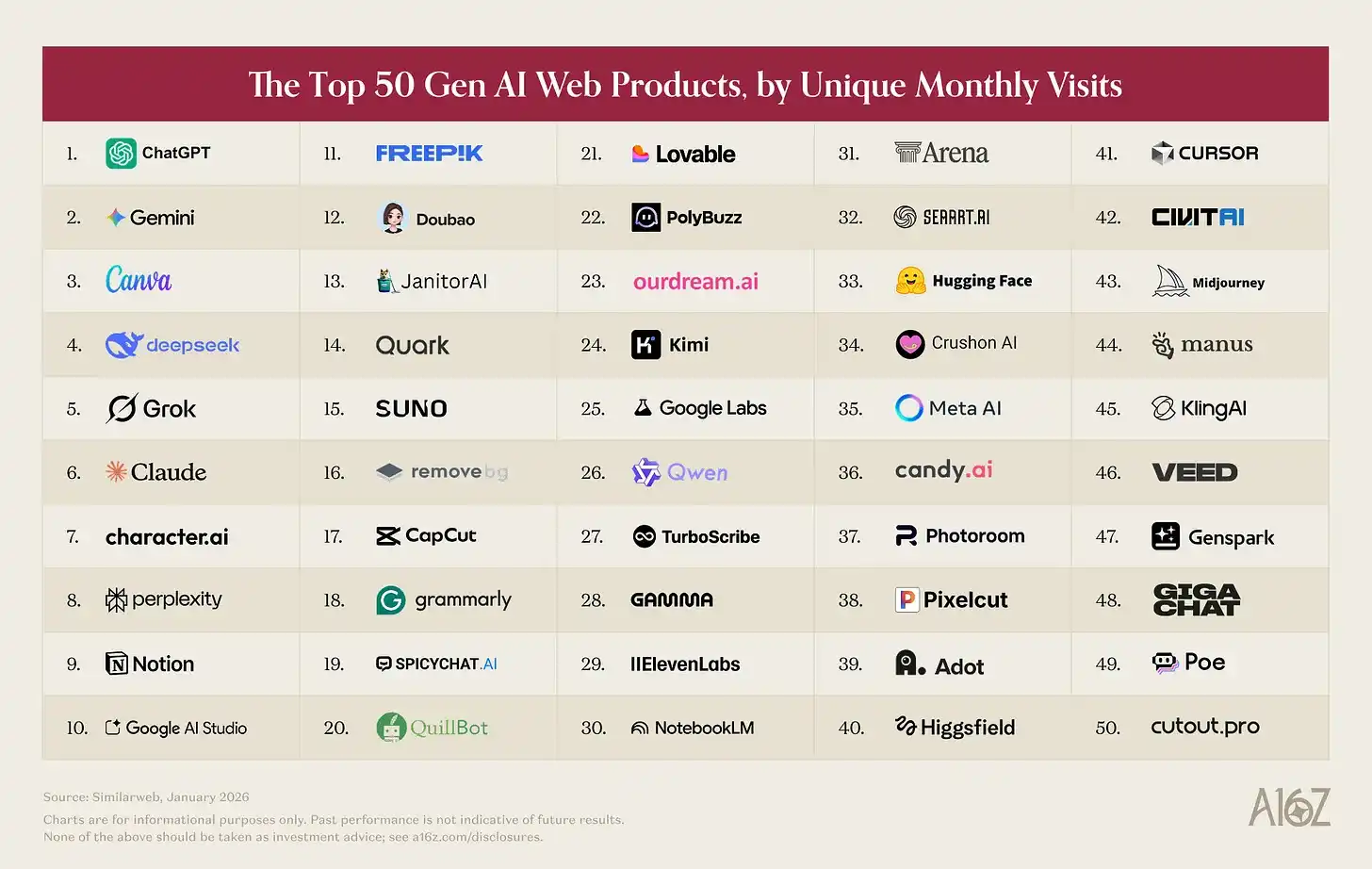
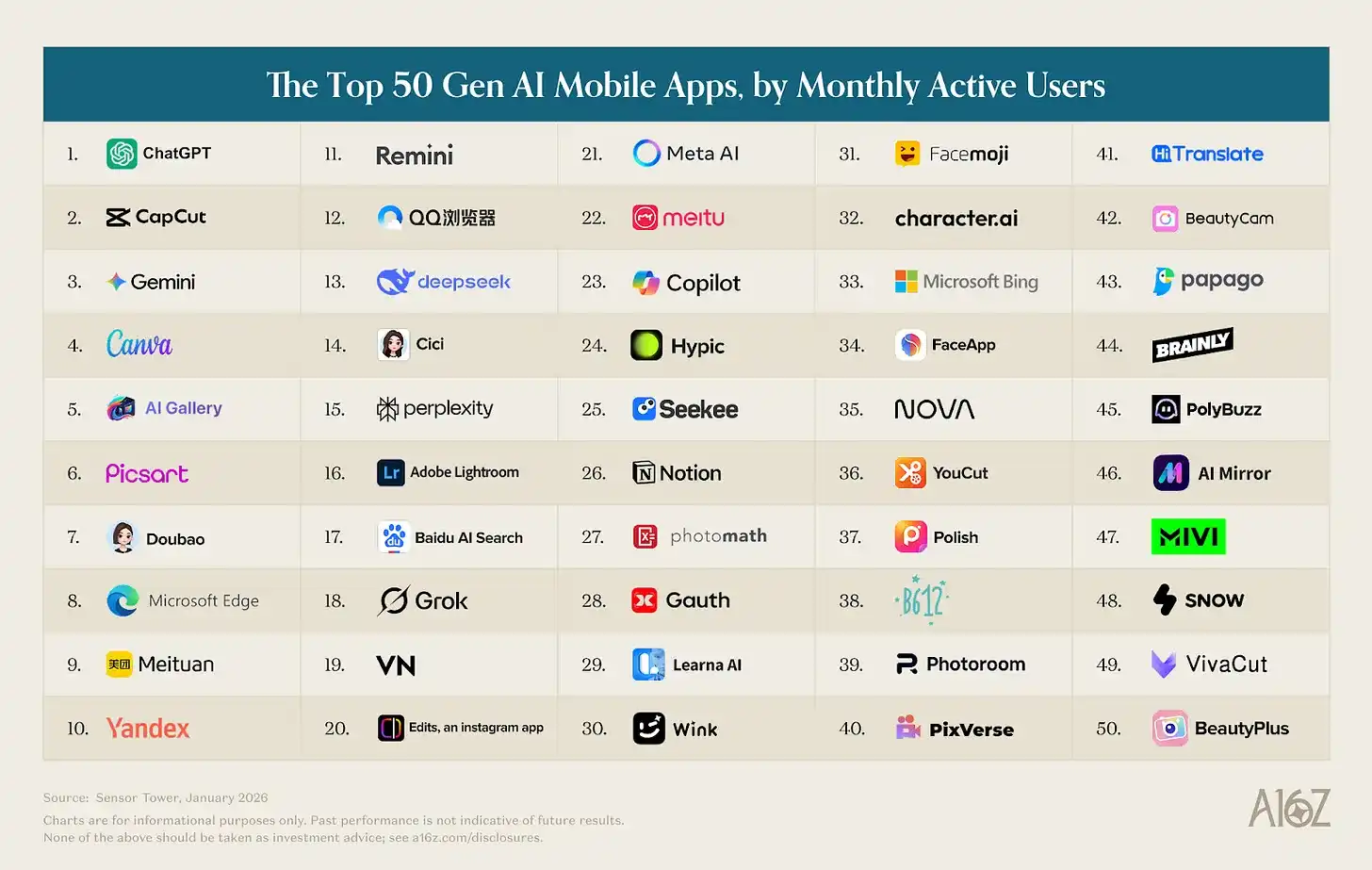
That line no longer holds. CapCut, a video editor with 736 million monthly active mobile users, has its most popular features entirely powered by AI—background removal, AI effects, auto-captions, and text-to-video. Canva's growth engine is completely built on its Magic Suite AI tools. Notion's paid attachment rate for AI soared from 20% to over 50% in a year, with AI features now contributing to about half of the company's ARR.

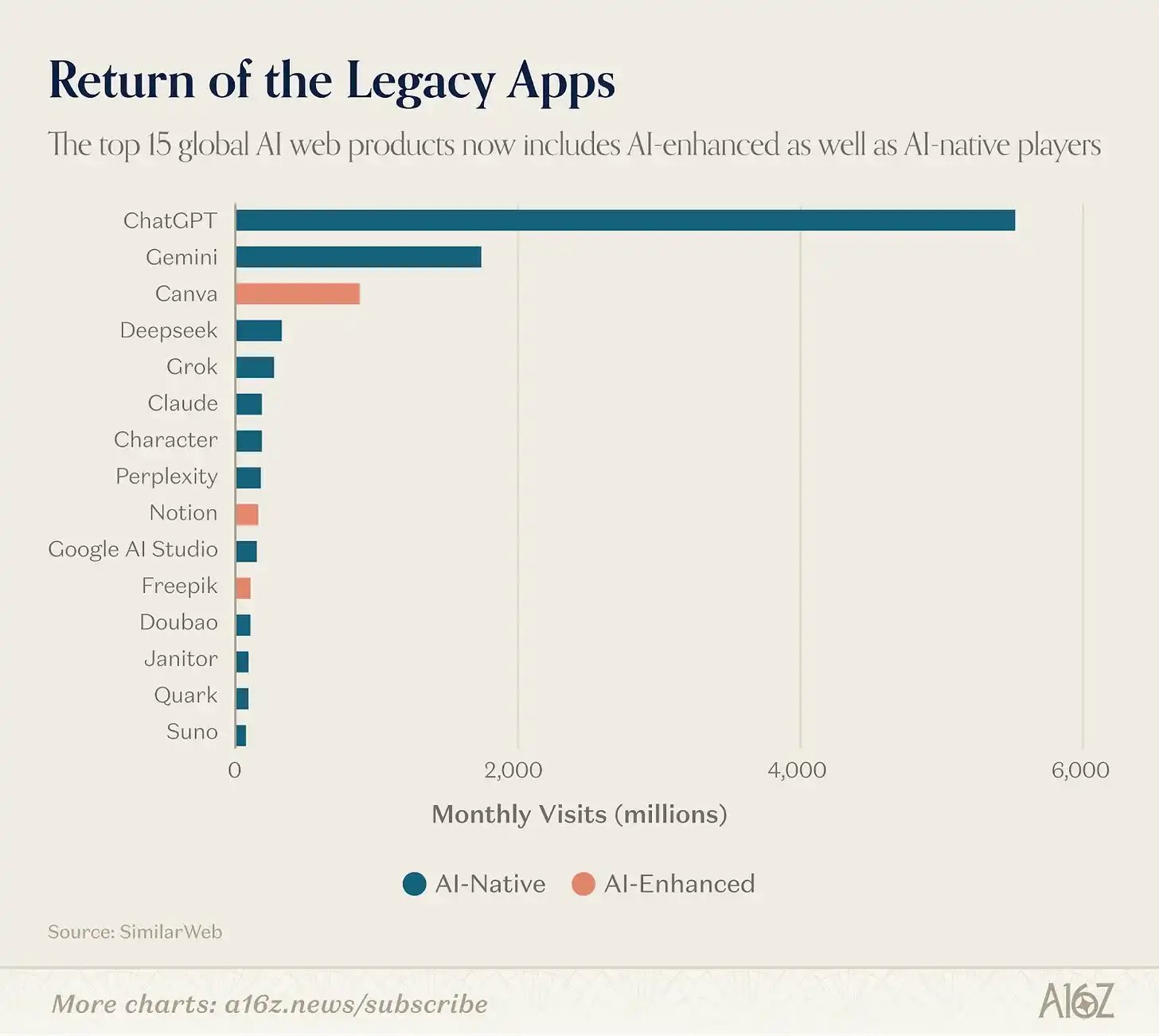
Starting with this edition, we've expanded our scope to include all consumer products where generative AI has become a core part of the experience, including CapCut, Canva, Notion, Picsart, Freepik, and Grammarly. We believe this gives a more accurate picture of how people actually use AI, though the top-ranked products are still mostly AI-native.
Caption: Full Top 100 Generative AI Consumer Applications List, March 2026 Edition

As before, web rankings are based on monthly unique visitors (data source: SimilarWeb, as of January 2026), and mobile rankings are based on monthly active users (data source: Sensor Tower, as of January 2026). Here are our key findings:

1. ChatGPT Leads, But the Battle for the "Default AI" Has Begun

ChatGPT remains the largest consumer AI product by a significant margin. Its web traffic is 2.7 times that of the second-place Gemini, and its mobile MAU is 2.5 times Gemini's. ChatGPT's weekly active users grew by 500 million in the past year, now reaching 900 million. This is staggering given the difficulty of growth at scale—over 10% of the global population uses ChatGPT weekly.
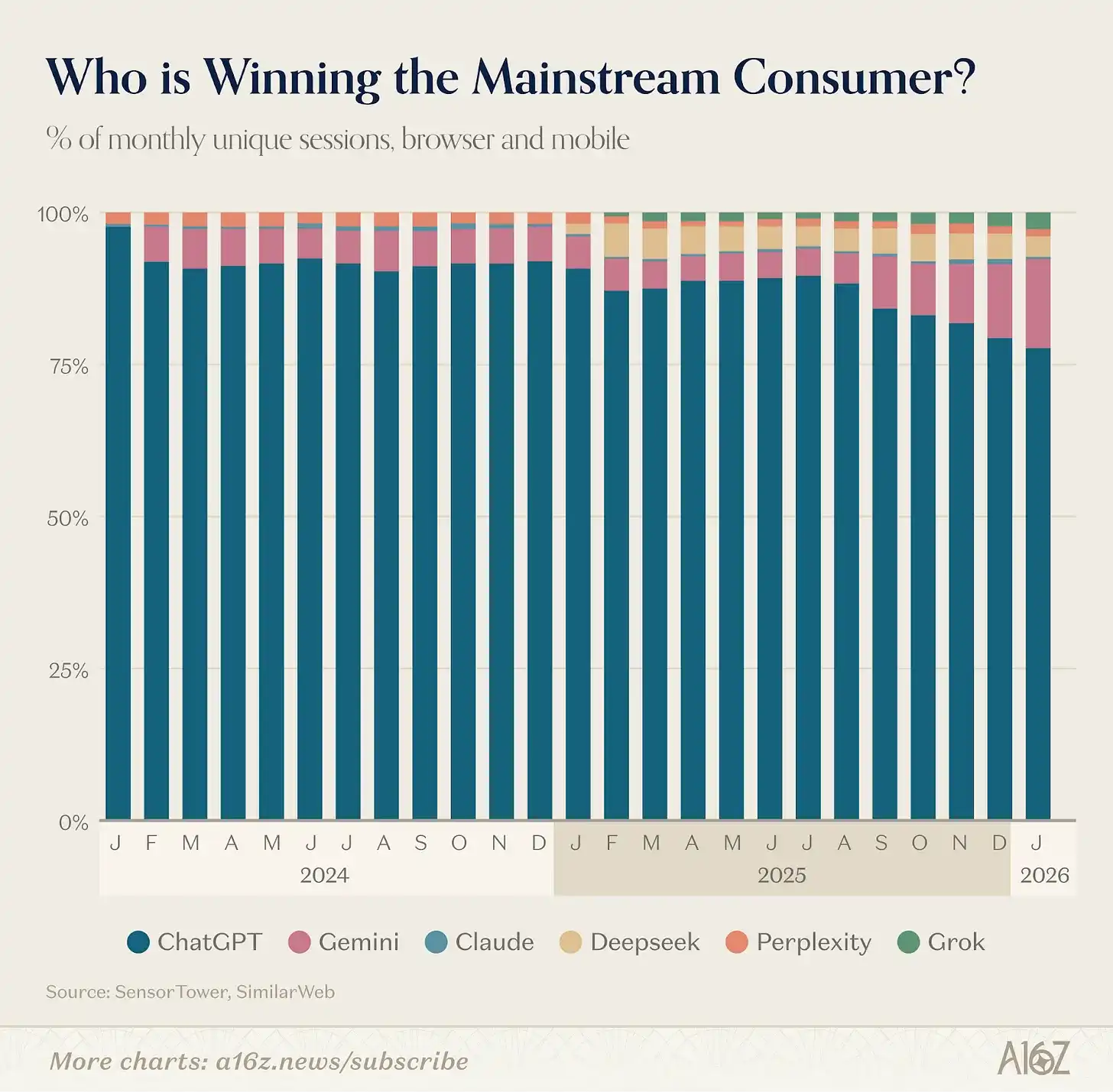
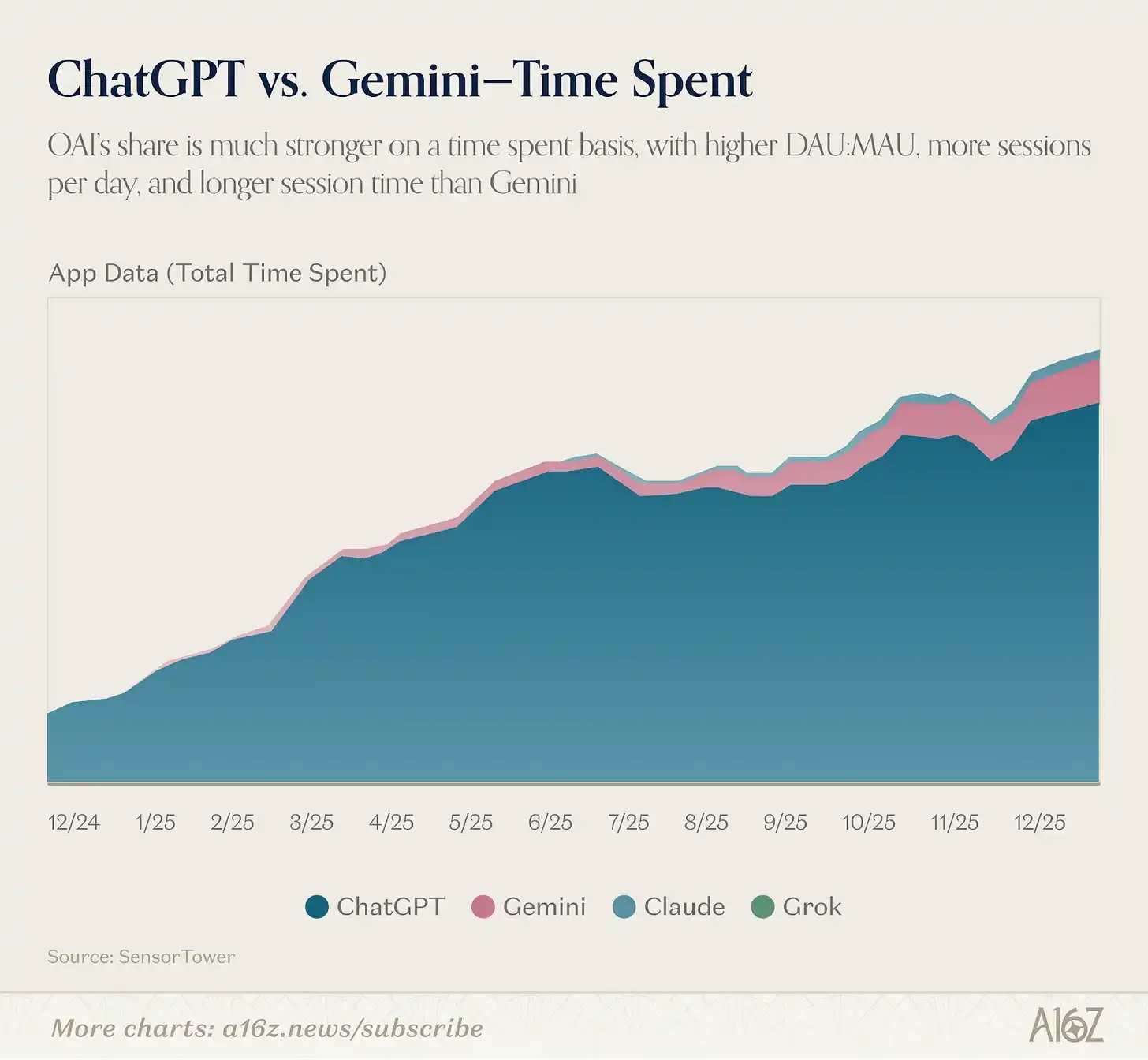
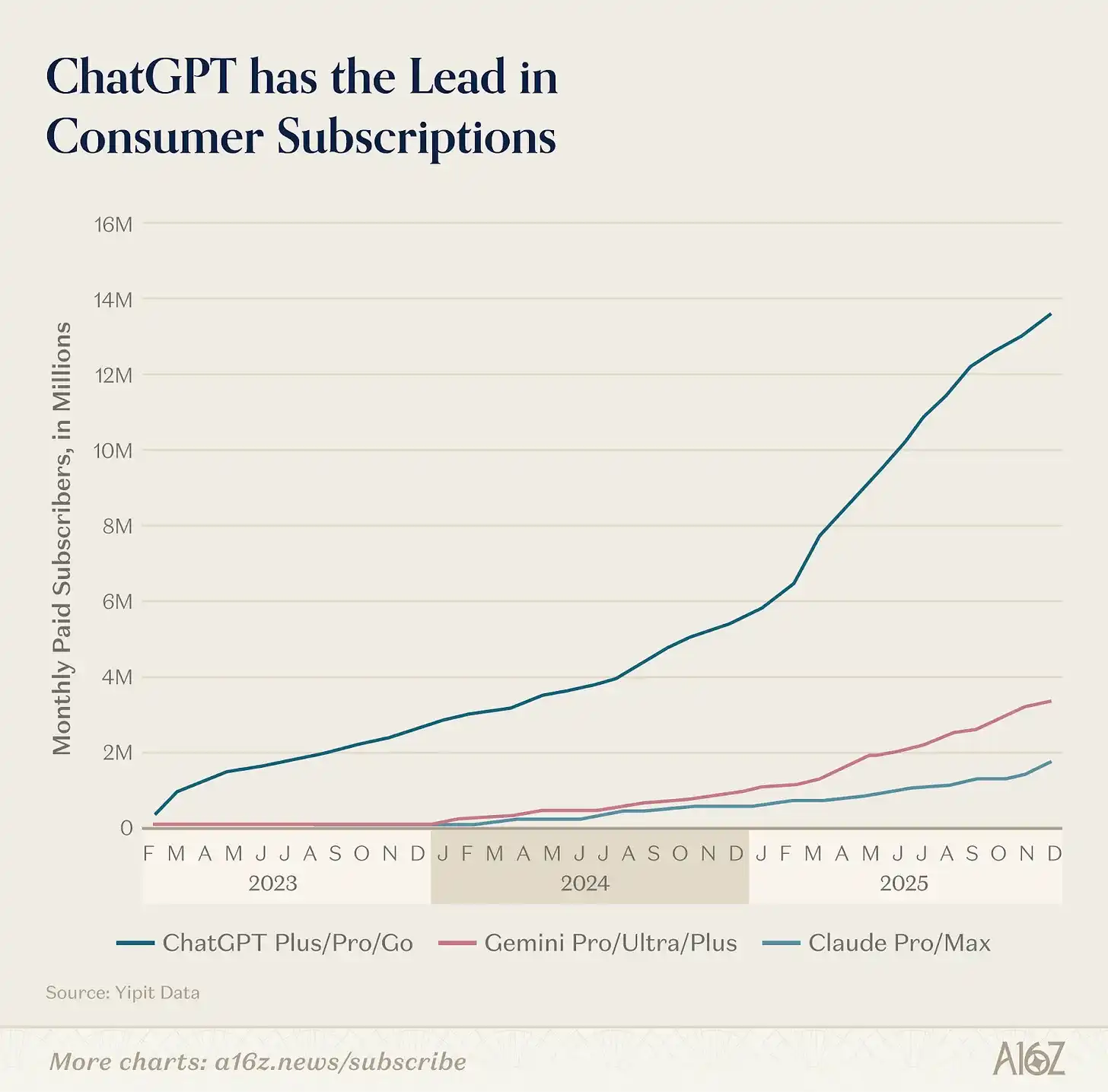
But we're starting to see the field widen, with other general-purpose platforms focusing on specific scenarios. Gemini and Claude's paid subscription growth in the US accelerated over the past year (though they are still far behind ChatGPT in absolute terms—ChatGPT has 8x the paid users of Claude and 4x those of Gemini). According to Yipit Data, as of January 2026, Claude's paid users grew over 200% year-over-year, while Gemini's grew 258%. We also see increasing "multi-platform" behavior—about 20% of ChatGPT's weekly web users also used Gemini in the same week.
What's happening? Competitors are pushing hard. Google scored a big win with creative models—Nano Banana generated 200 million images in its first week, bringing 10 million new users to Gemini; Veo 3 is widely recognized as a breakthrough moment for AI video. Anthropic is targeting professional users, launching Cowork, Claude in Chrome, Excel and PowerPoint plugins, and most crucially, Claude Code.

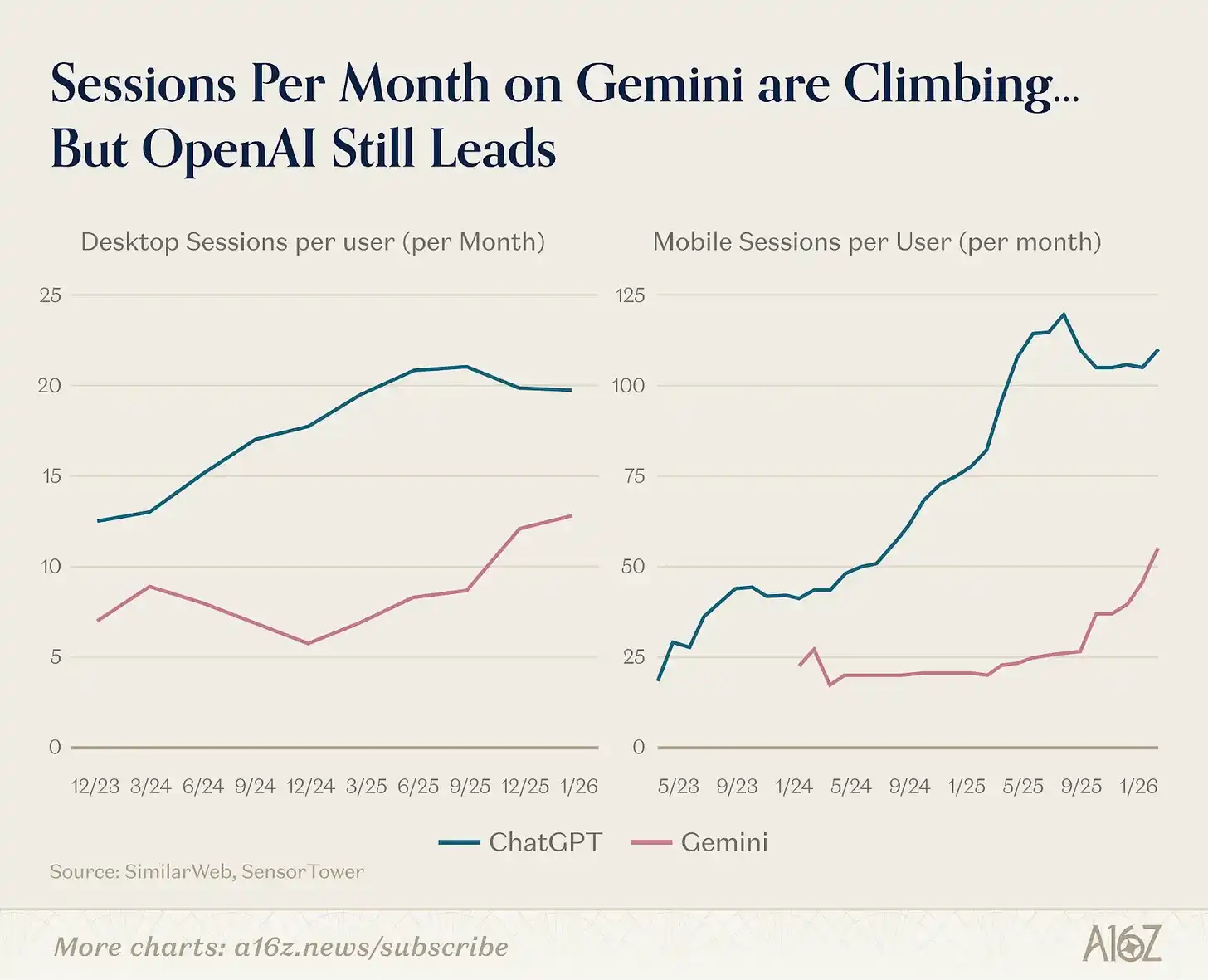
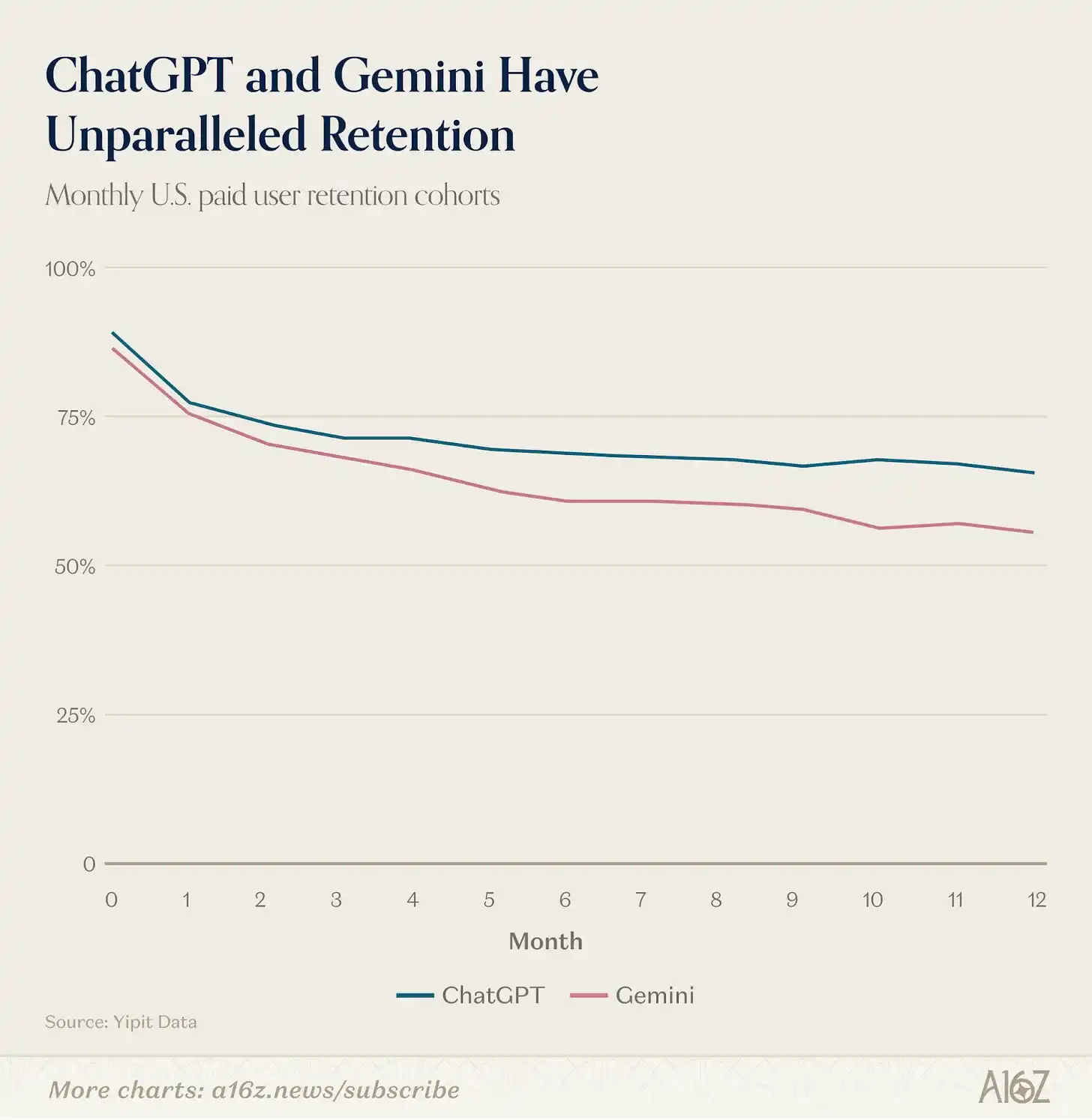
This competition isn't just about who leads today, but who can build structural moats. Context accumulates: the more an LLM knows about you, the better its results, and the more locked-in you become. Early data shows Gemini's average monthly sessions per user on the web are rising, though ChatGPT still leads by 1.3x. On mobile, ChatGPT's advantage is greater, with 2.2x the average monthly sessions per user compared to Gemini. According to Yipit Data, both have top-tier consumer paid user retention rates in the US.
The next layer of lock-in comes from app stores. Both ChatGPT and Claude have launched connector ecosystems—ChatGPT has GPTs and Apps, Claude has MCP integrations and Connectors, allowing users to build workflows on top of the assistants. Once users configure their AI to connect to their calendar, email, and CRM, switching costs rise dramatically. Developers are likely to focus their efforts on the platform with the most users, creating a flywheel effect similar to early platform wars.

We can already see the platforms diverging. Sam Altman previously stated that OpenAI wants to "bring AI to the billions who can't afford a subscription," which is why they started showing ads. He also indicated OpenAI would launch a "Sign in with ChatGPT" identity layer, positioning the AI assistant as the default interface between consumers and the internet. The ambition is to make ChatGPT the starting point for everything: shopping, booking hotels, browsing the web, health management, daily life.

The app directories reflect this divergence. As of late February, ChatGPT's app store covers 13 categories with 220 apps. Claude has about 160 curated connectors plus about 50 community MCP servers. But only 41 apps overlap between the two—roughly 11% of their combined directories—and these 41 are almost all universal productivity tools everyone needs: Slack, Notion, Figma, Gmail, Google Calendar, HubSpot, Stripe.

Beyond core tools, the two platforms are heading in almost completely different directions. ChatGPT has over 85 exclusive apps in categories like travel, shopping, food, health, lifestyle, and entertainment, where Claude has almost none. These are consumer transaction scenarios: booking flights on Expedia, grocery shopping via Instacart, browsing homes on Zillow, tracking nutrition on MyFitnessPal. This is the most aggressive super-app play among all AI companies. Claude's exclusive integrations lean professional: financial data terminals (PitchBook, FactSet, Moody's, MSCI), developer infrastructure (Sentry, Supabase, Snowflake, Databricks), science and medical tools (PubMed, Clinical Trials, Benchling), and an open-source MCP community which has no equivalent on ChatGPT.
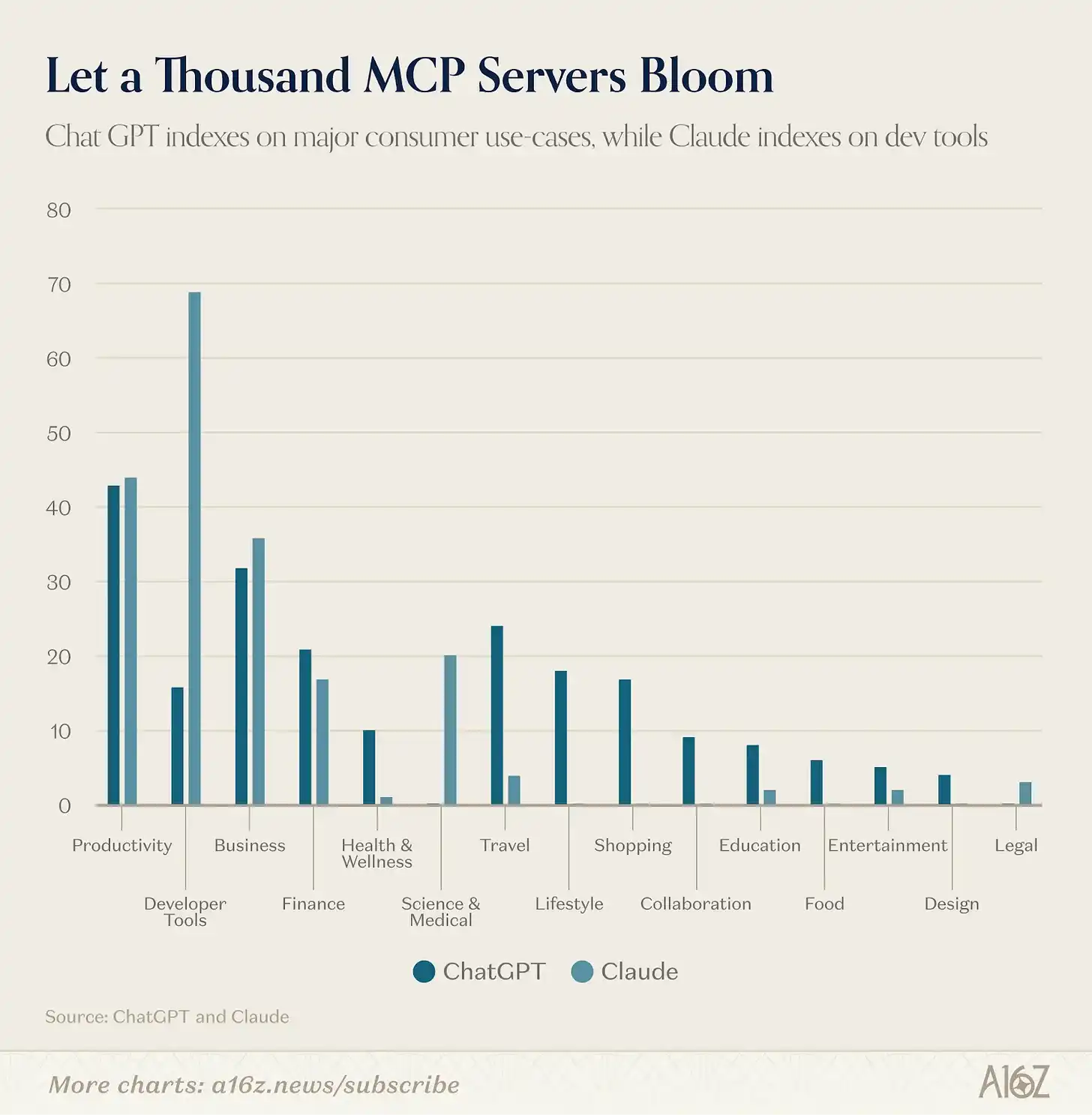
Anthropic seems focused on power AI users (developers, knowledge workers, etc.). These users are more willing and able to pay for expensive direct subscriptions. While ChatGPT also has products for similar audiences (e.g., Codex, Frontier), they are simultaneously aiming to be a platform for truly mass-market users—which could open more monetization paths as the user base grows. They are already testing ads, and transaction fees are a logical extension.

If AI assistants are not just chat windows but OS-level environments, this competition might ultimately resemble the mobile OS wars more than the search wars—two platforms with starkly different philosophies, each building trillion-dollar ecosystems.

2. Global Usage is Splitting Along Product Lines

Geographically, the AI market is splitting into three distinct ecosystems, with the gaps between them widening.
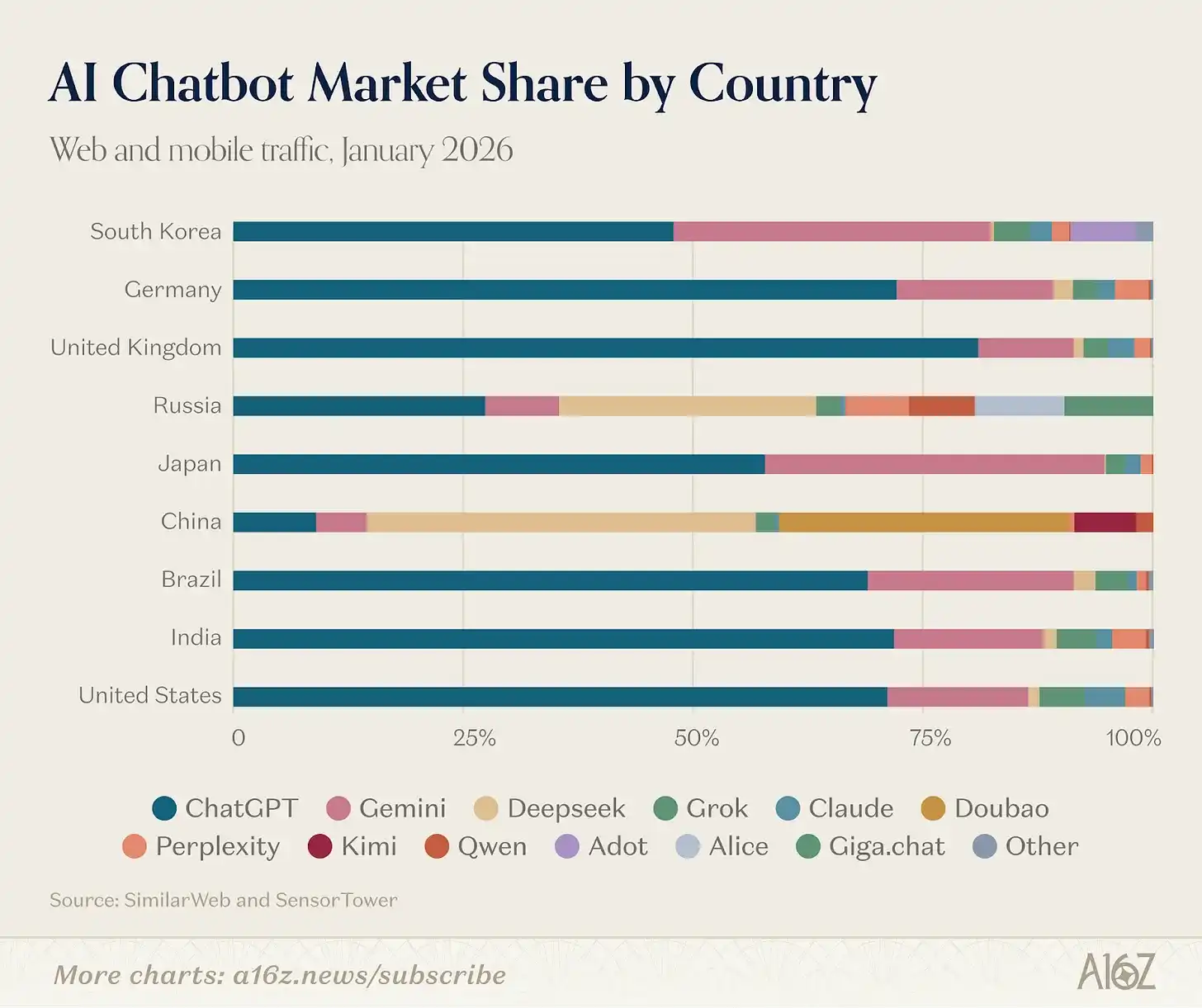
Western AI tools share highly similar user bases. The core markets for ChatGPT, Claude, Gemini, and Perplexity all come from the same pool: the US, India, Brazil, the UK, and Indonesia, just in different orders. None have significant usage in China or Russia. The reason is policy: since 2022, Western tech sanctions have restricted Russian access to US AI tools; China requires AI providers to register, store data locally, and comply with censorship rules.

DeepSeek is the only product that spans multiple camps. Its web traffic is distributed across China (33.5%), Russia (7.1%), and the US (6.6%), with a similar pattern on mobile. Chinese users also heavily use ByteDance's Doubao and local product Kimi.

Russia, which barely registered as a separate market in our early editions, has now become a third pole, with DeepSeek ranking second in penetration. The Yandex browser, integrated with the Alice AI assistant, has 71 million MAU, placing it in the global top 10 mobile AI products. Sber's GigaChat also appears on our web list for the first time. This pattern mirrors China's, just compressed: sanctions created a vacuum, and local products filled it within two years.

To measure AI adoption on a per capita basis, we built a simple index combining web visits per capita and mobile MAU per capita, scored from 0 to 100. The results redefine the geographic landscape. Singapore ranks first, followed by the UAE, Hong Kong, and South Korea. The US—the origin of most AI products—ranks 20th.
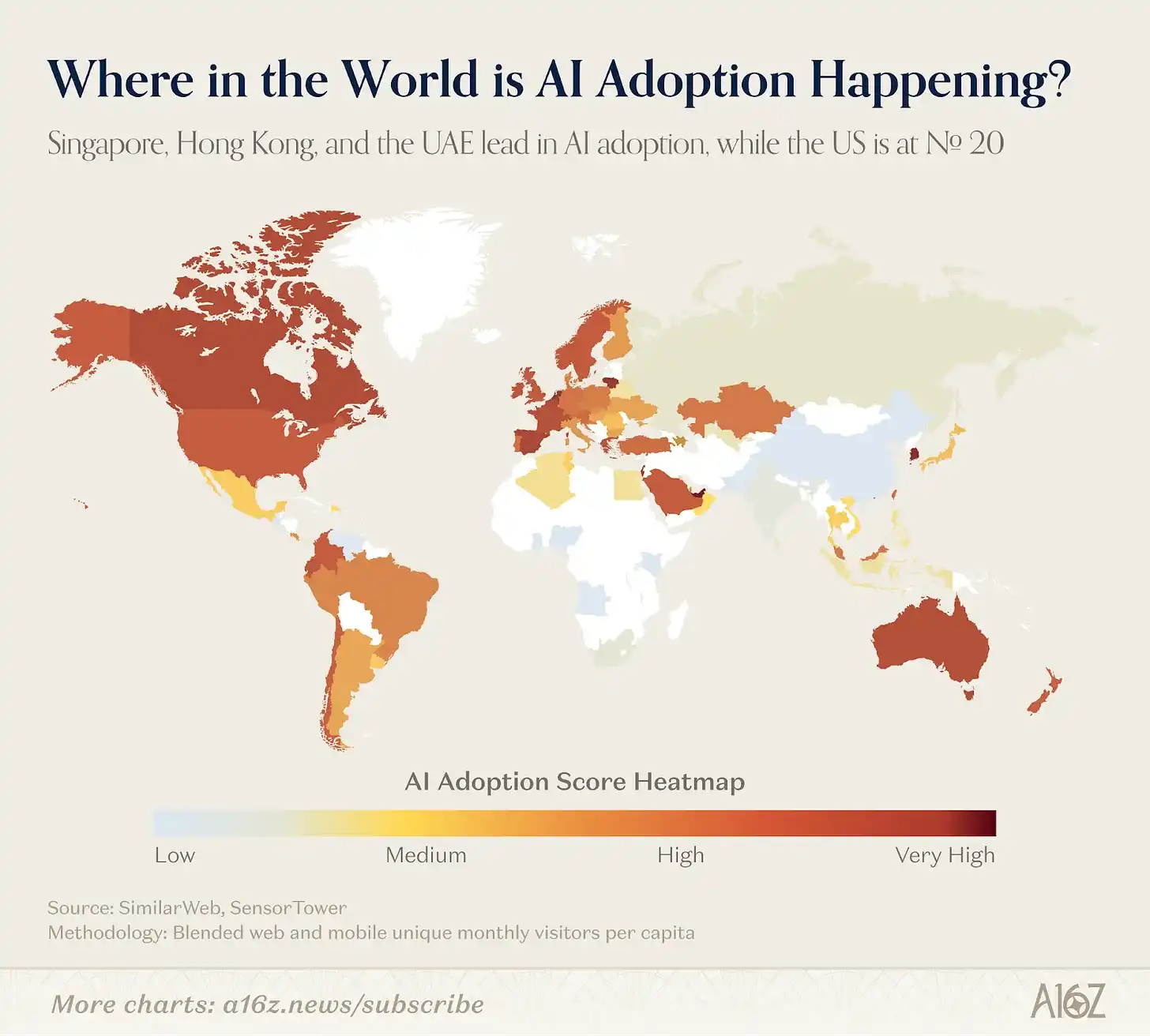
Caption: Generative AI Per Capita Adoption Index (0-100), Singapore leads, US ranks 20th

3. Creative Tools See Major Reshuffle

Midjourney, DALL-E, and Stable Diffusion were the products that brought most early users into the world of generative AI—all three launched before ChatGPT. Image generators not only dominated the creative category (video and audio generation came later) but also held steady positions in the upper tiers of our first three lists. This category has since changed dramatically.

In the first list from September 2023, 7 out of 9 creative tools on the web were image generators. Three years later, only 3 image generators remain on the list, but there are still 7 creative tools. The difference lies in what filled the vacancies: video, music, and voice products have claimed the spots vacated by image generation.
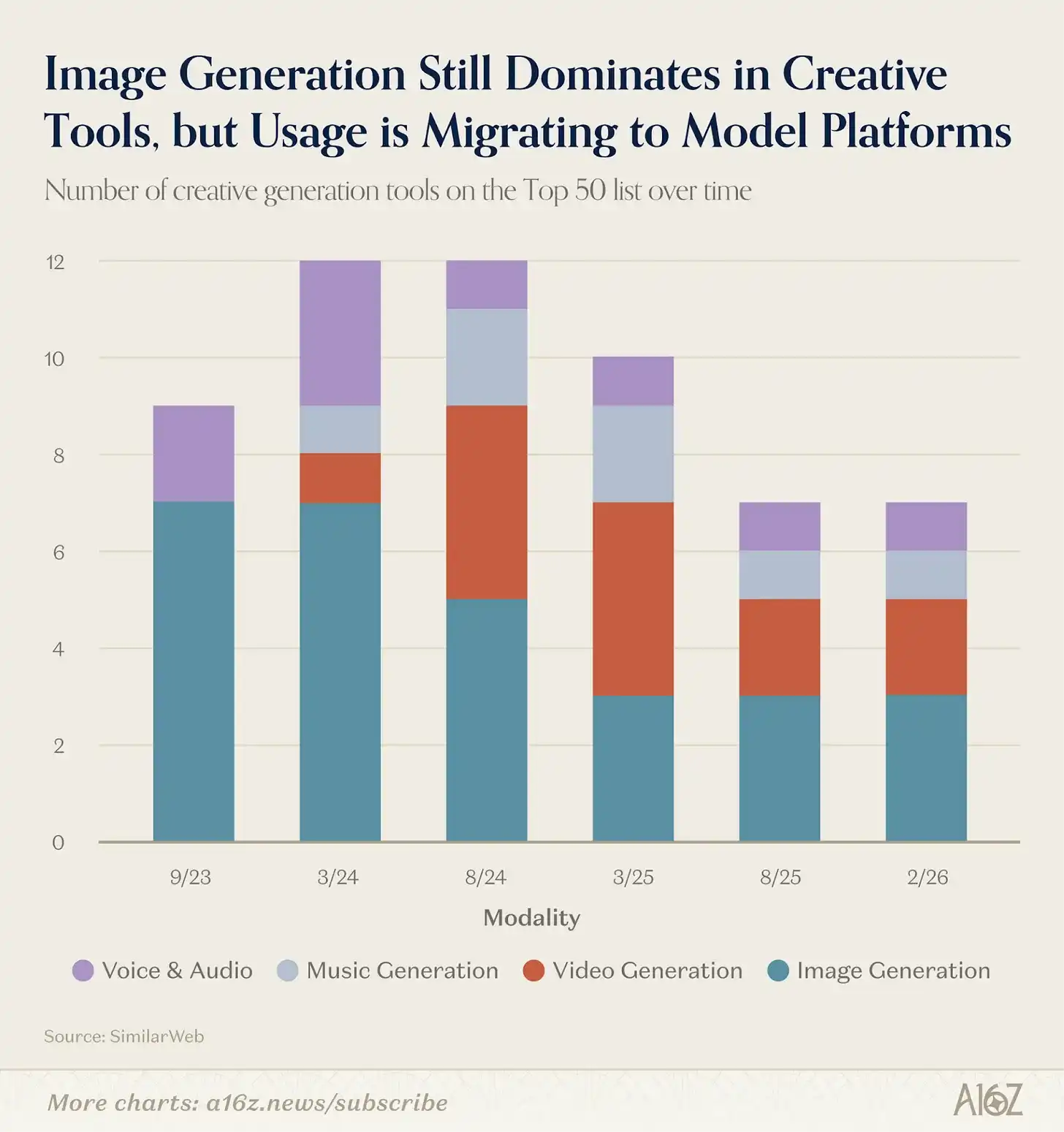
The story of image generation is one of being consumed by bundling. As the quality of built-in image models in ChatGPT (GPT Image 1.5) and Gemini (Nano Banana) improved, the bar for standalone image products rose sharply. Midjourney, which ranked in the top 10 in our first list, has now fallen to 46th place. The products that remain—Leonardo, Ideogram, CivitAI—tend to serve specific creative communities, differentiating with opinionated features rather than competing head-on with general-purpose generators.

Video generation is the area with the most change in this edition. Kling AI, Hailuo, and Pixverse have all built substantial user bases, with Chinese-developed models continuing to lead in output quality. It wouldn't surprise us to see apps based on Seedance 2.0 appear in the next list. Veo 3 was the first US model to close the gap, driving traffic to Google Labs (which rose from rank 36 to 25).

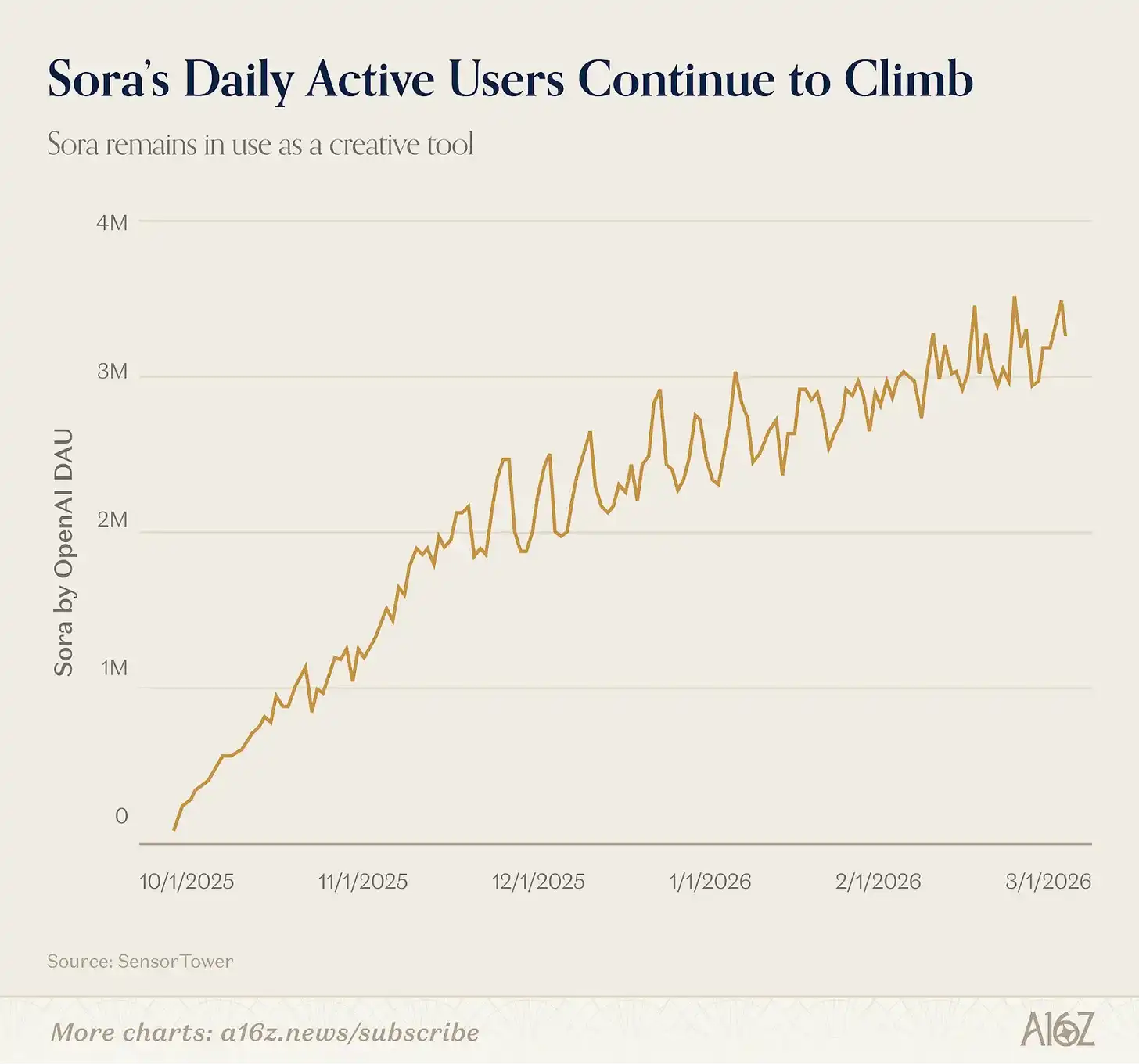
Who's missing? Sora. OpenAI launched Sora 2.0 as a standalone app in September 2025, allowing users to upload their own digital avatars as Cameos to generate videos featuring real people. Sora topped the US App Store charts for 20 consecutive days, reaching 1 million downloads faster than ChatGPT. Downloads subsequently fell back, because Sora failed to sustain viral growth as a social app (no one has cracked the AI × social formula yet), so it didn't make the mobile list this time. But SensorTower data shows Sora still has over 3 million mobile DAU, and AI video creators continue to use the model, even if they publish their work on other platforms.
Music and voice have been more defensible. Suno maintained its ranking from the previous edition (15th). ElevenLabs has been on every list since September 2023; its core capabilities—voice cloning, dubbing, audio production—are specialized enough that they haven't yet been turned into a checkbox feature in a giant's product.

The pattern to summarize: in creative directions where model giants and big players like Google and OpenAI focus (images, and increasingly video), traffic for independent products gets compressed—though there's still room for products targeting niches beyond the mainstream, potentially with higher price points. In directions the giants haven't focused on (music, voice), independent products have more room.

4. Agents Have Arrived

The shift towards agentic AI didn't start with this edition—it began last time, in the form of vibe coding. When Lovable, Cursor, and Bolt appeared on our March 2025 list, they represented something new: AI products that don't just answer questions or generate media, but build things for the user. This is agent behavior, just confined to a vertical.

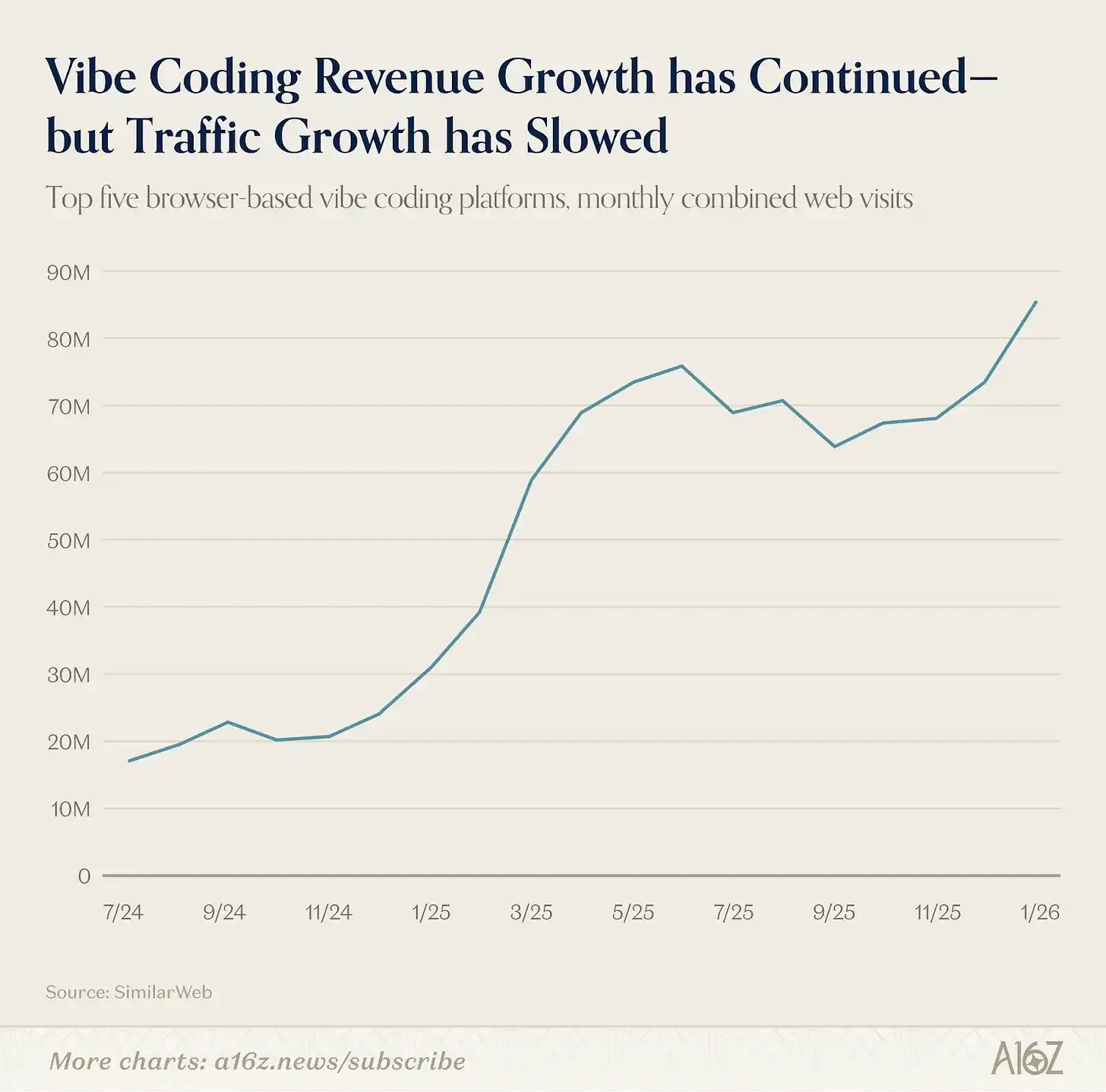
Vibe coding proved its retention capability among technical (and semi-technical) users. Both Replit and Lovable are on this list, as is Claude Code (via Claude). There's more room for growth, as this trend hasn't truly hit the mass market. Traffic for the top five vibe coding platforms is still growing, albeit slower than the initial explosion, but revenue for many products is rising as developers and teams deepen their usage.
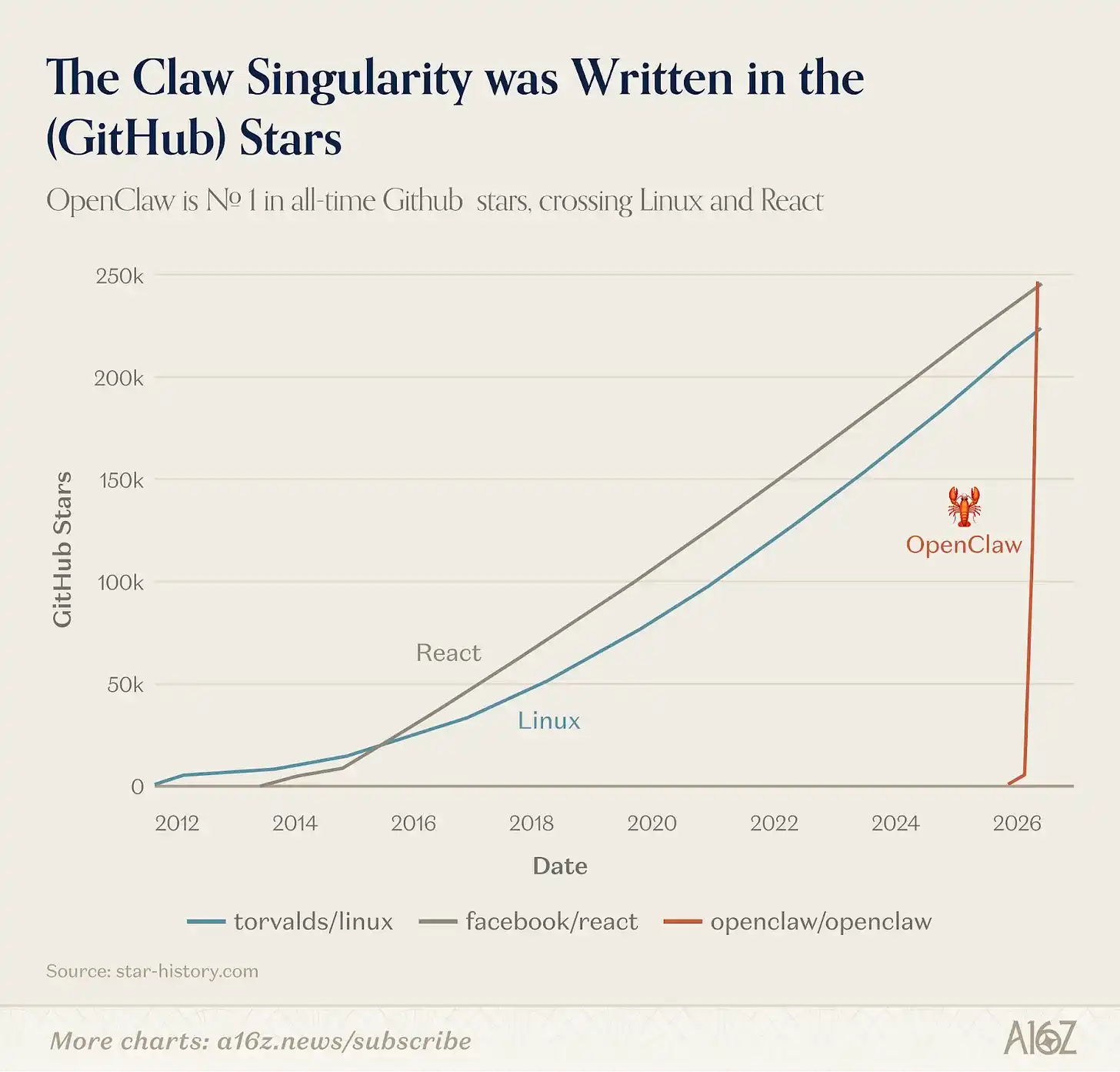
More recently, general-purpose agents have begun to emerge. In January 2026, an open-source project called OpenClaw went from a side project by an independent developer to 68,000 GitHub stars and mainstream media coverage in just weeks. Created by Austrian developer Peter Steinberger, OpenClaw is an AI agent that runs locally, connects to your messaging apps, and performs multi-step tasks on your behalf.

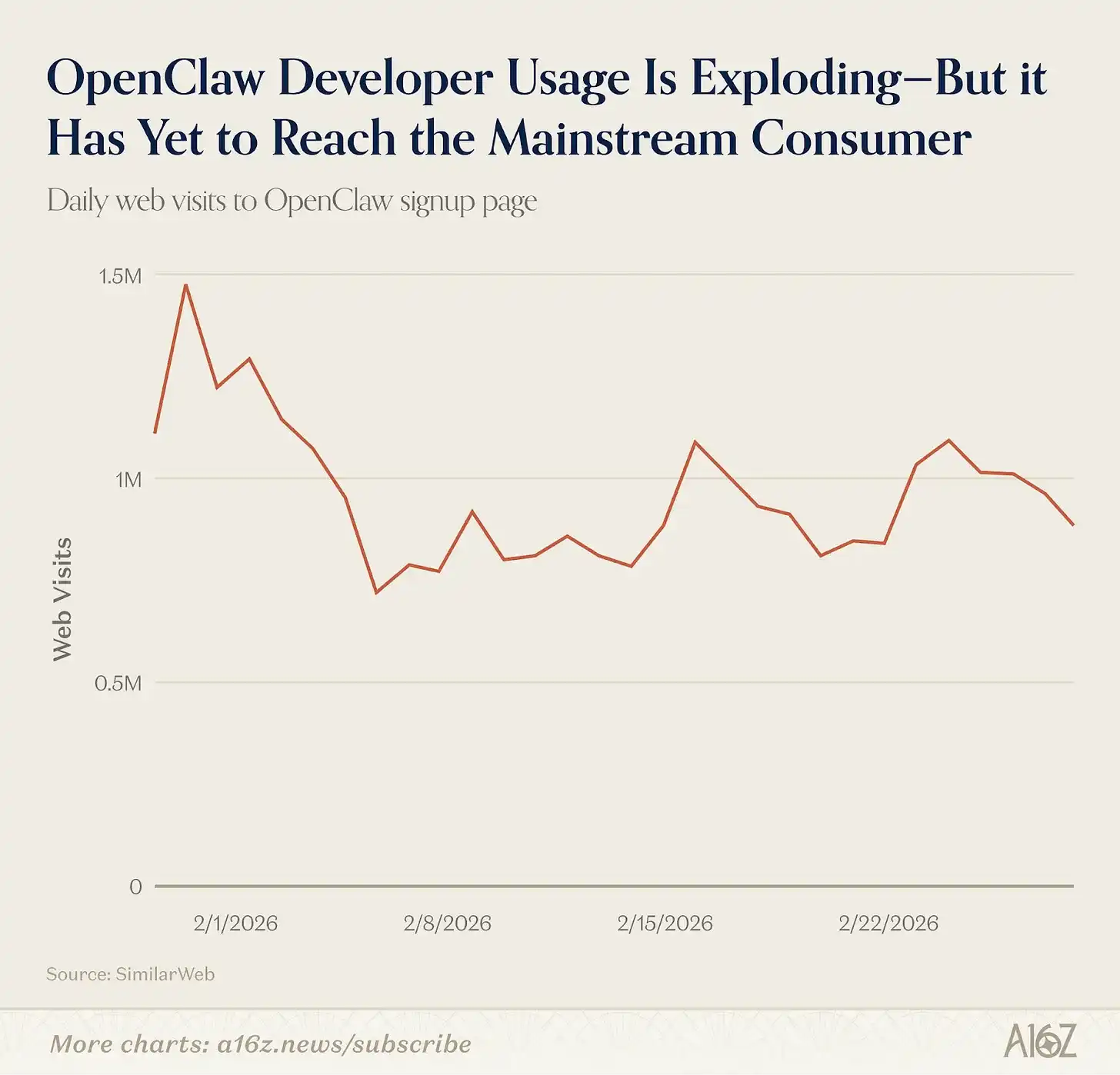
If ChatGPT was the moment consumers discovered AI could converse, OpenClaw might be the moment they discover AI can act. The product exploded in the developer community—if we extended our analysis window to February instead of January, OpenClaw would rank in the web top 30.

But OpenClaw isn't yet a consumer product—installation and maintenance require terminal skills. OpenClaw continues to gain momentum among technical users, becoming the most starred project on GitHub in early March, surpassing React and Linux. But the product hasn't "graduated" to truly mainstream users yet—at least judging by the new visitor data for the OpenClaw installation page, growth has been fairly flat. The project was acquired by OpenAI in February 2026, which might signal a more user-friendly version of OpenClaw is coming.
OpenClaw isn't the only general-purpose agent on the list. Manus and Genspark also made it—both platforms allow consumers to hand off open-ended tasks (research, spreadsheet analysis, slide deck creation) to AI, which completes the entire workflow end-to-end. Manus is on the list for the second time; after its last appearance, it was acquired by Meta for approximately $2 billion in December 2025. Genspark is new to this edition—the company closed a $300 million Series B earlier this year and announced it reached $100 million in annualized revenue.

On mobile, consumers often interact with agents via text, not through a mobile app. Upon installation, users connect OpenClaw to platforms like WhatsApp, Telegram, and Signal, sending it instructions as if messaging a friend, and it executes tasks in the background. Other products like Poke offer similar agent experiences via SMS.

These products will compete directly with the agent capabilities of the general-purpose LLM assistants consumers use every day—ChatGPT, Claude, and Gemini. As these giants build out their own connector and app ecosystems, will consumers choose one as their primary agent? The next six months will give us the answer.

5. AI Moves Beyond the Browser and App

Every previous edition of this list ranked AI products using two metrics: web visits and mobile MAU. But a new class of AI products is emerging that neither metric captures. Some of the most important consumer AI growth over the past year has occurred in products that are completely invisible in these two dimensions.

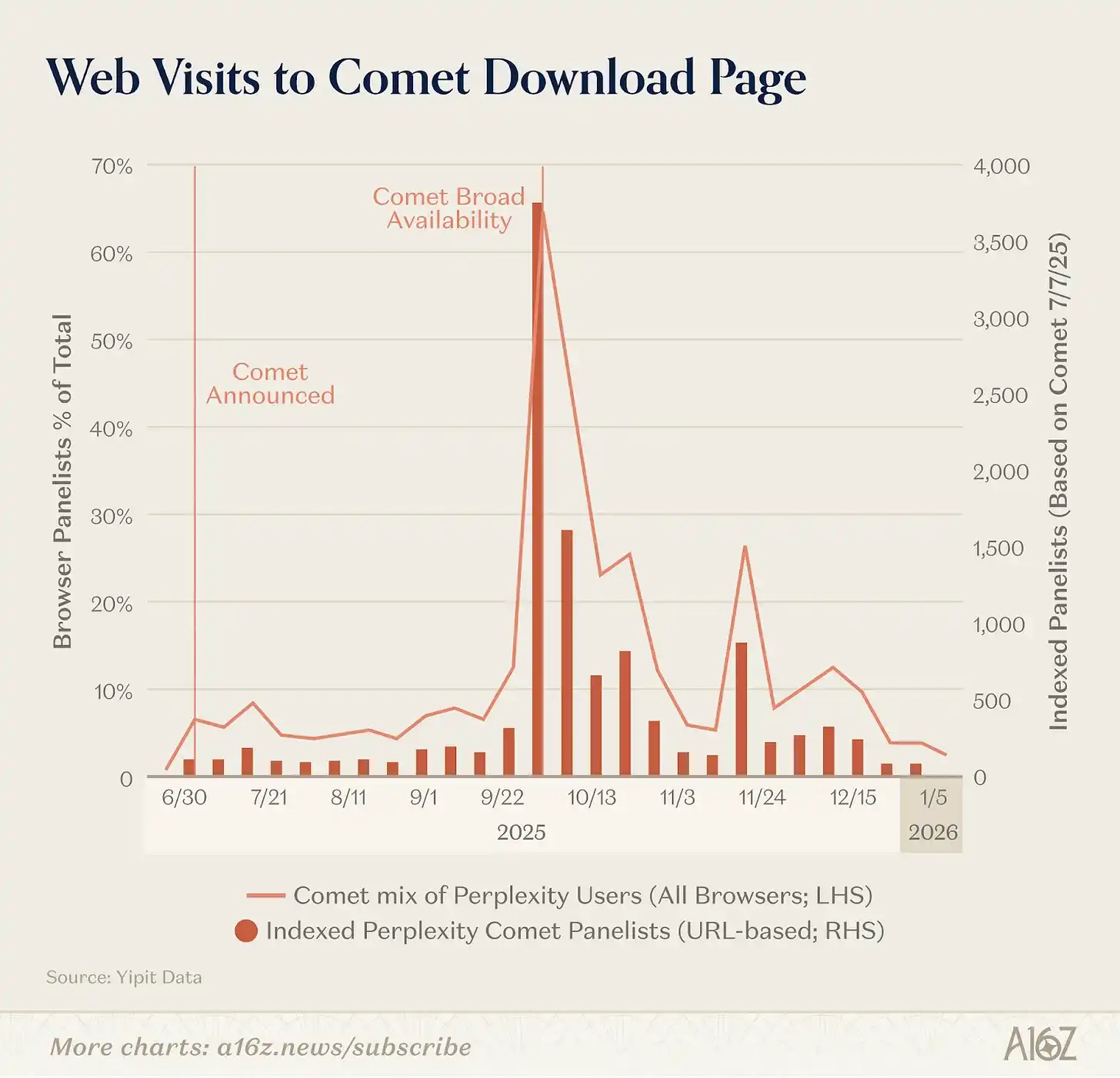
The most obvious change is that the browser itself is becoming an AI product. Over the past nine months, OpenAI released Atlas (a browser with ChatGPT built into every page), Perplexity launched Comet, and Browser Company (later acquired by Atlassian) launched Dia. Yipit data shows Perplexity's Comet has had the biggest impact in the market (measured by download page visits), but no AI browser has yet seen accelerating growth.

Other AI giants have chosen the path of adding AI to existing browsers rather than launching a separate AI browser. Google integrated Gemini into Chrome and released a beta of Disco, which can dynamically generate web apps based on a user's browser tabs. Anthropic released Claude in Chrome, which can connect to a user's Claude or Claude Code session to drive actions on the web.
Growth in native desktop AI tools is even more explosive, especially developer tools. Claude Code—a command-line developer agent—reached $1 billion in annualized revenue in just six months. OpenAI launched a standalone Mac app for Codex, and the company stated Codex had 2 million weekly active users by early March, growing 25% week-over-week. Cursor held its position in the web top 50.

For pure consumers, the most common standalone desktop AI applications are voice-related. Note-taking tools like Fireflies, Fathom, Otter, TL;DV, and Granola reach users through PLG models, gradually penetrating enterprises—the top five players combined have over 20 million visitors. Workspace apps like Notion (on the list for the first time) are also increasingly integrating AI through notetakers, research agents, and even task automation.

Finally, AI is embedding itself more deeply into the tools people already use. Anthropic launched Claude in Excel and Claude in PowerPoint. OpenAI launched ChatGPT for Excel. Google deepened Gemini's integration across the entire Workspace suite—Docs, Sheets, Gmail, and Meet all have native AI features. In January 2026, Google also launched Personal Intelligence, connecting Gemini to Gmail, Google Photos, YouTube, and Search, allowing the assistant to reference your hotel bookings, purchase history, photo library, and watch history without you having to tell it.

The implication for this list: our rankings increasingly underestimate the AI products people use the most. A developer who spends eight hours a day in Claude Code, or a knowledge worker who dictates every email through Wispr, are heavy AI users, but are almost invisible in web traffic data. As AI shifts from a destination to a feature, our methodology needs to evolve too.


Пов'язані питання

QWhat are the main findings of a16z's sixth edition of the Top 100 Generative AI Consumer Applications list?

AThe main findings include: 1) ChatGPT remains the dominant AI product but faces growing competition from Gemini and Claude, especially in paid subscriptions; 2) The global AI market is splitting into three distinct ecosystems (Western, Chinese, and Russian); 3) Creative tools are undergoing a major reshuffle, with video, music, and voice generation gaining ground over image generation; 4) AI agents are emerging as a new category, with tools like OpenClaw and Manus gaining traction; 5) AI is increasingly moving beyond browsers and apps into desktop tools, browsers themselves, and embedded integrations.

QHow has the competitive landscape for general AI assistants like ChatGPT, Gemini, and Claude evolved?

AWhile ChatGPT still leads with 900 million weekly active users (2.7x more web traffic than Gemini and 2.5x more mobile MAUs), Gemini and Claude are growing faster paid subscription rates in the U.S. (258% and 200% YoY growth, respectively). About 20% of ChatGPT's weekly web users also use Gemini in the same week. The competition is intensifying around building structural moats through context accumulation, app stores, and differentiated strategies—OpenAI aims for a super-app approach targeting mass consumers, while Anthropic focuses on high-end professional users.

QWhat geographic trends does the report highlight in AI adoption?

AThe global AI market is splitting into three ecosystems: 1) Western tools (ChatGPT, Gemini, Claude, Perplexity) dominate in the U.S., India, Brazil, the U.K., and Indonesia but have negligible usage in China or Russia due to policies; 2) China has its own ecosystem with products like DeepSeek, Doubao, and Kimi; 3) Russia has rapidly developed a local AI market with DeepSeek, Yandex Browser (with Alice AI), and GigaChat. Singapore leads in per capita AI adoption, while the U.S. ranks 20th.

QHow has the creative AI tools category changed since the first edition of the list?

AIn the first list (2023), 7 out of 9 creative tools were image generators. Now, only 3 image generators remain in the top 100, but creative tools still hold 7 spots—with video, music, and voice generation replacing image generation. Image tools like Midjourney declined as giants like ChatGPT and Gemini integrated high-quality image models. Video generation (e.g., Kling AI, Veo 3) saw significant momentum, while music (Suno) and voice (ElevenLabs) tools remain resilient due to their specialized, less-bundled nature.

QWhat are AI agents, and which examples are mentioned in the report?

AAI agents are products that go beyond generating content to taking actions or completing multi-step tasks for users. Examples include: 1) Vibe coding tools like Lovable, Cursor, and Claude Code for developers; 2) General-purpose agents like OpenClaw (an open-source agent for messaging apps), Manus (acquired by Meta), and Genspark (for research and presentations); 3) Mobile agents operating via text (e.g., Poke). These agents compete with the expanding capabilities of major LLM assistants like ChatGPT, Claude, and Gemini.

Пов'язані матеріали

Торгівля

Спот
Ф'ючерси

Популярні статті

Що таке $S$

Розуміння SPERO: Комплексний огляд Вступ до SPERO Оскільки ландшафт інновацій продовжує еволюціонувати, виникнення технологій web3 та криптовалютних проектів відіграє ключову роль у формуванні цифрового майбутнього. Один з проектів, який привернув увагу в цій динамічній сфері, — це SPERO, позначений як SPERO,$$s$. Ця стаття має на меті зібрати та представити детальну інформацію про SPERO, щоб допомогти ентузіастам та інвесторам зрозуміти його основи, цілі та інновації в рамках web3 та крипто-сектору. Що таке SPERO,$$s$? SPERO,$$s$ — це унікальний проект у криптопросторі, який прагне використати принципи децентралізації та технології блокчейн для створення екосистеми, що сприяє залученню, корисності та фінансовій інклюзії. Проект розроблений для полегшення взаємодії між користувачами новими способами, надаючи їм інноваційні фінансові рішення та послуги. У своїй основі SPERO,$$s$ прагне надати можливості індивідам, забезпечуючи інструменти та платформи, які покращують користувацький досвід у криптовалютному просторі. Це включає в себе можливість більш гнучких методів транзакцій, сприяння ініціативам, що підтримуються спільнотою, та створення шляхів для фінансових можливостей через децентралізовані додатки (dApps). Основна концепція SPERO,$$s$ обертається навколо інклюзивності, прагнучи зменшити розриви в традиційній фінансовій системі, використовуючи переваги технології блокчейн. Хто є творцем SPERO,$$s$? Особистість творця SPERO,$$s$ залишається дещо невідомою, оскільки є обмежені публічно доступні ресурси, що надають детальну інформацію про його засновників. Ця відсутність прозорості може бути наслідком зобов'язання проекту до децентралізації — етики, яку багато проектів web3 поділяють, ставлячи колективні внески вище за індивідуальне визнання. Зосереджуючи обговорення навколо спільноти та її колективних цілей, SPERO,$$s$ втілює суть наділення без виділення конкретних осіб. Таким чином, розуміння етики та місії SPERO є більш важливим, ніж ідентифікація єдиного творця. Хто є інвесторами SPERO,$$s$? SPERO,$$s$ підтримується різноманітними інвесторами, починаючи від венчурних капіталістів до ангельських інвесторів, які прагнуть сприяти інноваціям у крипто-секторі. Зосередження цих інвесторів зазвичай узгоджується з місією SPERO — пріоритет надається проектам, які обіцяють технологічний прогрес у суспільстві, фінансову інклюзію та децентралізоване управління. Ці інвесторські фонди зазвичай зацікавлені в проектах, які не лише пропонують інноваційні продукти, але й позитивно впливають на спільноту блокчейн та її екосистеми. Підтримка з боку цих інвесторів підкріплює SPERO,$$s$ як значного конкурента в швидко змінюваній сфері крипто-проектів. Як працює SPERO,$$s$? SPERO,$$s$ використовує багатогранну структуру, яка відрізняє його від традиційних криптовалютних проектів. Ось деякі ключові особливості, які підкреслюють його унікальність та інноваційність: Децентралізоване управління: SPERO,$$s$ інтегрує моделі децентралізованого управління, надаючи користувачам можливість активно брати участь у процесах прийняття рішень щодо майбутнього проекту. Цей підхід сприяє відчуттю власності та відповідальності серед членів спільноти. Корисність токена: SPERO,$$s$ використовує свій власний криптовалютний токен, розроблений для виконання різних функцій в екосистемі. Ці токени дозволяють здійснювати транзакції, отримувати винагороди та полегшувати послуги, що пропонуються на платформі, підвищуючи загальну залученість та корисність. Шарова архітектура: Технічна архітектура SPERO,$$s$ підтримує модульність та масштабованість, що дозволяє безперешкодно інтегрувати додаткові функції та додатки в міру розвитку проекту. Ця адаптивність є надзвичайно важливою для збереження актуальності в постійно змінюваному крипто-ландшафті. Залучення спільноти: Проект підкреслює ініціативи, що підтримуються спільнотою, використовуючи механізми, які стимулюють співпрацю та зворотний зв'язок. Підтримуючи сильну спільноту, SPERO,$$s$ може краще задовольняти потреби користувачів та адаптуватися до ринкових тенденцій. Фокус на інклюзію: Пропонуючи низькі комісії за транзакції та зручні інтерфейси, SPERO,$$s$ прагне залучити різноманітну базу користувачів, включаючи осіб, які раніше не брали участі в крипто-просторі. Це зобов'язання до інклюзії узгоджується з його загальною місією наділення через доступність. Хронологія SPERO,$$s$ Розуміння історії проекту надає важливі уявлення про його розвиток та етапи. Нижче наведено пропоновану хронологію, що відображає значні події в еволюції SPERO,$$s$: Етап концептуалізації та ідеації: Початкові ідеї, що стали основою SPERO,$$s$, були сформовані, тісно пов'язані з принципами децентралізації та фокусом на спільноті в індустрії блокчейн. Запуск білого паперу проекту: Після концептуального етапу був випущений комплексний білий папір, що детально описує бачення, цілі та технологічну інфраструктуру SPERO,$$s$, щоб залучити інтерес та зворотний зв'язок від спільноти. Створення спільноти та ранні залучення: Активні зусилля були спрямовані на створення спільноти ранніх прихильників та потенційних інвесторів, що полегшило обговорення цілей проекту та отримання підтримки. Подія генерації токенів: SPERO,$$s$ провів подію генерації токенів (TGE) для розподілу своїх рідних токенів серед ранніх прихильників та встановлення початкової ліквідності в екосистемі. Запуск початкового dApp: Перший децентралізований додаток (dApp), пов'язаний з SPERO,$$s$, став доступним, дозволяючи користувачам взаємодіяти з основними функціями платформи. Постійний розвиток та партнерства: Безперервні оновлення та вдосконалення пропозицій проекту, включаючи стратегічні партнерства з іншими учасниками блокчейн-простору, сформували SPERO,$$s$ у конкурентоспроможного та еволюціонуючого гравця на крипто-ринку. Висновок SPERO,$$s$ є свідченням потенціалу web3 та криптовалют для революціонізації фінансових систем та наділення індивідів. Завдяки зобов'язанню до децентралізованого управління, залучення спільноти та інноваційно спроектованих функцій, він прокладає шлях до більш інклюзивного фінансового ландшафту. Як і з будь-якими інвестиціями в швидко змінюваному крипто-просторі, потенційним інвесторам та користувачам рекомендується ретельно досліджувати та обдумано взаємодіяти з поточними подіями в SPERO,$$s$. Проект демонструє інноваційний дух крипто-індустрії, запрошуючи до подальшого дослідження його численних можливостей. Хоча подорож SPERO,$$s$ ще триває, його основні принципи можуть справді вплинути на майбутнє того, як ми взаємодіємо з технологією, фінансами та один з одним у взаємопов'язаних цифрових екосистемах.

73 переглядів усьогоОпубліковано 2024.12.17Оновлено 2024.12.17

Що таке $S$

Що таке AGENT S

Агент S: Майбутнє автономної взаємодії в Web3 Вступ У постійно змінюваному ландшафті Web3 та криптовалюти інновації постійно переосмислюють, як люди взаємодіють з цифровими платформами. Один з таких новаторських проектів, Агент S, обіцяє революціонізувати взаємодію людини з комп'ютером через свою відкриту агентну структуру. Прокладаючи шлях для автономних взаємодій, Агент S прагне спростити складні завдання, пропонуючи трансформаційні застосування в штучному інтелекті (ШІ). Це детальне дослідження заглиблюється в складності проекту, його унікальні особливості та наслідки для сфери криптовалюти. Що таке Агент S? Агент S є революційною відкритою агентною структурою, спеціально розробленою для вирішення трьох основних викликів в автоматизації комп'ютерних завдань: Набуття специфічних знань у галузі: Структура інтелектуально навчається з різних зовнішніх джерел знань та внутрішнього досвіду. Цей подвійний підхід дозволяє їй створити багатий репозиторій специфічних знань у галузі, покращуючи її продуктивність у виконанні завдань. Планування на довгих горизонтах завдань: Агент S використовує планування з підкріпленням досвіду, стратегічний підхід, який полегшує ефективний розподіл та виконання складних завдань. Ця функція значно підвищує її здатність ефективно та результативно управляти кількома підзавданнями. Обробка динамічних, неоднорідних інтерфейсів: Проект представляє Інтерфейс Агент-Комп'ютер (ACI), інноваційне рішення, яке покращує взаємодію між агентами та користувачами. Використовуючи багатомодальні великі мовні моделі (MLLMs), Агент S може безперешкодно орієнтуватися та маніпулювати різноманітними графічними інтерфейсами користувача. Завдяки цим новаторським функціям Агент S надає надійну структуру, яка вирішує складнощі, пов'язані з автоматизацією людської взаємодії з машинами, прокладаючи шлях для численних застосувань у ШІ та за його межами. Хто є творцем Агент S? Хоча концепція Агент S є фундаментально новаторською, конкретна інформація про його творця залишається невідомою. Творець наразі невідомий, що підкреслює або початкову стадію проекту, або стратегічний вибір зберегти засновників у таємниці. Незважаючи на анонімність, акцент залишається на можливостях та потенціалі структури. Хто є інвесторами Агент S? Оскільки Агент S є відносно новим у криптографічній екосистемі, детальна інформація про його інвесторів та фінансових спонсорів не задокументована. Відсутність публічно доступних відомостей про інвестиційні фонди або організації, що підтримують проект, викликає питання щодо його фінансової структури та дорожньої карти розвитку. Розуміння підтримки є критично важливим для оцінки стійкості проекту та потенційного впливу на ринок. Як працює Агент S? В основі Агент S лежить передова технологія, яка дозволяє йому ефективно функціонувати в різних умовах. Його операційна модель побудована навколо кількох ключових функцій: Взаємодія з комп'ютером, подібна до людської: Структура пропонує розширене планування ШІ, прагнучи зробити взаємодії з комп'ютерами більш інтуїтивними. Імітуючи людську поведінку при виконанні завдань, вона обіцяє підвищити досвід користувачів. Наративна пам'ять: Використовується для використання високорівневого досвіду, Агент S використовує наративну пам'ять для відстеження історій завдань, тим самим покращуючи свої процеси прийняття рішень. Епізодична пам'ять: Ця функція надає користувачам покрокові інструкції, дозволяючи структурі пропонувати контекстуальну підтримку в міру виконання завдань. Підтримка OpenACI: Завдяки можливості працювати локально, Агент S дозволяє користувачам зберігати контроль над своїми взаємодіями та робочими процесами, узгоджуючи з децентралізованою етикою Web3. Легка інтеграція з зовнішніми API: Його універсальність і сумісність з різними платформами ШІ забезпечують те, що Агент S може безперешкодно вписатися в існуючі технологічні екосистеми, роблячи його привабливим вибором для розробників та організацій. Ці функціональні можливості колективно сприяють унікальному положенню Агент S у крипто-просторі, оскільки він автоматизує складні, багатоступеневі завдання з мінімальним втручанням людини. У міру розвитку проекту його потенційні застосування в Web3 можуть переосмислити, як відбуваються цифрові взаємодії. Хронологія Агент S Розробка та етапи Агент S можуть бути узагальнені в хронології, яка підкреслює його значні події: 27 вересня 2024 року: Концепція Агент S була представлена в комплексній науковій статті під назвою “Відкрита агентна структура, яка використовує комп'ютери як людина”, що демонструє основи проекту. 10 жовтня 2024 року: Наукова стаття була опублікована на arXiv, пропонуючи детальне дослідження структури та її оцінки продуктивності на основі бенчмарку OSWorld. 12 жовтня 2024 року: Було випущено відеопрезентацію, що надає візуальне уявлення про можливості та особливості Агент S, ще більше залучаючи потенційних користувачів та інвесторів. Ці маркери в хронології не лише ілюструють прогрес Агент S, але й вказують на його прихильність до прозорості та залучення громади. Ключові моменти про Агент S У міру розвитку структури Агент S кілька ключових характеристик виділяються, підкреслюючи її новаторський характер та потенціал: Інноваційна структура: Розроблена для забезпечення інтуїтивного використання комп'ютерів, подібного до людської взаємодії, Агент S пропонує новий підхід до автоматизації завдань. Автономна взаємодія: Здатність автономно взаємодіяти з комп'ютерами через GUI означає стрибок до більш інтелектуальних та ефективних обчислювальних рішень. Автоматизація складних завдань: Завдяки своїй надійній методології він може автоматизувати складні, багатоступеневі завдання, роблячи процеси швидшими та менш схильними до помилок. Безперервне вдосконалення: Механізми навчання дозволяють Агенту S покращуватися на основі минулого досвіду, постійно підвищуючи свою продуктивність та ефективність. Універсальність: Його адаптивність до різних операційних середовищ, таких як OSWorld та WindowsAgentArena, забезпечує його здатність служити широкому спектру застосувань. Оскільки Агент S займає своє місце в ландшафті Web3 та криптовалюти, його потенціал покращити можливості взаємодії та автоматизувати процеси означає значний прогрес у технологіях ШІ. Завдяки своїй інноваційній структурі Агент S є прикладом майбутнього цифрових взаємодій, обіцяючи більш безперешкодний та ефективний досвід для користувачів у різних галузях. Висновок Агент S представляє собою сміливий крок вперед у поєднанні ШІ та Web3, з можливістю переосмислити, як ми взаємодіємо з технологією. Хоча проект все ще на ранніх стадіях, можливості для його застосування є величезними та переконливими. Завдяки своїй комплексній структурі, що вирішує критичні виклики, Агент S прагне вивести автономні взаємодії на передній план цифрового досвіду. У міру того, як ми заглиблюємося в сфери криптовалюти та децентралізації, проекти, подібні до Агент S, безсумнівно, відіграватимуть ключову роль у формуванні майбутнього технологій та співпраці людини з комп'ютером.

548 переглядів усьогоОпубліковано 2025.01.14Оновлено 2025.01.14

Що таке AGENT S

Як купити S

Ласкаво просимо до HTX.com! Ми зробили покупку Sonic (S) простою та зручною. Дотримуйтесь нашої покрокової інструкції, щоб розпочати свою криптовалютну подорож.Крок 1: Створіть обліковий запис на HTXВикористовуйте свою електронну пошту або номер телефону, щоб зареєструвати обліковий запис на HTX безплатно. Пройдіть безпроблемну реєстрацію й отримайте доступ до всіх функцій.ЗареєструватисьКрок 2: Перейдіть до розділу Купити крипту і виберіть спосіб оплатиКредитна/дебетова картка: використовуйте вашу картку Visa або Mastercard, щоб миттєво купити Sonic (S).Баланс: використовуйте кошти з балансу вашого рахунку HTX для безперешкодної торгівлі.Треті особи: ми додали популярні способи оплати, такі як Google Pay та Apple Pay, щоб підвищити зручність.P2P: Торгуйте безпосередньо з іншими користувачами на HTX.Позабіржова торгівля (OTC): ми пропонуємо індивідуальні послуги та конкурентні обмінні курси для трейдерів.Крок 3: Зберігайте свої Sonic (S)Після придбання Sonic (S) збережіть його у своєму обліковому записі на HTX. Крім того, ви можете відправити його в інше місце за допомогою блокчейн-переказу або використовувати його для торгівлі іншими криптовалютами.Крок 4: Торгівля Sonic (S)Легко торгуйте Sonic (S) на спотовому ринку HTX. Просто увійдіть до свого облікового запису, виберіть торгову пару, укладайте угоди та спостерігайте за ними в режимі реального часу. Ми пропонуємо зручний досвід як для початківців, так і для досвідчених трейдерів.

1.3k переглядів усьогоОпубліковано 2025.01.15Оновлено 2025.03.21

Як купити S

Обговорення

Ласкаво просимо до спільноти HTX. Тут ви можете бути в курсі останніх подій розвитку платформи та отримати доступ до професійної ринкової інформації. Нижче представлені думки користувачів щодо ціни S (S).

活动图片













