a16z Partner: Perpetual Contracts Are Rewriting Global Trading Rules

marsbitОпубліковано о 2026-04-10Востаннє оновлено о 2026-04-10

Анотація

Perpetual contracts ("perps"), a crypto-native innovation, are transforming global trading behavior and market structure. These non-expiring futures contracts have seen explosive on-chain growth in 2025, with decentralized exchange (DEX) volume surging 346% year-over-year to $6.7 trillion. Perps now extend beyond crypto to traditional assets like stocks, commodities, and even private company valuations. Key drivers include structural advantages over options for directional leverage: 24/7 trading, no expirations or rollovers, simpler risk exposure, and capital efficiency. Real-World Asset (RWA) perps have gained significant traction, at times comprising 44% of volume on leading DEXs like Hyperliquid. The ecosystem is expanding rapidly with new exchanges, front-ends, market creators, and liquidity providers. While challenges remain around liquidity, oracle reliability, and regulation, perps are evolving from a niche crypto instrument into a dominant global trading primitive. The open question is whether value will accumulate at the exchange layer or within applications built atop perpetual trading infrastructure.

Author: jay

Compiled by: Jiahuan, ChainCatcher

Perpetual contracts ("perps") are futures contracts that never settle. As a crypto-native innovation, they experienced an explosion on-chain in 2025. Today, they have become one of the largest markets in the crypto space, covering traditional assets with trading volumes reaching trillions of dollars.

Last year, the trading volume of perpetual contracts settled by top centralized exchanges reached $86.2 trillion (a 47% year-on-year increase), while the growth of on-chain perpetual contracts was even more astonishing: leading decentralized exchanges (DEX) reached a trading volume of $6.7 trillion (a 346% year-on-year increase). Currently, DEX trading volume accounts for about 7.8% of centralized exchange (CEX) volume, whereas just over a year ago, this proportion was only around 2.5%. [Note: While a few US-regulated centralized platforms offer US investors products similar to perpetual contracts, all centralized and decentralized exchanges restrict US investors from trading true perpetual contracts.]
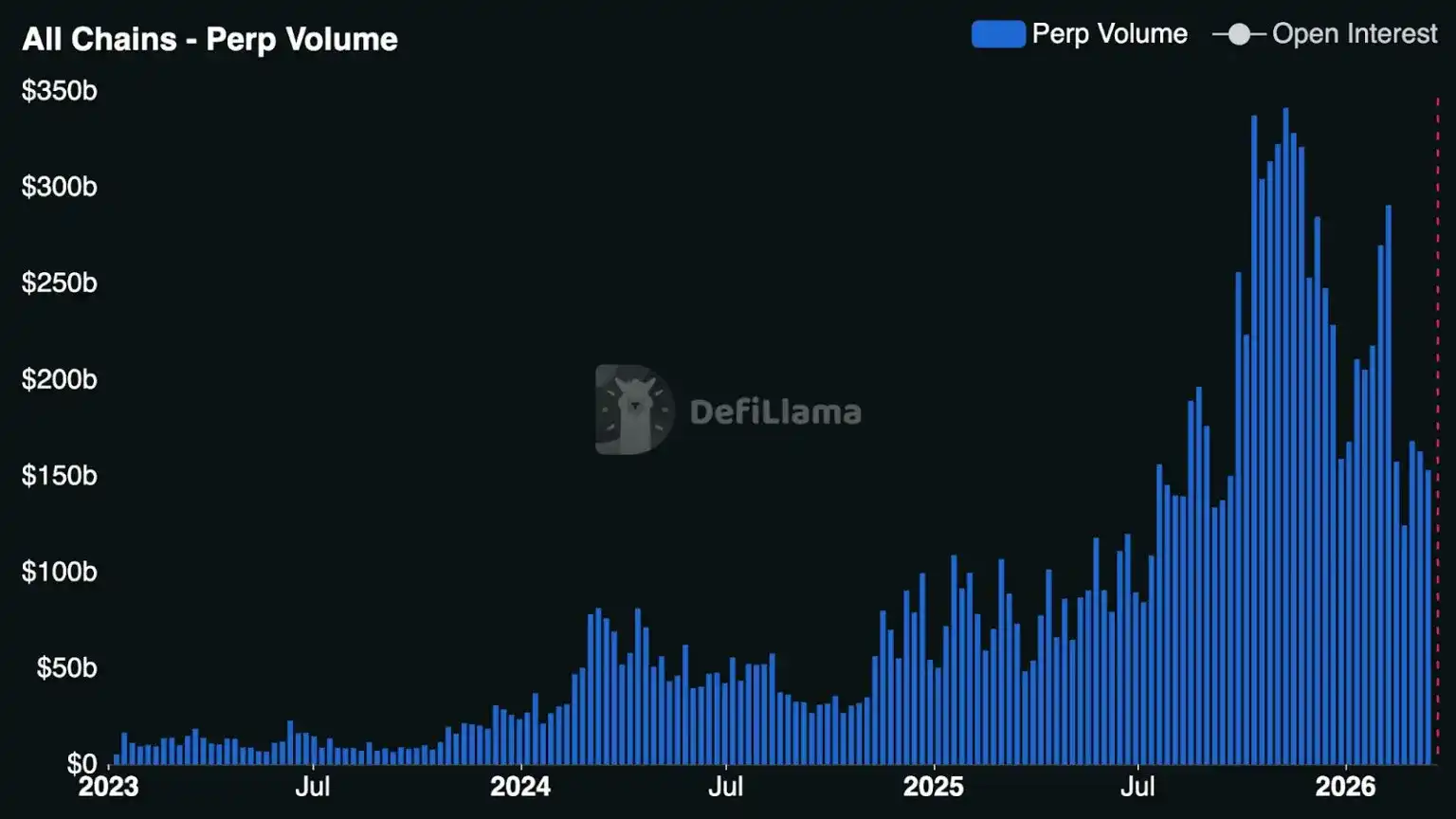
But more importantly, perpetual contracts are gradually shedding their image as a marginal crypto-native primitive and beginning to demonstrate the transformative power to reshape trading behavior and market structure fundamentally.

So, what is driving the popularity of perpetual contracts? Why now? The following will explore why global traders are increasingly favoring perpetual contracts, the scale of the market opportunity, and the opportunities seen by builders.

A Brief History and Evolution of Perpetual Contracts

The idea itself is actually older than the crypto industry. Theoretically, perpetual contracts existed as early as 1993, when Nobel laureate Robert Shiller proposed perpetual futures contracts, initially conceived as a tool to hedge against real estate value risks. But it wasn't until 2016, with the rise of BitMEX and XBTUSD (the longest-running Bitcoin perpetual swap contract), that perpetual contracts became popular in the crypto space.

A decade later, modern exchanges now offer perpetual contracts covering stocks, indices, commodities, interest rates, startup valuations, and even the price of Nvidia's H100 GPUs.

For years, perpetual contracts have been a multi-billion dollar revenue engine for centralized exchanges. As retail demand for leverage has grown, perpetual contracts have become the primary venue for short-term price discovery, liquidity, and trading activity—in many large Asian CEXs, their volume is multiple times that of spot trading.

What changed in the past year and a half is that decentralized perpetual exchanges began to meaningfully eat into the perpetual market share of CEXs. With the structural advantage of self-custody, perpetual DEXs are rapidly closing the gap with CEXs in terms of liquidity, performance, and features for active traders.

With the breakthrough success of perpetual DEXs like Hyperliquid, leading crypto wallets and applications began to support perpetual contracts and launched high-quality trading experiences, reaching millions of users. In the second half of 2025, the front-end for perpetual DEXs exploded—ranging from casual mobile apps to complex multi-venue trading terminals.

Hyperliquid, in particular, pushed the boundaries of what a DEX can offer through HIP-3 (Builder-Deployed Perpetuals). This mechanism allows anyone to permissionlessly launch a perpetual market on the exchange. With HIP-3, builders can list almost any asset and earn a 50% fee share while managing their own oracles and risk parameters.

At the same time, new entrants and competitors like Avantis, Lighter, Ostium, and Variational have emerged or accelerated product development. Increasing competition has forced perpetual DEXs to differentiate in exchange design, market structure, asset support, and permissionlessness, and has led some platforms to find strong product-market fit in new categories like real-world asset (RWA) perpetuals.

For years, perpetual traders only speculated on crypto assets—BTC, ETH, SOL, and various long-tail altcoins. But late last year, when perpetual volume cooled significantly from recent peaks amid a broader crypto market sell-off, RWA perpetuals began to gain traction. A few perpetual DEXs listed commodities, stocks, and stock indices, expanding the universe of tradable assets to include Nvidia, Samsung, even private companies like SpaceX, and commodities like silver and palladium.

This year, the growth of RWA perpetuals has accelerated further. In recent weeks, RWAs have accounted for up to 44% of Hyperliquid's total volume, and RWA pairs have consistently become some of the highest fee-generating pairs on the exchange. On Ostium, RWAs have constituted the vast majority of the exchange's volume for months.
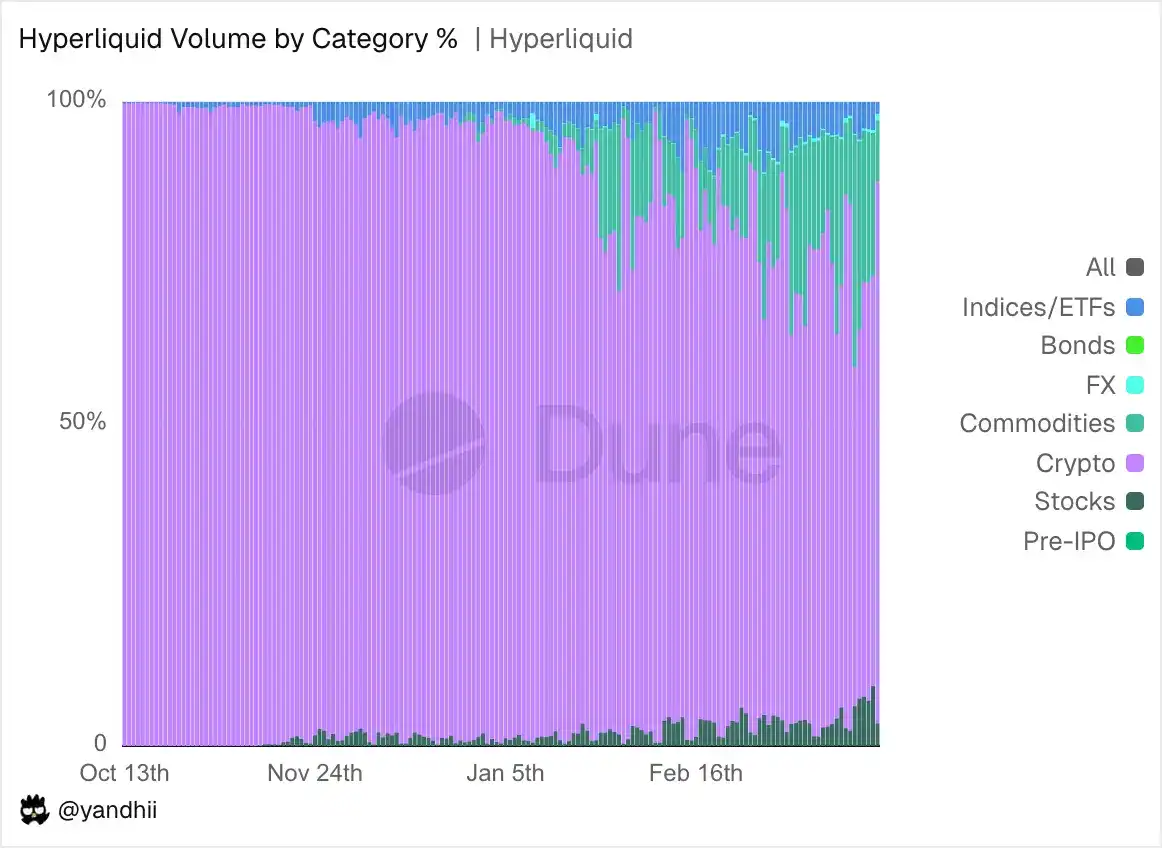
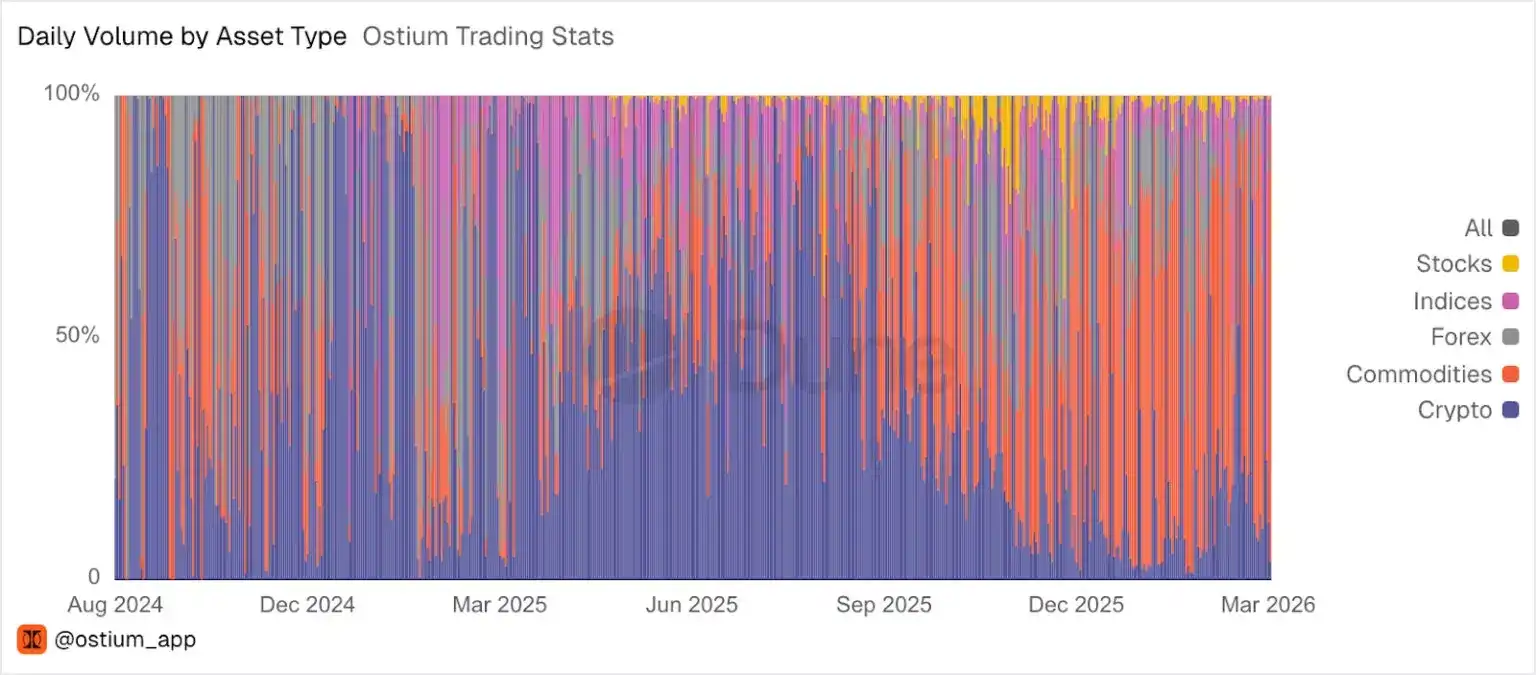
Decentralized exchanges have excelled at facilitating price discovery for RWAs like crude oil, especially on weekends when traditional exchanges are closed.

With the takeoff of RWA perpetuals, we see more companies developing products and businesses related to perpetual contracts. In the past 6 months alone, new exchanges, trading interfaces, market deployers, and liquidity providers have emerged.

Players flooding into this space include brand-new startups, startups pivoting to perpetuals, and some of the world's largest fintech companies integrating perpetual trading into their existing products.

All these diverse players are converging on the same opportunity: perpetual contracts have the potential to become one of the dominant trading instruments in global finance.

The Market Opportunity for Perpetual Contracts

Stepping back to look at traditional finance (TradFi), options are one of the largest and most actively traded markets globally. They exist in currencies, stocks, indices, commodities, and ETFs, and are extremely powerful and expressive tools that enable people to trade based on many different predictions: timing, volatility, price ranges, etc.

But if you zoom in on retail trading behavior, you find a huge amount of activity concentrated in a specific category of options: short-term, leveraged, directional exposure. A prominent example is 0DTE (zero days to expiration) options—traders pay a small cost to bet on high-magnitude intraday moves.

This type of trading is one of the fastest-growing option categories. In 2025, average daily volume for 0DTE SPX (S&P 500 Index) options reached 2.3 million contracts, up 51% year-on-year, accounting for 59% of total SPX option volume. Responding to this demand, the market introduced several new daily-expiring index products, including CBTX and MBTX Bitcoin ETF index options, and options on the equal-weight Cboe Magnificent 10 Index.

So, while options have many sophisticated uses—structured hedging, volatility trading, discrete trading, convexity (referring to the asymmetric特性 of收益与风险 : your maximum loss is fixed, but potential gains are theoretically unlimited), etc.—an enormous and growing flow of retail capital is essentially just looking for short-term, leveraged directional exposure. This is precisely the need that perpetual contracts fulfill perfectly.

The trade-offs are real: options excel at defined risk and convex payoffs, and remain the default tool for expressing volatility. Traders can lose at most the premium they pay. With perpetual contracts, the entire margined position can be liquidated. But for the directional leverage that most retail traders actually want, perpetual contracts have several structural advantages:

  • Always on. The latest generation of perpetual markets trade 24/7, with no trading hours or market close gaps. For a global, crypto-native user base, continuous access is an expected norm.
  • No strike prices, no expiration, no rollover. With a single continuous position, traders don't have to choose parameters, manage expiries, or rebuild positions daily or weekly. They can hold for seconds, months, or theoretically forever.
  • Simpler risk exposure. For perps, the primary considerations are price, collateral, and liquidation thresholds. For options, even if you're right on direction, you can lose due to time decay, implied volatility changes, and path dependence. Perps strip out this complexity. The trade is a pure expression of directional conviction.
  • Capital efficiency for continuous exposure. Short-term options require paying the full premium upfront and rolling over repeatedly. Perps require margin—often a fraction of the notional value—which is typically more capital efficient for intraday to multi-day directional positions.

Options aren't going away. They have long been part of financial history and will likely remain dominant for a significant subset of trading use cases, especially those involving defined risk and more complex payoff structures. But for the huge and growing flow of capital looking for Delta-1 directional leverage, perpetual contracts have already captured trillions in volume and billions in revenue.

This raises the question: as perpetual contracts evolve from niche tool to mainstream trading primitive, where will the value accrue in the tech stack?

In traditional markets, the most valuable companies are often built on top of exchange infrastructure, not at the exchange layer itself. For example, the retail broker Robinhood has a higher market cap than its underlying exchange, Nasdaq.

Whether this pattern holds in crypto—or whether platforms like Hyperliquid, Lighter, or Ostium can accumulate sufficiently powerful network effects at the exchange layer—is one of the most interesting open questions in the space.

Regardless, builder activity is expanding rapidly. We see developer growth in the following areas:

  • Customized distribution layers: Vertical or audience-specific frontends that not only present markets but also package narratives, strategies, gamification, or social hooks.
  • Market creators and operators (e.g., HIP-3 deployers): Operating a popular market on Hyperliquid essentially gives a deployer a "mini-exchange" without building the most complex exchange infrastructure. Today's deployers may only be scratching the surface of the data or price feeds that could be "perp-ified" in the future.
  • Specialized liquidity provision: Market makers focused on long-tail markets, event-driven order books, and cross-venue inventory management.
  • Perp-specific data infrastructure: An ecosystem of community-driven dashboards, block explorers, heatmaps, and analytics tools has already emerged around positions, funding rates, liquidations, trader signals, leverage exposure, retention cohorts, etc. More mature, high-quality, real-time data will make the entire ecosystem more transparent and efficient for all participants.

Of course, there are still significant open questions and challenges, spanning distribution, liquidity depth for new trading venues, oracle reliability as asset scope expands, inevitable tail events ("10/10" events), and regulation (which currently restricts US investor access to these products). These are the expected growing pains as perpetual contracts "graduate" from the crypto-native bubble and step onto the main stage of global finance. As the perpetual ecosystem matures, the question is no longer whether perps can scale, but who will build the most valuable applications and infrastructure around them when they do.


Пов'язані питання

QWhat are perpetual contracts and why are they considered a crypto-native innovation?

APerpetual contracts, or 'perps', are futures contracts that never expire and do not require settlement. They are considered a crypto-native innovation because they were popularized within the cryptocurrency space, starting with BitMEX's XBTUSD in 2016, and have since evolved to become a dominant trading instrument in crypto, with significant growth on both centralized and decentralized exchanges.

QHow has the growth of decentralized perpetual exchanges (DEX) compared to centralized exchanges (CEX) in recent years?

ADecentralized perpetual exchanges have grown at an astonishing rate. In the past year, leading DEXs saw a 346% increase in trading volume, reaching $6.7 trillion, while top CEXs settled $86.2 trillion in perpetual trading volume, a 47% increase. DEX volume now accounts for about 7.8% of CEX volume, up from just 2.5% a little over a year ago.

QWhat is HIP-3 on Hyperliquid and how does it impact the perpetual contract market?

AHIP-3, or Builder-Deployed Perpetuals, is a mechanism on Hyperliquid that allows anyone to permissionlessly launch a perpetual market on the exchange. It enables builders to list almost any asset, manage their own oracles and risk parameters, and earn 50% of the fees generated, significantly expanding the range of tradable assets and democratizing market creation.

QWhat are the key structural advantages of perpetual contracts over options for retail traders seeking directional leverage?

APerpetual contracts offer several advantages over options for directional leverage: they are always on (24/7 trading), have no strike prices or expiration dates (eliminating the need for rollovers), provide simpler risk exposure (focused on price, collateral, and liquidation thresholds without time decay or volatility complications), and offer capital efficiency for continuous exposure through margin requirements rather than full premium payments.

QWhat types of real-world assets (RWA) are being traded via perpetual contracts on DEXs, and how significant is their volume?

APerpetual contracts on DEXs now include a wide range of real-world assets such as commodities (e.g., silver, palladium, crude oil), stocks (e.g., Nvidia, Samsung), stock indices, and even private companies like SpaceX. RWA perpetuals have seen substantial growth, at times accounting for up to 44% of Hyperliquid's total volume and consistently being among the highest fee-generating pairs, with platforms like Ostium also seeing RWA dominate their trading activity.

Пов'язані матеріали

The Largest IPO in History Ignites Heated Debate: Is SpaceX Worth $1.77 Trillion?

SpaceX's potential IPO is priced at $135 per share, aiming to raise $75 billion and valuing the company at approximately $1.77 trillion, which would make it the largest IPO in history. This valuation has sparked intense debate among investors. Bullish analysts, including major underwriters Goldman Sachs and Morgan Stanley, argue the valuation is justified by SpaceX's long-term potential. They see it not just as a rocket company but as a future leader in space infrastructure, with key growth drivers being Starlink satellite internet, low-cost rocket launches, and future AI-related ventures. They project revenues reaching hundreds of billions to trillions of dollars by 2030-2040. ARK Invest's model suggests a 2030 enterprise value could reach $2.5 trillion. Bearish analysts from independent research firms like Morningstar, PitchBook, and New Constructs contend the IPO price is excessively high, already pricing in unrealistic future growth. Using DCF and sum-of-the-parts models, they estimate fair value between $780 billion and $1.7 trillion, significantly below the IPO target. They highlight risks such as the speculative nature of AI projections, over-dependence on Elon Musk, high growth expectations, and corporate governance concerns. Trefis set a target price of just $79 per share. While both sides acknowledge SpaceX's unique position in commercial space, the core disagreement centers on whether the $135 share price offers a reasonable margin of safety or is overly optimistic. Despite the valuation controversy, reported strong demand for the IPO indicates significant market interest.

marsbit44 хв тому

The Largest IPO in History Ignites Heated Debate: Is SpaceX Worth $1.77 Trillion?

marsbit44 хв тому

After the Passage of the GENIUS Act and the CLARITY Act, What Is the Correct Architecture for On-Chain Yield?

The article discusses the evolution of on-chain credit, distinguishing three markets: overcollateralized crypto lending, unsecured lending (largely unsuccessful), and asset-backed credit (ABC). ABC, backed by identifiable real-world collateral with legal recourse, is identified as the fastest-growing category and the only one credibly addressing adverse selection—the core problem in credit where the riskiest borrowers self-select. Current growth in on-chain Real World Assets (RWAs), particularly tokenized private credit funds (e.g., Maple Finance, Centrifuge), is substantial but often merely "wraps" existing fund structures, inheriting their risks rather than solving adverse selection at the protocol level. The regulatory landscape is a key driver, with the US GENIUS Act (prohibiting stablecoin issuers from paying yield) and the proposed CLARITY Act (closing loopholes on indirect yield) set to redefine permissible yield-bearing products. This makes vaults (like ERC-4626) the critical architecture—they become the primary compliant vehicle for delivering yield, functioning as issuance, disclosure, distribution, and recovery mechanisms. The author's thesis is that the correct post-GENIUS/CLARITY architecture involves building ABC solutions where credit assessment, structure, and recovery are encoded directly into the smart contract vault layer, moving beyond mere tokenized fund wrappers to solve adverse selection fundamentally and ensure regulatory compliance.

Foresight News1 год тому

After the Passage of the GENIUS Act and the CLARITY Act, What Is the Correct Architecture for On-Chain Yield?

Foresight News1 год тому

TechFlow Intelligence Bureau: Anthropic's New Model Fable Sparks Controversy by Restricting Biosafety Research, US CPI Soars to 4.2%, a Three-Year High

**Summary of TechFlow Intelligence Report:** The newsletter covers several key tech and finance developments. In AI, Anthropic's new Fable model faced backlash for secretly limiting biomedical research capabilities and enforcing a 30-day data retention policy, prompting the company to promise more transparent adjustments. In a related story, Anthropic's founder revealed his departure from OpenAI was due to dishonesty from Sam Altman, not safety concerns. Meanwhile, OpenAI is considering significant price cuts to compete with Anthropic, potentially sparking a price war. In crypto/Web3, BlackRock filed a new amendment for a yield-generating Bitcoin ETF, while Bank of America's CEO warned that stablecoin yields could drain trillions from traditional banks. U.S. Senator Cynthia Lummis advocated for the U.S. to officially accumulate Bitcoin reserves. In hardware, Nvidia released the DiffusionGemma-2-6B image model optimized for efficient inference, and AMD promoted its unified memory architecture to challenge Nvidia's dominance. TSMC's CFO hinted at possible price increases due to soaring AI chip demand. A major legal ruling in Germany held Google legally responsible for inaccurate information generated by its AI Overviews feature. Google Chrome also moved to fully block ad-blocker workarounds like uBlock Origin. Macroeconomic headlines included U.S. CPI rising to 4.2% (a 3-year high) and Iran's complete closure of the Strait of Hormuz, raising oil price and inflation fears. South Korean markets saw continued volatility with massive foreign capital outflow. Other notable stories: Microsoft expanded its Copilot AI assistant "Mico" globally; a study found r/wallstreetbets users' stock picks outperformed Wall Street; a fully autonomous drone killed a human soldier for the first time, raising AI ethics concerns; and a Chinese hospital used brain-computer interface technology to help a blind person "see." The overarching theme connects debates over AI boundaries and responsibility (Anthropic's restrictions, Google's liability, lethal autonomous drones) with real-world economic and geopolitical turmoil (inflation, Strait of Hormuz closure, market instability), highlighting the tense interplay between technological advancement and global chaos.

marsbit1 год тому

TechFlow Intelligence Bureau: Anthropic's New Model Fable Sparks Controversy by Restricting Biosafety Research, US CPI Soars to 4.2%, a Three-Year High

marsbit1 год тому

Alibaba's Yet Another New Business Division: What Signal Does It Send?

Alibaba has established a new "Token Foundry" business unit, merging its Tongyi large model division and Future Life Lab. Led directly by Group CEO Wu Yongming, this marks the company's third significant AI organizational reshuffle in 2026, following the creation of the Alibaba Token Hub (ATH) and a Group Technology Committee. The move signals a strategic shift from consolidating AI resources to accelerating productization and commercialization. The "Token Foundry" name reflects Alibaba's ambition to become a foundational supplier in the AI era, focusing on model development and commercial application. Key teams, including those behind the high-performing HappyHorse video generation model, have been integrated into the new unit. Concurrently, Zhou Jingren, architect of the Qwen model series, has been appointed Group Chief Scientist to lead a new AI Future Research Institute, focusing on long-term technological breakthroughs like Agent capabilities. This restructuring creates a clear four-layer AI architecture within Alibaba: the research institute for frontier exploration, Token Foundry for core models and commercialization, MaaS for platform services, and business units like Qianwen (C端) and Wukong (B端) for end-user applications. The adjustments align with a global trend among tech giants like Google and Microsoft to centralize AI leadership under the CEO and deeply integrate research with business units. The urgency is driven by a narrowing competitive window. Alibaba has announced its AI business is now entering a commercialization phase, with AI-related revenue seeing triple-digit growth for eleven consecutive quarters. The company faces intense competition in the MaaS (Model-as-a-Service) sector from rivals like ByteDance and Tencent. The Token Foundry initiative represents Alibaba's effort to streamline execution and enhance competitiveness in this critical, fast-evolving landscape.

marsbit2 год тому

Alibaba's Yet Another New Business Division: What Signal Does It Send?

marsbit2 год тому

Торгівля

Спот
Ф'ючерси
活动图片




