a16z: Crypto Payment Cards Swipe $759 Million in a Single Month, a 2.5x Increase in One Year, with Dollar Stablecoins Dominating the Entire Field

marsbitОпубліковано о 2026-08-10Востаннє оновлено о 2026-08-10

Анотація

Stablecoins are rapidly moving from on-chain assets to practical payment tools, with crypto payment cards now processing over $759 million in monthly spending, a 2.5x increase from a year ago. These cards allow users to spend cryptocurrencies at traditional merchants by instantly converting them (primarily stablecoins) to local currency. This provides dollar-based financial access even for the unbanked. In July, nearly 9 million transactions were made, averaging about $86 each. The underlying settlement landscape has shifted from being concentrated on Gnosis to a multi-chain environment, with Optimism, Solana, and Base now handling most of the volume. US dollar stablecoins have completely dominated the market, with USDC and USDT accounting for 84% of all card spending, replacing the early dominance of euro-backed stablecoins like EURe. Nearly all this activity flows through the traditional Visa card network. This growth signifies stablecoins' increasing integration into mainstream payment systems, expanding global access to digital dollars through familiar spending mechanisms.

Author: a16z crypto

Compiled by: Shenchao TechFlow

Deep Tide Introduction: Stablecoins are no longer just on-chain numbers; they can now be used to swipe a card to buy coffee. Crypto payment cards have exceeded a monthly transaction volume of $750 million, growing 2.5 times in a year. Behind nearly 9 million transactions, USDC and USDT account for 84% of the share, with Visa becoming the biggest winner. This card allows people without bank accounts to spend dollars, and stablecoins are infiltrating the payment system in the most traditional way.

The scale of spending stablecoins via card swipes is growing rapidly.

Crypto payment cards have evolved from a novelty to a business with a monthly transaction volume exceeding $750 million. These cards allow people to pay with cryptocurrency anywhere that accepts traditional card networks. The underlying mechanism is that cryptocurrency (overwhelmingly stablecoins) is instantly converted to local currency at the time of payment, so for merchants, the transaction is indistinguishable from an ordinary card swipe.

Holders of crypto cards do not need a traditional bank account. Depending on the project, users either deposit stablecoins with the card issuer or hold them directly in self-custody on-chain. Crypto cards expand global access to dollar-denominated accounts and provide a convenient way for stablecoin holders to transact.
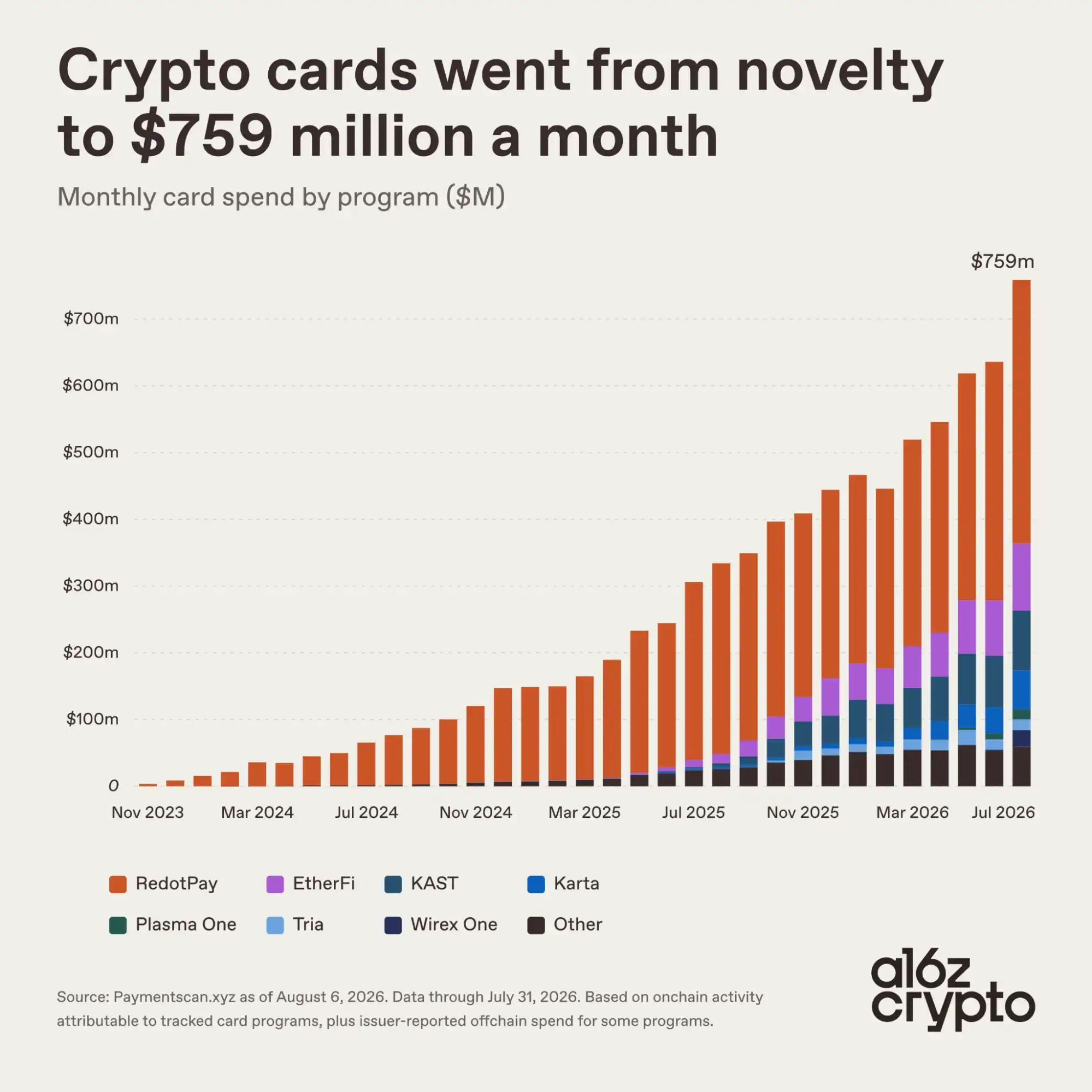
July Single Month Swipe: $759 Million, a 2.5x Increase in One Year

The monthly transaction volume of crypto payment cards reached $759 million in July, an increase of about 2.5 times from $306 million a year earlier, and was less than $1 million when tracking began in October 2023. These figures reflect the on-chain activity of card projects tracked by Paymentscan. (For the highest-volume project, RedotPay, spending data is self-reported by the issuer, not from on-chain observations.)

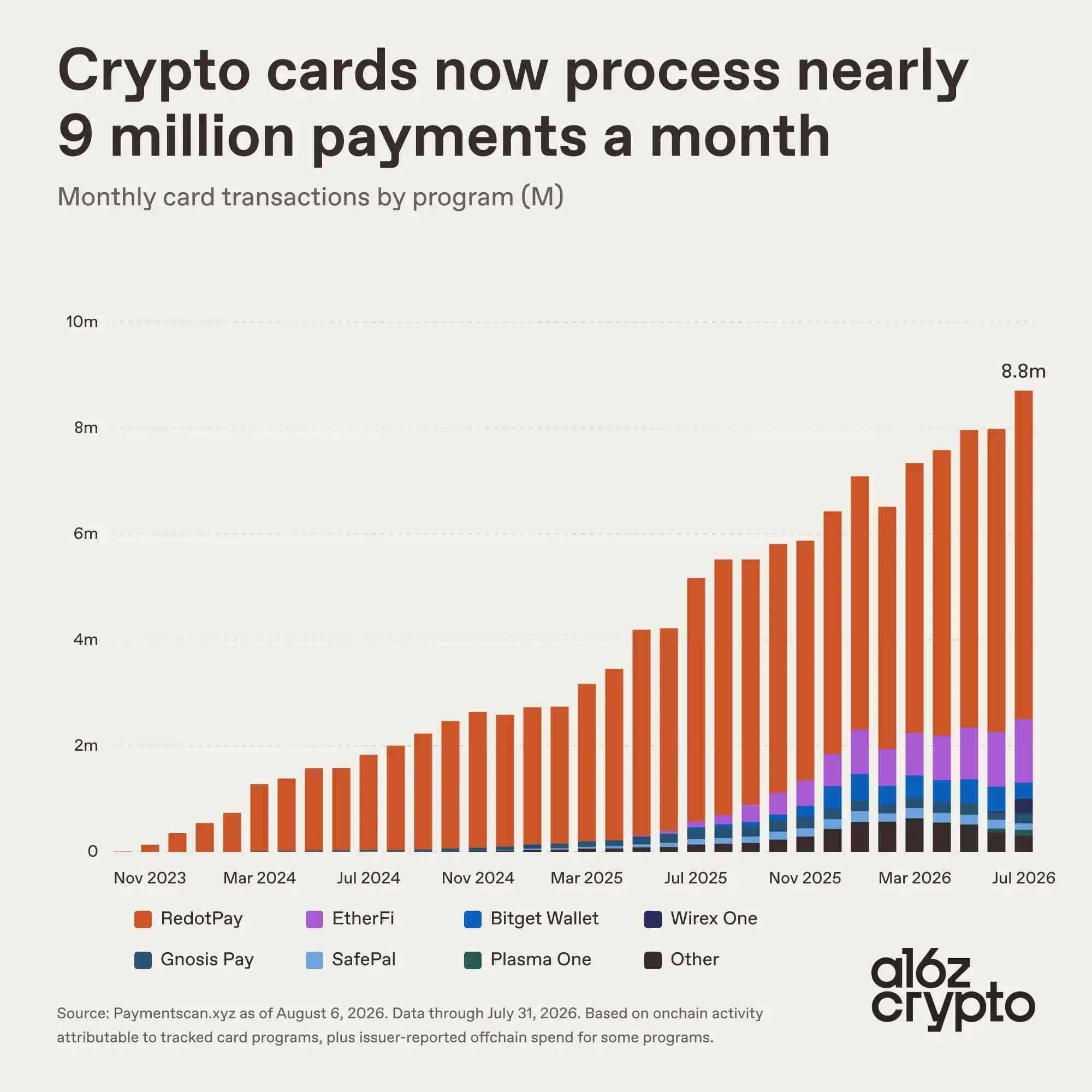
The growth trend in purchase frequency for crypto payment cards is similar to the transaction volume growth. Purchase frequency using crypto payment cards approached 9 million times in July, up from about 5.2 million times a year ago.

This indicates an average transaction amount of about $86.
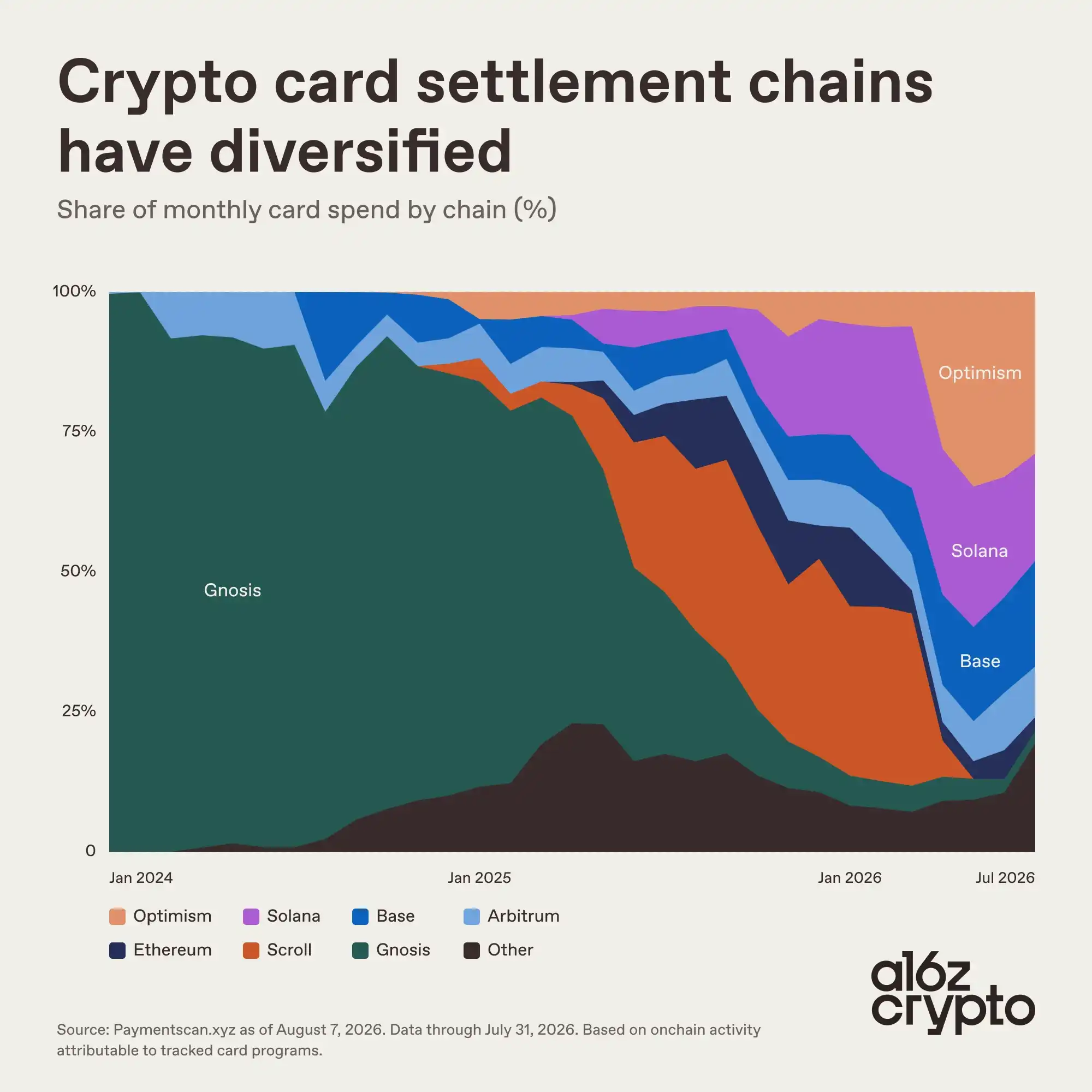
Optimism, Solana, and Base Form a Tripartite Division

At the beginning of 2024, crypto card spending was concentrated on a single chain: Gnosis, the home of Gnosis Pay (the first Visa card directly connected to a self-custody wallet). As new card projects launched, the number of chains used for card settlement has expanded.

According to Paymentscan data, as of July, Optimism handled about 29% of crypto card spending volume, Solana about 19%, and Base about 19%. Gnosis has declined to about 2%.
Dollar Stablecoins Fully Dominate, USDC + USDT Account for 84%

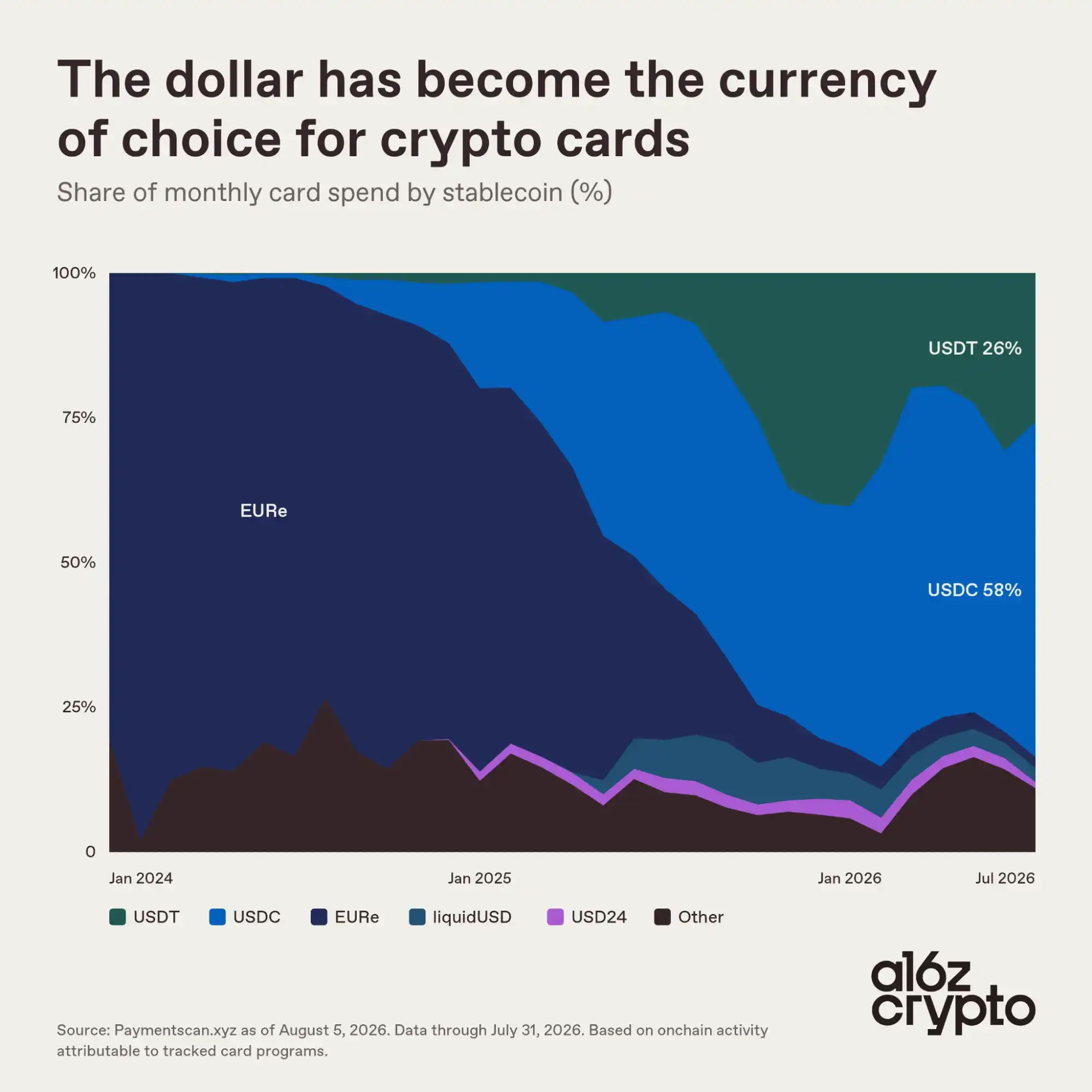
Euro-backed stablecoins once dominated spending: in early 2024, about 88% of crypto card transactions were settled in EURe, mostly on Gnosis. By July, EURe's share had dropped to about 2%.

U.S. dollar-backed stablecoins have now taken the lead. USDC handles about 58% of card spending, and USDT about 26%, up from about 48% and 7% a year ago, respectively. Crypto payment card spending is now almost entirely conducted in digital dollars.
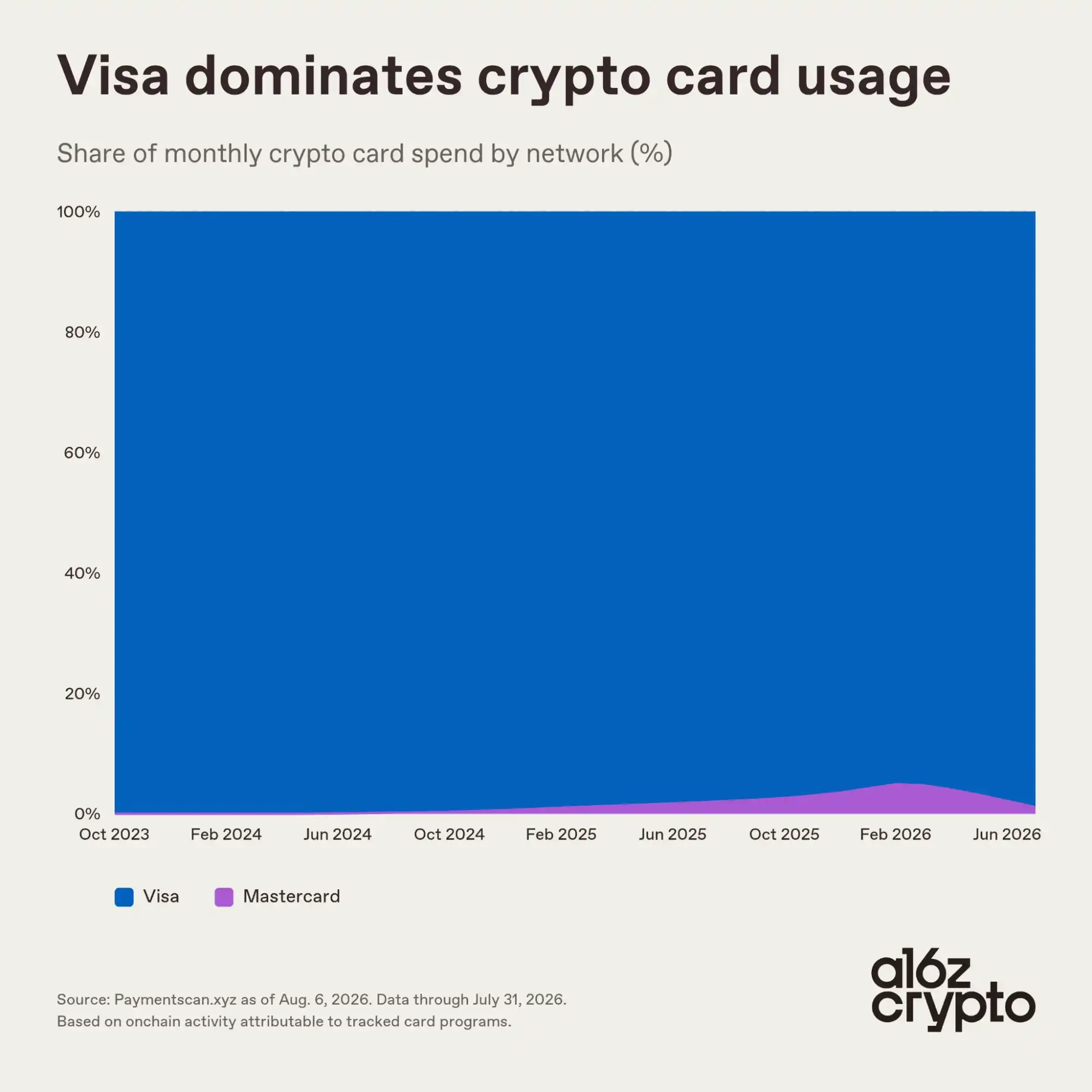
Visa Grabs Almost All Share

Compared to traditional card networks that process trillions of dollars monthly, crypto payment cards remain a small market.

But as stablecoins gain more ground in the global financial system, including via the rails of existing major card networks. For the tracked projects, this is happening almost entirely through Visa.
Crypto payment cards are part of the broader crypto acceleration following GENIUS, which we have been tracking here. This includes the rapid adoption of stablecoins and tokenized assets.

Трендові криптовалюти

Пов'язані питання

QWhat was the monthly transaction volume of crypto payment cards in July, and how much growth does this represent compared to a year earlier?

AIn July, the monthly transaction volume of crypto payment cards reached $759 million. This represents a growth of approximately 2.5 times compared to the $306 million volume from a year earlier.

QWhich stablecoins currently dominate crypto card spending, and what is their combined market share as of July?

ADollar-backed stablecoins, specifically USDC and USDT, dominate crypto card spending. As of July, USDC accounts for approximately 58% and USDT for 26%, giving them a combined market share of 84%.

QWhat are the top three blockchains for crypto card spending settlement as of July, and what were their approximate shares?

AAs of July, the top three blockchains for crypto card spending settlement were Optimism (approximately 29%), Solana (approximately 19%), and Base (approximately 19%).

QHow has the role of the Gnosis blockchain and the EURe stablecoin changed in the crypto card market from early 2024 to July?

AIn early 2024, the Gnosis blockchain was dominant, with about 88% of crypto card spending settled using the EURe stablecoin. By July, Gnosis's share had fallen to about 2%, and EURe's share had also declined to approximately 2%.

QWhich traditional card network is primarily used by the crypto payment card projects tracked in the article?

AFor the crypto payment card projects tracked in the article, transactions occur almost entirely through the Visa network.

Пов'язані матеріали

Artemis: A Review of Figma's Q2 Earnings, Optimistic About Current Market Pricing

**Summary of "Artemis: Figma Q2 Earnings Review, Bullish on Current Market Pricing"** Following Figma's strong Q2'26 earnings report (revenue of $370.1M, up 48% YoY), the stock price fell 17%. The article argues this market reaction is mistaken, as it underestimates Figma's transformation from a tool for designers to the foundational design layer for all software creation in the AI era. Key supporting arguments are: 1. **Rise of the "Product Engineer":** AI is lowering coding barriers, leading to the emergence of hybrid "product engineers" who handle both engineering and design. As engineering teams are historically larger than design teams, this role significantly expands Figma's potential user base. 2. **AI Agents as Users:** The future SaaS model will charge not only for human users ("seats") but also for the work done by AI agents on their behalf. These agents will consume computational resources within Figma (e.g., editing components, converting designs to code), creating a new revenue stream. 3. **Margin Expansion:** While AI inference initially pressured gross margins, Figma's introduction of paid credits for AI usage (like Figma Make) has allowed its non-GAAP gross margin to recover to 85% in Q2'26. Monetizing its AI products further will likely drive continued margin improvement. The article acknowledges the long-term risk that AI tools like Claude could bypass the "design-to-code" workflow entirely. However, Figma's established customer base, integrated workflows, and embedded design systems act as strong moats for the foreseeable future. The author contends the market is mispricing Figma by viewing it as just a design software company. With sustained high growth (40%+ YoY revenue growth), strong Net Dollar Retention (136%), and its strategic positioning for the AI-driven future, Figma's Total Addressable Market (TAM) is much larger than currently priced. The future narrative involves more creators using Figma, more AI agents operating on its platform, and effective monetization of that AI usage.

marsbit9 хв тому

Artemis: A Review of Figma's Q2 Earnings, Optimistic About Current Market Pricing

marsbit9 хв тому

When POAP Also Reaches Its End: The Crypto Industry's 'Closure Wave' Hits, How Should Ordinary Users Cope?

The crypto industry is currently experiencing a wave of project shutdowns and closures. Notable examples include long-standing entities like the BitMEX exchange and the POAP (Proof of Attendance Protocol) project. This trend highlights a key shift: beyond major hacks or scams, many projects with real users and functional products are failing due to an inability to find sustainable business models. This signifies a structural correction, moving away from growth fueled by speculation and incentives toward projects with genuine, revenue-generating utility. For ordinary users, this "slowdown" presents new risks. The principle of "Not your keys, not your coins" addresses control but not the complete picture of asset safety. Assets in a self-custodied wallet can represent different things: native assets (e.g., ETH), protocol deposit tokens, LP tokens, or bridged/wrapped assets. If the underlying protocol, bridge, or even blockchain shuts down, the ability to redeem or exit these assets can be lost, even with the private key. The article outlines three key considerations for users: 1. **Understanding Exit Rights:** Evaluate if you can withdraw funds directly via smart contracts if a project's front-end shuts down (as with dYdX v3). 2. **Distinguishing Assets from Claims:** Recognize that tokens like renBTC are claims on assets held elsewhere; their value depends on the solvency and operation of the issuing bridge or protocol. 3. **Assessing Network Viability:** If an entire L1/L2 blockchain halts, private keys alone cannot facilitate transactions. To navigate this environment, users are advised to look beyond token prices and monitor: * **Financial Sustainability:** Is there real, non-incentivized demand and protocol revenue? * **Project Activity:** Is development active (GitHub), or is the project only maintained on social media? * **Exit Channels:** Know the exact nature, location (chain, contract), and redemption process for your holdings. In conclusion, while project lifecycles ending is a sign of industry maturation, users must develop a more nuanced understanding of self-custody. It involves not just holding private keys but also critically assessing what an asset truly represents and ensuring a viable path to exit, independent of any single project's continued operation.

marsbit12 хв тому

When POAP Also Reaches Its End: The Crypto Industry's 'Closure Wave' Hits, How Should Ordinary Users Cope?

marsbit12 хв тому

Earning $400 Million a Year Without Writing a Single Line of Code

**Summary: Rimini Street - The $400 Million Business That Doesn't Write Code** This article details the unlikely success of Rimini Street, a company generating over $400 million annually by offering third-party support for legacy enterprise software systems, primarily from Oracle and SAP, without developing any software itself. Its core business model is simple: it charges clients roughly half of the exorbitant annual maintenance fees (typically 22% of the license cost) demanded by Oracle and SAP. In return, Rimini provides maintenance, security patches, regulatory updates, and technical support for these often-stable but expensive-to-maintain old systems. Major clients like Welch's, AUTOBACS, and Khimji Ramdas have switched, reportedly saving up to 80% on total maintenance costs. The company's founder, Seth Ravin, previously attempted this model with TomorrowNow (acquired by SAP), which Oracle sued successfully. Rimini Street itself faced a 15-year legal battle with Oracle over copyright infringement. Ultimately, courts ruled in Rimini's favor, recognizing its services as "legitimate competition." Having broken the vendor "lock-in," Rimini now builds its own "lock" through expanded services. After clients save on maintenance, Rimini upsells them on managed services (Rimini Manage), integration tools (Rimini Connect), security solutions (Rimini Protect), and AI-powered workflow automation layered on top of legacy systems. This increases client reliance and switching costs. However, challenges remain. Its "virtual patching" security approach may not satisfy highly regulated industries. Growth shows signs of pressure, and returning to the original vendor incurs massive penalty fees. Meanwhile, Oracle and SAP are pushing clients to cloud-based SaaS models, creating a new, more fundamental architectural lock-in by removing the software license from the client's control entirely. The article concludes by framing this as a cycle of lock creation and dismantling, and questions why a similar model hasn't emerged in China's enterprise software market dominated by vendors like Yonyou and Kingdee.

marsbit14 хв тому

Earning $400 Million a Year Without Writing a Single Line of Code

marsbit14 хв тому

Торгівля

Спот

Популярні статті

Як купити ONE

Ласкаво просимо до HTX.com! Ми зробили покупку Harmony (ONE) простою та зручною. Дотримуйтесь нашої покрокової інструкції, щоб розпочати свою криптовалютну подорож.Крок 1: Створіть обліковий запис на HTXВикористовуйте свою електронну пошту або номер телефону, щоб зареєструвати обліковий запис на HTX безплатно. Пройдіть безпроблемну реєстрацію й отримайте доступ до всіх функцій.ЗареєструватисьКрок 2: Перейдіть до розділу Купити крипту і виберіть спосіб оплатиКредитна/дебетова картка: використовуйте вашу картку Visa або Mastercard, щоб миттєво купити Harmony (ONE).Баланс: використовуйте кошти з балансу вашого рахунку HTX для безперешкодної торгівлі.Треті особи: ми додали популярні способи оплати, такі як Google Pay та Apple Pay, щоб підвищити зручність.P2P: Торгуйте безпосередньо з іншими користувачами на HTX.Позабіржова торгівля (OTC): ми пропонуємо індивідуальні послуги та конкурентні обмінні курси для трейдерів.Крок 3: Зберігайте свої Harmony (ONE)Після придбання Harmony (ONE) збережіть його у своєму обліковому записі на HTX. Крім того, ви можете відправити його в інше місце за допомогою блокчейн-переказу або використовувати його для торгівлі іншими криптовалютами.Крок 4: Торгівля Harmony (ONE)Легко торгуйте Harmony (ONE) на спотовому ринку HTX. Просто увійдіть до свого облікового запису, виберіть торгову пару, укладайте угоди та спостерігайте за ними в режимі реального часу. Ми пропонуємо зручний досвід як для початківців, так і для досвідчених трейдерів.

523 переглядів усьогоОпубліковано 2024.12.12Оновлено 2026.06.02

Як купити ONE

Обговорення

Ласкаво просимо до спільноти HTX. Тут ви можете бути в курсі останніх подій розвитку платформи та отримати доступ до професійної ринкової інформації. Нижче представлені думки користувачів щодо ціни ONE (ONE).

活动图片