a16z crypto Partner: Cash Flow Is the True Moat

Foresight NewsОпубліковано о 2026-06-11Востаннє оновлено о 2026-06-11

Анотація

Title: a16z Crypto Partner: Capital Flow is the True Moat In business history, enduringly successful enterprises often share a core logic: capturing value by facilitating its creation and transfer within an ecosystem, taking a share of the proceeds. The scale of value flowing through the ecosystem directly correlates with the company's growth. Cryptography is the first modern technology natively suited to this commercial logic. Startups that don't leverage this framework in product design and business model construction miss significant opportunities. Stablecoins enable internet-speed, 24/7 global settlement of value with end-to-end programmability. With open underlying channels for capital flow and transparent unit economics, every circulating dollar globally represents potential flow in this arena. Blockchain is inherently a network business model. All transactions are recorded on a shared ledger, and each new participant strengthens this foundational system for future developers. More users and applications increase the network's value for all. Crypto entrepreneurs start with built-in network effects, unlike traditional businesses that spend years building them on legacy infrastructure. Network tokens amplify this advantage. A well-designed token system aligns users, developers, service providers, and validators around a common goal—network growth—while distributing rewards based on contribution. All proceeds flow back to ecosystem participants, creating a virtuous cyc...


Author: Jason Rosenthal, Operating Partner at a16z crypto

Compiled by: Chopper, Foresight News


Throughout business history, the success logic of many enduring enterprises has been inseparable from the link of capital flow: undertaking businesses that create and transfer value within the ecosystem and extracting revenue from them. The larger the volume of value flowing through the ecosystem, the larger the scale of the enterprise tends to be.


Cryptographic technology is the first modern technology inherently suited to this business logic. If a startup does not base its product design and business model architecture on this logic during the planning stages, it misses out on tremendous opportunities. The proliferation of stablecoins has endowed capital and value with internet-level transfer speeds, enabling 24/7 global settlement with end-to-end programmability. Now, the underlying channels for capital flow are fully open, unit economic models are transparent, and every circulating dollar globally represents potential flow in this arena.


Underlying Business Logic


Blockchain is fundamentally a network-based business model. All transactions are uniformly recorded on a shared ledger, and each new participant reinforces this underlying system for subsequent developers. The more people who use the ecosystem and build applications, the greater the value of the entire network for all users.


Most traditional enterprises spend years building network effects on top of outdated infrastructure; whereas entrepreneurs in the crypto space start with inherent network effects from the outset.


Network tokens further amplify this advantage. A well-designed token system can bind users, developers, service providers, node validators, and the protocol ecosystem to a common goal—driving network growth—while distributing revenue according to each party's contributions. The revenue generated by the protocol ultimately belongs to all ecosystem participants. There are no secret rebates, no special deals, only the formation of a positive feedback loop: value circulates within the system, and returns flow back to everyone building the ecosystem.


This business logic is not new; it's just that the crypto industry is the first to enable startups to implement and scale it more easily.


The profit core of railroad companies was never selling locomotives, but charging a toll for every freight train transporting grain, coal, or steel. Standard Oil, U.S. Steel, and AT&T were all giants rooted in the links of value flow. Google and Meta replaced traditional print and television media not merely because their advertising formats were better, but because they occupied the critical node where attention converts into commercial transactions, taking a cut from trillions of dollars in commercial flow. Amazon Web Services occupies the central position for computing resources.
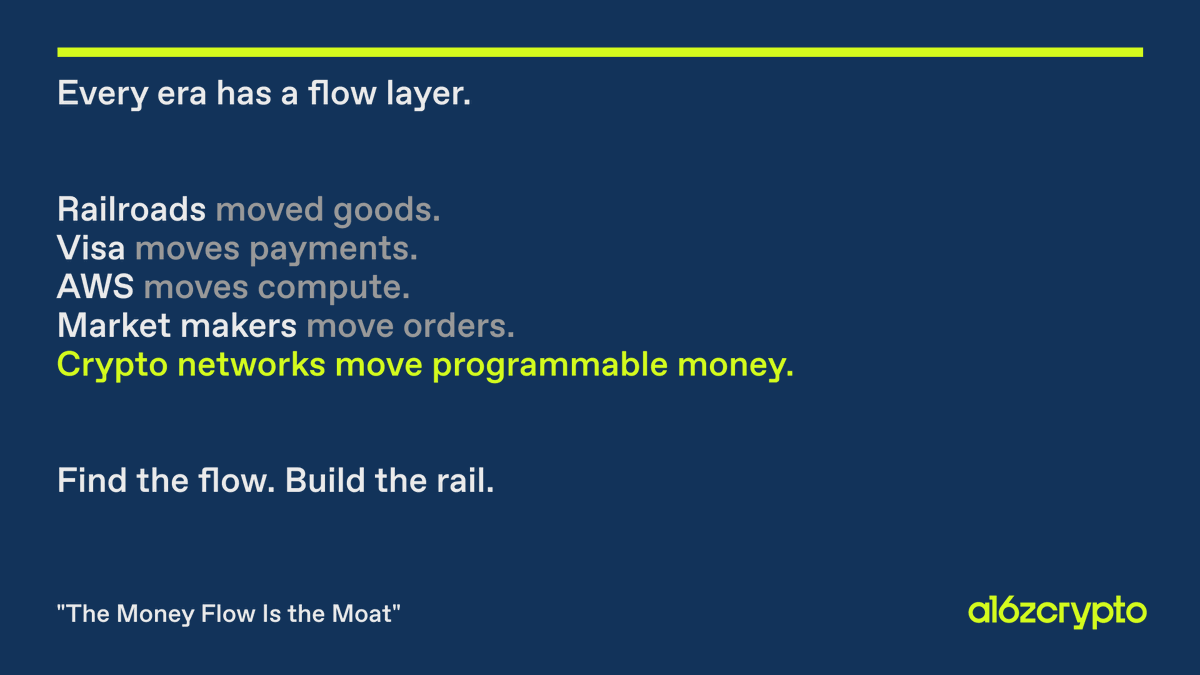


The pattern remains consistent: find the core path of value flow and occupy a key position within it.


This logic is vividly reflected in financial markets. In fiscal year 2024, Visa processed payment volumes totaling $15.7 trillion, generating net revenue of $35.9 billion. The well-known market maker Jane Street's trading net revenue reached $20.5 billion last year, surpassing Citibank and Bank of America. The top five market makers in the US handled 87% of order flow payments: they don't predict market ups and downs, they just need to reside in the flow path of every order; the higher the trading volume, the greater their earnings.


Such enterprises share another commonality: powerful network effects. The more merchants that accept Visa cards, the more valuable the card is to cardholders; conversely, the more cardholders, the more merchants are attracted to offer the service. The order flow market is similar: the more brokers connected, the narrower the bid-ask spread, which in turn attracts more brokers, bringing even larger order flow.


Cash flow coupled with network effects is one of the most robust business models in the commercial world.


Your Margin Is My Opportunity


Jeff Bezos once proposed a classic viewpoint: "Your margin is my opportunity." This statement originally targeted the retail industry, but it fits even more aptly in the traditional financial services sector—the industry with the largest scale of profit capture globally. This holds true across subsectors like payments, asset custody, lending, foreign exchange, asset securitization, trade settlement, and market making.


Visa and Mastercard, based on networks built in the 1960s, charge transaction fees of 2% to 3%; cross-border remittance channels have fees as high as 6% to 9%; prime brokers and asset custodians take a cut from every securities transaction. Even though the US shortened the securities settlement cycle to T+1 in 2024, funds can still sit idle overnight, which constitutes a structural cost borne by all market participants.


The existing profit margins in these industries are all potential entry points for disruption. Reducing transaction costs, improving capital flow efficiency, and potentially further expanding the overall market size. Stripe and Square have proven this model works in payments.
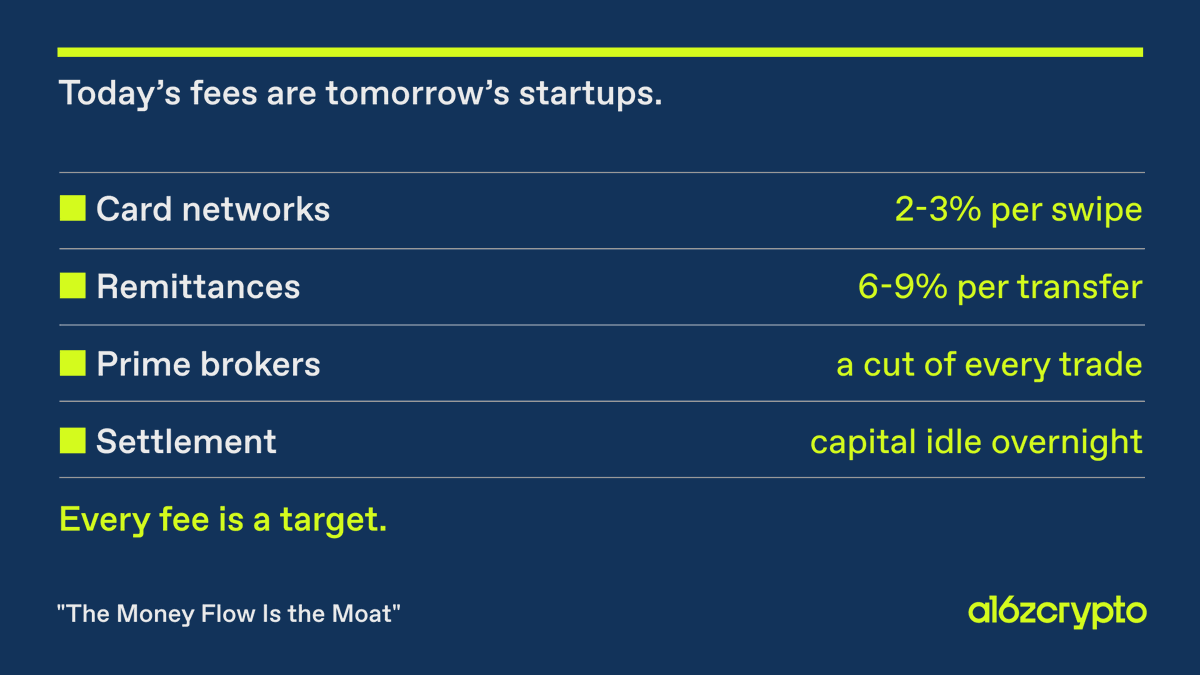


Entrepreneurs in the crypto industry have the opportunity to build the next-generation infrastructure: programmable, transactions settled instantly, globally accessible services, and rooted in the capital flow chain from its inception.


The opportunities also extend far beyond financial services. Markets for computing power and GPU trading, storage chips, AI training data, energy, robotics, aerospace, rare earth metals, and more are all on the verge of experiencing large-scale global value flow, for which existing traditional channels are completely inadequate.


The aforementioned sectors represent entirely new blue-ocean markets built on programmable infrastructure, centered on the cash flow model. Here, there are no deeply entrenched legacy platforms, no tangled webs of middlemen, and no old structures to defend.


As an entrepreneur, ask yourself a few questions: Is your current business positioned in the core link of value flow? When the transaction volume and value scale of your product ecosystem grow tenfold, can your revenue grow in sync? If you are developing a new product, in your target market, which link has the highest profit capture relative to the value it creates?


Where the answer lies, there lies the opportunity. Compress the costs of the original links, enter new value flow tracks, and then achieve sustained growth by leveraging network effects.


Трендові криптовалюти

Пов'язані питання

QWhat is the core business logic shared by many enduring enterprises throughout business history, according to the article?

AThe core business logic is to occupy a key position in the flow of value, capturing a portion of the value as it moves through an ecosystem. The greater the volume of value flowing, the larger the enterprise typically becomes.

QHow does the article characterize the fundamental nature of blockchain technology in relation to business models?

AThe article characterizes blockchain as fundamentally a network-based business model. All transactions are recorded on a shared ledger, and each new participant strengthens this underlying system for subsequent developers. The more people who use and build on the ecosystem, the more valuable the entire network becomes for all users.

QAccording to the article, what creates one of the most durable business models in the commercial world?

AThe combination of capital flow and network effects creates one of the most durable business models in the commercial world.

QWhat is the meaning of Bezos's quote 'Your margin is my opportunity' in the context of traditional financial services?

AIn the context of traditional financial services, the quote means that the existing profit margins (or high fees) in sectors like payments, asset custody, and cross-border transfers represent opportunities for new, more efficient entrants to disrupt the industry by compressing those costs and capturing market share.

QWhat key questions should entrepreneurs ask themselves to identify opportunities, as suggested by the article?

AEntrepreneurs should ask: 1) Is my current business positioned at the core of a value flow? 2) If the transaction volume and value in my product's ecosystem grow tenfold, will my revenue grow correspondingly? 3) In my target market, which segment has the highest profit margin relative to the value it creates? The answers point to where the opportunities lie.

Пов'язані матеріали

In Conversation with Ray Dalio: We Are Currently in an AI Bubble, with 1% of My Portfolio in Bitcoin

Ray Dalio, founder of Bridgewater Associates, warns in an interview that the current AI boom shows classic bubble characteristics, which could lead to significant economic downturns as seen in past cycles like 1929 or 2000. He explains that speculative enthusiasm, fueled by debt and overvaluation, often precedes a crash when rising rates or taxation force asset sales, causing widespread losses and recession. Dalio also outlines his "Big Cycle" theory, describing an approximate 80-year pattern where widening wealth gaps, massive government deficits, and shifting geopolitical power (like China's rise) create internal conflict and global instability. He emphasizes that we are in a late-cycle, transitional phase where traditional powers like the US and UK face decline. For personal wealth protection, Dalio advises diversification beyond cash into assets like stocks, bonds, real estate, and particularly gold, which he prefers over Bitcoin. While he holds about 1% of his portfolio in Bitcoin as a non-printable hard asset, he views gold as more secure from technological or governmental threats. Regarding AI's impact, Dalio believes it will disproportionately benefit capital owners, worsening inequality by replacing both physical and cognitive labor. He suggests that human intuition and emotional intelligence, combined with AI, will be key for future workers. On taxation, Dalio argues that wealth taxes are impractical and risk triggering asset sell-offs, reducing productive investment. He points to the UK as a cautionary example of debt, low productivity, and political strife. Geopolitically, Dalio foresees a more regionalized world, with the US showing weakness in prolonged conflicts like with Iran, akin to past imperial declines. The ideal outcome, he suggests, is coexisting powerful blocs (e.g., Americas, China-Asia Pacific) without major war.

marsbit33 хв тому

In Conversation with Ray Dalio: We Are Currently in an AI Bubble, with 1% of My Portfolio in Bitcoin

marsbit33 хв тому

Daily 7.2 Trillion KRW: Foreign Capital's Record Net Buying on Friday! Wall Street Says Headwinds for Korean Stock Fund Flows Have Subsided

South Korean stock market sees a dramatic shift in fund flows. On July 31, foreign investors made a record net purchase of approximately KRW 7.2 trillion in KOSPI stocks, marking a fundamental reversal from the persistent large-scale net outflows seen in previous months. This contributed to a significant narrowing of foreign net selling in July to KRW 9.8 trillion, down sharply from KRW 48.4 trillion in June and KRW 44.5 trillion in May. Simultaneously, domestic institutional pressure eased. South Korean pension funds and asset managers turned to a net buying position in July, purchasing KRW 1.0 trillion worth of KOSPI shares, contrasting with net sales in May and June. Market volatility is expected to be dampened by new financial regulations. Effective July 31, the Financial Services Commission tightened access for retail investors to single-stock leveraged ETFs by raising the minimum cash deposit requirement. Trading volumes for these products subsequently dropped to about 50% of their monthly average. Citigroup Research maintains its year-end KOSPI target of 10,000 points. The firm cites several supportive factors: the substantial easing of headwinds from capital outflows, a robust fundamental outlook for the semiconductor sector, historically low market valuations, strong economic fundamentals, and the potential for policy support from financial authorities if needed.

marsbit33 хв тому

Daily 7.2 Trillion KRW: Foreign Capital's Record Net Buying on Friday! Wall Street Says Headwinds for Korean Stock Fund Flows Have Subsided

marsbit33 хв тому

Thanks to Dice Rolls, Bitcoin Keys Are Stored Offline, But Not Everyone Will Do It

The article discusses using dice rolls to generate secure Bitcoin wallet seeds, providing entropy independent of potentially flawed hardware random number generators. It explains that each fair dice roll offers about 2.585 bits of entropy, with around 50 rolls needed for a standard 12-word seed phrase and 99+ recommended for higher security. This method gained attention after a vulnerability was revealed in some Coldcard hardware wallets, where a faulty firmware RNG (dating back to 2021) compromised generated keys. The analysis notes that while a dice-generated main seed was safe from this specific flaw, other Coldcard functions (like creating paper wallets, backup keys, or passwords) could still be vulnerable if they used the defective RNG. The piece argues that while dice-based entropy is technically robust, the manual process is error-prone, tedious, and unrealistic for most new users, who might make mistakes in recording or inputting rolls. It concludes that while manual entropy generation should remain an option for advanced users, the long-term goal is to develop reliable, user-friendly hardware and software that securely generates randomness without requiring specialized knowledge. Coldcard users are advised to check their firmware version and replace any secondary secrets (like paper wallet keys) created with vulnerable devices, while also considering multi-signature setups with devices from different manufacturers for added security.

cryptonews.ru5 год тому

Thanks to Dice Rolls, Bitcoin Keys Are Stored Offline, But Not Everyone Will Do It

cryptonews.ru5 год тому

Торгівля

Спот

Популярні статті

Як купити FLOW

Ласкаво просимо до HTX.com! Ми зробили покупку Flow (FLOW) простою та зручною. Дотримуйтесь нашої покрокової інструкції, щоб розпочати свою криптовалютну подорож.Крок 1: Створіть обліковий запис на HTXВикористовуйте свою електронну пошту або номер телефону, щоб зареєструвати обліковий запис на HTX безплатно. Пройдіть безпроблемну реєстрацію й отримайте доступ до всіх функцій.ЗареєструватисьКрок 2: Перейдіть до розділу Купити крипту і виберіть спосіб оплатиКредитна/дебетова картка: використовуйте вашу картку Visa або Mastercard, щоб миттєво купити Flow (FLOW).Баланс: використовуйте кошти з балансу вашого рахунку HTX для безперешкодної торгівлі.Треті особи: ми додали популярні способи оплати, такі як Google Pay та Apple Pay, щоб підвищити зручність.P2P: Торгуйте безпосередньо з іншими користувачами на HTX.Позабіржова торгівля (OTC): ми пропонуємо індивідуальні послуги та конкурентні обмінні курси для трейдерів.Крок 3: Зберігайте свої Flow (FLOW)Після придбання Flow (FLOW) збережіть його у своєму обліковому записі на HTX. Крім того, ви можете відправити його в інше місце за допомогою блокчейн-переказу або використовувати його для торгівлі іншими криптовалютами.Крок 4: Торгівля Flow (FLOW)Легко торгуйте Flow (FLOW) на спотовому ринку HTX. Просто увійдіть до свого облікового запису, виберіть торгову пару, укладайте угоди та спостерігайте за ними в режимі реального часу. Ми пропонуємо зручний досвід як для початківців, так і для досвідчених трейдерів.

300 переглядів усьогоОпубліковано 2024.12.10Оновлено 2026.06.02

Як купити FLOW

Обговорення

Ласкаво просимо до спільноти HTX. Тут ви можете бути в курсі останніх подій розвитку платформи та отримати доступ до професійної ринкової інформації. Нижче представлені думки користувачів щодо ціни FLOW (FLOW).

活动图片












