This article is from:a16z crypto
Compiled by|Odaily Planet Daily(@OdailyChina); Translator|Moni
Tokenized Assets, often referred to as "Real World Assets (RWA)", are transforming the form of assets, how they flow, and how financial systems are constructed.
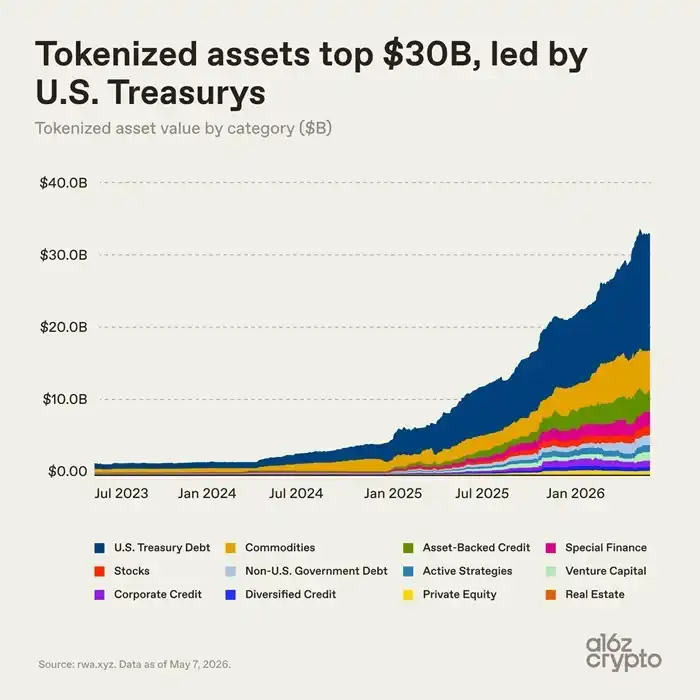
Just last month, the market size of tokenized assets surpassed $30 billion and is currently hovering around $34 billion (excluding stablecoins). This scale is roughly equivalent to a regional bank or a top-tier university endowment. While still minuscule compared to the global financial system, it is significant enough to have a tangible impact.
Two years ago, the tokenized asset market was worth less than $3 billion. Since then, the market has undergone dramatic changes: The US GENIUS Act has brought a clearer regulatory framework for stablecoins, institutional-grade on-chain infrastructure has matured, and a large number of financial institutions have nearly simultaneously begun deploying blockchain technology—it is precisely under the impetus of these factors that the tokenized asset market has grown tenfold in less than two years. (Note: While stablecoins are not included in the above statistics, they have substantially driven the growth of the entire market by greatly simplifying on-chain payments and settlements.)
This article will use 7 charts to analyze the reasons behind the rise of tokenized assets and their future trajectory.
Tokenized Assets Take Off: US Treasuries Become the Biggest Growth Engine
US Treasury bonds are the primary driver of the recent growth in the tokenized asset market.
The advantages of tokenized US Treasuries are clear and intuitive: investors can hold stable yield-generating assets in a digital form, enabling more efficient and flexible trading and transfer; financial institutions can achieve efficiency gains in settlement and collateral asset allocation, seamlessly connecting with digital financial markets.
Crypto investors can also use tokenized Treasuries to leverage idle stablecoins to gain returns from traditional money markets. Asset management institutions like BlackRock and Franklin Templeton have strategically positioned themselves accordingly, catalyzing a trillion-dollar market.
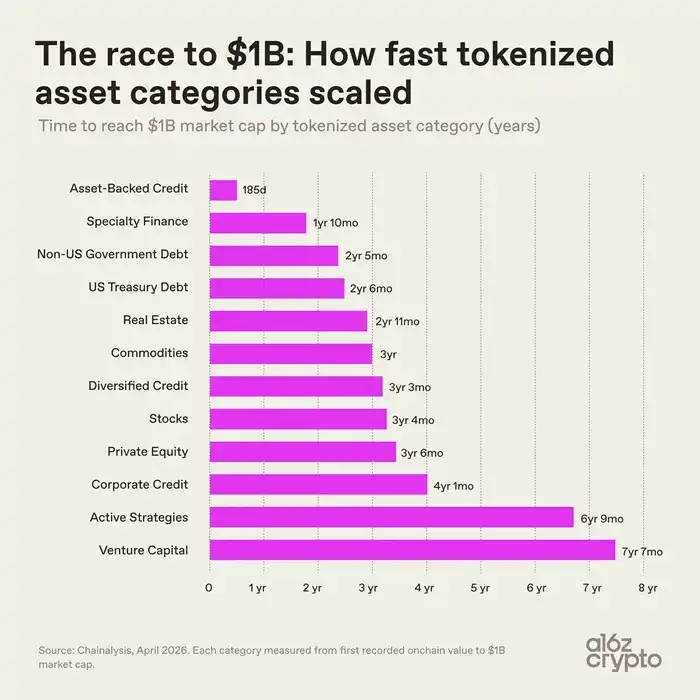
It is important to note that the growth rates of various tokenized assets vary widely, stemming from both the technical and regulatory difficulties of putting different assets on-chain and the market acceptance of products after launch.
- Asset-backed credit assets have seen leading growth. Such tokenized assets mainly include tokenized home equity lines of credit, lending vault tokens, with reinsurance contracts, Bitcoin mining notes, and other niche financial assets following, reaching a market value of $1 billion within two years.
- Venture capital assets took over seven years to exceed $10 billion in market value, with actively managed strategy assets following a similar cycle. These assets have complex structures, long investment horizons, and higher operational and regulatory barriers.
- Treasuries and commodities have moved on-chain at a moderate pace, breaking the $10 billion market cap mark within 2 to 3 years and now representing mainstream categories.
At the beginning of 2024, Treasuries and commodities accounted for almost the entire tokenized asset market share. After 2024, the share of credit, niche finance, and equity categories steadily increased, but market concentration remains high. Currently, tokenized US Treasuries and commodities together account for about two-thirds of the market share.
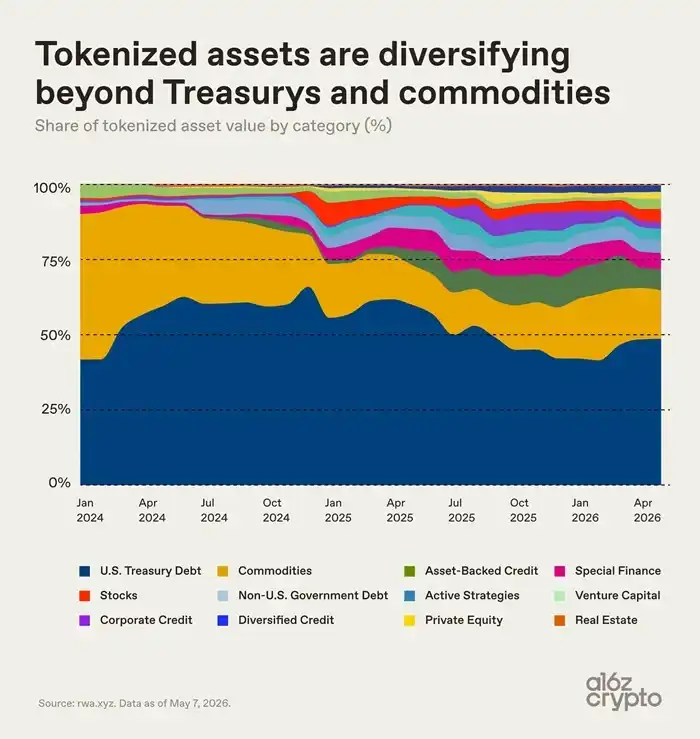
Segmentation of the Tokenized Asset Market
The commodity tokenization sector is highly concentrated internally, with gold tokens dominating the vast majority, with a total scale of approximately $5.1 billion, of which gold tokens account for $5.0 billion. Silver and other category tokens total only $57.6 million, accounting for less than 0.01%.
Gold is naturally suited to the tokenized asset model. Currently, the commodity token market is essentially led by gold because: gold has a global unified standard, is convenient to store, is not easily damaged, and has long been traded via claim certificates.
Furthermore, crypto market investors have historically favored gold assets, with Bitcoin being called digital gold in its early days. Products like Tether's gold token XAUT and Paxos's gold token PAXG map ownership of vaulted gold onto the blockchain, transforming physical gold claims into digital tokens that can be held in on-chain wallets.
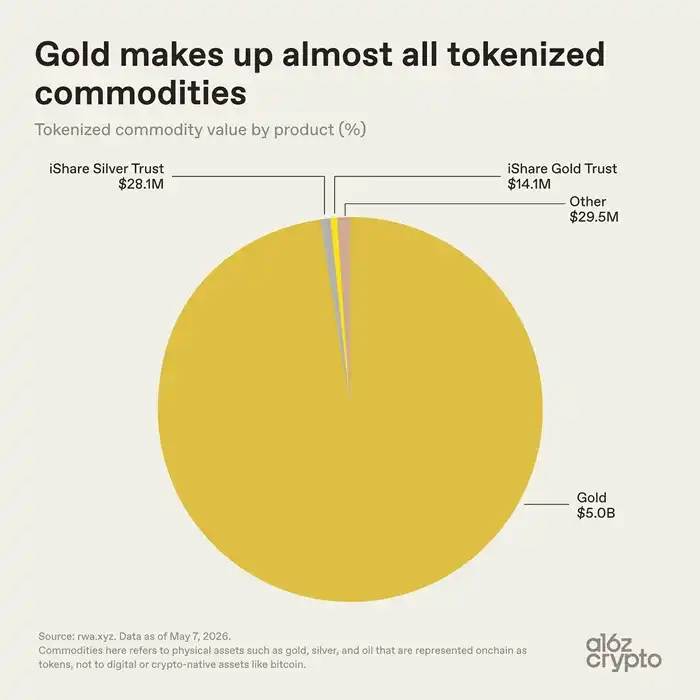
The market share for tokenized assets of crude oil, agricultural products, and emerging categories like energy and computing power is extremely low, with the industry still in its infancy.
Looking at the underlying public chain landscape, the tokenized asset ecosystem is more diversified. Ethereum, with its first-mover advantage in decentralized finance and institutional adoption foundation, still holds the leading position, hosting $15.7 billion in assets, accounting for over half of the market.
The remaining tokenized asset market is distributed across multiple public chains: BNB Chain's tokenized asset market size is about $4.0 billion, Solana about $2.2 billion, Stellar about $1.7 billion, Bitcoin sidechain Liquid Network about $1.5 billion. Tokenized asset sizes on XRP Ledger, ZKsync Era, and Arbitrum are all close to $1 billion.
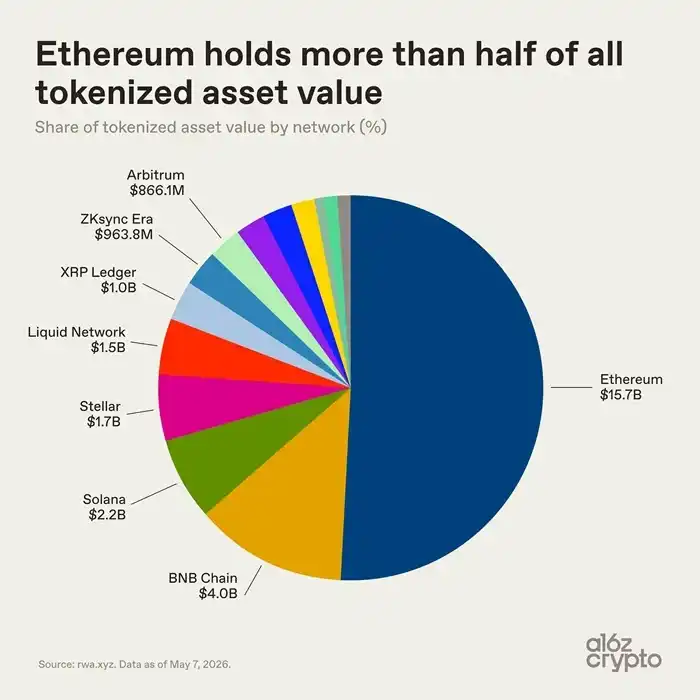
The tokenized asset industry has not consolidated onto a single public chain. Assets are distributed across major blockchain ecosystems based on transaction costs, liquidity, compliance requirements, and business partnerships. However, the most telling data point is not the size of the tokenized asset market... but how these assets are being used.
Let's continue the analysis—
Most Tokenized Assets Are Not Yet "Composable"
Market size is not the only core metric; the actual application value of assets is more informative.
Bonds are the largest category of tokenized assets by market capitalization, at $15.2 billion, but only 5% of the circulating supply is used in DeFi protocols, amounting to only about $800 million. The utilization rate of precious metal tokenized assets is similarly low. Most tokenized assets are only used for on-chain storage and have not yet become freely composable, interconnected, and reusable financial building blocks.
Smaller tokenized asset categories show the opposite performance: reinsurance tokens with a market cap of $362 million have an on-chain protocol usage rate as high as 84%; private credit tokens have a 33% usage rate. These two asset classes were designed from the outset for on-chain composability. In contrast, top categories like Treasuries and gold are positioned primarily to simplify holding and transferring assets on-chain, without altering their original operational logic. This situation also highlights a core divergence in the tokenized asset industry: the varying degrees of on-chain native-ness among different tokenized assets.
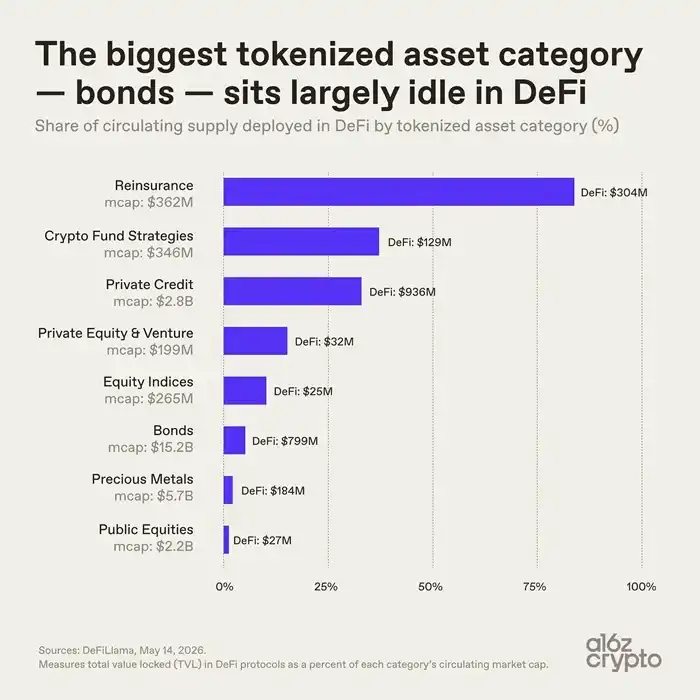
Some assets can be freely transferred and applied across chains, while others merely use the blockchain as a ledger tool, limiting asset transfer and composability functions. Currently, most tokenized assets are essentially just digitized assets, merely moving accounting onto the chain, without unlocking their composability potential. And composability is the core value of on-chain finance and a key to upgrading the financial system.
The Pantera Capital Token Native Index shows that over 70% of tokenized assets have the lowest level of on-chain native-ness. A large number of tokens are merely digital certificates for offline physical assets, with actual asset control still relying on offline ledgers and intermediaries.
Currently, the tokenized asset industry is still in its early stages: one type is assets that are only digitally recorded on-chain, and another is assets that are natively on-chain and deeply integrated with blockchain characteristics.
The on-chain composability technology infrastructure is ready, and asset categories are gradually enriching, but deep integration and application have just begun.
Future Trends of Tokenized Assets
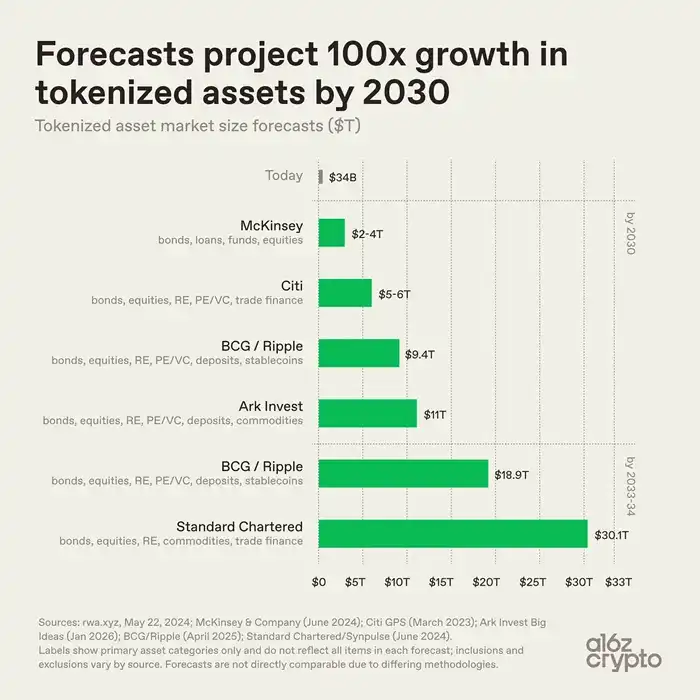
Industry predictions for the long-term scale of the tokenized asset market vary, but all generally agree the market will continue to expand.
- McKinsey predicts the tokenized asset market will reach $2-4 trillion by 2030;
- Ark Invest estimates the tokenized asset market at $11 trillion;
- Boston Consulting Group and Ripple jointly calculate that the tokenized asset market will reach $9.4 trillion by 2030 and climb to $18.9 trillion by 2033;
- Standard Chartered predicts the tokenized asset market will exceed $30 trillion by 2034.
Based on the above institutional estimates, compared to the current market size of $34 billion, the future growth space for the tokenized asset market industry could be a hundredfold. Of course, the numerical differences are not due to disagreements about the speed of industry adoption, but rather to different statistical definitions. The scope of statistics varies among institutions, covering differences in asset categories, whether stablecoins and deposits are included, and the defined scope of tokenization. For example: McKinsey's statistics focus on bonds, credit, funds, and stocks; Standard Chartered adds commodities and trade finance; BCG and Ripple additionally include deposits and stablecoins. However, despite the differences in statistical scope, the industry unanimously agrees that the scale of tokenized assets will undergo a leap forward expansion.
Looking at the global financial landscape, the current size of tokenized assets is still minuscule.
- The global bond market is over $140 trillion, while tokenized bonds are only $15.2 billion, accounting for 0.01%;
- The global physical gold market is worth tens of trillions of dollars, while tokenized gold is $5 billion, accounting for less than 0.02%;
- The global stock market is over a hundred trillion dollars, while tokenized stocks are $1.5 billion, accounting for only 0.001%.
Today, emerging sectors have steadily taken shape. Assets with clear pricing, stable demand, and simple ownership, such as US Treasuries, gold, and private credit, have taken the lead in going on-chain. Currently, tokenization has not yet disrupted the underlying nature of assets, only optimizing the settlement and transfer methods. The deep integration of assets with the digital financial system is still being explored.
Currently, tokenized assets are more about digitization, and assets struggle to achieve programmable composable applications. The next phase of the industry faces a core challenge: bringing the more complex parts of the financial system on-chain and more deeply integrating tokenized assets into composable, internet-native financial infrastructure.