A Voice from a Seasoned Polymarket User: We've Actually Been Overtaken by Our Competitor

marsbitОпубліковано о 2026-04-23Востаннє оновлено о 2026-04-23

Анотація

A veteran Polymarket user expresses deep concern that the platform is losing its leadership in the prediction market space to its competitor, Kalshi. Despite Polymarket's pioneering role, strong brand, and cultural significance, operational issues and strategic missteps have allowed Kalshi to gain a significant advantage. Key points include: - Kalshi now has a higher valuation ($22B vs. $15B) and greater trading volume year-to-date. - Polymarket faces repeated technical delays, poor communication, and extended downtime, undermining user trust. - The recent announcement of perpetual contracts—prior to fixing core platform issues and fully launching the U.S. app—signals misplaced priorities, focusing on monetization over stability and accessibility. - The author urges Polymarket to prioritize fixing the platform, opening the U.S. app to all users, and improving operational reliability before expanding into new products. Despite these challenges, the author remains optimistic due to Polymarket’s iconic brand, strong community, major partnerships (e.g., ICE, MLB), and regulatory positioning. The piece concludes with a call to action: stabilize the core product, execute reliably, and reclaim market leadership.

Author:Jonah

Compiled by: Jiahuan, ChainCatcher

I've been holding onto this article for a while.

I've wanted to write it, but kept holding back, hoping things would quietly correct themselves. Until this morning when Bloomberg published "Polymarket Loses Prediction Market Lead to Delays and Backlash". To be honest, that report already says most of what I originally wanted to say. So I'll quote heavily from it, letting it shoulder some of the weight.

Polymarket, facing increasing operational setbacks in its attempt to reach its key audience (US customers), has now fallen behind its main competitor. From bloomberg.com

That headline is painful. And it should be.

I've been watching Polymarket since mid-2024. I believed in its vision, defended the platform in every regulatory scare, and recommended it to every trader I know. Prediction markets are some of the most important financial infrastructure of this decade, and Polymarket was the company I always hoped would win this赛道.

So this is not a hit piece. This is the kind of letter you write to something you truly care about.

Shayne Coplan, and the entire team, we need to talk.

The Current Situation is Brutal

Let's start with the data.

Reportedly, Kalshi's valuation is around $22 billion, and Polymarket's negotiated valuation is around $15 billion. That's a gap of about $7 billion against an opponent that was once far behind Polymarket. Year-to-date trading volume: Kalshi ~$37 billion, Polymarket ~$29 billion. US market share: Kalshi nearly 90%, while Polymarket is still stuck behind a waitlist.

A year ago, the mainstream narrative was "Polymarket is the king of prediction markets, Kalshi is the regulated stepchild." Today, the narrative has completely flipped. Kalshi has become the compliant, fast-delivering, institutionally credible option, while Polymarket has become the crypto-native veteran that keeps tripping over itself.

This lead was once firmly in our hands. Now, we are giving it away.

The Platform Itself Isn't Fully Operational

This needs to be said straight: there are real problems with the core product, and the company is acting like it's fine.

Last weekend, Polymarket delayed the CLOB V2 migration, the new pUSD collateral token, and the rebuilt matching engine by at least a week. To be fair, the delay itself was the right decision. The developer community had been shouting for weeks that there simply wasn't enough time for a clean migration integration. Pushing a half-finished product live would have been much worse than a delay.

So the delay is not the problem; the delay is actually a good thing.

What was embarrassing was the way the announcement was handled.

From what circulated in the community: the news of the delay went out on Twitter first, but the official migration announcement containing the guide hadn't even been posted yet. The migration guide that followed shortly after still referenced the old, now obsolete dates. Then corrections were added on top of corrections.

Structurally, this is exactly the kind of communication chaos that a "methodical operating machine" should not produce.

Then on Monday, a scheduled five-minute restart took over an hour. The exchange was effectively offline during peak weekday hours. Another small thing added to the mountain of problems.

As the Bloomberg article quotes a Polymarket spokesperson: you can't "build one of the most interesting consumer finance products of the last few years without becoming a methodical operating machine." That's true, that's the vision. But the reality is that this machine keeps failing on avoidable small things, and these small things are accumulating into a pattern.

And these are not isolated incidents:

  • Fee adjustments for sports and crypto markets seemed reactive and poorly communicated
  • The team预告ed the migration for months, with repeated delays on the infrastructure
  • Planned maintenance windows repeatedly far exceeded the stated duration
  • The US app has been stalled for months in a "mobile-only, sports-only, invite-only" beta phase, reportedly with over a million people on the waitlist

"Crypto-native" was supposed to mean more transparent, more resilient, and more accountable than traditional platforms, not an excuse for poor UX and unreliable infrastructure.

The community has patience, but patience is clearly not infinite. Every outage, every missed deadline, every vague status update pushes marginal users towards the competitor that "just works".

The Priority Order is Wrong

What really broke me yesterday was this.

Objectively, the platform is not at 100%. The upgrade was delayed. The US app is not fully open. A million people are on the waitlist. Traders on the global product suffered an outage on Monday afternoon.

And then yesterday, Polymarket announced Perpetuals.
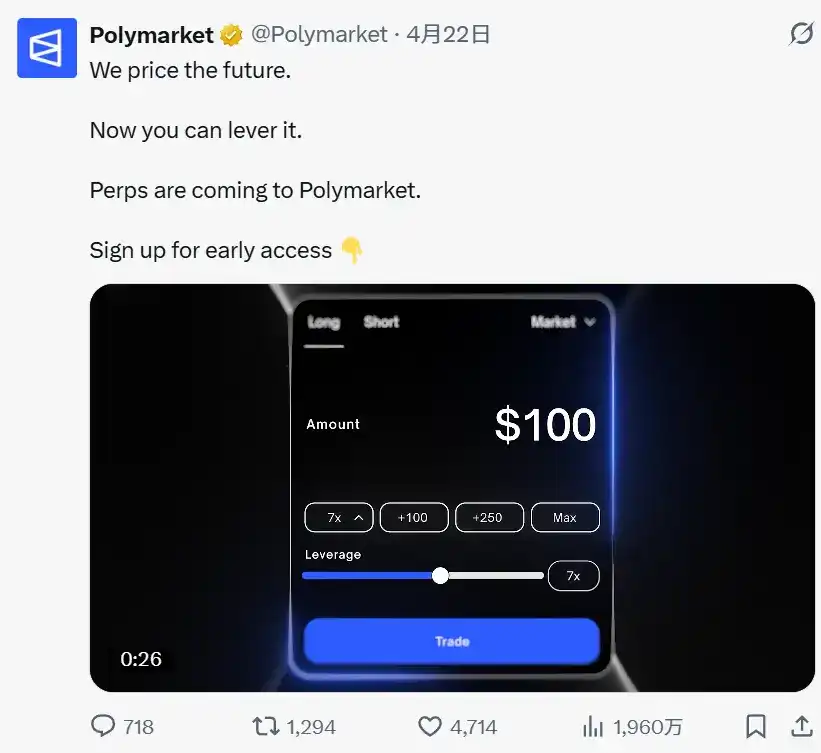
We price the future. Now you can leverage it. Perpetuals are coming to Polymarket. Sign up for early access.

Perpetuals are a great product, and in the long run, they absolutely belong on the roadmap. But announcing them now—just days after an infrastructure upgrade was delayed and a restart ran严重overtime, and while the US app is still in beta—sends only one message to most community members: a cash grab.

Perpetuals are the highest-fee, highest-leverage, highest-volume product in crypto, the fastest path to extracting revenue from existing users. Announcing them while the core exchange is unstable and a million Americans are locked out clearly signals where the team's true priorities lie: monetize the existing traders first, fix the platform later, and address the people outside the gate even later.

Whether intended or not, that is the signal this move sends. Revenue coverage优先于 product stability. Shipping new收费 products优先于 perfecting already-launched products. Harvesting existing users rather than fixing the experience for everyone—current and waiting.

Honestly, interpreting this as a "cash grab" might already be generous.

Look at the order. Kalshi预告ed its crypto perpetual product "Timeless": specific date, specific venue, specific launch event—April 27th, New York, a full product, delivered a week later.

Breaking: US's first CFTC-regulated prediction market exchange @Kalshi has chosen Pyth Pro as the exclusive data layer for its commodity markets. Gold, silver, oil, natural gas, copper, corn, soybeans, wheat. Here's why it matters.

Within days, Polymarket's response was... an early access sign-up page. No release date, no venue, no product specs, no product itself. Just a marketing tweet, a slogan "We price the future. Now you can leverage it," and a form to collect accounts.

That wasn't a product launch; it was a press release disguised as a launch announcement. When what you put out to counter an opponent is明显空洞, you are no longer setting the pace in this赛道—you are chasing someone else's pace. And there's a waitlist for it?

This is a赛道 defined by Polymarket itself. Polymarket was the pioneer, the cultural phenomenon, the incumbent with a head start of years. And today, on the derivatives launch, Polymarket became the chaser, using a sign-up form as PR material, simply because Kalshi announced first.

This is the most embarrassing sentence in this entire letter, but it's exactly what the Bloomberg article is really about.

The operational order should be very simple:

  1. The US App. Fully open it, kill the waitlist, make it stable, make it feature-complete. This is Polymarket's biggest lever, yet it's been sealed for months, letting Kalshi eat the US retail market. This must be priority number one. Not second, first.
  2. Core Platform Reliability. Finish the CLOB V2 migration, execute the pUSD transition cleanly, stop missing maintenance windows, make the exchange something traders can "set and forget".
  3. Then, and only then, expand the business surface. Perpetuals, new market categories, other things on the whiteboard.

The current order is backwards, and the community sees it clearly.

The Startup Phase is Over

The Bloomberg article put into the open what the community has been discussing for months: delays, distractions, and a culture that still feels like a 2021 wild-west startup—despite Polymarket now sitting on billions in open interest, a major partnership with ICE, a CFTC designated exchange status via the QCEX acquisition, and an MLB partnership.

That wild-west startup era is over. It has to be.

You are no longer facing a forum or a niche crypto app. You are facing a CFTC-licensed, institutionally-backed, New York-bred opponent that delivers on time and is taken seriously by regulators, counterparties, and the media.

This is the maturation period that every phenomenal finance company must eventually go through. Coinbase went through it, Stripe went through it. Every serious trading venue must eventually stop operating like a "group chat" and start becoming—to borrow the spokesperson's own words—a methodical operating machine.

Concretely, this means bringing in truly seasoned professionals in operations, risk, and PR. It means cutting out distractions that don't serve US rollout and core stability. It means over-communicating when things go wrong, with real post-mortems and real accountability, not just brief status updates and subsequent silence.

This is not hostility. This is what every serious financial venue eventually does. Polymarket is now one of them. Act like it.

Why I'm Still Bullish on Polymarket

With all that said, here's why I haven't left the platform, and why I don't think this race is over.

ICE is on your side. Jeffrey Sprecher doesn't write checks for vaporware. Intercontinental Exchange, the parent company of the NYSE, led a round last fall, a signal the market still hasn't fully priced in. You now have direct access to one of the world's most sophisticated market infrastructure operators. Use it.

The MLB partnership is a ceiling-level bonus. This signal says the endgame here is not "another betting app," but making prediction markets mainstream, embedded institutional financial infrastructure. Sports leagues, TV networks, traditional finance rails all converging on a single order book is epoch-making. Kalshi clearly doesn't have this cultural reach.

The brand is iconic. For better or worse, in public perception, Polymarket is almost synonymous with prediction markets. The election cycle cemented this彻底, with the platform being cited by journalists, hedge funds, and memes repeatedly. This is a moat most companies can only dream of.

The community is still here. The people who showed up in the early markets, scaled it during the 2024 election, and stuck with the platform through all the growing pains, haven't left. We want to win, and we want to see you win. That's why we're writing letters like this now,而不是 silently migrating volume to another platform.

Bring the Win Home

Truth: Kalshi is winning this quarter, and possibly this entire year.

But Polymarket can still win the decade. The brand, the partnerships, the community, the regulatory angle via QCEX, the ICE relationship—it's all still there, nothing is lost. It's just not being fully utilized while the team is pushing the wrong things in the wrong order.

So the ask is simple.

Fix the platform. Push out the US app. Stop announcing new products until the old ones are stable. Truly become the methodical operating machine the spokesperson described.

The community is still with you, and the believers are still here. But the window to close the gap is narrower than it was six months ago, and it will be even narrower in another six months.

Fix the platform first. Then, bring the win home.

Penned by a longtime Polymarket user who wants, more than anyone, to never have to write a letter like this again.


Пов'язані питання

QWhat are the main reasons the author believes Polymarket is losing its leading position in the prediction market?

AThe author cites several reasons: operational setbacks like repeated delays in infrastructure upgrades and extended maintenance windows, poor communication during these events, the prolonged waitlist for the U.S. app which blocks growth, and a misalignment of priorities where new revenue-generating products (like perpetuals) are announced before core platform stability and U.S. market access are secured.

QHow does the data compare between Polymarket and its competitor Kalshi according to the article?

AThe article states that Kalshi has a higher valuation of approximately $22 billion compared to Polymarket's reported $15 billion. In terms of year-to-date trading volume, Kalshi has about $37 billion while Polymarket has around $29 billion. Most significantly, Kalshi holds close to 90% of the U.S. market share, while Polymarket's access is still behind a waitlist.

QWhat specific product launch timing does the author criticize as demonstrating misplaced priorities?

AThe author heavily criticizes the announcement of Polymarket's perpetual contracts product. This announcement came just days after a core infrastructure upgrade was delayed and a platform restart ran significantly over time, and while the U.S. app was still in a limited, invite-only beta with a million people on the waitlist. The author sees this as prioritizing quick revenue from existing users over fixing fundamental platform issues and expanding access.

QWhat does the author suggest should be Polymarket's correct order of operational priorities?

AThe author proposes a clear order of priorities: 1) Fix and fully launch the U.S. application, removing the waitlist. 2) Ensure core platform reliability by completing the CLOB V2 migration and pUSD transition smoothly and avoiding operational hiccups. 3) Only after the first two are accomplished should the company expand into new product areas like perpetual contracts.

QDespite the criticisms, what advantages does the author believe Polymarket still holds over Kalshi?

AThe author remains bullish on Polymarket due to several key advantages: the strategic investment and infrastructure expertise from ICE (Intercontinental Exchange, owner of the NYSE), the landmark partnership with MLB which offers immense cultural reach, its iconic brand that is synonymous with prediction markets for many, and a loyal core community that has supported it through growth pains.

Пов'язані матеріали

Must-Watch Events Next Week|CLARITY Act Could Face Senate Vote; SpaceX, Circle to Report Earnings (8.3-8.9)

**Summary: Key Events and Developments to Watch (August 3-9)** The upcoming week is marked by significant financial disclosures, key legislative deadlines, and notable product updates. **Major Financial Events:** Several companies are scheduled to release their Q2 2026 earnings. American Bitcoin (ABTC) will report on August 3, followed by SpaceX and Hut 8 Mining Corp. on August 4, and Circle on August 5. Notably, a significant portion of SpaceX shares (up to 12% of total shares) will be unlocked on August 6 following their earnings release. **Key Legislative Deadline:** The U.S. Senate faces an August 7 deadline to secure 60 votes for the CLARITY Act, a bipartisan bill aiming to establish a federal regulatory framework for cryptocurrencies. The Senate may hold a full vote on the bill during the week. **Economic Data:** The U.S. July Non-Farm Payrolls report will be released on August 7, providing crucial labor market data. **Technology & Product Updates:** * **Shutdowns:** DeFi portfolio tracker Zapper and wallet app Ctrl Wallet will cease operations on August 3. * **Upgrades:** LayerZero will deprecate its v1 relayers on August 3. XRP Ledger's new version 3.3.0, featuring five new functions, is expected next week. * **AI:** Elon Musk announced that the advanced Grok 4.6 AI model is set for release around August 7. * **Bitcoin:** The BIP-110 forced signaling for a potential Bitcoin network change is scheduled to begin around August 8. **Other Notable Events:** Chinese robotics firm Unitree Tech has set its preliminary price inquiry for its IPO for August 5. South Korean exchange Upbit will delist AQT and AERGO tokens on August 3.

marsbit8 хв тому

Must-Watch Events Next Week|CLARITY Act Could Face Senate Vote; SpaceX, Circle to Report Earnings (8.3-8.9)

marsbit8 хв тому

Stocks Are Plummeting More Sharply Than Cryptocurrencies. Where Has the Money Gone?

Stock Markets Plunge Deeper Than Cryptocurrencies: Where Did the Money Go? In late July, Seoul's Kospi index triggered circuit breakers for two consecutive days, plummeting over 40% from its June high. The collapse was led by heavyweight stocks like SK Hynix, whose record profits still disappointed investors, and devastating leveraged ETFs, with one major product losing over 83% of its value. This signaled a global, forced deleveraging targeting the most crowded trades. Interestingly, while stocks exhibited extreme volatility akin to crypto markets, Bitcoin rose nearly 15% in July after a prior steep drop. Analysis shows the money fleeing equities did not flow into Bitcoin. Instead, Bitcoin had already absorbed its sell-off in May-June, when U.S. spot Bitcoin ETFs saw historic outflows. The true safe-haven beneficiary was gold, whose price rose over 20% year-on-year, highlighting a decoupling between Bitcoin and gold as "digital gold." The sell-off was a targeted unwinding of leveraged positions in tech and semiconductors, accelerated by broker-dealer risk management and shifts in the AI narrative, including new competition from Chinese memory chipmakers. The retreat path was clear: from high-valuation tech stocks to cash and U.S. Treasuries, then to gold. For Bitcoin to attract sustained institutional inflows, conditions like eased global liquidity pressure, a "soft-landing" Fed rate cut, and U.S. regulatory clarity via legislation like the stalled CLARITY Act are needed. Currently, Bitcoin is not a safe haven but an already-cleared asset. Its low correlation with tech stocks, however, makes it a potential diversification play for institutional portfolios once the storm passes. The money isn't here yet, but the positioning is underway.

marsbit8 хв тому

Stocks Are Plummeting More Sharply Than Cryptocurrencies. Where Has the Money Gone?

marsbit8 хв тому

In Conversation with Ray Dalio: We Are Currently in an AI Bubble, with 1% of My Portfolio in Bitcoin

Ray Dalio, founder of Bridgewater Associates, warns in an interview that the current AI boom shows classic bubble characteristics, which could lead to significant economic downturns as seen in past cycles like 1929 or 2000. He explains that speculative enthusiasm, fueled by debt and overvaluation, often precedes a crash when rising rates or taxation force asset sales, causing widespread losses and recession. Dalio also outlines his "Big Cycle" theory, describing an approximate 80-year pattern where widening wealth gaps, massive government deficits, and shifting geopolitical power (like China's rise) create internal conflict and global instability. He emphasizes that we are in a late-cycle, transitional phase where traditional powers like the US and UK face decline. For personal wealth protection, Dalio advises diversification beyond cash into assets like stocks, bonds, real estate, and particularly gold, which he prefers over Bitcoin. While he holds about 1% of his portfolio in Bitcoin as a non-printable hard asset, he views gold as more secure from technological or governmental threats. Regarding AI's impact, Dalio believes it will disproportionately benefit capital owners, worsening inequality by replacing both physical and cognitive labor. He suggests that human intuition and emotional intelligence, combined with AI, will be key for future workers. On taxation, Dalio argues that wealth taxes are impractical and risk triggering asset sell-offs, reducing productive investment. He points to the UK as a cautionary example of debt, low productivity, and political strife. Geopolitically, Dalio foresees a more regionalized world, with the US showing weakness in prolonged conflicts like with Iran, akin to past imperial declines. The ideal outcome, he suggests, is coexisting powerful blocs (e.g., Americas, China-Asia Pacific) without major war.

marsbit4 год тому

In Conversation with Ray Dalio: We Are Currently in an AI Bubble, with 1% of My Portfolio in Bitcoin

marsbit4 год тому

Daily 7.2 Trillion KRW: Foreign Capital's Record Net Buying on Friday! Wall Street Says Headwinds for Korean Stock Fund Flows Have Subsided

South Korean stock market sees a dramatic shift in fund flows. On July 31, foreign investors made a record net purchase of approximately KRW 7.2 trillion in KOSPI stocks, marking a fundamental reversal from the persistent large-scale net outflows seen in previous months. This contributed to a significant narrowing of foreign net selling in July to KRW 9.8 trillion, down sharply from KRW 48.4 trillion in June and KRW 44.5 trillion in May. Simultaneously, domestic institutional pressure eased. South Korean pension funds and asset managers turned to a net buying position in July, purchasing KRW 1.0 trillion worth of KOSPI shares, contrasting with net sales in May and June. Market volatility is expected to be dampened by new financial regulations. Effective July 31, the Financial Services Commission tightened access for retail investors to single-stock leveraged ETFs by raising the minimum cash deposit requirement. Trading volumes for these products subsequently dropped to about 50% of their monthly average. Citigroup Research maintains its year-end KOSPI target of 10,000 points. The firm cites several supportive factors: the substantial easing of headwinds from capital outflows, a robust fundamental outlook for the semiconductor sector, historically low market valuations, strong economic fundamentals, and the potential for policy support from financial authorities if needed.

marsbit4 год тому

Daily 7.2 Trillion KRW: Foreign Capital's Record Net Buying on Friday! Wall Street Says Headwinds for Korean Stock Fund Flows Have Subsided

marsbit4 год тому

Торгівля

Спот
活动图片




