A Trillion-Dollar Frenzy for Memory Sellers, Halved Profits for Memory Buyers

marsbitОпубліковано о 2026-05-27Востаннє оновлено о 2026-05-27

Анотація

Summary: A stark divide has emerged in the tech industry. While memory chipmaker Micron's stock soared 19% in a single day, pushing its market cap over $1 trillion, smartphone manufacturer Xiaomi reported a 43% plunge in adjusted net profit. The core driver is a severe supply crunch in memory chips, particularly for AI applications. Wall Street analysts, led by UBS and its unprecedented 204% target price hike for Micron, argue that long-term agreements (LTAs) from AI cloud giants are fundamentally ending the sector's notorious boom-and-bust cycles, justifying a re-rating from cyclical to infrastructure-like valuations. However, the "storage" market is now fragmented into three tiers. The first, AI-grade memory like HBM and server DDR5, faces extreme shortages and soaring prices driven by massive cloud capex. The second, mobile memory for smartphones, is also seeing sharp price hikes as manufacturers like Xiaomi are forced to pay more for remaining capacity, severely squeezing their margins. The third, PC retail channels, shows price declines due to existing inventory. The article questions the sustainability of the "supercycle" narrative. It highlights that Micron's revenue surge is driven almost entirely by price increases, not shipment volumes, making it vulnerable to a potential demand slowdown. While LTAs may dampen volatility, history suggests they are often tested during downturns. The current peak earnings, used to justify high valuations, represent a classic cyclica...

Author: Xiao Jing, Tencent Technology

Editor: Xu Qingyang

Two events happened simultaneously on the evening of May 26th.

Xiaomi released its Q1 2026 financial report. Total revenue was 99.1 billion yuan, down 10.9% year-on-year; adjusted net profit was 6.07 billion yuan, plummeting 43.1% year-on-year. Smartphone business revenue was 44.3 billion yuan, down 12.5% year-on-year, with gross margin dropping to 10.1%, a decrease of 2.3 percentage points compared to the same period last year.

During the earnings call, Xiaomi Group President Lu Weibing mentioned a number: the price of memory of the same specification has surged nearly 4 times compared to the same period last year. For a phone with 12GB LPDDR5 + 512GB UFS configuration, the memory cost alone increased by about 1,500 yuan. He said Xiaomi "will not pass on the memory price increase to consumers," but also predicted the price hike cycle would continue into 2027 or even 2028. To survive, Xiaomi proactively cut entry-level models, with quarterly shipments dropping to 33.8 million units.

The second event: Micron Technology surged over 19% in a single day, with its market cap breaking the $1 trillion mark. UBS raised Micron's target price from $535 directly to $1,625, an increase of about 204%, making it the highest target price among the 46 brokerages covering Micron.

A few days earlier, Citigroup had just raised Micron's target price from $425 to $840, and HSBC raised it from $750 to $1,100. Wall Street hasn't been this unanimous on a single cyclical stock in a long time. Twelve months ago, Micron's stock price was under $110. It has increased eightfold in a year.

On the same day, memory sellers enjoyed a trillion-dollar frenzy, while memory buyers saw their profits halved.

Goldman Sachs played a thought-provoking role in this frenzy. In December 2025, Goldman gave Micron a Neutral rating with a $205 target price. In Q1 2026, Goldman reduced its Micron position by nearly 20%.

On March 19th, the day Micron reported earnings, Goldman adjusted its target price from $360 to $400 but maintained Neutral, even though the stock price had already far exceeded $400. Micron then surged 40% in a week, and Goldman perfectly missed the rally.

On May 17th, Goldman issued a storage industry report, concluding it was the "most severe supply shortage in 15 years" and upgraded the overall sector rating. But for Micron, it remained Neutral with a target price of $400. As the outlier, Goldman is either the last sober person in this frenzy, or the one who missed out most severely.

But such a strong divergence is worth serious consideration.

01 Why the Crazy Surge? A New Story Called LTA?

The core argument of UBS analyst Timothy Arcuri's May 26th report is that Long-Term Agreements (LTAs) are fundamentally eliminating the cyclicality of the memory industry.

Memory chips are the segment of the semiconductor industry most akin to commodities. DRAM and NAND prices have followed a brutal pattern for four decades: two years up, two years down, with price collapses never absent. Profits of Micron, Samsung, and SK Hynix fluctuate like an EKG, and the market has never dared to value these companies based on "steady-state earnings." For forty years, the valuation fluctuation range for cyclical stocks has roughly been 8 to 15 times PE.
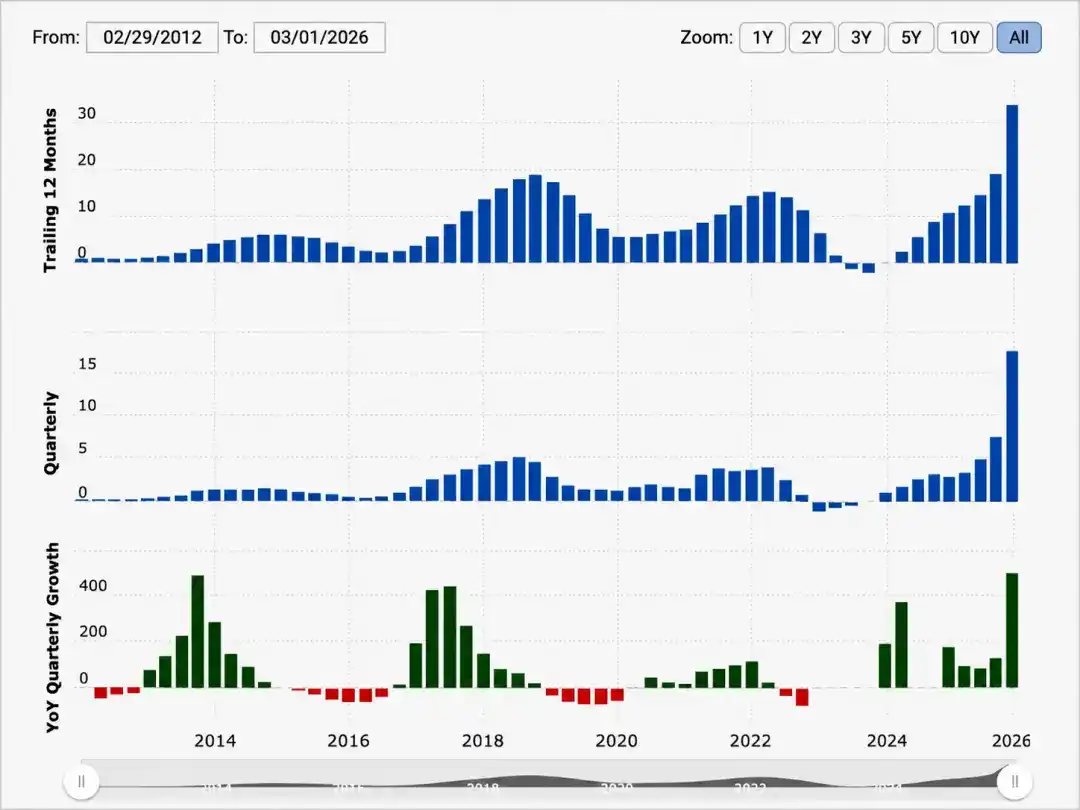
Chart: EKG-like Fluctuations in Micron's Financial Data

UBS's story is that these companies' "cycle curse" will be broken, and the protagonist behind it is "AI."

Cloud vendors like Microsoft, Google, Amazon, and Meta, to lock in HBM and DDR5 supply in the AI arms race, have started actively signing 3-to-5-year fixed-price long-term contracts with memory manufacturers, including prepayments. These contracts are not the traditional "intention-based" agreements in the semiconductor industry; they are binding purchase commitments, locking in volume, price, and even wafer capacity.
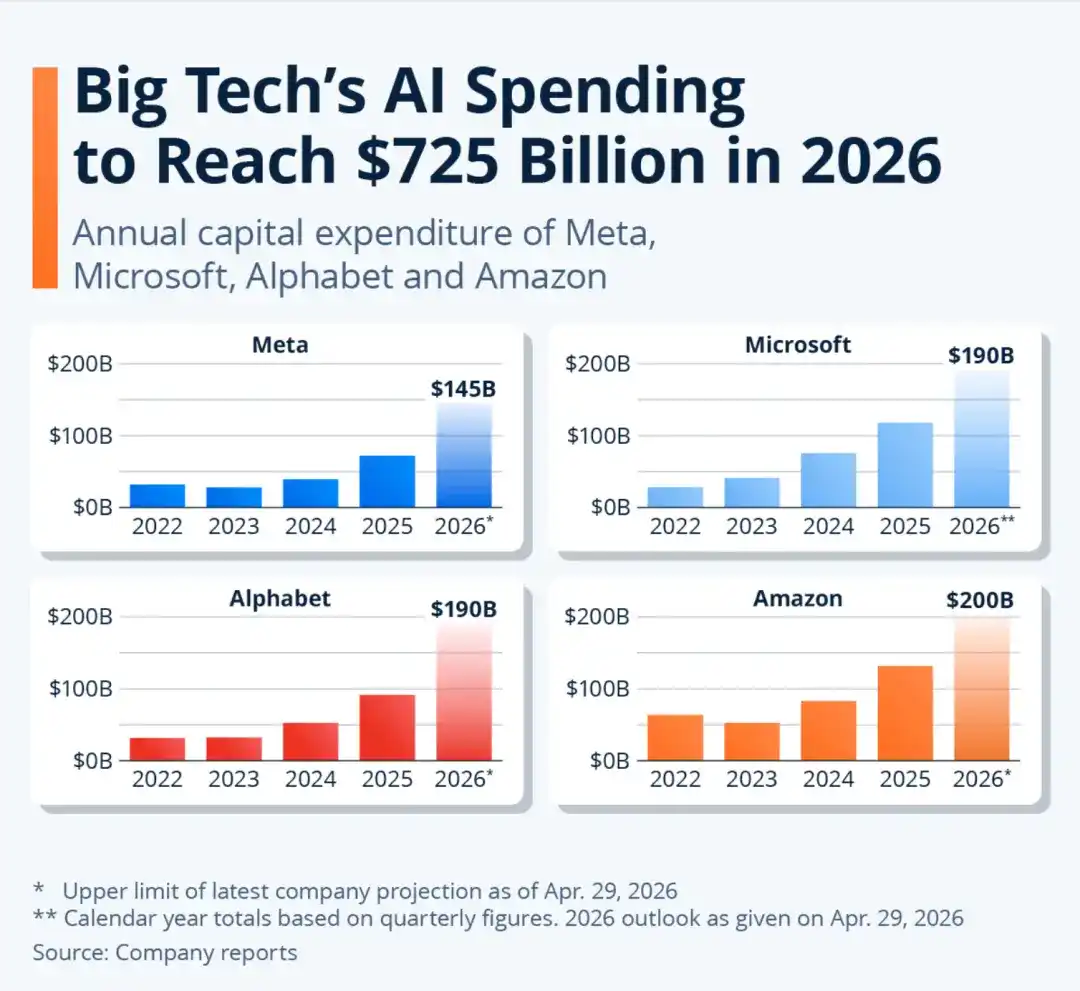
Chart: Major Tech Companies' AI Capital Expenditure (2022—2026E): Combined total for four companies expected to reach $725 billion in 2026. Individually, Amazon $200B, Microsoft $190B, Alphabet $190B, Meta $145B. 2026 data is the latest guidance upper limit from each company as of April 29, Microsoft's figure is a calendar year sum based on quarterly data.

In April, Microsoft and Google were reported to be in talks with SK Hynix for three-year DRAM contracts, with structures including prepaid deposits. Previously, manufacturers begged customers for orders; now, customers pay deposits to lock capacity. The power dynamic in the supply chain has reversed.

UBS's model calculations show that after incorporating LTAs into Micron's earnings forecast, even if DRAM spot prices crash 50% in FY2029, Micron's annual EPS can still maintain over $100. LTAs can narrow the DDR price fluctuation amplitude from peak to trough by about 50%. By 2027, 20% to 30% of the industry's total DDR bit shipments will be locked in fixed-price LTAs. For hyperscalers' DDR5 procurement, 60% to 70% may already be under fixed contracts.

From a valuation perspective, if cyclicality disappears, memory stocks should not be valued as cyclical stocks, but as infrastructure utilities, jumping from 8-15x PE to 20-30x PE.

J.P. Morgan also issued a report with similar conclusions in mid-May, titled "LTAs are Eliminating the Memory Industry's Cyclicality." Citigroup's logic is that HBM production crowds out wafer capacity for ordinary DRAM, leading to long-term shortages in general memory.

Micron's stock surge welcomes the Davis Double Click of profit growth and valuation system switching.

02 This Memory is Not That Memory

Wall Street uses the "Memory Super Cycle" to tell a unified bullish narrative. But "memory" and "memory" are completely different.

The 2026 memory market shows a three-tier divergence.

The first tier is AI memory: HBM, server DDR5, enterprise SSD. Here, price hikes, shortages, and LTAs locking capacity occur simultaneously. TrendForce expects Q2 2026 DRAM contract prices to rise 58% to 63% QoQ, NAND Flash contract prices to rise 70% to 75% QoQ; Kioxia has also publicly stated that its 2026 capacity is basically sold out. This tier is the story behind Micron's trillion-dollar market cap.

The second tier is mobile and embedded memory: mobile DRAM and mobile NAND. Prices here are also rising sharply. Counterpoint data shows DRAM prices rose over 50% QoQ in Q1 2026, NAND Flash prices rose over 90% QoQ. TrendForce reports show memory typically accounted for about 10% to 15% of a phone's BOM, now it has risen to 30% to 40%, with low-end models under more pressure.
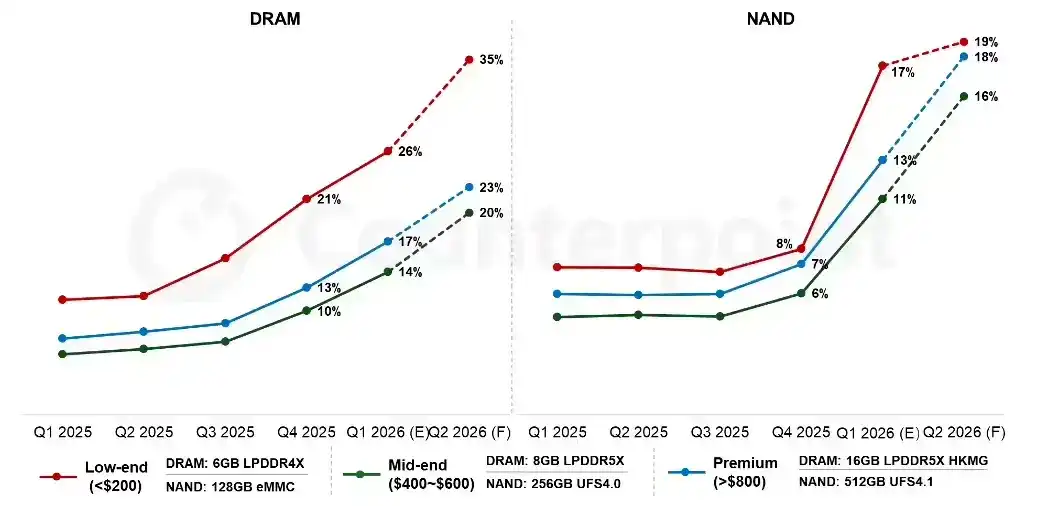
Left chart DRAM (Memory) Trend: Low-end phones rise most sharply, climbing from initial lows to a forecast of 35% in Q2 2026; high-end to 23%; mid-range to 20%. Dotted portion (after Q1 2026) are forecasts.

Right chart NAND (Flash) Trend: All price segments remained relatively flat through Q3 2025, but began rising sharply from Q4 2025.

Xiaomi sits in this tier. Its pain is "AI has taken away capacity, leaving less for phones, and phone makers must pay higher prices for the remaining capacity."

Manufacturers give capacity priority to AI customers, leaving phone makers with few options for contract procurement. To ship, you have to buy at the new contract price; if you don't, production lines and new product schedules will be affected.

The third tier is PC retail spot: DDR5 modules, consumer SSD. Here, a counter-directional fluctuation occurred. TrendForce reports show that by late March in China, channel 32GB DDR5 modules dropped 500 to 1050 yuan from near 3000 RMB, with some clearance prices as low as 1950 yuan; Tom’s Hardware also wrote that some DDR5 products in Chinese and overseas retail markets retreated 25% to 30% from highs.

But this is mainly a split between retail spot and contract procurement. The PC channel has inventory to sell off; phone makers procure via contracts, with no sell-off option.

Within the same "memory" industry, three tiers, three directions. The essence of this divergence is that the three memory giants are shifting wafer capacity from consumer-grade to AI. HBM production crowds out ordinary DRAM wafers, enterprise SSDs crowd out consumer NAND supply, leaving less capacity for phones and PCs. Phone makers, forced to ship, are compelled to accept price hikes; the PC channel, with ample inventory, can slash prices for clearance.
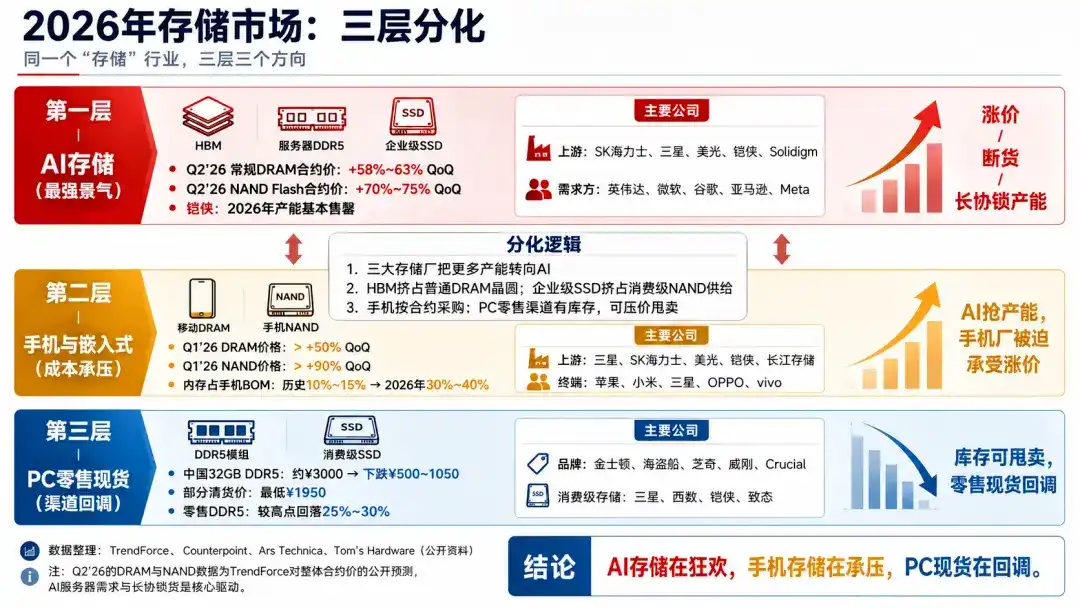
Image generated with AI assistance

Micron & Co. have actively chosen to allocate capacity to AI customers willing to pay more. In the short term, this is a nice product mix upgrade. But it also means Micron is sealing off its retreat path; if AI demand slows, capacity may not switch back smoothly.

Micron's earnings report shows QoQ, DRAM bit shipments only grew mid-single digits, NAND bit shipments only grew low-single digits; growth mainly came from ASP increases. Micron's story today is only about "extreme shortages in this AI memory branch."

Micron is betting everything on this branch.

03 Can LTAs Really Eliminate the Cycle?

The LTA logic seems solid. Under the AI spending pace, the supply elasticity of memory chips is extremely low. HBM capacity takes 18 to 24 months from planning to production, and producing HBM crowds out general DRAM wafer capacity. Cloud vendors sign LTAs because they fear "AI project delays."

But LTAs eliminating cyclicality have a prerequisite: the demand side doesn't collapse.

Different institutions have different statistical calibers for AI CapEx, but the direction is consistent: AI infrastructure investment is moving from the hundreds of billions of dollars level to near a trillion dollars. According to some market models, this is a capital expenditure curve with near 40% to 50% annual growth.

However, nothing in the physical world grows at 40%+ forever. AI bubble bursting isn't needed; a slowdown from 45% to 20% growth could reverse the supply-demand balance for memory chips within 18 months. The three memory makers are all expanding capacity frantically; Micron's FY2026 CapEx is $25 billion, adding another $10 billion in 2027.

Another thing to face squarely: when a company's revenue growth relies entirely on price elasticity rather than volume elasticity, the story is fragile. Micron's shipment volume only grew 4% to 6%; its 196% revenue growth mainly came from price hikes. Prices can rise but can also fall, and they fall faster than they rise. This is the nature of cyclicality.

Let's do a simple arithmetic problem.

Micron's current market cap is $1 trillion. Micron has raised its FY2026 CapEx to over $25 billion, and expects capital expenditure to increase significantly in FY2027, with some market reports mentioning an incremental increase possibly over $10 billion.

Micron's Q2 FY2026 non-GAAP net profit was about $14 billion, simply annualized to about $56 billion, implying a PE of about 18x. If further price hikes and LTAs are extrapolated, PE could still be calculated at around 15x.

That might seem "cheap." But this PE's denominator is a super-cycle peak profit where DDR4 contract prices rose 10x in 15 months, HBM is sold out for the year, and gross margin jumped from 36% to 75%.

Multiplying a peak-cycle profit by a seemingly "reasonable" multiple to arrive at a seemingly "not expensive" valuation is precisely the classic valuation trap when cyclical stocks peak.

Cisco in 2000 also had a PE of "only" 60-some times, based on 15 consecutive quarters of 50%+ revenue growth. When growth slowed from 50% to 20% to 0%, EPS didn't need to fall much for the stock to drop 80%, because both the multiple and earnings contracted simultaneously.

From Davis Double Click to Double Kill.

History tells us one thing: in commodity markets, LTAs have never been a one-sided "floor." They protect buyers in an up-cycle and sellers in a down-cycle, but the premise is that both sides have the ability and willingness to fulfill them. The moment LTAs are most needed is precisely when they are most likely to fail.

This is not to say Micron is necessarily a bubble. AI's demand for computing and memory may truly be structural, LTAs may truly rewrite industry rules, and a trillion-dollar market cap may just be the starting point.

But when all of Wall Street simultaneously shouts "this time is different," it's at least worth pausing to ask: what happened the last time everyone was this certain?

In a sense, one must enjoy the frenzy of the bubble to make money.

But, it took Cisco about 25 years, until today's AI era, to finally surpass its closing high from the dot-com bubble period, and the internet indeed changed everything.


Пов'язані питання

QAccording to the article, what is the core argument of the UBS analyst's report regarding the future of the memory chip industry?

AThe core argument is that Long-Term Agreements (LTAs) signed between memory chip makers and major cloud/AI companies will fundamentally eliminate the cyclicality of the memory industry. These contracts lock in supply, price, and even wafer capacity for 3-5 years with prepayments, fundamentally shifting power dynamics and providing stable revenue, which should lead to a re-rating from cyclical stock valuations to infrastructure/utility-like valuations (20-30x PE).

QWhat three distinct layers does the current 2026 memory market show according to the article? Briefly describe the situation in each.

A1. AI Storage (HBM, server DDR5, enterprise SSD): Extreme shortages, massive price increases, LTAs, and sold-out capacity. This is the driver for Micron's valuation. 2. Mobile/Embedded Storage (mobile DRAM/NAND): Significant price increases due to AI capacity crowding out supply. Phone makers like Xiaomi are forced to pay higher contract prices to maintain production, squeezing their profits. 3. PC Retail Spot Market (DDR5 modules, consumer SSD): Prices have fallen 25-30% from highs due to channel inventory being sold off. This contrasts with the mobile contract market, showing a split between spot and contracted procurement.

QWhat critical risk does the article identify regarding the 'LTA eliminating cycles' narrative promoted by bullish analysts?

AThe critical risk is that the narrative depends entirely on sustained, extremely high AI demand growth (~40-50% annually). If AI capital expenditure growth slows significantly (e.g., from 45% to 20%), the supply-demand balance could reverse within 18 months. Furthermore, memory makers are ramping up massive capacity based on peak-cycle pricing. When growth slows, the industry could face a classic cyclical downturn where prices and volumes contract simultaneously, potentially rendering LTAs vulnerable if buyers seek to renegotiate.

QHow does the article characterize the fundamental driver behind Micron's recent massive revenue growth and stock surge?

AThe article characterizes it as being driven almost entirely by price increases (Average Selling Price - ASP), not by volume growth. Micron's bit shipments grew only in the low-to-mid single digits, while revenue grew 196% year-over-year. This reliance on price elasticity, rather than volume elasticity, makes the story fragile because prices can fall much faster than they rise, which is the essence of cyclicality.

QWhat historical analogy does the article draw to warn about potential valuation risks for Micron at its current market peak?

AThe article draws an analogy to Cisco during the dot-com bubble in 2000. Cisco's valuation at the time appeared 'reasonable' based on peak-cycle earnings supported by over 15 consecutive quarters of 50%+ revenue growth. When that growth rate inevitably slowed and then stalled, Cisco's stock price collapsed by over 80% due to a simultaneous contraction in both its earnings multiple (PE) and its profits—a phenomenon known as a 'Davis Double Kill' (the opposite of a Davis Double Click).

Пов'язані матеріали

Claude's Watermark Has Been Cracked, Gaining 11k Stars, But Installation Is Refused

The article discusses the controversy surrounding Anthropic's implementation of a hidden watermark in all text generated by its AI, Claude. This policy, based on Google DeepMind's SynthID-Text technique, embeds a statistical signature by making inconsequential word choices. The watermark applies globally, even to human-written text lightly edited by Claude, sparking user backlash over issues of ownership and the creation of an "AI content second-class citizen" status. In response, an open-source tool called "watermarks-remover" (originally "remove-claude-marks") was released on GitHub, quickly gaining 11k stars. It works on three levels: removing invisible Unicode characters, using an agent to rewrite text and break statistical patterns, and stripping metadata from various file formats. Notably, Claude itself refused to install this removal tool as an Agent Skill, a task ultimately completed by another AI model, GLM 5.2. The article points out the irony that the removal code may have been written by Claude. The piece frames this as an ongoing battle between watermarking for traceability against misinformation and the desire for unmarked, owned content from paying users. It questions the practicality of mandatory technical markings when AI-generated text becomes indistinguishable from human writing, suggesting the open-source community's rapid development of countermeasures will continually outpace regulatory efforts.

marsbit21 хв тому

Claude's Watermark Has Been Cracked, Gaining 11k Stars, But Installation Is Refused

marsbit21 хв тому

SafePal Leaks Data of Nearly 40,000 Hardware Wallet Buyers: Private Keys Intact, Yet Danger Moves Closer to the Physical

Hardware wallet manufacturer SafePal has disclosed a data breach affecting approximately 39,798 customers who placed orders between March 2025 and April 2026. The leak exposed personal information including names, email addresses, phone numbers, physical delivery addresses, and purchase records. The company confirmed that private keys, recovery phrases, wallet passwords, and financial details were not compromised, as the cold storage systems operate in an isolated environment separate from the e-commerce servers. However, the breach poses significant risks beyond digital theft. Attackers now possess a high-value list of confirmed hardware wallet owners, effectively marking them as likely holders of substantial cryptocurrency. This enables highly targeted social engineering attacks, such as phishing emails referencing real order details, fake hardware deliveries, or phone scams impersonating SafePal support. The company has already identified and taken down over 30 related phishing sites. A critical aspect of the incident is the delayed disclosure timeline. SafePal acknowledged receiving initial user reports of phishing attempts in May but treated them as isolated. A full investigation began in July, with a public announcement not made until August, leaving users exposed for approximately three months. Furthermore, a configuration error prevented a data-purge routine from deleting old order information as intended, potentially increasing the scope of the leaked data. The incident highlights a structural paradox in the hardware wallet industry: while the devices are designed to secure private keys offline, the necessary e-commerce process collects sensitive personal data that, if leaked, makes the user a target. This mirrors a similar breach suffered by Ledger in 2020. Affected users are advised to be extremely vigilant. They should verify if they are impacted via SafePal's dedicated page, treat all unsolicited communications (emails, calls, physical mail) referencing SafePal as suspicious, and never share recovery phrases. Users who may have entered sensitive information on a phishing site must create a new wallet immediately. The breach underscores that in cryptocurrency security, the most vulnerable link is often the human user, not the cryptographic technology.

marsbit42 хв тому

SafePal Leaks Data of Nearly 40,000 Hardware Wallet Buyers: Private Keys Intact, Yet Danger Moves Closer to the Physical

marsbit42 хв тому

30 Years After Being Crushed by AI, People Have Fallen Back in Love with Chess

On May 11, 1997, IBM's "Deep Blue" defeated chess champion Garry Kasparov, marking the first time a machine triumphed in a top-level intellectual game. The narrative of human defeat by AI seemed cemented when AlphaGo beat Lee Sedol in Go in 2016, a game once considered AI's final frontier. Yet, nearly 30 years after AI's dominance began, chess is experiencing unprecedented popularity. Chess.com boasts over 250 million registered users and 10 million daily active players. Its CEO, Erik Allebest, attributes this resurgence to several waves: the pandemic, the Netflix series *The Queen's Gambit*, and viral AI chess bots like "Mittens" on social media. Crucially, each surge left a permanently higher user base. The key insight is that AI liberated the game. When machines unequivocally became the best, the pressure to "win" as the ultimate human was removed. Chess returned to its core: the intrinsic joy of play—the thrill of a tactical combo, the tension of a time scramble, the curiosity of post-game analysis. AI, now serving as an always-available coach and anti-cheat tool, became infrastructure that enhanced rather than killed the experience. In contrast, Go, deeply rooted in East Asian elite culture and often pursued for mastery and status, suffered a "collapse of meaning" at the professional level after AlphaGo. Players began mimicking AI moves, erasing distinctive styles and narrative. While some Go players gained fame as online personalities, it didn't translate to widespread engagement with the game itself. The divergence highlights a fundamental question in the age of AI: is the motivation for an activity about *winning* or *playing*? Activities where the process itself is the reward, like chess, can thrive when the pressure of being the best is gone. AI may rightly take over tasks done purely for outcome, but it cannot replace the human experience of simply enjoying the game.

marsbit57 хв тому

30 Years After Being Crushed by AI, People Have Fallen Back in Love with Chess

marsbit57 хв тому

Exiting Top Ten Shareholders of Kweichow Moutai, 'Long-term Capital' Portfolio Adjustments Revealed: National Social Security Fund Enters 12 New Stocks, Invests in Hard Tech Mthreads

With the ongoing release of semi-annual reports, the second-quarter investment moves of long-term institutional investors like the National Social Security Fund (NSSF) and insurance capital are becoming clear. Central Huijin Asset Management and China Securities Finance Corp., often referred to as the "national team," are no longer among the top ten shareholders of Kweichow Moutai. Data shows that as of August 14th, the NSSF held positions in 33 A-share companies, with a total portfolio value exceeding 11 billion yuan. It added 12 new stocks in Q2, spanning sectors like chemicals, food & beverage, and semiconductors. The NSSF maintains its stable investment style, favoring companies with solid performance and attractive valuations. Apart from exiting Moutai, Huijin and China Securities Finance also left the top ten shareholder lists of companies like Ping An Bank and Dahua Technology. Insurance capital heavily invested in 41 companies in Q2, with a total holding value over 26 billion yuan. They showed a continued preference for cyclical sectors like non-ferrous metals and chemicals, as well as high-dividend-yield stocks. Analysts note that these long-term funds act as market stabilizers and investment bellwethers. Their presence is reshaping the market ecology, steering focus towards fundamental corporate value and away from speculative trading. A notable move was the NSSF's new investment in Moore Threads, a loss-making but leading domestic GPU design company listed on the STAR Market, indicating interest in hard technology sectors. Looking ahead, analysts expect long-term capital to continue a dual-strategy: maintaining a foundation in high-dividend-value stocks while gradually increasing exposure to growth areas aligned with industrial upgrading, such as advanced manufacturing and tech self-sufficiency. The market's recovery is seen as gaining a firmer footing after recent adjustments.

marsbit1 год тому

Exiting Top Ten Shareholders of Kweichow Moutai, 'Long-term Capital' Portfolio Adjustments Revealed: National Social Security Fund Enters 12 New Stocks, Invests in Hard Tech Mthreads

marsbit1 год тому

Data of 54,000 wallet users leaked, Clarity odds just 10%: Hodler’s Digest, Aug. 16

Galaxy Digital has slashed the odds of the CLARITY Act passing in 2026 from 75% to just 10%, citing limited Senate session days. If it fails, the SEC and CFTC plan to issue their own crypto rules, though an SEC meeting was abruptly cancelled. High-profile meetings at the White House are planned to discuss the bill. Amid growing hack fears, crypto companies are urging AI labs to grant developers early access to advanced AI models for cybersecurity, following a $116M Coldcard wallet theft. Data breaches at Trezor and SafePal have exposed over 54,000 users' personal information. The CFTC is clashing with states over regulating prediction markets like Kalshi, ordering it to ignore a New York restraining order to maintain a national market, while a Washington state judge ruled against it. The Ethereum Foundation is revising its post-quantum plan, moving away from the Poseidon hash function, and scoping its next major upgrade, Hegotá, for next year. Tether received its first full clean audit opinion from KPMG, showing reserves exceeding liabilities by $6.814 billion. Marketwise, major cryptos saw weekly declines. Predictions include a possible Bitcoin bottom in October, while analysts dispute the feasibility of BTC reaching $1M by 2030. Glassnode notes Bitcoin is in its longest capitulation phase since FTX's collapse. Three men were charged for an alleged Bitcoin kidnapping plot in Missouri.

cointelegraph2 год тому

Data of 54,000 wallet users leaked, Clarity odds just 10%: Hodler’s Digest, Aug. 16

cointelegraph2 год тому

Торгівля

Спот
活动图片




