A Transformative Era for DeFi Collateral: Exploring RWA as the New Composable Infrastructure for DeFi

marsbitОпубліковано о 2026-04-20Востаннє оновлено о 2026-04-20

Анотація

DeFi Collateral Transformation: RWA Emerges as Composable Infrastructure The tokenized Real-World Asset (RWA) market has reached $27 billion, yet only about $2.7 billion is actively used as collateral in DeFi lending markets. This growth was accelerated by key 2025-2026 regulatory milestones in the U.S., including the GENIUS Act for stablecoins and the classification of major blockchain tokens as digital commodities. The composition of tokenized assets differs significantly from those actively used in DeFi. U.S. Treasuries dominate tokenized AUM (48.5%) but represent only 2% of DeFi deposits. Conversely, credit assets (17% of AUM) constitute 80% of deposits, driven by yield differentials that enable profitable leverage strategies. Reinsurance is emerging as a new composable asset class, with over 80% of its tokenized supply active in DeFi. The market is evolving in real-time. As yield spreads compress, collateral diversification is increasing, evidenced by Aave Horizon's shifting composition. Permissionless access is a critical driver for distribution, as demonstrated by Maple Finance's 'syrup' tokens, which have been composably deployed across multiple chains and protocols without requiring permissions. In conclusion, while the absolute value of RWA in DeFi is still small, its rapid growth rate, the divergence between tokenized and utilized assets, and the power of permissionless composability are the key trends shaping this new infrastructure layer.

Author: Dune

Compiled by: Felix, PANews

This article is an expanded analysis based on the speech by Fredrik Haga, co-founder and CEO of Dune, at EthCC 2026. Details below.

The scale of tokenized RWAs has reached $27 billion. However, only about $2.7 billion is actively deposited in decentralized lending markets: as collateral, in vaults, or for yield strategies. This article explores the distribution of these funds, the driving forces behind them, and what this portends for the future.

From Regulatory Clarity to Composable Capital

Three regulatory milestones in late 2025 and early 2026 accelerated the tokenization process. In July 2025, the GENIUS Act established the first comprehensive framework for payment stablecoins in the United States, requiring 1:1 asset backing and clear regulation. In March 2026, the U.S. SEC and CFTC jointly classified major blockchain tokens as digital commodities rather than securities. Days later, the SEC approved Nasdaq to trade and settle tokenized stocks and ETFs on its main market.

These milestones further propelled the tokenization process. The total supply of stablecoins, serving as the settlement layer for tokenized assets, surpassed $330 billion, growing 12-fold since 2020. During the same period, the number of active stablecoins increased from 31 to 215. Tokenized RWAs showed a similar trajectory, with their Assets Under Management (AUM) growing 27-fold in two years to approximately $27 billion, expanding from a few initial categories to the seven categories tracked in the dashboard (including reinsurance and stocks).

Beyond the impressive AUM figures, a more meaningful question is: how much of this capital is actually being used in the DeFi space. Currently, about $2.7 billion worth of RWA tokens are actively deposited in DeFi lending markets, accounting for roughly 10% of the $27 billion tokenized AUM. A year ago, this 10% share was almost non-existent. Composability is arguably the most promising advantage of tokenization. That is, the ability for tokenized assets to serve as collateral, be used for lending, and be utilized in various yield strategies across different protocols and chains.
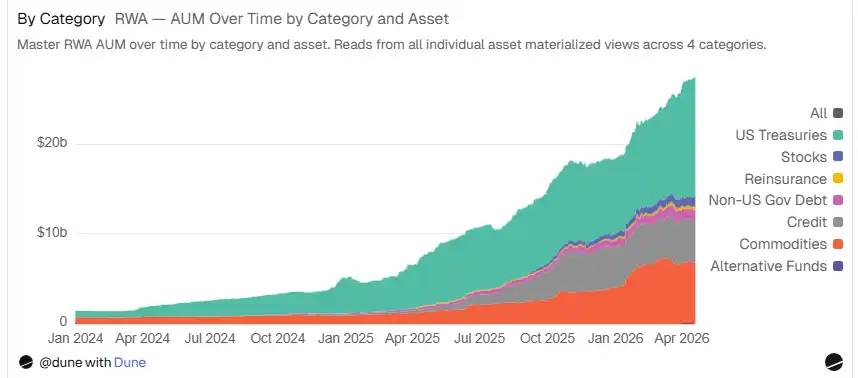
Note: The RWA tokens counted are limited to collateral and vault supplies. Data as of April 16, 2026.

Where is the ~$2.7 Billion Deposited?

The funds are distributed across four main platforms on Ethereum, Solana, and multiple L2s:
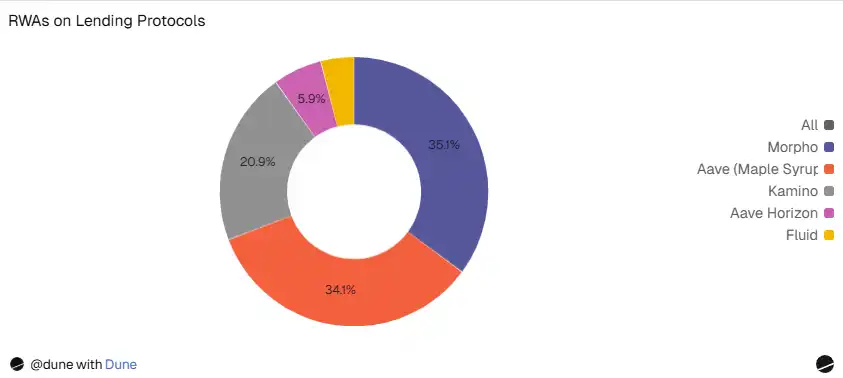
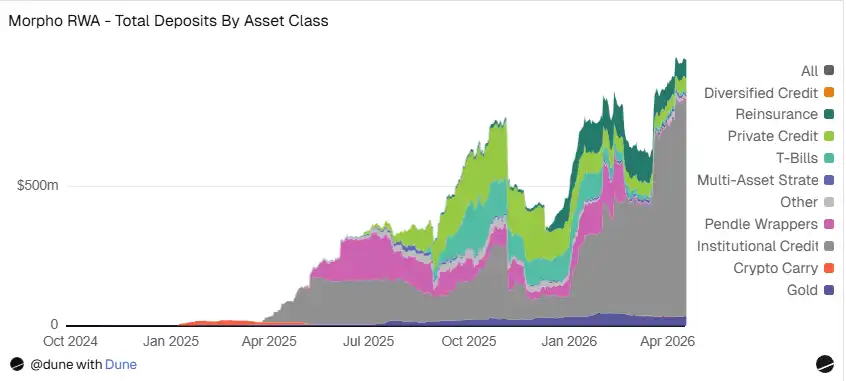
  • Morpho ($957 million): Permissionless, listing 41 RWA assets across 10 chains. Professional curators like Gauntlet and Steakhouse manage vaults, allocating funds to these markets and building structured leverage strategies on top of tokenized RWAs.
  • Aave ($929 million): Maple's syrup tokens are deposited on Plasma, Base, and Ethereum. Institutional credit flows permissionlessly to where the economics of borrowing are best.
  • Kamino ($587 million): The largest lending protocol and RWA platform on Solana. This includes $315 million for PRIME (HELOC lending yield), $161 million for syrupUSDC, $71 million for ONyc (reinsurance), $18 million for USCC, plus xStocks markets (covering seven tokenized stocks totaling $21 million).
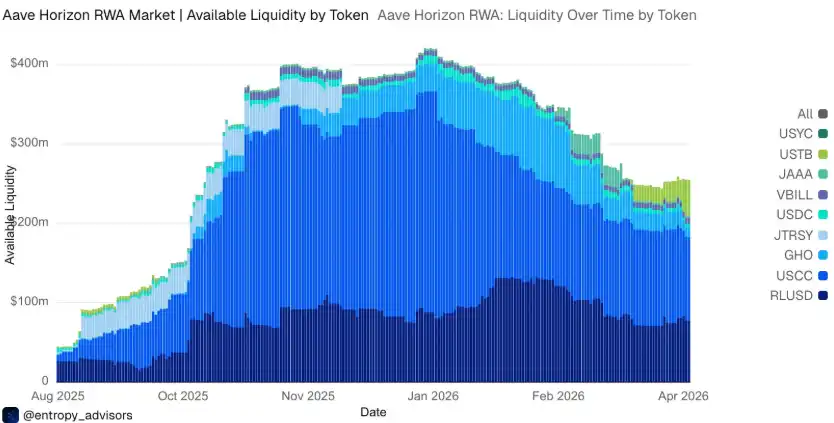
  • Aave Horizon ($161 million): Aave's permissioned, institutionally-oriented RWA market. There are 256 addresses with an average holding of $1.5 million. This includes $105 million in USCC, $46 million in USTB, $7 million in VBILL, and $3 million in JAAA. The total active borrowing in stablecoins is $124 million, with a utilization rate of 77%.
  • Fluid ($109 million): $94 million in reUSD (reinsurance), $12 million in gold, $2 million in syrup. Notably, it supports using Re Protocol's reUSD as collateral, which is not offered by other platforms.

Tokenized Assets vs. Actively Used Assets Are Not Aligned

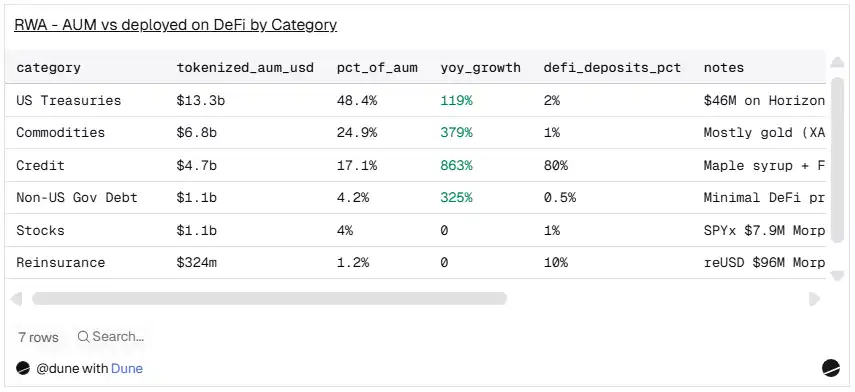
There is a significant discrepancy between the assets dominating tokenized AUM and those actually deposited as collateral in lending protocols. These two leaderboards are almost completely inverted.
Source: Dune

U.S. Treasuries account for 48.5% of tokenized AUM ($13.2 billion) but only 2% of DeFi deposits. Credit assets account for 17% of AUM but dominate deposits at around 80%. Commodities account for 25.2% of AUM but constitute almost less than 1% of DeFi deposits.

Credit assets dominate due to their profit model. Maple's syrupUSDC yields about 6%, while Treasury Bills (T-Bills) yield about 3.5%. When your collateral earns 6% and you can borrow stablecoins at 3%, you achieve positive carry. Curators like Gauntlet build explicit looping strategies on top of this: deposit RWA as collateral, borrow against it, and buy more. This is designed and risk-controlled leverage. This also explains why credit assets appear on every major lending platform: $957 million on Morpho, $929 million on Aave, $476 million on Kamino.
Source: Dune

Reinsurance is emerging as a genuinely new, composable asset class. Re Protocol's reUSD appears on multiple platforms: $96 million on Morpho (including $50 million in Pendle PT-reUSD), $94 million on Fluid, while OnRe's ONyc occupies $71 million on Kamino. Overall, tokenized reinsurance AUM is $324 million (1.2% of total), with DeFi deposits around $261 million (10% of total), meaning about 80% of tokenized reinsurance capital is active in lending protocols, a much higher deposit ratio than any other asset class.
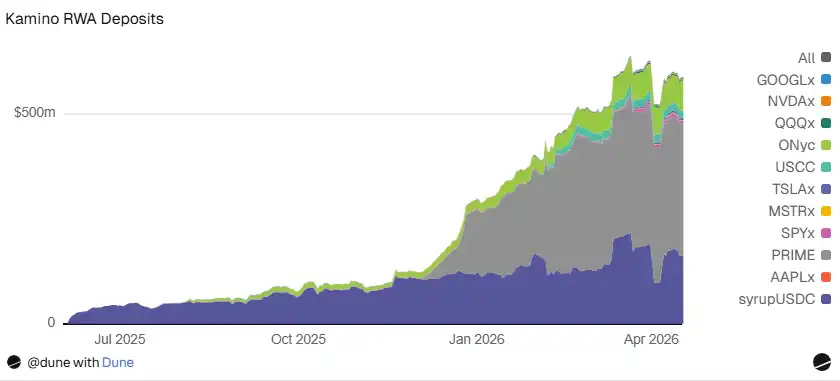
Tokenized stocks are also appearing in DeFi: SPYx ($7.9 million on Morpho), xStocks on Kamino (covering SPYx, TSLAx, QQQx, NVDAx, GOOGLx, MSTRx, AAPLx totaling $21 million), and deSPXA ($3.6 million). While the amounts are smaller, the infrastructure is live, and borrowing activity against stock collateral is happening.

This discrepancy is instructive. Tokenization prioritizes safety and familiarity. U.S. Treasuries are easy to understand, regulate, offer transparency (frequent NAV updates and easy oracle pricing), and are highly attractive to institutional balance sheets. Composability, however, values different things: yield differentials and leverage economics.

Collateral Composition is Evolving in Real-Time

The dominance of high-yield credit might be partly a function of timing. Aave Horizon provides the clearest evidence.

When Horizon launched in August 2025, Superstate's USCC, a crypto arbitrage fund, offered ~15% APY through basis trading on crypto futures. This yield led it to constitute 93% of all RWA collateral. Treasury products were also listed but saw no uptake.

Since then, as the basis narrowed, USCC's yield compressed to ~4%, converging with the 3-4% yield of Treasuries. The result: USCC's collateral share dropped from 93% to about 67%, while USTB surged 570% in 30 days from under $1 million to $45.6 million. As yield differentials narrow, the market is diversifying.
Source: Dune

This is significant not just for Horizon. If credit yields compress across the market (as often happens in mature markets), the collateral composition across all platforms could become more diverse. The assets that dominated the first wave (high-yield credit) might not dominate the next. Risk appetite, regulatory environment, and settlement mechanics will start to matter more.

Pendle adds another dimension to this evolution. Its Principal Tokens (PTs) account for $58 million in deposits on Morpho (allowing users to lock in fixed yields from RWA products). Pendle also directly offers RWA markets for thBILL and mTBILL, bringing yield curve trading into the composability stack. As more RWA products list on Pendle, fixed-rate strategies will become another channel for RWA distribution.

Permissionless Access Drives Distribution

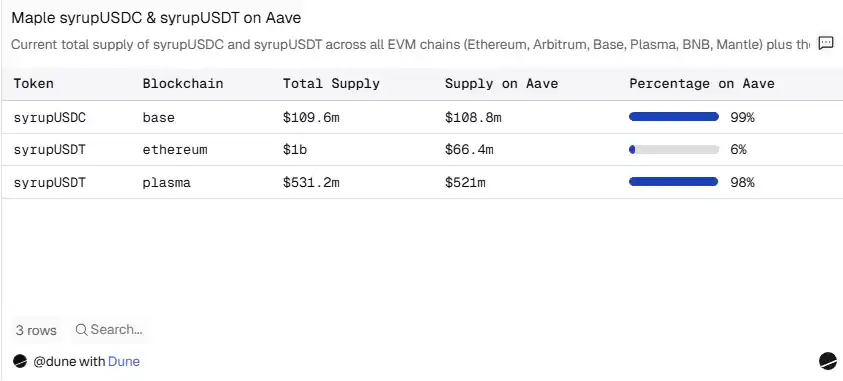
Maple Syrup is the clearest case. syrupUSDC and syrupUSDT are permissionless ERC-20 tokens. Technically, they are hybrids between stablecoins and RWAs, as they are pegged 1:1 to USDC/USDT but earn yield from institutional credit. They are classified as RWAs because the underlying exposure is real-world lending. Anyone can mint, trade, or deposit them into any lending protocol. No KYC, no whitelists, no partnership required.

The result: 98% of syrupUSDT on Plasma and 99% of syrupUSDC on Base are actively deployed on Aave. Curators like Gauntlet on Morpho independently built leveraged vaults around Syrup without coordinating with Maple. syrupUSDC also reached $161 million on Kamino (Solana).
Source: Dune

Each integration adds utility, utility attracts capital, and capital drives more integrations. It is this flywheel effect that has led to $929 million being organically distributed across three chains.

This is crucial because distribution is recognized as the industry's biggest challenge. Centrifuge's "Tokenization Outlook 2026" report noted that 86% of operators said scaling distribution for existing products is more important than launching new ones. The Maple case on Aave shows that permissionless composability is itself a distribution channel.

$1.85 Billion Tokenized, Only $13 Million Composable

Centrifuge's report highlights both the opportunity and the gap for RWAs. It is one of the largest tokenization platforms, with institutional product AUM exceeding $1.85 billion: JTRSY (US Treasury tokenized fund) at $1.52 billion, JAAA (AAA-rated CLO tokenized fund) at $403 million, ACRDX (Apollo Diversified Credit Fund) at $52 million, and the recently launched SPXA (first S&P 500 index tokenized fund) at $3.7 million. However, only about $13 million of this is composable in DeFi: primarily through deRWA wrapper tokens and JAAA on Horizon.
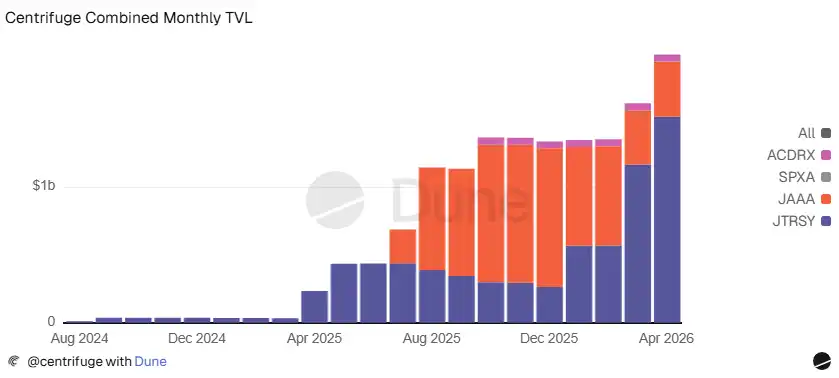
Source: Dune

This gap ultimately comes down to timing and design. The deRWA wrappers only launched in September 2025. The permissioned design slowed integration, and liquidity was thin.

But integration is accelerating. Resolv committed $100 million to JAAA on Horizon. Falcon Finance added JAAA and JTRSY as collateral for USDf. Grove is deploying $250 million on Avalanche. LayerZero enables distribution across 165+ networks. And deSPXA (the DeFi wrapper version of Centrifuge's S&P 500 fund) has reached a total TVL of $3.6 million and DEX trading volume of $7.9 million, showing early organic activity and the potential of the deRWA model: permissionless wrapper tokens operating in parallel with permissioned institutional products.

Three Key Takeaways

Growth rate is more important than current size. There is $2.7 billion in RWA deposits across major DeFi lending markets, about 10% of the $27 billion tokenized AUM. But this $2.7 billion barely existed a year ago. The absolute numbers are still small, but the growth rate is what truly matters.

Tokenized assets are not the same as actively used assets. Treasuries account for 48.5% of tokenized AUM but only 2% of DeFi deposits. Credit accounts for 17% of AUM but 80% of deposits. Higher yields enable positive carry, which supports leverage loops. Credit yields above 6% work; Treasury yields at 3.5% do not. But as the macro environment changes and yield differentials shift across asset classes, collateral composition will adjust, accommodating different assets and emerging categories like reinsurance.

Permissionless access drives distribution. Maple's syrup tokens (hybrids between RWAs and stablecoins) reached over $1 billion across Aave and Kamino on four chains. The token was designed to be composable, so the market composited it. Assets that are easy to onboard get adopted more easily. Assets requiring whitelists are catching up but are moving much slower.

Related reading: On-chain is not liquidity: RWA still needs the final leap

Пов'язані питання

QWhat is the total value of tokenized RWA currently being actively used as collateral in DeFi lending markets, and what percentage of the total tokenized RWA AUM does this represent?

AApproximately $2.7 billion of tokenized RWA is actively used as collateral in DeFi lending markets, which represents about 10% of the total $27 billion tokenized RWA AUM.

QWhich three regulatory milestones in late 2025 and early 2026 are credited with accelerating the tokenization process?

AThe three regulatory milestones are: 1) The GENIUS Act in July 2025, which established a comprehensive U.S. framework for payment stablecoins. 2) The joint classification of major blockchain tokens as digital commodities, not securities, by the U.S. SEC and CFTC in March 2026. 3) The SEC's approval for Nasdaq to trade and settle tokenized stocks and ETFs on its main market, also in March 2026.

QWhy do credit assets dominate the DeFi collateral deposits despite U.S. Treasuries making up a larger portion of the total tokenized AUM?

ACredit assets dominate DeFi deposits because of their profit-generating model. They offer higher yields (e.g., ~6% from Maple's syrupUSDC) compared to U.S. Treasuries (~3.5%). This yield spread allows for positive carry trades, where users can borrow stablecoins at a lower rate than the yield their collateral generates, enabling leveraged strategies that are not feasible with lower-yielding assets like Treasuries.

QHow does permissionless access, as exemplified by Maple's syrup tokens, facilitate the use of RWA in DeFi?

APermissionless access facilitates RWA use in DeFi by allowing assets to be easily minted, traded, and deposited into any lending protocol without requiring KYC, whitelisting, or formal partnerships. This design enables organic distribution and integration across multiple platforms and chains, creating a flywheel effect where utility attracts capital, which in turn drives further integration. For example, Maple's syrup tokens reached over $1 billion across Aave and Kamino on four different chains.

QWhat significant discrepancy does the case of Centrifuge highlight regarding tokenized AUM and its composability in DeFi?

AThe case of Centrifuge highlights a significant gap between the total tokenized AUM and its active use in DeFi. While Centrifuge has over $1.85 billion in institutional product AUM, only about $13 million of it is composable in DeFi. This discrepancy is attributed to factors like the recent launch of its deRWA wrapper tokens and a permissioned design that initially slowed down integration and limited its composability compared to permissionless models.

Пов'язані матеріали

Anthropic Cries Wolf: Is the AGI Threat Real, or Just an IPO Story?

Anthropic has published an article titled "When AI builds itself," discussing the emerging concept of "recursive self-improvement," where AI begins to actively participate in designing, training, testing, and optimizing its own subsequent versions. The company presents internal data showing that by May 2026, over 80% of code merged into its codebase was written by Claude, its AI model. Claude's capabilities have expanded to handling complex, open-ended engineering tasks, achieving a 76% success rate in such areas, and even contributing to research processes, such as optimizing code performance and conducting AI safety experiments. Anthropic outlines an evolution from human-driven development to AI-assisted workflows, culminating in the current stage where AI agents can autonomously write, run, and delegate code. The company cautions that the path toward a "closed loop," where AI continuously improves itself, is becoming visible. It calls for coordinated global mechanisms to potentially slow or pause frontier AI development to allow safety research and societal structures to catch up. However, the timing of this warning coincides with Anthropic's preparations for an IPO, framing the narrative not just as a safety concern but also as a demonstration of Claude's advanced capabilities and its integral role in accelerating Anthropic's own R&D—creating a potential "flywheel" effect for competitive advantage. This contrasts with OpenAI's recent, more policy-oriented discussion of the same risks, highlighting the competitive dynamics in the AI industry as companies position themselves in both the technological and regulatory landscape.

marsbit46 хв тому

Anthropic Cries Wolf: Is the AGI Threat Real, or Just an IPO Story?

marsbit46 хв тому

BIT Research: ETF Purchases Have Slowed, Strategy (MicroStrategy) Has Slowed, What Else Can Drive Bitcoin's Rise?

Market Refocus on Inflation and Rate Expectations Weighs on Bitcoin Currently, the market is in a phase of macro-repricing dominated by inflation and interest rate expectations. Bitcoin, which previously benefited from easy liquidity and low inflation, is seeing its core bullish drivers weaken. These drivers were market expectations for interest rate cuts and strong inflows from Bitcoin ETFs and institutions like MicroStrategy (referred to as "Strategy" in the text). The logic has shifted. Recent high inflation data (e.g., CPI hitting 3.8% in a May 2026 report) has caused the market to sharply reduce its rate cut expectations for 2025 and even price in potential hikes. This is a key constraint for Bitcoin, as it lacks cash flows and is highly sensitive to rate expectations. Concurrently, institutional capital flows have slowed significantly. Following the hot CPI data, Bitcoin ETFs saw accelerated outflows, with around $4.3 billion leaving over a period. MicroStrategy's ability to keep adding substantial Bitcoin to its balance sheet is also diminishing. Together, ETF and MicroStrategy holdings total roughly $110 billion, but their momentum as growth engines is cooling. In summary, Bitcoin's current pressure stems not from its own fundamentals but from a changing macro environment. As long as inflation stays elevated, Bitcoin is likely to remain in a consolidating phase. However, historically, inflation eventually peaks. Once it recedes and rate cut expectations rebuild, institutional capital could return, potentially fueling a new and more robust recovery phase for Bitcoin.

marsbit54 хв тому

BIT Research: ETF Purchases Have Slowed, Strategy (MicroStrategy) Has Slowed, What Else Can Drive Bitcoin's Rise?

marsbit54 хв тому

Earning 1000 Trillion in Half a Year, 'Pocketing' 20 Million per Capita: This Round of Wealth Creation in the Korean Stock Market is Unprecedented in Scale

The South Korean stock market is experiencing an unprecedented wealth surge in 2026, with household equity and fund asset values soaring by over 1,000 trillion KRW (~$730bn) year-to-date. This translates to an average per capita wealth increase of roughly 20 million KRW, fueled by a historic 109% rally in the KOSPI index. The boom is driven by three converging forces: an AI-driven semiconductor supercycle boosting giants like Samsung and SK Hynix; the government's "Value-Up" market reforms addressing long-standing corporate governance issues; and aggressive real estate regulations that have locked capital within financial markets, preventing profits from flowing back into property. This has triggered a wealth effect, boosting high-end consumption significantly. However, the gains are highly concentrated. The two semiconductor behemoths account for over half the index's value, but retail investors own relatively low stakes in them, systematically missing the biggest rallies. Wealth and consumption benefits are skewed towards luxury goods and imported cars, bypassing mainstream retail. Further risks stem from excessive leverage, with high trading volume in leveraged ETFs, and a market sentiment heavily reliant on the AI sector's fortunes and speculative rumors. While this cycle marks a potential shift from real estate to equities as a primary wealth generator for Koreans, its sustainability, amid structural imbalances and leverage, remains a critical test.

marsbit59 хв тому

Earning 1000 Trillion in Half a Year, 'Pocketing' 20 Million per Capita: This Round of Wealth Creation in the Korean Stock Market is Unprecedented in Scale

marsbit59 хв тому

Behind ZEC's Over 30% Plunge: An 'Unlimited Minting' Vulnerability with No Way to Prove if It Was Ever Exploited

A critical vulnerability was discovered in Zcash's Orchard privacy pool, allowing for the theoretical creation of undetectable counterfeit ZEC. Researcher Taylor Hornby found the flaw on May 29th, 2024, within the Orchard circuit's cryptographic constraints, which could let an attacker bypass asset conservation rules. Although a rapid emergency fix was deployed within days via a coordinated soft and hard fork, a core uncertainty remains: due to Orchard's privacy features, it is impossible to cryptographically prove whether this "unlimited mint" flaw was exploited in the nearly four years since the pool's 2022 launch. This uncertainty, rather than the patched flaw itself, triggered a market panic, causing ZEC's price to drop over 30%. While the Zcash Foundation stated no evidence of exploitation was found, independent entity Shielded Labs emphasized the impossibility of definitively proving no counterfeit ZEC was ever created. The incident highlights the unique trust challenge in privacy systems. To address this, developers are proposing a new network upgrade with enhanced auditing to allow verifiable proof of supply integrity. Notably, the researcher utilized the newly released AI model Claude Opus 4.8 as a tool during the security review, signaling the growing role of advanced AI in uncovering complex cryptographic vulnerabilities.

marsbit1 год тому

Behind ZEC's Over 30% Plunge: An 'Unlimited Minting' Vulnerability with No Way to Prove if It Was Ever Exploited

marsbit1 год тому

Торгівля

Спот
Ф'ючерси

Популярні статті

Як купити ERA

Ласкаво просимо до HTX.com! Ми зробили покупку Caldera (ERA) простою та зручною. Дотримуйтесь нашої покрокової інструкції, щоб розпочати свою криптовалютну подорож.Крок 1: Створіть обліковий запис на HTXВикористовуйте свою електронну пошту або номер телефону, щоб зареєструвати обліковий запис на HTX безплатно. Пройдіть безпроблемну реєстрацію й отримайте доступ до всіх функцій.ЗареєструватисьКрок 2: Перейдіть до розділу Купити крипту і виберіть спосіб оплатиКредитна/дебетова картка: використовуйте вашу картку Visa або Mastercard, щоб миттєво купити Caldera (ERA).Баланс: використовуйте кошти з балансу вашого рахунку HTX для безперешкодної торгівлі.Треті особи: ми додали популярні способи оплати, такі як Google Pay та Apple Pay, щоб підвищити зручність.P2P: Торгуйте безпосередньо з іншими користувачами на HTX.Позабіржова торгівля (OTC): ми пропонуємо індивідуальні послуги та конкурентні обмінні курси для трейдерів.Крок 3: Зберігайте свої Caldera (ERA)Після придбання Caldera (ERA) збережіть його у своєму обліковому записі на HTX. Крім того, ви можете відправити його в інше місце за допомогою блокчейн-переказу або використовувати його для торгівлі іншими криптовалютами.Крок 4: Торгівля Caldera (ERA)Легко торгуйте Caldera (ERA) на спотовому ринку HTX. Просто увійдіть до свого облікового запису, виберіть торгову пару, укладайте угоди та спостерігайте за ними в режимі реального часу. Ми пропонуємо зручний досвід як для початківців, так і для досвідчених трейдерів.

465 переглядів усьогоОпубліковано 2025.07.17Оновлено 2026.06.02

Як купити ERA

Обговорення

Ласкаво просимо до спільноти HTX. Тут ви можете бути в курсі останніх подій розвитку платформи та отримати доступ до професійної ринкової інформації. Нижче представлені думки користувачів щодо ціни ERA (ERA).

活动图片