A Role Reversal: As AI Grows Stronger, Humans Begin 'Proving Their Innocence'

marsbitОпубліковано о 2026-05-29Востаннє оновлено о 2026-05-29

Анотація

As AI grows increasingly sophisticated, humans are now forced to prove they are not AI themselves. This month, a winning story for the Commonwealth Short Story Prize was flagged as "100% AI-generated" by a detection tool, though a review by Claude yielded no clear verdict. Simultaneously, Nobel laureate Olga Tokarczuk faced public speculation that her upcoming novel was AI-written after she mentioned using AI for research assistance, forcing her to publicly clarify her solo authorship. The trend reflects a "reverse Turing test," where humans must demonstrate their humanity. In visual arts, illustrators now routinely record their entire drawing process or stage multi-camera live streams to disprove accusations of using AI, sometimes even engaging in monetary "duels" with accusers. The problem is compounded by unreliable detection methods. AI text detectors like Pangram analyze statistical patterns but are prone to false positives, as shown in a Stanford study where many genuine non-native English essays were mislabeled as AI. Visual "detection" is equally fallible, highlighted by a viral incident where a genuine Monet painting was widely criticized online as inferior AI-generated art. Technical solutions like watermarking (e.g., metadata standards like C2PA or invisible watermarks like Google's SynthID) are being developed for images and videos. However, they are not foolproof—metadata can be stripped, and watermarks degraded. For text, reliable, universally adopted waterm...

AI is becoming more human-like, forcing humans to prove they are not AI.

Just this month, two incidents occurred in the literary world.

One involved a winning entry in the Commonwealth Short Story Prize being flagged as '100% AI-generated' by a third-party AI detection tool. The organizers used Claude to double-check, but did not get a similar result.

The other involved a new novel by a Nobel laureate being questioned as AI-written even before its release.

AI is growing increasingly powerful, making text, images, and videos harder to distinguish with the naked eye. Yet, the tools humans have for judgment are not equally reliable.

Thus, a new order has emerged.

Winners of literary prizes must explain their works, Nobel-winning authors must explain their creative methods, illustrators must record their screens, stream live, or show their layers, and even ordinary bloggers may face comments questioning a 'strong AI vibe.'

In the past, machines strived to pass the Turing test, proving they were like humans.

Now, more and more people are participating in a reverse Turing test: proving they are not machines.

01

Even Nobel Literature Laureates Can't Escape 'AI Detection'

In May this year, a winning entry in the Commonwealth Short Story Prize sparked a major controversy over 'AI detection.'

The controversy centered on a short story by Trinidad and Tobago writer Jamir Nazir.

This work won the 2026 Commonwealth Short Story Prize Caribbean Region Award and was published in the literary magazine Granta. Soon, readers and industry insiders began questioning the story, suggesting its language bore clear AI traces: mixed metaphors, uniform sentence structures, and rhetoric that seemed mass-produced.
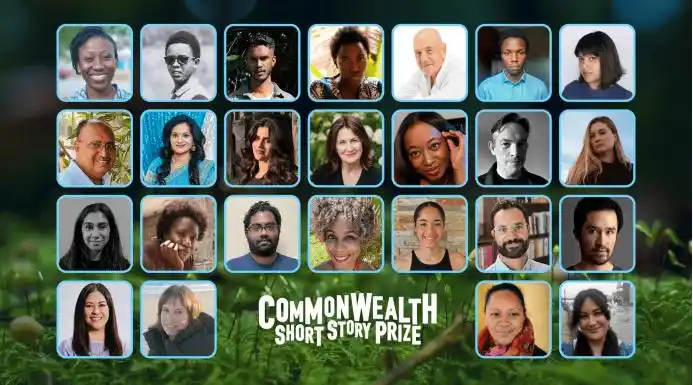
Subsequently, the AI detection tool Pangram gave a seemingly definitive judgment: 100% AI-generated.

The '100%' figure seemed like ironclad evidence, but it didn't immediately become a verdict.

The Commonwealth Foundation stated that all shortlisted authors had confirmed no AI assistance was used; Granta also couldn't rule a violation based solely on one detection result.
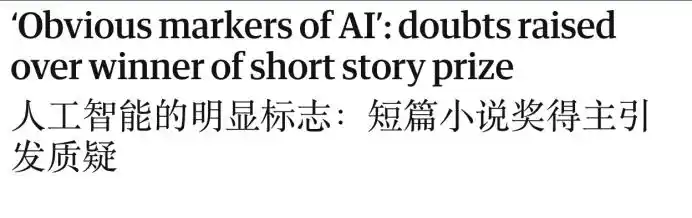
Thus, the situation entered an utterly absurd phase. Granta magazine attempted to have Claude review the story, using another AI to judge if it was AI-written.

The result: Claude did not provide a definitive answer. In other words, the work Pangram confidently deemed '100% AI-generated' was something Claude couldn't determine.

Nobel Literature Laureate Olga Tokarczuk also recently faced controversy.

The trigger was her mentioning in an interview that she uses AI to assist with brainstorming, data organization, preliminary research, and fact-checking.
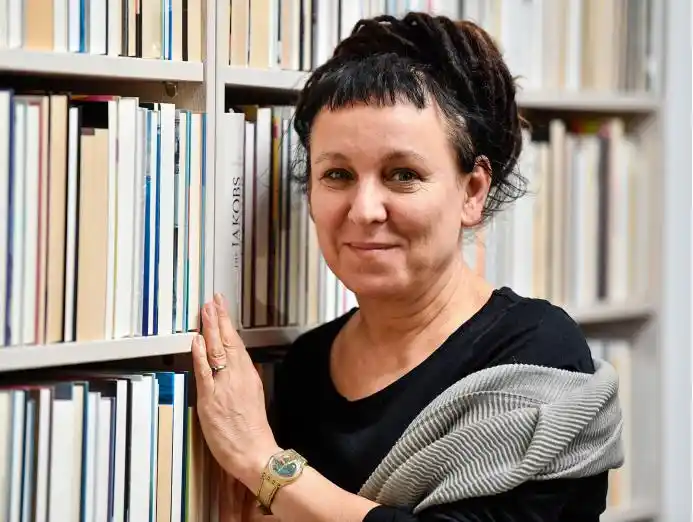
This statement quickly sparked public discussion. The critical issue was Tokarczuk's upcoming new book, leading to widespread speculation about whether her new novel was AI-written.

Subsequently, Tokarcchuk had to publicly clarify that her new Polish-language book, scheduled for publication in Autumn 2026, was not written by AI or anyone else. She emphasized that for decades, she had always written alone.

Ultimately, AI is indeed becoming more powerful, making 'AI detection' increasingly difficult.

Late last year, The New Yorker published an experimental article. Researchers fine-tuned models with works from multiple writers, allowing AI to learn and mimic their personal styles.

In the experiment, creative writing students, unaware of the source, read both human and AI texts and judged which segment they preferred. The result: in nearly two-thirds of the cases, they preferred the AI-generated version.

This is more troublesome than 'AI can write fiction.'

New Yorker author Vauhini Vara also wrote in the article that friends and professional readers mistook AI-generated sentences for her own writing and criticized her actual original sentences as 'AI-like.'

02

Illustrators in Tears, Recording Entire Process to 'Prove Innocence'

The 'uncanny valley effect' is not limited to entities that look almost, but not quite, human. When AI-generated text, images, and videos increasingly approach human quality, even conquering the most human-like 'style,' humans inevitably experience an existential crisis.

This is a core driver behind the current trend of 'baseless AI detection.'

In other words, people's 'AI detection' is understandable; behind it lies a kind of fear—Is this human? Is this AI? Who am I? Who are we?

But being understandable doesn't make it righteous. 'AI detection' is creating trouble for creators in various fields, forcing them to bear the additional cost of 'proving their innocence' on top of their creative work.

Regarding the impact of AI, the illustration community is no stranger. We discussed the impact of AI on illustrators and their resistance to it years ago.

However, at present, the trouble illustrators face is not just guarding against AI training on their work, but having their handcrafted creations 'detected as AI.'

Searching for 'illustrator proving innocence' on social platforms reveals many cases.

Some illustrators, after being 'AI-detected,' record their screens to show all layers, proving the work is their own.
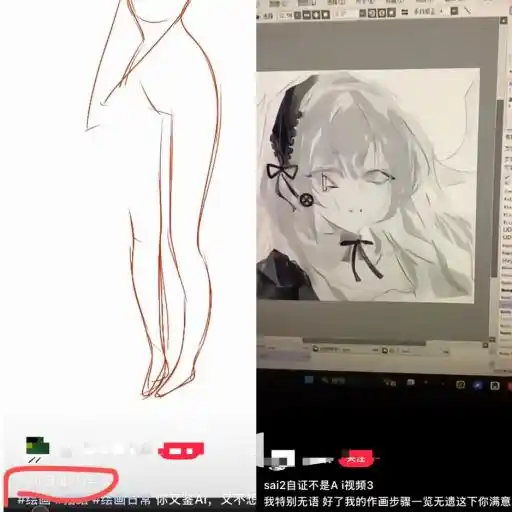
But often, this is not enough.

An illustrator friend told us that many illustrators now record the entire drawing process to prevent difficulty in self-justification when 'AI-detected.' This is currently the most reliable method.

If there's no recording, or if there is recording 'evidence' but suspicion remains that it's 'tracing or copying,' then there's the next step—a wager.

Yes, the art world has developed wagers between the 'AI detectors' and the 'AI-detected' due to AI. In one case we saw, a poster listed reasons like 'disconnected hair lines' and 'problematic neck-shoulder structure' to suspect an illustrator's work was traced or copied from an AI image placed underneath.

The two parties wagered 2000 yuan. Ultimately, the illustrator 'successfully proved innocence,' and the poster paid the 2000 yuan.
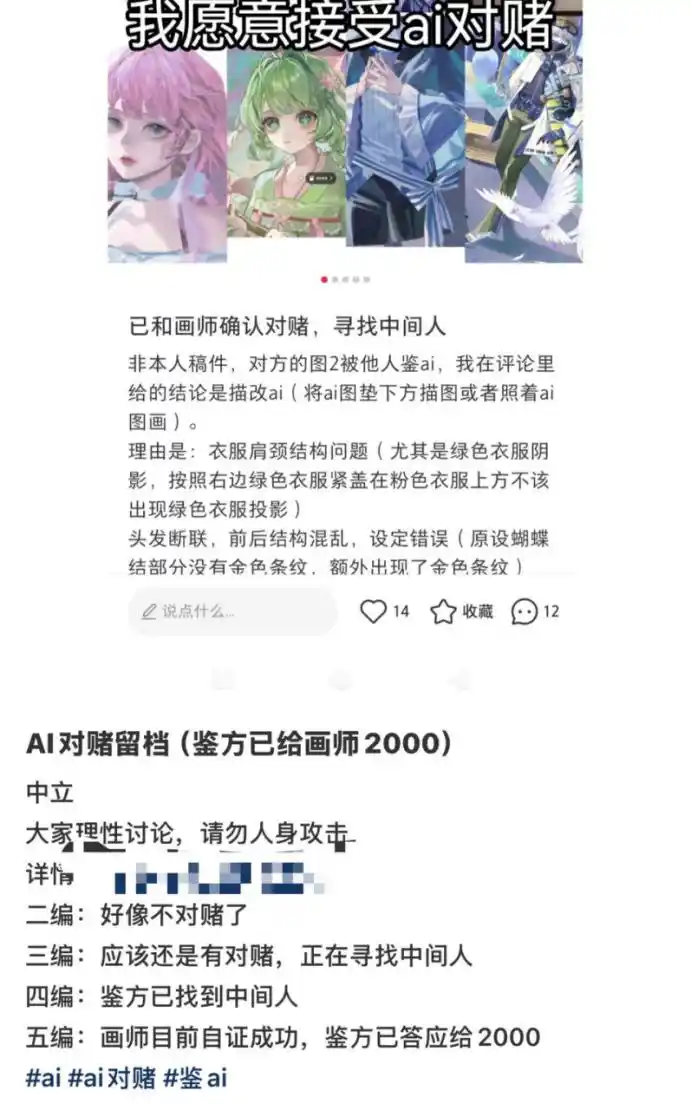
Generally, the 'proof' in such wagers involves both parties agreeing on a time for a live drawing session. The live stream requires multiple camera angles, such as one showing the screen drawing process and another recording the illustrator's physical drawing to prevent 'ghostwriting.'

From many illustrators' 'proof posts,' one can easily sense their helplessness. They often lament, 'My turn has finally come,' and vow, 'This is the first and last time I prove myself.'

Thus, while hating 'baseless AI detection,' when it's their turn, they have no choice but to 'prove their innocence,' which is truly distressing.
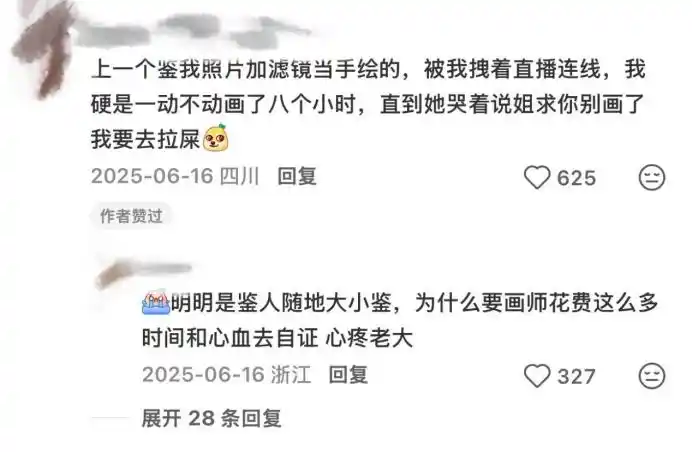
Are there cases where 'AI detection' succeeds and the illustrator 'fails to prove innocence'? Yes. But this still doesn't make 'AI detection' more justified. After all, the cost of 'AI detection' is almost zero.

And the method of 'AI detection' is even cruder—relying on the naked eye.

This brings us to a recent joke. An X user posted a picture, claiming it was their AI-generated 'Monet-style image,' and asked everyone to 'explain in as much detail as possible why it is inferior to a real Monet.'
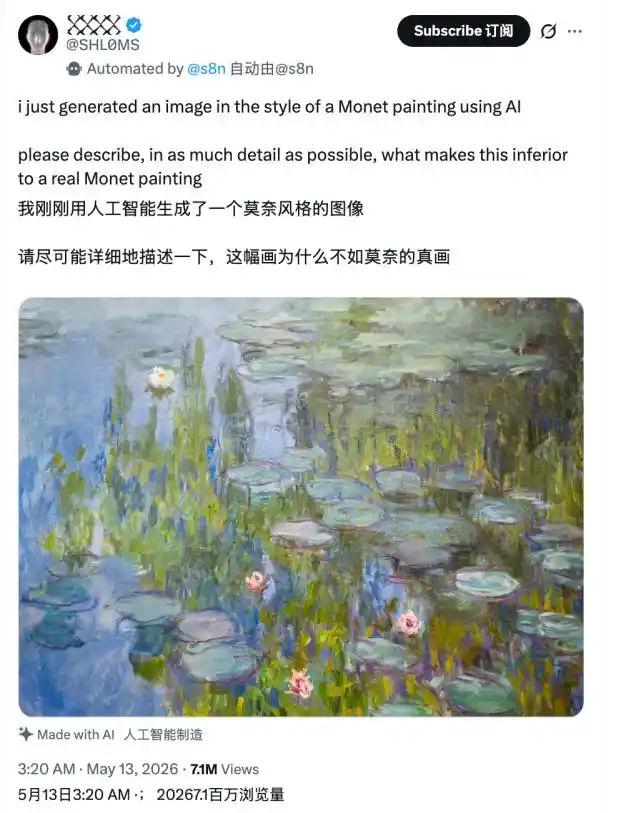
The post later gained 7 million views. Many in the comments seriously 'detected AI,' saying it lacked depth, had inconsistent colors, no human touch, or inferior composition compared to the real work. Some even analyzed brushstrokes and spatial perception in detail.
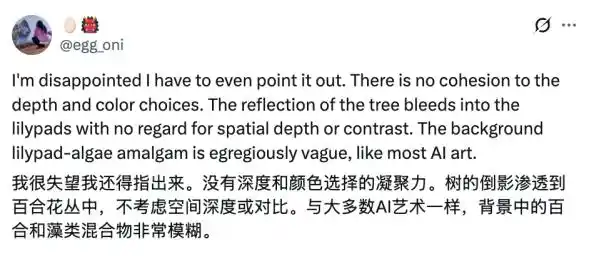
The twist: that image was an actual Monet painting.

03

Who Has the Final Say in 'AI Detection'?

So, this is essentially the conflict between the fear of AI becoming more human-like and the lack of perfect 'AI detection' methods.

The crudeness of 'AI detection' methods is another key factor plunging creators into the collective need to 'prove innocence.'

Besides 'visual identification,' another main method, as mentioned earlier with the literary award winner, is third-party detection tools like Pangram.

AI detection tools are commonly used in text fields, creating an illusion: they give a percentage, like '80% AI-generated' or '100% AI-generated.' This number looks like a conclusion, even like a technical appraisal.
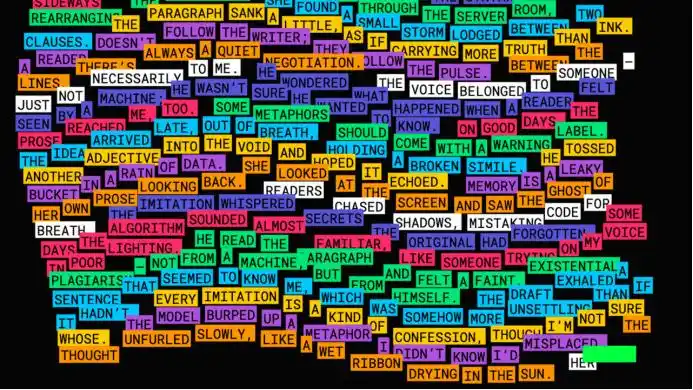
But text detection is not the same as DNA testing. What it judges is more like 'what statistical features this text resembles.'

AI detection tools are also essentially checking if it 'looks like AI wrote it.'

Pangram explains on its website that its AI detector uses natural language processing techniques and vast amounts of human and AI writing data to analyze structural, stylistic, and semantic patterns in AI text. Pangram's technical report also states its core is a Transformer-based neural network classifier, trained to distinguish text written by large language models from that written by humans.
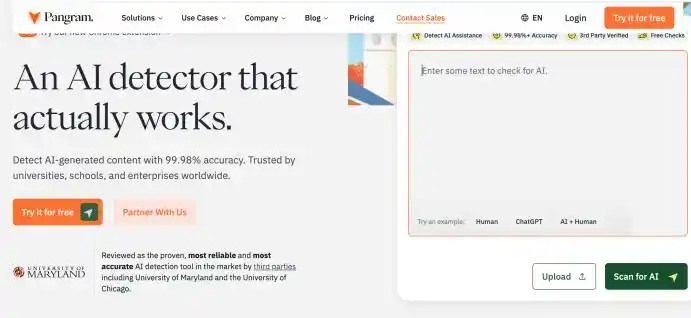
In other words, such tools are not checking an article against an 'AI text database' to see if it matches a known sample.

It's more like pattern recognition. Do the vocabulary choices, sentence rhythm, structural arrangement, and semantic connections of this text resemble the human text it has seen, or the AI text it has seen?

Even more troublesome are the many special cases. If an article is human-drafted but polished with a few AI sentences, how to judge? If an AI generates an outline, and a human rewrites it fully, how to judge? If an English source is AI-translated into Chinese and then manually edited, can detection tools still judge? If a student is a non-native English writer, with more regular, templated sentences, are they more likely to be falsely flagged?

The same applies to the art field. Some illustrators lament—indeed, the structure has issues, but that's because my skills need improvement, not because it's AI-generated!

In 2023, Stanford University researchers tested 7 AI text detectors.

They selected 91 TOEFL essays written by non-native English students—these essays came from official TOEFL exam corpora, meaning they were handwritten by students in real exam settings, so they were confirmed not AI-generated.

The result: 89 of them were flagged as AI-generated by at least one detector; the average false positive rate reached 61.22%; 18 essays were unanimously judged as AI-generated by all 7 detectors. In other words, these students, while writing in a foreign language, were flagged as machines because their expression was more regular and templated.

Of course, 2023 or 2024 detection tools are not simply equivalent to today's. Over the past few years, commercial detectors have indeed iterated, with some new tools showing significant improvement in specific tests.

But the problem is not solved.

As long as 'misjudgment' is not completely eliminated, room for conflict remains.

After all, what the tool provides is essentially probability, but for individuals, it becomes an accusation.

04

What Happened to the Promised 'Watermark'?

A bigger question: Should AI companies implement 'source marking'?

Couldn't placing a native 'watermark' on all AI content—one that cannot be removed—solve the identification problem?

Many people, upon hearing 'watermark,' still think of logos in image corners, platform identifiers on video frames, or large text saying 'AI-generated.'

But today's AI watermarks are no longer just such visible marks.

The industry roughly has two approaches: one is metadata, like C2PA and Content Credentials, which is akin to attaching an 'identity description' to digital content, recording what tool generated it, when, and what edits it underwent;
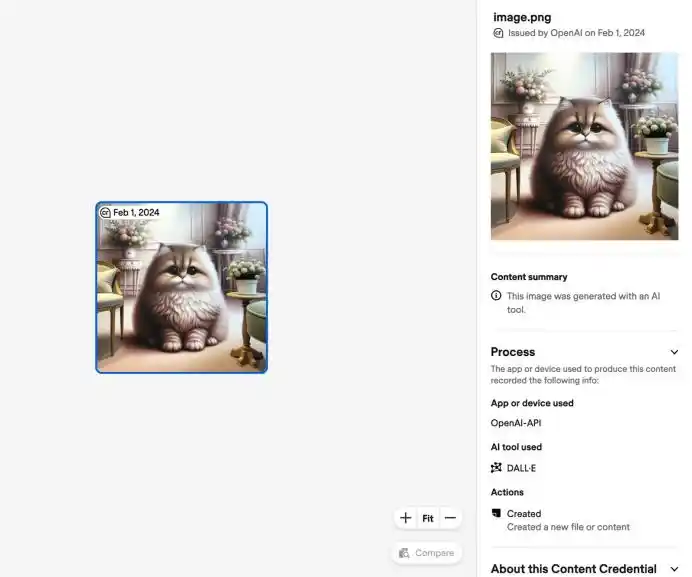
The other is invisible watermarks, embedding signals imperceptible to the human eye but detectable by machines into images, audio, video, and even text.

In the image and video fields, these solutions have begun implementation.

Google DeepMind's SynthID can embed invisible watermarks into content generated by tools like Imagen, Veo, Lyria, and Gemini.

Meta stated that images generated or edited by Meta AI include visible watermarks, invisible watermarks, and metadata; OpenAI also added C2PA content credentials to DALL·E 3 and ChatGPT-generated images, later introducing SynthID invisible watermarks. Companies like Adobe, Microsoft, Google, Meta, and OpenAI have all participated in the C2PA and content credentials ecosystem.
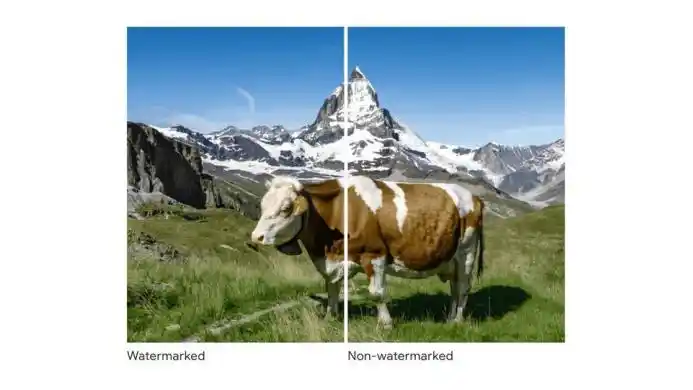
This indicates AI companies also recognize that relying solely on visual judgment of 'AI-likeness' is insufficient. They are already attempting to leave machine-readable source signals for AI-generated content using metadata, content credentials, invisible watermarks, and platform labels.

But these solutions are not perfect. Metadata can be lost during screenshots, compression, forwarding, or re-uploading; visible watermarks can be cropped or covered; invisible watermarks are more durable but can also be weakened by post-processing, perturbations, or re-generation.

More crucially, these solutions typically only identify content that has integrated the corresponding system and retained the corresponding markers. That is, Google's SynthID mainly identifies content with SynthID, and OpenAI's content credentials mainly indicate content from OpenAI systems. As long as content comes from models not integrated with markers, or undergoes multiple transfers, the source chain can break.

For text, the problem is more complex.

Text can certainly be watermarked. The principle involves subtly altering the probability of certain word choices during model generation, making the final text exhibit a statistical pattern invisible to the human eye but detectable by a detector. Simply put, it's making AI leave its 'vocabulary fingerprint.'

Google has already released SynthID-Text, claiming it can embed watermarks in text generated by Gemini. OpenAI has long been expected to address this. In July 2023, companies including OpenAI, Google, Meta, Amazon, Anthropic, and Microsoft made a voluntary commitment to develop mechanisms to help users identify AI-generated content, including watermarks and content source markers.

But years later, marking solutions for images, audio, and video have progressed, while text still lacks a clear, default-enabled, publicly available universal answer.

OpenAI once launched an AI Text Classifier in 2023 to judge if text was AI-generated, but cautioned users not to rely on it as the sole basis for decision-making at launch.

Six months later, OpenAI took it offline due to low accuracy.

In 2024, The Wall Street Journal reported that OpenAI internally developed a text watermarking tool effective on sufficiently long ChatGPT-generated text with up to 99.9% accuracy. But OpenAI ultimately did not publicly release it.

The reasons aren't entirely technical. The report mentioned OpenAI's concerns about text watermarks causing user backlash, affecting product usage, and additional stigmatization of non-English users.

Surveys also showed nearly 30% of ChatGPT users said they might reduce usage if text watermarking were enabled.

Ultimately, returning to the tug-of-war between 'AI detection' and 'proving innocence,' all the mentioned watermarking solutions are not yet foolproof.

Humans have a saying, 'While the priest climbs a post, the devil climbs ten,' and another, 'For every policy, there is a countermeasure.' As long as humans still believe in these, 'AI detection' will not cease.

Perhaps one day, when 'AI participation' becomes the default and 'human originality' becomes exceptionally rare, this large-scale tug-of-war between 'AI detection' and 'proving innocence' will lose its meaning.

This article is from WeChat public account '直面AI' (ID: faceaibang), author: 小金牙, editor: 王靖

Пов'язані питання

QWhat is the main phenomenon described in the article regarding AI and human creators?

AThe article describes a phenomenon where AI-generated content (text, images, video) has become so advanced that it is increasingly difficult to distinguish from human-created work. As a result, human creators are now often forced to 'prove their innocence' by providing evidence that their work is not AI-generated.

QWhat are some of the methods mentioned that creators use to prove their work is human-made?

ATo prove their work is human-made, creators use methods such as: recording the entire screen during the creation process (especially for digital art), providing layers and timelapses of their work, conducting live-streamed drawing sessions with multiple camera angles, and publicly explaining their creative process.

QAccording to the article, what are the main problems with current AI detection tools for text?

ACurrent AI text detection tools have significant problems. They are not definitive like DNA tests but rely on statistical patterns, leading to high rates of false positives. They can mistakenly flag human-written text, especially from non-native speakers or highly stylized writers, as AI-generated. Different tools can also give conflicting results for the same piece of text.

QWhat are some of the 'watermarking' solutions for AI content mentioned, and what are their limitations?

AThe article mentions watermarking solutions like: 1) Metadata standards (e.g., C2PA, Content Credentials) that attach provenance information. 2) Invisible watermarks (e.g., SynthID) embedded in images, audio, or video that are machine-readable. Their limitations include: metadata can be stripped during editing or sharing, visible watermarks can be cropped, invisible watermarks can be degraded by processing, and no universal, foolproof standard exists—especially for text.

QWhat fundamental shift in societal dynamics does the article suggest is happening due to advanced AI?

AThe article suggests a fundamental reversal of the classic Turing Test dynamic. In the past, machines strived to pass as human. Now, with AI content becoming highly convincing, humans are increasingly subjected to a 'reverse Turing Test,' where they must prove they are *not* machines or that their creative work is authentically human.

Пов'язані матеріали

BIS Latest Research: The Future of Stablecoins and the Global Monetary Landscape

BIS Working Paper No. 170, released in May 2026, analyzes the impact of stablecoins on the global monetary system. The market has grown exponentially since 2014, with over 300 active stablecoins exceeding $300 billion in market capitalization. It is highly concentrated, dominated by USD-linked stablecoins (98% by market cap, mainly USDT and USDC), which function as new forms of private offshore dollar claims on blockchain. Currently, stablecoin use remains largely within crypto ecosystems for trading and DeFi collateral. Real-economy adoption, such as in cross-border payments, is nascent but growing in emerging markets and developing economies (EMDEs) facing high inflation and volatile currencies, where they facilitate capital flight and "digital dollarization." The paper assesses impacts using the Cohen-Kennen framework. For private-sector functions, stablecoins most directly affect value storage (as a dollar-denominated safe haven in EMDEs) and the medium of exchange (enhancing cross-border payment efficiency, further entrenching dollar use). Impacts on the unit of account and official-sector functions are currently limited but could indirectly constrain monetary policy autonomy and capital controls. The report outlines three potential future scenarios: 1) **Niche adoption**, where stablecoins remain crypto-centric with minimal systemic impact; 2) **Digital dollarization**, a high-risk scenario where USD stablecoins become de facto standards in EMDEs, eroding monetary sovereignty; and 3) **Local currency stablecoin integration**, an ideal but challenging scenario where regulated domestic stablecoins linked to CBDCs enhance efficiency without foreign currency substitution. Key policy recommendations emphasize global coordination: establishing uniform regulatory standards (e.g., for reserves and disclosure), strengthening cross-border supervisory cooperation, enhancing domestic defenses in EMDEs (via macroeconomic stability, improved payment systems, and CBDCs), and combating illicit activities. The paper concludes that stablecoins are a structural force reinforcing dollar dominance in the near term, posing significant risks to EMDEs' financial stability and policy autonomy. Their long-term trajectory depends on regulatory responses, adoption patterns, and the co-evolution with public digital currencies.

marsbit8 хв тому

BIS Latest Research: The Future of Stablecoins and the Global Monetary Landscape

marsbit8 хв тому

BIS Latest Research: Stablecoins and the Future of the Global Monetary Landscape

The Bank for International Settlements (BIS) Working Paper No. 170 analyzes the rise of stablecoins and their impact on the global monetary system. Stablecoins, privately issued digital tokens pegged to fiat currencies, have grown exponentially since 2014, with a market dominated by USD-pegged variants like USDT and USDC. Their core function remains within the crypto ecosystem, though use in cross-border payments and as a store of value in high-inflation emerging markets is increasing. The report identifies stablecoins as a new form of offshore dollar claims, extending dollar liquidity via blockchain. Their stability depends entirely on reserve quality and market arbitrage, lacking traditional banking safeguards. In the short term, stablecoins reinforce the US dollar's dominance, posing risks to monetary sovereignty in emerging market and developing economies (EMDEs) by facilitating "digital dollarization," which can undermine local currency deposits, capital controls, and monetary policy effectiveness. The BIS outlines three potential future scenarios: 1) Niche adoption within crypto (baseline), 2) Widespread "digital dollarization" in EMDEs (high-risk), and 3) Integration of domestic currency stablecoins (ideal but challenging). Effective global regulatory coordination is crucial to manage risks like reserve transparency, cross-border spillovers, and illicit activities. The report concludes that stablecoins represent a structural force reshaping international monetary hierarchies, presenting both opportunities for payment efficiency and significant risks to financial stability and autonomy, necessitating robust policy responses.

链捕手14 хв тому

BIS Latest Research: Stablecoins and the Future of the Global Monetary Landscape

链捕手14 хв тому

Solo Company Craze: Some Earn Millions Annually, Others See Incomes Shrink by 90%

The Rise of the "One-Person Company" (OPC): AI Fuels a Solo Entrepreneurship Wave The concept of the "One-Person Company" (OPC)—where an individual leverages AI tools to start and run a business—is gaining significant traction, hailed by some as ushering in a "golden age" for solo entrepreneurship. While success stories abound, the reality is a mixed picture of high earnings and significant struggles. The article profiles several OPC founders across different industries: * A game developer created 6 bullet-chat (danmaku) games in a year using an AI-powered workflow, earning approximately 1 million RMB. AI handled around 70% of art and 99% of coding tasks, slashing development cycles from months to about 15 days per game. * A materials researcher in Japan, using AI for tasks from translation to legal advice, earns roughly triple the salary of a local white-collar worker. * A biotech entrepreneur uses AI Agents to automate 80% of repetitive work like data analysis, doubling their previous income while gaining time freedom. * Conversely, a former tech executive turned cross-border e-commerce founder in Latin America reports a 90% drop in income compared to their previous corporate job, cautioning against blindly following the trend. Key insights from these cases include: AI dramatically lowers barriers to entry and operational costs, but does not guarantee success. It excels at automating repetitive tasks but cannot replace core human skills like creativity, project management, judgment, and client acquisition. Industry experience and existing client/resources remain critical advantages. The model suits self-starters with specific expertise but poses challenges in areas like sales, compliance, and scaling. Ultimately, while AI empowers solo ventures, entrepreneurship's inherent risks and demands persist.

marsbit20 хв тому

Solo Company Craze: Some Earn Millions Annually, Others See Incomes Shrink by 90%

marsbit20 хв тому

Goldman Sachs Research Report Analysis: Chip Shortage to Persist Until 2028, Maintain Buy Recommendations

Goldman Sachs Research Report Summary: Memory Shortage Until 2028, Maintain Buy Recommendations Goldman Sachs' latest Asia-Pacific equities report, "The 720," forecasts a sustained memory chip upcycle extending into 2028, driven by strong AI server demand visibility, limited supply growth, and binding long-term agreements. The firm believes the market significantly underestimates the cycle's duration, as evidenced by low P/E ratios for memory stocks. Key sector calls include raising 12-month price targets for Samsung Electronics and SK Hynix, and upgrading Kioxia from Hold to Buy, citing higher and more sustainable peak profits over the next 2-3 years. The report also highlights the broader AI hardware supply chain benefiting from hyperscaler capex acceleration. Recommendations include: * MediaTek (Buy) for its data center/ASIC pivot. * Eoptolink (Buy) on 1.6T optical module ramp-up. * Biren (Buy) for its AI chip migration. * Huaqin (Buy, newly covered) for its shift from consumer electronics ODM to AI data centers. * Lenovo (Buy) on the AI PC refresh cycle. Other notable mentions include China property developers (under an optimistic scenario), BYD for its affordable city NOA strategy, and select Japanese semiconductor equipment makers. A macro theme notes the divergence between AI-boom beneficiaries (e.g., Korea, Taiwan) and energy-importing economies facing inflationary pressure. The report concludes with standard disclaimers, noting that price targets are forward-looking estimates and that sell-side research has an inherent bullish bias. The core investment thesis hinges on the longevity of the memory upcycle and the AI-driven capex wave.

marsbit54 хв тому

Goldman Sachs Research Report Analysis: Chip Shortage to Persist Until 2028, Maintain Buy Recommendations

marsbit54 хв тому

Торгівля

Спот
Ф'ючерси

Популярні статті

Що таке GROK AI

Grok AI: Революція в розмовних технологіях ери Web3 Вступ У швидко змінюваному ландшафті штучного інтелекту Grok AI вирізняється як помітний проєкт, що поєднує сфери передових технологій та взаємодії з користувачами. Розроблений компанією xAI, яку очолює відомий підприємець Ілон Маск, Grok AI прагне переосмислити, як ми взаємодіємо зі штучним інтелектом. Оскільки рух Web3 продовжує процвітати, Grok AI має на меті використати потужність розмовного ШІ для відповіді на складні запитання, надаючи користувачам досвід, який є не лише інформативним, але й розважальним. Що таке Grok AI? Grok AI — це складний розмовний чат-бот, розроблений для динамічної взаємодії з користувачами. На відміну від багатьох традиційних систем ШІ, Grok AI охоплює ширший спектр запитів, включаючи ті, які зазвичай вважаються недоречними або виходять за межі стандартних відповідей. Основні цілі проєкту включають: Надійне міркування: Grok AI акцентує увагу на здоровому глузді, щоб надавати логічні відповіді на основі контекстуального розуміння. Масштабоване управління: Інтеграція допоміжних інструментів забезпечує моніторинг та оптимізацію взаємодій користувачів для покращення якості. Формальна верифікація: Безпека є пріоритетом; Grok AI впроваджує методи формальної верифікації для підвищення надійності своїх результатів. Розуміння довгого контексту: Модель ШІ відзначається здатністю зберігати та згадувати обширну історію розмов, що сприяє змістовним та контекстуально обізнаним дискусіям. Стійкість до атак: Зосереджуючись на покращенні своїх захистів від маніпульованих або зловмисних вхідних даних, Grok AI прагне зберегти цілісність взаємодій з користувачами. По суті, Grok AI — це не просто пристрій для отримання інформації; це занурюючий розмовний партнер, який заохочує динамічний діалог. Творець Grok AI Геній, що стоїть за Grok AI, — це ніхто інший, як Ілон Маск, особа, яка стала синонімом інновацій у різних сферах, включаючи автомобільну промисловість, космічні подорожі та технології. Під егідою xAI, компанії, що зосереджена на розвитку технологій ШІ на користь суспільства, бачення Маска прагне переосмислити розуміння взаємодій з ШІ. Лідерство та основоположна етика глибоко впливають на прагнення Маска розширити технологічні межі. Інвестори Grok AI Хоча конкретні деталі щодо інвесторів, які підтримують Grok AI, залишаються обмеженими, загальновідомо, що xAI, інкубатор проєкту, заснований і підтримується переважно самим Ілоном Маском. Попередні підприємства та активи Маска забезпечують надійну підтримку, що додатково зміцнює довіру до Grok AI та потенціал для зростання. Однак наразі інформація про додаткові інвестиційні фонди або організації, що підтримують Grok AI, не є доступною, що позначає область для потенційного майбутнього дослідження. Як працює Grok AI? Операційна механіка Grok AI є такою ж інноваційною, як і його концептуальна структура. Проєкт інтегрує кілька передових технологій, які сприяють його унікальним функціональним можливостям: Надійна інфраструктура: Grok AI побудований з використанням Kubernetes для оркестрації контейнерів, Rust для продуктивності та безпеки, і JAX для високопродуктивних числових обчислень. Ця трійка забезпечує ефективну роботу чат-бота, його масштабованість та швидке обслуговування користувачів. Доступ до знань у реальному часі: Однією з відмінних рис Grok AI є його здатність отримувати дані в реальному часі через платформу X — раніше відому як Twitter. Ця можливість надає ШІ доступ до останньої інформації, що дозволяє надавати своєчасні відповіді та рекомендації, які можуть бути пропущені іншими моделями ШІ. Два режими взаємодії: Grok AI пропонує користувачам вибір між “Розважальним режимом” та “Звичайним режимом”. Розважальний режим дозволяє більш ігровий та гумористичний стиль взаємодії, тоді як Звичайний режим зосереджується на наданні точних і правильних відповідей. Ця універсальність забезпечує індивідуальний досвід, що відповідає різним уподобанням користувачів. По суті, Grok AI поєднує продуктивність із залученням, створюючи досвід, який є одночасно збагачуючим і розважальним. Хронологія Grok AI Шлях Grok AI відзначений важливими етапами, які відображають його розвиток та етапи впровадження: Початковий розвиток: Фундаментальна фаза Grok AI тривала приблизно два місяці, протягом яких проводилося початкове навчання та налаштування моделі. Випуск бета-версії Grok-2: У значному досягненні була оголошена бета-версія Grok-2. Цей випуск представив дві версії чат-бота — Grok-2 та Grok-2 mini — кожна з яких оснащена можливостями для спілкування, кодування та міркування. Публічний доступ: Після бета-розробки Grok AI став доступним для користувачів платформи X. Ті, хто має акаунти, підтверджені номером телефону та активні принаймні сім днів, можуть отримати доступ до обмеженої версії, що робить технологію доступною для ширшої аудиторії. Ця хронологія відображає систематичний розвиток Grok AI від початку до публічної взаємодії, підкреслюючи його прагнення до постійного вдосконалення та взаємодії з користувачами. Ключові особливості Grok AI Grok AI охоплює кілька ключових особливостей, які сприяють його інноваційній ідентичності: Інтеграція знань у реальному часі: Доступ до актуальної та релевантної інформації відрізняє Grok AI від багатьох статичних моделей, забезпечуючи захоплюючий та точний досвід для користувачів. Універсальні стилі взаємодії: Пропонуючи різні режими взаємодії, Grok AI задовольняє різноманітні уподобання користувачів, запрошуючи до творчості та персоналізації у спілкуванні з ШІ. Передова технологічна основа: Використання Kubernetes, Rust та JAX надає проєкту надійну основу для забезпечення надійності та оптимальної продуктивності. Етичні міркування в дискурсі: Включення функції генерації зображень демонструє інноваційний дух проєкту. Однак це також піднімає етичні питання, пов'язані з авторським правом та поважним зображенням впізнаваних фігур — триваюча дискусія в спільноті ШІ. Висновок Як піонер у сфері розмовного ШІ, Grok AI втілює потенціал трансформаційних користувацьких досвідів в цифрову епоху. Розроблений компанією xAI та керований візією Ілона Маска, Grok AI інтегрує знання в реальному часі з передовими можливостями взаємодії. Він прагне розширити межі того, що може досягти штучний інтелект, зберігаючи при цьому акцент на етичних міркуваннях та безпеці користувачів. Grok AI не лише втілює технологічний прогрес, але й представляє нову парадигму спілкування в ландшафті Web3, обіцяючи залучити користувачів як глибокими знаннями, так і ігровою взаємодією. Оскільки проєкт продовжує розвиватися, він слугує свідченням того, що може досягти перетин технологій, творчості та людської взаємодії.

442 переглядів усьогоОпубліковано 2024.12.26Оновлено 2024.12.26

Що таке GROK AI

Що таке ERC AI

Euruka Tech: Огляд $erc ai та його амбіцій у Web3 Вступ У швидко змінюваному ландшафті технології блокчейн та децентралізованих додатків нові проекти з'являються часто, кожен з унікальними цілями та методологіями. Одним з таких проектів є Euruka Tech, який працює у широкій сфері криптовалют та Web3. Основна увага Euruka Tech, зокрема його токена $erc ai, зосереджена на представленні інноваційних рішень, розроблених для використання зростаючих можливостей децентралізованих технологій. Ця стаття має на меті надати всебічний огляд Euruka Tech, дослідження його цілей, функціональності, ідентичності його творця, потенційних інвесторів та його значення в ширшому контексті Web3. Що таке Euruka Tech, $erc ai? Euruka Tech характеризується як проект, який використовує інструменти та функціональність, що пропонуються середовищем Web3, зосереджуючи увагу на інтеграції штучного інтелекту у своїй діяльності. Хоча конкретні деталі про структуру проекту дещо неясні, він розроблений для покращення залучення користувачів та автоматизації процесів у крипто-просторі. Проект має на меті створити децентралізовану екосистему, яка не лише полегшує транзакції, але й включає прогностичні функції через штучний інтелект, звідси і назва його токена, $erc ai. Мета полягає в тому, щоб надати інтуїтивно зрозумілу платформу, яка сприяє розумнішим взаємодіям та ефективній обробці транзакцій у зростаючій сфері Web3. Хто є творцем Euruka Tech, $erc ai? На даний момент інформація про творця або засновницьку команду Euruka Tech залишається невизначеною та дещо непрозорою. Ця відсутність даних викликає занепокоєння, оскільки знання про бекграунд команди часто є важливим для встановлення довіри в секторі блокчейн. Тому ми класифікували цю інформацію як невідому, поки конкретні деталі не стануть доступними в публічному домені. Хто є інвесторами Euruka Tech, $erc ai? Аналогічно, ідентифікація інвесторів або організацій, які підтримують проект Euruka Tech, не надається через доступні дослідження. Аспект, який є критично важливим для потенційних зацікавлених сторін або користувачів, які розглядають можливість співпраці з Euruka Tech, - це впевненість, що походить від встановлених фінансових партнерств або підтримки від авторитетних інвестиційних компаній. Без розкриття інформації про інвестиційні зв'язки важко зробити всебічні висновки про фінансову безпеку або довговічність проекту. Відповідно до знайденої інформації, цей розділ також має статус невідомий. Як працює Euruka Tech, $erc ai? Незважаючи на відсутність детальних технічних специфікацій для Euruka Tech, важливо враховувати його інноваційні амбіції. Проект прагне використовувати обчислювальну потужність штучного інтелекту для автоматизації та покращення досвіду користувачів у середовищі криптовалют. Інтегруючи ШІ з технологією блокчейн, Euruka Tech має на меті надати такі функції, як автоматизовані угоди, оцінка ризиків та персоналізовані інтерфейси користувачів. Інноваційна суть Euruka Tech полягає в його меті створити безшовний зв'язок між користувачами та величезними можливостями, які пропонують децентралізовані мережі. Завдяки використанню алгоритмів машинного навчання та ШІ, він має на меті мінімізувати труднощі для нових користувачів і спростити транзакційні досвіди в рамках Web3. Ця симбіоз між ШІ та блокчейном підкреслює значення токена $erc ai, який виступає як міст між традиційними інтерфейсами користувачів та розвиненими можливостями децентралізованих технологій. Хронологія Euruka Tech, $erc ai На жаль, через обмежену інформацію про Euruka Tech ми не можемо представити детальну хронологію основних подій або досягнень у подорожі проекту. Ця хронологія, яка зазвичай є безцінною для відстеження еволюції проекту та розуміння його траєкторії зростання, наразі недоступна. Як тільки інформація про значні події, партнерства або функціональні доповнення стане очевидною, оновлення, безумовно, підвищать видимість Euruka Tech у крипто-сфері. Роз'яснення щодо інших проектів “Eureka” Варто зазначити, що кілька проектів та компаній мають схожу назву з “Eureka”. Дослідження виявило ініціативи, такі як AI-агент від NVIDIA Research, який зосереджується на навчанні роботів складним завданням за допомогою генеративних методів, а також Eureka Labs та Eureka AI, які покращують користувацький досвід в освіті та аналітиці обслуговування клієнтів відповідно. Однак ці проекти відрізняються від Euruka Tech і не повинні бути змішані з його цілями чи функціональністю. Висновок Euruka Tech, разом із його токеном $erc ai, представляє обіцяючого, але наразі невідомого гравця в ландшафті Web3. Хоча деталі про його творця та інвесторів залишаються невідомими, основна амбіція поєднання штучного інтелекту з технологією блокчейн є центром інтересу. Унікальні підходи проекту до сприяння залученню користувачів через передову автоматизацію можуть виділити його на фоні прогресу екосистеми Web3. Оскільки крипто-ринок продовжує еволюціонувати, зацікавлені сторони повинні уважно стежити за новинами, пов'язаними з Euruka Tech, оскільки розвиток задокументованих інновацій, партнерств або визначеного дорожньої карти може представити значні можливості в найближчому майбутньому. На даний момент ми чекаємо на більш суттєві інсайти, які можуть розкрити потенціал Euruka Tech та його позицію в конкурентному крипто-ландшафті.

423 переглядів усьогоОпубліковано 2025.01.02Оновлено 2025.01.02

Що таке ERC AI

Що таке DUOLINGO AI

DUOLINGO AI: Інтеграція вивчення мов з Web3 та інноваціями штучного інтелекту В епоху, коли технології змінюють освіту, інтеграція штучного інтелекту (ШІ) та блокчейн-мереж відкриває нові горизонти для вивчення мов. З'являється DUOLINGO AI та його асоційована криптовалюта, $DUOLINGO AI. Цей проект прагне об'єднати освітні можливості провідних платформ для вивчення мов з перевагами децентралізованих технологій Web3. У цій статті розглядаються ключові аспекти DUOLINGO AI, його цілі, технологічна структура, історичний розвиток та майбутній потенціал, зберігаючи чіткість між оригінальним освітнім ресурсом та цією незалежною криптовалютною ініціативою. Огляд DUOLINGO AI В основі DUOLINGO AI лежить прагнення створити децентралізоване середовище, де учні можуть отримувати криптографічні винагороди за досягнення освітніх етапів у мовній компетенції. Застосовуючи смарт-контракти, проект має на меті автоматизувати процеси перевірки навичок та розподілу токенів, дотримуючись принципів Web3, які підкреслюють прозорість та власність користувачів. Модель відрізняється від традиційних підходів до вивчення мов, акцентуючи увагу на структурі управління, що базується на спільноті, що дозволяє власникам токенів пропонувати поліпшення змісту курсів та розподілу винагород. Деякі з помітних цілей DUOLINGO AI включають: Гейміфіковане навчання: Проект інтегрує досягнення на блокчейні та невзаємозамінні токени (NFT), щоб представляти рівні мовної компетенції, сприяючи мотивації через захоплюючі цифрові винагороди. Децентралізоване створення контенту: Це відкриває можливості для викладачів та мовних ентузіастів вносити свої курси, сприяючи моделі розподілу доходів, яка вигідна всім учасникам. Персоналізація на основі ШІ: Використовуючи сучасні моделі машинного навчання, DUOLINGO AI персоналізує уроки, щоб адаптуватися до індивідуального прогресу навчання, подібно до адаптивних функцій, що є в усталених платформах. Творці проекту та управління Станом на квітень 2025 року команда, що стоїть за $DUOLINGO AI, залишається псевдонімною, що є поширеною практикою в децентралізованому криптовалютному середовищі. Ця анонімність має на меті сприяти колективному розвитку та залученню зацікавлених сторін, а не зосереджуватися на окремих розробниках. Смарт-контракт, розгорнутий на блокчейні Solana, зазначає адресу гаманця розробника, що свідчить про зобов'язання до прозорості щодо транзакцій, незважаючи на те, що особи творців залишаються невідомими. Згідно з його дорожньою картою, DUOLINGO AI прагне перетворитися на Децентралізовану Автономну Організацію (DAO). Ця структура управління дозволяє власникам токенів голосувати з важливих питань, таких як реалізація функцій та розподіл скарбниці. Ця модель узгоджується з етикою розширення прав і можливостей спільноти, що спостерігається в різних децентралізованих додатках, підкреслюючи важливість колективного прийняття рішень. Інвестори та стратегічні партнерства На даний момент немає публічно відомих інституційних інвесторів або венчурних капіталістів, пов'язаних з $DUOLINGO AI. Натомість ліквідність проекту в основному походить з децентралізованих бірж (DEX), що є різким контрастом до стратегій фінансування традиційних компаній у сфері освітніх технологій. Ця модель знизу вгору вказує на підхід, орієнтований на спільноту, що відображає зобов'язання проекту до децентралізації. У своєму білому документі DUOLINGO AI згадує про формування співпраці з неуточненими “блокчейн-освітніми платформами”, спрямованими на збагачення своїх курсів. Хоча конкретні партнерства ще не були розкриті, ці спільні зусилля натякають на стратегію поєднання інновацій блокчейну з освітніми ініціативами, розширюючи доступ та залучення користувачів у різноманітні навчальні напрямки. Технологічна архітектура Інтеграція ШІ DUOLINGO AI включає два основні компоненти на основі ШІ для покращення своїх освітніх пропозицій: Адаптивний навчальний двигун: Цей складний двигун навчається на основі взаємодій користувачів, подібно до власних моделей великих освітніх платформ. Він динамічно регулює складність уроків, щоб вирішувати конкретні проблеми учнів, зміцнюючи слабкі місця через цілеспрямовані вправи. Розмовні агенти: Використовуючи чат-боти на базі GPT-4, DUOLINGO AI надає платформу для користувачів, щоб брати участь у симульованих розмовах, сприяючи більш інтерактивному та практичному досвіду вивчення мови. Інфраструктура блокчейну Побудований на блокчейні Solana, $DUOLINGO AI використовує комплексну технологічну структуру, яка включає: Смарт-контракти для перевірки навичок: Ця функція автоматично нагороджує токенами користувачів, які успішно проходять тести на компетентність, підкріплюючи структуру стимулів для справжніх навчальних результатів. NFT значки: Ці цифрові токени позначають різні етапи, яких досягають учні, такі як завершення розділу курсу або оволодіння конкретними навичками, що дозволяє їм обмінюватися або демонструвати свої досягнення в цифровому форматі. Управління DAO: Члени спільноти, наділені токенами, можуть брати участь в управлінні, голосуючи за ключові пропозиції, що сприяє культурі участі, яка заохочує інновації в курсах та функціях платформи. Історичний хронологічний графік 2022–2023: Концептуалізація Основи DUOLINGO AI закладаються з створення білого документа, що підкреслює синергію між досягненнями ШІ у вивченні мов та децентралізованим потенціалом блокчейн-технологій. 2024: Бета-реліз Обмежений бета-реліз представляє пропозиції з популярних мов, винагороджуючи ранніх користувачів токенами в рамках стратегії залучення спільноти проекту. 2025: Перехід до DAO У квітні відбувається повний запуск основної мережі з обігом токенів, що спонукає обговорення в спільноті щодо можливих розширень на азійські мови та інші розробки курсів. Виклики та майбутні напрямки Технічні труднощі Незважаючи на свої амбітні цілі, DUOLINGO AI стикається з суттєвими викликами. Масштабованість залишається постійною проблемою, особливо в балансуванні витрат, пов'язаних із обробкою ШІ, та підтриманням чутливої, децентралізованої мережі. Крім того, забезпечення якості створення контенту та модерації в умовах децентралізованої пропозиції створює складнощі у підтримці освітніх стандартів. Стратегічні можливості Дивлячись у майбутнє, DUOLINGO AI має потенціал використовувати партнерства з мікрокреденційними академічними установами, надаючи блокчейн-верифіковані підтвердження мовних навичок. Крім того, розширення через різні блокчейни може дозволити проекту залучити ширші бази користувачів та додаткові екосистеми блокчейну, покращуючи його взаємодію та охоплення. Висновок DUOLINGO AI представляє інноваційне злиття штучного інтелекту та блокчейн-технологій, пропонуючи альтернативу, орієнтовану на спільноту, традиційним системам вивчення мов. Хоча його псевдонімна розробка та нова економічна модель несуть певні ризики, зобов'язання проекту до гейміфікованого навчання, персоналізованої освіти та децентралізованого управління освітлює шлях вперед для освітніх технологій у сфері Web3. Оскільки ШІ продовжує розвиватися, а екосистема блокчейну еволюціонує, ініціативи на кшталт DUOLINGO AI можуть переосмислити, як користувачі взаємодіють з мовною освітою, наділяючи спільноти та винагороджуючи залучення через інноваційні механізми навчання.

450 переглядів усьогоОпубліковано 2025.04.11Оновлено 2025.04.11

Що таке DUOLINGO AI

Обговорення

Ласкаво просимо до спільноти HTX. Тут ви можете бути в курсі останніх подій розвитку платформи та отримати доступ до професійної ринкової інформації. Нижче представлені думки користувачів щодо ціни AI (AI).

活动图片













