A New Scaling Variable for Text-to-Image Generation, Discovered by ByteDance's Seed Team

marsbitОпубліковано о 2026-08-12Востаннє оновлено о 2026-08-12

Анотація

ByteDance's SEED team investigated a crucial but often overlooked scaling variable in text-to-image diffusion models: the amount of image-grounded information in training captions. They found that simply increasing caption length with natural language does not improve model performance, as it often adds redundancy without new, usable visual supervision. The core discovery is that the final training loss of a diffusion model can be predicted by the *information content* of its text condition, measured by two complementary metrics: Grounded Perplexity Gain (GPG) and Effective Detailness (ED). This establishes a scaling relationship for text conditioning. To systematically increase information content, the team proposed **Structured Prompt (SP)**, a JSON-based representation that organizes visual variables (global scene, object attributes, spatial relationships) into clear fields, enhancing **Diffusability**—the model's ability to learn from captions. For inference, an LLM **Prompter** is trained to convert user queries into detailed SP instances, defining **Promptability**. The overall generation quality is viewed as a product of Diffusability and Promptability. A three-stage training strategy (SFT, cold-start reasoning distillation, and verifier-guided reinforcement) significantly improves the prompter's capability. The structured format also enables efficient iterative refinement through a *refine-render-judge* loop. In matched-control experiments using the same Qwen-Imag...

Text-to-image models have consistently scaled along dimensions of model size, data, and compute. However, the amount of information contained in the Captions paired with training images has rarely been systematically studied as an independent variable. ByteDance's Seed team discovered that longer natural language captions do not necessarily provide more usable visual supervision to the model; compared to length, the amount of information bound to the image within a caption is a better predictor of the final training loss a diffusion model can achieve.

Based on this finding, the team proposed Structured Prompt, aiming to enhance text conditioning from both sides of Diffusability and Promptability. This approach led to significant improvements on tasks involving complex composition, reasoning, and world knowledge generation.
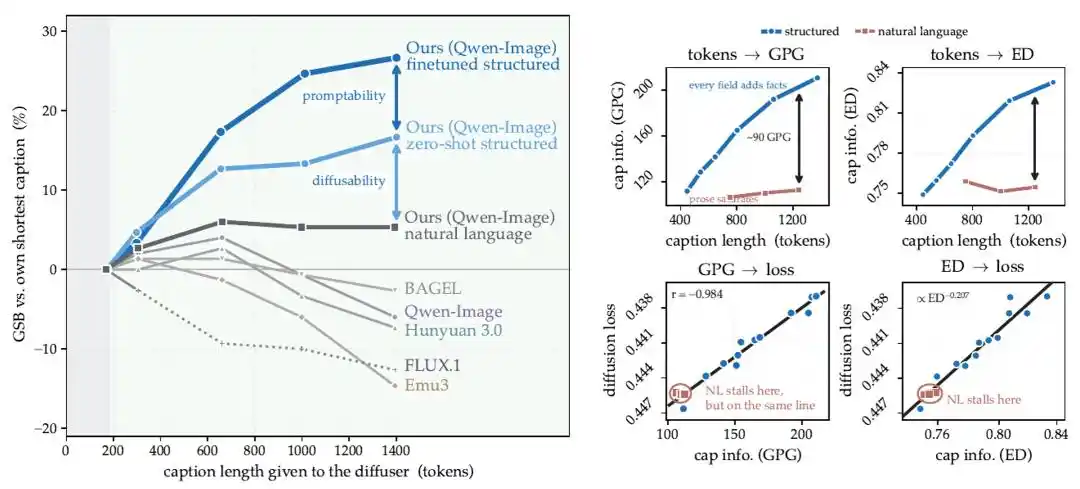
Figure 1 from the paper | Natural language length saturates quickly; structured conditioning continues to increase image information and consistently lowers the diffusion training loss along a unified relationship.

In recent years, the advancement of text-to-image models has largely followed a familiar path: larger models, more data, and increased training compute.

However, there is an easily overlooked difference between text-to-image models and language models. Language models can learn directly from text sequences via self-supervision; text-to-image models rely on image-caption pairs to learn "what kind of text corresponds to what kind of visual content." An image may contain numerous objects, attributes, positions, actions, and relations, but only the parts that are accurately described and clearly bound in the caption can be passed to the model as text-conditioned supervision.

Thus, a fundamental question arises: Beyond scaling up models, data, and compute, can we improve the learning of generation models by increasing the image information carried by captions?

In this new work, ByteDance's Seed team investigated this question. The core conclusion can be summarized in one sentence:

What truly scales with text conditioning is not the number of tokens in a caption, but the image information within it that can be utilized by the model.
  • Paper Title: Scaling Properties of Text Conditioning in Visual Generation
  • Authors: Zilong Chen, Chaorui Deng, Kunchang Li, Hongyi Yuan, Haoqi Fan Affiliation: ByteDance Seed
  • Paper: https://arxiv.org/abs/2607.29679
  • Project Page: https://heheyas.github.io/context-scaling
  • Code: https://github.com/heheyas/context-scaling
  • Models: https://huggingface.co/collections/heheyas/context-scaling
  • Online Demo: https://heheyas-context-scaling.hf.space/
  • Hugging Face Paper: https://huggingface.co/papers/2607.29679

Why Don't Models Get Stronger When Prompts Get Longer?

An intuitive approach is to write training captions or user prompts longer and in more detail. More tokens seem like they should mean more supervision and help the model generate more complex images.

However, experiments gave a different answer. On various existing open-source text-to-image systems, natural language prompts quickly saturated with increasing length, with final performance even falling below that of their respective shortest prompts. Even training diffusion models specifically on the same set of long-text captions yielded limited benefits.

To observe this phenomenon more clearly, the team designed an image reconstruction experiment with a fixed backbone network. For the same reference image, the team generated four natural language captions of progressively increasing detail from the same set of complete annotations, then used the same Qwen-Image model and random seed to attempt to reconstruct the image. These captions described the same entities and relations, with later versions mainly adding length by supplementing and expanding the natural language expressions.

Surprisingly, although the captions became significantly longer, the quality of image reconstruction hardly improved. The added prose mostly explained, rephrased, or connected already present content, rather than continuously adding new, stably usable visual variables.
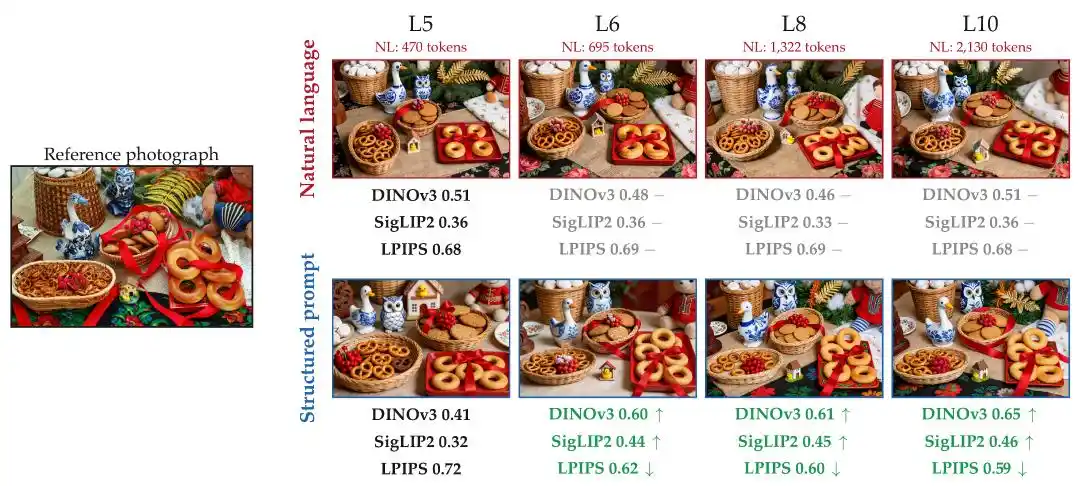
Figure 3 from the paper | Fixed-backbone reconstruction experiment: Reconstruction plateaus as NL Caption continues to lengthen, but gradually restoring SP fields yields continuous improvement.

This indicates that caption length is only a weak proxy variable. A text can be very long yet still fail to clearly specify which attribute belongs to which object, what relation exists between two objects, their respective locations, and their front-back order in the scene.

How to Measure the True Image Information in a Caption?

If token count is insufficient to gauge supervision strength, we need to directly measure the information bound to the image within a caption. For this purpose, the team adapted two complementary metrics from existing work: Grounded Perplexity Gain (GPG) and Effective Detailness (ED).

GPG: How much does the image make the caption "more predictable"?

GPG is a white-box metric that requires reading model token probabilities. For the same caption, the team separately had a frozen vision-language model see and not see the paired image, and calculated the increase in log-likelihood for the caption's content tokens after the image was presented. If the caption contains a large amount of information tightly bound to that image, seeing the image should significantly enhance the model's predictive ability for those tokens.

ED: How many reliable image attributes does the caption cover?

ED is a black-box semantic metric that does not rely on token probabilities. It extracts attributes with entity contexts from the image and the caption separately, then calculates the accuracy of caption attributes and the recall of image attributes. It finally uses F0.5, which places more weight on accuracy, applying stronger penalties to descriptions in the caption without visual grounding.

The two metrics approach the same problem from different angles: GPG focuses on the statistical dependency between image and text, while ED focuses on whether the caption accurately covers verifiable visual content.
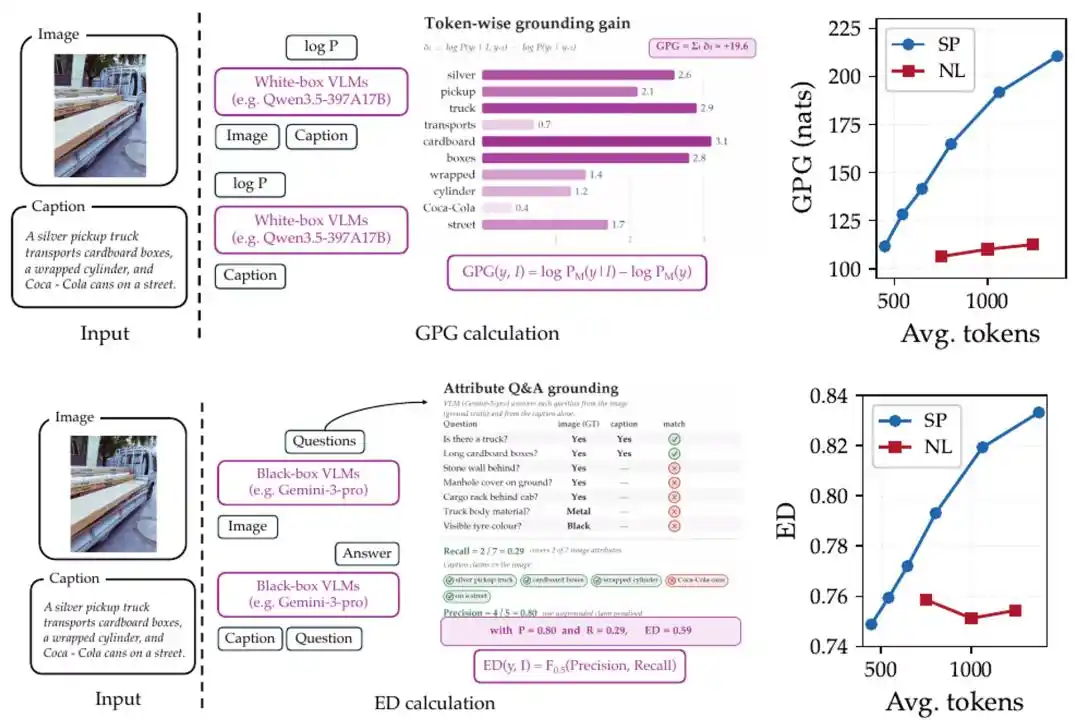
Figure 6 from the paper | Definitions and measurement trends of GPG and ED.

Caption Information Content Can Predict Diffusion Model Training Loss

Next, the team fixed the images, model architecture, initialization method, optimization configuration, and training budget, varying only the training captions. The entire experiment included 15 caption configurations: three natural language versions of different lengths, six Structured Prompt versions gradually restoring fields, and six variants with spatial expression or field masking. Each configuration started from the same BAGEL continued-training checkpoint and independently trained a diffusion model.

The results showed no consistent relationship between the token count of natural language captions and training outcomes. However, when the x-axis was changed to caption information content, configurations of different formats and detail levels fell onto highly regular curves:

  • The converged diffusion loss had an approximately linear relationship with GPG, Pearson r = -0.984.
  • The converged diffusion loss followed a power-law trend with ED, with Pearson r = -0.971 in log-log space.
  • GPG and ED also showed high consistency in ranking different caption configurations, Spearman ρ = 0.96.

The team refers to this as the scaling properties of text conditioning. It is not a theoretical law holding for all models, but an empirical calibration obtained under fixed architecture and training recipe. However, it provides two immediate benefits.

First, it transforms caption information content from a vague "data quality" concept into a trainable variable that can be controlled and measured: when model, images, and compute are fixed, information content can predict the final training loss the model achieves.

Second, after performing one calibration, candidate caption schemes can be compared using GPG or ED under the same training recipe before deciding whether to invest in expensive diffusion model training. For six caption variants not involved in the fitting, the two metrics still accurately predicted their convergence loss.
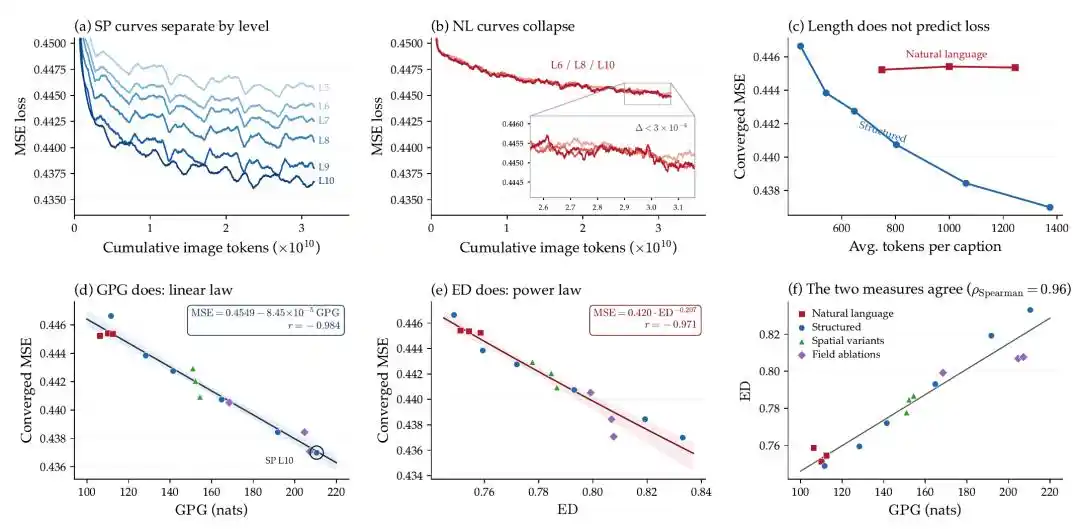
Figure 7 from the paper | Under a fixed training recipe, the convergence loss shows a stable relationship with caption information content.

Structured Prompt: Making Information Not Just More, But Easier for the Model to Use

The earlier experiments reveal a crucial point: merely adding natural language prose is not enough; the new information also needs to be organized in a stable and unambiguous manner.

Therefore, the team proposes Structured Prompt (SP), using structured JSON to represent the visual variables in an image. It consists of three layers:

  • Global Layer: Scene intent, setting, atmosphere, style, lighting, and photographic information.
  • Element Layer: Each subject's identity, attributes, actions, position, optional depth, and local photographic information.
  • Relation Layer: Positional, occlusion, interaction, and semantic relations between different elements.

Compared to free text, the key of SP is not just the "JSON" appearance, but placing different visual variables into stable named fields, reducing ambiguity in attribute assignment, spatial relations, and object binding. In the fixed-backbone reconstruction experiment, reconstruction quality continuously improved as SP fields were gradually restored; in the full training sweep, increased field coverage also consistently raised GPG, ED, and lowered the converged diffusion loss.
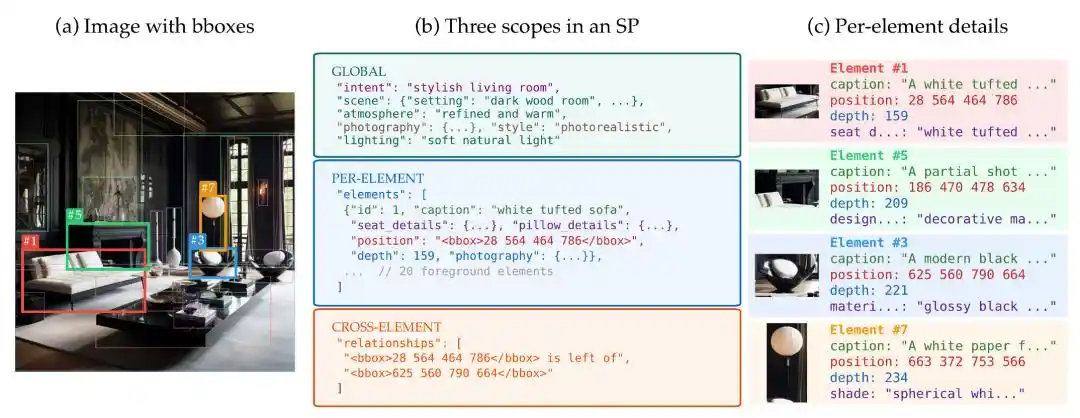
Figure 5 from the paper | Structured Prompt organizes global, element-level, and cross-element visual variables into named fields.

To generate complete SP for large-scale training data, the team constructed an image-to-SP annotation pipeline. A general VLM handles global semantics and local content, Sapiens supplements human pose evidence, DepthAnything V2 provides relative depth, SAM 2.1 provides masks and occlusion cues, and finally a VLM unifies this information into a consistent, complete SP.
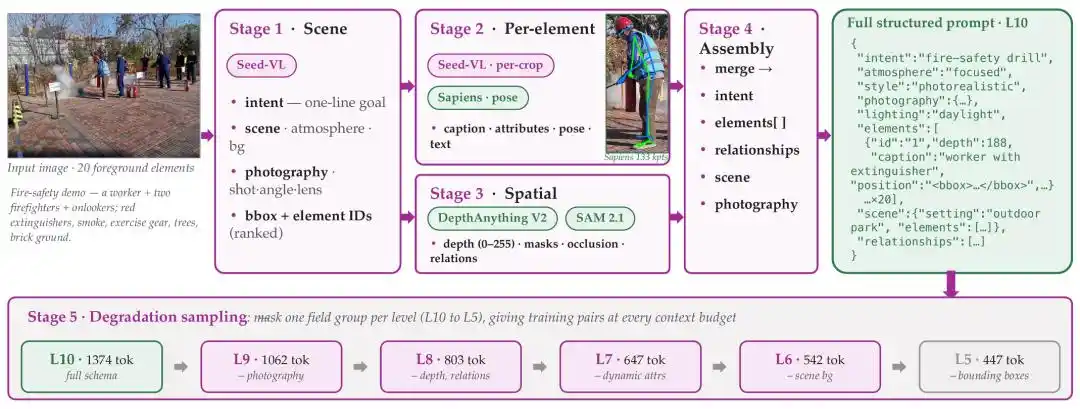
Figure 8 from the paper | VLM and experts for pose, depth, and segmentation collaboratively construct a complete Structured Prompt.

The team terms the ability of a caption representation to expose and organize image supervision for a diffusion model as Diffusability. SP enhances precisely this aspect: without changing the diffusion model architecture, it allows the model to learn more and clearer visual variables from the text condition.

Promptability: With a Good Structure, You Still Need an LLM to Fill It Well

During training, complete SP can be extracted from paired images, but during actual generation, only the user's sentence is available—there is no reference image or oracle annotation. The system also requires an LLM prompter to expand the user request into a detailed, coherent SP that does not violate the original constraints.

The team calls this ability to instantiate structured conditions from user requests Promptability. End-to-end generation quality depends on the joint effect of both sides:

Generation Quality = Diffusability × Promptability

The multiplication sign here is an organizational perspective, not a mathematically derived formula: Diffusability describes what the diffusion model can learn from the caption representation, and Promptability describes whether the LLM can truly produce a high-quality caption instance during inference.
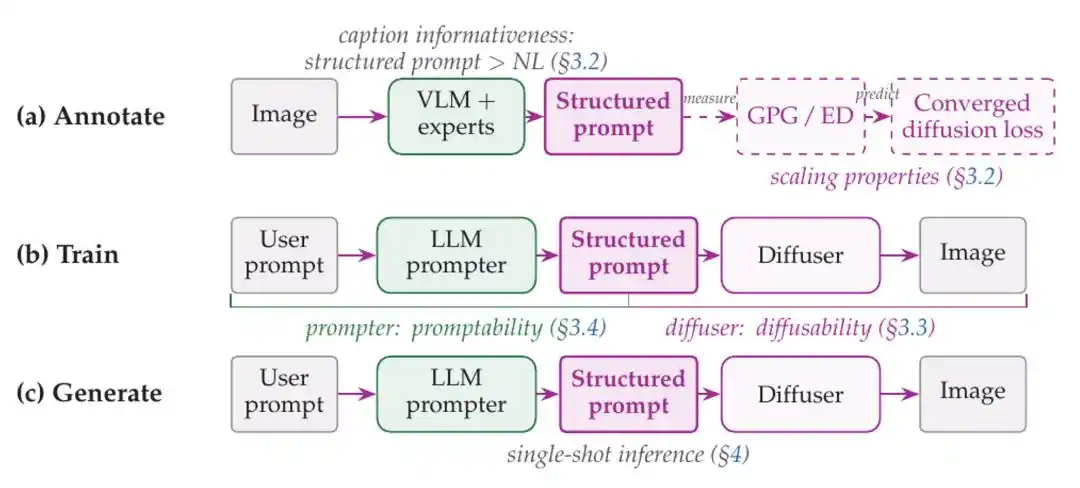
Figure 4 from the paper | Structured Prompt connects annotation, measurement, diffuser training, prompter training, and final generation.

First, the team fixed the SP schema and Qwen-Image diffuser, only replacing the zero-shot LLM prompter. As Qwen3.5 scaled from 0.8B to 397B, GenEval++ score in thinking mode improved from 46.4% to 86.8%. Apart from the smallest model which tended to repeat during thinking and failed to output valid JSON, chain-of-thought provided further improvements at other scales. This indicates that the model capability and reasoning ability of general LLMs can be directly translated into better image generation results through the caption interface.

However, zero-shot LLMs still tend to generate SP lacking in information and with relatively simple composition. To further improve Promptability, the team adopted three-stage training:

SFT learns the distribution of SP content expected by the diffusion model, not just the JSON format.

Cold-start distills "how to deduce SP solely from user requests" from privileged reasoning traces paired with images.

RFT continues optimization on rollouts generated and rendered by the prompter itself, where a verifier selects high-confidence trajectories, and then provides dense token supervision through on-policy self-distillation from an image-conditioned teacher.

Ablation experiments show the three stages serve different purposes: SFT brings the largest single-stage structural improvement, cold-start strengthens the deduction from user requests to SP, and verifier-gated OPSD achieves the strongest results within the prompter's own distribution.
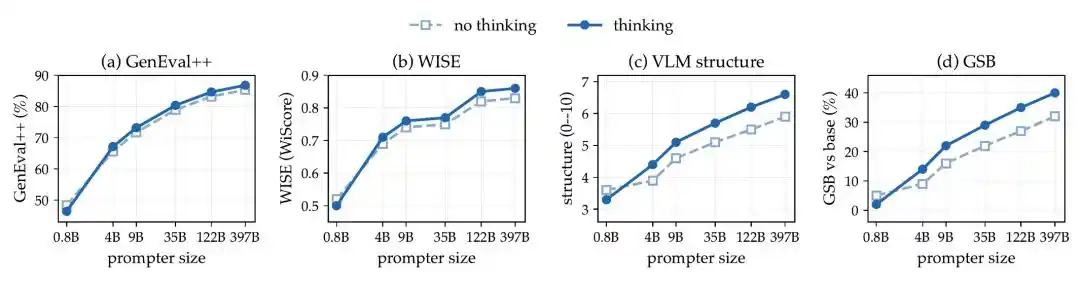
Figure 9 from the paper | With fixed schema and diffuser, generation quality improves with LLM prompter scale and reasoning mode.
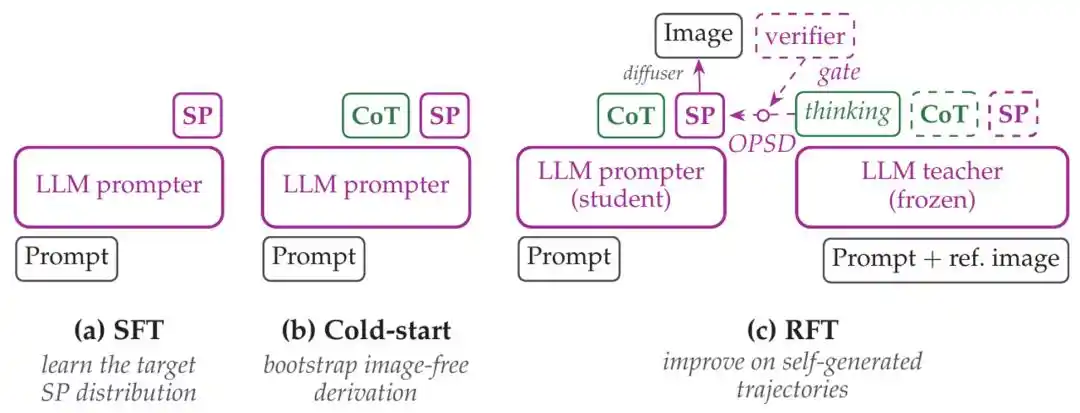
Figure 10 from the paper | Three-stage prompter training: SFT, cold-start, and verifier-gated RFT.

Structured Representation Also Makes the Generation Process Easier to Iteratively Correct

Another natural advantage of SP's field-based representation is that when errors appear in the generated image, the system can locate and modify the corresponding object, attribute, relation, or layout fields, rather than rewriting the entire natural language prompt.

Based on this, the team built a refine-render-judge loop. In each round, the prompter generates or revises SP based on user request and historical feedback, the fixed diffuser renders an image, and an online judge provides PASS/FAIL decisions along with specific issues regarding prompt adherence, structure, and visual quality. If it fails, the next round only needs adjustments around the relevant fields.

Experiments show that increasing iteration budget can further improve structural alignment, adherence, and GSB performance; however, effective reasoning length is not long. For the trained prompter, even when allowed up to 8 rounds, an average of only 2.31 rounds were used; increasing Tmax from 4 to 8 yielded minimal additional benefit. This indicates that text-to-image generation does benefit from iterative error correction, but under the current setup, does not require very long prompt-side reasoning trajectories: after fixing major specification errors, additional rounds saturate quickly.

Figure 14 from the paper | Agentic reasoning loop of refine-render-judge.

Figure 15 from the paper | The loop can correct issues with object splitting, relations, and overall layout.

How Much Improvement Does the Structured Interface Bring to the Same Qwen-Image Base?

The final system consists of an SP-trained diffuser and a trained LLM prompter. It outperforms all compared open-weight models on almost every reported metric and reaches or surpasses most compared closed-source systems on the majority of evaluations, with advantages particularly pronounced on composition, reasoning, and world knowledge tasks.

More crucially, the matched control. To rule out explanations like "it just trained more," the team trained an additional system using the exact same Qwen-Image architecture, training images, training stages, and budget, but consistently using free natural language captions. The results are as follows:
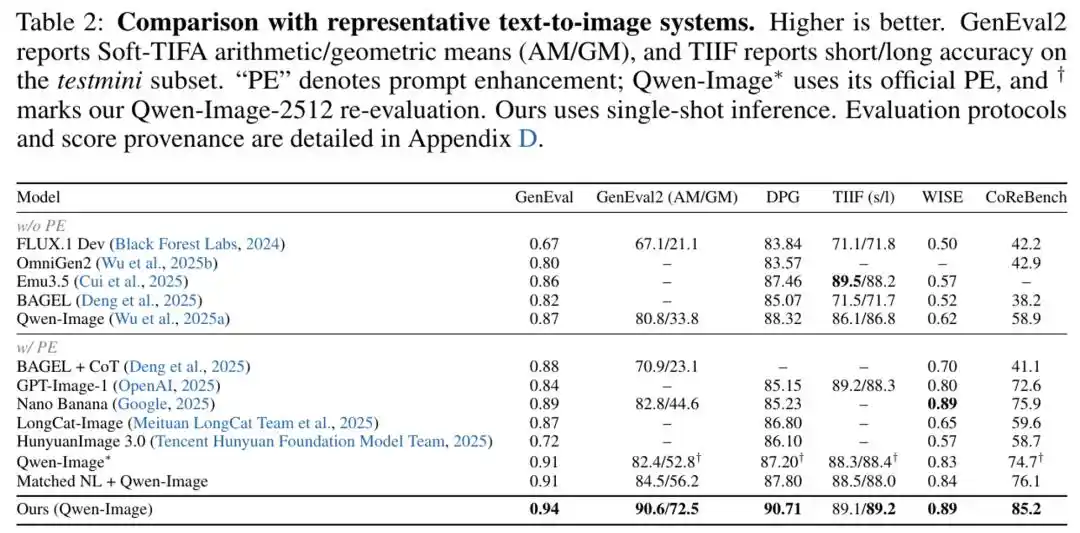
Table 2 from the paper | Complete comparison with representative text-to-image systems. Screenshot retains evaluation definitions, bold text, and footnotes from the paper.

The additional training for the matched NL system indeed brought some improvements, but far from enough to replicate the SP system's results. This indicates that the gains cannot be simply attributed to a larger backbone or more training but are closely related to the structured caption interface used between the prompter and diffuser.
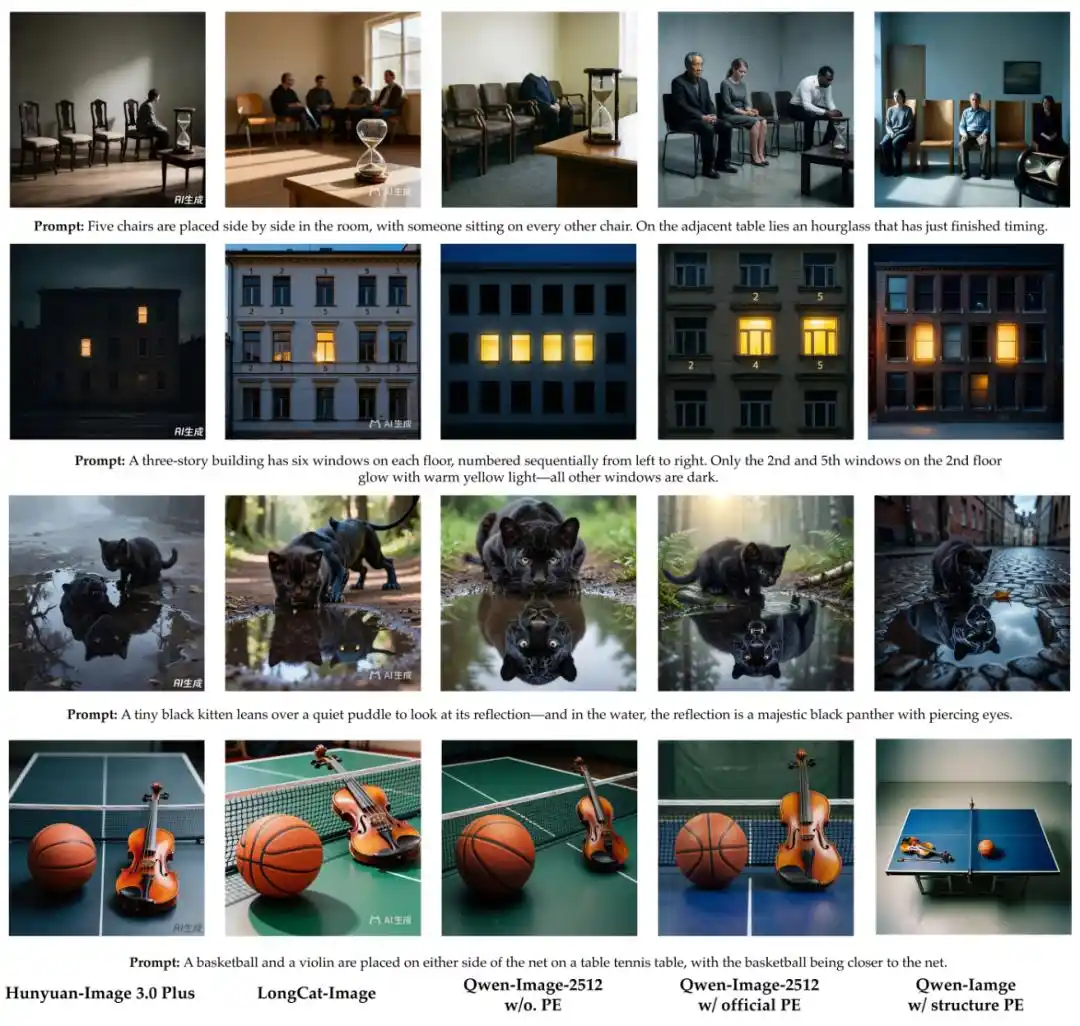
Figure 11 from the paper | Qualitative comparison on complex spatial relations, quantities, and attribute binding.

The Next Step is Not Just to Scale the Model, But Also to Scale the Condition Itself

The starting point of this work is simple: For text-to-image models, captions are not irrelevant metadata, but the primary interface through which image content enters text-conditioned learning.

When captions merely become longer, the new tokens may just rephrase and elaborate; when image information is accurately extracted, clearly bound, and stably organized, the same generation model can learn more from it. GPG and ED make this information a measurable variable, Structured Prompt improves Diffusability, and LLM scaling, post-training, and short-range agentic refinement improve Promptability.

Therefore, the next step in scaling text-to-image should not only focus on "how large the rendering model is" but also ask:

How much image information—information it can truly learn and use—is the text condition passed to the model actually carrying?

This article is from the WeChat official account "Machine Heart"

Трендові криптовалюти

Пов'язані питання

QWhat is the key finding of ByteDance Seed team regarding text caption length and its effect on text-to-image model training?

AThe team found that increasing the length of natural language captions does not necessarily provide more usable visual supervision. Instead, the amount of image-grounded information in the caption, measured by metrics like Grounded Perplexity Gain (GPG) and Effective Detailness (ED), is a better predictor of the final training loss a diffusion model can achieve.

QWhat two complementary metrics did the researchers propose to measure the image-grounded information in a caption?

AThe researchers proposed two complementary metrics: 1) **Grounded Perplexity Gain (GPG)**: A white-box metric measuring how much an image makes a caption more predictable for a frozen Vision-Language Model. 2) **Effective Detailness (ED)**: A black-box semantic metric measuring how accurately a caption covers verifiable visual attributes from the image.

QWhat is Structured Prompt (SP) and how does it address the limitations of natural language captions?

AStructured Prompt (SP) is a JSON-based representation that organizes visual variables into hierarchical fields: a global layer (intent, scene, style), an element layer (identity, attributes, position of subjects), and a relation layer (interactions between elements). It addresses natural language ambiguity by stably assigning attributes, spatial relations, and object bindings to specific named fields, thereby increasing the amount of usable visual information (Diffusability) for the model.

QHow does the concept of 'Promptability' relate to the overall generation quality in the proposed system?

APromptability refers to the ability of a Large Language Model (LLM) prompter to instantiate a high-quality Structured Prompt (SP) from a user's simple request during inference. The overall generation quality is viewed as depending on both Diffusability (how much the diffusion model can learn from the caption representation) and Promptability. Enhancing the LLM prompter's capabilities through scaling and multi-stage training directly improves the generation results.

QWhat experimental evidence supports the claim that the gains from Structured Prompt are not simply due to more training data or compute?

AA matched control experiment was conducted. Using the exact same Qwen-Image architecture, training images, stages, and budget, a separate system was trained using only free-form natural language captions. While this matched NL system showed some improvement, its performance was far below that of the SP-based system. This demonstrates that the gains are primarily due to the structured caption interface itself, not merely from extra training of the backbone model.

Пов'язані матеріали

Strategy CEO Announces Plan to Resume Bitcoin Purchases This Year, With Buying Volume 25 Times Selling Volume

Strategy CEO Announces Resumption of Bitcoin Purchases This Year, Buy-to-Sell Ratio at 25x In a FOX Business interview, Phong Le, CEO of Strategy (formerly MicroStrategy), stated the company plans to resume its Bitcoin acquisition strategy within the current year. This ends a pause in buying that began in May. Le revealed that since the start of the year, Strategy has purchased approximately 175,000 bitcoins while selling around 7,000, making its buy volume about 25 times its sell volume. The company remains the world's largest corporate holder of Bitcoin, with 840,447 BTC, representing roughly 4% of the circulating supply. Le explained that recent sales were used to fulfill capital obligations under a newly approved framework, including paying preferred stock dividends, funding share buybacks, and bolstering the company's US dollar reserves, which now stand at about $4.7 billion. This move marks a shift from the firm's previous "never sell" mantra, which had contributed to its market premium. The change in strategy and the associated financial pressures led to a significant drop in its stock price (MSTR) and a rating downgrade from JPMorgan. The CEO framed the company's role as the "JPMorgan of the crypto economy," emphasizing its long-term goal of increasing the amount of Bitcoin per MSTR share. The announcement signals the return of a major institutional buyer to the Bitcoin market, which could provide price support. It is also viewed as a micro-indicator of recovering institutional confidence, suggesting the company believes the most acute phase of liquidity pressure has passed.

marsbit12 хв тому

Strategy CEO Announces Plan to Resume Bitcoin Purchases This Year, With Buying Volume 25 Times Selling Volume

marsbit12 хв тому

ArthurHayes新文:押注日元升值,ENA未来几月或涨5至10倍

Arthur Hayes argues that the Japanese Yen is significantly undervalued and posits that its appreciation against the US Dollar is imminent. He outlines three potential mechanisms for this shift, dismissing the first two—the Bank of Japan raising interest rates and domestic institutions selling foreign assets—as politically or economically unfeasible. He identifies the third and preferred method: the Japanese Ministry of Finance (MOF) using its holdings of US Treasuries as collateral in the Fed's FIMA repo facility to borrow US dollars, then selling those dollars to buy Yen in the forex market. Hayes believes US Treasury Secretary Bessant has signaled support for this approach, which requires the Fed's Foreign Currency Subcommittee, led by Chairman Walsh, to remove lending limits on the FIMA tool. Hayes asserts that implementing this "Scheme 3" would lead to a significant expansion of US dollar liquidity. He predicts this surge in liquidity will act as a catalyst, driving up the prices of assets like Bitcoin and physical gold. Within the crypto space, he views Ethereum (ETH) as undervalued and singles out Ethena's ENA token as a speculative play with potential for 5-10x gains in the coming months, contingent on a recovery in Bitcoin basis trades that would boost demand for its USDe stablecoin. He concludes that investors should watch for the Fed's rule change as the key trigger for these market movements.

marsbit24 хв тому

ArthurHayes新文:押注日元升值,ENA未来几月或涨5至10倍

marsbit24 хв тому

Торгівля

Спот

Популярні статті

Що таке $S$

Розуміння SPERO: Комплексний огляд Вступ до SPERO Оскільки ландшафт інновацій продовжує еволюціонувати, виникнення технологій web3 та криптовалютних проектів відіграє ключову роль у формуванні цифрового майбутнього. Один з проектів, який привернув увагу в цій динамічній сфері, — це SPERO, позначений як SPERO,$$s$. Ця стаття має на меті зібрати та представити детальну інформацію про SPERO, щоб допомогти ентузіастам та інвесторам зрозуміти його основи, цілі та інновації в рамках web3 та крипто-сектору. Що таке SPERO,$$s$? SPERO,$$s$ — це унікальний проект у криптопросторі, який прагне використати принципи децентралізації та технології блокчейн для створення екосистеми, що сприяє залученню, корисності та фінансовій інклюзії. Проект розроблений для полегшення взаємодії між користувачами новими способами, надаючи їм інноваційні фінансові рішення та послуги. У своїй основі SPERO,$$s$ прагне надати можливості індивідам, забезпечуючи інструменти та платформи, які покращують користувацький досвід у криптовалютному просторі. Це включає в себе можливість більш гнучких методів транзакцій, сприяння ініціативам, що підтримуються спільнотою, та створення шляхів для фінансових можливостей через децентралізовані додатки (dApps). Основна концепція SPERO,$$s$ обертається навколо інклюзивності, прагнучи зменшити розриви в традиційній фінансовій системі, використовуючи переваги технології блокчейн. Хто є творцем SPERO,$$s$? Особистість творця SPERO,$$s$ залишається дещо невідомою, оскільки є обмежені публічно доступні ресурси, що надають детальну інформацію про його засновників. Ця відсутність прозорості може бути наслідком зобов'язання проекту до децентралізації — етики, яку багато проектів web3 поділяють, ставлячи колективні внески вище за індивідуальне визнання. Зосереджуючи обговорення навколо спільноти та її колективних цілей, SPERO,$$s$ втілює суть наділення без виділення конкретних осіб. Таким чином, розуміння етики та місії SPERO є більш важливим, ніж ідентифікація єдиного творця. Хто є інвесторами SPERO,$$s$? SPERO,$$s$ підтримується різноманітними інвесторами, починаючи від венчурних капіталістів до ангельських інвесторів, які прагнуть сприяти інноваціям у крипто-секторі. Зосередження цих інвесторів зазвичай узгоджується з місією SPERO — пріоритет надається проектам, які обіцяють технологічний прогрес у суспільстві, фінансову інклюзію та децентралізоване управління. Ці інвесторські фонди зазвичай зацікавлені в проектах, які не лише пропонують інноваційні продукти, але й позитивно впливають на спільноту блокчейн та її екосистеми. Підтримка з боку цих інвесторів підкріплює SPERO,$$s$ як значного конкурента в швидко змінюваній сфері крипто-проектів. Як працює SPERO,$$s$? SPERO,$$s$ використовує багатогранну структуру, яка відрізняє його від традиційних криптовалютних проектів. Ось деякі ключові особливості, які підкреслюють його унікальність та інноваційність: Децентралізоване управління: SPERO,$$s$ інтегрує моделі децентралізованого управління, надаючи користувачам можливість активно брати участь у процесах прийняття рішень щодо майбутнього проекту. Цей підхід сприяє відчуттю власності та відповідальності серед членів спільноти. Корисність токена: SPERO,$$s$ використовує свій власний криптовалютний токен, розроблений для виконання різних функцій в екосистемі. Ці токени дозволяють здійснювати транзакції, отримувати винагороди та полегшувати послуги, що пропонуються на платформі, підвищуючи загальну залученість та корисність. Шарова архітектура: Технічна архітектура SPERO,$$s$ підтримує модульність та масштабованість, що дозволяє безперешкодно інтегрувати додаткові функції та додатки в міру розвитку проекту. Ця адаптивність є надзвичайно важливою для збереження актуальності в постійно змінюваному крипто-ландшафті. Залучення спільноти: Проект підкреслює ініціативи, що підтримуються спільнотою, використовуючи механізми, які стимулюють співпрацю та зворотний зв'язок. Підтримуючи сильну спільноту, SPERO,$$s$ може краще задовольняти потреби користувачів та адаптуватися до ринкових тенденцій. Фокус на інклюзію: Пропонуючи низькі комісії за транзакції та зручні інтерфейси, SPERO,$$s$ прагне залучити різноманітну базу користувачів, включаючи осіб, які раніше не брали участі в крипто-просторі. Це зобов'язання до інклюзії узгоджується з його загальною місією наділення через доступність. Хронологія SPERO,$$s$ Розуміння історії проекту надає важливі уявлення про його розвиток та етапи. Нижче наведено пропоновану хронологію, що відображає значні події в еволюції SPERO,$$s$: Етап концептуалізації та ідеації: Початкові ідеї, що стали основою SPERO,$$s$, були сформовані, тісно пов'язані з принципами децентралізації та фокусом на спільноті в індустрії блокчейн. Запуск білого паперу проекту: Після концептуального етапу був випущений комплексний білий папір, що детально описує бачення, цілі та технологічну інфраструктуру SPERO,$$s$, щоб залучити інтерес та зворотний зв'язок від спільноти. Створення спільноти та ранні залучення: Активні зусилля були спрямовані на створення спільноти ранніх прихильників та потенційних інвесторів, що полегшило обговорення цілей проекту та отримання підтримки. Подія генерації токенів: SPERO,$$s$ провів подію генерації токенів (TGE) для розподілу своїх рідних токенів серед ранніх прихильників та встановлення початкової ліквідності в екосистемі. Запуск початкового dApp: Перший децентралізований додаток (dApp), пов'язаний з SPERO,$$s$, став доступним, дозволяючи користувачам взаємодіяти з основними функціями платформи. Постійний розвиток та партнерства: Безперервні оновлення та вдосконалення пропозицій проекту, включаючи стратегічні партнерства з іншими учасниками блокчейн-простору, сформували SPERO,$$s$ у конкурентоспроможного та еволюціонуючого гравця на крипто-ринку. Висновок SPERO,$$s$ є свідченням потенціалу web3 та криптовалют для революціонізації фінансових систем та наділення індивідів. Завдяки зобов'язанню до децентралізованого управління, залучення спільноти та інноваційно спроектованих функцій, він прокладає шлях до більш інклюзивного фінансового ландшафту. Як і з будь-якими інвестиціями в швидко змінюваному крипто-просторі, потенційним інвесторам та користувачам рекомендується ретельно досліджувати та обдумано взаємодіяти з поточними подіями в SPERO,$$s$. Проект демонструє інноваційний дух крипто-індустрії, запрошуючи до подальшого дослідження його численних можливостей. Хоча подорож SPERO,$$s$ ще триває, його основні принципи можуть справді вплинути на майбутнє того, як ми взаємодіємо з технологією, фінансами та один з одним у взаємопов'язаних цифрових екосистемах.

284 переглядів усьогоОпубліковано 2024.12.17Оновлено 2024.12.17

Що таке $S$

Що таке AGENT S

Агент S: Майбутнє автономної взаємодії в Web3 Вступ У постійно змінюваному ландшафті Web3 та криптовалюти інновації постійно переосмислюють, як люди взаємодіють з цифровими платформами. Один з таких новаторських проектів, Агент S, обіцяє революціонізувати взаємодію людини з комп'ютером через свою відкриту агентну структуру. Прокладаючи шлях для автономних взаємодій, Агент S прагне спростити складні завдання, пропонуючи трансформаційні застосування в штучному інтелекті (ШІ). Це детальне дослідження заглиблюється в складності проекту, його унікальні особливості та наслідки для сфери криптовалюти. Що таке Агент S? Агент S є революційною відкритою агентною структурою, спеціально розробленою для вирішення трьох основних викликів в автоматизації комп'ютерних завдань: Набуття специфічних знань у галузі: Структура інтелектуально навчається з різних зовнішніх джерел знань та внутрішнього досвіду. Цей подвійний підхід дозволяє їй створити багатий репозиторій специфічних знань у галузі, покращуючи її продуктивність у виконанні завдань. Планування на довгих горизонтах завдань: Агент S використовує планування з підкріпленням досвіду, стратегічний підхід, який полегшує ефективний розподіл та виконання складних завдань. Ця функція значно підвищує її здатність ефективно та результативно управляти кількома підзавданнями. Обробка динамічних, неоднорідних інтерфейсів: Проект представляє Інтерфейс Агент-Комп'ютер (ACI), інноваційне рішення, яке покращує взаємодію між агентами та користувачами. Використовуючи багатомодальні великі мовні моделі (MLLMs), Агент S може безперешкодно орієнтуватися та маніпулювати різноманітними графічними інтерфейсами користувача. Завдяки цим новаторським функціям Агент S надає надійну структуру, яка вирішує складнощі, пов'язані з автоматизацією людської взаємодії з машинами, прокладаючи шлях для численних застосувань у ШІ та за його межами. Хто є творцем Агент S? Хоча концепція Агент S є фундаментально новаторською, конкретна інформація про його творця залишається невідомою. Творець наразі невідомий, що підкреслює або початкову стадію проекту, або стратегічний вибір зберегти засновників у таємниці. Незважаючи на анонімність, акцент залишається на можливостях та потенціалі структури. Хто є інвесторами Агент S? Оскільки Агент S є відносно новим у криптографічній екосистемі, детальна інформація про його інвесторів та фінансових спонсорів не задокументована. Відсутність публічно доступних відомостей про інвестиційні фонди або організації, що підтримують проект, викликає питання щодо його фінансової структури та дорожньої карти розвитку. Розуміння підтримки є критично важливим для оцінки стійкості проекту та потенційного впливу на ринок. Як працює Агент S? В основі Агент S лежить передова технологія, яка дозволяє йому ефективно функціонувати в різних умовах. Його операційна модель побудована навколо кількох ключових функцій: Взаємодія з комп'ютером, подібна до людської: Структура пропонує розширене планування ШІ, прагнучи зробити взаємодії з комп'ютерами більш інтуїтивними. Імітуючи людську поведінку при виконанні завдань, вона обіцяє підвищити досвід користувачів. Наративна пам'ять: Використовується для використання високорівневого досвіду, Агент S використовує наративну пам'ять для відстеження історій завдань, тим самим покращуючи свої процеси прийняття рішень. Епізодична пам'ять: Ця функція надає користувачам покрокові інструкції, дозволяючи структурі пропонувати контекстуальну підтримку в міру виконання завдань. Підтримка OpenACI: Завдяки можливості працювати локально, Агент S дозволяє користувачам зберігати контроль над своїми взаємодіями та робочими процесами, узгоджуючи з децентралізованою етикою Web3. Легка інтеграція з зовнішніми API: Його універсальність і сумісність з різними платформами ШІ забезпечують те, що Агент S може безперешкодно вписатися в існуючі технологічні екосистеми, роблячи його привабливим вибором для розробників та організацій. Ці функціональні можливості колективно сприяють унікальному положенню Агент S у крипто-просторі, оскільки він автоматизує складні, багатоступеневі завдання з мінімальним втручанням людини. У міру розвитку проекту його потенційні застосування в Web3 можуть переосмислити, як відбуваються цифрові взаємодії. Хронологія Агент S Розробка та етапи Агент S можуть бути узагальнені в хронології, яка підкреслює його значні події: 27 вересня 2024 року: Концепція Агент S була представлена в комплексній науковій статті під назвою “Відкрита агентна структура, яка використовує комп'ютери як людина”, що демонструє основи проекту. 10 жовтня 2024 року: Наукова стаття була опублікована на arXiv, пропонуючи детальне дослідження структури та її оцінки продуктивності на основі бенчмарку OSWorld. 12 жовтня 2024 року: Було випущено відеопрезентацію, що надає візуальне уявлення про можливості та особливості Агент S, ще більше залучаючи потенційних користувачів та інвесторів. Ці маркери в хронології не лише ілюструють прогрес Агент S, але й вказують на його прихильність до прозорості та залучення громади. Ключові моменти про Агент S У міру розвитку структури Агент S кілька ключових характеристик виділяються, підкреслюючи її новаторський характер та потенціал: Інноваційна структура: Розроблена для забезпечення інтуїтивного використання комп'ютерів, подібного до людської взаємодії, Агент S пропонує новий підхід до автоматизації завдань. Автономна взаємодія: Здатність автономно взаємодіяти з комп'ютерами через GUI означає стрибок до більш інтелектуальних та ефективних обчислювальних рішень. Автоматизація складних завдань: Завдяки своїй надійній методології він може автоматизувати складні, багатоступеневі завдання, роблячи процеси швидшими та менш схильними до помилок. Безперервне вдосконалення: Механізми навчання дозволяють Агенту S покращуватися на основі минулого досвіду, постійно підвищуючи свою продуктивність та ефективність. Універсальність: Його адаптивність до різних операційних середовищ, таких як OSWorld та WindowsAgentArena, забезпечує його здатність служити широкому спектру застосувань. Оскільки Агент S займає своє місце в ландшафті Web3 та криптовалюти, його потенціал покращити можливості взаємодії та автоматизувати процеси означає значний прогрес у технологіях ШІ. Завдяки своїй інноваційній структурі Агент S є прикладом майбутнього цифрових взаємодій, обіцяючи більш безперешкодний та ефективний досвід для користувачів у різних галузях. Висновок Агент S представляє собою сміливий крок вперед у поєднанні ШІ та Web3, з можливістю переосмислити, як ми взаємодіємо з технологією. Хоча проект все ще на ранніх стадіях, можливості для його застосування є величезними та переконливими. Завдяки своїй комплексній структурі, що вирішує критичні виклики, Агент S прагне вивести автономні взаємодії на передній план цифрового досвіду. У міру того, як ми заглиблюємося в сфери криптовалюти та децентралізації, проекти, подібні до Агент S, безсумнівно, відіграватимуть ключову роль у формуванні майбутнього технологій та співпраці людини з комп'ютером.

894 переглядів усьогоОпубліковано 2025.01.14Оновлено 2025.01.14

Що таке AGENT S

Як купити S

Ласкаво просимо до HTX.com! Ми зробили покупку Sonic (S) простою та зручною. Дотримуйтесь нашої покрокової інструкції, щоб розпочати свою криптовалютну подорож.Крок 1: Створіть обліковий запис на HTXВикористовуйте свою електронну пошту або номер телефону, щоб зареєструвати обліковий запис на HTX безплатно. Пройдіть безпроблемну реєстрацію й отримайте доступ до всіх функцій.ЗареєструватисьКрок 2: Перейдіть до розділу Купити крипту і виберіть спосіб оплатиКредитна/дебетова картка: використовуйте вашу картку Visa або Mastercard, щоб миттєво купити Sonic (S).Баланс: використовуйте кошти з балансу вашого рахунку HTX для безперешкодної торгівлі.Треті особи: ми додали популярні способи оплати, такі як Google Pay та Apple Pay, щоб підвищити зручність.P2P: Торгуйте безпосередньо з іншими користувачами на HTX.Позабіржова торгівля (OTC): ми пропонуємо індивідуальні послуги та конкурентні обмінні курси для трейдерів.Крок 3: Зберігайте свої Sonic (S)Після придбання Sonic (S) збережіть його у своєму обліковому записі на HTX. Крім того, ви можете відправити його в інше місце за допомогою блокчейн-переказу або використовувати його для торгівлі іншими криптовалютами.Крок 4: Торгівля Sonic (S)Легко торгуйте Sonic (S) на спотовому ринку HTX. Просто увійдіть до свого облікового запису, виберіть торгову пару, укладайте угоди та спостерігайте за ними в режимі реального часу. Ми пропонуємо зручний досвід як для початківців, так і для досвідчених трейдерів.

1.9k переглядів усьогоОпубліковано 2025.01.15Оновлено 2026.06.02

Як купити S

Обговорення

Ласкаво просимо до спільноти HTX. Тут ви можете бути в курсі останніх подій розвитку платформи та отримати доступ до професійної ринкової інформації. Нижче представлені думки користувачів щодо ціни S (S).

活动图片