Author: Dan Koe
Compiled by: FFIVE, MOOC.com
"If you have to consciously try to remember it, it's not important; if it's truly important, it will naturally emerge when you need it."
This statement may sound like a mystical aphorism, but it is the core proposition Dan Koe posits in his article "How to Remember Everything You Read." Our generation has fallen into a peculiar anxiety: saving thousands of articles, installing five or six note-taking apps, building seemingly perfect "second brains," only to find that when we need to retrieve something, nothing comes out. We end up feeling like we are "forgetting more and more."
The problem was never about memory, but rather a fundamental misunderstanding of what "learning" truly is. Following Dan Koe's framework, I will combine cybernetics, output-driven learning, and practical methods using modern AI tools (Obsidian + Claude, Eden, etc.) to reorganize a system that enables you to truly "remember" and "use" what you learn. This is a long article, but each part addresses a real pitfall you've likely encountered in knowledge management.
I. Why "Remembering Everything" is a False Proposition
First, dismantle a deeply ingrained belief: Learning ≠ stuffing information into your brain.
School trained us for over a decade with memorization and exams, leading us to mistakenly believe that "being able to recite word-for-word" is the hallmark of learning. But the real world doesn't score based on answer sheets—your boss won't promote you for reciting a paragraph from The Economist, and a client won't sign a contract just because you remember a few steps from a marketing book.
Dan Koe's observation is sharp: The reason most people don't remember what they read isn't because they didn't read carefully enough, but because they see "remembering" as the endpoint of reading. You desperately try to remember every sentence, essentially wanting to appear smart—"Look, I can casually drop knowledge points." This vanity-driven learning is off track from the start.
What's truly important never requires rote memorization. It naturally sinks into your cognitive structure through repeated use, repeated thinking, and repeated discussion with others. Forgetting most content is a normal function of the brain, not your failure. What you should care about isn't "how to remember," but "which things are worth remembering, and what mechanisms can make them appear when needed."
II. Viewing Learning as a Ship: The Four-Step Closed Loop from a Cybernetics Perspective
Dan Koe borrows from Cybernetics—a term originating from the ancient Greek word for "steersman"—to redefine learning as a feedback regulation system, not a unidirectional input pipeline.
An intelligent learning system operates on the same logic as your home's thermostat or your body's insulin-secreting pancreas, consisting of four stages:
| Step | Cybernetics Term | Corresponds to in Learning | Consequence of Missing |
|---|---|---|---|
| 1 | Goal | The clearly known "state I want to reach" | No direction; all information seems both relevant and irrelevant |
| 2 | Sense | Honestly assessing "Where am I now?" | Self-deception, believing saving = learning |
| 3 | Compare | Seeing "the gap between goal and current state" | Failing to detect deviation kills learning motivation |
| 4 | Act | Taking concrete actions to narrow the gap | Remaining stuck in contemplation, forever "preparing to start learning" |
Most people fail to learn effectively not due to poor willpower, but because they only have Step 2 (blind input), lacking Step 1 (clear goals) to generate a "deviation signal." Without deviation, the brain doesn't know which information is worth retaining and which can be discarded, so it ends up cramming everything in and then forgetting it all.
An intuitive example: A vague goal like "I want to be healthy" doesn't trigger any corrective feedback—you won't feel you've deviated after a night of heavy drinking or staying up until 3 AM. But if your goal is "complete a half marathon in three months," every night you skip a run generates a clear "deviation signal" that forces you to adjust. Learning works the same way.
III. The Most Effective Learning Starts with "Output," Not Input
Understanding the cybernetics framework leads to the most counterintuitive yet effective principle: Don't study first; start working.
Naval has spoken about the concept of "Specific Knowledge"—knowledge that aligns with your nature, provides competitive advantage, and is irreplaceable. This type of knowledge cannot be acquired through "systematic study"; it can only be acquired "on-demand" through the process of doing things.
The path Dan Koe offers is threefold:
- Start with a meaningful goal that is truly your own (not the default path society imposes, like "get a certificate/go to school/get a raise"). The more specific this goal, the stronger the neuroplasticity.
- Launch a project directly, don't "prepare lessons" first. Want to learn After Effects? Don't binge-watch the entire tutorial series. First, define a concrete project—like "make a 30-second promotional video for a friend's café." Then, only learn the skills needed to complete that specific project.
- Learn what you lack, when you lack it. Stuck on keyframes? Go look up keyframe tutorials. Stuck on color grading? Study the color grading panel. After a few projects, your acquired skills are cumulative, and each piece is tied to a real-world scenario, making them unforgettable.
Learning guitar is the same: Don't bury yourself in music theory books first. Pick a song you genuinely want to play, learn the first chord, the second chord, and when you get stuck, incidentally learn about tuning and rhythm. When you can actually play a few songs, you'll naturally wonder, "Can I write my own melody?"—Learning happens within the pull of "wanting to create," not while passively watching instructional videos.
School is good at teaching general knowledge but doesn't teach you how to navigate for yourself. Self-education isn't about hoarding knowledge to create the illusion of "making progress." It's about acquiring just enough knowledge to bridge the gap for a goal you have set for yourself.
IV. Why "Second Brains" Mostly Become Digital Graveyards
When discussing knowledge management, we can't avoid the concept of the "Second Brain." Tiago Forte's PARA method and CODE workflow were meant to liberate memory, but in reality, 90% of people use them as advanced bookmarks.
Dan Koe himself has experimented with several generations of tools: from Roam Research changing his writing process, to creating Kortex, which later evolved into what is now Eden. His conclusion: The problem isn't the tool, but how it's used.
Most people fall into three traps:
- The "Collecting is Completion" Illusion: Links are saved, highlights are made, notes are taken, and then never opened again. The act of organizing itself provides cheap dopamine, making you mistakenly believe "I am learning."
- Over-Organization Obsession: Tagging each note with five or six labels, spending hours tweaking PARA categories, but never producing a short article, a project proposal, or a single presentation based on those notes. The value of notes lies in the work they help you complete, not in the notes themselves.
- Neglecting Design for "Retrieval": Almost all tutorials focus on "how to put things in," but no one teaches you "how to pull them out when needed." A system that only takes in but never gives out isn't a knowledge base; it's a digital graveyard.
Look back at those who truly produce works—Marcus Aurelius's "Meditations" was originally private notes; Leonardo da Vinci left thousands of pages of sketches and questions; Mark Twain, Montaigne, Rick Rubin all had their own note-taking systems. The biggest difference between them and modern "note-taking enthusiasts" is: They collect ideas to turn them into works. Seneca offers a brilliant metaphor: gathering pollen from many flowers to make your own honey. Today, this means digesting external materials to create something of your own.
V. Upgrading the "Second Brain" to a "Second Subconscious"
Dan Koe proposes a more precise term: We need to build not a static warehouse, but a "Second Subconscious."
What characterizes the subconscious? It doesn't work only when you actively search; it constantly makes connections in the background and suddenly "throws" an association at you when you're staring at a problem. A good knowledge system should be the same—when you're creating, it actively pushes relevant materials in front of you.
Option A: Obsidian + Claude Code (The Self-Build Approach)
Suitable for those willing to tinker and seeking complete data localization. The core idea is to let Claude act as your "knowledge curator," rather than you personally maintaining complex classification trees.
The setup logic roughly looks like this:
- Set up the Base: Install Obsidian (local Markdown notes, data fully under your control) and configure the Claude Code or Claude Cowork environment.
- Set the Working Directory: Set Obsidian's Vault folder as Claude's working directory, essentially giving the AI a "read-only + on-demand rewrite" key.
- Write Two Skills (Instruction Commands):
- "Save Idea" Skill: When you give Claude a piece of inspiration, an article link, or a tweet, it creates a new note in the Vault's
Inboxfolder, automatically adding a clear title and timestamp. - "Process Inbox" Skill: Let Claude periodically read the
Inbox, add tags, move notes to appropriate categorized folders (Projects / Areas / Resources / Archives), and add bidirectional links[[ ]]to relevant notes.
- "Save Idea" Skill: When you give Claude a piece of inspiration, an article link, or a tweet, it creates a new note in the Vault's
- Daily Usage: When writing or working on a project, simply tell Claude, "Find all content related to [current topic] in my Vault." The AI will search across the entire knowledge base and return materials with citations.
For a more advanced vault structure, consider this layered approach:
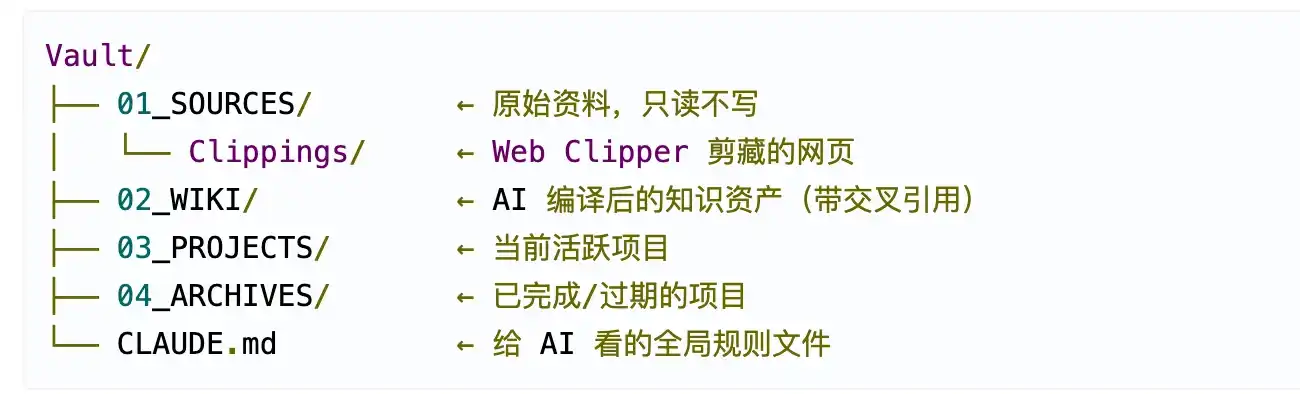
The core principle is source files are read-only, AI only operates on the Wiki layer. The CLAUDE.md file states your areas of focus, vault structure rules, import and query processes—this is like giving the AI a map, telling it where each type of information should be filed and what format to use when citing.
Option B: Tools like Eden ("Automatic Categorization + Semantic Search")
If you don't want to maintain vector databases, embedding APIs, indexing scripts yourself, or worry about cache issues from re-embedding after each change, then handing the underlying maintenance to a tool and focusing solely on thinking and creation is a more efficient choice.
Eden (the evolution of Dan Koe's earlier project, Kortex) does similar things to Obsidian + Claude but is more "seamless":
- Automatic Collection: Substack articles, YouTube videos, X long-form posts can all be saved with one click, automatically transcribing text and generating highlights.
- Automatic Embedding & Semantic Search: Each record is encoded into a vector of about 1500 numbers, akin to "GPS coordinates" in knowledge space. Even if two notes share no overlapping keywords, as long as they are semantically close, the system can link them—something traditional keyword search cannot do.
- Integration with Readwise: If you use Readwise to store book excerpts, they can sync into Eden, becoming a material library that's searchable by semantics, interactive, and draggable onto Boards as reference cards.
- Outlier Content Discovery: Eden analyzes content that performs exceptionally well for creators, helping you find topics worth deep discussion, rather than aimlessly scrolling through feeds.
MyMind is another representative of this philosophy—you throw links and ideas into it, and it automatically categorizes, tags, and provides semantic retrieval without requiring you to maintain the process.
Neither approach is inherently superior:
- Obsidian + Claude excels in complete autonomy, local-only data, and high customizability, but requires you to write rules and manage indexing.
- Eden / MyMind excels in zero maintenance, strong semantic associations, and built-in creative workflows, but data and indexing are cloud-based (though Eden promises not to upload private content, architecturally you depend on its service).
VI. Filtering is More Important than Collecting: What to Put in Your System
Regardless of the tool you use, one thing must be clear: Don't save everything.
AI can already mass-produce content. Scarcity has never been about information, but about the layer that has been filtered by you and can be digested by your worldview. Dan Koe's advice is straightforward—only save ideas you are willing to be shaped by.
The thinkers and creators you consistently follow and repeatedly ponder will gradually form your worldview lens. For instance, when Dan Koe himself contemplates the nature of reality, concepts like history, integral theory, and spiral dynamics naturally emerge because they are his common frameworks for explaining problems. What you need to slowly accumulate is your own collection of such "idea sets," not saving today's hot topic and tomorrow's new concept indiscriminately.
How to do this specifically:
- Read more from long-term, stable, good authors and thinkers, and scroll less through information feeds that amplify anxiety. For writers and creators, research might constitute 80% of the workload, with the remaining 20% being digesting researched material into useful expressions for others.
- Make the material part of yourself through writing and public sharing. Merely collecting without output leaves those ideas suspended in "someone else's wisdom"; only when you restate them in your own words, reconstruct them with your own experience, and subject them to feedback in real scenarios do they truly enter your cognitive structure.
- Let projects be your filter. Knowledge that cannot advance your current project, even if temporarily learned, won't stay. Projects provide clear boundaries and milestones, automatically filtering out noise for you.
VII. AI's Proper Place: Reducing Friction, Not Speaking for You
Finally, we must clarify the boundaries of AI in reading and writing—this is perhaps the area of greatest misunderstanding currently.
Dan Koe's stance is balanced: Don't use AI to express your own values and judgments, but you can let it serve as your researcher, tutor, and editor.
The specific boundaries are roughly:
- Factual content can leverage AI: For example, explaining Greuter's nine stages of self-development or outlining the background of a certain theory, having AI generate or cite existing materials is fine—it's no different from Googling and then writing. Forcing yourself to rewrite everything from scratch would waste the reader's time.
- Opinion and structure must be done personally: To articulate your own thoughts clearly, you must experience some "resistance"—personally refining structure, organizing arguments, revising wording. Only then will you better understand what you truly believe. If you delegate even this part to AI, your output isn't your worldview but the model's statistical average.
- Using AI to "remove friction" in these scenarios: Having it suggest a few organizational structures when you're stuck; letting it provide potential directions when unsure how to proceed; having it help you quickly enter research when encountering unfamiliar concepts. The person who ultimately makes the judgment and decides what to publish is always you.
The true warning behind "Don't use AI to write" is to not let AI express your own values for you. AI doesn't replace reading; it makes reading more crucial—because answers AI can directly provide are becoming increasingly less valuable. The irreplaceable worldview you build through deep reading is what others are willing to follow.
VIII. An Actionable Writing/Creation Closed Loop
If you're preparing to start writing (whether for Substack, a WeChat public account, X long-form posts, or YouTube scripts), the workflow Dan Koe provides can serve as a starting point:
- Choose a topic at the intersection of "proven" and "personally interesting." "Proven" means the topic has garnered real attention in the past—you can save high-engagement social media posts or use Eden's outlier discovery feature to find standout content. "Interesting" refers to questions you'd be willing to explore even without audience traffic. Combining the two maintains your expressive drive while making your work more visible.
- Dump ideas first, then build the structure. Don't stare at a blank page waiting for inspiration. First, write down all thoughts related to the topic, pull usable materials from your notes library, then give them a simple narrative skeleton (e.g., Problem → Insight → Solution), and fill the materials into appropriate places.
- Connect the first draft. Keep the outline, scattered notes, and knowledge base materials in accessible locations (like having Claude read your Vault or opening Eden's semantic search), then connect them into a complete article.
- Revise repeatedly until it says what you truly mean. If a piece doesn't yet carry your value, thoughts, and beliefs, keep revising until it does.
IX. In Conclusion: Remembering is Not the Goal; It's a Byproduct
Returning to the opening statement—you don't need to remember everything you read.
What truly remains and helps you make better decisions is never the sentences you forced yourself to memorize, but rather:
- Things you actively learned for a goal of your own;
- Things you repeatedly used within a real project;
- Things you digested through writing, sharing, and discussion;
- Things you placed in your second subconscious, letting them emerge on their own when needed.
Tools (Obsidian, Claude, Eden, Readwise, etc.) only make this process smoother. They cannot build a worldview for you, nor can they answer "Where exactly do I want to go?"
First, make your goals specific enough. Start working on a project that is truly your own. Then let knowledge find its way to you in the process of doing things—whether you remember it or not becomes irrelevant by then, because the important things have already become a part of you.