Better launches Bitcoin-backed mortgages powered by Coinbase

cointelegraphОпубліковано о 2026-08-26Востаннє оновлено о 2026-08-26

Анотація

Better Mortgage and Coinbase have launched a Bitcoin-backed mortgage product for U.S. homebuyers, allowing them to use Bitcoin as collateral for a down payment without selling it. Borrowers must pledge Bitcoin worth at least 250% of the down payment loan, held in a Coinbase Prime custodial account. The mortgage and down payment loan share the same interest rate and are repaid via a single monthly payment. Bitcoin price drops alone do not trigger margin calls, but collateral can be liquidated if payments are 60 days delinquent. This launch follows a 2025 FHFA directive for Fannie Mae and Freddie Mac to consider cryptocurrency in mortgage assessments, reflecting a broader trend of integrating digital assets into the U.S. housing market.

Better Mortgage and Coinbase have made their Bitcoin-backed mortgage product generally available, allowing US homebuyers to pledge Bitcoin as collateral for a down payment without selling it, the companies announced Wednesday.

According to Coinbase’s Help Center, the product pairs a Fannie Mae-backed home loan with a separate down payment loan secured by Bitcoin (BTC). Borrowers must pledge BTC worth at least 250% of the down payment loan, with the pledged BTC transferred to Better’s custodial account on Coinbase Prime.

The two loans carry the same interest rate and amortization term and are repaid through a single monthly payment, Coinbase said. The pledged BTC is returned once the mortgage is fully repaid or refinanced, subject to the loan terms.

Bitcoin price declines alone do not trigger margin calls or changes to the mortgage terms. However, Better can liquidate the pledged BTC if a borrower becomes 60 days delinquent on payments, according to Coinbase.

Borrowers must be US residents with a verified Coinbase account, and remain subject to Better’s credit, income and other underwriting requirements. Coinbase One members are also eligible for a 1% rebate from Better, subject to a $10,000 cap, that can be used toward closing costs and fees.

Better and Coinbase first announced the token-backed mortgage in March, initially opening it through an early-access program.

Related: 77% of Americans see crypto in retirement plans as risky: Survey

Crypto gains ground in US mortgage market

The Better-Coinbase product comes amid broader efforts to incorporate digital assets into US mortgage underwriting.

In June 2025, the Federal Housing Finance Agency directed Fannie Mae and Freddie Mac to develop proposals to consider cryptocurrency held on US-regulated centralized exchanges as an asset in single-family mortgage risk assessments, without requiring conversion to US dollars.
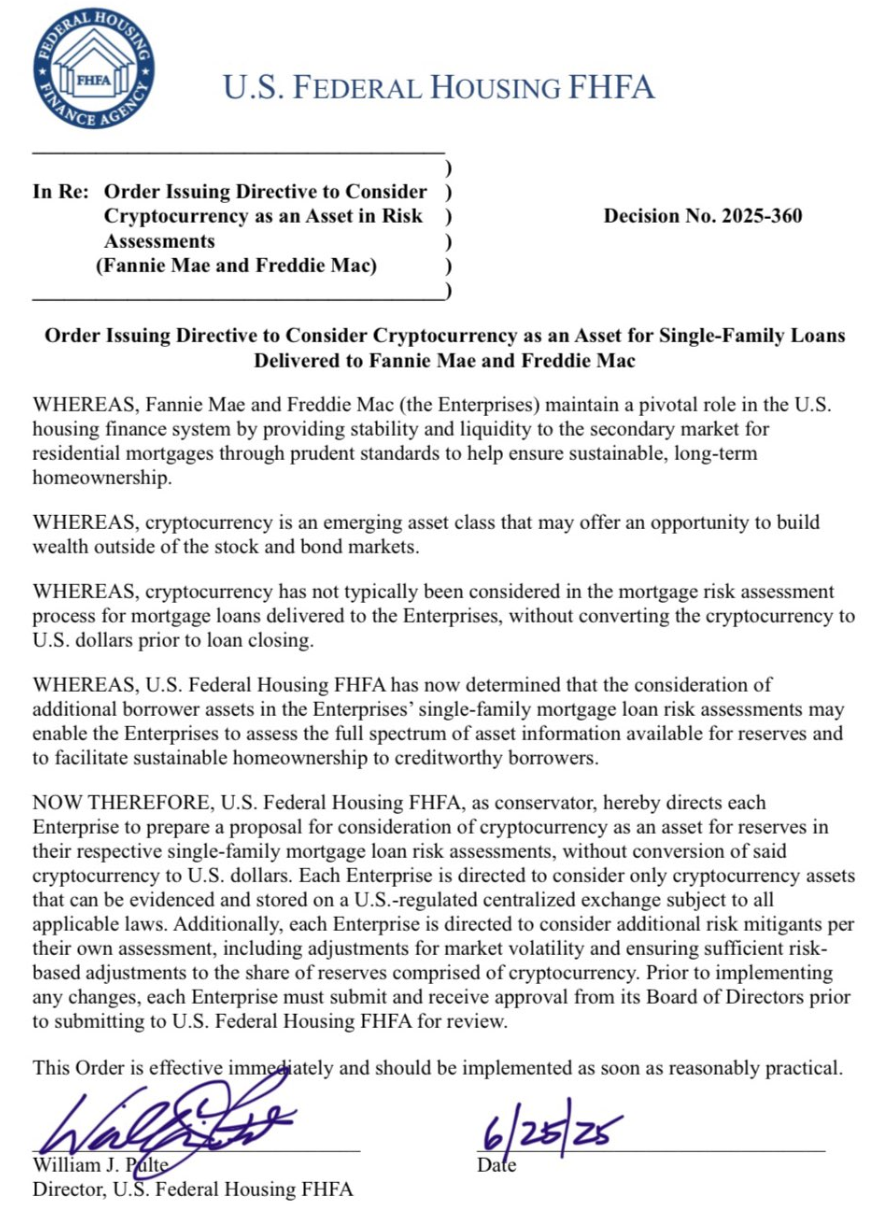
FHFA directive ordering Fannie Mae and Freddie Mac to consider cryptocurrency in mortgage risk assessments. Source: William Pulte

The directive also required the two government-sponsored enterprises to consider risk-mitigation measures for crypto’s volatility and submit any proposed changes to their boards for approval before FHFA review.

Other US lenders have also begun moving in that direction. Mortgage lender and servicer Newrez announced in January that it would recognize certain cryptocurrency holdings when evaluating mortgage applications beginning in February, including for home purchases and refinancing.

The expansion of Bitcoin-backed home financing comes as US housing prices remain near historic highs. The median sales price of a new US home was about $400,000 in 2026, according to data from the US Census Bureau and Department of Housing and Urban Development compiled by the Federal Reserve Bank of St. Louis.
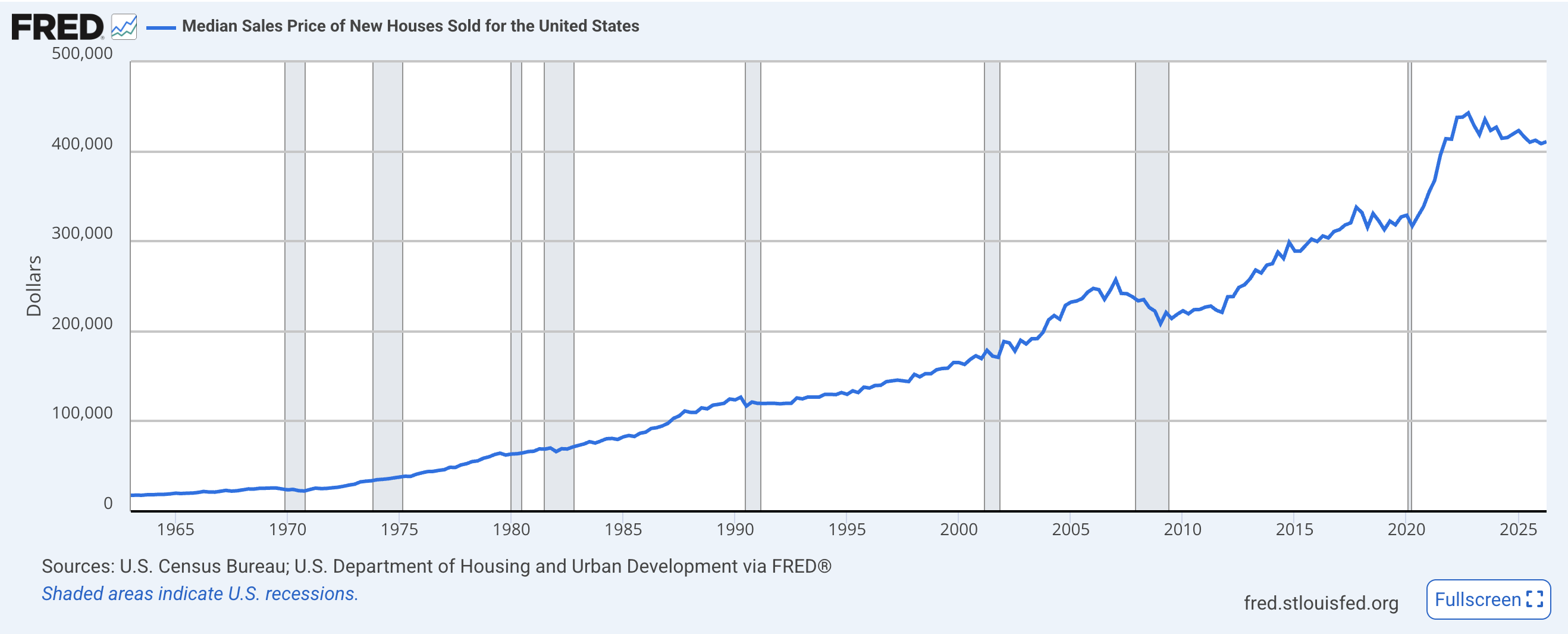
US median new home prices have fallen since 2022, but remain historically elevated. Source: Federal Reserve Bank of St. Louis

Magazine: Hugging Face hack exposes the open-weight AI cybersecurity paradox

Пов'язані питання

QWhat is the new product launched by Better Mortgage and Coinbase?

AThey have launched a generally available Bitcoin-backed mortgage product. This allows U.S. homebuyers to pledge Bitcoin as collateral for a down payment without having to sell it.

QHow does the Bitcoin collateral work for the down payment loan?

ABorrowers must pledge Bitcoin worth at least 250% of the down payment loan amount. The pledged BTC is transferred to Better's custodial account on Coinbase Prime and is returned once the mortgage is fully repaid or refinanced.

QWhat triggers the liquidation of the pledged Bitcoin?

ABitcoin price declines alone do not trigger margin calls. However, Better can liquidate the pledged BTC if a borrower becomes 60 days delinquent on their loan payments.

QWhat recent regulatory development supports the consideration of crypto in US mortgages?

AIn June 2025, the Federal Housing Finance Agency (FHFA) directed Fannie Mae and Freddie Mac to develop proposals to consider cryptocurrency held on U.S.-regulated exchanges as an asset in single-family mortgage risk assessments, without requiring conversion to U.S. dollars.

QAside from Better, which other US lender has announced plans to recognize cryptocurrency in mortgage evaluations?

AMortgage lender and servicer Newrez announced in January that it would recognize certain cryptocurrency holdings when evaluating mortgage applications beginning in February, including for home purchases and refinancing.

Пов'язані матеріали

How 5G Will Be Launched in Russia: The Digital Ministry's Proposal and the Roadmap to 2035

Russia's Ministry of Digital Development has proposed a plan for launching 5G networks. It allows the "Big Four" mobile operators (Beeline, Megafon, MTS, T2) to deploy 5G on existing 4G/LTE base stations and frequencies, and will allocate them the new 4.63–4.99 GHz band. A key element is "technological neutrality," permitting the use of foreign equipment until September 2026. The new 4.63–4.99 GHz band is intended for more advanced services and industrial applications. However, a phased transition to Russian-made base stations will begin in 2027, with a target of at least 50% domestic equipment by 2030. The rollout timeline aims for 5G in cities with over 1 million people by the end of 2027, expanding to 84 cities by 2035. Initial "5G Ready" service, operating over existing infrastructure, will offer minimal speed improvements. Significant speed gains (4-10x over LTE) will require the new band and corresponding equipment. The plan addresses long-standing regulatory delays, including the military's hold on the global standard 3.4–3.8 GHz band. This forced Russia to adopt the 4.63–4.99 GHz range, overlapping with a Chinese band, making Chinese equipment a potential transitional solution. The success of the rollout will depend on equipment supply and the pace of production localization, while a challenge lies in smartphone compatibility with this non-standard frequency band.

cryptonews.ru1 год тому

How 5G Will Be Launched in Russia: The Digital Ministry's Proposal and the Roadmap to 2035

cryptonews.ru1 год тому

The Federal Reserve Bank of Dallas Announces a Colossal $700 Billion Allocation! How Will This Affect Bitcoin?

The Federal Reserve Bank of Dallas warns that the growing adoption of tokenized deposits in the banking sector could pose unforeseen risks to the financial system. Tokenized deposits, which transfer traditional bank deposits to blockchain infrastructure, offer features like instant settlement and programmable payments. While issued by regulated banks and maintaining deposit characteristics, they could enable customers to move funds between banks much faster in search of higher yields. This would significantly weaken banks' liquidity management and lending capacity. The Fed's analysis estimates that an increase in deposit interest rate sensitivity by 10% could reduce the interest rate risk banks can bear by approximately $700 billion over ten years. Similarly, a 10% shortening of the average deposit maturity could reduce the banking system's capacity to convert deposits into loans by about $580 billion. This acceleration of deposit movement could force banks to rely on more expensive wholesale funding, increasing borrowing costs for consumers and businesses and potentially making traditional banks resemble non-bank financial institutions. While the report does not directly address Bitcoin, the described shifts could have long-term implications. Firstly, the tokenization of deposits by banks could promote institutional adoption of blockchain-based financial infrastructure, indirectly legitimizing digital asset classes like Bitcoin. Secondly, faster-moving deposits and resulting higher funding costs could increase the price of liquidity in the financial system. This could create near-term headwinds for risk assets, including Bitcoin, due to tighter financial conditions and potential selling pressure. The report concludes that widespread adoption of this technology could impact many areas, from payment systems to monetary policy transmission mechanisms.

cryptonews.ru1 год тому

The Federal Reserve Bank of Dallas Announces a Colossal $700 Billion Allocation! How Will This Affect Bitcoin?

cryptonews.ru1 год тому

Торгівля

Спот
活动图片