SKYAI nears October 2025 lows as manipulation concerns weigh on sentiment

ambcryptoОпубліковано о 2026-07-10Востаннє оновлено о 2026-07-10

Анотація

In mid-June, SkyAI (SKYAI) experienced a brief rally of 216%, surging from $0.151 to $0.479. However, it has since plummeted 92% from that peak. On-chain researchers, citing data from Nansen and Bubblemaps, allege the price action is consistent with market manipulation—where a concentrated supply held by a few wallets was distributed to retail investors during hype, leading to a violent dump. The token has broken key support at $0.146 and is rapidly approaching its October 2025 lows near $0.007. Although a recent spike in trading volume and open interest briefly pushed the price to $0.05, this bounce quickly reversed into another sell-off. With ongoing manipulation concerns and fading retail interest, the recovery outlook for SKYAI remains highly uncertain.

In mid-June, SkyAI [SKYAI] witnessed some short-term bullish momentum. The $0.20 key support zone was defended, and a 216% rally from $0.151 to $0.479 occurred in a week.

However, the bears have regained control of the market since then. The altcoin has fallen 92% since the $0.479 high.

Researcher Freeman wrote in a post on X that the crash wasn’t the fade of an organic AI hype. Using Nansen data, whales dumping SKYAI during bounces, such as the mid-June one to $0.47, were detailed.

The post succinctly broke down the manipulation playbook.

Parabolic narrative pump → concentrated supply in few wallets → heavy distribution into retail FOMO → violent dump.

Bubblemaps had also flagged patterns it said were consistent with potential market manipulation on centralized exchanges. The pattern was something investigator ZachXBT had also been warning of, in relation to RAVE.

AMBCrypto had apprised readers of the decline in Open Interest following the mid-June rally to $0.479.

As more supply hits the market, the pressure on the token would increase. It is unclear if there is enough market conviction in SKYAI to reverse the severe drawdown.

Compared to large orders, retail influence was fading. This was another red flag for traders and investors of suspicious price action and market activity.

Assessing the current SKYAI trends
Source: SKYAI on TradingView

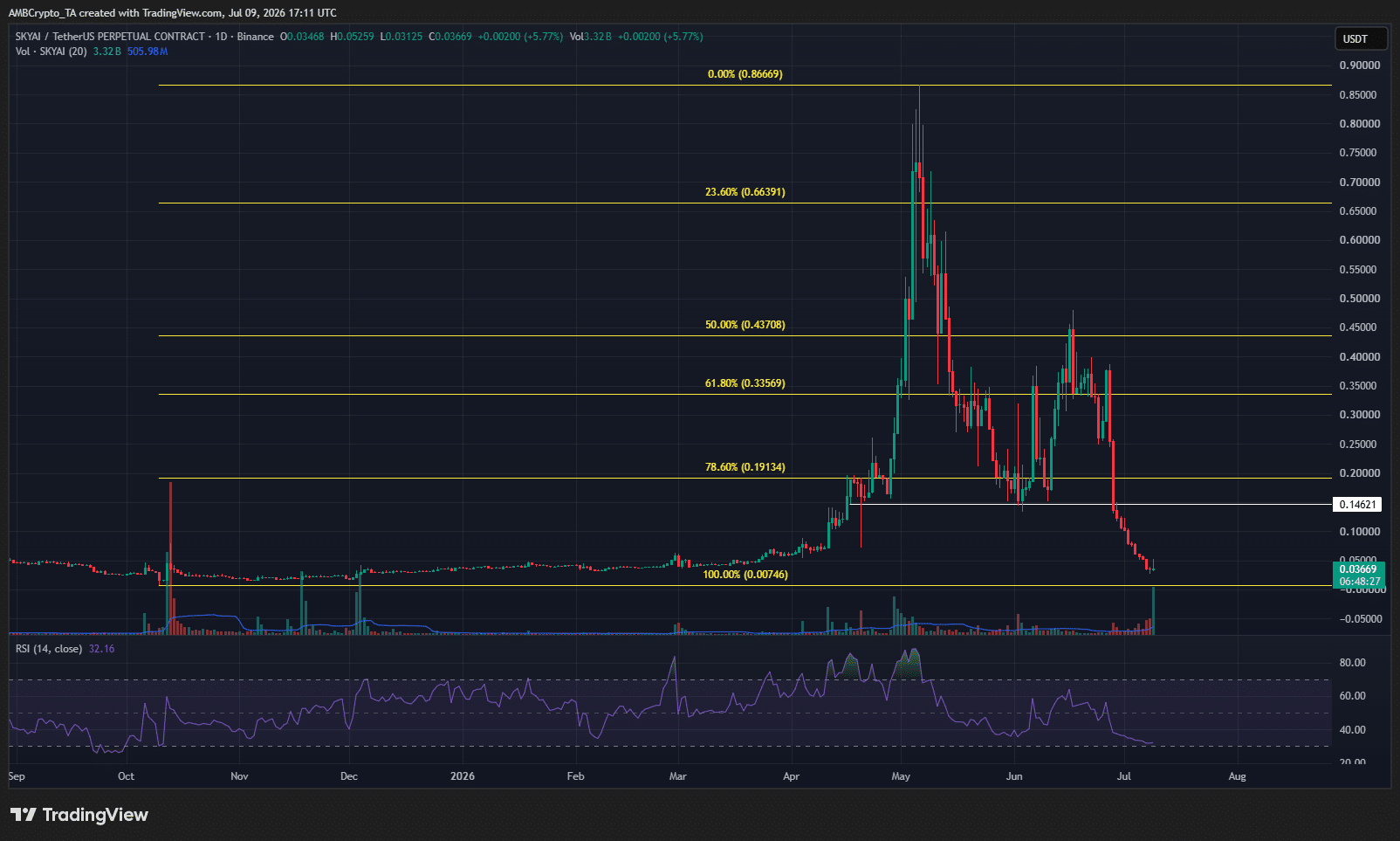
SKYAI has fallen below the $0.146 support that had been in place since April. More accurately, the current market price was 75% below this key former support level.

The token was rapidly falling toward the $0.007 lows from October 2025, but there was high trading volume on the day of writing. On the back of this volume, the price reached $0.05.

The Open Interest nearly doubled from $6.81 million on July 8 to $13.14 million in recent trading hours. The combination of the sharp correction and ongoing manipulation allegations leaves the recovery outlook uncertain.


Final Summary

  • On-chain investigators have linked SKYAI’s extreme price volatility to allegations of concentrated insider-controlled supply.
  • A bounce to the $0.05 level has turned into another short-term sell-off in recent hours.

Пов'язані питання

QAccording to the article, what specific pattern of price action does researcher Freeman describe as the 'manipulation playbook' for SKYAI?

AFreeman describes the manipulation playbook as: Parabolic narrative pump → concentrated supply in few wallets → heavy distribution into retail FOMO → violent dump.

QWhat key support level from April has SKYAI fallen below, and by what percentage is the current price below that level?

ASKYAI has fallen below the $0.146 support level that had been in place since April. The current market price is 75% below this key former support level.

QWhat happened to Open Interest (OI) for SKYAI between July 8 and the recent trading hours mentioned in the article?

AThe Open Interest nearly doubled from $6.81 million on July 8 to $13.14 million in recent trading hours.

QWhat was the price range of the '216% rally' that SKYAI experienced in mid-June?

AThe 216% rally in mid-June occurred from $0.151 to $0.479.

QBesides Freeman, which other investigators or services have flagged potential market manipulation patterns related to SKYAI?

ABubblemaps had flagged patterns consistent with potential market manipulation on centralized exchanges. The article also mentions that investigator ZachXBT had been warning of a similar pattern in relation to another token, RAVE.

Пов'язані матеріали

When Real Estate Ownership Goes Digital: What Happens to Your Rights, Risks, and Liquidity?

"Tokenizing Real Estate: Rights, Risks, and the Path to Liquidity" While tokenizing real-world assets (RWA) gains traction, real estate presents unique complexities. Beyond technical token issuance, critical challenges remain: enforcing legal rights, managing the underlying physical asset, and creating genuine secondary market liquidity. This article explores these issues through OneAsset, a Dubai-based commercial real estate (CRE) tokenization platform. OneAsset moves away from simply offering asset fragmentation. Instead, it focuses on institutional-grade infrastructure, prioritizing asset quality, legal enforceability, and operational fundamentals. Each property is held in an independent, single-asset vault, backed by a legally separate Special Purpose Vehicle (SPV) for bankruptcy remoteness. Investors acquire tokens representing the economic rights to a specific property, with precise legal claims defined by the underlying SPV structure. OneAsset emphasizes that tokenization cannot transform a poor-quality asset. Its initial focus is on institutional investors and quality Dubai-based CRE, selected for stable tenant cash flows and a clear regulatory environment. The platform integrates compliance by design, aiming to embed investor qualification and transfer rules directly into the token architecture. A core insight is that asset fragmentation does not automatically create liquidity. True liquidity depends on the asset's inherent quality—its location, cash flow, and valuation—as well as sufficient buyer demand. The goal is not just tradability, but making real estate rights more easily priced, verified, and reallocated. Looking ahead, the article discusses the potential for "AiFi" (AI-powered finance). For AI agents to autonomously allocate capital, investment assets like real estate tokens must become truly "machine-readable." This requires a high degree of standardization in legal rights, valuations, cash flows, and compliance data—a direction OneAsset is pursuing through its structured data reporting. In conclusion, real estate tokenization is shifting from a technology narrative to a focus on asset fundamentals. Blockchain can enhance efficiency and programmability, but it cannot replace sound underwriting, property management, or legal execution. The real work begins after the asset is on-chain.

marsbit10 хв тому

When Real Estate Ownership Goes Digital: What Happens to Your Rights, Risks, and Liquidity?

marsbit10 хв тому

After Affecting Two Generations, Meta Ordered to Pay $18 Billion in Damages

After more than two decades, a legal parallel has emerged. In 1998, major U.S. tobacco companies settled for $206 billion, leading to strict advertising bans and warning labels that significantly reduced smoking rates. On August 26, 2026, Meta reached a landmark settlement with U.S. attorneys general, agreeing to pay up to approximately $18 billion and implement mandatory changes to Facebook and Instagram. This historic settlement, one of the largest against a tech company, stems from allegations that Meta deliberately designed addictive features like infinite scroll and push notifications, harming youth mental health and violating child privacy laws. Facing a potential $1.4 trillion lawsuit and a series of unfavorable jury verdicts, Meta chose to settle on the eighth day of trial to avoid a catastrophic ruling. The core of the agreement is not just the financial penalty, which Meta will pay over 10 years, but a series of strict, 10-year product mandates for young users. These include a hard two-hour daily time limit (combined across apps), a default "nighttime block" from midnight to 6 AM, restricted notifications during school hours, hidden "like" counts, an optional non-algorithmic feed, and stronger age verification. An independent auditor will monitor compliance. Crucially, roughly 30% ($5.3 billion) of Meta's payment is contingent on YouTube and TikTok adopting similar measures and paying around $5 billion each. This move aims to create an industry-wide standard and prevent Meta from being competitively disadvantaged. The settlement is being likened to Big Tobacco's "tobacco moment." By legally framing addictive algorithm design as a "public nuisance," it sets a powerful precedent. Nearly 3,000 similar cases are pending against other social media giants, signaling a fundamental shift in regulatory pressure. The era where platforms could deny the addictive impact of their designs on children is effectively over.

marsbit16 хв тому

After Affecting Two Generations, Meta Ordered to Pay $18 Billion in Damages

marsbit16 хв тому

Торгівля

Спот
活动图片