Six Years Later, UNI Finally Welcomes Its Own "Buyback Bull"

marsbitОпубліковано о 2026-07-31Востаннє оновлено о 2026-07-31

Анотація

After years of debate, Uniswap's UNI token has finally entered a 'buyback bull' phase following the long-awaited activation of its fee-switch mechanism. The UNIfication proposal, executed in December 2025, redirected a portion of protocol fees from select pools and Unichain sequencer revenue into a treasury (TokenJar) dedicated to buying back and permanently burning UNI. Initial market reaction was muted due to modest early burn rates. A significant shift occurred in July 2026 with the launch of Robinhood Chain. Uniswap's immediate deployment there skyrocketed trading volume, making it a top fee-generator. Subsequently, governance votes extended the fee mechanism to v4 pools and Robinhood Chain, causing protocol revenue to nearly triple. Daily funds directed to UNI burns rose sharply, with Robinhood Chain contributing over half. This transitioned UNI's narrative from a governance token to a cash-flow asset backed by a perpetual automatic buyer. UNI's price, which had languished around $2.30 in early June, nearly doubled to approach $4.60 by late July. Analysts credit this to the tangible cash flow from fees rather than mere speculation. Unlike many newer projects where buybacks are offset by large investor unlocks, UNI's six-year history has resulted in a widely distributed and relatively clean supply, allowing the buyback pressure to effectively impact the secondary market. The key test will be whether trading activity, particularly on Robinhood Chain, sustains after its i...

Original Author: Eric, Foresight News

During the overall market volatility in June and July, the price movements of most major tokens were lackluster, but UNI performed unexpectedly strongly.

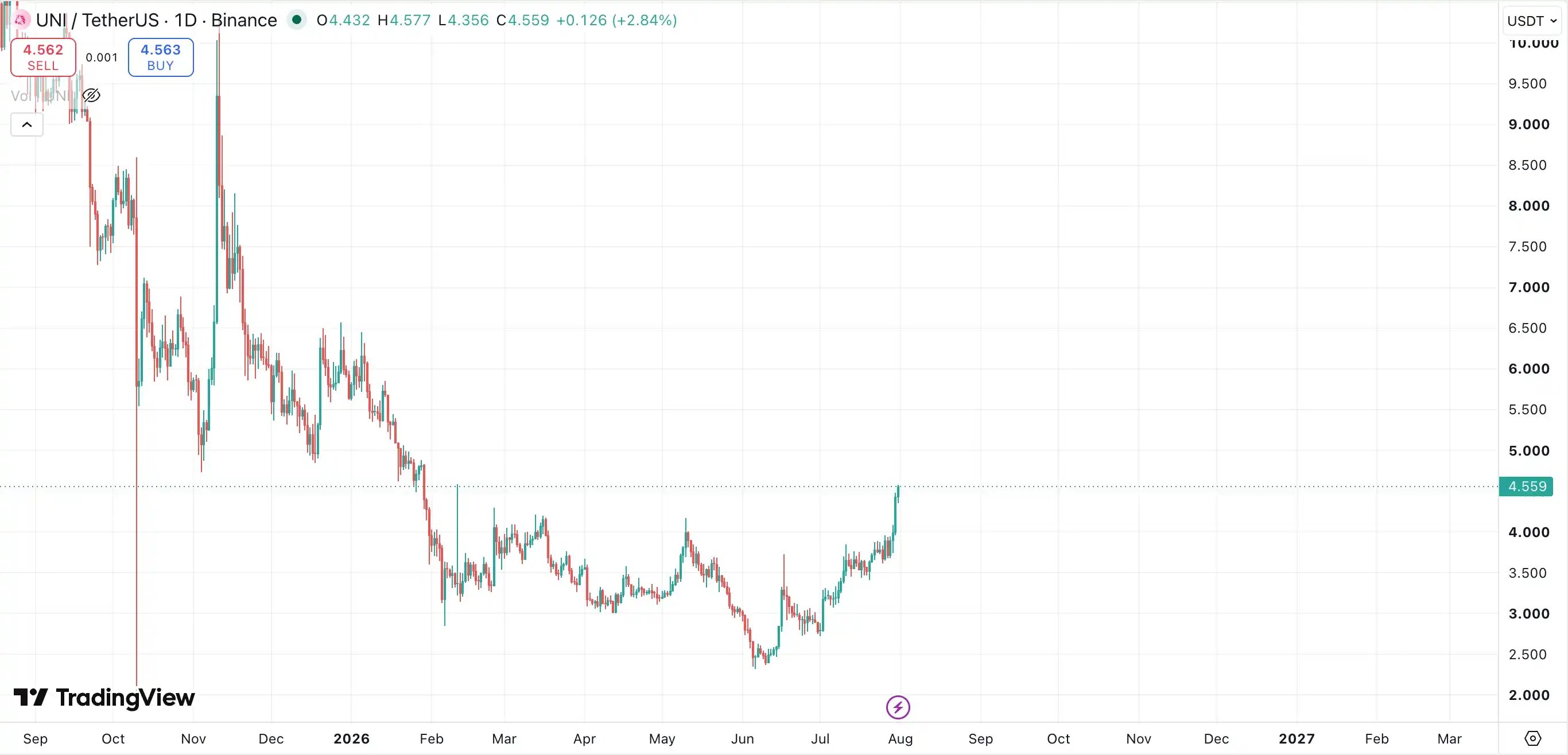
In early June, the price of UNI was hovering around $2.3. By the end of July, it had approached $4.6, nearly doubling in two months. Rewinding to last December, when Uniswap had just passed the long-debated fee switch proposal, UNI rose for only one day before falling alongside the broader market, with little market interest in the leading DEX of the DeFi world.
But the turning point had been set then, though few realized it at the time.

On December 28, 2025, the Uniswap governance proposal UNIfication was officially executed on-chain. The protocol fee switch was activated, diverting a portion of trading fees from Ethereum mainnet v2 pools and some v3 pools to the protocol; sequencer revenue from Unichain, after deducting OP shares and L1 data costs, also flowed into the same fund pool; a one-time burn of 100 million UNI tokens from the treasury served as retrospective compensation for the past years of the "free era"; Uniswap Labs reduced its fees for the frontend, wallet, and API to zero, while receiving an annual 20 million UNI growth budget. All these protocol revenues ultimately converged into a treasury contract named TokenJar, which had only one outlet: buying UNI through the Firepit contract for permanent destruction.

This is what the long-debated "fee switch" truly looked like upon implementation. Since DeFi Summer, the community had debated whether to allocate a portion of trading fees to the protocol, but each vote was stalled by concerns over profit distribution, legal risks, and LP attrition. When it finally passed, the market reaction was quite muted. When the proposal was announced, UNI surged nearly 50% in a few hours, but then declined as the broader market weakened. By March 2026, UNI had fallen below $3.8, ranging sideways around $3 in April and May, and even dropping to $2.3 in early June. The fee switch was turned on, but quietly.
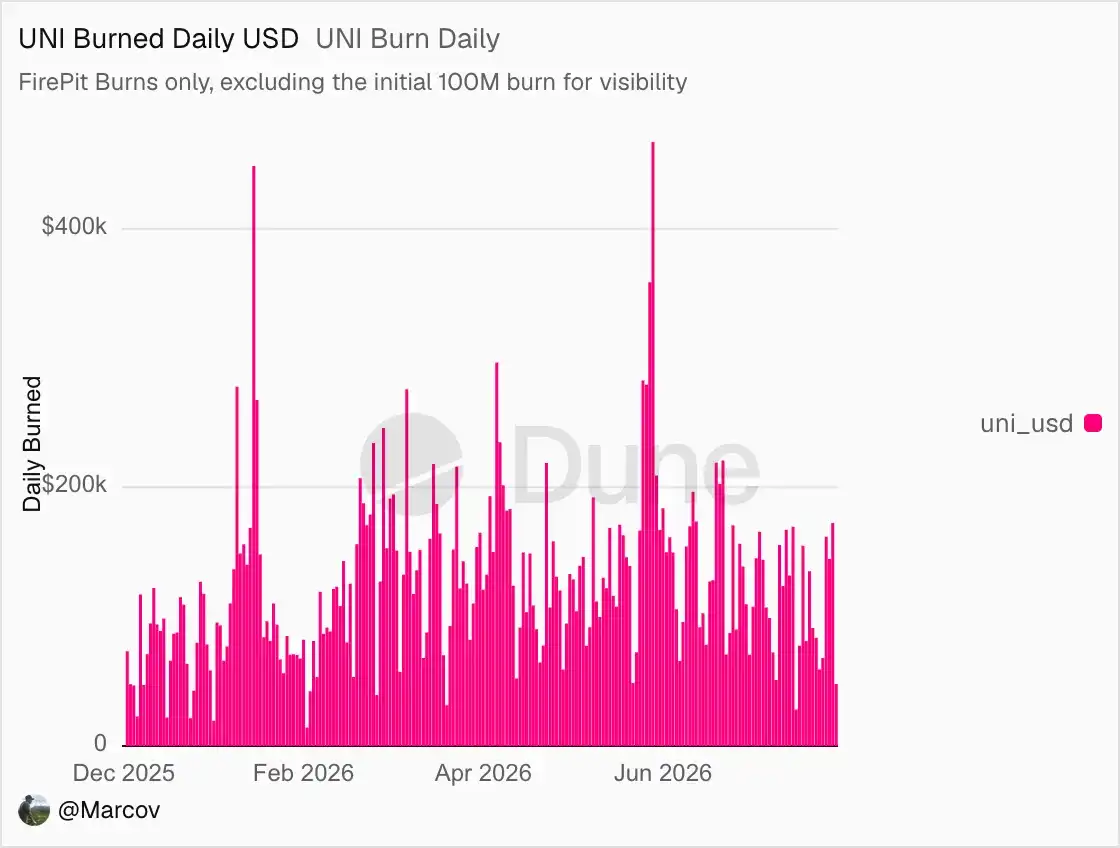
The quietness was due to underwhelming data. According to Dune statistics, in the first 12 days after the fee switch was activated, the cumulative value of burned UNI was only about $800,000, roughly $26-27 million annualized, corresponding to an annual burn of approximately 4 to 5 million UNI tokens. Considering the protocol's annual 20 million UNI growth budget expenditure, this figure held little appeal. By May 2026, cumulative protocol revenue was about $12.3 million, with daily protocol revenue around $73,000. The burn mechanism was operating, but it was more like an engine idling too quietly to be heard.

The change occurred in July. On July 1, Robinhood Chain officially launched, with Uniswap's v2, v3, v4, and UniswapX deployed on the first day. This chain, built for tokenized stocks, pushed Uniswap's daily trading volume to $5 billion within eight days, with cumulative trading volume surpassing $10 billion by July 10. In its first week, Robinhood Chain contributed nearly half of Uniswap's total weekly fees, approximately $11 million. Daily total protocol fees once reached $5.2 million, second only to the two major stablecoin issuers across the entire network. Uniswap founder Hayden Adams called it the most active chain outside of Ethereum mainnet.

Then came the votes. A Snapshot vote from July 7 to 12 decided to extend the fee mechanism to v4 pools, followed by on-chain voting the next week; a temperature check for activating protocol fees on the Robinhood Chain deployment ran from July 10 to 15. On July 27, the v4 fee switch was officially activated. The effect was immediate: according to DefiLlama data, protocol revenue nearly tripled after activation. Daily funds flowing to UNI burns rose from about $114,000 in early July to $325,000, with Robinhood Chain alone contributing $170,000, over half the total, and Ethereum mainnet contributing about $82,000. On the day the news materialized, UNI rose 12%, touching $4.4.

Looking back at this curve, the logic is quite clear. When the fee switch was turned on at the end of last year, the market priced in expectations, and when expectations weren't met, it fell back. But when the burn data climbed from a few hundred thousand dollars per month to a few hundred thousand dollars per day, and when the largest new revenue source by trading volume connected to this burn machine, the market began pricing not expectations but cash flow. For a protocol with annual trading volume in the trillions, token holders previously received nothing. Now, every transaction creates a permanent, automatic buyer for the token. This transformation from a governance token to a cash-flow asset is the core narrative behind this rally.

It's worth noting that buyback-and-burn mechanisms are no longer novel in today's crypto industry. Hyperliquid has a monthly buyback size of nearly $95 million, pump.fun has $35 million, Jupiter uses half its operating income for buybacks, and dYdX, Aave, and Lido are all advancing similar mechanisms. But whether buyback-and-burn works never depends on the mechanism itself, but on the token distribution structure.

UNI is an "old token" that completed its distribution in 2020. Six years have allowed for sufficiently dispersed holdings. There are no massive, pending unlocks in the circulating supply. Approximately $830 million worth of UNI is available for sale on exchanges. The buyback-formed buying pressure genuinely acts on the secondary market. Many new projects also sport buyback-and-burn labels, but the monthly token unlocks for teams and investors far exceed the buyback volume. The burned tokens are just a drop in the bucket against the constant influx of new supply, so prices naturally cannot hold.

This is a rare advantage for old DeFi projects. Having survived long enough, launching early enough, and having sufficiently cleaned-up token distribution allows the buyback-and-burn machine to truly start turning. For UNI, the next question to verify is also specific: Robinhood Chain's gas subsidies are set to expire roughly 90 days after launch. How much trading volume remains thereafter will determine whether this doubling is the beginning of value realization or just another illusion propped up by subsidies.


Пов'язані питання

QWhat is the main reason behind UNI's strong price performance from June to July, according to the article?

AThe article attributes UNI's strong performance to the effective implementation of the 'fee switch' and the subsequent shift from a governance token to a cash-flow asset. The key driver was the significant increase in daily protocol revenue, which funds an automatic buyback and burn mechanism, creating a permanent buyer for UNI. This was amplified by Uniswap's deployment on the new Robinhood Chain, which greatly boosted trading volume and fee revenue.

QWhat is the role of the TokenJar treasury contract and the Firepit contract in the new Uniswap fee mechanism?

AThe TokenJar treasury contract is the central pool that collects all protocol revenue from the activated fee switch (from Ethereum v2/v3 pools, etc.) and sequencer revenue from Unichain. The Firepit contract is its only exit; it uses the funds in TokenJar to buy UNI tokens and permanently burn them, directly linking protocol revenue to deflationary pressure on the token supply.

QHow did the launch of Robinhood Chain impact Uniswap's metrics in July 2026?

AThe launch of Robinhood Chain in July 2026 dramatically increased Uniswap's activity. In its first week, it contributed nearly half of Uniswap's total weekly fees (about $11 million), pushed Uniswap's daily trading volume to $500 million, and helped achieve a cumulative volume of over $1 billion by July 10. After the fee mechanism was extended to it, Robinhood Chain alone contributed over $170,000 daily to the UNI burn, which was more than half of the total daily burn amount at the time.

QWhy does the article claim that buyback/burn mechanisms work better for 'old DeFi projects' like UNI compared to many new projects?

AThe article argues that old DeFi projects like UNI, which launched and distributed tokens years ago (2020 for UNI), have a more favorable token distribution. Their circulating supply is widely distributed with no large, pending unlocks from teams or investors. This means the buyback pressure from protocol revenue acts directly on the secondary market supply. In contrast, many new projects have monthly unlock schedules where newly released tokens for teams and investors often far exceed the amount being bought back and burned, diluting the deflationary effect.

QWhat future challenge or test does the article mention for UNI's current bullish narrative?

AThe article identifies the upcoming expiration of Robinhood Chain's gas fee subsidies (around 90 days after launch) as a key test. The sustainability of Uniswap's trading volume and fee revenue on that chain after the subsidies end will determine whether the recent price increase represents a true 'value discovery' or was merely a temporary illusion propped up by incentives.

Пов'язані матеріали

PA Graphics Explanation | One Chart to Understand the Major Web3 Events in August 2026

**PANews Crypto Calendar: Key Web3 Events in August 2026** PANews introduces its revamped crypto calendar, featuring comprehensive coverage, flexible filtering, and easy export options. The market in August will be shaped by multiple key events across macroeconomics, regulation, tokenomics, and project developments: * **Macro & Policy:** Key US economic data releases (July Non-Farm Payrolls, CPI), the Federal Reserve meeting minutes, and the Jackson Hole Economic Symposium will be in focus. On the regulatory front, the US Senate plans to release a new draft of the *CLARITY Act*, while the EU's expanded crypto ban against Belarus comes into effect. * **Token Unlocks:** Significant token unlocks are scheduled for assets including ENA, AVAX, CONX, ZRO, and KAITO, which may influence market volatility. * **Project Updates & Shutdowns:** Several services, including Exchange Art, Ctrl Wallet, Zapper, NFTfi, and Summer.fi, are set to cease operations or undergo major adjustments. Users are advised to manage their assets accordingly. * **Corporate Activity:** Q2 earnings reports from companies like SpaceX, Circle, and Nvidia are due. Unitree Robotics will initiate its IPO subscription on the STAR Market, and Moonshot AI plans to begin a Pre-IPO financing round. * **Industry Events:** Major conferences such as Bitcoin Asia 2026 and the 2026 Digital Expo will take place. The overarching market narrative for August will revolve around macroeconomic expectations, regulatory developments, token unlock schedules, and ongoing industry consolidation.

marsbit7 хв тому

PA Graphics Explanation | One Chart to Understand the Major Web3 Events in August 2026

marsbit7 хв тому

Wall Street's Most Famous 'Cassandra' Now Has His Sights Set on Nvidia

Michael Burry, the famed "Big Short" investor, has once again captured Wall Street's attention with a series of short positions against major tech and semiconductor stocks, most notably Nvidia. In late June and July, through his "Cassandra Unchained" newsletter, Burry disclosed short bets against Nvidia, Tesla, Applied Materials, Caterpillar, the SOXX semiconductor ETF, and later, Micron Technology. His core thesis revolves around potential distortions in the AI infrastructure boom, specifically questioning whether extended depreciation schedules (e.g., 6 years vs. a realistic 2-3 years for AI chips) by cloud giants like Microsoft and Google artificially inflate profits. He also raises concerns about possible "off-balance-sheet circular financing," where chip demand might be propped up by vendor-backed funding to clients. Nvidia's stock experienced volatility following these disclosures, briefly dipping but largely holding near Burry's reported entry points, leaving his positions roughly flat or slightly underwater as of late July. This move is part of a pattern for Burry, whose track record since his legendary 2008 bet is mixed. He has faced notable losses, such as on Tesla in 2021, while scoring on broader market turns like the 2020 pandemic crash. His methodology focuses intensely on free cash flow and scrutinizing original financial documents to spot overvaluation and structural risks, but it often struggles with timing the market. The article contrasts Burry's stance with other prominent investors. Steve Eisman, another "Big Short" figure, is not shorting Nvidia, citing strong fundamentals but expressing nervousness about sustainability. Jim Chanos agrees with the broad "accounting mismatch" concern—comparing it to the dot-com bubble—but targets financial leverage in private equity firms rather than the chip stocks themselves. While Nvidia's short interest remains relatively low at 1.3-1.4% of float, the massive stock size means absolute short losses have been significant, exceeding $5 billion earlier this year. The piece concludes that for ordinary investors, the key takeaway is not replicating specific short bets but learning from the critical frameworks these investors use: questioning rosy accounting, identifying structural vulnerabilities, and maintaining skepticism during market euphoria, even if pinpointing the exact catalyst for a downturn remains elusive.

marsbit32 хв тому

Wall Street's Most Famous 'Cassandra' Now Has His Sights Set on Nvidia

marsbit32 хв тому

Weekly Selection丨Epic Stock Market Volatility, Changxin Tech's IPO Reshapes Storage Landscape, Saylor Aims to Re-Anchor STRC Around September 8th

PANews Weekly Digest: Market Turmoil, Tech Breakthroughs, and Crypto Developments. The week saw significant volatility across global markets. South Korea's KOSPI index experienced extreme turbulence, including multiple trading halts, largely driven by sharp declines in AI hardware stocks like SK Hynix. In contrast, China's Changxin Xinqiao (CXC) achieved a landmark IPO with a market cap surpassing 4 trillion yuan, marking a major success for the domestic DRAM industry after a decade of losses. In the crypto and Web3 space, several key narratives emerged. AI is driving demand for new infrastructure, with projects like AI agent wallets and programmable payments gaining traction, attracting interest from firms like Coinbase. The Bitcoin mining sector is pivoting, with companies like MARA focusing on energy management as electricity becomes a core AI-era asset. Meanwhile, the RWA (Real World Assets) sector faces a "utilization puzzle," with hundreds of billions in on-chain assets remaining dormant. Notable market movements included a historic single-day surge of over 17% for the KOSPI index and a significant migration of $16.5 billion in staked ETH within the Lido ecosystem. Michael Saylor announced a target to re-peg the STRC stablecoin around September 8th. Other highlights include discussions on Ethereum's ambitious 2030 roadmap for scaling and privacy, analysis showing high protocol revenues not always translating to token price gains, and warnings from Citi about potential extreme commodity price shocks by late 2026.

marsbit37 хв тому

Weekly Selection丨Epic Stock Market Volatility, Changxin Tech's IPO Reshapes Storage Landscape, Saylor Aims to Re-Anchor STRC Around September 8th

marsbit37 хв тому

When the Market Begins to Question AI Capex: A Full Analysis of Q2 Earnings Reports from Five Tech Giants

In late July 2026, five major US tech giants—Alphabet, Intel, Microsoft, Meta, and Apple—released their Q2 earnings reports. While all companies exceeded revenue and profit expectations, driven by strong AI-related business growth, investor reactions diverged sharply due to concerns over escalating AI capital expenditures (capex) and their impact on free cash flow. Alphabet reported strong revenue growth and a surging cloud business, but its stock fell after announcing a doubled year-on-year capex and negative quarterly free cash flow for the first time. Intel posted its strongest revenue growth in over 15 years, but its stock experienced volatile trading after significantly raising its full-year capex guidance. Microsoft saw its stock surge after beating estimates and, crucially, lowering its capex forecast while projecting positive free cash flow. Meta faced the most severe sell-off as its profits declined despite revenue beats, with free cash flow plunging over 90% and its capex guidance raised. Apple reported record June-quarter results, but its stock plummeted after providing Q4 revenue guidance that fell short of expectations, citing supply chain constraints and forex headwinds. The overall takeaway is that the market's focus has shifted from validating AI demand to scrutinizing the timeline for returns on massive AI investments. Companies demonstrating a clearer path to managing capex and preserving free cash flow, like Microsoft, were rewarded, while those signaling continued aggressive spending faced investor skepticism.

Odaily星球日报47 хв тому

When the Market Begins to Question AI Capex: A Full Analysis of Q2 Earnings Reports from Five Tech Giants

Odaily星球日报47 хв тому

a16z: From Companies to DAOs, DUNA May Become the Next Generation Organizational Form

This article, "From Companies to DAOs: How DUNA Could Become the Next Organizational Form," traces the 500-year evolution of business collaboration. It begins with medieval structures like the *commenda* and Florentine *compagnia*, which exposed partners to personal risk. The modern corporation, exemplified by the Dutch East India Company (VOC), was a revolutionary leap, enabling large-scale, capital-intensive ventures by offering limited liability and reducing coordination costs. However, corporations introduced new challenges like principal-agent problems and bureaucratic overhead. The piece argues that software and internet-native protocols are now reducing these traditional overheads. Decentralized Autonomous Organizations (DAOs) emerged as a new model for coordination without centralized management. Yet, DAOs face a significant legal vacuum: they lack legal recognition, leaving members exposed to unlimited personal liability, and their tokens are vulnerable to being classified as securities under unclear regulations (e.g., the Howey Test). This has forced projects into suboptimal workarounds like offshore foundations. The article identifies the Decentralized Unincorporated Nonprofit Association (DUNA) as a potential solution. Recently legalized in states like Wyoming, the DUNA provides a legal wrapper for decentralized networks. It grants key protections—legal personality, limited liability, and perpetual existence—to a group without imposing a traditional hierarchical management structure. This allows token-holder communities to govern, hold assets, and contract as a single legal entity, aligning with their decentralized nature. While DUNA doesn't solve all governance challenges or magically resolve securities law questions, it represents a crucial step. It fills the legal recognition gap, offering a native legal form for internet-scale, decentralized collaboration and extending the separation of personal risk from organizational venture into a new domain.

marsbit1 год тому

a16z: From Companies to DAOs, DUNA May Become the Next Generation Organizational Form

marsbit1 год тому

Торгівля

Спот
活动图片