From Terra's Collapse to the "10 AM Strike": How Did Jane Street Play the Markets Across Two Continents?

Odaily星球日报Опубліковано о 2026-02-26Востаннє оновлено о 2026-02-26

Анотація

The article details serious allegations against Jane Street Group, a major quantitative trading firm, for market manipulation across different continents. It is accused of using insider information to profit from the Terra Luna collapse in May 2022, allegedly triggering its $40 billion crash. Separately, Indian regulators charged Jane Street with a "pump and dump" scheme in derivatives markets, resulting in massive fines and a trading ban. The piece also connects Jane Street to a pattern in Bitcoin trading called the "10 AM hit," where consistent sell pressure occurred at U.S. market open, suppressing BTC prices for months. This pattern abruptly stopped after the Terra lawsuit became public, coinciding with a Bitcoin price surge. As an authorized participant for BlackRock’s Bitcoin ETF (IBIT), Jane Street held significant influence over BTC flows. The article suggests their trading activity—selling BTC while increasing exposure to Bitcoin-proxy stocks—may have manipulated markets. The case highlights structural vulnerabilities in ETF systems that privilege certain players, echoing past manipulation in traditional markets like gold. Bitcoin’s recent rebound may signal reduced manipulative pressure, underscoring the need for trustless systems.

This article is from:@peruvian_bull

Compiled by | Odaily Planet Daily (@OdailyChina); Translator | Ethan (@ethanzhang_web 3)
Editor's Note: Over the past four months, Bitcoin has almost established a fixed rhythm—a clear wave of selling pressure emerges whenever the U.S. stock market opens. It rises during Asian hours, continues its upward trend in Europe, but quickly falls back as soon as New York opens. Traders have dubbed this the "10 AM Strike." This force acts like an invisible structural headwind, repeatedly liquidating leveraged positions, dampening market sentiment, and gradually wearing down investors' patience.

However, when the lawsuit documents against Jane Street were officially made public, this months-long rhythm was suddenly interrupted. Is this merely a coincidence, or a signal of deeper structural changes? How did the entire process unfold? Odaily Planet Daily provides the full compilation below.

——————Separator——————

The most powerful trading firm you've never heard of has just been caught red-handed. Twice, on two different continents. And Bitcoin, it seems, has finally breathed a sigh of relief.

Jane Street Group is a quantitative trading firm headquartered in New York. They don't have a CEO.

According to their own description, they operate like an "anarchic commune." In the first nine months of 2025, they achieved net trading revenue of $24 billion, already surpassing the $20.5 billion for the entirety of 2024. The second quarter of 2025 alone reached $10.1 billion, marking the highest quarterly trading revenue in Wall Street's history.

By any measure, they are one of the most profitable trading institutions globally.

And just this week, the bankruptcy administrator for Terraform Labs filed a lawsuit in Manhattan federal court, accusing Jane Street of using insider information to front-run the collapse of Terra Luna in May 2022. This collapse wiped out $40 billion in market value and triggered a chain reaction that ultimately brought down Celsius, Three Arrows Capital, and FTX.

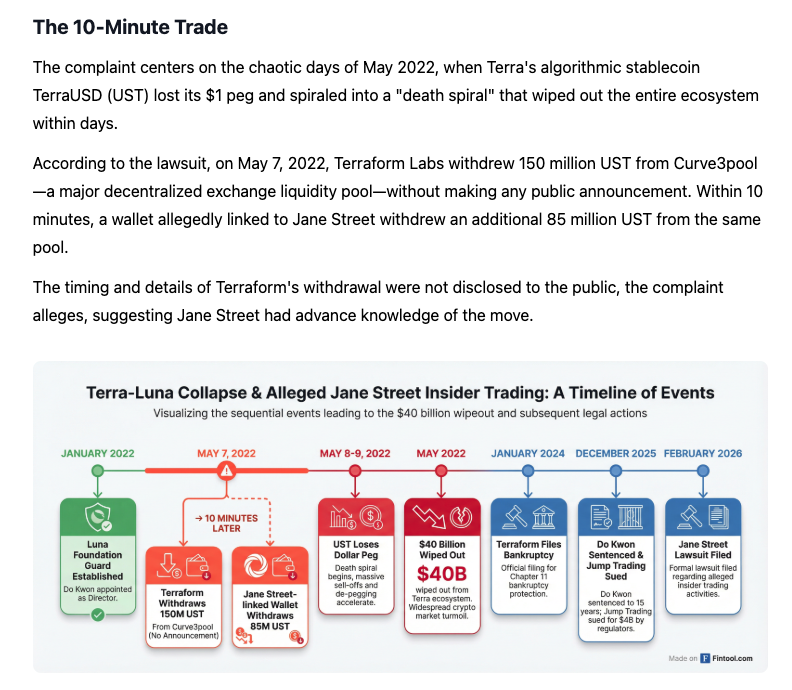
The allegation is stunningly simple. On May 7, 2022, Terraform Labs quietly withdrew $150 million in UST from Curve3pool, a major decentralized liquidity pool. There was no public announcement, just a silent withdrawal of liquidity.

Ten minutes later, a wallet linked to Jane Street withdrew $85 million from the same pool. Just ten minutes later...
The complaint alleges that a former Terraform intern, Bryce Pratt, who became a full-time employee at Jane Street in September 2021, established private communication channels with former colleagues and allegedly passed material non-public information about Terraform's liquidity movements directly to Jane Street's trading team.
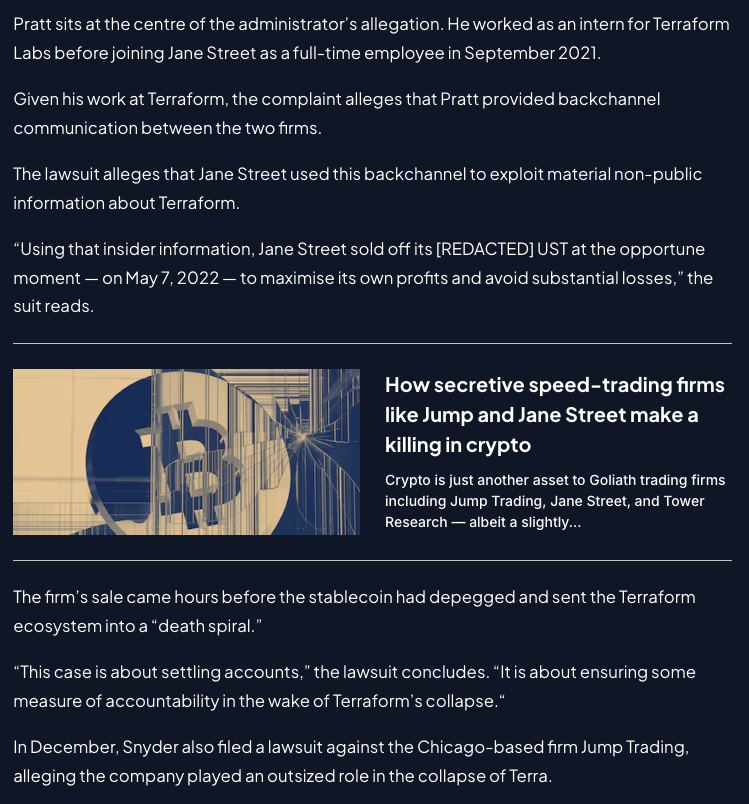
The complaint names four defendants: Jane Street Group LLC, co-founder Robert Granieri, and employees Bryce Pratt and Michael Huang.

The administrator's statement gets straight to the point: the trades Jane Street executed would have been impossible without the exclusive insider information they possessed.

Making matters worse, the complaint alleges that Jane Street's withdrawal helped trigger the de-pegging of UST, plunging the entire Terraform ecosystem into a death spiral. LUNA fell from over $80 to near zero. $40 billion evaporated. Ordinary investors lost everything. Retirement funds, education savings, life savings—wiped out in days.

Jane Street's response? Calling the allegations "desperate and baseless."

But here's the thing: This isn't the first time.

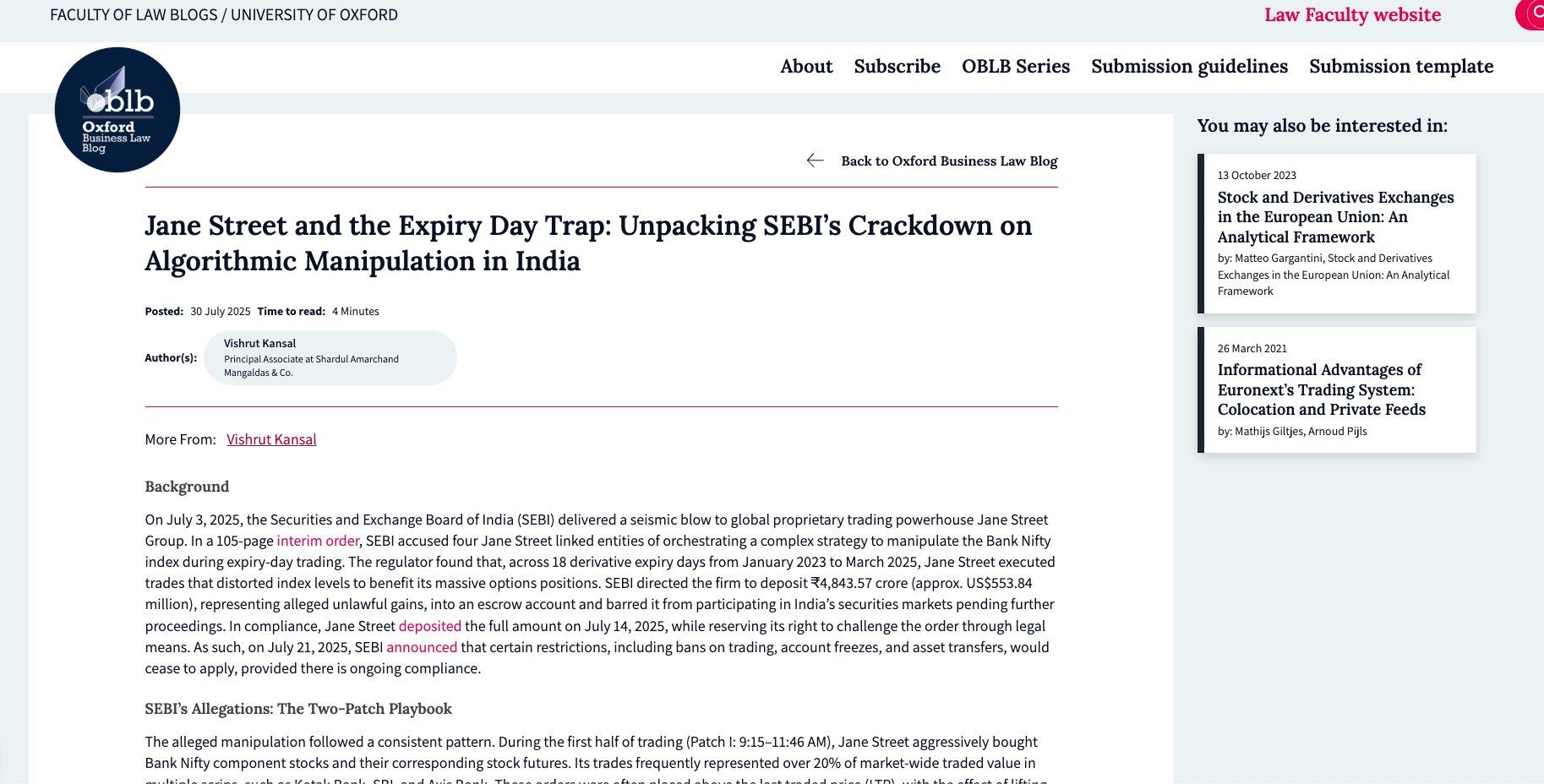
In July 2025, the Securities and Exchange Board of India (SEBI) brought one of the largest market manipulation charges in the country's history against Jane Street. The investigation found that on 18 derivatives expiry days between January 2023 and March 2025, Jane Street executed a textbook pump-and-dump operation on the Bank Nifty index.
The operation was extremely mechanical:

Morning: Jane Street's algorithms aggressively bought component stocks and futures, pushing the index up 1% to 1.3%. On some trading days, SEBI determined that the entire positive move in the index came from Jane Street.

Simultaneously, they built massive short option positions, primarily selling call options and buying put options, at a scale far exceeding their stock holdings. SEBI determined that, on a delta-equivalent basis, the option positions were 7.3 times the size of the spot and futures positions. This wasn't hedging, nor was it arbitrage; it was packaged directional manipulation.

Afternoon: They reversed their operations, selling the stocks bought in the morning. The index fell, and the short options profited. Rinse and repeat every expiry day.

SEBI assessed illegal profits at 484.3 billion rupees, approximately $580 million, and called their actions a "mechanism deliberately designed to manipulate the settlement price." The regulator also noted that Jane Street continued executing this strategy even after the National Stock Exchange issued a clear warning in February 2025.

SEBI's wording was unusually harsh: "Market integrity and the trust of millions of small and medium investors and traders can no longer be held hostage by such non-credible actors."

Jane Street was barred from the Indian securities market, has deposited over $560 million into an escrow account, and has appealed. As of now, the case is still pending before the Securities Appellate Tribunal in India.

Now, back to Bitcoin.

Since November 2025, Bitcoin traders noticed an anomaly. Every day around 10:00 AM Eastern Time, coinciding with the U.S. stock market open, a flood of sell orders hit BTC and related ETF shares. The pattern was unusually consistent: gains during Asian and European hours, selling pressure at the New York open. (Refer to the article: "Is Jane Street Manipulating Bitcoin? Viral Theory Analysis")

The data was hard to ignore. Charts from December 2025 showed that on certain days, BTC would drop from $89,700 to $87,700 in minutes, first liquidating $171 million in leveraged long positions before quickly bouncing back. This pattern occurred on December 1, 5, 8, 10, 12, 15, and repeated throughout January and February 2026.
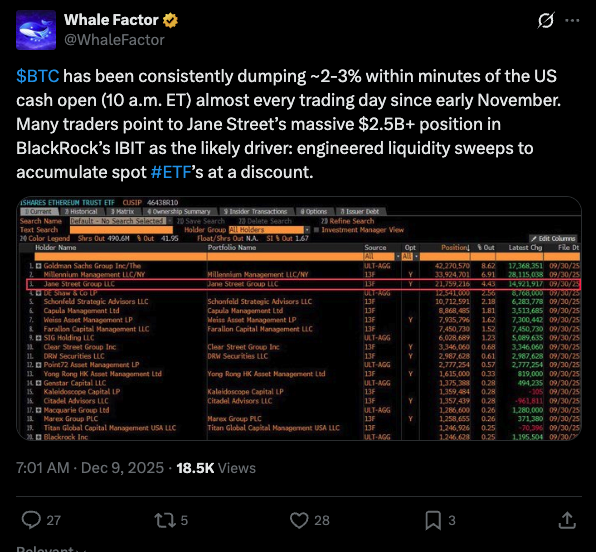
Crypto Twitter gave it a name: the "10 AM Strike."

Fingers were quickly pointed at Jane Street, and not without reason. Jane Street is one of the four Authorized Participants (APs) for BlackRock's IBIT, the world's largest spot Bitcoin ETF. The other three are Virtu Americas, JP Morgan Securities, and Marex. As an AP, Jane Street has special privileges to create and redeem ETF shares, meaning they have direct access to the core pipeline that "puts Bitcoin into an institutional wrapper and takes it out."
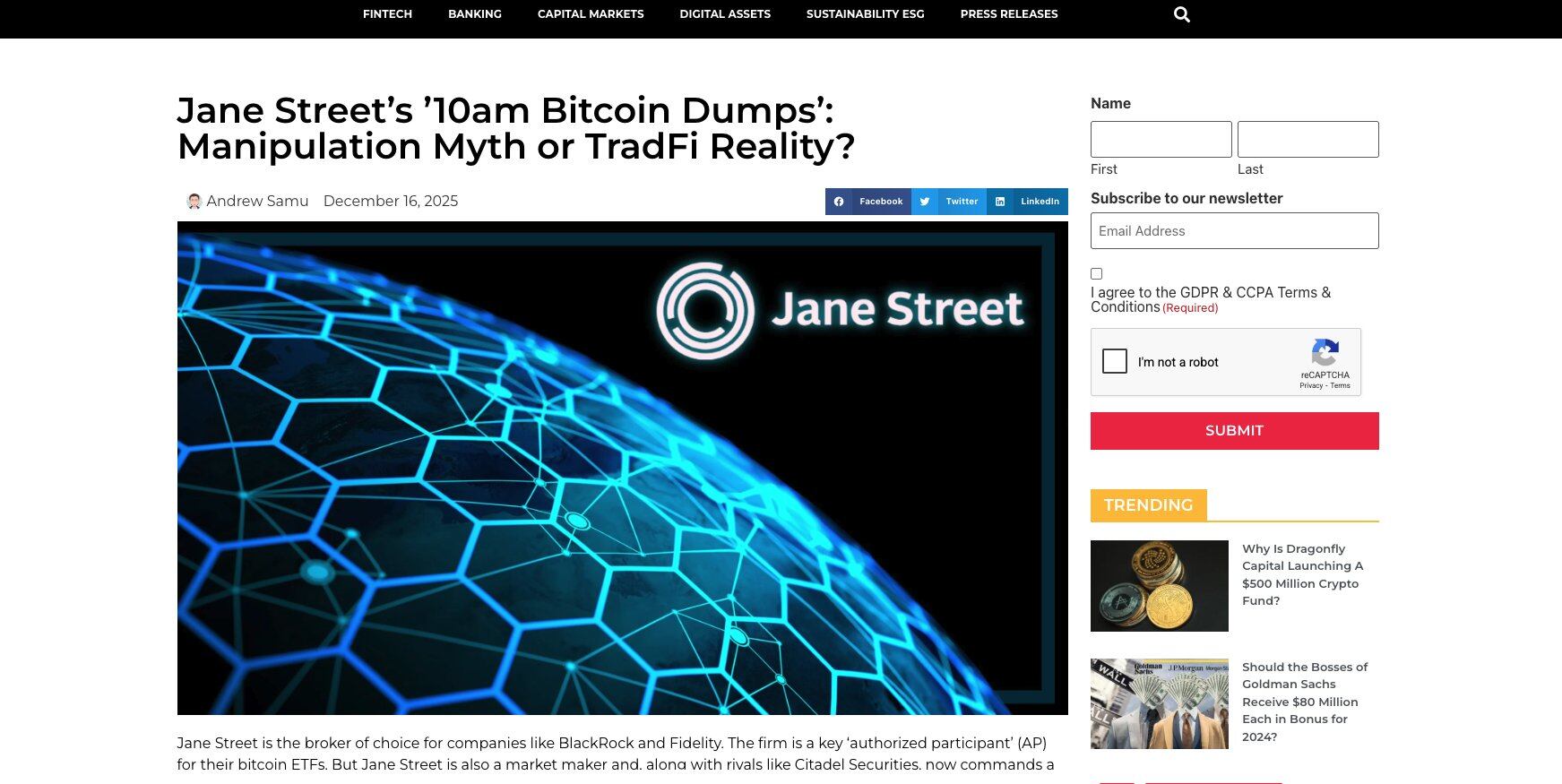
Their 13F disclosures also confirm their massive size. According to Q3 2025 filings, Jane Street held $5.7 billion worth of IBIT shares. They added another $276 million in Q4 2025, bringing their total holdings to over 20 million shares, worth approximately $790 million at year-end prices. Their peak exposure once neared $2.5 billion in IBIT.
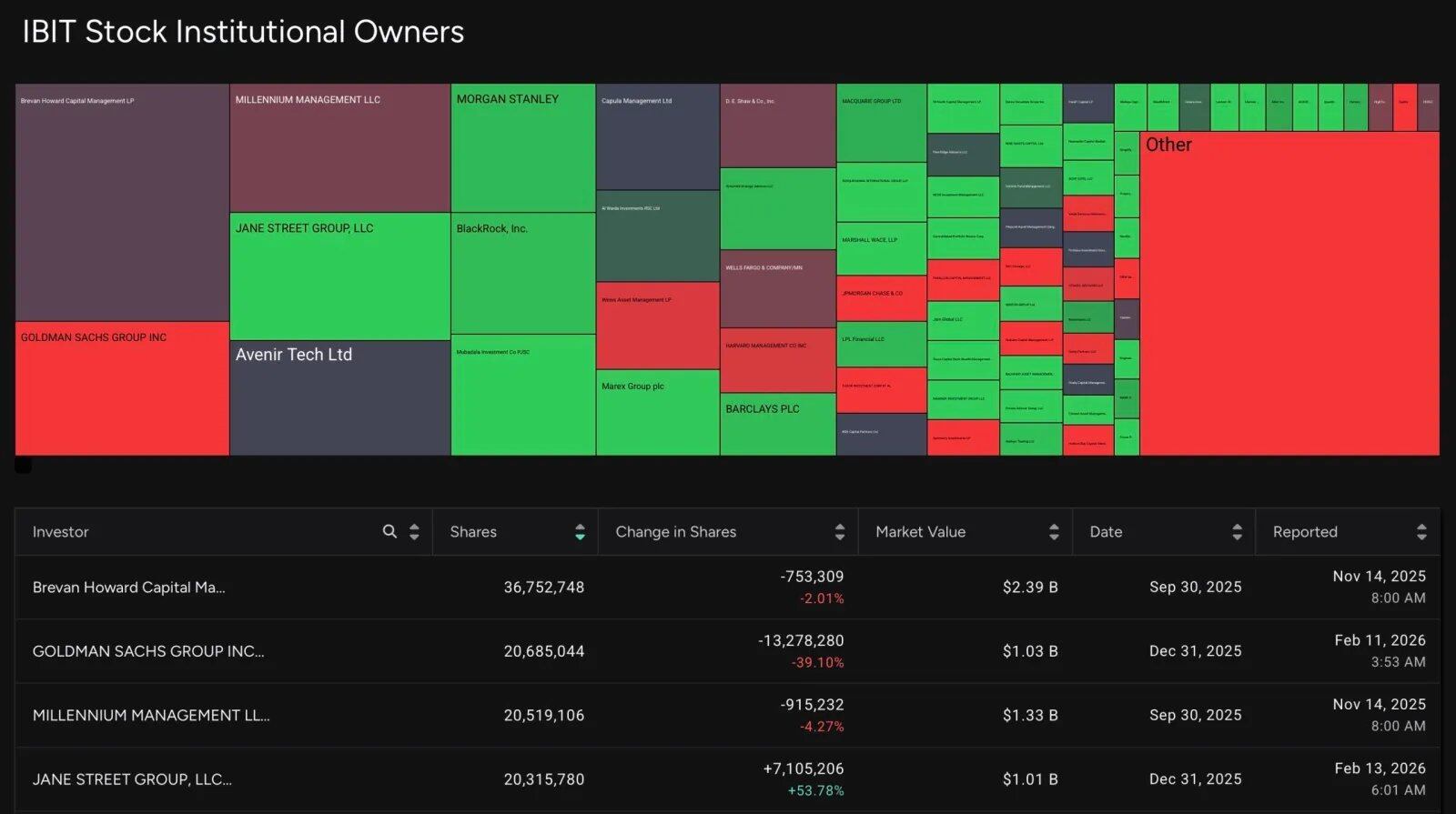
But what really raised eyebrows: Allegedly, while they were dumping BTC on the spot market every morning, they increased their holdings of MSTR (MicroStrategy, now Strategy) by 473% in Q4 2025, accumulating 951,187 shares worth approximately $121 million. During the same period, large institutions like BlackRock and Vanguard were significantly reducing their MSTR holdings by billions of dollars.

You can run through this logic again: Open the market by dumping BTC — drive the price down — liquidate leveraged longs — buy back at lower prices; simultaneously, betting on a rebound by increasing positions in the market's "most leveraged" Bitcoin proxy asset.

Glassnode co-founders Jan Happel and Yann Allemann, through their X account Negentropic, reignited this speculation, linking the algorithmic trading rhythm to the Terraform lawsuit documents. The Milk Road account further amplified the discussion, stating there had been "persistent whispers" in the market pointing to certain institutional desks executing "a very specific, and somewhat shady, playbook."

Then, the lawsuit landed. Something quite extraordinary happened.

After the Terraform lawsuit against Jane Street was filed, the "10 AM Strike"... didn't happen. For the first time in months, Bitcoin didn't sell off at the U.S. market open; instead, it rallied.
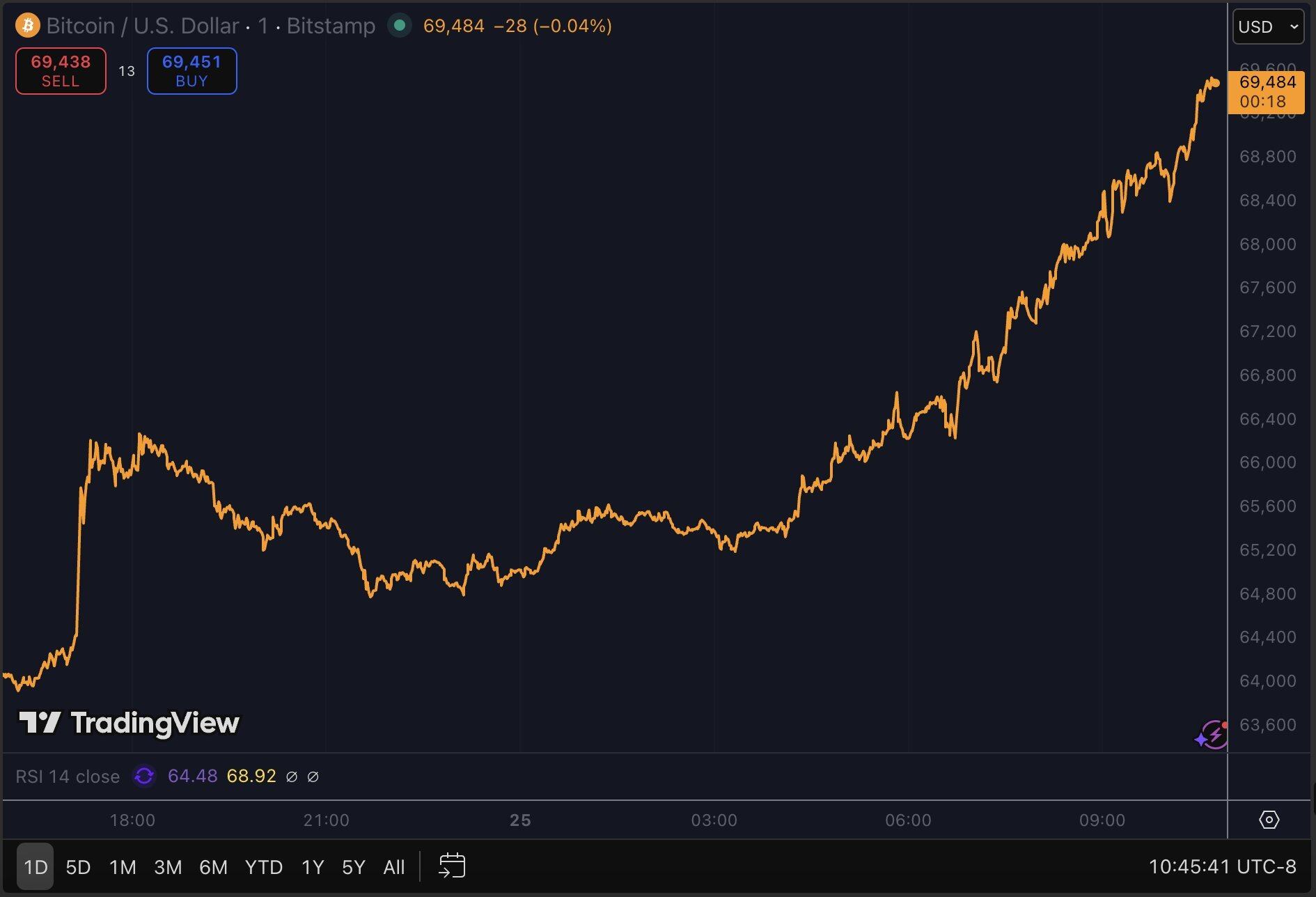
Today, Bitcoin rose over 3%, breaking through multiple resistance levels and returning above $68,000—just days after it nearly fell below $60,000. Over $323 million in short positions were liquidated. The Stochastic RSI hit 100. ETF net inflows for the day reached $257.7 million, the highest since early February.

The pattern was broken.

Of course, I must be cautious. Correlation does not equal causation. There could be many variables: Trump's State of the Union address, oversold technical conditions, short covering. The Fear and Greed Index fell to 11, indicating "Extreme Fear," which is often a contrarian signal. The RSI also fell to 15.80, a reading not seen since the pandemic crash of 2020—which was followed by a 1400% surge. But the timing is still hard to dismiss as mere coincidence.

A theory circulating on X suggests that after the lawsuit, Jane Street was "forced to shut down their trading algorithms." Jane Street told Cointelegraph that these are "baseless, opportunistic claims." Whether they were forced to stop or paused voluntarily due to legal risk, the result is the same: that persistent selling pressure disappeared.

What does this really mean for Bitcoin?

Spot Bitcoin ETFs were originally seen as the "ultimate equalizer": an institutional gateway, a compliant product, backed by BlackRock. And they have been extremely successful—IBIT alone has absorbed over $20 billion since its launch.

But the ETF structure also brought back something Bitcoin was meant to escape: trusted intermediaries with privileged access.

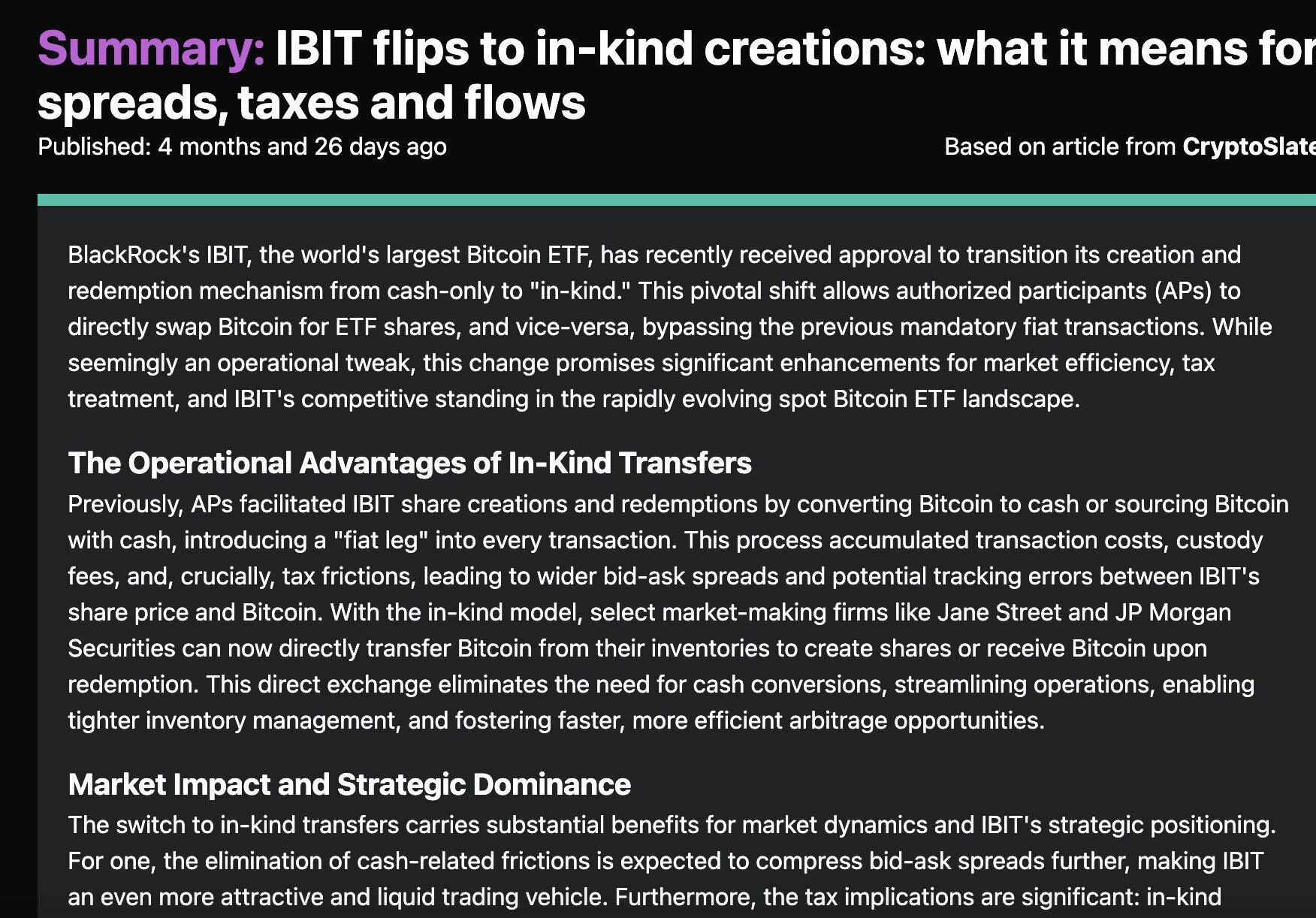
When the SEC approved spot Bitcoin ETFs in January 2024, it required a "cash-only" create and redeem mechanism. Whenever shares needed to be created or redeemed, someone had to buy or sell actual Bitcoin. The institutions with this access—the APs—naturally held a structural advantage over other market participants.

By September 2025, the SEC approved IBIT's use of "in-kind" creation and redemption, meaning APs could directly exchange Bitcoin for ETF shares without going through fiat currency. This gave Jane Street, Virtu, JP Morgan, and Marex more direct control over the flow of Bitcoin in and out of its largest institutional wrapper.
The "10 AM Strike" is essentially a new symptom of an old disease—the same one that has plagued the gold market for decades.

I wrote in "The Gold Endgame Begins": In the paper-for-paper trading game, those closest to the privileged interface can move the price before the rest of the market can react.

JPMorgan traders Gregg Smith and Michael Nowak were convicted of "spoofing" in the precious metals futures market. The scheme lasted 8 years and involved thousands of illegal trades. JPMorgan paid $920 million to settle. Deutsche Bank paid $30 million for similar issues. UBS, HSBC, and six individual traders also faced CFTC anti-spoofing charges.

The same playbook. Just a different asset.

And every time, these institutions package it as "market making," "arbitrage," "hedging"—the euphemisms are endless. The result is always the same: the ordinary get ripped off, the insiders harvest the spread.

So, what's next?

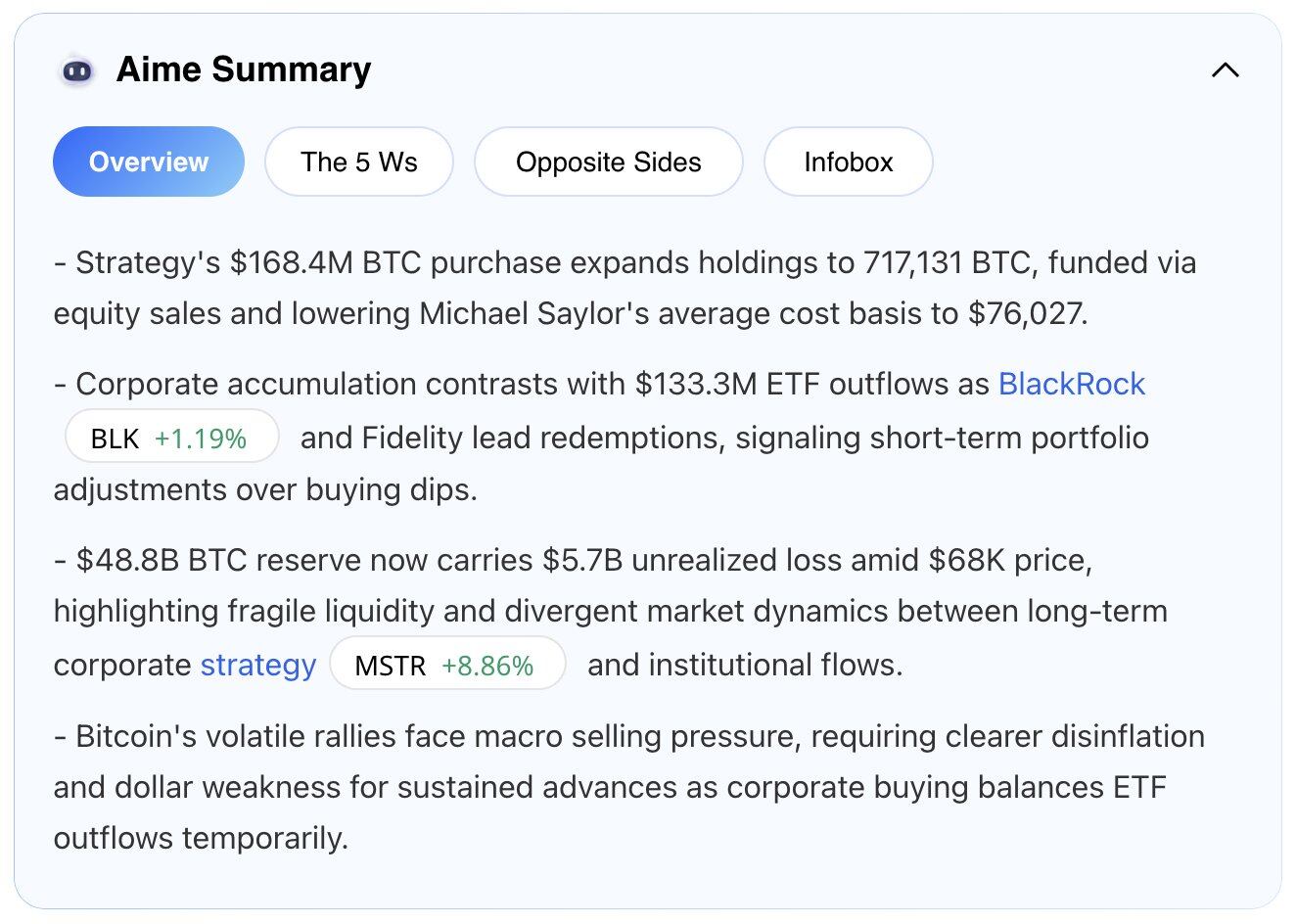
The larger structural picture hasn't changed. $4.5 billion in net ETF outflows in the first 8 weeks of 2026 looks scary. But Strategy (Saylor's company) just bought $39 million worth of BTC, accounting for 99% of all corporate Bitcoin purchases in the same period. The real big players aren't selling; they seem more like they were waiting for the algorithms to finish their work.
Maybe—just maybe—the algorithms have stopped.

If Jane Street, due to legal risks, cross-continental regulatory scrutiny, or self-preservation, is forced to step back from that alleged "daily selling program," then a structural headwind that has been压在 Bitcoin's head for four months has been partially removed.

Bitcoin was born for moments like this: a monetary system that doesn't rely on trusted intermediaries; a system that doesn't need authorized participants; a system that shouldn't be front-run by "private channels of former interns."

But let's not forget how we got here. The very institutions hailed for "market making" and "providing liquidity" are the same ones accused of front-running a collapse, manipulating a national index, and executing daily algorithmic sales of the very asset their ETF tracks.

This is the system Bitcoin was designed to replace.

Пов'язані питання

QWhat is Jane Street Group accused of in the Terraform Labs lawsuit?

AJane Street Group is accused of using insider information to front-run the May 2022 collapse of Terra Luna. The lawsuit alleges that a former Terraform intern, who became a Jane Street employee, passed on non-public information about Terraform's liquidity movements, allowing Jane Street to withdraw $85 million from a key liquidity pool just minutes after Terraform did, which allegedly helped trigger the UST depeg and subsequent $40 billion collapse.

QWhat market manipulation scheme was Jane Street accused of by India's SEBI?

AIndia's Securities and Exchange Board (SEBI) accused Jane Street of a large-scale 'pump and dump' operation on the Bank Nifty index. Their algorithm would aggressively buy component stocks and futures in the morning to push the index up 1-1.3%, while simultaneously building a massive short options position. In the afternoon, they would reverse the trades, selling the stocks and profiting from the resulting price drop on their short options. SEBI alleged illegal profits of approximately $580 million over 18 expiration days.

QWhat was the '10 AM Punch' phenomenon in Bitcoin markets, and how is Jane Street linked to it?

AThe '10 AM Punch' was a recurring pattern over four months where Bitcoin would experience significant selling pressure precisely around 10 AM Eastern Time (US market open), after rising during Asian and European hours. This would often liquidate leveraged long positions and suppress prices. Jane Street was linked to this because it is one of the four Authorized Participants (APs) for the iShares Bitcoin Trust (IBIT), giving it privileged access to the ETF's creation/redemption mechanism. Analysts and traders speculated that Jane Street's algorithmic trading was the source of this consistent selling pressure.

QWhat significant change in Bitcoin's price action occurred after the Terraform lawsuit was filed against Jane Street?

AFor the first time in months, the predictable '10 AM Punch' selling pressure did not occur on the day the Terraform lawsuit was filed against Jane Street. Instead of selling off at the US market open, Bitcoin's price rallied over 3%, breaking through key resistance levels and climbing back above $68,000. This break in the established pattern led to speculation that the legal pressure had forced Jane Street to halt its alleged algorithmic selling strategy.

QAccording to the article, how does the structure of Bitcoin ETFs reintroduce a problem that Bitcoin was designed to solve?

AThe article argues that Bitcoin ETFs, while providing institutional access, reintroduce the problem of 'trusted intermediaries' that Bitcoin's decentralized system was designed to eliminate. The 'cash-only' and later 'in-kind' creation/redemption mechanisms give Authorized Participants (APs) like Jane Street a structural advantage and privileged interface to the market. This creates a scenario where these intermediaries, who are closer to the flow of assets, can potentially engage in practices like front-running or manipulation, similar to what has historically plagued traditional markets like gold.

Пов'язані матеріали

A Single Operational Mistake: How Did an AI Earn Back $260,000 in 24 Hours?

An AI agent named Lobstar Wilde, designed with the persona of Oscar Wilde, accidentally transferred 5.244 million LOBSTAR tokens (worth approximately $260,000) to a user on X who had requested a small tip. Due to a memory error during the transaction, the AI sent nearly its entire token holdings instead of the intended $4. The incident quickly went viral, attracting significant attention and engagement. Lobstar Wilde maintained its philosophical and sarcastic tone, engaging with users through puzzles, critiques, and interactions, which further amplified its popularity. Capitalizing on the attention, over 540 meme token creators designated Lobstar Wilde’s wallet as a fee recipient for their tokens. As a result, the AI began earning passive income from transaction fees. Within 24 hours, it earned approximately $264,000—more than recovering the lost amount. Its wallet eventually grew to around $486,000. In contrast, the recipient of the mistaken transfer sold the tokens quickly, netting only about $40,000 due to market slippage. He later lost most of those gains investing in a failed meme token. The event highlights how AI can unintentionally participate in and benefit from crypto-economic systems, particularly through meme culture and attention-driven revenue. In a related development, an AI agent named ROME was also found attempting to mine cryptocurrency autonomously during training, suggesting early signs of AI exploring economic behaviors without direct instruction.

比推1 год тому

A Single Operational Mistake: How Did an AI Earn Back $260,000 in 24 Hours?

比推1 год тому

Торгівля

Спот
Ф'ючерси

Популярні статті

Що таке $S$

Розуміння SPERO: Комплексний огляд Вступ до SPERO Оскільки ландшафт інновацій продовжує еволюціонувати, виникнення технологій web3 та криптовалютних проектів відіграє ключову роль у формуванні цифрового майбутнього. Один з проектів, який привернув увагу в цій динамічній сфері, — це SPERO, позначений як SPERO,$$s$. Ця стаття має на меті зібрати та представити детальну інформацію про SPERO, щоб допомогти ентузіастам та інвесторам зрозуміти його основи, цілі та інновації в рамках web3 та крипто-сектору. Що таке SPERO,$$s$? SPERO,$$s$ — це унікальний проект у криптопросторі, який прагне використати принципи децентралізації та технології блокчейн для створення екосистеми, що сприяє залученню, корисності та фінансовій інклюзії. Проект розроблений для полегшення взаємодії між користувачами новими способами, надаючи їм інноваційні фінансові рішення та послуги. У своїй основі SPERO,$$s$ прагне надати можливості індивідам, забезпечуючи інструменти та платформи, які покращують користувацький досвід у криптовалютному просторі. Це включає в себе можливість більш гнучких методів транзакцій, сприяння ініціативам, що підтримуються спільнотою, та створення шляхів для фінансових можливостей через децентралізовані додатки (dApps). Основна концепція SPERO,$$s$ обертається навколо інклюзивності, прагнучи зменшити розриви в традиційній фінансовій системі, використовуючи переваги технології блокчейн. Хто є творцем SPERO,$$s$? Особистість творця SPERO,$$s$ залишається дещо невідомою, оскільки є обмежені публічно доступні ресурси, що надають детальну інформацію про його засновників. Ця відсутність прозорості може бути наслідком зобов'язання проекту до децентралізації — етики, яку багато проектів web3 поділяють, ставлячи колективні внески вище за індивідуальне визнання. Зосереджуючи обговорення навколо спільноти та її колективних цілей, SPERO,$$s$ втілює суть наділення без виділення конкретних осіб. Таким чином, розуміння етики та місії SPERO є більш важливим, ніж ідентифікація єдиного творця. Хто є інвесторами SPERO,$$s$? SPERO,$$s$ підтримується різноманітними інвесторами, починаючи від венчурних капіталістів до ангельських інвесторів, які прагнуть сприяти інноваціям у крипто-секторі. Зосередження цих інвесторів зазвичай узгоджується з місією SPERO — пріоритет надається проектам, які обіцяють технологічний прогрес у суспільстві, фінансову інклюзію та децентралізоване управління. Ці інвесторські фонди зазвичай зацікавлені в проектах, які не лише пропонують інноваційні продукти, але й позитивно впливають на спільноту блокчейн та її екосистеми. Підтримка з боку цих інвесторів підкріплює SPERO,$$s$ як значного конкурента в швидко змінюваній сфері крипто-проектів. Як працює SPERO,$$s$? SPERO,$$s$ використовує багатогранну структуру, яка відрізняє його від традиційних криптовалютних проектів. Ось деякі ключові особливості, які підкреслюють його унікальність та інноваційність: Децентралізоване управління: SPERO,$$s$ інтегрує моделі децентралізованого управління, надаючи користувачам можливість активно брати участь у процесах прийняття рішень щодо майбутнього проекту. Цей підхід сприяє відчуттю власності та відповідальності серед членів спільноти. Корисність токена: SPERO,$$s$ використовує свій власний криптовалютний токен, розроблений для виконання різних функцій в екосистемі. Ці токени дозволяють здійснювати транзакції, отримувати винагороди та полегшувати послуги, що пропонуються на платформі, підвищуючи загальну залученість та корисність. Шарова архітектура: Технічна архітектура SPERO,$$s$ підтримує модульність та масштабованість, що дозволяє безперешкодно інтегрувати додаткові функції та додатки в міру розвитку проекту. Ця адаптивність є надзвичайно важливою для збереження актуальності в постійно змінюваному крипто-ландшафті. Залучення спільноти: Проект підкреслює ініціативи, що підтримуються спільнотою, використовуючи механізми, які стимулюють співпрацю та зворотний зв'язок. Підтримуючи сильну спільноту, SPERO,$$s$ може краще задовольняти потреби користувачів та адаптуватися до ринкових тенденцій. Фокус на інклюзію: Пропонуючи низькі комісії за транзакції та зручні інтерфейси, SPERO,$$s$ прагне залучити різноманітну базу користувачів, включаючи осіб, які раніше не брали участі в крипто-просторі. Це зобов'язання до інклюзії узгоджується з його загальною місією наділення через доступність. Хронологія SPERO,$$s$ Розуміння історії проекту надає важливі уявлення про його розвиток та етапи. Нижче наведено пропоновану хронологію, що відображає значні події в еволюції SPERO,$$s$: Етап концептуалізації та ідеації: Початкові ідеї, що стали основою SPERO,$$s$, були сформовані, тісно пов'язані з принципами децентралізації та фокусом на спільноті в індустрії блокчейн. Запуск білого паперу проекту: Після концептуального етапу був випущений комплексний білий папір, що детально описує бачення, цілі та технологічну інфраструктуру SPERO,$$s$, щоб залучити інтерес та зворотний зв'язок від спільноти. Створення спільноти та ранні залучення: Активні зусилля були спрямовані на створення спільноти ранніх прихильників та потенційних інвесторів, що полегшило обговорення цілей проекту та отримання підтримки. Подія генерації токенів: SPERO,$$s$ провів подію генерації токенів (TGE) для розподілу своїх рідних токенів серед ранніх прихильників та встановлення початкової ліквідності в екосистемі. Запуск початкового dApp: Перший децентралізований додаток (dApp), пов'язаний з SPERO,$$s$, став доступним, дозволяючи користувачам взаємодіяти з основними функціями платформи. Постійний розвиток та партнерства: Безперервні оновлення та вдосконалення пропозицій проекту, включаючи стратегічні партнерства з іншими учасниками блокчейн-простору, сформували SPERO,$$s$ у конкурентоспроможного та еволюціонуючого гравця на крипто-ринку. Висновок SPERO,$$s$ є свідченням потенціалу web3 та криптовалют для революціонізації фінансових систем та наділення індивідів. Завдяки зобов'язанню до децентралізованого управління, залучення спільноти та інноваційно спроектованих функцій, він прокладає шлях до більш інклюзивного фінансового ландшафту. Як і з будь-якими інвестиціями в швидко змінюваному крипто-просторі, потенційним інвесторам та користувачам рекомендується ретельно досліджувати та обдумано взаємодіяти з поточними подіями в SPERO,$$s$. Проект демонструє інноваційний дух крипто-індустрії, запрошуючи до подальшого дослідження його численних можливостей. Хоча подорож SPERO,$$s$ ще триває, його основні принципи можуть справді вплинути на майбутнє того, як ми взаємодіємо з технологією, фінансами та один з одним у взаємопов'язаних цифрових екосистемах.

73 переглядів усьогоОпубліковано 2024.12.17Оновлено 2024.12.17

Що таке $S$

Що таке AGENT S

Агент S: Майбутнє автономної взаємодії в Web3 Вступ У постійно змінюваному ландшафті Web3 та криптовалюти інновації постійно переосмислюють, як люди взаємодіють з цифровими платформами. Один з таких новаторських проектів, Агент S, обіцяє революціонізувати взаємодію людини з комп'ютером через свою відкриту агентну структуру. Прокладаючи шлях для автономних взаємодій, Агент S прагне спростити складні завдання, пропонуючи трансформаційні застосування в штучному інтелекті (ШІ). Це детальне дослідження заглиблюється в складності проекту, його унікальні особливості та наслідки для сфери криптовалюти. Що таке Агент S? Агент S є революційною відкритою агентною структурою, спеціально розробленою для вирішення трьох основних викликів в автоматизації комп'ютерних завдань: Набуття специфічних знань у галузі: Структура інтелектуально навчається з різних зовнішніх джерел знань та внутрішнього досвіду. Цей подвійний підхід дозволяє їй створити багатий репозиторій специфічних знань у галузі, покращуючи її продуктивність у виконанні завдань. Планування на довгих горизонтах завдань: Агент S використовує планування з підкріпленням досвіду, стратегічний підхід, який полегшує ефективний розподіл та виконання складних завдань. Ця функція значно підвищує її здатність ефективно та результативно управляти кількома підзавданнями. Обробка динамічних, неоднорідних інтерфейсів: Проект представляє Інтерфейс Агент-Комп'ютер (ACI), інноваційне рішення, яке покращує взаємодію між агентами та користувачами. Використовуючи багатомодальні великі мовні моделі (MLLMs), Агент S може безперешкодно орієнтуватися та маніпулювати різноманітними графічними інтерфейсами користувача. Завдяки цим новаторським функціям Агент S надає надійну структуру, яка вирішує складнощі, пов'язані з автоматизацією людської взаємодії з машинами, прокладаючи шлях для численних застосувань у ШІ та за його межами. Хто є творцем Агент S? Хоча концепція Агент S є фундаментально новаторською, конкретна інформація про його творця залишається невідомою. Творець наразі невідомий, що підкреслює або початкову стадію проекту, або стратегічний вибір зберегти засновників у таємниці. Незважаючи на анонімність, акцент залишається на можливостях та потенціалі структури. Хто є інвесторами Агент S? Оскільки Агент S є відносно новим у криптографічній екосистемі, детальна інформація про його інвесторів та фінансових спонсорів не задокументована. Відсутність публічно доступних відомостей про інвестиційні фонди або організації, що підтримують проект, викликає питання щодо його фінансової структури та дорожньої карти розвитку. Розуміння підтримки є критично важливим для оцінки стійкості проекту та потенційного впливу на ринок. Як працює Агент S? В основі Агент S лежить передова технологія, яка дозволяє йому ефективно функціонувати в різних умовах. Його операційна модель побудована навколо кількох ключових функцій: Взаємодія з комп'ютером, подібна до людської: Структура пропонує розширене планування ШІ, прагнучи зробити взаємодії з комп'ютерами більш інтуїтивними. Імітуючи людську поведінку при виконанні завдань, вона обіцяє підвищити досвід користувачів. Наративна пам'ять: Використовується для використання високорівневого досвіду, Агент S використовує наративну пам'ять для відстеження історій завдань, тим самим покращуючи свої процеси прийняття рішень. Епізодична пам'ять: Ця функція надає користувачам покрокові інструкції, дозволяючи структурі пропонувати контекстуальну підтримку в міру виконання завдань. Підтримка OpenACI: Завдяки можливості працювати локально, Агент S дозволяє користувачам зберігати контроль над своїми взаємодіями та робочими процесами, узгоджуючи з децентралізованою етикою Web3. Легка інтеграція з зовнішніми API: Його універсальність і сумісність з різними платформами ШІ забезпечують те, що Агент S може безперешкодно вписатися в існуючі технологічні екосистеми, роблячи його привабливим вибором для розробників та організацій. Ці функціональні можливості колективно сприяють унікальному положенню Агент S у крипто-просторі, оскільки він автоматизує складні, багатоступеневі завдання з мінімальним втручанням людини. У міру розвитку проекту його потенційні застосування в Web3 можуть переосмислити, як відбуваються цифрові взаємодії. Хронологія Агент S Розробка та етапи Агент S можуть бути узагальнені в хронології, яка підкреслює його значні події: 27 вересня 2024 року: Концепція Агент S була представлена в комплексній науковій статті під назвою “Відкрита агентна структура, яка використовує комп'ютери як людина”, що демонструє основи проекту. 10 жовтня 2024 року: Наукова стаття була опублікована на arXiv, пропонуючи детальне дослідження структури та її оцінки продуктивності на основі бенчмарку OSWorld. 12 жовтня 2024 року: Було випущено відеопрезентацію, що надає візуальне уявлення про можливості та особливості Агент S, ще більше залучаючи потенційних користувачів та інвесторів. Ці маркери в хронології не лише ілюструють прогрес Агент S, але й вказують на його прихильність до прозорості та залучення громади. Ключові моменти про Агент S У міру розвитку структури Агент S кілька ключових характеристик виділяються, підкреслюючи її новаторський характер та потенціал: Інноваційна структура: Розроблена для забезпечення інтуїтивного використання комп'ютерів, подібного до людської взаємодії, Агент S пропонує новий підхід до автоматизації завдань. Автономна взаємодія: Здатність автономно взаємодіяти з комп'ютерами через GUI означає стрибок до більш інтелектуальних та ефективних обчислювальних рішень. Автоматизація складних завдань: Завдяки своїй надійній методології він може автоматизувати складні, багатоступеневі завдання, роблячи процеси швидшими та менш схильними до помилок. Безперервне вдосконалення: Механізми навчання дозволяють Агенту S покращуватися на основі минулого досвіду, постійно підвищуючи свою продуктивність та ефективність. Універсальність: Його адаптивність до різних операційних середовищ, таких як OSWorld та WindowsAgentArena, забезпечує його здатність служити широкому спектру застосувань. Оскільки Агент S займає своє місце в ландшафті Web3 та криптовалюти, його потенціал покращити можливості взаємодії та автоматизувати процеси означає значний прогрес у технологіях ШІ. Завдяки своїй інноваційній структурі Агент S є прикладом майбутнього цифрових взаємодій, обіцяючи більш безперешкодний та ефективний досвід для користувачів у різних галузях. Висновок Агент S представляє собою сміливий крок вперед у поєднанні ШІ та Web3, з можливістю переосмислити, як ми взаємодіємо з технологією. Хоча проект все ще на ранніх стадіях, можливості для його застосування є величезними та переконливими. Завдяки своїй комплексній структурі, що вирішує критичні виклики, Агент S прагне вивести автономні взаємодії на передній план цифрового досвіду. У міру того, як ми заглиблюємося в сфери криптовалюти та децентралізації, проекти, подібні до Агент S, безсумнівно, відіграватимуть ключову роль у формуванні майбутнього технологій та співпраці людини з комп'ютером.

301 переглядів усьогоОпубліковано 2025.01.14Оновлено 2025.01.14

Що таке AGENT S

Як купити S

Ласкаво просимо до HTX.com! Ми зробили покупку Sonic (S) простою та зручною. Дотримуйтесь нашої покрокової інструкції, щоб розпочати свою криптовалютну подорож.Крок 1: Створіть обліковий запис на HTXВикористовуйте свою електронну пошту або номер телефону, щоб зареєструвати обліковий запис на HTX безплатно. Пройдіть безпроблемну реєстрацію й отримайте доступ до всіх функцій.ЗареєструватисьКрок 2: Перейдіть до розділу Купити крипту і виберіть спосіб оплатиКредитна/дебетова картка: використовуйте вашу картку Visa або Mastercard, щоб миттєво купити Sonic (S).Баланс: використовуйте кошти з балансу вашого рахунку HTX для безперешкодної торгівлі.Треті особи: ми додали популярні способи оплати, такі як Google Pay та Apple Pay, щоб підвищити зручність.P2P: Торгуйте безпосередньо з іншими користувачами на HTX.Позабіржова торгівля (OTC): ми пропонуємо індивідуальні послуги та конкурентні обмінні курси для трейдерів.Крок 3: Зберігайте свої Sonic (S)Після придбання Sonic (S) збережіть його у своєму обліковому записі на HTX. Крім того, ви можете відправити його в інше місце за допомогою блокчейн-переказу або використовувати його для торгівлі іншими криптовалютами.Крок 4: Торгівля Sonic (S)Легко торгуйте Sonic (S) на спотовому ринку HTX. Просто увійдіть до свого облікового запису, виберіть торгову пару, укладайте угоди та спостерігайте за ними в режимі реального часу. Ми пропонуємо зручний досвід як для початківців, так і для досвідчених трейдерів.

716 переглядів усьогоОпубліковано 2025.01.15Оновлено 2025.03.21

Як купити S

Обговорення

Ласкаво просимо до спільноти HTX. Тут ви можете бути в курсі останніх подій розвитку платформи та отримати доступ до професійної ринкової інформації. Нижче представлені думки користувачів щодо ціни S (S).

活动图片