2026 Global Overview of Crypto Asset Taxation

marsbitОпубліковано о 2026-08-17Востаннє оновлено о 2026-08-17

Анотація

Global Cryptocurrency Tax Overview for 2026 As cryptocurrencies integrate into the mainstream financial system, tax treatments across jurisdictions have moved from initial regulatory gaps towards institutionalization. The OECD's 2020 report, *Taxing Virtual Currencies*, was a key early comparative study. Since then, more jurisdictions have clarified tax rules through existing laws, specific regulations, or guidance, increasing the procedural and technical complexity of crypto taxation. Currently, crypto taxation is predominantly built upon traditional tax frameworks, typically applying income tax, capital gains tax, corporate tax, and indirect taxes based on asset nature and transaction activity. The maturity of rules varies: basic trading and mining are well-covered, while DeFi, NFTs, and other on-chain activities involve more complex asset exchanges and profit recognition, with corresponding tax rules remaining underdeveloped. Significant disparities exist in tax treatment and effective tax burdens across jurisdictions. Crypto assets can trigger direct taxes, indirect taxes, and property-related levies. Factors such as holding period, transaction type, income nature, and taxpayer status further influence the tax outcome. The global crypto tax landscape is thus evolving from the initial question of "whether to tax" towards more nuanced classification and treatment of different assets, transactions, and economic activities. The scope of crypto tax rules continues to expan...

Author: FinTax

Abstract

As crypto assets gradually enter the mainstream financial system, jurisdictions are shifting from early regulatory gaps to institutionalization in their tax treatment. The OECD's 2020 publication, "Taxing Virtual Currencies," was one of the early comprehensive studies that systematically compared the tax treatment of crypto assets across multiple jurisdictions. Subsequently, with the development of the crypto asset market, an increasing number of jurisdictions have begun clarifying relevant tax treatments through existing tax laws, special provisions, or tax guidance, leading to continuous growth in the procedural and complex nature of crypto asset taxation.

From the perspective of existing systems, the taxation of crypto assets remains primarily built upon traditional tax frameworks. Jurisdictions typically incorporate them into existing income tax, capital gains tax, corporate income tax, and indirect tax systems based on the nature of the asset and transaction activities, further specifying details through special provisions or tax guidance. The maturity of rules varies across different activities. Common activities such as buying/selling and mining entered the tax system earlier, while on-chain native activities like DeFi and NFT involve more complex asset exchanges, income recognition, and transaction structures, with related tax rules still relatively lagging.

Meanwhile, significant differences exist in tax treatment and effective tax burdens across jurisdictions. Crypto assets may involve direct taxes, indirect taxes, and property-related taxes simultaneously. Different holding periods, transaction methods, income nature, and taxpayer status can also alter tax outcomes. Therefore, the global crypto asset tax system is gradually shifting from the question of whether to tax towards more refined classification and treatment of different assets, transactions, and economic activities.

Crypto Tax Rules Continue to Expand

Crypto assets entered the tax system relatively late. The OECD's 2020 report, "Taxing Virtual Currencies: An Overview of Tax Treatments and Emerging Tax Policy Issues," conducted a systematic comparison of the income tax, consumption tax, and property tax implications of crypto assets based on the participation of over 50 jurisdictions. It was the first comprehensive study of its kind covering such a broad range of jurisdictions at the time. The OECD noted that research into the tax implications of crypto assets in various regions was still in its early stages, with no consistent treatment established on fundamental issues such as asset nature, taxable events, income classification, and valuation.

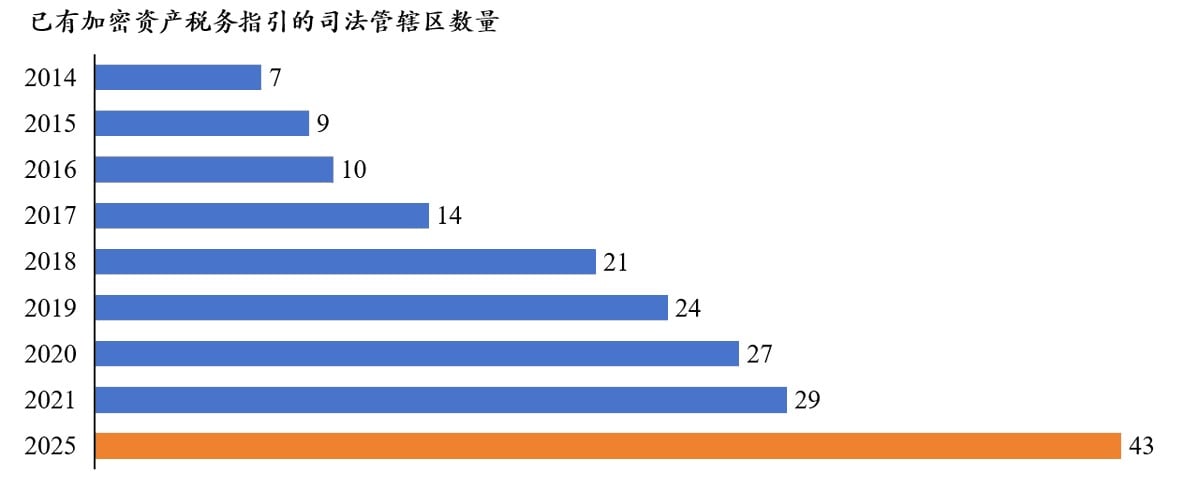
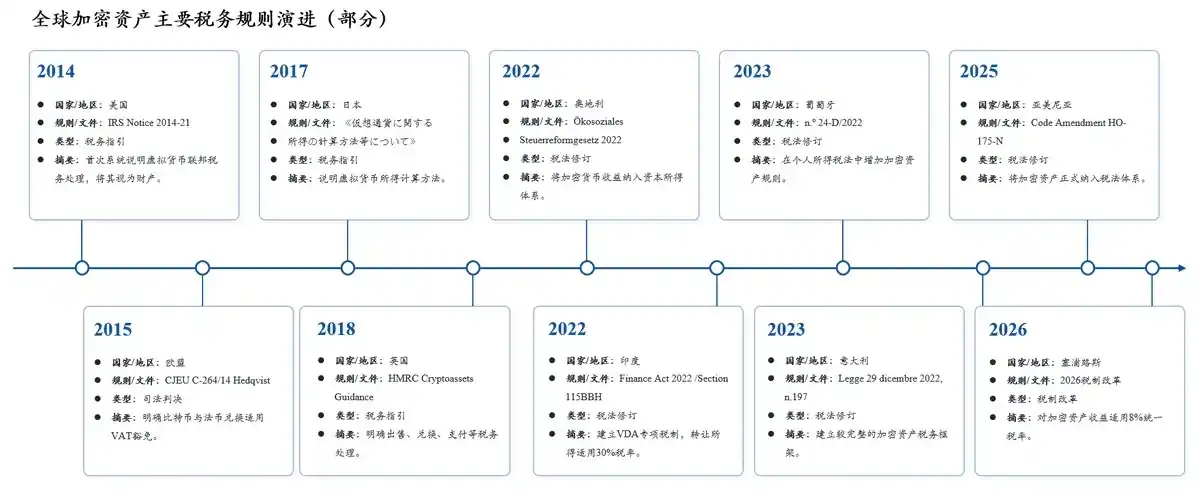
Since then, the coverage of crypto asset tax rules has continued to expand. PwC data from 2021 showed that jurisdictions with tax guidance for crypto assets increased from 7 in 2014 to 29 in 2021, more than quadrupling in seven years. By 2025, this number had further increased to 43. While coverage continued to expand, existing systems also accelerated in refinement and extension.
Existing Tax Regimes Still Dominate, with Diverging Rule Maturity

Currently, the taxation of crypto assets still primarily relies on existing tax systems. The U.S. continues to treat digital assets as property subject to general tax rules, while Australia's 2025 tax review concluded that existing tax laws already cover digital asset transactions. A European Commission comparison across 27 member states showed that most member states handle crypto assets mainly within the existing tax framework, with corporate crypto business income uniformly included in corporate income tax.
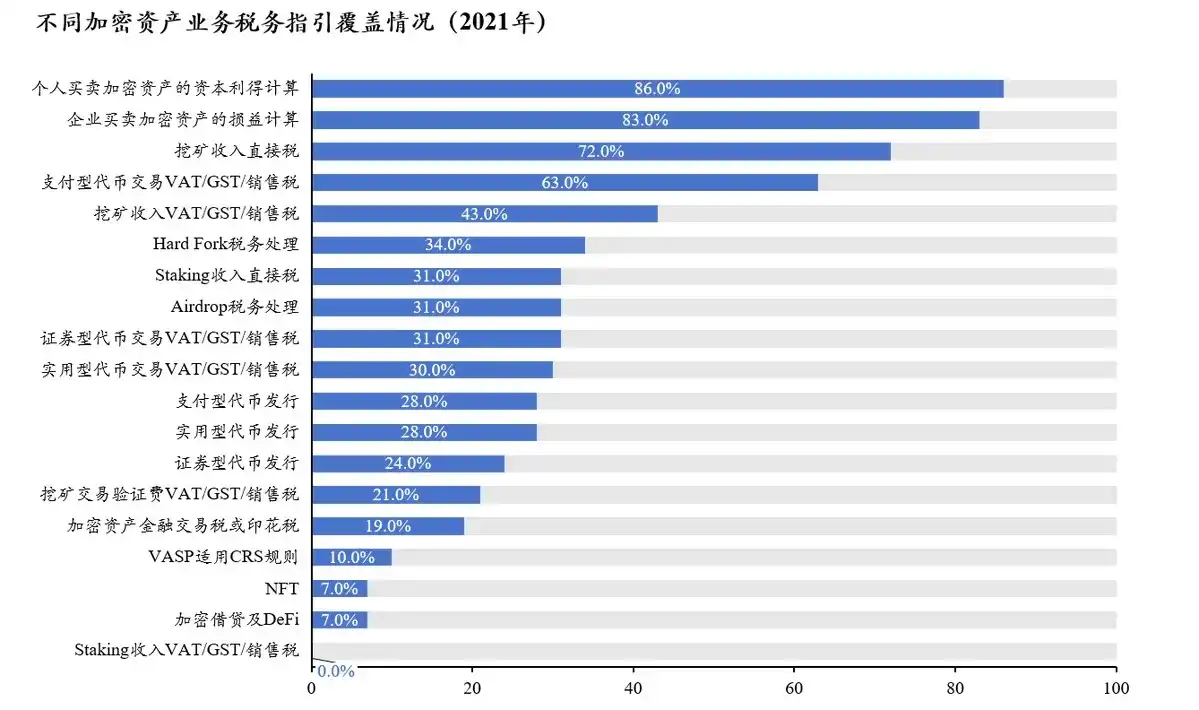
Tax rule coverage for different crypto activities is uneven. In PwC's 2021 survey of over 40 jurisdictions, the proportions having tax guidance for individual and corporate crypto asset buying/selling were 86% and 83% respectively, 72% for mining, but only 31% for staking, and just 7% each for DeFi and NFT. By 2025, this disparity persisted: Germany's latest income tax guidance for crypto assets covers many common transaction types, but NFT and liquidity mining are still not included; Australia also lists DAOs, DeFi, GameFi, and NFT as areas requiring further study. Overall, activities more easily mapped to traditional assets, income, and financial transactions are more readily absorbed by existing tax laws; the more complex the on-chain structure, the more tax rules tend to lag.

Significant Tax Burden Differences Across Jurisdictions

Crypto asset taxation is highly complex. The tax burden is not determined by a single rate but may involve multiple tax types such as personal income tax, capital gains tax, corporate income tax, value-added tax or sales tax, property tax, and inheritance tax. Specific application also depends on the nature of the transaction. For example, buying/selling, payments, mining, staking, and business operations may respectively constitute asset disposal, investment income, or business income, subject to different tax calculation rules.

Therefore, so-called "crypto tax friendliness" is a comprehensive judgment based on individual needs and jurisdictional rules. Beyond nominal tax rates, factors such as tax residency status, individual or corporate entity status, income classification, holding period, tax-exempt thresholds, and long-term holding incentives must be considered. The same jurisdiction may be friendly towards long-term personal investment but apply a completely different tax burden for high-frequency trading, mining, or corporate operations.

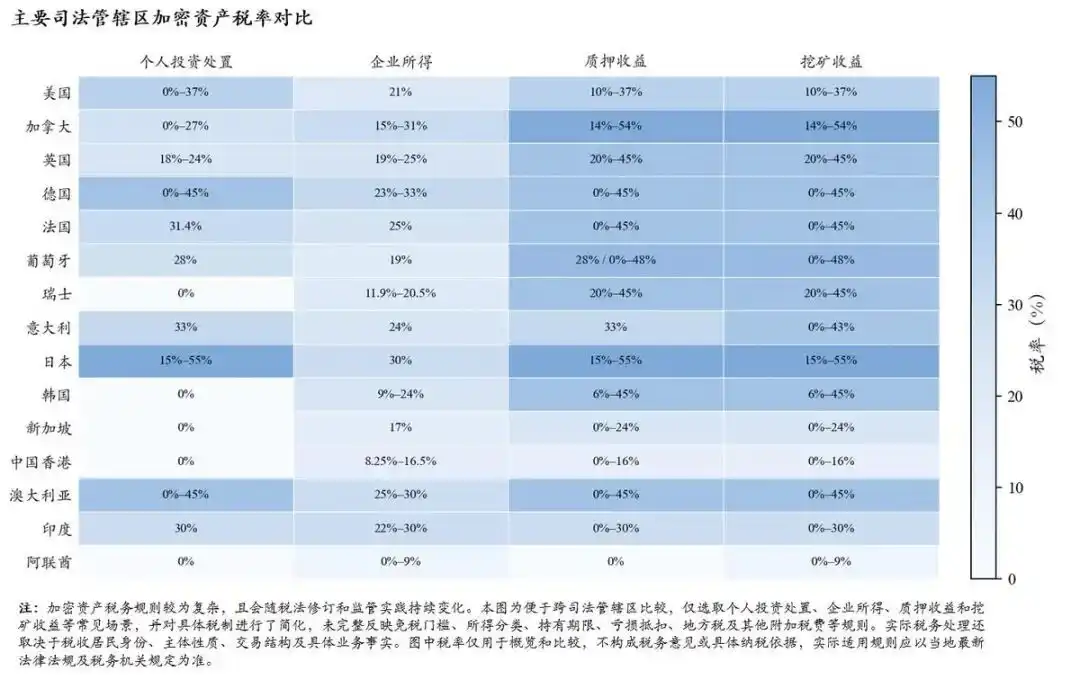
The figure below compares representative tax rates in major jurisdictions, considering common scenarios such as personal investment disposal, corporate income, staking rewards, and mining rewards. The comparison also factors in economic scale, crypto asset market activity, and regional representativeness, revealing significant differences in actual tax burdens. Given the complexity and continuous evolution of crypto asset tax rules globally, certain applicable conditions and special rules have been simplified in the figure for easier visual comparison. For complete tax rules of a specific jurisdiction, please refer to our series of foundational research on crypto taxation.
Пов'язані питання

QWhat was a key early comparative study on the taxation of cryptocurrencies published by the OECD in 2020?

AThe OECD published a key early comparative study titled 'Taxing Virtual Currencies: An Overview of Tax Treatments and Emerging Tax Policy Issues' in 2020, which systematically compared the income, consumption, and property tax treatments of crypto-assets across more than 50 jurisdictions.

QAccording to the article, how many jurisdictions had issued specific tax guidance on crypto-assets by 2025, based on the trend mentioned?

ABy 2025, the number of jurisdictions that had issued specific tax guidance on crypto-assets had increased to 43, continuing the expansion from 29 in 2021 and just 7 in 2014.

QWhat does the article identify as a primary characteristic of how crypto-assets are taxed globally?

AA primary characteristic is that the taxation of crypto-assets is still predominantly built upon traditional tax systems. Jurisdictions typically incorporate them into existing income tax, capital gains tax, corporate tax, and indirect tax frameworks, with further clarification through specific rules or guidance.

QWhich crypto-related activities had the lowest percentage of tax guidance coverage according to PwC's 2021 survey mentioned in the article?

AAccording to PwC's 2021 survey mentioned, DeFi and NFT activities had the lowest coverage, with only 7% of the over 40 surveyed jurisdictions having issued specific tax guidance for each. Staking was also relatively low at 31%.

QWhy is determining a 'crypto-tax-friendly' jurisdiction considered complex according to the article?

AIt is considered complex because tax liability is not determined by a single rate but can involve multiple taxes (e.g., income, capital gains, corporate, VAT/GST). The final outcome depends on factors like the taxpayer's status (individual/company), nature of the activity (trading, mining, staking), classification of income, holding period, and specific exemptions or incentives offered by the jurisdiction.

Пов'язані матеріали

'The Idea of Catching the Absolute Bottom Is Wrong': Experts on a New Phase of Bitcoin Capitulation

Analysts from CryptoQuant advise investors against trying to pinpoint the exact bottom of Bitcoin's price. Their data shows the percentage of the Bitcoin supply in profit has fallen to 51.4%, a level historically associated with capitulation phases followed by accumulation. This means approximately 48.6% of circulating coins are held at an unrealized loss. The metric, based on UTXO analysis comparing a coin's last moved price to its current market value, last neared this level in early 2023 when Bitcoin traded between $16,000 and $20,000. CryptoQuant states that the idea of catching the "absolute bottom" is flawed. The decline in the average cost basis during a bear market reflects coins transferring from weak hands to stronger, long-term holders. While some investors realize losses, others may use the decline for gradual accumulation. The accumulation window may last longer than many expect, even as fear drives some participants away. Historically, a supply in profit below 55% has been linked to re-accumulation periods. Separately, Swan Bitcoin CEO Cory Klippsten offered a forecast, suggesting Bitcoin could form a bottom in October 2026, followed by a recovery towards approximately $130,000 ahead of the 2028 halving. This aligns with the historical pattern of local lows forming about 12 months after bull market peaks; Bitcoin hit its all-time high above $126,000 in early October 2025. However, Klippsten cautioned against over-relying on past cycles due to limited historical data.

cryptonews.ru14 хв тому

'The Idea of Catching the Absolute Bottom Is Wrong': Experts on a New Phase of Bitcoin Capitulation

cryptonews.ru14 хв тому

How Does FalconX Bring Institutional Lending On-Chain? Deep Dive into the FALX Operational Mechanism

FALX is a structured credit facility that brings institutional prime brokerage loans on-chain as fixed-income assets. It works by having FalconX originate overcollateralized loans to institutional clients (e.g., quant funds, market makers). These loan exposures enter a bankruptcy-remote SPV. The Pareto protocol provides the on-chain credit vault infrastructure, while M11 Credit acts as the credit curator, administrative agent, and collateral agent. Platforms like Plume, Ethereum, and Solana serve as distribution channels for investors. Investors deposit USDC into the vault, receiving an estimated ~7.4% net yield (after a 10% performance fee). This yield represents a premium over low-risk on-chain alternatives (like tokenized Treasuries at ~4%) to compensate for risks including FalconX operational risk, collateral liquidation risk, SPV legal risk, M11's execution risk, a 31-day redemption notice period, and potential contagion from DeFi re-collateralization. The structure incorporates multiple risk mitigations: overcollateralized underlying loans, a first-loss capital contribution from FalconX, and independent oversight by M11. However, challenges remain, such as scaling investor demand (current AUM is ~$148M against a ~$1B potential capacity), managing redemption liquidity, and addressing new risks from the vault token's use as collateral in DeFi lending protocols like Morpho. FALX demonstrates a pragmatic path for on-chain credit by leveraging existing institutional loan origination and combining it with legal structures, external curation, and blockchain-based distribution.

marsbit15 хв тому

How Does FalconX Bring Institutional Lending On-Chain? Deep Dive into the FALX Operational Mechanism

marsbit15 хв тому

Торгівля

Спот
活动图片