Crypto Industry Backs Custodia in Supreme Court Dispute with Fed

cryptonews.ruОпубліковано о 2026-08-13Востаннє оновлено о 2026-08-13

Анотація

The Blockchain Association has urged the U.S. Supreme Court to consider crypto bank Custodia's lawsuit against the Federal Reserve. The suit stems from the Fed's denial of Custodia's application for a master account, which would grant the crypto-focused, Wyoming-chartered bank direct access to the Fed's payment system. In an amicus brief, the association argued that federal law compels the Fed to provide payment services to eligible non-member banks and that the Fed should not have broad discretion to deny access. It linked the case to alleged "Operation Choke Point 2.0" efforts to cut off crypto firms from banking services. An appeals court previously ruled the Kansas City Fed had the right to reject Custodia's 2020 application. This legal battle occurs as other crypto firms gain greater access to the U.S. banking system. Notably, Kraken Financial recently secured a limited-purpose master account from the same Kansas City Fed, while companies like Coinbase, Circle, Ripple, and others have received or applied for trust bank charters from the OCC. Traditional banking groups have opposed some of these moves, arguing crypto firms seek banking benefits without full regulatory burdens.

The Blockchain Association has urged the U.S. Supreme Court to consider Custodia Bank's lawsuit against the Federal Reserve over its refusal to approve a master account application, which would grant the crypto-focused bank direct access to the Fed's payment system.

In an amicus curiae brief filed on Wednesday, the industry group stated that federal law requires the central bank to provide payment services to eligible non-member banks. The association believes the Fed should not have broad discretion to deny access.

The association argued that the appellate court's decision effectively gives the Fed a veto over state-chartered banks, allowing it to withhold services essential for their independent operation. It also linked the Custodia case to the alleged de-banking of crypto companies under 'Operation Choke Point 2.0,' claiming federal regulators have discouraged banks from serving the digital asset industry.

Custodia, a state-chartered bank in Wyoming specializing in digital assets, applied for a Fed master account in 2020. The bank sought direct access to the central bank's payment services without relying on an intermediary financial institution.

The Federal Reserve Bank of Kansas City denied Custodia's application in 2023. Later, the Tenth Circuit Court of Appeals ruled that the regional Fed branch had the authority to deny the request. In March, the appeals court voted 7-3 against rehearing the case, leaving the Supreme Court as Custodia's only avenue for appeal.

The Blockchain Association stated that the Tenth Circuit Court of Appeals interpreted the Fed's authority too broadly, essentially permitting it to deny payment system access to eligible state-chartered banks serving the crypto industry.
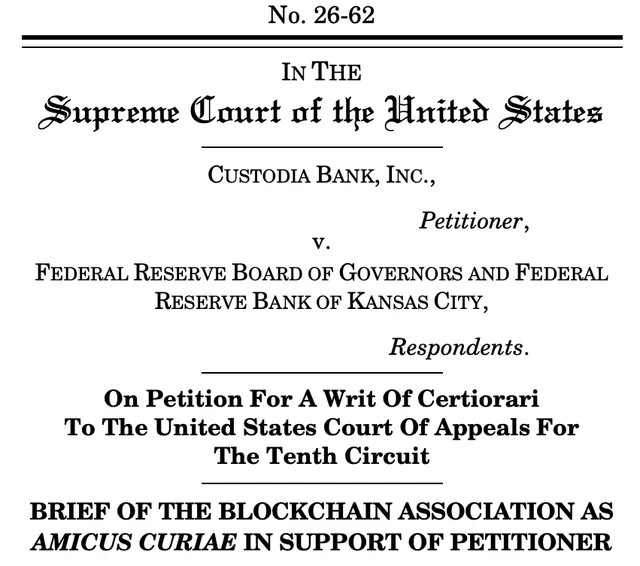
Blockchain Association supports Custodia's Supreme Court petition. Source: U.S. Supreme Court petition

Related: Goldman Sachs CEO backs 'imperfect' CLARITY law ahead of expected vote

Crypto Companies Gain Broader Access to U.S. Banking System

Custodia's lawsuit unfolds against a backdrop of other crypto companies securing wider access to the U.S. banking system. This includes federal licenses and, in one case, direct access to Fed payment infrastructure.

In March, Kraken Financial became the first crypto banking unit to obtain a limited-purpose master account from the Federal Reserve Bank of Kansas City, giving it direct access to Fedwire. This approval contrasts with Custodia's rejection by the same regional Fed bank in 2023.

In April, Coinbase received conditional approval from the Office of the Comptroller of the Currency (OCC) to form a national trust company, moving its custodial business under federal oversight but without the ability to take retail deposits or operate as a commercial bank.

In July, Circle received final OCC approval to create a national trust bank, and the following month, Kraken's parent company Payward filed for its own national trust company license. In December, the OCC also conditionally approved applications for national trust banks from Ripple, BitGo, Fidelity Digital Assets, and Paxos.

This trend has faced resistance from traditional banking groups. The Independent Community Bankers of America opposed Coinbase's approval in April, arguing that crypto companies seek the benefits of banking charters without being subject to the full regulatory framework applied to traditional banks.

Magazine: Bitcoin will never fall below $60K again: Nansen founder

Пов'язані питання

QWhat is the main reason for the legal dispute between Custodia Bank and the Federal Reserve?

AThe Federal Reserve Bank of Kansas City refused to approve Custodia Bank's application for a master account, which would grant the crypto-focused bank direct access to the Fed's payment system.

QWhich organization filed an amicus curiae brief in support of Custodia's Supreme Court petition, and what was its key argument?

AThe Blockchain Association filed the amicus curiae brief. Its key argument was that federal law requires the central bank to provide payment services to eligible non-member banks, and the Fed should not have broad discretion to deny access.

QWhat contrasting example from 2024 is provided regarding a crypto company gaining direct Fed payment system access, and from which Federal Reserve Bank?

AIn March 2024, Kraken Financial obtained a limited-purpose master account from the Federal Reserve Bank of Kansas City, the same regional Fed that denied Custodia's application. This gave Kraken direct access to Fedwire.

QBesides master accounts, what other primary method of accessing the U.S. banking system have crypto companies pursued in 2024, and which regulator is involved?

ACrypto companies have pursued obtaining federal trust charters from the Office of the Comptroller of the Currency (OCC). In 2024, companies like Coinbase, Circle, Ripple, BitGo, Fidelity Digital Assets, and Paxos received conditional or final OCC approvals for national trust bank charters.

QWhat criticism did traditional banking groups level against the regulatory approvals for crypto companies like Coinbase?

ATraditional banking groups, such as the Independent Community Bankers of America, argued that crypto companies were seeking the benefits of banking charters without being subject to the full regulatory framework applied to traditional banks.

Пов'язані матеріали

Trezor Customer Data Leak: Coins Are Safe, But Phishing Is Inevitable

Trezor, a hardware cryptocurrency wallet manufacturer, reported a data breach at its logistics partner, ShipMonk, affecting around 13,689 customers. The incident, confirmed on August 13, 2026, involved unauthorized access to ShipMonk's systems, which stored order information from May 10 to August 8, 2026. Trezor's own systems and user crypto assets were not compromised. The leaked data varies: for 11,742 customers, full names, email addresses, phone numbers, and delivery addresses were exposed. For 1,947 others, only name, city, and email were leaked. The breach was limited to customers in the US, UK, Sweden, Colombia, Brazil, Italy, and Portugal. Trezor warns affected users of an increased risk of phishing attacks, where malicious actors may use the stolen contact details to impersonate Trezor, banks, or exchanges to steal wallet recovery phrases. All impacted customers have been notified via email. In response, Trezor announced a planned "Anonymous Delivery" feature for the EU (September 2026) and the US (end of 2026), aiming to anonymize logistics data. ShipMonk has not yet issued a public statement on its official website. The analysis highlights this as a recurring industry pattern where third-party logistics vendors become weak links in the supply chain, storing data longer than necessary. Similar incidents, like the 2020 Ledger breach, led to prolonged phishing campaigns. A key question remains whether hardware wallets can ever fully decouple from external logistics risks.

cryptonews.ru7 хв тому

Trezor Customer Data Leak: Coins Are Safe, But Phishing Is Inevitable

cryptonews.ru7 хв тому

Token Buyback Volumes Continue to Rise, But Price Lows Keep Falling

The volume of token buybacks continues to grow, but the minimum price level is constantly declining, according to an internal memo by Bitwise CIO Matt Hogan. He argues that most crypto tokens, except Bitcoin, are undervalued as investors are unaware of the revenue now being returned to holders. He highlights the example of Hyperliquid, which has bought back and burned $1.3 billion worth of its $HYPE token. Hogan posits that tokens are beginning to trade based on revenue, similar to stocks and bonds, marking the end of an era where scaling networks provided little token utility. He links token valuation to strengthening protocol revenue, noting that Hyperliquid has earned over $800 million in the past year and spends nearly all fees on $HYPE buybacks. Following this model, protocols like Uniswap and Aave have implemented fee mechanisms to buy back and burn their own tokens. The trend has also affected base chains like Solana and Aptos, which have proposed or enacted higher fee burns. However, the memo acknowledges that reducing token supply has not reliably boosted prices. A Cryptopolitan report found many tokens with regular buybacks still underperformed the market. Even Hyperliquid's upward trend broke, and Pump.fun conducted significant buybacks near token lows. Hogan cautions that token buybacks differ from stock buybacks due to the lack of contractual claims on profits or assets, as governance rules can always be rewritten.

cryptonews.ru57 хв тому

Token Buyback Volumes Continue to Rise, But Price Lows Keep Falling

cryptonews.ru57 хв тому

Торгівля

Спот
活动图片