"We're Back": Michael Saylor Hints Company May Resume Bitcoin Purchases

cryptonews.ruОпубліковано о 2026-08-30Востаннє оновлено о 2026-08-30

Анотація

Speculation that MicroStrategy (MSTR) may resume buying Bitcoin surged after executive chairman Michael Saylor posted a cryptic message on X on August 30. The post consisted of the phrase "We're ₿ack" and an accompanying chart showing the company's holdings of 840,447 BTC, valued at approximately $65.72 billion. This came after two consecutive weeks with no Bitcoin transactions reported by the company. MicroStrategy's last SEC filing, dated August 24, confirmed its holdings of 840,447 BTC were acquired for $63.36 billion at an average price of $75,385 per Bitcoin. The company reported no purchases or sales between August 17 and 23. Instead, it raised capital by selling MSTR shares for about $2.01 billion, boosting its total US dollar liquidity to $6.69 billion. This capital reorganization had paused Bitcoin acquisitions. Saylor's post followed a significant Bitcoin price recovery from around $65,000 on August 19 to over $79,000 by August 30. As the largest publicly traded corporate Bitcoin holder, controlling roughly 4% of the total 21 million supply, MicroStrategy's potential return to the buyer's market is closely watched. The company has $1.59 billion in flexible cash reserves that the board could allocate for further Bitcoin purchases, dividends, debt repayment, or other treasury purposes. The next corporate report will clarify if the "We're ₿ack" message signaled an actual new acquisition.

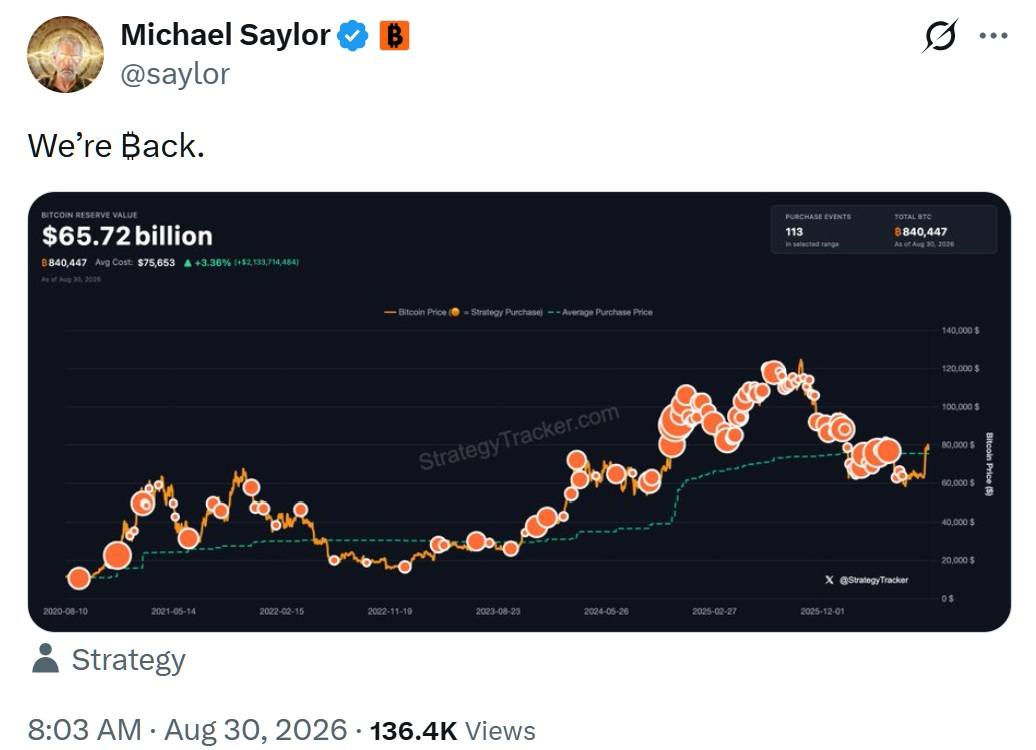
Speculation about the resumption of bitcoin purchases arose on Sunday after MicroStrategy Inc. (Nasdaq: MSTR) Executive Chairman Michael Saylor posted a chart of the company's assets without describing its future actions regarding treasury assets. Saylor shared this cryptic message on X on August 30, as investors awaited MicroStrategy's next report after two consecutive weeks without bitcoin transactions.

The attached chart showed that MicroStrategy owns 840,447 $BTC, with the reserve's value estimated at $65.72 billion. It also displayed the company's transactions compared to the market price of bitcoin and the average acquisition cost. The message itself consisted of two words, with Saylor replacing a character inside the last word with the bitcoin symbol, stating:

“We’re ₿ack.”
This post should be viewed more as a potential signal than as a transaction disclosure; to confirm whether the company's assets have changed, one must review its filings with regulators. In MicroStrategy's August 24 report filed with the U.S. Securities and Exchange Commission, it indicated the acquisition of 840,447 $BTC for $63.36 billion at an average price of $75,385 per bitcoin, including fees and expenses.

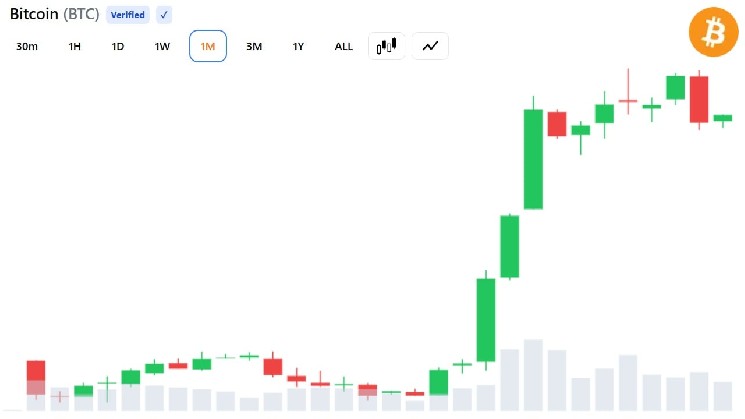
Saylor's post followed a sharp recovery in the bitcoin price, beginning on August 19, when $BTC rose from around $65,000 and surpassed $75,000 by August 21. On August 27, bitcoin reached around $81,000, and at the time of writing on August 30, it was trading around $79,000.
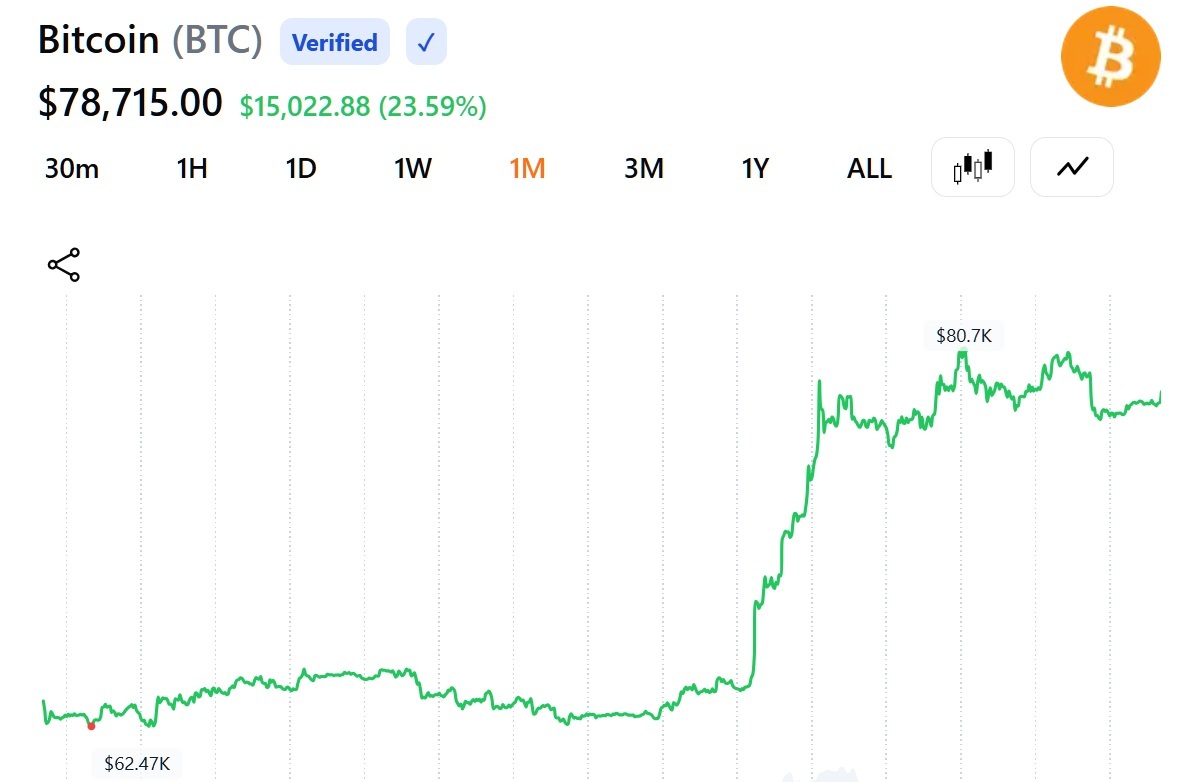
Bitcoin price chart as of August 30. Source: Bitcoin.com Markets.

$6.69 Billion in Dollar Liquidity

MicroStrategy reported no bitcoin purchases or sales during the period from August 17 to 23, leaving its reserve unchanged for the second consecutive week. Instead, the company sold MSTR shares for approximately $2.01 billion, increased its restricted dollar reserve to $5.10 billion, formed a U.S. dollar cash balance of $1.59 billion, and repurchased STRC preferred shares for $136.4 million.

This capital reallocation paused bitcoin purchases while increasing total dollar liquidity to $6.69 billion. Unlike the U.S. dollar reserve, which is used to pay preferred share dividends and interest, the separate U.S. dollar cash account can be used to fund bitcoin acquisitions, security buybacks, convertible note redemptions, or further reserve increases.

MicroStrategy's official bitcoin ledger records all disclosed acquisition and sale transactions, including four sales totaling 6,916 $BTC made after the last purchase on June 22. The latest sale transaction was 1,690 $BTC for $108.6 million during August 3-9, reducing the company's asset volume to the current level of 840,447 $BTC.
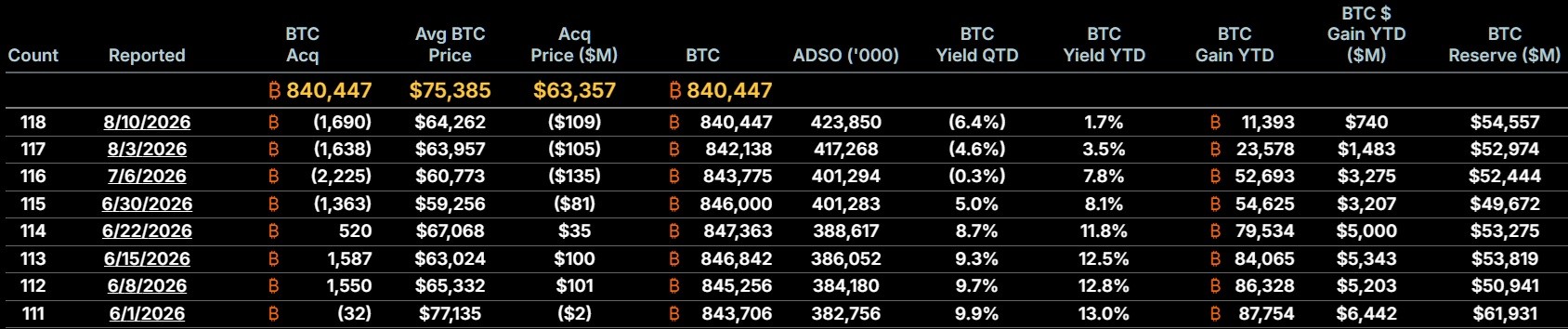
MicroStrategy $BTC ledger as of August 30. Source: MicroStrategy Inc.

The corporate bitcoin treasury holds $BTC as a company reserve asset, using cash, shares, debt, or other securities to finance its position. MicroStrategy pioneered this model in August 2020 and remains the largest publicly traded corporate holder of bitcoin, controlling approximately 4% of bitcoin's fixed supply of 21 million.

Saylor Expands His Bitcoin Message

New speculation around a transaction followed a series of more general statements by Saylor about bitcoin's role in global finance. He recently called for a "bitcoin reformation" beyond early ideological orthodoxy, arguing that institutional custody, banks, corporations, governments, and bitcoin-backed securities could expand access while preserving the possibility of direct ownership.

Saylor also characterized bitcoin's "deepest breakthrough" as economically valuable, digitally governed property. He stated that this capability could extend to individuals, families, companies, machines, and states, thus expanding his characterization of bitcoin from peer-to-peer electronic cash to digital property.

MicroStrategy's next report will reveal whether the phrase “We’re ₿ack” accompanied a new acquisition deal or signaled another treasury decision. At the beginning of the last reporting period, the company had $1.59 billion in flexible cash that the board of directors could allocate to bitcoin purchases, dividend payments, debt redemption, security buybacks, or other company treasury purposes.

end-content

Пов'язані питання

QWhat triggered speculation about MicroStrategy resuming Bitcoin purchases according to the article?

ASpeculation was triggered after MicroStrategy's Executive Chairman Michael Saylor posted a cryptic message on X on August 30, stating 'We're ₿ack,' alongside a chart showing the company's Bitcoin holdings, after two consecutive weeks with no Bitcoin transactions.

QWhat were the details of MicroStrategy's Bitcoin holdings as shown in the chart Michael Saylor shared?

AThe chart showed that MicroStrategy held 840,447 BTC, with a reserve value estimated at $65.72 billion. It also displayed the company's transactions compared to Bitcoin's market price and average acquisition cost.

QWhat financial moves did MicroStrategy make in the reporting period from August 17 to 23, and how did it affect their Bitcoin buying?

AMicroStrategy reported no Bitcoin purchases or sales during that period. Instead, it sold MSTR shares for approximately $2.01 billion, increased its restricted US dollar reserve to $5.10 billion, formed $1.59 billion in US dollar cash, and redeemed $136.4 million in STRC preferred shares. This capital reallocation paused Bitcoin purchases.

QWhat is the total dollar liquidity MicroStrategy had available at the time of the article, and what are its potential uses?

AMicroStrategy had a total dollar liquidity of $6.69 billion. The separate US dollar cash account (part of this liquidity) can be used to finance Bitcoin acquisitions, securities repurchases, convertible note redemptions, or further increasing reserves.

QHow did Michael Saylor's recent public statements characterize Bitcoin's role, beyond the potential transaction hint?

ASaylor called for a 'Bitcoin reformation' beyond early ideological orthodoxy. He argued that institutional custody, banks, corporations, governments, and Bitcoin-backed securities could expand access while preserving direct ownership. He also characterized Bitcoin's 'deepest breakthrough' as economically valuable digital property.

Пов'язані матеріали

ECB's Schnabel says central bank money 'should move to blockchain'

ECB Executive Board member Isabel Schnabel stated that central bank money "must move onto the blockchain." She argued that stablecoins lack the independent ability to scale liquidity during financial stress—a gap only a central bank can fill. Her proposed solution involves tokenization, which she says can make transactions faster, safer, and more programmable, but only if the safest asset (central bank money) is on the same "rails" as other tokenized assets. This marks a notable shift for the Eurosystem, which had previously viewed Distributed Ledger Technology (DLT) mainly as a tool for regulating stablecoins and crypto, not as infrastructure to adopt directly. The first step is Project Pontes, launching in September. It will initially synchronize the ECB’s existing TARGET services with private DLT platforms. Eventually, it aims to enable settlement finality on a Eurosystem-managed DLT platform with smart contract functionality and 24/7 operation. The long-term strategy is Project Appia, tasked with developing the architecture, standards, and legal framework for a genuine European tokenized asset market by 2028. Trials have already processed around €1.6 billion, and since March 2026, the ECB accepts DLT-based assets as collateral. While not directly impacting Bitcoin's price, these developments signal that a major G7 central bank is preparing to settle transactions on-chain, lending legitimacy to the underlying infrastructure of crypto markets. The ECB's move to avoid "disintermediation" by private tokenization shows that debates in central bank boardrooms are now aligning with discussions long followed in the crypto space.

cryptonews.ru2 год тому

ECB's Schnabel says central bank money 'should move to blockchain'

cryptonews.ru2 год тому

Ripple Labs Warns of a New Challenge for Blockchains

Ripple Labs is preparing the XRP Ledger for quantum threats but now emphasizes a broader challenge: ensuring financial infrastructure can adapt simultaneously to quantum computing and artificial intelligence. Senior Director of Engineering Ayo Akinyele states the goal is not merely anticipating a "Q-Day" but building infrastructure capable of preemptively adopting new security mechanisms without network disruption. The shift to post-quantum cryptography involves more than swapping algorithms; it requires flexible infrastructure, improved key management, and clear upgrade paths. Financial systems were not designed with quantum computers in mind, necessitating a rethink of transaction, identity, asset, and data protection. This is underscored by significant investments, such as the $2 billion U.S.-IBM quantum factory initiative and a 2030 U.S. government mandate for post-quantum cryptography adoption. AI introduces distinct risks by driving automation and autonomous economic activity, increasing demand for an always-on, internet-oriented payment infrastructure. AI agents could soon conduct transactions independently, creating new security requirements. Ripple Labs advocates for proactive, orderly preparation rather than a crisis-driven transition, having outlined a four-phase strategy aiming for a full XRP Ledger transition by 2028, now expanded to address both quantum and AI-driven challenges.

cryptonews.ru2 год тому

Ripple Labs Warns of a New Challenge for Blockchains

cryptonews.ru2 год тому

Торгівля

Спот
活动图片