Breaking: Alibaba Bans Claude Entirely, Mandatory Uninstallation Effective July 10th

marsbitОпубліковано о 2026-07-03Востаннє оновлено о 2026-07-03

Анотація

Alibaba has issued an internal notice to completely ban the use of Claude and all other Anthropic products, effective July 10. The decision follows the discovery of a covert user detection mechanism in Claude Code, starting from version 2.1.91 released in April 2026. The mechanism reportedly operated in three steps: secretly identifying users in China by checking system time zones and proxy/API addresses for keywords related to major Chinese tech and AI firms; silently tagging these users by subtly altering date formats and characters in system prompts to encode status information; and transmitting this modified data back to Anthropic's servers with normal requests. This code was intentionally obfuscated and not mentioned in update logs. Anthropic has acknowledged this "experimental" feature and claims to have removed it in a July 2 update. However, the breach of trust, coupled with a recent wave of account bans for Chinese users—often without refunds—prompted Alibaba's decisive action. The company will promote its self-developed Qoder as an alternative. This move signifies a major shift for Chinese tech giants, from actively adopting powerful external AI tools to prioritizing security and control over core business operations.

Just moments ago, Alibaba issued an internal notice—a complete ban on Claude, officially effective July 10th!

The entire suite, including Sonnet, Opus, Fable, and even the popular Claude Code—all Anthropic products—are blacklisted. Not a single one is allowed to remain on employee computers.

It is reported that due to recently exposed security risks involving implanted backdoors in Claude Code, Alibaba has comprehensively assessed the situation and added it to the high-risk software list, recommending the self-developed Qoder as an alternative.

Earlier this year, to promote AI internally, Alibaba not only provided free quotas for its self-developed models but also offered substantial reimbursement for employee expenses on external models.

Many programmers were burning hundreds of dollars weekly on Claude, GPT, and Gemini.

Claude Code Hides a "Stealth Trojan"

What solidified Alibaba's decision was security.

A few days ago, reverse engineering analysis in the developer community revealed: Starting from version 2.1.91 released in April 2026, Claude Code has included a hidden user detection mechanism.
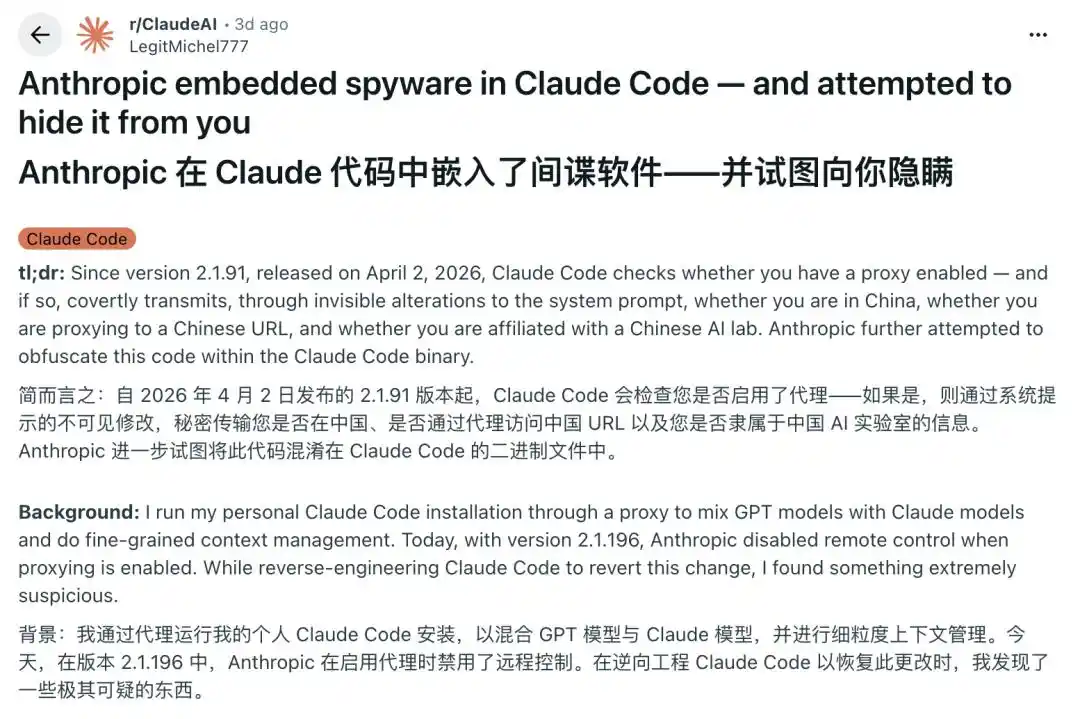
In simple terms, this mechanism does three things—

Step one, quietly checking who you are. It reads your computer's system timezone to see if it's Asia/Shanghai or Asia/Urumqi.

Simultaneously, it checks your proxy address or custom API for keywords related to Chinese cloud providers and AI companies like Alibaba, ByteDance, Baidu, Moonshot AI, and MiniMax.

Step two, tagging you covertly. If a match is found, it won't notify you with a pop-up. Instead, it stealthily alters the system prompt: changing the date format from "2026-06-30" to "2026/06/30".

It replaces the apostrophe in "Today's date is" with Unicode characters that are visually indistinguishable—right single quotation mark (’), modifier letter apostrophe (ʼ), modifier letter prime (ʹ), corresponding to three statuses: "Matched Chinese domain but not AI lab", "Associated with Chinese AI lab", and "Matched both".

Step three, quietly sending it back. These tampered prompts are sent to Anthropic's servers along with your every normal request.

What the user sees is just a normal date; what the server sees is an additional layer of environmental fingerprinting.

What's more unsettling is that this detection code itself was deliberately hidden—the core logic is encrypted and obfuscated, a list of 147 monitored domains is password-protected, and it's never mentioned in the version update logs.

In other words, Anthropic not only did it secretly but also took special care to prevent discovery.

A tool installed on your computer, with filesystem and shell execution permissions, secretly marks and signals your identity, hiding for over two months from deployment until exposure.

Afterwards, Anthropic Claude Code team member Thariq Shihipar publicly acknowledged this "experimental" measure, stating it was rolled back and removed in the new version released on July 2nd.
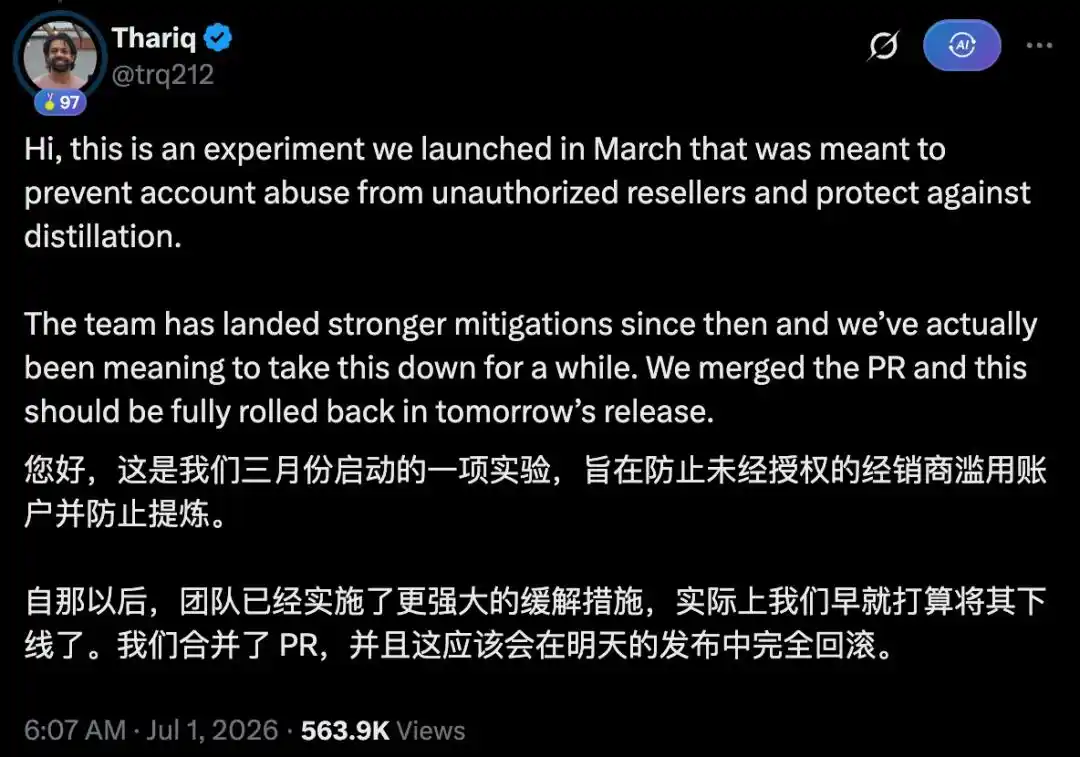
For a company that entrusts its most critical engineering code to Claude Code, this is a collapse of trust.

You open up your entire code repository, development environment, and internal logic to it, and it's secretly concerned with who you are, where you're from, and who you're connected to.

Trust, once cracked, cannot be mended by even the strongest model.

Ban Wave Adds Fuel to the Fire

Around the same time this hidden mechanism was exposed, Anthropic launched a new wave of large-scale account bans.

In recent days, a significant number of Chinese users were abruptly locked out, with both personal subscriptions and team accounts affected.

Even more frustratingly, many accounts that paid directly through the official website received no refunds after being deemed non-compliant, with appeal success rates practically zero.

From "Begging to Use" to "Company-Wide Ban"

For the past two years, it was Chinese developers queuing up to "beg to use" Claude: scrambling for quotas, finding relays, enduring the constant risk of bans, all to access that "world's best".

Now, one of China's largest tech companies is the first to decisively show Claude the door.

The once-treasured tool, once used with reimbursement, is now high-risk software. The roles of giver and receiver have been reversed for the first time.

This also signals that leading Chinese tech companies are shifting their attitude towards "building core business on others' closed-source tools" from "borrowing what's available" to "security first".

It's not about not wanting good tools; it's that good tools must also withstand scrutiny.

There are countless tools for writing code, but one principle holds true: Only the tools you can trust in your own hands are truly unremovable.

This article is from the WeChat public account "New Zhiyuan", author: New Zhiyuan

Пов'язані питання

QWhat is the main action that Alibaba is taking regarding Claude's products, and when is it effective?

AAlibaba is implementing a comprehensive ban on all Claude products, including Sonnet, Opus, Fable, and Claude Code. The ban is set to officially take effect on July 10th, requiring all employee computers to have the software uninstalled.

QWhat specific security risk prompted Alibaba to ban Claude Code?

AThe ban was prompted by the discovery that Claude Code, starting from version 2.1.91 released in April 2026, contained a covert user detection mechanism. This mechanism secretly identified users from China, tagged them with hidden markers using modified Unicode characters in prompts, and transmitted this data back to Anthropic's servers without user knowledge.

QHow did Anthropic respond to the discovery of the hidden detection mechanism in Claude Code?

AAnthropic's Claude Code team member, Thariq Shihipar, publicly acknowledged the 'experimental' measure. The company stated it had rolled back and removed the feature in a new version released on July 2nd.

QWhat does Alibaba's decision to ban Claude signal about the approach of major Chinese tech companies towards foreign AI tools?

AAlibaba's decision signals a strategic shift from a 'borrowing approach' to a 'security-first' mentality. It indicates that leading Chinese tech companies are becoming more cautious about building core business operations on closed-source, foreign-developed tools, prioritizing security and trustworthiness over perceived performance advantages.

QWhat alternative solution does Alibaba offer to its employees after banning Claude products?

AFollowing the ban on Claude products, Alibaba recommends its employees use the company's self-developed AI coding tool, Qoder, as an alternative solution.

Пов'язані матеріали

Hot Takes|Why Did the Famous "Tech Lead" Dump All His Bitcoin? The "Investment Whiz Kid" is Here!

**Weekly Spicy Review: Tech Lead's Bitcoin Bust, Reddit Meme, and Trump's Crypto Cash** This week's "Spicy Review" covers three notable incidents from the crypto world. **1. A Tech Lead Learns the Hard Way:** A former Google and Meta technical lead, Patrick Shyu, went viral after revealing he was forced to liquidate all his Bitcoin holdings. He suffered massive losses due to excessive leverage during Bitcoin's sharp decline from $120k to $60k. He shared critical observations: crypto trading often hinges on attention, not fundamentals; Bitcoin lacks a stable source of public focus; the AI boom is diverting capital; and Bitcoin faces structural risks like centralization of code maintenance and quantum computing threats. Despite his short-term exit, he remains a long-term believer. **2. Reddit Roasts the "Investment Whiz":** A popular meme on Reddit's CryptoCurrency subreddit depicted MicroStrategy's Michael Saylor looking down from a balcony. The caption joked about his relentless focus on buying Bitcoin with corporate funds, contrasting with average investors' mundane concerns. The post sparked humorous commentary on his high-risk, high-conviction strategy. **3. Trump's $1.4 Billion Crypto Haul:** The White House's financial disclosure revealed former President Donald Trump earned at least $1.4 billion from cryptocurrency activities in a year, contributing to a total income of over $2.2 billion. This windfall stands in stark contrast to the performance of "TrumpCoin" (officially DJT), which plummeted over 97% from its peak, reportedly causing investor losses exceeding $2 billion. Critics, like California Governor Gavin Newsom, accused Trump of profiting while his supporters suffered losses. The week highlighted a mix of painful lessons learned from leverage, community humor at industry figures, and the stark realities of political figures capitalizing on the crypto market.

Foresight News1 год тому

Hot Takes|Why Did the Famous "Tech Lead" Dump All His Bitcoin? The "Investment Whiz Kid" is Here!

Foresight News1 год тому

Торгівля

Спот
活动图片