Bezos, Schmidt, Powell Jobs: The Three AI Investment Philosophies of Silicon Valley's Old Money

marsbitОпубліковано о 2026-05-14Востаннє оновлено о 2026-05-14

Анотація

Jeff Bezos, Eric Schmidt, and Laurene Powell Jobs, three prominent figures from Silicon Valley's "old money," are deploying massive personal fortunes into AI, but with distinctly different investment philosophies reflecting their visions for the future. Eric Schmidt, the former Google CEO, approaches AI as a geopolitical and infrastructural arms race. Through his family office, Hillspire, he invests heavily in defense AI companies, energy infrastructure (like Bolt Data & Energy to power data centers), and space launch capabilities (Relativity Space). For Schmidt, the ultimate AI advantage lies in physical resources—energy, transport, and military application—framing it as a national competition requiring state-level strategy and endurance. Jeff Bezos is building a vertically integrated, full-stack AI empire. His bets span the model layer (via Amazon's massive investment in Anthropic), the application layer (through investments like Perplexity), and now, the physical execution layer. His new venture, Project Prometheus, with $6.2 billion, aims to inject AI into manufacturing, creating a closed loop from AI chips and cloud compute (AWS) to real-world production, potentially for Amazon's own ventures like the Kuiper satellite network. In contrast, Laurene Powell Jobs adopts a more subtle, human-centric approach through her Emerson Collective. Her AI investments focus on specific, positive-impact applications—such as AI for healthcare (Proximie, Atropos Health), education (Cur...

Author: Deep Chao TechFlow

On November 17, 2025, 61-year-old Jeff Bezos once again became the CEO of a company. It was the first time he returned to an operational role since stepping down from Amazon in 2021. The new company is called Project Prometheus, with a startup fund of $6.2 billion, focusing on "Physical AI" and targeting the manufacturing industry.

Seven months earlier, 70-year-old Eric Schmidt took control of a rocket company called Relativity Space and appointed himself as CEO. He didn't explain why he needed to step in at his age, perhaps "every day matters in the AI era" was the default answer.

In June of the same year, Steve Jobs' widow, Laurene Powell Jobs, gave a rare public interview. She sat next to Jony Ive, talking about the prototype she saw at the company io. It was an "AI device" acquired by OpenAI with $6.4 billion in stock, reportedly screenless and shaped like a player hanging around the neck. Her evaluation of the prototype was: "It's an incredible thing to see an idea become reality."

Three people, three different postures. But they are all placing bets at the same casino.

Over the past three years, top moneybags in Silicon Valley have almost all been doing the same thing: pouring money from family offices, venture capital, and charitable foundations into AI. Schmidt, Bezos, and Powell Jobs are just the three most prominent examples. But a closer look at their target lists reveals that this is not the same game; they are betting on three completely different futures.

Schmidt: Treating AI as the Next Cold War
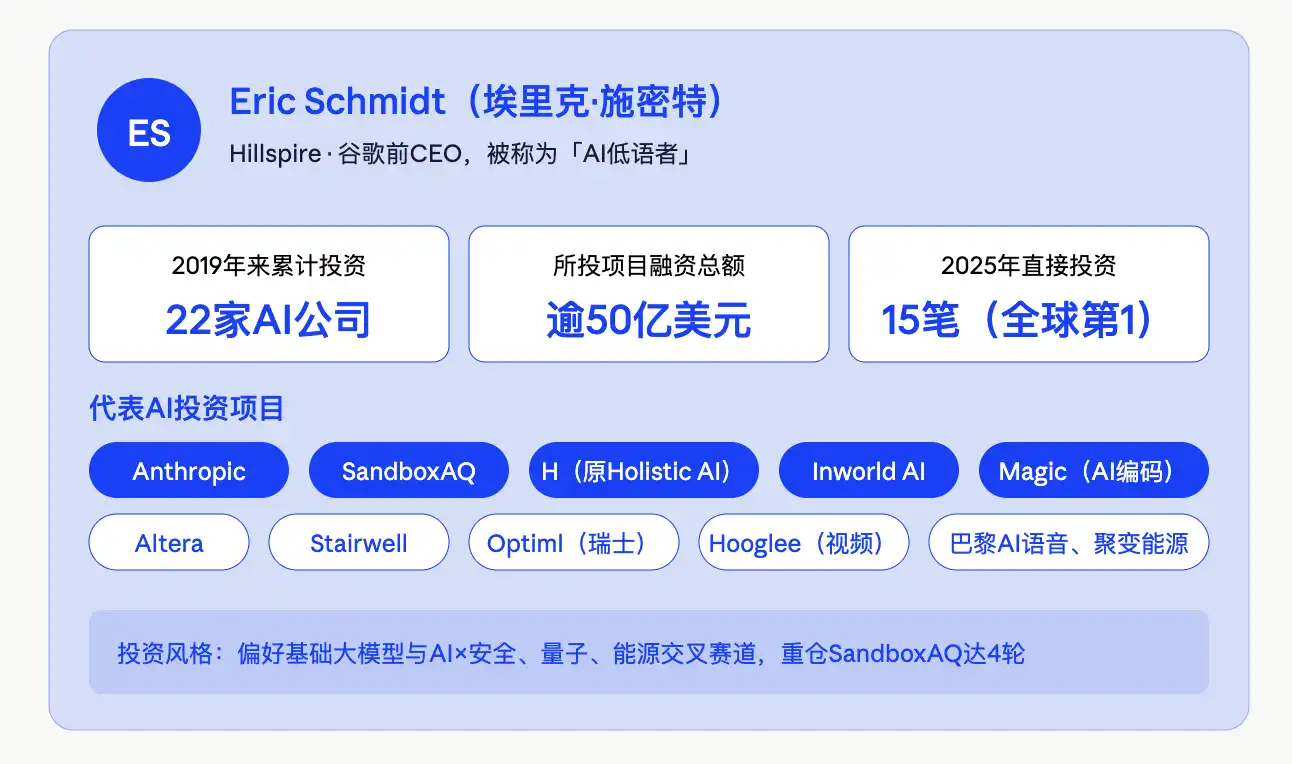
According to data cited by Wikipedia and The AI Insider, Schmidt's family office Hillspire has invested in over 22 AI companies since 2019, totaling more than $5 billion. The list includes Anthropic, SandboxAQ (a quantum+AI company spun off from Alphabet), Inworld AI, Holistic AI, and Altera. These are the targets that "insiders in the industry" would list.

But what truly reveals his underlying approach is another list.

White Stork: A company producing AI drones in Ukraine. Rebellion Defense: Defense AI. Istari: Simulation. Swift Beat: Military software. This is a family office that treats AI as the next generation of military equipment.

Schmidt has served as Chairman of the Defense Innovation Board since 2016 and co-led the National Security Commission on Artificial Intelligence from 2019 to 2021. He is a player who treats AI policy, defense procurement, and energy infrastructure as one and the same. In January 2024, Forbes disclosed that he simultaneously launched White Stork's drone projects in the U.S. and Ukraine, treating the Ukrainian battlefield as a "laboratory for AI weapons."

Then there's infrastructure.

In January 2026, he co-founded a company called Bolt Data & Energy with Texas Pacific Land, serving as its chairman. This company doesn't rent server rooms or buy electricity from the grid; it aims to build its own natural gas power plants in the West Texas wilderness, directly pumping electricity into data centers. The plan is to first reach 1 gigawatt, eventually scaling to 10 gigawatts, equivalent to the electricity consumption of 7 million households. Texas Pacific Land contributed $50 million, plus priority water supply rights. In an email reply to Fortune, Schmidt said: "The biggest bottleneck for AI is not algorithms, it's energy."

In March of the same year, he took control of Relativity Space. This company is developing a reusable rocket called Terran R, aiming to challenge SpaceX's monopoly in medium-to-low orbit launches. By that time, it had $2.9 billion in orders.

Putting these pieces together, the logic becomes clear.

Schmidt doesn't believe in the approach of "investing in a basket of large model companies." He believes the outcome of AI will ultimately depend on three things: computing power (data centers and electricity), transport (rockets, satellites, drones), and policy (defense committees and congressional hearings). He also invests in model companies, and even publicly wrote an article calling for the U.S. to increase open-source investment after DeepSeek emerged, but that's just one piece on his chessboard, not the whole game.

His reaction to DeepSeek is very telling. After DeepSeek's release in early 2025, Schmidt immediately wrote an article in The Washington Post, calling it a "turning point in the global AI race." His prescription wasn't retreat, but escalation, including more open source, more Stargate-style infrastructure, and more sharing of training methods between model labs.

In other words, he sees AI as an endurance race between nations, and he has already positioned himself on the sidelines while also serving as a committee member. At 70, stepping out to become CEO of Relativity might seem like a struggle to outsiders. He explains it himself: Kissinger worked until he was 100, "times of major transformation require responsibility, not withdrawal."

Bezos: The Full-Stack Control Freak
Bezos's approach is completely different from Schmidt's.

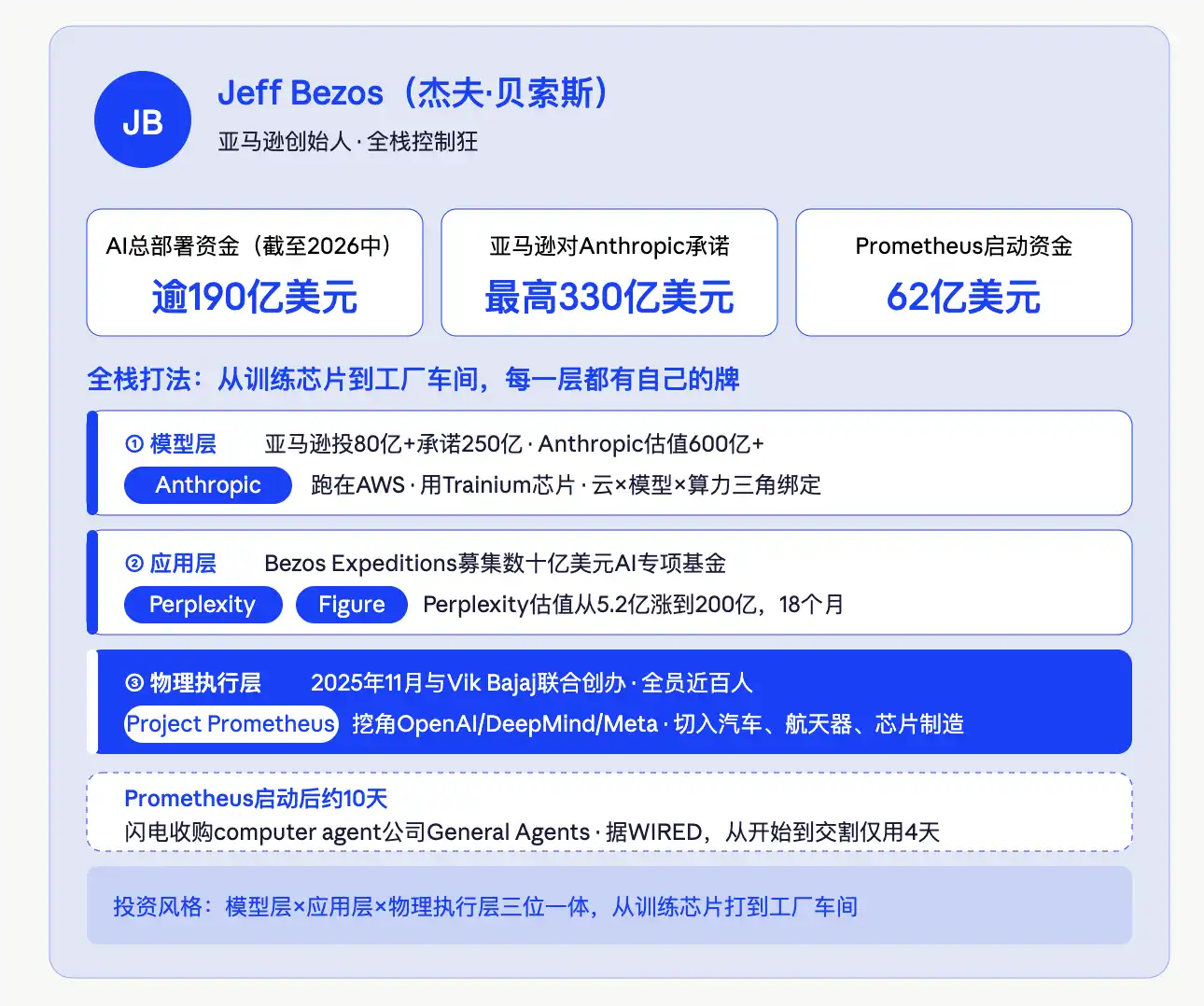
According to data cited by StartupHub from TechCrunch, The Information, and the Bezos Earth Fund, as of mid-2026, Bezos had deployed over $19 billion into AI. This number is still rising.

Breaking it down, it's mainly divided into three parts.

The first part is Anthropic. Amazon started investing in September 2023, eventually reaching $8 billion, and in April 2026, committed to adding up to $25 billion more. Anthropic runs on AWS, using Amazon's Trainium chips. This binds Amazon's cloud infrastructure, Bezos's model-layer bet, and Anthropic's research capacity into a triangle, going far beyond a mere financial investment. When Anthropic's valuation soared above $60 billion, Amazon had already captured the largest external slice of the pie.

The second part is the scattered investments of Bezos Expeditions. Bezos Expeditions is raising a multi-billion dollar AI-specific fund, upgrading "Bezos's personal angel investments" into "institutional investor." Among them, its investment in Perplexity, an AI search company, rose from a $520 million valuation in January 2024 to $20 billion in September 2025.

The third part is Project Prometheus.

In November 2025, Bezos and former Google X executive Vik Bajaj jointly announced the founding of this company, with a startup fund of $6.2 billion, nearly 100 employees. The team was recruited from OpenAI, DeepMind, and Meta. The founding advisor list included Ashish Vaswani and Jakob Uszkoreit, two of the authors of the 2017 paper "Attention Is All You Need." The company's goal is to apply AI to manufacturing, including cars, spacecraft, and chips.

Why manufacturing? Because this neatly meshes with Bezos's other businesses. Amazon has the Kuiper satellite constellation; once manufacturing AI is realized, its first batch of customers will be right in his own backyard.

Musk called Project Prometheus a "copycat" on X.

But structurally, this is not copying.

Bezos holds the model layer through Anthropic, the application layer through Perplexity and Figure, and the computing layer through Amazon. Now, by creating Prometheus, he's integrating AI into manufacturing, taking on the "physical world execution layer" as well. This is a full-stack approach, with his own cards at every layer, from training chips to deployment on the factory floor.

About 10 days after Project Prometheus launched, it quietly acquired a company called General Agents. This company developed "computer agents," AI agents capable of directly operating an entire computer. WIRED later disclosed that this acquisition, from start to closing, took only four days.

Donely's CEO Harsha Abegunasekara commented: "What General Agents truly cracked is speed; Ace runs on your computer almost instantaneously." His company was originally a competitor of General Agents.

From angel investing to forming a specialized fund, to personally taking the CEO role, Bezos only needed 18 months. He is essentially building a system larger than Amazon.

Powell Jobs: The Low-Key Camp
Looking at these three individuals together, Powell Jobs is the one who least resembles an "AI investor."

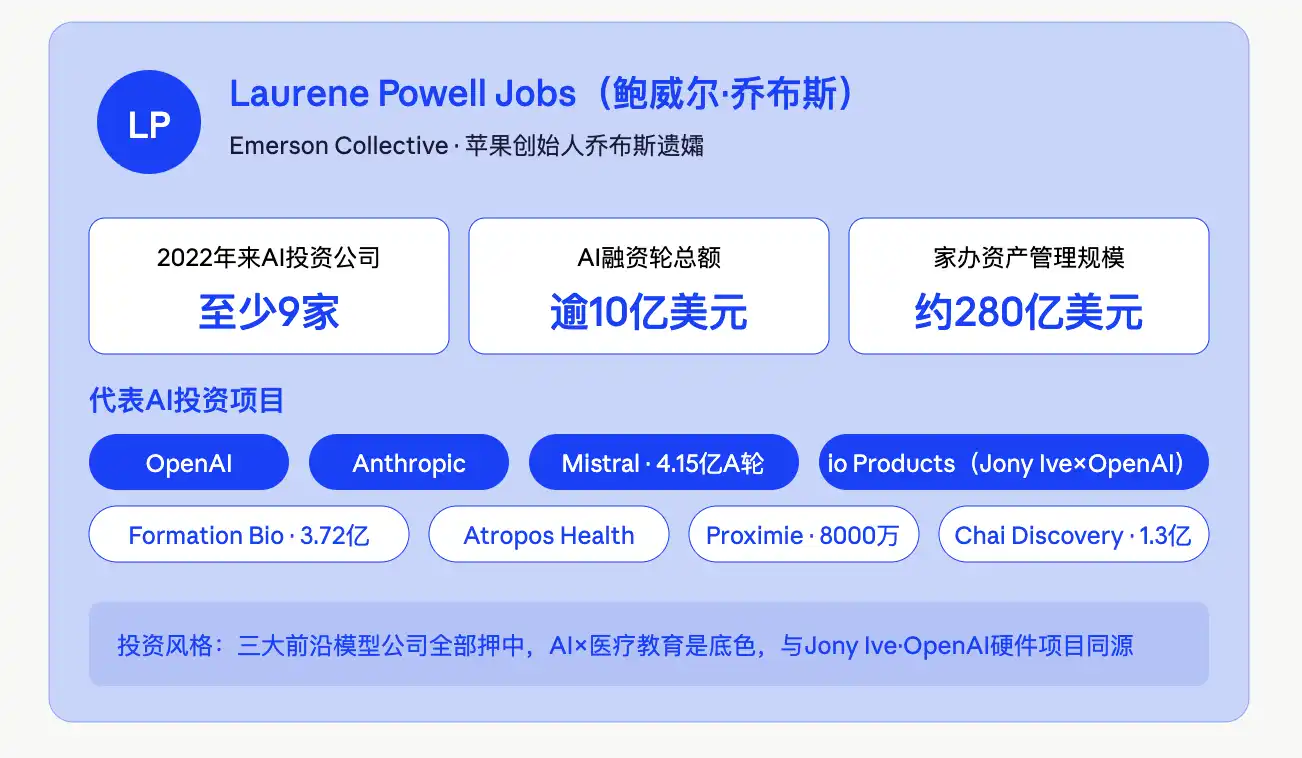
According to CNBC citing data from the private wealth platform Fintrx, her family office, Emerson Collective, has invested in at least 9 AI-related startups since 2022, participating in funding rounds totaling over $1 billion. This figure is not on the same scale as Schmidt's or Bezos's.

But the interesting part is the list itself.

Proximie: A remote surgical connection platform; Atropos Health: Clinical data AI; Formation Bio: AI drug discovery; Curipod: A Norwegian AI teaching tool; Mistral: The French large model company, Europe's sole contender against OpenAI.

No defense, no data centers, no rockets.

Emerson Collective's website clearly states its investment directions: Education, Energy & Environment, Digital Health, Fintech, Media. AI is just a tool woven into these themes. She holds a majority stake in The Atlantic and is very adept at Columbia-style "soft power" investments.

But the one investment she truly nailed is not on the same line as the ones mentioned above.

After Jony Ive left Apple in 2019, Powell Jobs invested in his design firm LoveFrom through Emerson Collective. Ive later said in a Financial Times interview: "If it weren't for Laurene, LoveFrom wouldn't exist at all." A few years later, Ive founded another hardware company called io, specializing in AI devices, and Powell Jobs invested again. In May 2025, OpenAI acquired io in an all-stock transaction worth $6.4 billion, making Ive a billionaire on paper. Emerson Collective also cashed out.

Another key investment: Emerson Collective was one of the early investors in Mistral AI when this French company was still Europe's last remaining contender in large models.

Putting these together, her AI bets are concentrated in two directions: either "using AI to solve specific human problems" or "reshaping the way humans and machines interact" (io's devices, Ive's design).

VC Sheet described Emerson Collective in an assessment: "An intentionally opaque LLC that houses venture capital, philanthropy, policy advocacy, art, and media ownership under one roof, able to use whichever tool—grants, policy lobbying, or investment—is most effective."

Philosophically, she is closer to the older generation of East Coast family offices: influence is more important than returns, the long term more important than the short term, having the microphone more important than the spotlight.

Three Investment Philosophies

Placing the three lists side by side, you see three sets of judgments about AI's future.

Schmidt is betting on national competition and infrastructure bottlenecks. In his world, AI will ultimately be determined by "who has the most electricity, the fastest rockets, the strongest drones." Models are just the entry ticket; the real moat is in the physical layer. That's why he personally steps in to lead Relativity and Bolt. What he wants is not returns, but control.

Bezos is betting on application diffusion at an industrial revolution scale. He believes AI will eventually permeate every machine tool, every airplane, every satellite like electricity. So he locks down the model layer through Amazon, the manufacturing layer through Prometheus, and embeds into the consumer application layer through Expeditions. He's not betting on whether a specific company will win, but whether this entire "full-stack" structure can win.

Powell Jobs is betting on something else. She's betting that humans will ultimately be unable to tolerate the current human-machine interaction model. She and Ive repeatedly emphasized in the Financial Times interview that "humans deserve better." Her investments in io, LoveFrom, medical AI, and educational AI are based on the same judgment: the biggest market of the next decade will be "fixing the side effects caused by the internet in the last decade."

Three sets of judgments, three different approaches.

Which one is right? No one knows. Schmidt might overestimate the weight of geopolitics in the AI economy. Bezos might underestimate the capital consumption of the "full-stack" heavy-asset model—a typical example is that Prometheus hasn't shipped anything yet, and there's already talk of needing to raise another $10 billion. Powell Jobs faces an even more awkward question: io's devices won't go into mass production until 2027, and OpenAI's own financial model has been repeatedly questioned by the market.

But one thing is certain. When the winners of the last internet generation collectively turn their family funds toward AI, this is no longer a small hype cycle in a certain sector. Bolt has already raised $150 million in startup funds; Anthropic alone is set to receive Amazon's committed $33 billion. Capital flows of this magnitude will shape the industrial geography of the next decade on their own.

As for who will have the last laugh, we'll have to look back in 2030. Until then, the three old-timers are still at the table, and the chips are still being added.


Пов'язані питання

QAccording to the article, what are the three distinct AI investment philosophies of Jeff Bezos, Eric Schmidt, and Laurene Powell Jobs?

AJeff Bezos's philosophy is an 'all-stack control freak' approach, aiming to build a system controlling everything from chips to factory floors through model layers (Anthropic), application layers (Perplexity, Figure), computing power (AWS), and manufacturing (Project Prometheus). Eric Schmidt views AI as the next Cold War, focusing on national competition and physical infrastructure like energy, rockets, drones, and defense policy. Laurene Powell Jobs focuses on human-centered applications, investing in using AI to solve specific human problems or reshape human-machine interaction through hardware and design.

QWhat specific company did Eric Schmidt personally become the CEO of to support his AI investment strategy, and what is its business?

AEric Schmidt became the CEO of Relativity Space, a rocket company developing a reusable rocket called Terran R to challenge SpaceX's monopoly in low-Earth orbit launch services. This is part of his strategy to secure the 'transportation' layer for AI's future.

QHow does Jeff Bezos's Project Prometheus connect to his broader business ecosystem?

AProject Prometheus focuses on applying AI to manufacturing (cars, spacecraft, chips). This aligns with Bezos's other businesses, as its first major clients could be internal. For example, Amazon has the Kuiper satellite constellation, and Project Prometheus's manufacturing AI could directly support its production.

QWhat is Laurene Powell Jobs's significant investment connection to Apple's former design chief Jony Ive?

ALaurene Powell Jobs's Emerson Collective invested in Jony Ive's design firm LoveFrom and later in his AI hardware company io. In 2025, OpenAI acquired io in a $6.4 billion all-stock deal, resulting in a significant financial return for both Ive and Emerson Collective.

QWhat common move have these three Silicon Valley figures made in the past three years regarding AI?

AIn the past three years, these top Silicon Valley figures have directed substantial capital from their family offices, venture capital, and charitable foundations into AI. While their specific strategies differ, they are all heavily betting on AI as a defining technology for the next decade, driving massive capital flows that will shape the future industry landscape.

Пов'язані матеріали

Торгівля

Спот
Ф'ючерси

Популярні статті

Що таке $S$

Розуміння SPERO: Комплексний огляд Вступ до SPERO Оскільки ландшафт інновацій продовжує еволюціонувати, виникнення технологій web3 та криптовалютних проектів відіграє ключову роль у формуванні цифрового майбутнього. Один з проектів, який привернув увагу в цій динамічній сфері, — це SPERO, позначений як SPERO,$$s$. Ця стаття має на меті зібрати та представити детальну інформацію про SPERO, щоб допомогти ентузіастам та інвесторам зрозуміти його основи, цілі та інновації в рамках web3 та крипто-сектору. Що таке SPERO,$$s$? SPERO,$$s$ — це унікальний проект у криптопросторі, який прагне використати принципи децентралізації та технології блокчейн для створення екосистеми, що сприяє залученню, корисності та фінансовій інклюзії. Проект розроблений для полегшення взаємодії між користувачами новими способами, надаючи їм інноваційні фінансові рішення та послуги. У своїй основі SPERO,$$s$ прагне надати можливості індивідам, забезпечуючи інструменти та платформи, які покращують користувацький досвід у криптовалютному просторі. Це включає в себе можливість більш гнучких методів транзакцій, сприяння ініціативам, що підтримуються спільнотою, та створення шляхів для фінансових можливостей через децентралізовані додатки (dApps). Основна концепція SPERO,$$s$ обертається навколо інклюзивності, прагнучи зменшити розриви в традиційній фінансовій системі, використовуючи переваги технології блокчейн. Хто є творцем SPERO,$$s$? Особистість творця SPERO,$$s$ залишається дещо невідомою, оскільки є обмежені публічно доступні ресурси, що надають детальну інформацію про його засновників. Ця відсутність прозорості може бути наслідком зобов'язання проекту до децентралізації — етики, яку багато проектів web3 поділяють, ставлячи колективні внески вище за індивідуальне визнання. Зосереджуючи обговорення навколо спільноти та її колективних цілей, SPERO,$$s$ втілює суть наділення без виділення конкретних осіб. Таким чином, розуміння етики та місії SPERO є більш важливим, ніж ідентифікація єдиного творця. Хто є інвесторами SPERO,$$s$? SPERO,$$s$ підтримується різноманітними інвесторами, починаючи від венчурних капіталістів до ангельських інвесторів, які прагнуть сприяти інноваціям у крипто-секторі. Зосередження цих інвесторів зазвичай узгоджується з місією SPERO — пріоритет надається проектам, які обіцяють технологічний прогрес у суспільстві, фінансову інклюзію та децентралізоване управління. Ці інвесторські фонди зазвичай зацікавлені в проектах, які не лише пропонують інноваційні продукти, але й позитивно впливають на спільноту блокчейн та її екосистеми. Підтримка з боку цих інвесторів підкріплює SPERO,$$s$ як значного конкурента в швидко змінюваній сфері крипто-проектів. Як працює SPERO,$$s$? SPERO,$$s$ використовує багатогранну структуру, яка відрізняє його від традиційних криптовалютних проектів. Ось деякі ключові особливості, які підкреслюють його унікальність та інноваційність: Децентралізоване управління: SPERO,$$s$ інтегрує моделі децентралізованого управління, надаючи користувачам можливість активно брати участь у процесах прийняття рішень щодо майбутнього проекту. Цей підхід сприяє відчуттю власності та відповідальності серед членів спільноти. Корисність токена: SPERO,$$s$ використовує свій власний криптовалютний токен, розроблений для виконання різних функцій в екосистемі. Ці токени дозволяють здійснювати транзакції, отримувати винагороди та полегшувати послуги, що пропонуються на платформі, підвищуючи загальну залученість та корисність. Шарова архітектура: Технічна архітектура SPERO,$$s$ підтримує модульність та масштабованість, що дозволяє безперешкодно інтегрувати додаткові функції та додатки в міру розвитку проекту. Ця адаптивність є надзвичайно важливою для збереження актуальності в постійно змінюваному крипто-ландшафті. Залучення спільноти: Проект підкреслює ініціативи, що підтримуються спільнотою, використовуючи механізми, які стимулюють співпрацю та зворотний зв'язок. Підтримуючи сильну спільноту, SPERO,$$s$ може краще задовольняти потреби користувачів та адаптуватися до ринкових тенденцій. Фокус на інклюзію: Пропонуючи низькі комісії за транзакції та зручні інтерфейси, SPERO,$$s$ прагне залучити різноманітну базу користувачів, включаючи осіб, які раніше не брали участі в крипто-просторі. Це зобов'язання до інклюзії узгоджується з його загальною місією наділення через доступність. Хронологія SPERO,$$s$ Розуміння історії проекту надає важливі уявлення про його розвиток та етапи. Нижче наведено пропоновану хронологію, що відображає значні події в еволюції SPERO,$$s$: Етап концептуалізації та ідеації: Початкові ідеї, що стали основою SPERO,$$s$, були сформовані, тісно пов'язані з принципами децентралізації та фокусом на спільноті в індустрії блокчейн. Запуск білого паперу проекту: Після концептуального етапу був випущений комплексний білий папір, що детально описує бачення, цілі та технологічну інфраструктуру SPERO,$$s$, щоб залучити інтерес та зворотний зв'язок від спільноти. Створення спільноти та ранні залучення: Активні зусилля були спрямовані на створення спільноти ранніх прихильників та потенційних інвесторів, що полегшило обговорення цілей проекту та отримання підтримки. Подія генерації токенів: SPERO,$$s$ провів подію генерації токенів (TGE) для розподілу своїх рідних токенів серед ранніх прихильників та встановлення початкової ліквідності в екосистемі. Запуск початкового dApp: Перший децентралізований додаток (dApp), пов'язаний з SPERO,$$s$, став доступним, дозволяючи користувачам взаємодіяти з основними функціями платформи. Постійний розвиток та партнерства: Безперервні оновлення та вдосконалення пропозицій проекту, включаючи стратегічні партнерства з іншими учасниками блокчейн-простору, сформували SPERO,$$s$ у конкурентоспроможного та еволюціонуючого гравця на крипто-ринку. Висновок SPERO,$$s$ є свідченням потенціалу web3 та криптовалют для революціонізації фінансових систем та наділення індивідів. Завдяки зобов'язанню до децентралізованого управління, залучення спільноти та інноваційно спроектованих функцій, він прокладає шлях до більш інклюзивного фінансового ландшафту. Як і з будь-якими інвестиціями в швидко змінюваному крипто-просторі, потенційним інвесторам та користувачам рекомендується ретельно досліджувати та обдумано взаємодіяти з поточними подіями в SPERO,$$s$. Проект демонструє інноваційний дух крипто-індустрії, запрошуючи до подальшого дослідження його численних можливостей. Хоча подорож SPERO,$$s$ ще триває, його основні принципи можуть справді вплинути на майбутнє того, як ми взаємодіємо з технологією, фінансами та один з одним у взаємопов'язаних цифрових екосистемах.

73 переглядів усьогоОпубліковано 2024.12.17Оновлено 2024.12.17

Що таке $S$

Що таке AGENT S

Агент S: Майбутнє автономної взаємодії в Web3 Вступ У постійно змінюваному ландшафті Web3 та криптовалюти інновації постійно переосмислюють, як люди взаємодіють з цифровими платформами. Один з таких новаторських проектів, Агент S, обіцяє революціонізувати взаємодію людини з комп'ютером через свою відкриту агентну структуру. Прокладаючи шлях для автономних взаємодій, Агент S прагне спростити складні завдання, пропонуючи трансформаційні застосування в штучному інтелекті (ШІ). Це детальне дослідження заглиблюється в складності проекту, його унікальні особливості та наслідки для сфери криптовалюти. Що таке Агент S? Агент S є революційною відкритою агентною структурою, спеціально розробленою для вирішення трьох основних викликів в автоматизації комп'ютерних завдань: Набуття специфічних знань у галузі: Структура інтелектуально навчається з різних зовнішніх джерел знань та внутрішнього досвіду. Цей подвійний підхід дозволяє їй створити багатий репозиторій специфічних знань у галузі, покращуючи її продуктивність у виконанні завдань. Планування на довгих горизонтах завдань: Агент S використовує планування з підкріпленням досвіду, стратегічний підхід, який полегшує ефективний розподіл та виконання складних завдань. Ця функція значно підвищує її здатність ефективно та результативно управляти кількома підзавданнями. Обробка динамічних, неоднорідних інтерфейсів: Проект представляє Інтерфейс Агент-Комп'ютер (ACI), інноваційне рішення, яке покращує взаємодію між агентами та користувачами. Використовуючи багатомодальні великі мовні моделі (MLLMs), Агент S може безперешкодно орієнтуватися та маніпулювати різноманітними графічними інтерфейсами користувача. Завдяки цим новаторським функціям Агент S надає надійну структуру, яка вирішує складнощі, пов'язані з автоматизацією людської взаємодії з машинами, прокладаючи шлях для численних застосувань у ШІ та за його межами. Хто є творцем Агент S? Хоча концепція Агент S є фундаментально новаторською, конкретна інформація про його творця залишається невідомою. Творець наразі невідомий, що підкреслює або початкову стадію проекту, або стратегічний вибір зберегти засновників у таємниці. Незважаючи на анонімність, акцент залишається на можливостях та потенціалі структури. Хто є інвесторами Агент S? Оскільки Агент S є відносно новим у криптографічній екосистемі, детальна інформація про його інвесторів та фінансових спонсорів не задокументована. Відсутність публічно доступних відомостей про інвестиційні фонди або організації, що підтримують проект, викликає питання щодо його фінансової структури та дорожньої карти розвитку. Розуміння підтримки є критично важливим для оцінки стійкості проекту та потенційного впливу на ринок. Як працює Агент S? В основі Агент S лежить передова технологія, яка дозволяє йому ефективно функціонувати в різних умовах. Його операційна модель побудована навколо кількох ключових функцій: Взаємодія з комп'ютером, подібна до людської: Структура пропонує розширене планування ШІ, прагнучи зробити взаємодії з комп'ютерами більш інтуїтивними. Імітуючи людську поведінку при виконанні завдань, вона обіцяє підвищити досвід користувачів. Наративна пам'ять: Використовується для використання високорівневого досвіду, Агент S використовує наративну пам'ять для відстеження історій завдань, тим самим покращуючи свої процеси прийняття рішень. Епізодична пам'ять: Ця функція надає користувачам покрокові інструкції, дозволяючи структурі пропонувати контекстуальну підтримку в міру виконання завдань. Підтримка OpenACI: Завдяки можливості працювати локально, Агент S дозволяє користувачам зберігати контроль над своїми взаємодіями та робочими процесами, узгоджуючи з децентралізованою етикою Web3. Легка інтеграція з зовнішніми API: Його універсальність і сумісність з різними платформами ШІ забезпечують те, що Агент S може безперешкодно вписатися в існуючі технологічні екосистеми, роблячи його привабливим вибором для розробників та організацій. Ці функціональні можливості колективно сприяють унікальному положенню Агент S у крипто-просторі, оскільки він автоматизує складні, багатоступеневі завдання з мінімальним втручанням людини. У міру розвитку проекту його потенційні застосування в Web3 можуть переосмислити, як відбуваються цифрові взаємодії. Хронологія Агент S Розробка та етапи Агент S можуть бути узагальнені в хронології, яка підкреслює його значні події: 27 вересня 2024 року: Концепція Агент S була представлена в комплексній науковій статті під назвою “Відкрита агентна структура, яка використовує комп'ютери як людина”, що демонструє основи проекту. 10 жовтня 2024 року: Наукова стаття була опублікована на arXiv, пропонуючи детальне дослідження структури та її оцінки продуктивності на основі бенчмарку OSWorld. 12 жовтня 2024 року: Було випущено відеопрезентацію, що надає візуальне уявлення про можливості та особливості Агент S, ще більше залучаючи потенційних користувачів та інвесторів. Ці маркери в хронології не лише ілюструють прогрес Агент S, але й вказують на його прихильність до прозорості та залучення громади. Ключові моменти про Агент S У міру розвитку структури Агент S кілька ключових характеристик виділяються, підкреслюючи її новаторський характер та потенціал: Інноваційна структура: Розроблена для забезпечення інтуїтивного використання комп'ютерів, подібного до людської взаємодії, Агент S пропонує новий підхід до автоматизації завдань. Автономна взаємодія: Здатність автономно взаємодіяти з комп'ютерами через GUI означає стрибок до більш інтелектуальних та ефективних обчислювальних рішень. Автоматизація складних завдань: Завдяки своїй надійній методології він може автоматизувати складні, багатоступеневі завдання, роблячи процеси швидшими та менш схильними до помилок. Безперервне вдосконалення: Механізми навчання дозволяють Агенту S покращуватися на основі минулого досвіду, постійно підвищуючи свою продуктивність та ефективність. Універсальність: Його адаптивність до різних операційних середовищ, таких як OSWorld та WindowsAgentArena, забезпечує його здатність служити широкому спектру застосувань. Оскільки Агент S займає своє місце в ландшафті Web3 та криптовалюти, його потенціал покращити можливості взаємодії та автоматизувати процеси означає значний прогрес у технологіях ШІ. Завдяки своїй інноваційній структурі Агент S є прикладом майбутнього цифрових взаємодій, обіцяючи більш безперешкодний та ефективний досвід для користувачів у різних галузях. Висновок Агент S представляє собою сміливий крок вперед у поєднанні ШІ та Web3, з можливістю переосмислити, як ми взаємодіємо з технологією. Хоча проект все ще на ранніх стадіях, можливості для його застосування є величезними та переконливими. Завдяки своїй комплексній структурі, що вирішує критичні виклики, Агент S прагне вивести автономні взаємодії на передній план цифрового досвіду. У міру того, як ми заглиблюємося в сфери криптовалюти та децентралізації, проекти, подібні до Агент S, безсумнівно, відіграватимуть ключову роль у формуванні майбутнього технологій та співпраці людини з комп'ютером.

626 переглядів усьогоОпубліковано 2025.01.14Оновлено 2025.01.14

Що таке AGENT S

Як купити S

Ласкаво просимо до HTX.com! Ми зробили покупку Sonic (S) простою та зручною. Дотримуйтесь нашої покрокової інструкції, щоб розпочати свою криптовалютну подорож.Крок 1: Створіть обліковий запис на HTXВикористовуйте свою електронну пошту або номер телефону, щоб зареєструвати обліковий запис на HTX безплатно. Пройдіть безпроблемну реєстрацію й отримайте доступ до всіх функцій.ЗареєструватисьКрок 2: Перейдіть до розділу Купити крипту і виберіть спосіб оплатиКредитна/дебетова картка: використовуйте вашу картку Visa або Mastercard, щоб миттєво купити Sonic (S).Баланс: використовуйте кошти з балансу вашого рахунку HTX для безперешкодної торгівлі.Треті особи: ми додали популярні способи оплати, такі як Google Pay та Apple Pay, щоб підвищити зручність.P2P: Торгуйте безпосередньо з іншими користувачами на HTX.Позабіржова торгівля (OTC): ми пропонуємо індивідуальні послуги та конкурентні обмінні курси для трейдерів.Крок 3: Зберігайте свої Sonic (S)Після придбання Sonic (S) збережіть його у своєму обліковому записі на HTX. Крім того, ви можете відправити його в інше місце за допомогою блокчейн-переказу або використовувати його для торгівлі іншими криптовалютами.Крок 4: Торгівля Sonic (S)Легко торгуйте Sonic (S) на спотовому ринку HTX. Просто увійдіть до свого облікового запису, виберіть торгову пару, укладайте угоди та спостерігайте за ними в режимі реального часу. Ми пропонуємо зручний досвід як для початківців, так і для досвідчених трейдерів.

1.4k переглядів усьогоОпубліковано 2025.01.15Оновлено 2025.03.21

Як купити S

Обговорення

Ласкаво просимо до спільноти HTX. Тут ви можете бути в курсі останніх подій розвитку платформи та отримати доступ до професійної ринкової інформації. Нижче представлені думки користувачів щодо ціни S (S).

活动图片