Apple's $5 Trillion Moment: Strongest Earnings, Weakest AI

marsbitОпубліковано о 2026-08-01Востаннє оновлено о 2026-08-01

Анотація

Apple's $5 Trillion Moment: Strongest Earnings, Weakest AI Apple released its Q2 2026 (FY Q3 2026) earnings, posting record revenue of $109.42 billion, up 16.4% year-over-year, and net income of $29.79 billion, up 27%. Driven by the iPhone 17's "super cycle" and strong Mac sales, hardware remained the core growth engine. However, the market reaction was muted, with the stock falling sharply after hours, contrasting with rallies in AI-heavy stocks like Microsoft and Nvidia. The report highlights Apple's ongoing AI struggles. After delays, its new Siri AI is finally launching, but its strategy reveals dependencies: partnering with Google's Gemini model overseas and with Alibaba and Baidu in China. This underscores Apple's lag in the foundational AI model race. Apple faces four key pressures: 1) sustaining growth after the iPhone 17's high sales base potentially "cannibalizes" future demand; 2) supply chain constraints and soaring memory costs impacting production and margins; 3) intense competition from AI-native smartphones that could redefine the user interface; and 4) a CEO transition, with hardware chief John Ternus taking over from Tim Cook in September. This stellar quarter serves as both Cook's final report card and the first major test for his successor, as Apple navigates a market increasingly defined by AI prowess rather than hardware alone.

Article | AIX Finance (AIXcaijing), Author | Wang Hanxing, Editor | Wei Jia

"When AI giants are doing well, Apple isn't, and vice versa." The U.S. stock market has been spending real money over the past month to prove this saying.

After U.S. markets closed on July 30th, Apple released its earnings report for the third quarter of fiscal year 2026 (corresponding to calendar year Q2 2026, all future references use the calendar year). It was an outstanding report card: revenue for the period was $109.417 billion, up 16.4% year-over-year; net profit was $29.789 billion, up 27%; and overall gross margin reached over 50%.

Cook stated that this was Apple's best second quarter ever, with double-digit growth recorded for iPhone, Mac, Services revenue, and every geographic segment.

However, the market's reaction was much cooler than the earnings.

On the day of the earnings release, Apple's stock closed down 1.41%. After the report came out, the stock fell more than 8% in after-hours trading. Just a few days earlier, the company had just reclaimed the title of the world's most valuable company by market capitalization from Nvidia. On July 29th during trading, Apple's stock price briefly hit a historic high of $342.89, and its market cap momentarily surpassed $5 trillion, becoming the second publicly traded company in history, after Nvidia, to touch this figure.

In stark contrast was the frenzy in the AI sector. On the same day, Microsoft surged 15.51%, Micron rose 18.36%, AMD gained 13%, and Nvidia climbed 2.65% with after-hours trading continuing higher. Amazon, which reported earnings almost simultaneously with Apple, saw its stock jump over 9% in after-hours trading.

After weeks of being suppressed by "AI bubble panic," money is flowing back into assets with higher AI content, and Apple happens to be the one among the tech giants whose AI story has been the most halting.

Additionally, this was the last earnings call where Cook appeared as Apple's CEO. On September 1st, hardware engineering chief John Ternus will take over as CEO, with Cook transitioning to Executive Chairman. From a market cap of about $350 billion when he took over in 2011 to $5 trillion today, this is Cook's report card. In the AI era, can Apple deliver an even better one?

01. A Stellar Earnings Report, and a Conservative Guidance

Looking at the numbers alone, this is an almost flawless earnings report, with the core of growth this quarter still being hardware.

Q2 revenue of $109.417 billion exceeded market expectations of $108.7 billion. Hardware product sales revenue was $78.68 billion with a gross margin of 40%, while software and services revenue was $30.74 billion with a gross margin reaching 75.6%. The overall gross margin was 50.1%.

However, about 2 percentage points of the gross margin came from a one-time impact of refunded U.S. government tariffs. Excluding this impact, the actual gross margin was approximately 48.1%, still above market expectations and the mid-point of the company's previous guidance.
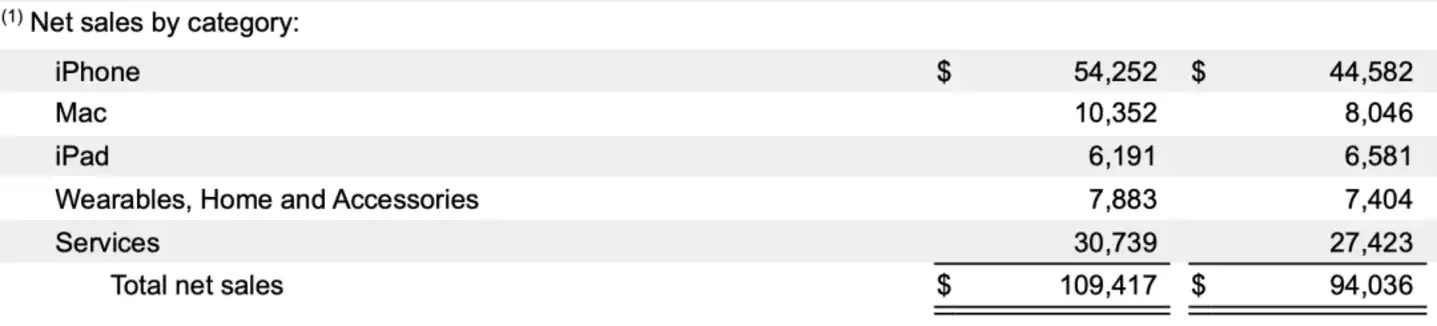
By product, iPhone once again carried this earnings report. Q2 iPhone revenue was $54.25 billion, up 21.7% year-over-year, marking the third consecutive quarter with growth exceeding 20%.

It's worth noting that iPhone sales last year were already at a relatively high base. Due to tariff policy impacts, many consumers made advance purchases and stockpiled in Q2 last year, leading to a 13.5% growth in iPhone sales. Maintaining over 20% growth on top of this high base to some extent proves the popularity of the iPhone 17 series and the strength of this super product cycle.

Mac also performed very strongly this quarter, with revenue of $10.35 billion and 28.7% year-over-year growth, standing out starkly against the broader PC industry backdrop.

IDC data shows that in Q2, amidst significant upstream memory price increases, global PC shipments fell 4.9% year-over-year to 68.2 million units, the first decline after nine consecutive quarters of growth. Shipments from leading manufacturers like Lenovo, HP, and Dell all declined, with only Mac growing 10% against the trend, increasing its market share from 8.5% to 9.9%.

The MacBook Neo, launched in Q1 this year with a starting price of $599, lowered the price threshold for Apple computers to a historic low, covering a broader range of potential buyers. Both the entry-level MacBook Neo and high-end MacBook Pro jointly drove Mac sales growth this quarter.

iPad sales performance remained weak, with revenue of $6.19 billion, down 5.9% year-over-year, returning to negative growth after a brief rebound in the previous two quarters.
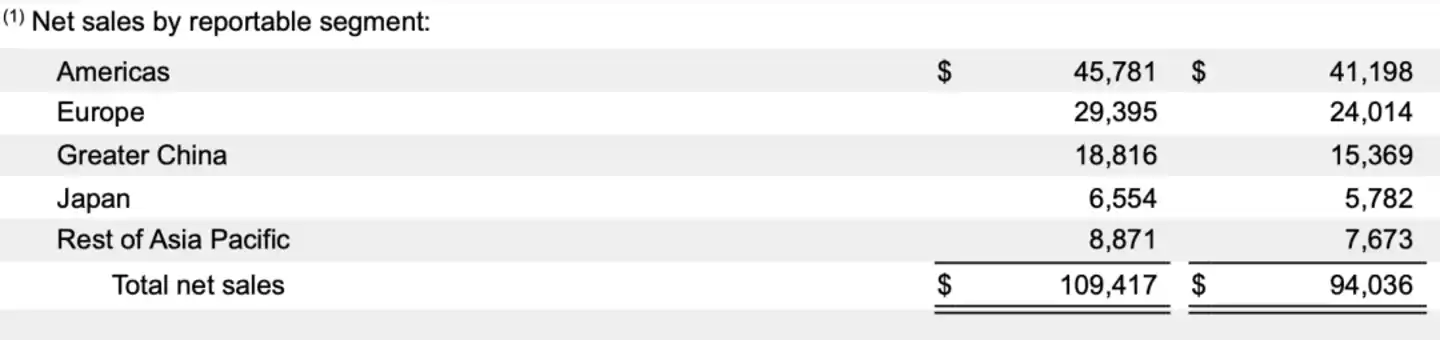
By region, Q2 Apple Americas revenue was $45.78 billion, up 11.1% year-over-year; Greater China revenue was $18.82 billion, up 22.4%, leading growth among all regions, but the growth rate was still about 4 percentage points lower than expectations.

IDC data shows that global smartphone shipments fell 6.7% in Q2, while the Chinese market declined 4.3%, marking the fifth consecutive quarter of year-over-year decline. However, Apple's shipments in China grew 24.4% year-over-year, with its market share rising from 13.9% to 18.1%.

The recovery in the Chinese market is due to both the product strength of the iPhone 17 and price expectations leading to advance purchases. While Android manufacturers generally adjusted prices and configurations due to memory price increases, Apple maintained stable prices for its core models in Q2, reinforcing its relative competitiveness in the high-end market.

Beyond the numbers, management poured some cold water during the earnings call. Apple anticipates that next quarter's overall revenue will be impacted by foreign exchange and supply constraints. Q3 iPhone revenue will be dragged down by supply constraints, with growth expected to fall into the low-double-digit range around 15%, and Mac and iPad products will also face supply chain shocks.

In other words, the high growth of the past three quarters may be difficult to sustain. Nevertheless, this remains a stellar earnings report: in an era where everyone is busy talking about AI, iPhone and Mac upheld Apple's stature, with the global active installed base of devices reaching new highs across all product categories and regions. Apple proved that hardware's value as an "entry point" remains immense.

The question is, how long can the entry point story be told.

02. AI, Two Years Late, Finally Enters the Product

The hardware story can't be told forever, and Apple knows it. That's why it has been trying to transform with AI, though for a long time, this transformation hasn't been particularly successful.

Over the past two years, Apple's AI has mostly been about "making big promises" without forming a core product powerful enough to change user habits.

At WWDC 2024, Apple grandly announced Apple Intelligence, proposing a different path from its competitors: deeply embedded personal intelligence at the system level, on-device processing and private cloud computing, and cross-application task execution.

The market was once excited. Apple's valuation logic seemed poised to shift from a hardware company to an AI entry point company. Apple wouldn't need to lead in the generic large language model parameter race; embedding AI into over a billion devices could redefine human-computer interaction.

But subsequently, the most critical Siri upgrade was continuously delayed. In 2025, Apple admitted that the originally planned personalized Siri needed more time, with some features postponed to 2026.

The problem wasn't just "one year late." During a phase of rapid iteration for generative AI, delays meant developers couldn't plan products around a stable interface, user expectations for Apple's AI capabilities were repeatedly diminished, and it gave Google, OpenAI, Amazon, and Chinese smartphone manufacturers a longer window of opportunity.

By 2026, Apple's strategy underwent a substantive shift. In January, Apple and Google announced a multi-year partnership. The next generation of Apple's foundational model would be built based on the Gemini model and Google Cloud technology. For a company whose faith lies in vertical integration and self-research, handing the "brain" of its AI to a decades-long rival was both a pragmatic choice and a tacit admission that, in the large model race, Apple could no longer catch up from scratch.

Then, at WWDC in June, Apple finally officially launched the new Siri AI, emphasizing personal context, screen awareness, cross-application operation, and an independent conversational interface.

Apple AI's development path in China has been even more tortuous.

As Apple's second-largest market, devices sold in mainland China ("National Edition") have long been excluded from Apple Intelligence. Regulatory filing for generative AI is an unavoidable hurdle. The absence of AI features has been a key factor suppressing sales expectations and stock price performance for Apple in China.

In March of this year, Apple briefly and mistakenly enabled related features for National Edition users, only to quickly withdraw them.

The shoe finally dropped in July this year. The cyberspace administration published a new batch of filing lists for on-device generative AI services on mobile phones, with "Apple Intelligence" listed. Subsequently, Alibaba confirmed that its Tongyi Qianwen model would be integrated into Apple Intelligence, covering the Chinese versions of iPhone, iPad, Mac, and Vision Pro. Simultaneously, Baidu confirmed it was collaborating with Apple to develop related features for Chinese iPhone users.

This means the Chinese version of Apple Intelligence will not simply replicate the overseas solution but will form a combination of "Apple devices and system + local models and compliance."

This step fills the most obvious product gap for Apple in China's high-end market and may also release some pent-up replacement demand. However, it also exposes the boundaries of Apple's AI transformation: in the U.S., Apple relies on Google; in China, Apple relies on Alibaba and Baidu. Apple still controls the entry point but no longer fully controls the intelligence layer.

Apple's AI report card is not yet complete. Although the new Siri has finally transitioned from a "future feature" to a testable product, the real test will begin only after the large-scale rollout this fall: Is its reliability sufficient for handling high-frequency tasks? Are third-party developers willing to integrate? How are cloud inference costs controlled? And can AI truly drive a new wave of hardware upgrades?

The earnings report provides no answers to these questions for now.

03. After the Super Cycle, Apple Faces Fourfold Pressure

The most immediate challenge for Apple is how to navigate beyond the high base set by the iPhone 17.

Historically, iPhone sales have experienced multiple instances where explosive growth in one generation cannibalized replacement demand, leading to stagnant or declining sales for several subsequent generations. The iPhone 6 is a classic example. Analysts from Bank of America Merrill Lynch and KGI Securities explicitly pointed out at the time that the "super cycle" created by the iPhone 6 had pulled forward replacement demand for the next one to two years. The vast majority of users willing to switch to larger screens had upgraded in that generation, leaving the 6s and 7 series unable to stimulate a new replacement wave.

Today, the global smartphone replacement cycle exceeds three years, so the cannibalization effect from a super product could last even longer. From Q4 2025 when the iPhone 17 officially went on sale to Q2 2026, iPhone revenue has grown over 20% year-over-year for three consecutive quarters, nearing the characteristics of a "super product cycle."

The challenge for Apple in the next phase is not simply to sell the iPhone 18 well, but to sustain growth on this extremely high base.

The second layer of pressure comes from the cost side. The expansion of AI data centers is competing for advanced semiconductor process, DRAM, and NAND capacity. For the first time, consumer electronics manufacturers are vying with cloud computing giants for upstream resources. Data from TrendForce shows that in Q1 2026, DRAM contract prices rose over 90% quarter-over-quarter, with 12GB mobile phone memory costs soaring from ¥200 to ¥600, and 1TB flash memory unit prices tripling. The pressure first crushed low-end phones and is now spreading up the price ladder.

IDC previously noted in a report that this memory crisis is splitting the mobile phone market into two camps: manufacturers with scale, long-term purchasing power, and a high-end product portfolio can lock in supply and pass on costs, while brands reliant on low prices and high volumes bear greater impact. Apple clearly belongs to the former, but this doesn't mean it is immune.

Previously, Micron's Chief Commercial Officer, Sumit Sadana, told the media that the root of the memory shortage lies precisely in the aggressive price pressure from downstream major customers. Excessively low purchase prices dampened manufacturers' investment willingness, forcing the cancellation of numerous capacity expansion projects in 2023.

This statement was interpreted by the outside world as shifting the blame for memory price hikes onto Apple.

Recently, Apple has already raised prices for some Mac and iPad models, and management has warned that supply constraints will intensify significantly next quarter.

The third layer of pressure is AI device competition.

In the past, Apple could wait for technology to mature before entering the market because it had stronger product integration capabilities and a user base. However, competition for AI phones doesn't entirely follow traditional hardware rhythms.

Google, Samsung, and Chinese manufacturers are turning model capabilities into system-level functions. Agents are starting to take over search, shopping, content generation, and app operations. At the recently concluded WAIC, AI phones from Nubia, Stepfun, and Honor were showcased together.

AI phones are becoming a trend. If users in the future stop frequently opening apps and instead complete tasks through AI assistants, whoever controls the assistant may rewrite mobile internet traffic distribution. Apple has the entry point advantage, but it also faces a danger: if Siri isn't good enough, the iPhone could become a premium hardware shell for other models, or be directly replaced by other AI phones.
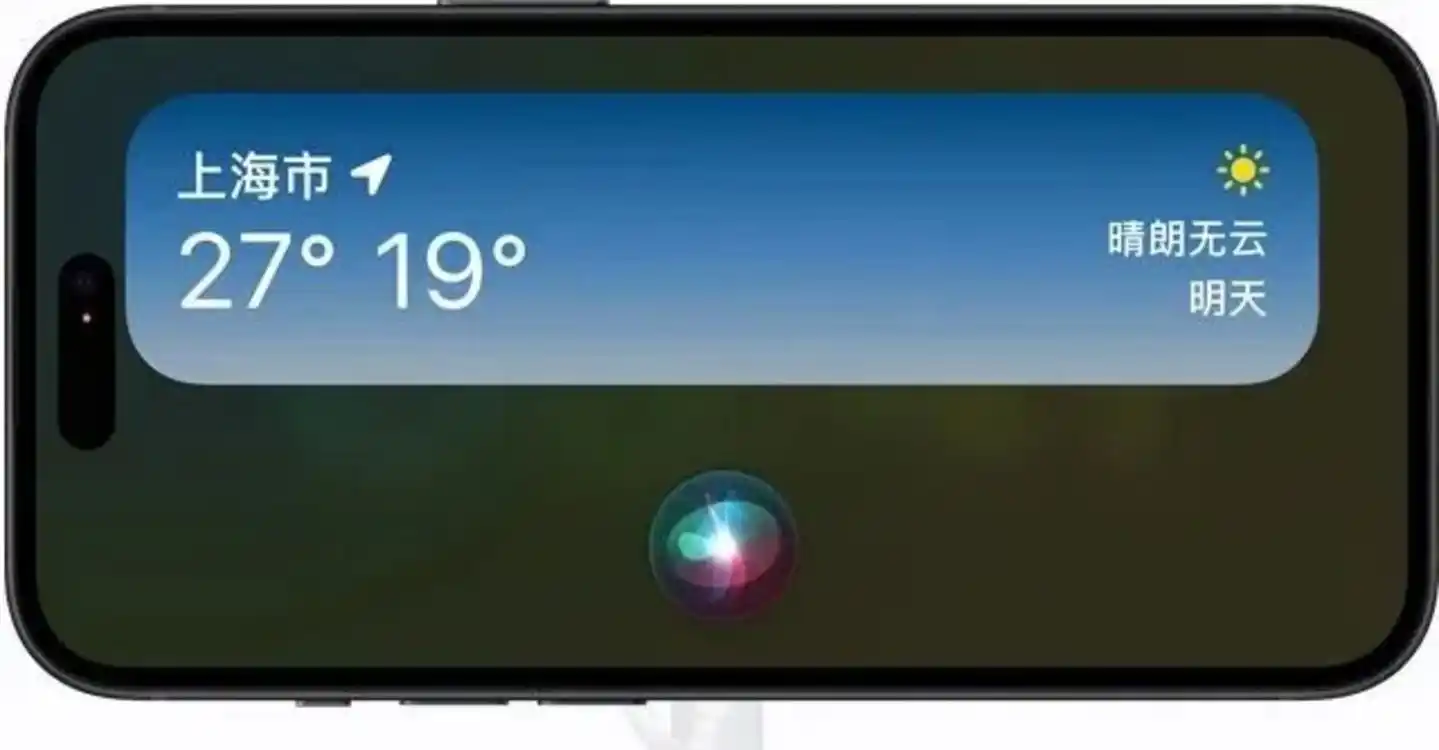
Image Source / Apple Siri official website

The fourth layer of pressure is the leadership transition. On September 1st, Cook will formally step down as CEO and transition to Executive Chairman. Theoretically, he could still steer the company for one more fiscal quarter thereafter, but it's certain this was his last earnings call as CEO.

The successor, Ternus, is 50 years old. He joined the product design team in 2001 and has since participated in the development of AirPods, iPad, and multiple generations of Macs and iPhones. Cook described him as having "the mind of an engineer and the soul of an innovator." A product-focused CEO taking over suggests that Apple's cultural focus may shift back from operational efficiency to product innovation.

Fifteen years ago, Jobs handed over a company with a $350 billion market cap to Cook. The external skepticism was: without that obsessive product genius, how long could Apple survive? Fifteen years later, Cook hands over a company with a $5 trillion market cap to Ternus. The question becomes: as AI redefines the concept of the entry point, can Apple continue to hold onto it?

This historically best-ever second quarter earnings report is the final report card from Cook and also the first test paper handed to the new captain.


Трендові криптовалюти

Пов'язані питання

QWhy did Apple's stock price fall despite reporting strong Q2 2026 earnings?

AApple's stock price fell because the market perceived its AI strategy as weak compared to other tech giants. While Apple reported excellent financial results, investor enthusiasm shifted towards companies with stronger AI narratives like Microsoft, AMD, and Nvidia, whose stocks rallied significantly. Apple's conservative guidance for the next quarter, citing potential supply constraints and foreign exchange impacts, also contributed to the negative reaction.

QWhat were the key financial highlights of Apple's Q2 2026 (FY Q3 2026) earnings report?

AApple's Q2 2026 earnings report showed revenue of $109.417 billion, a 16.4% year-over-year increase. Net profit was $29.789 billion, up 27%. The gross margin reached 50.1% (or approximately 48.1% excluding a one-time tariff refund benefit). iPhone revenue grew 21.7% to $54.25 billion, Mac revenue surged 28.7% to $10.35 billion, and Greater China revenue increased 22.4% to $18.82 billion, leading all geographic segments.

QHow has Apple's approach to AI development evolved, particularly regarding Siri and the Chinese market?

AApple's AI development has shifted from delayed, independent efforts to strategic partnerships. Initially, the Siri upgrade with Apple Intelligence was repeatedly delayed. In 2026, Apple announced a partnership with Google to build its next-generation foundational model on Gemini, acknowledging it couldn't catch up alone in the foundational model race. For China, after regulatory clearance, Apple partnered with local AI giants like Alibaba's Tongyi Qianwen and Baidu to integrate their models into 'Apple Intelligence' for Chinese devices, creating a hybrid system combining Apple's hardware with localized, compliant AI services.

QWhat are the four major challenges or pressures Apple faces according to the article?

AAccording to the article, Apple faces four major pressures: 1. The challenge of sustaining growth after the iPhone 17 'super cycle,' which may have pulled forward future demand. 2. Cost pressures from the AI-driven competition for advanced semiconductor and memory (DRAM/NAND) supply, potentially leading to component shortages and price increases. 3. Intensifying competition in the AI terminal/phone market, where rivals like Google and Chinese manufacturers are integrating powerful AI assistants that could redefine the user experience and threaten Apple's ecosystem control. 4. The leadership transition from Tim Cook to John Ternus as CEO, which brings uncertainty about the company's strategic direction, particularly in balancing operational efficiency with product innovation in the AI era.

QWhat is the significance of Apple briefly reaching a $5 trillion market capitalization and Tim Cook's impending role change?

AApple briefly reaching a $5 trillion market cap reaffirmed its position as the world's most valuable company, a milestone Tim Cook helped achieve by growing the company's valuation from around $350 billion when he took over in 2011. This moment, coupled with his final earnings call as CEO, marks the end of an era defined by operational excellence and massive financial growth under his leadership. The significance lies in the transition of leadership to John Ternus, a product-focused executive, as Apple enters a critical phase where its future depends on successfully navigating the AI revolution—a challenge that will define the new CEO's tenure.

Пов'язані матеріали

Goldman Sachs: July Smashes Through Crowded Trades, U.S. Stock Bull Market Not Broken but Harder to Navigate

Goldman Sachs: July Sees Crowded Trades Unwound, U.S. Bull Market Intact but Getting Tougher. The U.S. stock market in July did not see an index-level crash, but rather a significant unwinding of speculative positions. While the S&P 500 remained stable—trading within a narrow 3.5% range and staying within 2% of its high—underlying market dynamics were volatile. Heavily crowded trades, particularly in high-momentum tech, AI-linked stocks, and Asian strategies, faced severe pressure and forced deleveraging. Data indicates this was a meaningful cleanse, not a minor adjustment. Global tech exposure saw its largest sell-off in over five years, leverage in Korean equity ETFs plummeted, and Goldman's prime brokerage recorded the largest gross exposure reduction since late 2022. Leverage on momentum factors among fundamental long/short clients fell to the 28th percentile of its one-year range. The AI trade narrative shifted from pure potential to a focus on tangible returns. While Meta failed to show clear AI monetization, Microsoft and Amazon provided evidence that massive capital expenditure is translating into scalable revenue and product growth, preventing a blanket sell-off of the AI sector. The Federal Reserve's more opaque communication style and volatility in long-end Treasury yields have introduced new friction, particularly for rate-sensitive growth and tech stocks. The broader outlook for U.S. equities remains favorable, supported by a strong economy, robust earnings, and substantial AI capital expenditure. However, risk/reward is no longer cheap, and the market's upward elasticity has weakened. The Nasdaq 100's trajectory—up 12% year-to-date despite significant pullbacks—illustrates that the bull trend persists but the path is becoming more difficult. The key lesson from July is that the market no longer rewards crowded, highly leveraged trades, requiring more disciplined and liquid portfolio approaches.

marsbit25 хв тому

Goldman Sachs: July Smashes Through Crowded Trades, U.S. Stock Bull Market Not Broken but Harder to Navigate

marsbit25 хв тому

Interview with Robinhood Executive: Meme + Tokenized US Stocks as "Barbell" Customer Acquisition Strategy, All Business Lines Achieve Hundreds of Millions in Revenue

Interview with Robinhood executive Johann Kerbrat reveals the company's "barbell" customer acquisition strategy for its new Robinhood Chain, combining meme tokens with tokenized stocks. Three weeks after mainnet launch, the chain has seen over $3B in weekly DEX volume and 105M transactions. Kerbrat explains the logic behind the permissionless chain: meme tokens attract DeFi users, while tokenized real-world assets (RWA), currently over 90 US stocks and ETFs accessible in 120+ countries, serve global users. The goal is to bring Robinhood's 27 million funded accounts on-chain by simplifying DeFi with a user-friendly interface, exemplified by features like Robinhood Earn which offers yield without requiring wallet management. Built on Arbitrum's technology stack for its speed, low cost, and Ethereum's security, the chain focuses on financial products like Earn, spot trading, and perpetuals. Kerbrat downplays direct competition with platforms like Base, emphasizing the goal of expanding the overall market for on-chain assets. He details selective partnerships (e.g., Morpho, Lighter) based on compliance, unique UX, and differentiation. While regulatory clarity is pending for US perpetuals, the expansion continues via Bitstamp in Europe. Finally, Kerbrat positions Robinhood as a "super app" integrating stocks, options, crypto, banking, and AI trading, with all major business lines generating hundreds of millions in revenue. For the chain, current priority is driving adoption over maximizing gas fee revenue.

marsbit2 год тому

Interview with Robinhood Executive: Meme + Tokenized US Stocks as "Barbell" Customer Acquisition Strategy, All Business Lines Achieve Hundreds of Millions in Revenue

marsbit2 год тому

Fidelity Q3 Report: BTC, ETH, and SOL Continue to Build Bottoms; How Much Further Will This Crypto Bear Market Go?

Fidelity's Q3 Crypto Signal Report analyzes the current bear market, noting Bitcoin (BTC), Ethereum (ETH), and Solana (SOL) are in a prolonged bottoming phase. Key indicators like the weighted Net Unrealized Profit/Loss (NUPL) have turned negative (-0.01), signaling the market is slightly below its aggregate cost basis, with BTC acting as the primary stabilizing asset. BTC's dominance has risen to 68%, indicating a lack of capital rotation to other digital assets. Performance has been weak across the board, with BTC, ETH, and SOL down significantly year-to-date. Market sentiment is depressed, exacerbated by substantial outflows from spot ETPs and a challenging macro environment. The report compares the current ~203-day downtrend to historical ~300-day bottoming cycles, suggesting the process may be two-thirds complete, with late 2026 as a potential timeframe to monitor. For Bitcoin, NUPL at 0.09 indicates cautious sentiment, while momentum signals remain negative. The Yardstick metric points to potential undervaluation relative to network security (hashrate). Ethereum's NUPL is deep in the "capitulation" zone at -0.43, a historically positive signal for future returns, though its momentum and network fee revenue are negative. Solana shows the deepest NUPL at -0.72 but demonstrates relative resilience in on-chain activity and stablecoin transfer volume. The report concludes that while several metrics are near historical capitulation levels, a definitive market bottom has not yet been established. The path forward likely involves continued consolidation, with BTC's relative strength and fundamental on-chain usage for ETH and SOL providing key areas for investor observation.

marsbit2 год тому

Fidelity Q3 Report: BTC, ETH, and SOL Continue to Build Bottoms; How Much Further Will This Crypto Bear Market Go?

marsbit2 год тому

Торгівля

Спот

Популярні статті

Що таке GROK AI

Grok AI: Революція в розмовних технологіях ери Web3 Вступ У швидко змінюваному ландшафті штучного інтелекту Grok AI вирізняється як помітний проєкт, що поєднує сфери передових технологій та взаємодії з користувачами. Розроблений компанією xAI, яку очолює відомий підприємець Ілон Маск, Grok AI прагне переосмислити, як ми взаємодіємо зі штучним інтелектом. Оскільки рух Web3 продовжує процвітати, Grok AI має на меті використати потужність розмовного ШІ для відповіді на складні запитання, надаючи користувачам досвід, який є не лише інформативним, але й розважальним. Що таке Grok AI? Grok AI — це складний розмовний чат-бот, розроблений для динамічної взаємодії з користувачами. На відміну від багатьох традиційних систем ШІ, Grok AI охоплює ширший спектр запитів, включаючи ті, які зазвичай вважаються недоречними або виходять за межі стандартних відповідей. Основні цілі проєкту включають: Надійне міркування: Grok AI акцентує увагу на здоровому глузді, щоб надавати логічні відповіді на основі контекстуального розуміння. Масштабоване управління: Інтеграція допоміжних інструментів забезпечує моніторинг та оптимізацію взаємодій користувачів для покращення якості. Формальна верифікація: Безпека є пріоритетом; Grok AI впроваджує методи формальної верифікації для підвищення надійності своїх результатів. Розуміння довгого контексту: Модель ШІ відзначається здатністю зберігати та згадувати обширну історію розмов, що сприяє змістовним та контекстуально обізнаним дискусіям. Стійкість до атак: Зосереджуючись на покращенні своїх захистів від маніпульованих або зловмисних вхідних даних, Grok AI прагне зберегти цілісність взаємодій з користувачами. По суті, Grok AI — це не просто пристрій для отримання інформації; це занурюючий розмовний партнер, який заохочує динамічний діалог. Творець Grok AI Геній, що стоїть за Grok AI, — це ніхто інший, як Ілон Маск, особа, яка стала синонімом інновацій у різних сферах, включаючи автомобільну промисловість, космічні подорожі та технології. Під егідою xAI, компанії, що зосереджена на розвитку технологій ШІ на користь суспільства, бачення Маска прагне переосмислити розуміння взаємодій з ШІ. Лідерство та основоположна етика глибоко впливають на прагнення Маска розширити технологічні межі. Інвестори Grok AI Хоча конкретні деталі щодо інвесторів, які підтримують Grok AI, залишаються обмеженими, загальновідомо, що xAI, інкубатор проєкту, заснований і підтримується переважно самим Ілоном Маском. Попередні підприємства та активи Маска забезпечують надійну підтримку, що додатково зміцнює довіру до Grok AI та потенціал для зростання. Однак наразі інформація про додаткові інвестиційні фонди або організації, що підтримують Grok AI, не є доступною, що позначає область для потенційного майбутнього дослідження. Як працює Grok AI? Операційна механіка Grok AI є такою ж інноваційною, як і його концептуальна структура. Проєкт інтегрує кілька передових технологій, які сприяють його унікальним функціональним можливостям: Надійна інфраструктура: Grok AI побудований з використанням Kubernetes для оркестрації контейнерів, Rust для продуктивності та безпеки, і JAX для високопродуктивних числових обчислень. Ця трійка забезпечує ефективну роботу чат-бота, його масштабованість та швидке обслуговування користувачів. Доступ до знань у реальному часі: Однією з відмінних рис Grok AI є його здатність отримувати дані в реальному часі через платформу X — раніше відому як Twitter. Ця можливість надає ШІ доступ до останньої інформації, що дозволяє надавати своєчасні відповіді та рекомендації, які можуть бути пропущені іншими моделями ШІ. Два режими взаємодії: Grok AI пропонує користувачам вибір між “Розважальним режимом” та “Звичайним режимом”. Розважальний режим дозволяє більш ігровий та гумористичний стиль взаємодії, тоді як Звичайний режим зосереджується на наданні точних і правильних відповідей. Ця універсальність забезпечує індивідуальний досвід, що відповідає різним уподобанням користувачів. По суті, Grok AI поєднує продуктивність із залученням, створюючи досвід, який є одночасно збагачуючим і розважальним. Хронологія Grok AI Шлях Grok AI відзначений важливими етапами, які відображають його розвиток та етапи впровадження: Початковий розвиток: Фундаментальна фаза Grok AI тривала приблизно два місяці, протягом яких проводилося початкове навчання та налаштування моделі. Випуск бета-версії Grok-2: У значному досягненні була оголошена бета-версія Grok-2. Цей випуск представив дві версії чат-бота — Grok-2 та Grok-2 mini — кожна з яких оснащена можливостями для спілкування, кодування та міркування. Публічний доступ: Після бета-розробки Grok AI став доступним для користувачів платформи X. Ті, хто має акаунти, підтверджені номером телефону та активні принаймні сім днів, можуть отримати доступ до обмеженої версії, що робить технологію доступною для ширшої аудиторії. Ця хронологія відображає систематичний розвиток Grok AI від початку до публічної взаємодії, підкреслюючи його прагнення до постійного вдосконалення та взаємодії з користувачами. Ключові особливості Grok AI Grok AI охоплює кілька ключових особливостей, які сприяють його інноваційній ідентичності: Інтеграція знань у реальному часі: Доступ до актуальної та релевантної інформації відрізняє Grok AI від багатьох статичних моделей, забезпечуючи захоплюючий та точний досвід для користувачів. Універсальні стилі взаємодії: Пропонуючи різні режими взаємодії, Grok AI задовольняє різноманітні уподобання користувачів, запрошуючи до творчості та персоналізації у спілкуванні з ШІ. Передова технологічна основа: Використання Kubernetes, Rust та JAX надає проєкту надійну основу для забезпечення надійності та оптимальної продуктивності. Етичні міркування в дискурсі: Включення функції генерації зображень демонструє інноваційний дух проєкту. Однак це також піднімає етичні питання, пов'язані з авторським правом та поважним зображенням впізнаваних фігур — триваюча дискусія в спільноті ШІ. Висновок Як піонер у сфері розмовного ШІ, Grok AI втілює потенціал трансформаційних користувацьких досвідів в цифрову епоху. Розроблений компанією xAI та керований візією Ілона Маска, Grok AI інтегрує знання в реальному часі з передовими можливостями взаємодії. Він прагне розширити межі того, що може досягти штучний інтелект, зберігаючи при цьому акцент на етичних міркуваннях та безпеці користувачів. Grok AI не лише втілює технологічний прогрес, але й представляє нову парадигму спілкування в ландшафті Web3, обіцяючи залучити користувачів як глибокими знаннями, так і ігровою взаємодією. Оскільки проєкт продовжує розвиватися, він слугує свідченням того, що може досягти перетин технологій, творчості та людської взаємодії.

510 переглядів усьогоОпубліковано 2024.12.26Оновлено 2024.12.26

Що таке GROK AI

Що таке ERC AI

Euruka Tech: Огляд $erc ai та його амбіцій у Web3 Вступ У швидко змінюваному ландшафті технології блокчейн та децентралізованих додатків нові проекти з'являються часто, кожен з унікальними цілями та методологіями. Одним з таких проектів є Euruka Tech, який працює у широкій сфері криптовалют та Web3. Основна увага Euruka Tech, зокрема його токена $erc ai, зосереджена на представленні інноваційних рішень, розроблених для використання зростаючих можливостей децентралізованих технологій. Ця стаття має на меті надати всебічний огляд Euruka Tech, дослідження його цілей, функціональності, ідентичності його творця, потенційних інвесторів та його значення в ширшому контексті Web3. Що таке Euruka Tech, $erc ai? Euruka Tech характеризується як проект, який використовує інструменти та функціональність, що пропонуються середовищем Web3, зосереджуючи увагу на інтеграції штучного інтелекту у своїй діяльності. Хоча конкретні деталі про структуру проекту дещо неясні, він розроблений для покращення залучення користувачів та автоматизації процесів у крипто-просторі. Проект має на меті створити децентралізовану екосистему, яка не лише полегшує транзакції, але й включає прогностичні функції через штучний інтелект, звідси і назва його токена, $erc ai. Мета полягає в тому, щоб надати інтуїтивно зрозумілу платформу, яка сприяє розумнішим взаємодіям та ефективній обробці транзакцій у зростаючій сфері Web3. Хто є творцем Euruka Tech, $erc ai? На даний момент інформація про творця або засновницьку команду Euruka Tech залишається невизначеною та дещо непрозорою. Ця відсутність даних викликає занепокоєння, оскільки знання про бекграунд команди часто є важливим для встановлення довіри в секторі блокчейн. Тому ми класифікували цю інформацію як невідому, поки конкретні деталі не стануть доступними в публічному домені. Хто є інвесторами Euruka Tech, $erc ai? Аналогічно, ідентифікація інвесторів або організацій, які підтримують проект Euruka Tech, не надається через доступні дослідження. Аспект, який є критично важливим для потенційних зацікавлених сторін або користувачів, які розглядають можливість співпраці з Euruka Tech, - це впевненість, що походить від встановлених фінансових партнерств або підтримки від авторитетних інвестиційних компаній. Без розкриття інформації про інвестиційні зв'язки важко зробити всебічні висновки про фінансову безпеку або довговічність проекту. Відповідно до знайденої інформації, цей розділ також має статус невідомий. Як працює Euruka Tech, $erc ai? Незважаючи на відсутність детальних технічних специфікацій для Euruka Tech, важливо враховувати його інноваційні амбіції. Проект прагне використовувати обчислювальну потужність штучного інтелекту для автоматизації та покращення досвіду користувачів у середовищі криптовалют. Інтегруючи ШІ з технологією блокчейн, Euruka Tech має на меті надати такі функції, як автоматизовані угоди, оцінка ризиків та персоналізовані інтерфейси користувачів. Інноваційна суть Euruka Tech полягає в його меті створити безшовний зв'язок між користувачами та величезними можливостями, які пропонують децентралізовані мережі. Завдяки використанню алгоритмів машинного навчання та ШІ, він має на меті мінімізувати труднощі для нових користувачів і спростити транзакційні досвіди в рамках Web3. Ця симбіоз між ШІ та блокчейном підкреслює значення токена $erc ai, який виступає як міст між традиційними інтерфейсами користувачів та розвиненими можливостями децентралізованих технологій. Хронологія Euruka Tech, $erc ai На жаль, через обмежену інформацію про Euruka Tech ми не можемо представити детальну хронологію основних подій або досягнень у подорожі проекту. Ця хронологія, яка зазвичай є безцінною для відстеження еволюції проекту та розуміння його траєкторії зростання, наразі недоступна. Як тільки інформація про значні події, партнерства або функціональні доповнення стане очевидною, оновлення, безумовно, підвищать видимість Euruka Tech у крипто-сфері. Роз'яснення щодо інших проектів “Eureka” Варто зазначити, що кілька проектів та компаній мають схожу назву з “Eureka”. Дослідження виявило ініціативи, такі як AI-агент від NVIDIA Research, який зосереджується на навчанні роботів складним завданням за допомогою генеративних методів, а також Eureka Labs та Eureka AI, які покращують користувацький досвід в освіті та аналітиці обслуговування клієнтів відповідно. Однак ці проекти відрізняються від Euruka Tech і не повинні бути змішані з його цілями чи функціональністю. Висновок Euruka Tech, разом із його токеном $erc ai, представляє обіцяючого, але наразі невідомого гравця в ландшафті Web3. Хоча деталі про його творця та інвесторів залишаються невідомими, основна амбіція поєднання штучного інтелекту з технологією блокчейн є центром інтересу. Унікальні підходи проекту до сприяння залученню користувачів через передову автоматизацію можуть виділити його на фоні прогресу екосистеми Web3. Оскільки крипто-ринок продовжує еволюціонувати, зацікавлені сторони повинні уважно стежити за новинами, пов'язаними з Euruka Tech, оскільки розвиток задокументованих інновацій, партнерств або визначеного дорожньої карти може представити значні можливості в найближчому майбутньому. На даний момент ми чекаємо на більш суттєві інсайти, які можуть розкрити потенціал Euruka Tech та його позицію в конкурентному крипто-ландшафті.

483 переглядів усьогоОпубліковано 2025.01.02Оновлено 2025.01.02

Що таке ERC AI

Що таке DUOLINGO AI

DUOLINGO AI: Інтеграція вивчення мов з Web3 та інноваціями штучного інтелекту В епоху, коли технології змінюють освіту, інтеграція штучного інтелекту (ШІ) та блокчейн-мереж відкриває нові горизонти для вивчення мов. З'являється DUOLINGO AI та його асоційована криптовалюта, $DUOLINGO AI. Цей проект прагне об'єднати освітні можливості провідних платформ для вивчення мов з перевагами децентралізованих технологій Web3. У цій статті розглядаються ключові аспекти DUOLINGO AI, його цілі, технологічна структура, історичний розвиток та майбутній потенціал, зберігаючи чіткість між оригінальним освітнім ресурсом та цією незалежною криптовалютною ініціативою. Огляд DUOLINGO AI В основі DUOLINGO AI лежить прагнення створити децентралізоване середовище, де учні можуть отримувати криптографічні винагороди за досягнення освітніх етапів у мовній компетенції. Застосовуючи смарт-контракти, проект має на меті автоматизувати процеси перевірки навичок та розподілу токенів, дотримуючись принципів Web3, які підкреслюють прозорість та власність користувачів. Модель відрізняється від традиційних підходів до вивчення мов, акцентуючи увагу на структурі управління, що базується на спільноті, що дозволяє власникам токенів пропонувати поліпшення змісту курсів та розподілу винагород. Деякі з помітних цілей DUOLINGO AI включають: Гейміфіковане навчання: Проект інтегрує досягнення на блокчейні та невзаємозамінні токени (NFT), щоб представляти рівні мовної компетенції, сприяючи мотивації через захоплюючі цифрові винагороди. Децентралізоване створення контенту: Це відкриває можливості для викладачів та мовних ентузіастів вносити свої курси, сприяючи моделі розподілу доходів, яка вигідна всім учасникам. Персоналізація на основі ШІ: Використовуючи сучасні моделі машинного навчання, DUOLINGO AI персоналізує уроки, щоб адаптуватися до індивідуального прогресу навчання, подібно до адаптивних функцій, що є в усталених платформах. Творці проекту та управління Станом на квітень 2025 року команда, що стоїть за $DUOLINGO AI, залишається псевдонімною, що є поширеною практикою в децентралізованому криптовалютному середовищі. Ця анонімність має на меті сприяти колективному розвитку та залученню зацікавлених сторін, а не зосереджуватися на окремих розробниках. Смарт-контракт, розгорнутий на блокчейні Solana, зазначає адресу гаманця розробника, що свідчить про зобов'язання до прозорості щодо транзакцій, незважаючи на те, що особи творців залишаються невідомими. Згідно з його дорожньою картою, DUOLINGO AI прагне перетворитися на Децентралізовану Автономну Організацію (DAO). Ця структура управління дозволяє власникам токенів голосувати з важливих питань, таких як реалізація функцій та розподіл скарбниці. Ця модель узгоджується з етикою розширення прав і можливостей спільноти, що спостерігається в різних децентралізованих додатках, підкреслюючи важливість колективного прийняття рішень. Інвестори та стратегічні партнерства На даний момент немає публічно відомих інституційних інвесторів або венчурних капіталістів, пов'язаних з $DUOLINGO AI. Натомість ліквідність проекту в основному походить з децентралізованих бірж (DEX), що є різким контрастом до стратегій фінансування традиційних компаній у сфері освітніх технологій. Ця модель знизу вгору вказує на підхід, орієнтований на спільноту, що відображає зобов'язання проекту до децентралізації. У своєму білому документі DUOLINGO AI згадує про формування співпраці з неуточненими “блокчейн-освітніми платформами”, спрямованими на збагачення своїх курсів. Хоча конкретні партнерства ще не були розкриті, ці спільні зусилля натякають на стратегію поєднання інновацій блокчейну з освітніми ініціативами, розширюючи доступ та залучення користувачів у різноманітні навчальні напрямки. Технологічна архітектура Інтеграція ШІ DUOLINGO AI включає два основні компоненти на основі ШІ для покращення своїх освітніх пропозицій: Адаптивний навчальний двигун: Цей складний двигун навчається на основі взаємодій користувачів, подібно до власних моделей великих освітніх платформ. Він динамічно регулює складність уроків, щоб вирішувати конкретні проблеми учнів, зміцнюючи слабкі місця через цілеспрямовані вправи. Розмовні агенти: Використовуючи чат-боти на базі GPT-4, DUOLINGO AI надає платформу для користувачів, щоб брати участь у симульованих розмовах, сприяючи більш інтерактивному та практичному досвіду вивчення мови. Інфраструктура блокчейну Побудований на блокчейні Solana, $DUOLINGO AI використовує комплексну технологічну структуру, яка включає: Смарт-контракти для перевірки навичок: Ця функція автоматично нагороджує токенами користувачів, які успішно проходять тести на компетентність, підкріплюючи структуру стимулів для справжніх навчальних результатів. NFT значки: Ці цифрові токени позначають різні етапи, яких досягають учні, такі як завершення розділу курсу або оволодіння конкретними навичками, що дозволяє їм обмінюватися або демонструвати свої досягнення в цифровому форматі. Управління DAO: Члени спільноти, наділені токенами, можуть брати участь в управлінні, голосуючи за ключові пропозиції, що сприяє культурі участі, яка заохочує інновації в курсах та функціях платформи. Історичний хронологічний графік 2022–2023: Концептуалізація Основи DUOLINGO AI закладаються з створення білого документа, що підкреслює синергію між досягненнями ШІ у вивченні мов та децентралізованим потенціалом блокчейн-технологій. 2024: Бета-реліз Обмежений бета-реліз представляє пропозиції з популярних мов, винагороджуючи ранніх користувачів токенами в рамках стратегії залучення спільноти проекту. 2025: Перехід до DAO У квітні відбувається повний запуск основної мережі з обігом токенів, що спонукає обговорення в спільноті щодо можливих розширень на азійські мови та інші розробки курсів. Виклики та майбутні напрямки Технічні труднощі Незважаючи на свої амбітні цілі, DUOLINGO AI стикається з суттєвими викликами. Масштабованість залишається постійною проблемою, особливо в балансуванні витрат, пов'язаних із обробкою ШІ, та підтриманням чутливої, децентралізованої мережі. Крім того, забезпечення якості створення контенту та модерації в умовах децентралізованої пропозиції створює складнощі у підтримці освітніх стандартів. Стратегічні можливості Дивлячись у майбутнє, DUOLINGO AI має потенціал використовувати партнерства з мікрокреденційними академічними установами, надаючи блокчейн-верифіковані підтвердження мовних навичок. Крім того, розширення через різні блокчейни може дозволити проекту залучити ширші бази користувачів та додаткові екосистеми блокчейну, покращуючи його взаємодію та охоплення. Висновок DUOLINGO AI представляє інноваційне злиття штучного інтелекту та блокчейн-технологій, пропонуючи альтернативу, орієнтовану на спільноту, традиційним системам вивчення мов. Хоча його псевдонімна розробка та нова економічна модель несуть певні ризики, зобов'язання проекту до гейміфікованого навчання, персоналізованої освіти та децентралізованого управління освітлює шлях вперед для освітніх технологій у сфері Web3. Оскільки ШІ продовжує розвиватися, а екосистема блокчейну еволюціонує, ініціативи на кшталт DUOLINGO AI можуть переосмислити, як користувачі взаємодіють з мовною освітою, наділяючи спільноти та винагороджуючи залучення через інноваційні механізми навчання.

521 переглядів усьогоОпубліковано 2025.04.11Оновлено 2025.04.11

Що таке DUOLINGO AI

Обговорення

Ласкаво просимо до спільноти HTX. Тут ви можете бути в курсі останніх подій розвитку платформи та отримати доступ до професійної ринкової інформації. Нижче представлені думки користувачів щодо ціни AI (AI).

活动图片