The U.S. stock semiconductor sector stands at a dual crossroads of both technical and fundamental factors.
While the SOX Index teeters at a critical support level, multiple pressures including questions about the quality of AI demand have heightened market alertness regarding the next moves for tech stocks.
On Tuesday, July 28th, Eastern U.S. time, the SOX Index fell over 6.5% in early trading to drop below 10,800 points, hitting a fresh intraday low. Losses narrowed by the afternoon, with the index closing down approximately 4.5%. Memory chip stocks continued their heavy slide that day. SanDisk (SNDK) plunged over 10% intraday, while Micron (MU), SK Hynix ADR (SKHY), Western Digital (WDC), and Seagate Technology (STX) all saw declines exceeding 10%. Performance among AI chip giants was mixed, with AMD (AMD) also dropping over 10% intraday, while Nvidia (NVDA) fell nearly 2% in the morning before turning slightly positive.
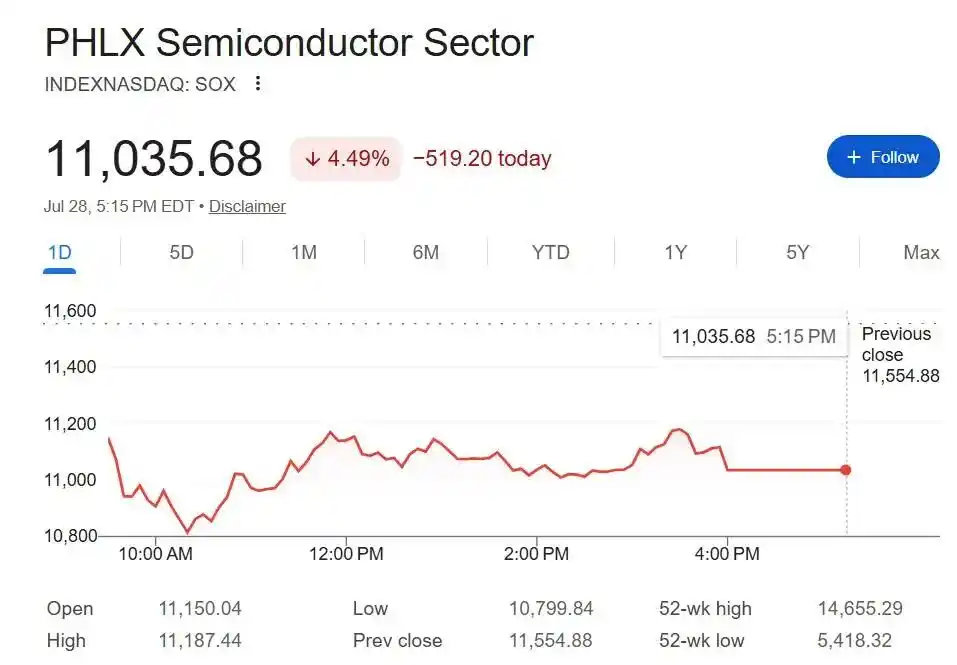
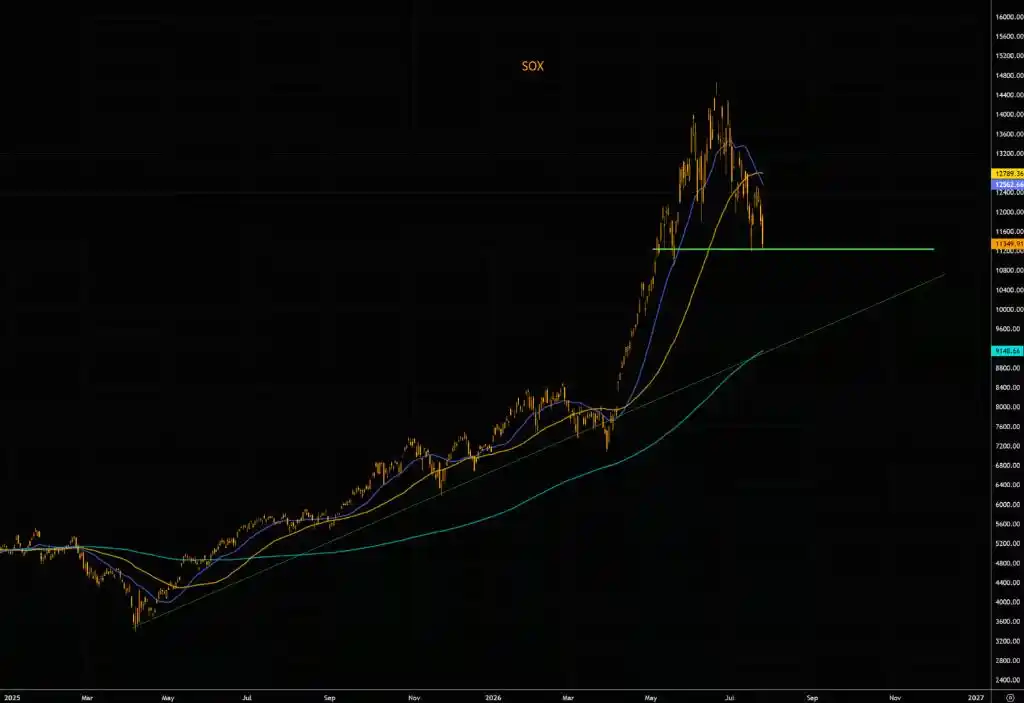
As chip stocks broadly continued to underperform the broader market, the SOX Index broke below the short-term key support near 11,200 points intraday and closed below this level. This level had successfully held during the sell-off on July 17th. However, technical indicators have continued to deteriorate since then—the 21-day moving average has crossed below the 50-day moving average, forming a short-term bearish signal. Concurrently, renewed concerns about the cyclicality of AI capital expenditures are weighing further on investor sentiment.
The semiconductor sector propelled global markets higher in the first half of this year, fueled by investor bets that it would be the primary beneficiary of the massive wave of AI spending. However, as many of these positions have been unwound, the sector has borne the brunt of the intense selling pressure in recent weeks.
Venu Krishna, Head of U.S. Equity Strategy at Barclays, commented: "Concerns around funding uncertainty, increased capital expenditures, and the free cash flow profiles of large tech companies have come into focus for the market."
Marija Veitmane, Head of Equity Research at State Street, described the sell-off as a "spiral." She noted, "The market is concerned about additional leverage and capex, and the sustainability of that spend. Negative momentum is building." However, she added, "Looking at the companies that have reported so far, demand is still incredibly strong... For us, this is a good opportunity to buy the dip."
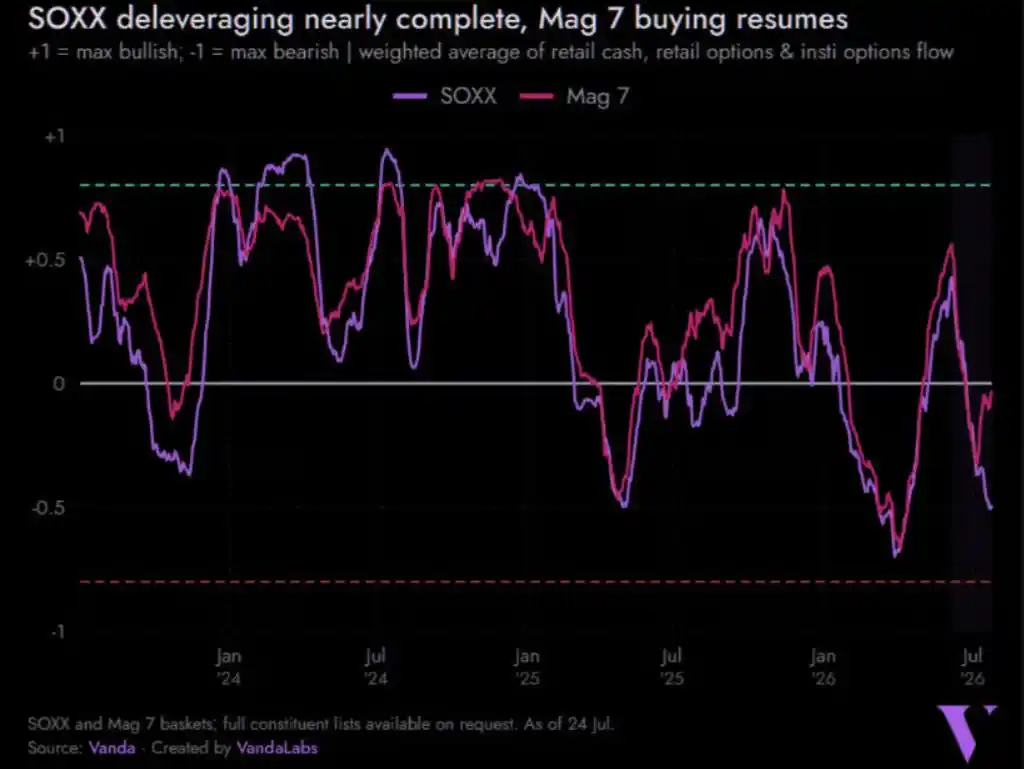
From a market structure perspective, institutional positioning has normalized. The previously crowded 'long semiconductors, short Mag 7' trade has largely been cleared out, resulting in cleaner positioning. Seasonal factors are also turning favorable, as historically the NDX tends to perform strongly after the current point in time. However, technical fragility and fundamental uncertainty mean that whether this potential support can translate into a substantial rebound remains highly uncertain.
01 Critical Support Teetering, Technicals Continue to Deteriorate
The SOX Index is currently testing the significant short-term support level of 11,200 points. This level served as key support during the sharp sell-off on July 17th, but the technical picture has noticeably weakened since that rebound.
The 21-day moving average crossing below the 50-day moving average constitutes a short-term bearish signal.
More concerning, if the 11,200-point level is decisively breached, there is virtually no meaningful support until the 200-day moving average, which currently coincides with the longer-term uptrend line. This suggests the index could face significant downside risk if support fails.
02 Positioning Unwinding Coupled with Seasonal Support, Prerequisites for a Rebound Emerging
Despite technical pressure, some positive shifts are occurring in market structure.
According to Vanda data, institutional positioning has returned to normal levels, and retail participation has also cooled significantly compared to earlier this summer. The previously highly crowded "long semiconductors, short Mag 7" trade has been largely digested and unwound, resulting in a clearer overall positioning structure.
At the same time, seasonal factors are turning favorable. Historical data shows the NDX tends to perform well after this point in the calendar, with July often being a month prone to short squeezes. If seasonal inflows from retail capital begin to pick up in the coming weeks, the overall environment for tech stocks could gradually improve.
03 AI Demand Quality Questioned, Capital Cyclicality Raises Alarms
Technical fragility and fundamental uncertainty are reinforcing each other. According to Bloomberg, Nvidia's latest financing discussions and strategic investment moves have reignited market concerns about the cyclicality of the AI build-out cycle—namely, that capital is funding the customers buying AI hardware, creating a self-perpetuating financial loop.
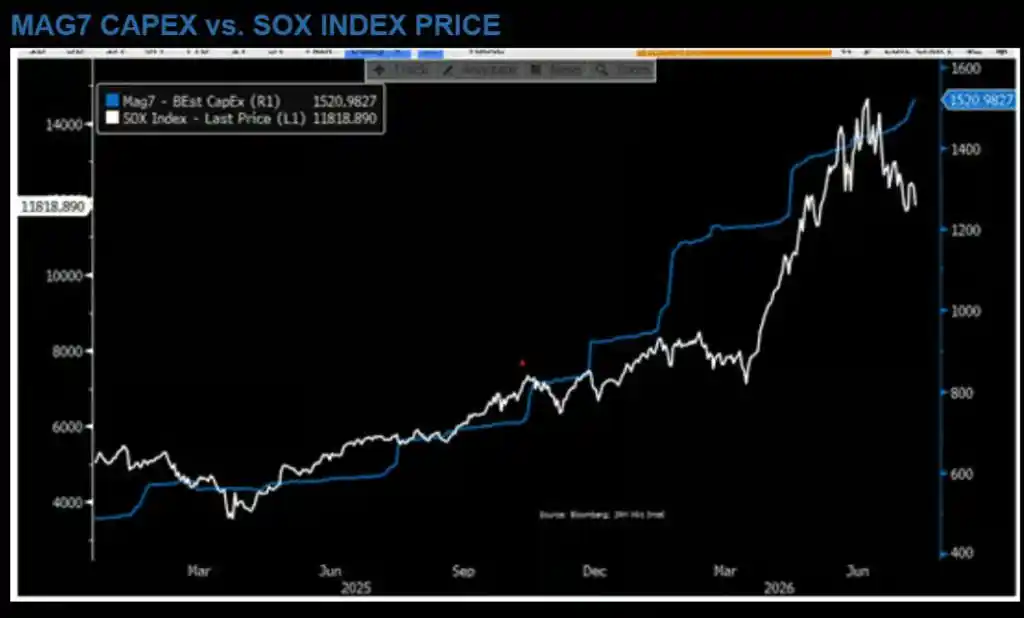
Concurrently, the performance of hyperscale cloud providers relative to the Nasdaq 100 Index has significantly lagged. According to Goldman Sachs data, this relative weakness has reached historically extreme levels. Data from Bloomberg and JPMorgan also show that the short-term divergence between Mag 7 capital expenditures and the SOX Index has widened to an abnormal degree. This growing gap is raising more questions about the sustainability of demand for AI hardware.
04 South Korea's KOSPI Rally Sparks Historical Comparisons, but Fundamental Support Differs
In surrounding markets, the strong rally in the KOSPI has raised caution among some market participants.
A key distinction is that the current rally has a firmer earnings foundation—the recovery in the memory cycle provides substantive performance support for South Korean tech companies.
However, if market sentiment runs too far ahead of fundamentals, the risks highlighted by historical experience should not be ignored.
05 Multiple Variables Intertwined, Whether SOX Holds Support is Key
In summary, the semiconductor sector currently faces a complex situation with mixed signals: weakening technicals, questions over AI demand quality, and accelerated Chinese competition coexist with positioning unwinding, seasonal support, and potential attractiveness after valuation corrections.
Regarding tech volatility, while the VXN/VIX ratio has retreated from recent highs, it remains in a range indicating elevated pressure on tech stocks.
The core variable in the current situation is whether the SOX can hold the 11,200-point support. If this level is lost, the next meaningful support will be the 200-day moving average. If it holds and stabilizes, seasonal capital inflows and the leaner structure following the positioning unwinding could provide a window for tech stocks to recover.
This article does not constitute personal investment advice and does not represent the platform's views. The market carries risks; investment requires caution. Please make independent judgments and decisions.
This article is from the WeChat public account "Wall Street Insights Max," by authors: Bu Shuqing and Li Dan.