Written by: Eric, Foresight News
On June 29, a proposal by the ENS community to extend the veto power of the ENS DAO Security Committee for two years entered the on-chain voting stage. Shortly after voting began, the over 800,000 votes in favor far exceeded the less than 300,000 votes against. However, ENS founder Nick Johnson used his substantial ENS holdings to significantly increase the opposing votes to 3.55 million in one go.
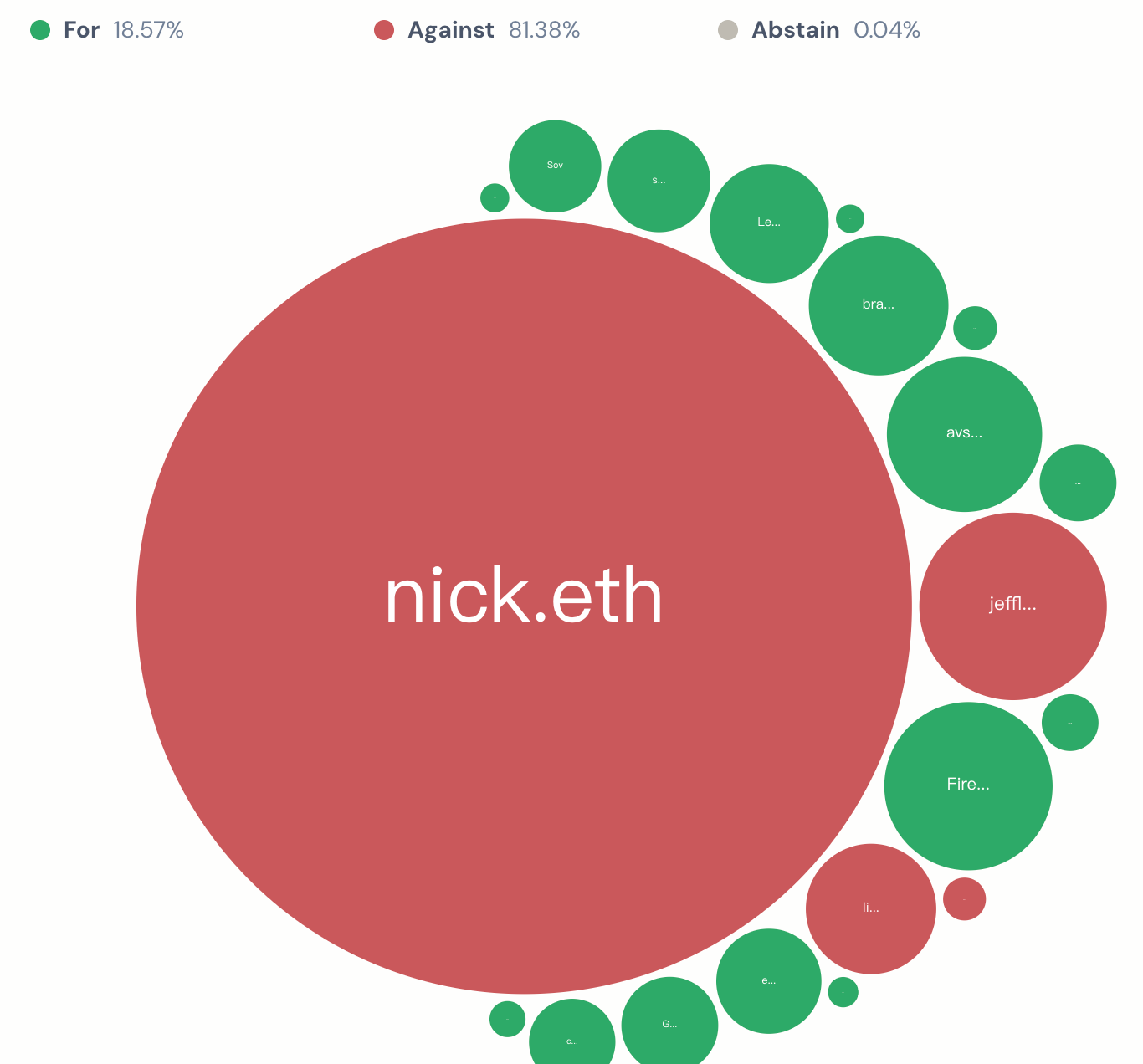
The ENS DAO Security Committee was established in July 2024. At that time, both active participants in ENS DAO proposals and the number of votes were relatively low. To prevent major holders from using this opportunity to launch malicious proposals that could jeopardize the ENS DAO treasury exceeding $350 million, the DAO chose to establish the Security Committee, granting it direct veto power over malicious proposals through a 4/8 multisig.
However, the committee's power is limited to vetoing malicious proposals. It cannot interfere with the process of normal proposals, nor can it initiate proposals. Its authority is retained for only two years at a time for easy adjustment.
Logically, renewing the authority of such an organization protecting the DAO treasury before its term ends should be quite normal. Why would the ENS founder personally step in to vote against a proposal designed to protect the DAO?
To understand this seemingly 'authoritarian' decision, we need to trace back to a discussion about ENS DAO governance in November last year.
I mentioned this incident in the article "Seeing ENS Struggling with Governance, I Think It's Time to Talk About DAO Problems" (https://foresightnews.pro/article/detail/93316): In November 2025, Nick Johnson wrote a meaningful post on the forum, roughly stating that the ENS DAO was now full of political infighting, capable people were gradually leaving, and the leadership of the DAO had fallen into the hands of inexperienced individuals, or even those whose interests were not aligned with the protocol.
Also in that month, ENS DAO Secretary Limes submitted a proposal suggesting that at the end of the sixth term, i.e., December 31, 2025, the operations of the three working groups—Metagovernance, Ecosystem, and Public Goods—be terminated. As for the reasons, firstly, because proposals had become a game of 'you support me, I support you,' with no one caring about what should actually be done; secondly, the lack of entry criteria led to the frequent phenomenon of 'bad money driving out good.' Limes believed that process improvements could not solve this structural deep-rooted problem, and shutting down was the only way out.
Although this proposal ultimately did not pass, Nick's desire for DAO reform was already clear.
On June 19, ENS COO Katherine Wu posted a new proposal on the ENS forum: "Next Era of ENS DAO: Empowering the ENS Foundation." The core contents of the proposal are twofold: first, to transfer daily operations, treasury management, and long-term capital strategy to a restructured ENS Foundation. The Foundation would be responsible for daily treasury operations, public goods grants, working group coordination, ecosystem strategy, trademark/brand assets, etc. Additionally, the Foundation would establish a 5-member board of directors to enhance professional execution and accountability.
Second, it commits that the DAO and token holders will retain core powers, including protocol-layer governance contract upgrades, registry control, fee structure, constitutional amendments, etc.
The biggest point of contention in this proposal is the DAO treasury. Critics believe this would allow the Foundation and, by extension, ENS Labs behind it, to effectively control the massive funds, weakening the direct influence of token holders. ENS original constitution author Brantly Millegan expressed strong opposition, arguing that it violates the DAO's original design where token holders should simultaneously control both the protocol and the treasury, essentially implying that ENS Labs wants direct control of the treasury.
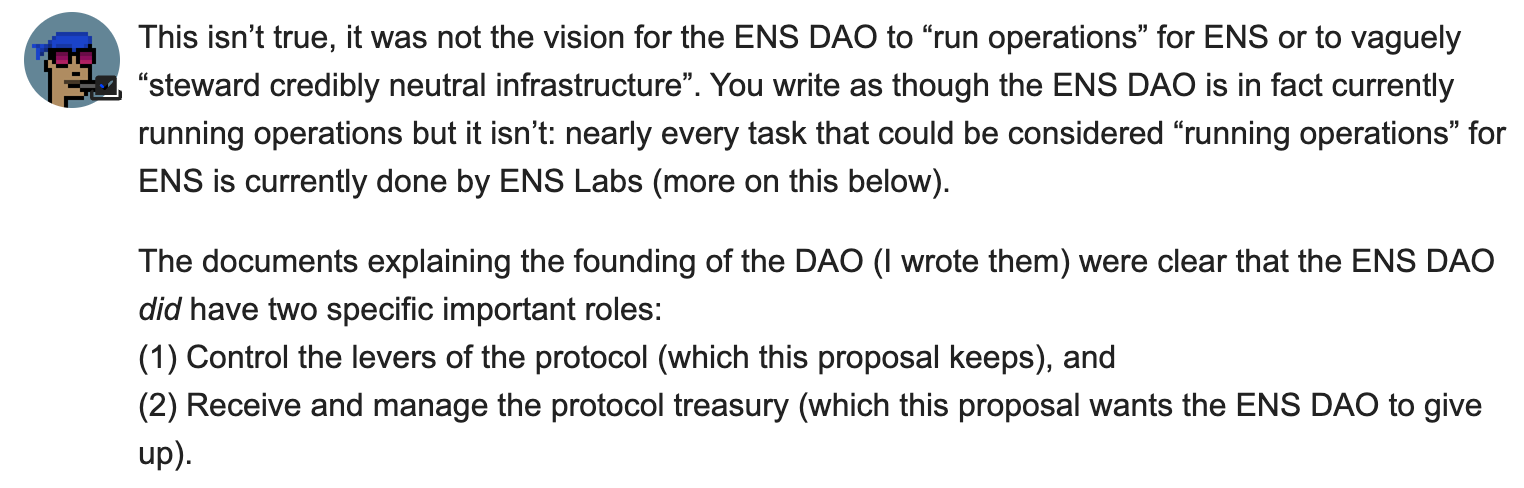
This is a conflict between decentralization fundamentalists and practical operators. One side does not believe inefficiency justifies the Foundation 'seizing power' from the DAO, while the other, after years of ups and downs, still believes that centralization, at least for now, is more beneficial for the project's development.
Nick's over 3 million opposing votes are seen as the first shot fired in the power war.
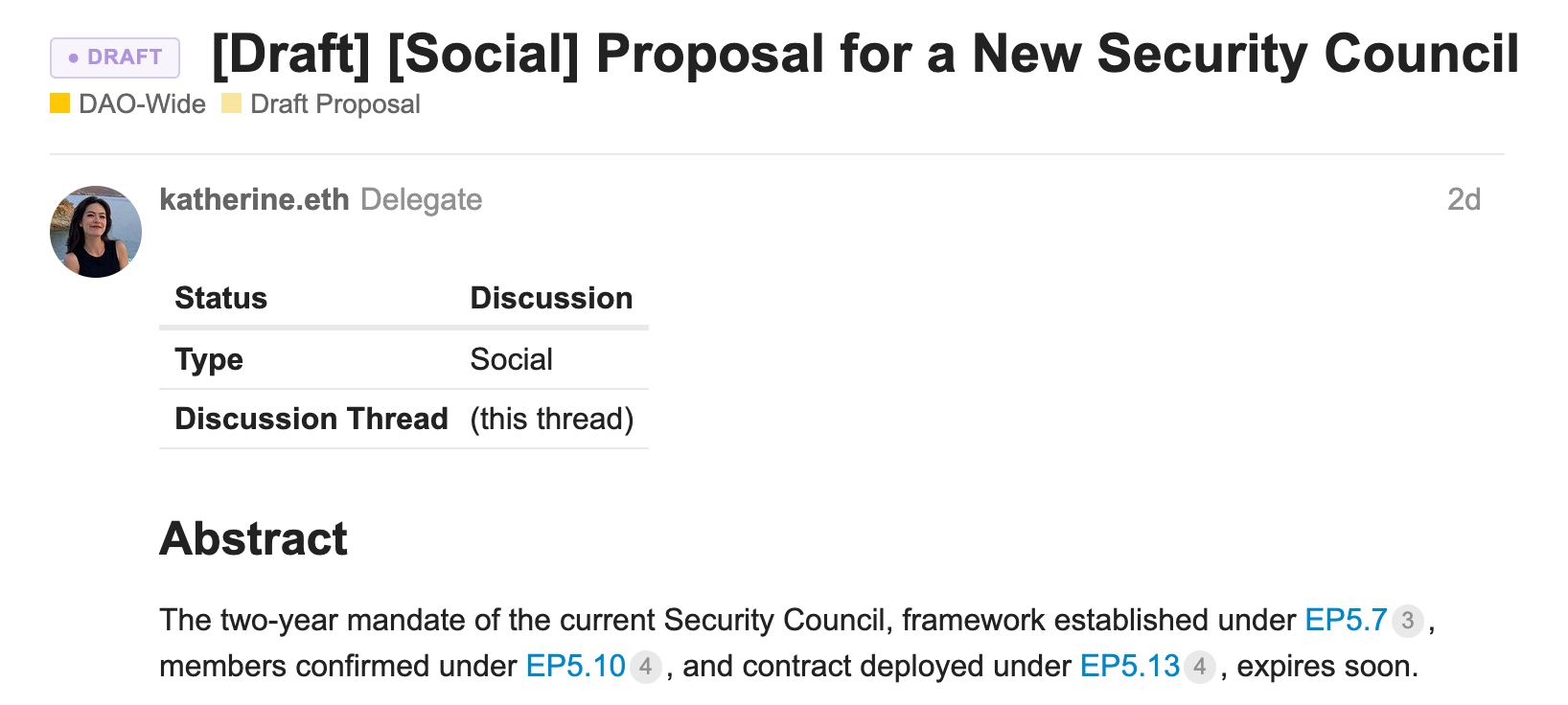
However, Nick himself also provided an explanation. His opposition stems from concerns that the current committee's power lacks sufficient checks and balances, and a two-year extension would solidify these issues. Additionally, he worries that some members might use the veto power for political purposes, blocking ordinary proposals they personally dislike, rather than limiting it to genuinely urgent situations.
In response, Katherine released a new proposal that raised the threshold for veto execution (from 4/8 to 5/8), implemented stricter power limitations, and added member removal mechanisms, among other things, to prevent power concentration.
Data shows ENS's annual revenue exceeded $10 million in 2023, declined to $7 million in 2024, and had fallen to less than $2 million in 2025. When there is enough money, no one cares how it is spent; but when the industry is in a downturn and revenue is falling, even assets worth several hundred million dollars require careful planning.
Nick's substantial holdings of ENS are enough for him to implement these changes, but the forced implementation of change via the token-holding 'bug' leaves Nick with no retreat. The new Foundation must perform at least better than the DAO. 'How to do it' is the problem Nick must solve in the next phase. Hopefully, the ENS core team already has the answer.