In AI Video Generation, 'Leading by a Wide Margin' Has Become a Reality

marsbitОпубліковано о 2026-05-21Востаннє оновлено о 2026-05-21

Анотація

Chinese AI companies, particularly ByteDance and Kuaishou, are now leading in AI video generation, surpassing their US counterparts like OpenAI and Google, according to a recent viral overseas article. The core advantage stems from access to massive, high-quality, and user-behavior-annotated video training data from platforms like Douyin and Kuaishou, creating a self-reinforcing data flywheel that US labs struggle to match. Key Chinese models such as ByteDance's Seedance 2.0, Kuaishou's Kling 3.0, and Alibaba's HappyHorse dominate user-voted rankings on platforms like Artificial Analysis. Their lead is amplified by strong commercial integration in e-commerce, advertising, and short dramas, driving practical monetization absent in the US. However, challenges persist: a widening compute power gap with the US, copyright disputes with Hollywood, rising commercialization costs leading to usage caps and fees, and a foundational lag behind US giants like OpenAI in underlying large language model capabilities. While China holds a tangible lead in this vertical, sustaining it requires navigating these significant hurdles.

By Letters AI

Rumors suggest that ByteDance's video generation model Seedance 2.1 will be released soon, with its generation effect expected to improve by 20% compared to the 2.0 version. ByteDance told Letters AI that this is false information.

Although Seedance 2.1 may not be released in the near future, it is true that Seedance 2.0's popularity has surged overseas.

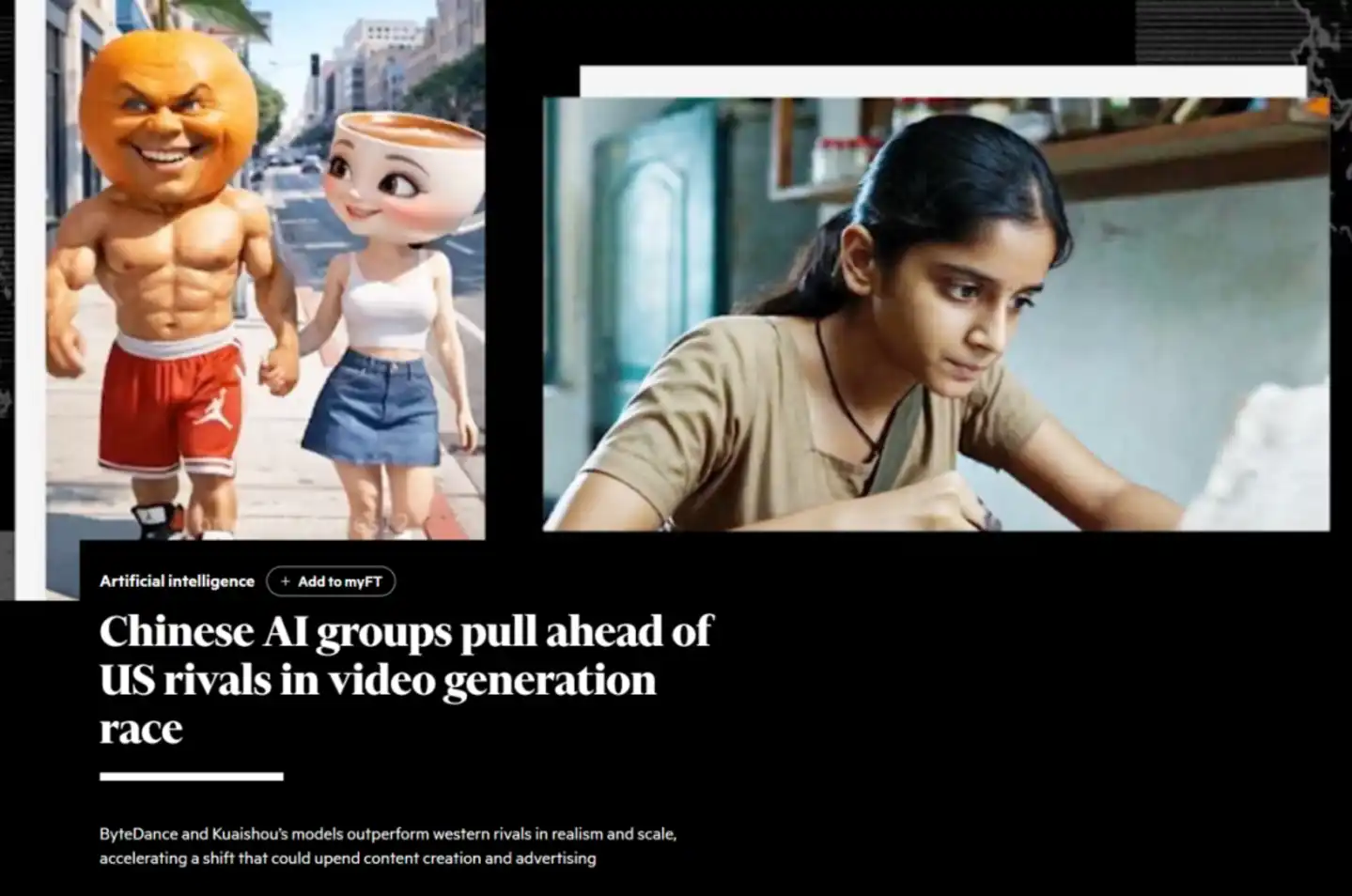
The reason is that over the weekend, an article titled "Chinese AI groups pull ahead of US rivals in video generation race" went viral overseas.

Using Seedance 2.0 and Kuaishou's Kling 3.0 as core evidence, the article reached a surprising conclusion: "In the field of AI video generation, China not only leads the United States, but this advantage will last forever."
This judgment sounds somewhat counter-intuitive; it seems more like flattery for Chinese AI. After all, over the past few years, the AI industry has always seen Silicon Valley launch a product first, followed by similar Chinese products, as we have all witnessed.

But after reading the foreign media's viewpoint, I realized that my thinking was indeed too one-sided. In Chinese AI video generation, it truly is leading the United States.

The article specifically interviewed several American AI entrepreneurs and filmmakers using AI video generation technology. The result was unanimous: everyone agrees that Chinese AI video tools have comprehensively surpassed their American counterparts.

More importantly, this lead is not a phased technological advantage but a comprehensive one, leading in every aspect from data to practical application.

Not only that, this lead is of the "unbeatable" kind. That is to say, this leading position will be maintained indefinitely.

Has "leading by a wide margin" become reality?

Why Will Chinese AI Forever Lead American AI?

One argument in the article is that in the field of AI video generation, the gap at the algorithm level is rapidly narrowing.

Currently, the technical architectures of various companies are already "more or less the same." Underlying technological paths like Transformer, diffusion models, and spatiotemporal attention mechanisms have become relatively transparent.

So the key question becomes: who possesses higher quality and larger quantities of training data?

This happens to be where ByteDance and Kuaishou excel. Douyin and Kuaishou are among the world's largest video production machines.

More importantly, this data comes with complete user behavior annotations.

Which videos are liked, favorited, shared; which have high completion rates—this data is all clear in the backend.

Moreover, these annotations do not require manual labeling; they are naturally generated from users' real behavior. This kind of high-quality, annotated data is something you might not be able to buy on the market even if you wanted to.

In contrast, OpenAI and Anthropic have no accumulation of video data.

When OpenAI launched Sora, it primarily relied on publicly crawled video data from the internet and some licensed film and television materials.

The problem is that public videos on the internet are often of mixed quality, containing a large amount of duplicate content, low-quality content, and even secondarily processed content with watermarks and advertisements.

Therefore, during the training process, it often results in more effort for less gain.

On the global evaluation platform Artificial Analysis, ByteDance's Seedance 2.0, Kuaishou's Kling 3.0, and Alibaba's HappyHorse together took the top spots in the text-to-video and image-to-video rankings.

This ranking is generated by real user votes, meaning that everyone generally finds the content generated by these three Chinese AI video tools to be better.

Although Google has YouTube as a data source and its own video generation model Veo 3,

Google's problem lies in having too many constraints. Videos on YouTube are generally over 5 minutes long, but current GPUs cannot yet accommodate such long, high-definition videos as training data, which can cause the model to fail during training.

This has led to a market reception for Veo 3 that has not been very good, falling short of Chinese AI video generation models like Seedance 2.0 and Kling 3.0.

"We've tried most American models, but they haven't performed well enough in video generation," said Ben Chiang, founder of Director AI. Therefore, he currently mainly uses Chinese tools like Kling, Seedance 2.0, and Halulu for creation.

Independent AI filmmaker George Won stated, "Seedance 2.0 is a game-changer. It can handle aggressive camera angles and speeds without losing facial details of characters or the contrast of light and shadow. Most AI models start to shake or drift during rapid movement."

Moreover, this data advantage can also enable products to undergo "self-reinforcement."

ByteDance has integrated Seedance 2.0 into creative tools like CapCut, allowing ByteDance to receive feedback data on over 50 million generated videos daily.

This way, ByteDance can know that "this video satisfied the user, this one did not."

Each piece of such feedback makes the development direction of the next-generation Seedance product a bit clearer.

This kind of continuous, large-scale feedback loop in real-world scenarios is also unmatched by the lab environments of companies like OpenAI and Anthropic.

Even with massive resource investment, it is difficult to establish a similar data flywheel in the short term.

Technology can be caught up with, algorithms can be imitated, but the accumulation of ecosystems and data takes time, requires a user base, and needs a complete product cycle.

Application Scenarios

For companies developing AI video, there must be a "purpose."

Data advantage is just the starting point; what truly turns technology into competitiveness is finding profitable application scenarios. With landing scenarios, companies have the motivation to develop AI video generation.

In this dimension, ByteDance and Kuaishou also outperform American AI.

The first large-scale application scenario is e-commerce video.

In the past, the cost of shooting a professional video for a product could be as high as several thousand yuan, including photographer, lighting technician, venue rental, model fees, post-production editing, etc.

For most small and medium-sized merchants, an ordinary Taobao store might have hundreds of products; filming them all would cost at least several hundred thousand yuan.

AI video generation technology has changed this situation.

Vincent Yang, CEO of video infrastructure company Firework, said, "A retailer asked us to create 100,000 videos for their product pages. Without AI, this would be completely unfeasible in terms of cost. Now, each product can have its own video, and even multiple customized versions for different customers."

Data shows that product pages with videos have a conversion rate 30% to 80% higher than those with only images and text. Moreover, Douyin and Kuaishou are among China's largest e-commerce live-streaming and short video sales platforms.

Once AI generates the video, you can turn right out the door and directly launch an advertising campaign.

Alibaba's HappyHorse model also explicitly positions e-commerce video as a core application scenario. It supports batch generation of product showcase short videos and virtual host talking videos. A merchant can upload product images and simple text descriptions, and the system can automatically generate multiple versions of sales videos, each targeting different audience groups with different scripts and presentation styles.

The second scenario is advertising.

The production cycle for traditional TVC (television commercial) is too long.

A 30-second brand advertisement often takes several weeks from creative planning to filming and production.

With video generation models, dozens of different versions of advertising creatives can be generated in just a few minutes.

The third scenario is short dramas.

AI short dramas experienced explosive growth in 2026. Data shows that the number of AI short dramas airing in March 2026 increased by 138% compared to January, far exceeding the production speed of traditional film and television content.

Through AI video generation, a small team or even an individual creator can produce a short drama within a few days.

Furthermore, ByteDance's Hongguo Short Drama platform has integrated an "image search for same items" feature.

This feature is easy to understand: while watching a short drama, if you are interested in a character's outfit, furniture in a scene, or a car parked at the door, you can directly click on image search. The system will recommend the same or similar items, allowing you to purchase them directly.

This essentially turns short dramas into a commercial scenario that can generate conversions.

In contrast, in the American market, despite having content platforms like Netflix and YouTube, there is no comparable application and conversion mechanism.

American AI video tools remain more in the creative experimentation stage, with the only commercial application scenario being subscription memberships.

Moreover, in terms of product functionality, Chinese video generation models are also more suitable for commercial application.

Seedance 2.0 can incorporate multiple source photos, videos, and sounds into the same AI video. Sora cannot do this; it can only generate videos by specifying an image and text to the model.

This is not because Sora's technology is insufficient, but because it lacks a complete commercial ecosystem to leverage these technological capabilities.

The Computing Power Gap

However, Chinese video AI also faces an unavoidable hurdle: computing power.

Leading American AI companies treat computing power as gold, hoarding all the computing power available on the market.

Anthropic recently signed computing power agreements totaling over 10 gigawatts.

This figure includes leasing all the computing power of SpaceX's Colossus 1 data center, covering 220,000 NVIDIA GPUs; a 5-gigawatt agreement with Amazon; and 3.5-gigawatt agreements with Google and Broadcom.

OpenAI operates similarly.

Through its deep collaboration with Microsoft, OpenAI has gained access to hundreds of thousands of high-end GPUs, and Microsoft has specifically built several hyperscale data centers for OpenAI.

In comparison, although Chinese companies have made significant progress in algorithm efficiency optimization, there is still a gap in the absolute scale of computing power.

According to foreign media statistics, the gap in AI computing power between China and the US was about 3 times in 2023 and had expanded to about 8 times by early 2026.

Besides computing power, Chinese AI faces other challenges.

The first is copyright.

Taking Seedance 2.0 as an example, about a month after its release, six Hollywood giants including Disney, Warner Bros., Paramount, Skydance, and Netflix jointly sent a cease-and-desist letter to ByteDance. They claimed that Seedance 2.0 had used copyright-protected film and television materials on a large scale without authorization during its training phase.

Subsequently, ByteDance urgently suspended the originally planned global release of Seedance 2.0 in mid-March.

If you have been using Seedance 2.0 from February until now, you will find that IP characters that could be generated before can no longer be used; instead, only "passerby" images can be used.

The second is that the commercialization threshold is rising.

American video generation AI, represented by Sora, often rejects generation requests due to usage policies. Chinese tools are more lenient, and their prices are also cheaper.

But this has also brought a "happy trouble" for Chinese AI companies.

Since February, Seedance 2.0 has seen a surge in usage demand, and some users have already encountered quota limits and longer queue times.

Foreign media reported that ByteDance has adopted a heavier commercialization approach for some American enterprise clients, requiring them to prepay approximately $2 million in exchange for model access rights and usage quotas.

Kuaishou is in a similar situation; they are spinning off the Kling business and may promote Kling for a separate listing in the future.

This indicates that Kling is an independent business with a potentially stronger growth story than Kuaishou's main entity.

The bigger the growth story, the clearer the accounting needs to be.

However, the cost of AI video is higher. The computing power consumed behind generating a few seconds of video for a user is far higher than generating a piece of text.

The higher the quality and the longer the duration of the generated video, the higher the inference cost.

Many video generation models are like this: initially very cheap, even free, but once users flood in, they quickly start implementing limits, queues, and price increases.

It's not that companies don't want to scale up; it's that the landlord doesn't have surplus grain either.

So what Chinese video AI needs to face next is not just "whether it can create a good model," but "whether it can turn a good model into a good business."

If the price is too low, the faster the user growth, the greater the losses; if the price is too high, there are no users, which defeats the purpose.

The third is the generational gap in model capabilities.

Ultimately, video generation capabilities are built upon language models.

No matter how powerful a video generation model is, it still needs language understanding capabilities as a foundation to understand user prompts. Then it uses reasoning capabilities to understand the logical relationships of scenes and characters and maintain coherence in the generated content.

According to foreign media assessments, OpenAI's ChatGPT 5.5 and Anthropic's Mythos have taken a lead of 9 months to 1 year over domestic AI companies.

This generational gap is reflected in multiple aspects, such as reasoning ability, contextual understanding, multi-turn dialogue, complex task handling, etc.

Although China leads American AI in vertical fields like AI video, a relatively noticeable gap can still be felt in general-purpose large models.

In summary, Chinese AI's lead in the field of video generation is real, but it is not without worries. The gap in computing power and foundational models is always a sword hanging overhead. But at least for now, we finally don't have to look up at the back of Silicon Valley anymore.


Пов'язані питання

QAccording to the article, why does it claim that Chinese AI video generation tools will maintain a permanent lead over American competitors?

AThe article argues that the lead is built on superior, user-behavior-annotated training data from platforms like Douyin and Kuaishou, a self-reinforcing product feedback loop, and strong commercial application scenarios (e.g., e-commerce, advertising, short dramas). These factors create an ecosystem and data advantage that is difficult for U.S. companies without such platforms to replicate quickly.

QWhat are the three main commercial application scenarios mentioned for AI video generation in China?

AThe three main commercial application scenarios are: 1) E-commerce product videos, 2) Advertising content creation, and 3) AI-generated short dramas, which are often integrated with shopping features for direct conversion.

QWhat significant challenge does the article highlight for Chinese AI video companies despite their technological lead?

AThe article highlights a significant and growing compute power (算力) gap with the U.S., estimating it had widened to about 8 times by early 2026. Other challenges include copyright infringement accusations from Hollywood studios, the high cost of video generation straining business models, and a foundational gap in underlying large language models (LLMs) compared to leaders like OpenAI and Anthropic.

QHow do Chinese platforms like ByteDance gain a data advantage for training their AI video models according to the text?

APlatforms like ByteDance's Douyin and Kuaishou are massive video production engines. They provide vast amounts of high-quality video data that is naturally annotated with user engagement metrics (likes, shares, completion rates). Furthermore, integrating models like Seedance into editing tools (e.g., CapCut) generates millions of daily feedback data points on what users like or dislike, creating a powerful, self-reinforcing data flywheel.

QWhat example does the article give to illustrate the functional advantage of Chinese AI video tools for commercial use compared to models like Sora?

AThe article states that ByteDance's Seedance 2.0 can integrate multiple source photos, videos, and audio into a single AI-generated video, making it more versatile for commercial content creation. In contrast, it mentions that OpenAI's Sora is limited to generating video from a single image and text prompt, not due to inferior technology but due to a lack of a comprehensive commercial ecosystem to support such features.

Пов'язані матеріали

Top 10 Promising Emerging Hyperliquid Native Protocols to Watch

Title: A Review of 10 Emerging Native Protocols on Hyperliquid Hyperliquid is evolving beyond perpetual contracts into a comprehensive on-chain financial stack. This article highlights 10 key native protocols driving this growth: 1. **Monetrix**: A yield-optimizing protocol akin to Ethena, aggregating funding rates, HLP rewards, maker rebates, and HIP-3 into a single stablecoin yield. 2. **ROSETTA**: An automated stablecoin yield router, allocating USDC across top protocols (e.g., Felix, Aave, HLP) for optimal returns, factoring in gas and slippage. 3. **papertrade.xyz**: A fair-launched perpetuals protocol offering up to 1000x leverage, no funding rates, no slippage, and fully on-chain, oracle-based execution. 4. **alt.fun**: A launchpad where tokens are paired with leveraged perpetual positions (2x-5x), linking token price to trading activity and underlying position performance. 5. **Ventuals**: Pre-IPO perpetual contracts (built on HIP-3) allowing up to 10x leveraged speculation on valuations of private companies like SpaceX and Stripe. 6. **Liminal**: A delta-neutral yield protocol that captures funding rates via automated short positions and uses generated xTokens (xBTC, etc.) as DeFi collateral. 7. **Melt**: Brings tokenized stocks, commodities, and RWAs to Hyperliquid spot markets, enabling 24/7 trading alongside crypto assets. 8. **Chainsight**: An oracle and data infrastructure protocol providing low-latency (<3s) price feeds, volatility indices, and risk metrics for novel derivatives. 9. **rip.xyz**: Tokenized vault strategies on HyperEVM; its flagship rHYPURR offers liquidity and fractional exposure to a Hypurr NFT basket, priced hourly via NAV. 10. **Markets**: A perpetuals exchange (by Kinetiq) for trading stocks, forex, commodities, bonds, and crypto with up to 50x leverage, using USDH collateral and Kaiko oracles. These protocols form the foundational layer for generating real yield, liquidity, and innovative financial products natively on Hyperliquid.

marsbit45 хв тому

Top 10 Promising Emerging Hyperliquid Native Protocols to Watch

marsbit45 хв тому

Musk Posted a Recruitment Ad for SpaceX, and After Reading the Comments Section, I Understood

On May 20th, SpaceX filed for a landmark IPO with a $1.75 trillion valuation. Shortly after, Elon Musk posted a recruitment call on X, seeking "world-class engineers and physicists" for SpaceX. The application process was starkly simple: email with three bullet points proving "exceptional ability," with real, complex projects as a plus. Musk promised to review qualifying emails himself. The post garnered millions of views and thousands of replies, revealing a spectrum of responses. Most comments, including a highly-upvoted humorous one listing absurd "skills," merely listed credentials or experiences in a conventional, non-differentiating way. This highlighted a key insight: a traditional resume listing degrees and skills often fails to demonstrate true exceptionalism. Effective self-presentation requires "performance efficiency." A standout reply came from an OpenAI engineering lead, who simply stated "codex." This demonstrated that for those who have built significant, recognized products, the product itself becomes the ultimate resume. The article argues that in the AI era, any tangible, shareable output—a tool, research, or online project—serves as a living, self-evident credential more powerful than a list of attributes. However, a twist emerged when applicants found the provided email address non-functional, leading to speculation that the post might also serve as an IPO publicity stunt, projecting an image of aggressive talent acquisition to investors. Ultimately, the episode served as a microcosm: some participate through performance, others through proof of work, while some question the reality of the stage itself. It underscores the enduring challenge of defining and demonstrating value in an age of abundant, yet often superficial, content.

marsbit1 год тому

Musk Posted a Recruitment Ad for SpaceX, and After Reading the Comments Section, I Understood

marsbit1 год тому

Cutting Off OpenAI, Anthropic Acquires the Tool Provider Used by a Quarter of Global Developers

Anthropic has acquired Stainless, a developer tool company that automatically generated official SDKs (Software Development Kits) for AI giants including OpenAI, Anthropic, Meta, and Cloudflare. The deal, reportedly valued at around $300 million, marks a strategic shift for Anthropic as it builds its "AI agent" infrastructure. Stainless acted as a "translator," converting complex API specifications into ready-to-use code libraries for developers. Its tools indirectly reached about a quarter of professional software developers globally. Following the acquisition, Stainless will shut down its public products and its team will join Anthropic to focus on internal platform development, notably for the Claude Platform. Existing SDKs remain with their respective client companies but will no longer receive updates from Stainless. This move is part of Anthropic's broader 18-month strategy to assemble a complete "agent stack." The stack consists of the Claude model at its core, the newly acquired Stainless for standardized API interfaces, and the Model Context Protocol (MCP), an open standard for connecting agents to external tools and data. This contrasts with OpenAI's focus on model generations and consumer-scale compute. Anthropic believes an agent's ultimate utility depends on its ability to connect to external systems. By internalizing the SDK layer and promoting MCP as a connection standard, Anthropic aims to lock in long-term ecosystem advantages and create path dependency, moving beyond the transient lead provided by any single model generation.

marsbit1 год тому

Cutting Off OpenAI, Anthropic Acquires the Tool Provider Used by a Quarter of Global Developers

marsbit1 год тому

Торгівля

Спот
Ф'ючерси

Популярні статті

Що таке $S$

Розуміння SPERO: Комплексний огляд Вступ до SPERO Оскільки ландшафт інновацій продовжує еволюціонувати, виникнення технологій web3 та криптовалютних проектів відіграє ключову роль у формуванні цифрового майбутнього. Один з проектів, який привернув увагу в цій динамічній сфері, — це SPERO, позначений як SPERO,$$s$. Ця стаття має на меті зібрати та представити детальну інформацію про SPERO, щоб допомогти ентузіастам та інвесторам зрозуміти його основи, цілі та інновації в рамках web3 та крипто-сектору. Що таке SPERO,$$s$? SPERO,$$s$ — це унікальний проект у криптопросторі, який прагне використати принципи децентралізації та технології блокчейн для створення екосистеми, що сприяє залученню, корисності та фінансовій інклюзії. Проект розроблений для полегшення взаємодії між користувачами новими способами, надаючи їм інноваційні фінансові рішення та послуги. У своїй основі SPERO,$$s$ прагне надати можливості індивідам, забезпечуючи інструменти та платформи, які покращують користувацький досвід у криптовалютному просторі. Це включає в себе можливість більш гнучких методів транзакцій, сприяння ініціативам, що підтримуються спільнотою, та створення шляхів для фінансових можливостей через децентралізовані додатки (dApps). Основна концепція SPERO,$$s$ обертається навколо інклюзивності, прагнучи зменшити розриви в традиційній фінансовій системі, використовуючи переваги технології блокчейн. Хто є творцем SPERO,$$s$? Особистість творця SPERO,$$s$ залишається дещо невідомою, оскільки є обмежені публічно доступні ресурси, що надають детальну інформацію про його засновників. Ця відсутність прозорості може бути наслідком зобов'язання проекту до децентралізації — етики, яку багато проектів web3 поділяють, ставлячи колективні внески вище за індивідуальне визнання. Зосереджуючи обговорення навколо спільноти та її колективних цілей, SPERO,$$s$ втілює суть наділення без виділення конкретних осіб. Таким чином, розуміння етики та місії SPERO є більш важливим, ніж ідентифікація єдиного творця. Хто є інвесторами SPERO,$$s$? SPERO,$$s$ підтримується різноманітними інвесторами, починаючи від венчурних капіталістів до ангельських інвесторів, які прагнуть сприяти інноваціям у крипто-секторі. Зосередження цих інвесторів зазвичай узгоджується з місією SPERO — пріоритет надається проектам, які обіцяють технологічний прогрес у суспільстві, фінансову інклюзію та децентралізоване управління. Ці інвесторські фонди зазвичай зацікавлені в проектах, які не лише пропонують інноваційні продукти, але й позитивно впливають на спільноту блокчейн та її екосистеми. Підтримка з боку цих інвесторів підкріплює SPERO,$$s$ як значного конкурента в швидко змінюваній сфері крипто-проектів. Як працює SPERO,$$s$? SPERO,$$s$ використовує багатогранну структуру, яка відрізняє його від традиційних криптовалютних проектів. Ось деякі ключові особливості, які підкреслюють його унікальність та інноваційність: Децентралізоване управління: SPERO,$$s$ інтегрує моделі децентралізованого управління, надаючи користувачам можливість активно брати участь у процесах прийняття рішень щодо майбутнього проекту. Цей підхід сприяє відчуттю власності та відповідальності серед членів спільноти. Корисність токена: SPERO,$$s$ використовує свій власний криптовалютний токен, розроблений для виконання різних функцій в екосистемі. Ці токени дозволяють здійснювати транзакції, отримувати винагороди та полегшувати послуги, що пропонуються на платформі, підвищуючи загальну залученість та корисність. Шарова архітектура: Технічна архітектура SPERO,$$s$ підтримує модульність та масштабованість, що дозволяє безперешкодно інтегрувати додаткові функції та додатки в міру розвитку проекту. Ця адаптивність є надзвичайно важливою для збереження актуальності в постійно змінюваному крипто-ландшафті. Залучення спільноти: Проект підкреслює ініціативи, що підтримуються спільнотою, використовуючи механізми, які стимулюють співпрацю та зворотний зв'язок. Підтримуючи сильну спільноту, SPERO,$$s$ може краще задовольняти потреби користувачів та адаптуватися до ринкових тенденцій. Фокус на інклюзію: Пропонуючи низькі комісії за транзакції та зручні інтерфейси, SPERO,$$s$ прагне залучити різноманітну базу користувачів, включаючи осіб, які раніше не брали участі в крипто-просторі. Це зобов'язання до інклюзії узгоджується з його загальною місією наділення через доступність. Хронологія SPERO,$$s$ Розуміння історії проекту надає важливі уявлення про його розвиток та етапи. Нижче наведено пропоновану хронологію, що відображає значні події в еволюції SPERO,$$s$: Етап концептуалізації та ідеації: Початкові ідеї, що стали основою SPERO,$$s$, були сформовані, тісно пов'язані з принципами децентралізації та фокусом на спільноті в індустрії блокчейн. Запуск білого паперу проекту: Після концептуального етапу був випущений комплексний білий папір, що детально описує бачення, цілі та технологічну інфраструктуру SPERO,$$s$, щоб залучити інтерес та зворотний зв'язок від спільноти. Створення спільноти та ранні залучення: Активні зусилля були спрямовані на створення спільноти ранніх прихильників та потенційних інвесторів, що полегшило обговорення цілей проекту та отримання підтримки. Подія генерації токенів: SPERO,$$s$ провів подію генерації токенів (TGE) для розподілу своїх рідних токенів серед ранніх прихильників та встановлення початкової ліквідності в екосистемі. Запуск початкового dApp: Перший децентралізований додаток (dApp), пов'язаний з SPERO,$$s$, став доступним, дозволяючи користувачам взаємодіяти з основними функціями платформи. Постійний розвиток та партнерства: Безперервні оновлення та вдосконалення пропозицій проекту, включаючи стратегічні партнерства з іншими учасниками блокчейн-простору, сформували SPERO,$$s$ у конкурентоспроможного та еволюціонуючого гравця на крипто-ринку. Висновок SPERO,$$s$ є свідченням потенціалу web3 та криптовалют для революціонізації фінансових систем та наділення індивідів. Завдяки зобов'язанню до децентралізованого управління, залучення спільноти та інноваційно спроектованих функцій, він прокладає шлях до більш інклюзивного фінансового ландшафту. Як і з будь-якими інвестиціями в швидко змінюваному крипто-просторі, потенційним інвесторам та користувачам рекомендується ретельно досліджувати та обдумано взаємодіяти з поточними подіями в SPERO,$$s$. Проект демонструє інноваційний дух крипто-індустрії, запрошуючи до подальшого дослідження його численних можливостей. Хоча подорож SPERO,$$s$ ще триває, його основні принципи можуть справді вплинути на майбутнє того, як ми взаємодіємо з технологією, фінансами та один з одним у взаємопов'язаних цифрових екосистемах.

73 переглядів усьогоОпубліковано 2024.12.17Оновлено 2024.12.17

Що таке $S$

Що таке AGENT S

Агент S: Майбутнє автономної взаємодії в Web3 Вступ У постійно змінюваному ландшафті Web3 та криптовалюти інновації постійно переосмислюють, як люди взаємодіють з цифровими платформами. Один з таких новаторських проектів, Агент S, обіцяє революціонізувати взаємодію людини з комп'ютером через свою відкриту агентну структуру. Прокладаючи шлях для автономних взаємодій, Агент S прагне спростити складні завдання, пропонуючи трансформаційні застосування в штучному інтелекті (ШІ). Це детальне дослідження заглиблюється в складності проекту, його унікальні особливості та наслідки для сфери криптовалюти. Що таке Агент S? Агент S є революційною відкритою агентною структурою, спеціально розробленою для вирішення трьох основних викликів в автоматизації комп'ютерних завдань: Набуття специфічних знань у галузі: Структура інтелектуально навчається з різних зовнішніх джерел знань та внутрішнього досвіду. Цей подвійний підхід дозволяє їй створити багатий репозиторій специфічних знань у галузі, покращуючи її продуктивність у виконанні завдань. Планування на довгих горизонтах завдань: Агент S використовує планування з підкріпленням досвіду, стратегічний підхід, який полегшує ефективний розподіл та виконання складних завдань. Ця функція значно підвищує її здатність ефективно та результативно управляти кількома підзавданнями. Обробка динамічних, неоднорідних інтерфейсів: Проект представляє Інтерфейс Агент-Комп'ютер (ACI), інноваційне рішення, яке покращує взаємодію між агентами та користувачами. Використовуючи багатомодальні великі мовні моделі (MLLMs), Агент S може безперешкодно орієнтуватися та маніпулювати різноманітними графічними інтерфейсами користувача. Завдяки цим новаторським функціям Агент S надає надійну структуру, яка вирішує складнощі, пов'язані з автоматизацією людської взаємодії з машинами, прокладаючи шлях для численних застосувань у ШІ та за його межами. Хто є творцем Агент S? Хоча концепція Агент S є фундаментально новаторською, конкретна інформація про його творця залишається невідомою. Творець наразі невідомий, що підкреслює або початкову стадію проекту, або стратегічний вибір зберегти засновників у таємниці. Незважаючи на анонімність, акцент залишається на можливостях та потенціалі структури. Хто є інвесторами Агент S? Оскільки Агент S є відносно новим у криптографічній екосистемі, детальна інформація про його інвесторів та фінансових спонсорів не задокументована. Відсутність публічно доступних відомостей про інвестиційні фонди або організації, що підтримують проект, викликає питання щодо його фінансової структури та дорожньої карти розвитку. Розуміння підтримки є критично важливим для оцінки стійкості проекту та потенційного впливу на ринок. Як працює Агент S? В основі Агент S лежить передова технологія, яка дозволяє йому ефективно функціонувати в різних умовах. Його операційна модель побудована навколо кількох ключових функцій: Взаємодія з комп'ютером, подібна до людської: Структура пропонує розширене планування ШІ, прагнучи зробити взаємодії з комп'ютерами більш інтуїтивними. Імітуючи людську поведінку при виконанні завдань, вона обіцяє підвищити досвід користувачів. Наративна пам'ять: Використовується для використання високорівневого досвіду, Агент S використовує наративну пам'ять для відстеження історій завдань, тим самим покращуючи свої процеси прийняття рішень. Епізодична пам'ять: Ця функція надає користувачам покрокові інструкції, дозволяючи структурі пропонувати контекстуальну підтримку в міру виконання завдань. Підтримка OpenACI: Завдяки можливості працювати локально, Агент S дозволяє користувачам зберігати контроль над своїми взаємодіями та робочими процесами, узгоджуючи з децентралізованою етикою Web3. Легка інтеграція з зовнішніми API: Його універсальність і сумісність з різними платформами ШІ забезпечують те, що Агент S може безперешкодно вписатися в існуючі технологічні екосистеми, роблячи його привабливим вибором для розробників та організацій. Ці функціональні можливості колективно сприяють унікальному положенню Агент S у крипто-просторі, оскільки він автоматизує складні, багатоступеневі завдання з мінімальним втручанням людини. У міру розвитку проекту його потенційні застосування в Web3 можуть переосмислити, як відбуваються цифрові взаємодії. Хронологія Агент S Розробка та етапи Агент S можуть бути узагальнені в хронології, яка підкреслює його значні події: 27 вересня 2024 року: Концепція Агент S була представлена в комплексній науковій статті під назвою “Відкрита агентна структура, яка використовує комп'ютери як людина”, що демонструє основи проекту. 10 жовтня 2024 року: Наукова стаття була опублікована на arXiv, пропонуючи детальне дослідження структури та її оцінки продуктивності на основі бенчмарку OSWorld. 12 жовтня 2024 року: Було випущено відеопрезентацію, що надає візуальне уявлення про можливості та особливості Агент S, ще більше залучаючи потенційних користувачів та інвесторів. Ці маркери в хронології не лише ілюструють прогрес Агент S, але й вказують на його прихильність до прозорості та залучення громади. Ключові моменти про Агент S У міру розвитку структури Агент S кілька ключових характеристик виділяються, підкреслюючи її новаторський характер та потенціал: Інноваційна структура: Розроблена для забезпечення інтуїтивного використання комп'ютерів, подібного до людської взаємодії, Агент S пропонує новий підхід до автоматизації завдань. Автономна взаємодія: Здатність автономно взаємодіяти з комп'ютерами через GUI означає стрибок до більш інтелектуальних та ефективних обчислювальних рішень. Автоматизація складних завдань: Завдяки своїй надійній методології він може автоматизувати складні, багатоступеневі завдання, роблячи процеси швидшими та менш схильними до помилок. Безперервне вдосконалення: Механізми навчання дозволяють Агенту S покращуватися на основі минулого досвіду, постійно підвищуючи свою продуктивність та ефективність. Універсальність: Його адаптивність до різних операційних середовищ, таких як OSWorld та WindowsAgentArena, забезпечує його здатність служити широкому спектру застосувань. Оскільки Агент S займає своє місце в ландшафті Web3 та криптовалюти, його потенціал покращити можливості взаємодії та автоматизувати процеси означає значний прогрес у технологіях ШІ. Завдяки своїй інноваційній структурі Агент S є прикладом майбутнього цифрових взаємодій, обіцяючи більш безперешкодний та ефективний досвід для користувачів у різних галузях. Висновок Агент S представляє собою сміливий крок вперед у поєднанні ШІ та Web3, з можливістю переосмислити, як ми взаємодіємо з технологією. Хоча проект все ще на ранніх стадіях, можливості для його застосування є величезними та переконливими. Завдяки своїй комплексній структурі, що вирішує критичні виклики, Агент S прагне вивести автономні взаємодії на передній план цифрового досвіду. У міру того, як ми заглиблюємося в сфери криптовалюти та децентралізації, проекти, подібні до Агент S, безсумнівно, відіграватимуть ключову роль у формуванні майбутнього технологій та співпраці людини з комп'ютером.

638 переглядів усьогоОпубліковано 2025.01.14Оновлено 2025.01.14

Що таке AGENT S

Як купити S

Ласкаво просимо до HTX.com! Ми зробили покупку Sonic (S) простою та зручною. Дотримуйтесь нашої покрокової інструкції, щоб розпочати свою криптовалютну подорож.Крок 1: Створіть обліковий запис на HTXВикористовуйте свою електронну пошту або номер телефону, щоб зареєструвати обліковий запис на HTX безплатно. Пройдіть безпроблемну реєстрацію й отримайте доступ до всіх функцій.ЗареєструватисьКрок 2: Перейдіть до розділу Купити крипту і виберіть спосіб оплатиКредитна/дебетова картка: використовуйте вашу картку Visa або Mastercard, щоб миттєво купити Sonic (S).Баланс: використовуйте кошти з балансу вашого рахунку HTX для безперешкодної торгівлі.Треті особи: ми додали популярні способи оплати, такі як Google Pay та Apple Pay, щоб підвищити зручність.P2P: Торгуйте безпосередньо з іншими користувачами на HTX.Позабіржова торгівля (OTC): ми пропонуємо індивідуальні послуги та конкурентні обмінні курси для трейдерів.Крок 3: Зберігайте свої Sonic (S)Після придбання Sonic (S) збережіть його у своєму обліковому записі на HTX. Крім того, ви можете відправити його в інше місце за допомогою блокчейн-переказу або використовувати його для торгівлі іншими криптовалютами.Крок 4: Торгівля Sonic (S)Легко торгуйте Sonic (S) на спотовому ринку HTX. Просто увійдіть до свого облікового запису, виберіть торгову пару, укладайте угоди та спостерігайте за ними в режимі реального часу. Ми пропонуємо зручний досвід як для початківців, так і для досвідчених трейдерів.

1.4k переглядів усьогоОпубліковано 2025.01.15Оновлено 2025.03.21

Як купити S

Обговорення

Ласкаво просимо до спільноти HTX. Тут ви можете бути в курсі останніх подій розвитку платформи та отримати доступ до професійної ринкової інформації. Нижче представлені думки користувачів щодо ціни S (S).

活动图片