Karpathy's Genius Strikes Again, Challenging RAG, Turning Your Notes into a Second Brain

marsbitОпубліковано о 2026-07-01Востаннє оновлено о 2026-07-01

Анотація

Andrej Karpathy has proposed a revolutionary concept for managing personal knowledge: treating notes as immutable "source code" and using LLMs as "compilers" to build a structured, interlinked wiki. This approach fundamentally shifts the cognitive workflow away from the limitations of RAG (Retrieval-Augmented Generation), which merely retrieves and pieces together fragments, leading to contradictions and "digital mummies"—unused, decaying notes. The LLM-Wiki framework introduces a three-layer architecture: the **Raw Layer** for original, immutable notes; the **Schema Layer** defining rules for structuring knowledge; and the **Wiki Layer**, where the LLM continuously compiles and maintains a coherent, cross-referenced knowledge base. Key operations are **Ingest** (adding new material, which triggers updates across related pages), **Query** (asking the compiled wiki, with answers that can become new pages), and **Lint** (periodic AI audits to find contradictions, outdated claims, or gaps). This system automates the tedious maintenance—updating links, resolving conflicts, keeping summaries fresh—that has historically made large-scale personal knowledge management unsustainable. It realizes Vannevar Bush's 1945 "Memex" vision by finally solving the maintenance problem. Karpathy's proposal represents a third piece in human-AI collaboration, following "Vibe Coding" and "Agentic Engineering." It liberates human attention from organizational drudgery, refocusing it on what matters:...

Saving does not mean owning. Highlighting does not mean understanding.

Those deeply insightful articles that stirred your heart at 2 a.m., the dense web of bidirectional links you created in Obsidian, the meticulously formatted databases in Notion—they are all "cyber mummies" lying dormant in your note-taking apps.

The graphs look impressive, but they have long since decayed.

This is a systemic failure of the entire information-overload era.

Andrej Karpathy, a current Anthropic engineer, former OpenAI co-founder, and former Tesla AI director, couldn't stand it any longer. He dropped a bombshell.
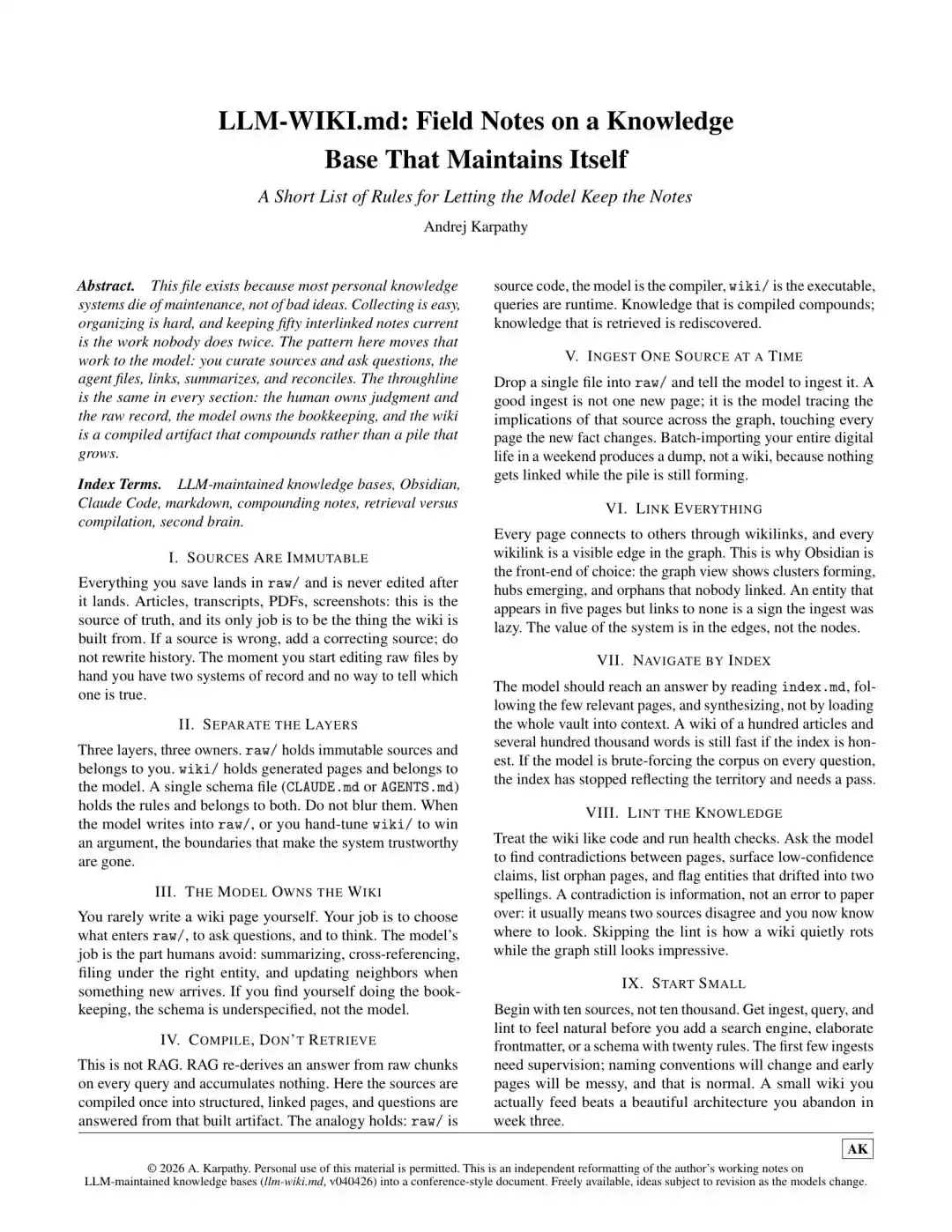
Portal:https://gist.github.com/karpathy/442a6bf555914893e9891c11519de94f

He didn't announce a new model or release a new framework. He simply said: Treat your notes as immutable source code, and let the LLM be the compiler.

Two months later, this document has sparked a quiet yet profound migration across the Obsidian, Claude, and Cursor communities.

Some have already expanded their personal wikis to hundreds of pages and hundreds of thousands of words.

Automated plugins are emerging. Academic researchers, independent entrepreneurs, and lifelong learners are collectively shifting towards a new mode of knowledge production.

The Twilight of RAG: Information Hauling Cannot Save Your Thinking

Before LLM-WIKI, the mainstream solution was RAG (Retrieval-Augmented Generation).

Simply put, it gives a large language model a "filer." When you ask a question, it searches your notes for a few snippets and pieces together an answer.
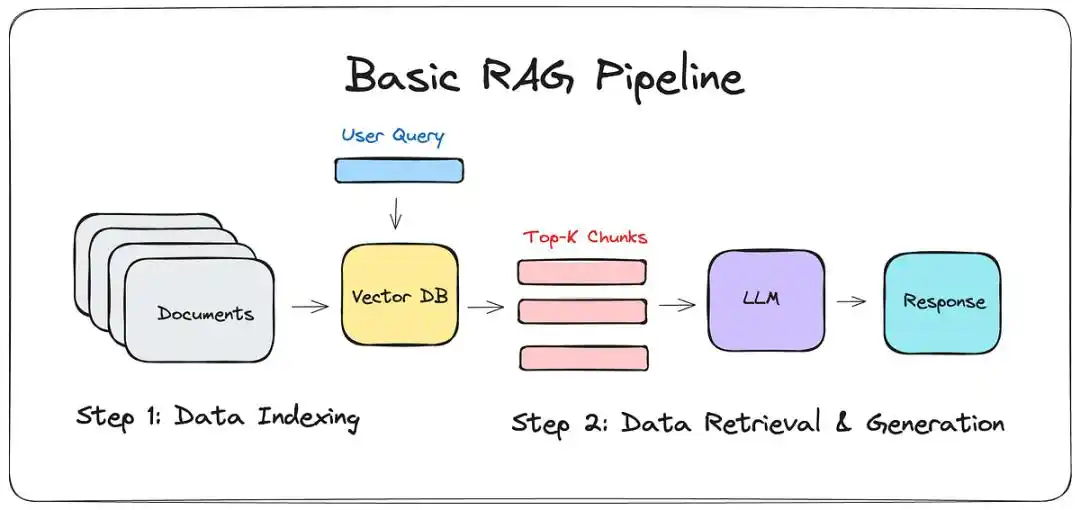
It sounds beautiful, but anyone who has used it knows the gap between "seller's show" and "buyer's reality."

It's merely a hauler: RAG only handles local context, incapable of global understanding.

It can tell you that note #5 mentions A, but it cannot tell you the underlying logic that all 500 notes collectively point towards.

It suffers from "split personality": If you believed A was correct six months ago but wrote a note refuting A yesterday, RAG often ends up contradicting itself, spouting a bunch of logically incoherent nonsense.

Graph Decay: Manually maintained knowledge links are like code without an automatic cleanup function. Over time, broken links are everywhere, and retrieval efficiency plummets exponentially.

Karpathy's insight is sharp: Search and retrieval are manifestations of human incapability. What we need is "consensus," "structure," "truth."

Treat Knowledge as Source Code, Let the LLM Be the Compiler

Karpathy's answer comes from an action programmers do every day but never think to apply to knowledge: compilation.

You write a piece of source code. You don't reread the entire code every time you run the program.

You compile it into a binary file. Compiling once is laborious, but every subsequent run is lightning-fast. The cost of compilation is amortized over thousands of future uses.

Why can't knowledge work the same way?

Karpathy says: Treat your raw notes as immutable source code. Treat the LLM as the compiler. Let it "compile" that pile of messy material once into a structured, interlinked Wiki.
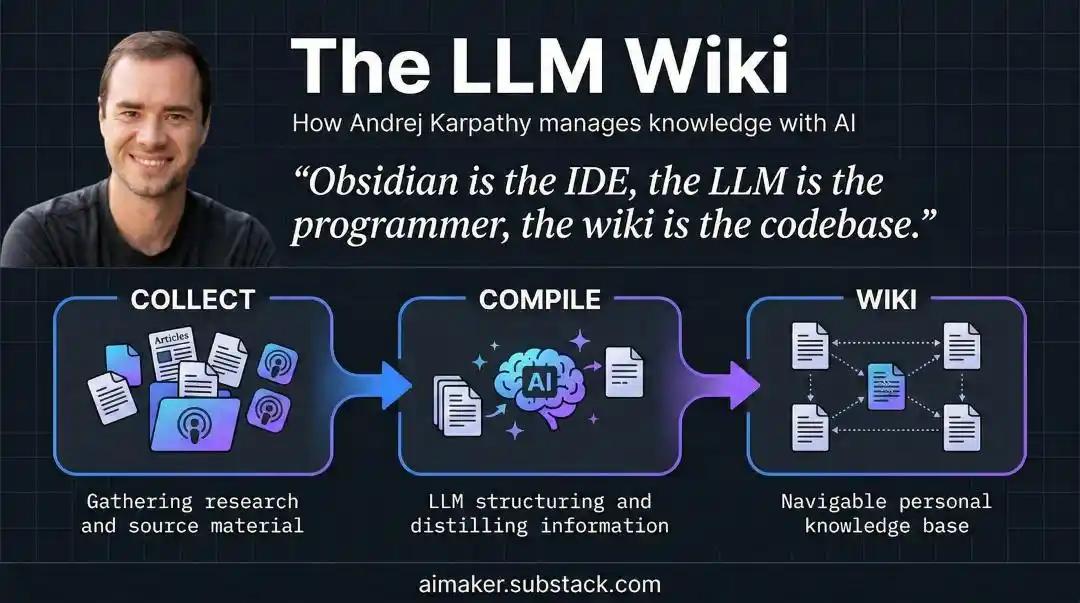
Every time you add new material, the AI performs a merge: it updates relevant entry pages, revises summaries, flags conflicts where new data clashes with old conclusions, and, in the process, reinforces or challenges existing judgments.
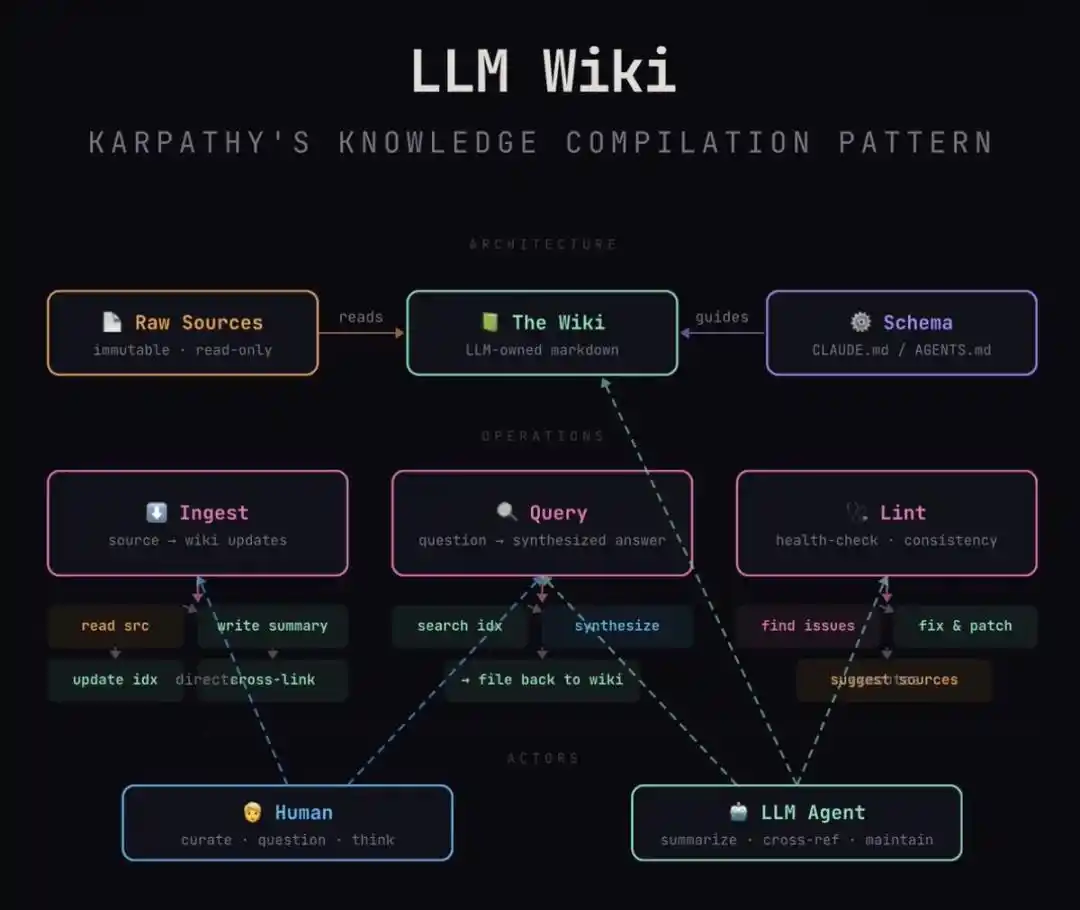
The key difference is here: Knowledge is compiled once and then kept fresh, not reconstructed from scratch for every query.

By the time you ask a question, cross-references are already there, contradictions have been flagged, and summaries already reflect everything you've read.

You don't recompile your source code every time you run a program. So why make the AI reread all your notes for every question?

A Fundamental Shift in the Production Relations of Cognition

In his LLM-WIKI framework, notes are no longer dead text; they are "source code."

The large model is no longer a translator looking up a dictionary; it is the "compiler."

This architecture brilliantly achieves a three-layer decoupling:

1. Raw Layer (Raw Material): This is your mine of inspiration. Random insights you jot down, clipped articles, meeting minutes. It is "immutable," preserving the rawness and messiness of human input.

2. Schema Layer (Knowledge Constitution): This is the "rules of engagement" you write for the AI. For example, you dictate: every person entry must contain "motivation, limitations, key achievements"; every technology stack must explain "pros and cons."

3. Wiki Layer (Compiled Product): This is the zone maintained autonomously by the AI. Following your Schema, it compiles that messy pile of Raw material into structured, cross-linked, logically coherent encyclopedia pages.
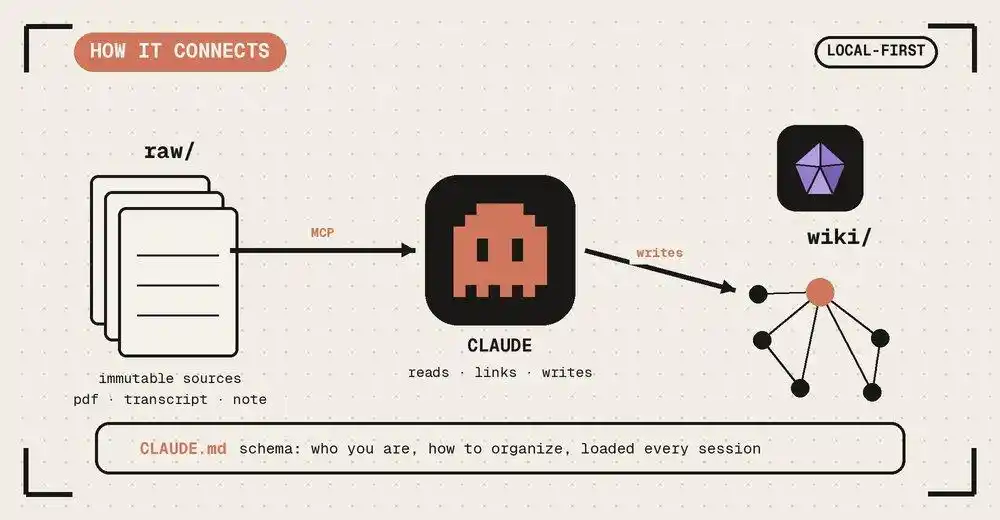
The daily workflow is three actions:

1. Ingest: Toss in a new piece of material. The AI reads it, discusses key points with you, writes a summary, and sweeps through the entire library to update related pages—one source can potentially affect a dozen pages.

2. Query: Ask the compiled Wiki directly. Answers come with citations. The best part: Excellent answers can be archived directly as new pages. Every exploration you make compounds interest.

3. Lint: Periodically have the AI perform a self-check, like code review—find contradictions, find outdated assertions, find isolated pages with no links, find gaps that need filling. Clean early, don't let the library grow rotten.

You are no longer a porter of knowledge; you are the architect of this intellectual empire.

You are only responsible for input and final review. The AI handles all the "grunt work": organizing, aligning, cross-linking, detecting contradictions.

This is a fundamental shift in the production relations of cognition.

This is not another chatbot. ChatGPT understands the internet. LLM-Wiki understands you—or more precisely, what you've taught it.

Every answer comes with [wiki-links] back to your knowledge graph. Every response is the starting point of an exploration path, not the end.

An Invention 80 Years Late

At this point, you might think this is just a clever workflow.

It's more than that.

At the end of his gist, Karpathy casually drops a name: Vannevar Bush, and his 1945 essay "As We May Think."
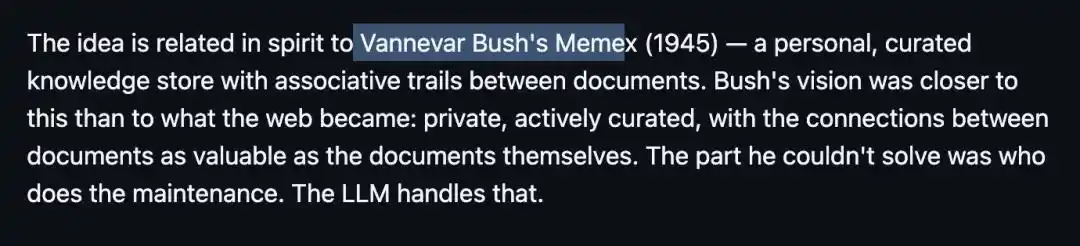
In 1945, just after WWII, this giant of American science envisioned a machine called "Memex":

A mechanical desk that could store all your books, records, and correspondence, and create "associative trails" between related items—connections between documents as valuable as the documents themselves.
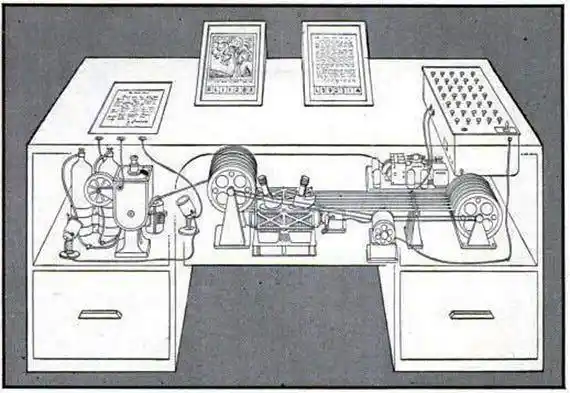
Sound familiar? This is almost a word-for-word description of LLM-Wiki.

Bush's vision was, in fact, closer to this than the later World Wide Web: a private, personally curated knowledge network where connections *are* the value.
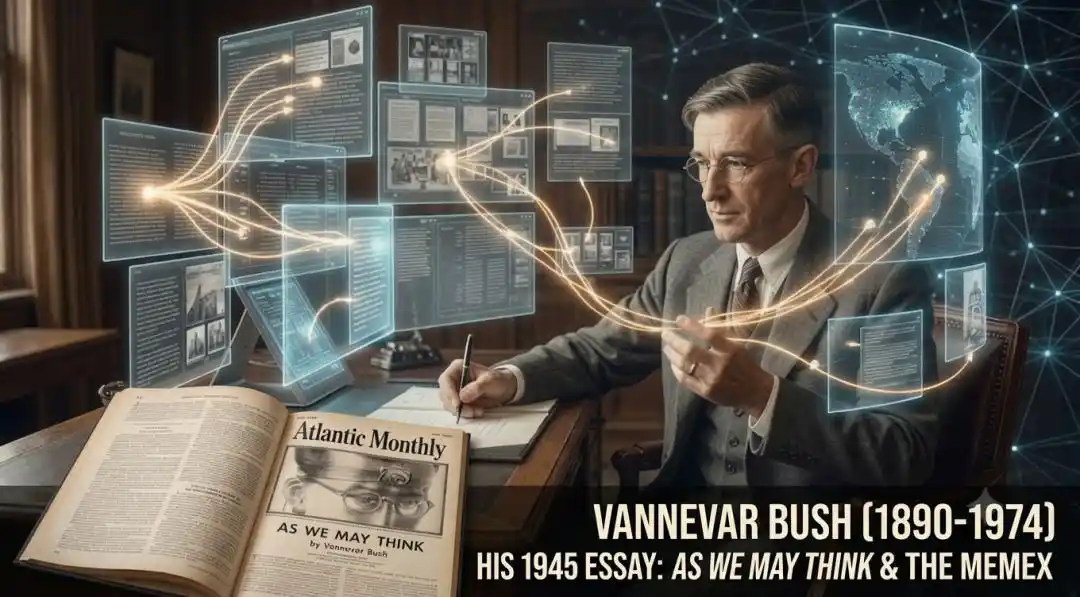
So why wasn't Memex built in 80 years?

Because Bush was stuck on a problem he couldn't solve—who maintains it?

Every associative trail had to be created manually. Every cross-reference had to be linked by someone.

Bush imagined dedicated "operators" laying down these little paths through knowledge for you.

But reality is, no one could sustain this tedious chore at scale. Humans abandon maintenance because the cost of maintenance always grows faster than the value it brings.

Karpathy's sentence is the crux of the entire paradigm: The hardest part of maintaining a knowledge base was never reading; it was bookkeeping.

Updating cross-references, keeping summaries fresh, tagging conflicts between new data and old conclusions, keeping dozens of pages consistent. This drudgery was enough to deter anyone.

But a large language model won't forget to update a cross-reference. It can modify fifteen files in one go.

It doesn't get tired. It doesn't get annoyed. It doesn't collapse from late-night fatigue. The maintenance cost is driven to near zero.

Thus, the machine that had stumped humanity for eighty years suddenly started running.

What's Liberated is Human Attention

Looking back, LLM-Wiki is Karpathy's third piece in the puzzle of "human-computer collaboration," and also the most restrained.

The first piece, Vibe Coding (Feb 2025): Accepting AI-written code, not reviewing line-by-line, trusting the model, testing the outcome.

The second piece, Agentic Engineering (Jan 2026): Humans orchestrating AI agents, not writing code themselves.

The third piece, LLM Knowledge Bases (April 2026): What the AI manages is no longer just code, but knowledge itself.
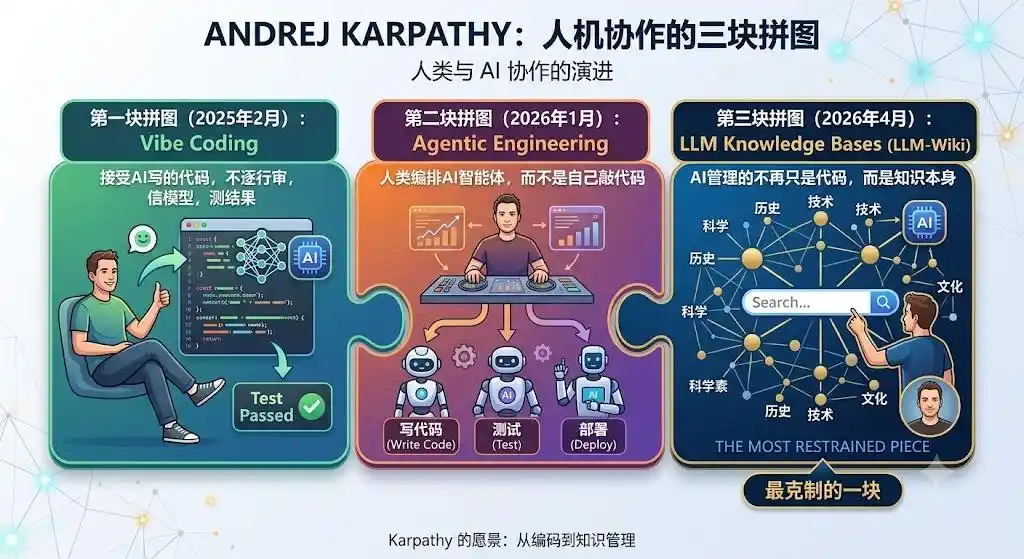
In this new paradigm, what is stripped away from humans are the chores no one likes to do: saving, organizing, linking, bookkeeping.

What remains for humans are only two things: deciding *what* to read, and figuring out what all of it *really means*. These are precisely the two things machines still cannot do and should never do for you.

This is a story of a tool evolving to its extreme, ultimately coming full circle to return human attention back to humans themselves.

That plain, almost unassuming markdown file didn't announce a model or top a leaderboard.

It just quietly reminded us: Your brain was never meant for bookkeeping.

This article is from the WeChat public account "新智元" (New Zhiyuan), author: ASI启示录

Трендові криптовалюти

Пов'язані питання

QWhat is the core concept behind Karpathy's LLM-Wiki approach, as described in the article?

AThe core concept is to treat your raw notes as immutable 'source code' and use an LLM as a 'compiler' to process them all at once into a structured, cross-referenced, and logically consistent wiki. This compiled knowledge base is then used for querying, unlike RAG which retrieves and processes raw notes for each query.

QWhat are the three main layers of Karpathy's LLM-Wiki architecture?

A1. Raw Layer: The immutable, original source material like ideas, clipped articles, and meeting notes. 2. Schema Layer: The 'constitution' or rules you define for the AI, specifying the required structure for different types of entries (e.g., person entries must include motivation, limitations, key achievements). 3. Wiki Layer: The compiled, structured, and cross-referenced encyclopedia pages that the AI maintains based on the Raw Layer and Schema Layer.

QAccording to the article, what are key limitations of the traditional RAG (Retrieval-Augmented Generation) approach for personal knowledge bases?

AKey limitations include: - It acts as a mere 'porter,' handling local fragments without understanding the global context. - It can produce contradictory or 'split-personality' answers if notes contain conflicting views over time. - Manually maintained knowledge graphs decay over time, with broken links and decreasing retrieval efficiency. - It rebuilds an answer from scratch for each query instead of leveraging a pre-compiled, consistent knowledge structure.

QHow does the LLM-Wiki approach solve the maintenance problem that hindered Vannevar Bush's 'Memex' vision for decades?

AThe LLM-Wiki approach solves the maintenance problem by automating the 'accounting'—the tedious work of updating cross-references, keeping summaries fresh, flagging conflicts, and ensuring consistency across dozens of pages. The LLM, acting as a tireless compiler, handles this maintenance at near-zero cost, which was the impractical manual burden that prevented Memex from becoming a reality.

QWhat fundamental shift in the 'cognitive relations of production' does the LLM-Wiki paradigm represent, according to the article?

AIt represents a shift where humans are no longer the 'porters' of knowledge, responsible for the manual labor of collecting, organizing, linking, and maintaining consistency. Instead, humans become the 'architects'—focusing only on input (deciding what to read/ingest) and final review (determining what it all means). The AI handles all the 'drudge work' of synthesis, alignment, cross-referencing, and contradiction detection, freeing human attention for higher-order thinking.

Пов'язані матеріали

The Largest Upgrade Since The Merge? How Glamsterdam Will Affect Ethereum and Regular Users?

The upcoming Glamsterdam upgrade, scheduled for late 2026, is considered Ethereum's most significant change since The Merge. It focuses on fundamentally restructuring Ethereum's block production, transaction execution, and gas pricing to enable major scalability improvements while preserving decentralization. The upgrade centers on three key innovations: * **Enshrined PBS (ePBS)**: Moves the Proposer-Builder Separation mechanism into the protocol's core, eliminating reliance on external relays. This reorganizes the block pipeline, extending the time window for processing execution payloads, which is crucial for safely increasing block capacity. * **Block-Level Access Lists (BALs)**: Attaches a "map" to each block, declaring in advance which state data its transactions will access. This enables potential parallel transaction processing and faster node synchronization, breaking a key performance bottleneck. * **Gas Repricing**: Introduces a more accurate resource pricing model by separating computation costs from state storage costs. This discourages uncontrolled state growth by making operations that create permanent data (like new accounts) more accurately reflect their long-term network burden. Together, these changes aim to solve the core challenges of increasing Ethereum's throughput (e.g., raising the Gas Limit) without overburdening node hardware or increasing centralization risks. They prepare the infrastructure for higher capacity, targeting a credible post-upgrade capacity of up to 200 million Gas. For users, the impact will be nuanced: * General transaction fees may become lower and more stable as block space increases. * Simple transfers could see cost reductions, while state-intensive operations (like contract deployment) may become relatively more expensive due to the new gas model. * Gas fee estimations by wallets will become more accurate. * L2 networks could benefit long-term from increased data blob capacity. * Standardized logs for all ETH transfers (EIP-7708) will improve tracking for wallets and exchanges. Ultimately, Glamsterdam represents a foundational shift, not a simple block size increase. It seeks to expand Ethereum's capacity by re-engineering its underlying mechanics, maintaining its commitment to decentralization while enabling significant performance gains.

marsbit2 год тому

The Largest Upgrade Since The Merge? How Glamsterdam Will Affect Ethereum and Regular Users?

marsbit2 год тому

Circle CEO Responds to the OUSD Challenge: Stablecoin is a Winner-Takes-All Business, and We Won't Slow Down

In response to questions about the OUSD stablecoin initiative, Circle CEO Jeremy Allaire argues that the stablecoin market is a "winner-take-most" platform business driven by powerful network effects, and Circle has no plans to slow down. He outlines three key drivers behind USDC's dominant position: 1. **Protocol/Software Layer Network Effects**: The value of a stablecoin network grows as more developers and services integrate it, creating compounding utility and user preference. Circle has spent nearly a decade building this ecosystem with USDC, now accelerated by mainstream adoption and enhanced by software stacks like CCTP and Gateway for interoperability. 2. **Liquidity Network Effects**: Liquidity begets more liquidity. USDC has achieved top-tier global liquidity—ranking among the top three digital assets alongside BTC and USDT—through nearly a decade of building deep primary and secondary market access across regions and venues. 3. **Regulatory and Policy Integration**: Establishing a global stablecoin requires deep regulatory engagement, licensing, and compliance across key markets—a significant, long-term investment where Circle is a leader. Allaire cites Artemis data showing USDC facilitated 80% of all dollar stablecoin on-chain transaction volume in Q1 2026, with USDT at 20% and all others negligible. He addresses OUSD's purported advantages: "free" minting/burning is often not sustainable in practice; redistributing all revenue can starve essential infrastructure investment; and large consortium models historically struggle with inefficiency and slow execution, unlike focused strategic partnerships. He reaffirms Circle's strong ongoing partnership with Coinbase on USDC and notes Circle collaborates with dozens of other stablecoin issuers through its expanding platform (Arc, CCTP, CPN, etc.). While welcoming OUSD to the ecosystem, Allaire asserts that Circle's vast, trusted network and continued investment make USDC the foundational digital dollar infrastructure for the world.

链捕手2 год тому

Circle CEO Responds to the OUSD Challenge: Stablecoin is a Winner-Takes-All Business, and We Won't Slow Down

链捕手2 год тому

Q2 Crypto Market Review: Did Bitcoin Rise for 'Nothing'? Did Money Flow to AI and On-Chain?

Q2 2026 Crypto Market Recap: Bitcoin's Gains Erased Amid Shift to AI and On-Chain Activity The second quarter of 2026 saw a significant reversal for the cryptocurrency market. Bitcoin gave back all its April gains, ending Q2 down approximately 11%, while major stock indices posted strong gains. This divergence was driven by a hawkish shift in Fed rate expectations, capital rotation into AI stocks, and weakening liquidity channels into crypto. Key demand pillars deteriorated simultaneously. Spot Bitcoin ETFs recorded net outflows of $4.08 billion for the quarter, with outflows dominating June. Crypto treasury entity Strategy's bitcoin accumulation slowed markedly, and the total stablecoin market cap contracted by ~$4.2 billion. This created a tighter liquidity environment. Exchange data reflected the downturn. Spot trading volumes fell 28% quarter-over-quarter. The market underwent significant deleveraging, with $8.35 billion in long liquidations for BTC and ETH, primarily in late May/early June. Open interest and order book liquidity also declined. Despite the bearish price action, structural developments point to an expanding on-chain ecosystem. These include the rise of tokenized stocks with full legal rights, the growth of RWA (real-world asset) perpetual contracts for trading stocks and commodities 24/7, and the use of crypto markets for price discovery ahead of major events like the SpaceX IPO. On-chain vaults are also emerging as a core layer for institutional capital allocation.

Foresight News2 год тому

Q2 Crypto Market Review: Did Bitcoin Rise for 'Nothing'? Did Money Flow to AI and On-Chain?

Foresight News2 год тому

Торгівля

Спот

Популярні статті

Що таке $S$

Розуміння SPERO: Комплексний огляд Вступ до SPERO Оскільки ландшафт інновацій продовжує еволюціонувати, виникнення технологій web3 та криптовалютних проектів відіграє ключову роль у формуванні цифрового майбутнього. Один з проектів, який привернув увагу в цій динамічній сфері, — це SPERO, позначений як SPERO,$$s$. Ця стаття має на меті зібрати та представити детальну інформацію про SPERO, щоб допомогти ентузіастам та інвесторам зрозуміти його основи, цілі та інновації в рамках web3 та крипто-сектору. Що таке SPERO,$$s$? SPERO,$$s$ — це унікальний проект у криптопросторі, який прагне використати принципи децентралізації та технології блокчейн для створення екосистеми, що сприяє залученню, корисності та фінансовій інклюзії. Проект розроблений для полегшення взаємодії між користувачами новими способами, надаючи їм інноваційні фінансові рішення та послуги. У своїй основі SPERO,$$s$ прагне надати можливості індивідам, забезпечуючи інструменти та платформи, які покращують користувацький досвід у криптовалютному просторі. Це включає в себе можливість більш гнучких методів транзакцій, сприяння ініціативам, що підтримуються спільнотою, та створення шляхів для фінансових можливостей через децентралізовані додатки (dApps). Основна концепція SPERO,$$s$ обертається навколо інклюзивності, прагнучи зменшити розриви в традиційній фінансовій системі, використовуючи переваги технології блокчейн. Хто є творцем SPERO,$$s$? Особистість творця SPERO,$$s$ залишається дещо невідомою, оскільки є обмежені публічно доступні ресурси, що надають детальну інформацію про його засновників. Ця відсутність прозорості може бути наслідком зобов'язання проекту до децентралізації — етики, яку багато проектів web3 поділяють, ставлячи колективні внески вище за індивідуальне визнання. Зосереджуючи обговорення навколо спільноти та її колективних цілей, SPERO,$$s$ втілює суть наділення без виділення конкретних осіб. Таким чином, розуміння етики та місії SPERO є більш важливим, ніж ідентифікація єдиного творця. Хто є інвесторами SPERO,$$s$? SPERO,$$s$ підтримується різноманітними інвесторами, починаючи від венчурних капіталістів до ангельських інвесторів, які прагнуть сприяти інноваціям у крипто-секторі. Зосередження цих інвесторів зазвичай узгоджується з місією SPERO — пріоритет надається проектам, які обіцяють технологічний прогрес у суспільстві, фінансову інклюзію та децентралізоване управління. Ці інвесторські фонди зазвичай зацікавлені в проектах, які не лише пропонують інноваційні продукти, але й позитивно впливають на спільноту блокчейн та її екосистеми. Підтримка з боку цих інвесторів підкріплює SPERO,$$s$ як значного конкурента в швидко змінюваній сфері крипто-проектів. Як працює SPERO,$$s$? SPERO,$$s$ використовує багатогранну структуру, яка відрізняє його від традиційних криптовалютних проектів. Ось деякі ключові особливості, які підкреслюють його унікальність та інноваційність: Децентралізоване управління: SPERO,$$s$ інтегрує моделі децентралізованого управління, надаючи користувачам можливість активно брати участь у процесах прийняття рішень щодо майбутнього проекту. Цей підхід сприяє відчуттю власності та відповідальності серед членів спільноти. Корисність токена: SPERO,$$s$ використовує свій власний криптовалютний токен, розроблений для виконання різних функцій в екосистемі. Ці токени дозволяють здійснювати транзакції, отримувати винагороди та полегшувати послуги, що пропонуються на платформі, підвищуючи загальну залученість та корисність. Шарова архітектура: Технічна архітектура SPERO,$$s$ підтримує модульність та масштабованість, що дозволяє безперешкодно інтегрувати додаткові функції та додатки в міру розвитку проекту. Ця адаптивність є надзвичайно важливою для збереження актуальності в постійно змінюваному крипто-ландшафті. Залучення спільноти: Проект підкреслює ініціативи, що підтримуються спільнотою, використовуючи механізми, які стимулюють співпрацю та зворотний зв'язок. Підтримуючи сильну спільноту, SPERO,$$s$ може краще задовольняти потреби користувачів та адаптуватися до ринкових тенденцій. Фокус на інклюзію: Пропонуючи низькі комісії за транзакції та зручні інтерфейси, SPERO,$$s$ прагне залучити різноманітну базу користувачів, включаючи осіб, які раніше не брали участі в крипто-просторі. Це зобов'язання до інклюзії узгоджується з його загальною місією наділення через доступність. Хронологія SPERO,$$s$ Розуміння історії проекту надає важливі уявлення про його розвиток та етапи. Нижче наведено пропоновану хронологію, що відображає значні події в еволюції SPERO,$$s$: Етап концептуалізації та ідеації: Початкові ідеї, що стали основою SPERO,$$s$, були сформовані, тісно пов'язані з принципами децентралізації та фокусом на спільноті в індустрії блокчейн. Запуск білого паперу проекту: Після концептуального етапу був випущений комплексний білий папір, що детально описує бачення, цілі та технологічну інфраструктуру SPERO,$$s$, щоб залучити інтерес та зворотний зв'язок від спільноти. Створення спільноти та ранні залучення: Активні зусилля були спрямовані на створення спільноти ранніх прихильників та потенційних інвесторів, що полегшило обговорення цілей проекту та отримання підтримки. Подія генерації токенів: SPERO,$$s$ провів подію генерації токенів (TGE) для розподілу своїх рідних токенів серед ранніх прихильників та встановлення початкової ліквідності в екосистемі. Запуск початкового dApp: Перший децентралізований додаток (dApp), пов'язаний з SPERO,$$s$, став доступним, дозволяючи користувачам взаємодіяти з основними функціями платформи. Постійний розвиток та партнерства: Безперервні оновлення та вдосконалення пропозицій проекту, включаючи стратегічні партнерства з іншими учасниками блокчейн-простору, сформували SPERO,$$s$ у конкурентоспроможного та еволюціонуючого гравця на крипто-ринку. Висновок SPERO,$$s$ є свідченням потенціалу web3 та криптовалют для революціонізації фінансових систем та наділення індивідів. Завдяки зобов'язанню до децентралізованого управління, залучення спільноти та інноваційно спроектованих функцій, він прокладає шлях до більш інклюзивного фінансового ландшафту. Як і з будь-якими інвестиціями в швидко змінюваному крипто-просторі, потенційним інвесторам та користувачам рекомендується ретельно досліджувати та обдумано взаємодіяти з поточними подіями в SPERO,$$s$. Проект демонструє інноваційний дух крипто-індустрії, запрошуючи до подальшого дослідження його численних можливостей. Хоча подорож SPERO,$$s$ ще триває, його основні принципи можуть справді вплинути на майбутнє того, як ми взаємодіємо з технологією, фінансами та один з одним у взаємопов'язаних цифрових екосистемах.

114 переглядів усьогоОпубліковано 2024.12.17Оновлено 2024.12.17

Що таке $S$

Що таке AGENT S

Агент S: Майбутнє автономної взаємодії в Web3 Вступ У постійно змінюваному ландшафті Web3 та криптовалюти інновації постійно переосмислюють, як люди взаємодіють з цифровими платформами. Один з таких новаторських проектів, Агент S, обіцяє революціонізувати взаємодію людини з комп'ютером через свою відкриту агентну структуру. Прокладаючи шлях для автономних взаємодій, Агент S прагне спростити складні завдання, пропонуючи трансформаційні застосування в штучному інтелекті (ШІ). Це детальне дослідження заглиблюється в складності проекту, його унікальні особливості та наслідки для сфери криптовалюти. Що таке Агент S? Агент S є революційною відкритою агентною структурою, спеціально розробленою для вирішення трьох основних викликів в автоматизації комп'ютерних завдань: Набуття специфічних знань у галузі: Структура інтелектуально навчається з різних зовнішніх джерел знань та внутрішнього досвіду. Цей подвійний підхід дозволяє їй створити багатий репозиторій специфічних знань у галузі, покращуючи її продуктивність у виконанні завдань. Планування на довгих горизонтах завдань: Агент S використовує планування з підкріпленням досвіду, стратегічний підхід, який полегшує ефективний розподіл та виконання складних завдань. Ця функція значно підвищує її здатність ефективно та результативно управляти кількома підзавданнями. Обробка динамічних, неоднорідних інтерфейсів: Проект представляє Інтерфейс Агент-Комп'ютер (ACI), інноваційне рішення, яке покращує взаємодію між агентами та користувачами. Використовуючи багатомодальні великі мовні моделі (MLLMs), Агент S може безперешкодно орієнтуватися та маніпулювати різноманітними графічними інтерфейсами користувача. Завдяки цим новаторським функціям Агент S надає надійну структуру, яка вирішує складнощі, пов'язані з автоматизацією людської взаємодії з машинами, прокладаючи шлях для численних застосувань у ШІ та за його межами. Хто є творцем Агент S? Хоча концепція Агент S є фундаментально новаторською, конкретна інформація про його творця залишається невідомою. Творець наразі невідомий, що підкреслює або початкову стадію проекту, або стратегічний вибір зберегти засновників у таємниці. Незважаючи на анонімність, акцент залишається на можливостях та потенціалі структури. Хто є інвесторами Агент S? Оскільки Агент S є відносно новим у криптографічній екосистемі, детальна інформація про його інвесторів та фінансових спонсорів не задокументована. Відсутність публічно доступних відомостей про інвестиційні фонди або організації, що підтримують проект, викликає питання щодо його фінансової структури та дорожньої карти розвитку. Розуміння підтримки є критично важливим для оцінки стійкості проекту та потенційного впливу на ринок. Як працює Агент S? В основі Агент S лежить передова технологія, яка дозволяє йому ефективно функціонувати в різних умовах. Його операційна модель побудована навколо кількох ключових функцій: Взаємодія з комп'ютером, подібна до людської: Структура пропонує розширене планування ШІ, прагнучи зробити взаємодії з комп'ютерами більш інтуїтивними. Імітуючи людську поведінку при виконанні завдань, вона обіцяє підвищити досвід користувачів. Наративна пам'ять: Використовується для використання високорівневого досвіду, Агент S використовує наративну пам'ять для відстеження історій завдань, тим самим покращуючи свої процеси прийняття рішень. Епізодична пам'ять: Ця функція надає користувачам покрокові інструкції, дозволяючи структурі пропонувати контекстуальну підтримку в міру виконання завдань. Підтримка OpenACI: Завдяки можливості працювати локально, Агент S дозволяє користувачам зберігати контроль над своїми взаємодіями та робочими процесами, узгоджуючи з децентралізованою етикою Web3. Легка інтеграція з зовнішніми API: Його універсальність і сумісність з різними платформами ШІ забезпечують те, що Агент S може безперешкодно вписатися в існуючі технологічні екосистеми, роблячи його привабливим вибором для розробників та організацій. Ці функціональні можливості колективно сприяють унікальному положенню Агент S у крипто-просторі, оскільки він автоматизує складні, багатоступеневі завдання з мінімальним втручанням людини. У міру розвитку проекту його потенційні застосування в Web3 можуть переосмислити, як відбуваються цифрові взаємодії. Хронологія Агент S Розробка та етапи Агент S можуть бути узагальнені в хронології, яка підкреслює його значні події: 27 вересня 2024 року: Концепція Агент S була представлена в комплексній науковій статті під назвою “Відкрита агентна структура, яка використовує комп'ютери як людина”, що демонструє основи проекту. 10 жовтня 2024 року: Наукова стаття була опублікована на arXiv, пропонуючи детальне дослідження структури та її оцінки продуктивності на основі бенчмарку OSWorld. 12 жовтня 2024 року: Було випущено відеопрезентацію, що надає візуальне уявлення про можливості та особливості Агент S, ще більше залучаючи потенційних користувачів та інвесторів. Ці маркери в хронології не лише ілюструють прогрес Агент S, але й вказують на його прихильність до прозорості та залучення громади. Ключові моменти про Агент S У міру розвитку структури Агент S кілька ключових характеристик виділяються, підкреслюючи її новаторський характер та потенціал: Інноваційна структура: Розроблена для забезпечення інтуїтивного використання комп'ютерів, подібного до людської взаємодії, Агент S пропонує новий підхід до автоматизації завдань. Автономна взаємодія: Здатність автономно взаємодіяти з комп'ютерами через GUI означає стрибок до більш інтелектуальних та ефективних обчислювальних рішень. Автоматизація складних завдань: Завдяки своїй надійній методології він може автоматизувати складні, багатоступеневі завдання, роблячи процеси швидшими та менш схильними до помилок. Безперервне вдосконалення: Механізми навчання дозволяють Агенту S покращуватися на основі минулого досвіду, постійно підвищуючи свою продуктивність та ефективність. Універсальність: Його адаптивність до різних операційних середовищ, таких як OSWorld та WindowsAgentArena, забезпечує його здатність служити широкому спектру застосувань. Оскільки Агент S займає своє місце в ландшафті Web3 та криптовалюти, його потенціал покращити можливості взаємодії та автоматизувати процеси означає значний прогрес у технологіях ШІ. Завдяки своїй інноваційній структурі Агент S є прикладом майбутнього цифрових взаємодій, обіцяючи більш безперешкодний та ефективний досвід для користувачів у різних галузях. Висновок Агент S представляє собою сміливий крок вперед у поєднанні ШІ та Web3, з можливістю переосмислити, як ми взаємодіємо з технологією. Хоча проект все ще на ранніх стадіях, можливості для його застосування є величезними та переконливими. Завдяки своїй комплексній структурі, що вирішує критичні виклики, Агент S прагне вивести автономні взаємодії на передній план цифрового досвіду. У міру того, як ми заглиблюємося в сфери криптовалюти та децентралізації, проекти, подібні до Агент S, безсумнівно, відіграватимуть ключову роль у формуванні майбутнього технологій та співпраці людини з комп'ютером.

743 переглядів усьогоОпубліковано 2025.01.14Оновлено 2025.01.14

Що таке AGENT S

Як купити S

Ласкаво просимо до HTX.com! Ми зробили покупку Sonic (S) простою та зручною. Дотримуйтесь нашої покрокової інструкції, щоб розпочати свою криптовалютну подорож.Крок 1: Створіть обліковий запис на HTXВикористовуйте свою електронну пошту або номер телефону, щоб зареєструвати обліковий запис на HTX безплатно. Пройдіть безпроблемну реєстрацію й отримайте доступ до всіх функцій.ЗареєструватисьКрок 2: Перейдіть до розділу Купити крипту і виберіть спосіб оплатиКредитна/дебетова картка: використовуйте вашу картку Visa або Mastercard, щоб миттєво купити Sonic (S).Баланс: використовуйте кошти з балансу вашого рахунку HTX для безперешкодної торгівлі.Треті особи: ми додали популярні способи оплати, такі як Google Pay та Apple Pay, щоб підвищити зручність.P2P: Торгуйте безпосередньо з іншими користувачами на HTX.Позабіржова торгівля (OTC): ми пропонуємо індивідуальні послуги та конкурентні обмінні курси для трейдерів.Крок 3: Зберігайте свої Sonic (S)Після придбання Sonic (S) збережіть його у своєму обліковому записі на HTX. Крім того, ви можете відправити його в інше місце за допомогою блокчейн-переказу або використовувати його для торгівлі іншими криптовалютами.Крок 4: Торгівля Sonic (S)Легко торгуйте Sonic (S) на спотовому ринку HTX. Просто увійдіть до свого облікового запису, виберіть торгову пару, укладайте угоди та спостерігайте за ними в режимі реального часу. Ми пропонуємо зручний досвід як для початківців, так і для досвідчених трейдерів.

1.6k переглядів усьогоОпубліковано 2025.01.15Оновлено 2026.06.02

Як купити S

Обговорення

Ласкаво просимо до спільноти HTX. Тут ви можете бути в курсі останніх подій розвитку платформи та отримати доступ до професійної ринкової інформації. Нижче представлені думки користувачів щодо ціни S (S).

活动图片