Xpeng and NIO Compete on Computing Power, Li Auto Shifts Architecture

marsbitОпубліковано о 2026-06-16Востаннє оновлено о 2026-06-16

Анотація

On June 15, 2026, Li Auto unveiled details of its self-developed chip, Mahe M100, for its new L9 Livis model. CTO Xie Yan stated the goal was not just a faster chip, but a fundamentally different one, targeting the chip architecture itself. While competitors like NIO, Xpeng, and Huawei highlight TOPS (computing power) figures for their self-developed chips, Li Auto’s Mahe M100 focuses on redesigning the underlying architecture. It employs a "dynamic data flow architecture" to address memory bandwidth bottlenecks in large model inference, claiming up to 3x the effective computing power of Nvidia's Thor U for its specific workloads and a 40% reduction in latency. The chip's design was peer-reviewed and accepted at ISCA 2026. However, this performance is highly optimized for Li Auto's own VLA2.1 algorithm, meaning it may not generalize as well to other tasks. Li Auto aims to achieve full-stack in-house development with Mahe M100, covering chip, compiler, OS, AI algorithms, and domain controller—a level of vertical integration few competitors match. Beyond the chip, CEO Li Xiang introduced a new strategic narrative: the "embodied intelligent vehicle," defined as an integration of an EV, a professional driver, an AI computer, and a life assistant. This shifts competition from features like large screens to systemic AI capabilities. A key commitment was that Li Auto's Mahe VLA autonomous driving model will match Tesla's FSD V14 by Q4 2026, with specific OTA milestones set for J...

On June 15th, Li Auto detailed the specifics of its in-house developed chip, Mahe M100, during a launch event. This chip is designed for the next-generation L9 Livis. CTO Xie Yan emphasized: It's not just about creating a chip that's faster than before, but about creating a fundamentally different type of chip. This 'difference' refers to the chip architecture.

In 2026, amidst a wave of automakers developing their own chips, TOPS is the most commonly used marketing metric. The NIO Shenji NX9031, Xpeng Turing, and Huawei MDC 810 Pro all prominently feature their computational power figures. Li Auto has chosen to fundamentally alter the underlying architecture.

The Mahe M100 aims to prove that architecture is more important than raw compute numbers. But whether it's right or not still needs to be tested by the market.

01. The Divergence in Chip Development Amidst Compute Power Inflation

Developing in-house chips has become a common choice for leading domestic automakers.

The NIO Shenji NX9031 is the world's first 5nm high-performance autonomous driving chip. Its special feature is its self-developed ISP, which improves pedestrian recognition rate by 40% in low-light conditions of 1 lux at night, showing significant reinforcement at the perception layer.

Xpeng's Turing chip also demonstrates clear customization, specifically designed for Xpeng's autonomous driving large model, with plans to extend to flying cars and robots.

Huawei has taken another path, using Ascend for MDC, emphasizing complete alignment between cloud training and vehicle-side inference, "one minute of training in the cloud, one minute of following in the vehicle."

These companies' chips are variants of the von Neumann architecture: a central processing unit, with data being shuttled back and forth between computing units and memory. The more advanced the process node, the faster the data moves, but the Mahe M100 aims to change the very act of moving data itself.

02. Altering the Underlying Logic

The von Neumann architecture wasn't a problem in the era of general-purpose computing, but large model inference is a different computational paradigm. VLM inference involves large-scale matrix parallelism, not sequential instruction execution. The bottleneck is almost entirely in memory bandwidth; the overhead of data repeatedly moving in and out of memory directly consumes a significant portion of the effective computing power.

The concept of the dynamic dataflow architecture is to allow data to flow along the computational graph, eliminating the need to repeatedly store it back in memory. Li Auto claims the result is that a single Mahe M100 chip offers approximately 3 times the effective computing power of NVIDIA's Thor U, with a 40% reduction in end-to-end latency.
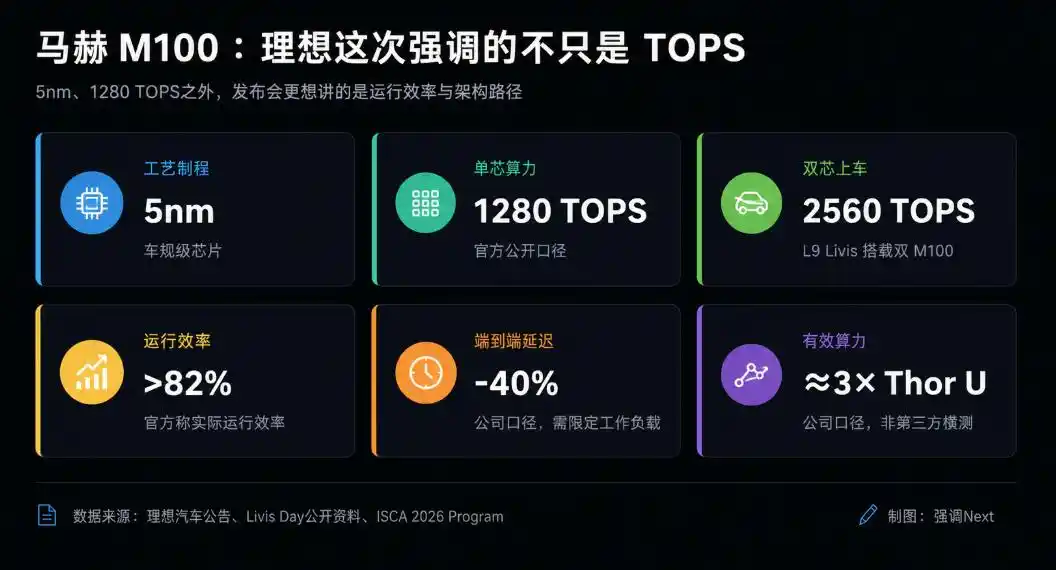
How credible is this "3 times" claim? There is one piece of external verification. The architecture paper for the Mahe M100 was accepted into the Industry Track of ISCA 2026. ISCA is a top-tier academic conference in computer architecture. Papers in the Industry Track undergo peer review, and the design details of the architecture are public. Li Auto is the first automobile manufacturer ever to be selected for this track since its establishment.

However, the 3x figure comes with its prerequisites. Effective computing power depends on the specific workload. The 3x performance achieved while running Li Auto's VLA2.1 algorithm may not hold up under a different system. The Mahe M100 is an algorithm-native chip, developed simultaneously with the model, deeply optimized for the company's own algorithms. It runs its own models best; performance on general tasks may vary.

This shares similarities with the design logic of Xpeng's Turing chip and Tesla's FSD Chip. The difference is that Tesla and Xpeng didn't make a paradigm shift at the architecture level; the Mahe M100 has made fundamental changes to the underlying logic. Whether an automaker can successfully bring a completely new architecture to reliable mass production is itself an unprecedented challenge.

With the deployment of the Mahe M100, Li Auto has achieved full-stack in-house development across chips, compilers, operating systems, AI algorithms, and domain controllers. This closed-loop system is uncommon among its peers.

NIO has its own chip but different levels of OS dependency. Xpeng develops its own chip but its compiler and OS still rely on external solutions. Huawei has a closed loop, but it is not a vehicle manufacturer. The strategic significance of Li Auto's chain lies in making it less susceptible to NVIDIA's supply chain control, keeping data within its own platform, and fully owning the optimization space for software-hardware synergy.

03. First-Mover Positioning in "Embodied AI"

The chip was only one of the stars of the launch event. Li Xiang also proposed a "Four-in-One" definition for embodied AI cars during the presentation: an electric vehicle, a professional driver, an AI computer, and a life assistant.

This marks a significant departure from Li Auto's past brand narrative.

In 2023, the L9 penetrated the 300,000 to 500,000 RMB market with its "Large Six-Seat Family SUV" positioning, followed by a generation of similarly styled models. The problem with this positioning is its low replication cost. Competitors like the AITO M9, NIO ES9, and Zeekr 9X have entered the fray. Refrigerators, screens, and large sofas have become industry standards, making it hard for any player to differentiate, leading only to price wars.

The "Embodied AI Car" shifts the competitive dimension from configurations to system capabilities. Within this framework, refrigerators and rear-seat screens are basic features. The differentiation point becomes "whose system can perceive, think, and grow." Defining a new category itself is a strategic asset; whoever articulates it first gains positioning.

Li Auto has matched this narrative with a relatively complete technological chain: the Mahe M100 computing foundation, the Mahe VLA2.1 autonomous driving large model, the Mahe Mind-Pro and Mind-Edge edge-side foundation models, and the Starlink OS for full-stack integration, with each layer having corresponding product implementations.

The launch event demonstrated features like the vehicle moving to music, a 4D racing simulator, and command-based parking – these are tangible experiences. Li Xiang also stated during the launch that autonomous driving is only the "first half" of embodied AI, with general-purpose humanoid robots being the "second half," but the specific timeline and implementation path for the second half remain unclear.

04. The Q4 Mandate

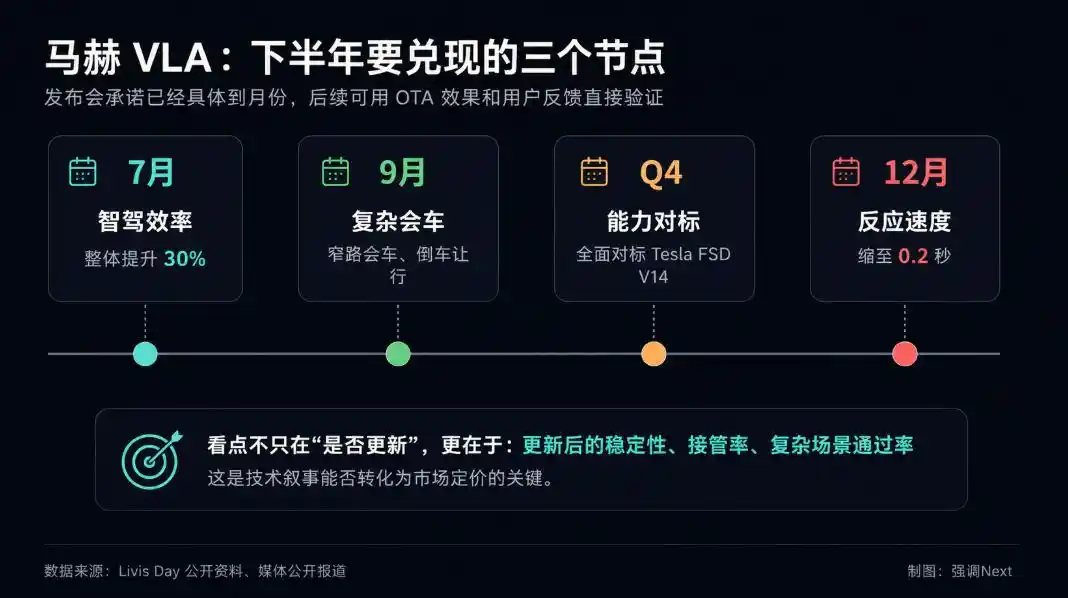
There was another crucial statement during the launch: Li Auto's autonomous driving large model, Mahe VLA, will comprehensively benchmark against Tesla's FSD V14 in Q4 of this year.

Li Xiang's consistent style is to make public commitments, using external pressure to drive internal execution. Having stated Q4 benchmarking against FSD V14, everyone will use that ruler to measure them by year-end.

In terms of technical route, Li Auto's choice is highly isomorphic to Tesla's: end-to-end + VLA large model + primarily vision-based. Huawei follows a path of lidar + multi-sensor fusion + a hybrid of rules and neural networks, offering stable short-term engineering implementation with lower compute demands. However, in the long run, if the vision-based + large model route ultimately prevails, Huawei's system may face greater switching costs. Li Auto is betting on the same technological belief as Tesla. Whether this judgment is correct will become clearer by year-end.

The OTA promises for the second half of the year are specified by month. July: a 30% improvement in autonomous driving efficiency. September: implementation of narrow-road meeting/backing-up yielding. December: vehicle response speed reduced to 0.2 seconds. Each milestone has clear technical indicators, providing data for comparison by year-end.
05. Several Data Points Beyond the Launch Event

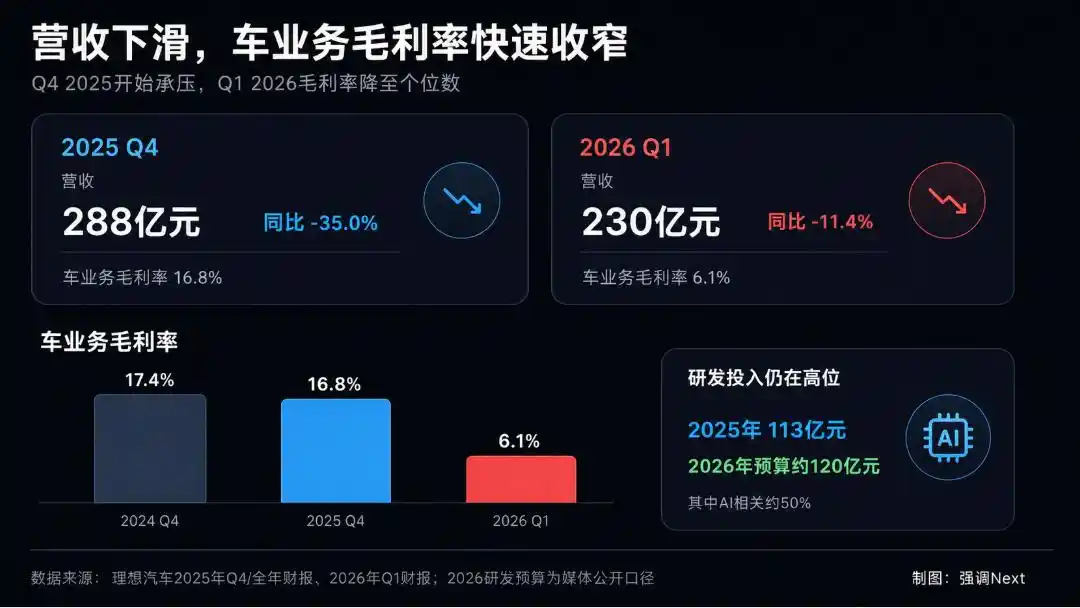
Li Auto's current financial situation is not easy. Since Q4 2025, its revenue has declined year-over-year, and automotive business gross margins have noticeably narrowed. Meanwhile, the R&D budget for 2026 remains around 12 billion RMB, with approximately 50% allocated to AI-related areas, essentially flat compared to 11.3 billion RMB and 50% in 2025. R&D investment is not decreasing, yet profitability pressure persists.
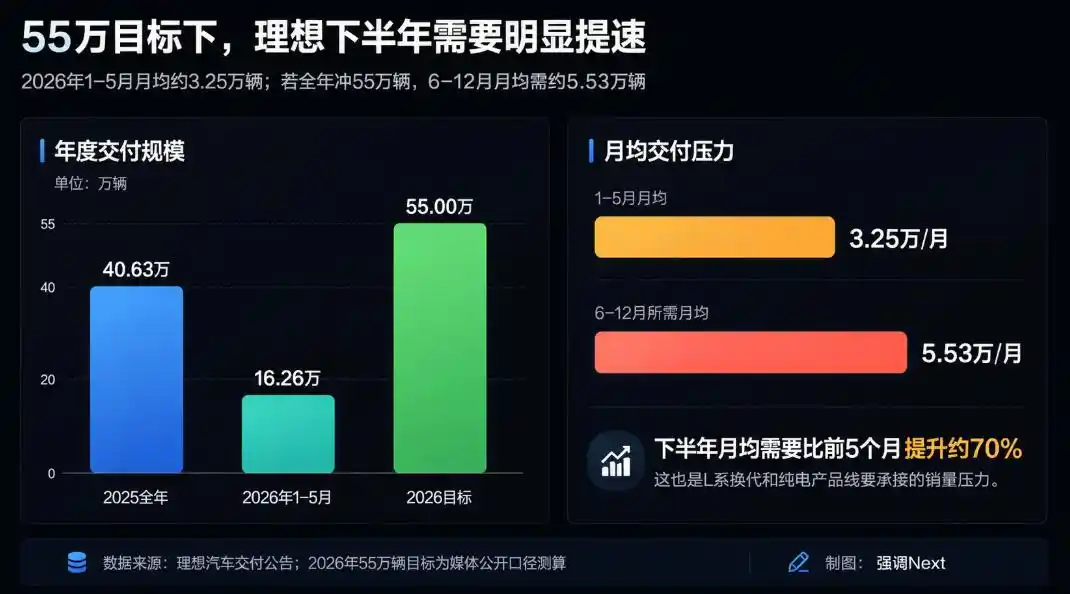
In terms of sales, Li Auto's target for 2026 is 550,000 units. Actual deliveries in 2025 were 406,000 units. May 2026 saw single-month deliveries of 33,000 units, still showing a year-over-year decline. The L9 Livis received over 10,000 non-refundable deposits within two weeks of launch, showing stable performance in the 500,000+ RMB market. However, overall delivery volume still relies on the full model changeover of the L series and the release of the pure electric product line in the second half of the year.
At the chip level, the deep binding of the Mahe M100 with its own algorithms is a design choice that brings advantages in software-hardware synergy efficiency. This also means that if future technological routes require adjustment, the switching cost would be higher than for manufacturers using third-party chip solutions. Xpeng's Turing, NIO's Shenji, and Tesla's FSD Chip face similar situations; this is an industry-wide characteristic of in-house developed, algorithm-native chips.

06. Q3 Will Reveal the Cards

The initial effects of the new L9 launch, the subsequent L8 update, and the first July OTA milestone will all be reflected in the Q3 financial report.

Xie Yan said he needed to create a completely different chip. Having the architecture paper pass peer review counts as external validation of the design concept. But the journey from design to mass production, and then to real user feedback in daily driving, is still long. The July OTA milestone is the first test; the year-end benchmarking against FSD V14 is an even more critical one.

This article is from the WeChat public account "EmphasizeNext" (ID: leo89203898), author: Yixiu, editor: Xiaobai


Пов'язані питання

QWhat is the key design choice that differentiates Li Auto's self-developed Mach M100 chip from its competitors?

ALi Auto's Mach M100 chip adopts a dynamic dataflow architecture, moving away from the traditional von Neumann architecture. This approach focuses on reducing the data movement bottleneck (data shuttling between memory and compute units) inherent in AI model inference, aiming to improve effective computing power and lower latency, rather than just increasing raw TOPS.

QAccording to the article, what is Li Auto's strategic goal with its 'Embodied Intelligent Vehicle' concept, and how does it differ from its previous branding?

ALi Auto's strategic goal with the 'Embodied Intelligent Vehicle' concept is to shift the competitive dimension from hardware configurations (like large screens and refrigerators) to system capabilities in perception, reasoning, and growth. This differs from its previous 'family SUV' branding focused on space and comfort. The new concept aims to establish a new product category and gain a first-mover positioning in the evolving smart car market.

QWhat specific public commitment did Li Xiang make regarding Li Auto's autonomous driving technology for Q4 2026?

ALi Xiang committed that Li Auto's Mach VLA intelligent driving large model will be comprehensively benchmarked against Tesla's FSD V14 in the fourth quarter of 2026. This public commitment uses external pressure to drive internal execution, with the results being measurable by year-end.

QWhat are the potential advantages and risks associated with Li Auto's full-stack in-house development approach (chip, OS, AI algorithm, etc.)?

AAdvantages: It creates a closed-loop system that prevents supply chain constraints (e.g., from Nvidia), keeps data within its own platform, and allows for deep, autonomous software-hardware co-optimization. Risks: The chip is algorithm-native, deeply optimized for its own models. This creates high switching costs if future technology paths require significant changes, and it may not perform as well on generic tasks compared to more general-purpose chips.

QWhat financial and sales challenges does Li Auto face in 2026, according to the article?

AFinancially, Li Auto faces pressure with year-on-year revenue decline since Q4 2025 and narrowing gross margins for its vehicle business, while maintaining high R&D investment (around 12 billion RMB, 50% AI-related). Sales-wise, it aims for 550,000 deliveries in 2026, but actual 2025 deliveries were 406,000, and monthly deliveries in May were down year-on-year. It relies on the new L9 Livis and upcoming full-line model refreshes and pure-electric products to boost sales in the second half of the year.

Пов'язані матеріали

2029 Finale Prediction: When Cryptocurrency Completely "Vanishes", Who Can Remain in This Financial Upheaval?

By 2029, the crypto industry will have transformed into a largely invisible but foundational layer for traditional finance. This timeline outlines the key shifts from now until then. By mid-2026, the most sought-after assets on-chain will not be traditional tokens, but synthetic perpetual contracts for private, high-growth companies (like SpaceX, OpenAI). These become primary price discovery tools, highlighting the market's craving for real-world asset value. Most altcoins enter a sustained bear market as their fundamental lack of asset-backed value is exposed. In late 2026, the "AI + Crypto" narrative largely fades as AI giants prove they don't need crypto infrastructure, except for prediction markets betting on model performance. Simultaneously, a quiet but significant wave of tokenization for institutional assets (money market funds, private credit) begins. The industry splits into a noisy speculative economy and a silent institutional one. Throughout 2027, major public blockchain foundations pivot decisively to serve institutional clients, building compliance toolkits and sales teams. However, key sectors hit growth ceilings: private perpetual contracts are legally restricted from public promotion, stable币 growth is capped by looming political uncertainty, and tokenization projects remain cautious. In 2028, following a U.S. election assumed to maintain a regulatory (not prohibitive) stance, a pivotal change occurs. After a major liquidation crisis exposes the flaws of synthetic contracts lacking a real-asset anchor, new regulations allow the *public solicitation* of private security sales (secondary market shares) to accredited investors. This creates a legitimate, direct on-ramp for retail capital into previously illiquid private equity. By 2029, the resulting bull market is driven by trading in real, innovative company shares (biotech, robotics, AI labs), not speculative tokens. "Crypto" as a distinct asset class recedes; it becomes the mundane, unseen plumbing for this new global private markets infrastructure. Tokens that survive are those capturing real cash flows from this infrastructure. Speculation persists but is marginalized. The core questions posed at the start are answered: token value is tied to legally enforceable claims on real assets, frontier tech adoption happens via private market channels, and crypto's absorption into traditional finance is marked by its becoming boring and invisible. The key validation for this entire thesis is whether, by late 2028, a legal pathway exists for ordinary accredited investors to access private assets directly.

marsbit27 хв тому

2029 Finale Prediction: When Cryptocurrency Completely "Vanishes", Who Can Remain in This Financial Upheaval?

marsbit27 хв тому

After the U.S. Banned Fable 5, Zhipu's Stock Soared 47%

On June 15, Chinese AI company Zhipu's stock surged up to 47.6% in Hong Kong, closing with a 32.82% gain. This sharp rise followed two key industry events. On June 12, Anthropic was compelled by a U.S. government export control order to suspend global access to its latest flagship models, Claude Fable 5 and Claude Mythos 5, impacting developers and businesses reliant on them. The next day, Zhipu announced it was opening access to its new open-source flagship model, GLM-5.2, for all Coding Plan users, with API and model weights (under the MIT license) to follow. The Anthropic incident highlighted a critical shift in the AI industry: beyond raw capability, the stability, continuous accessibility, and control over AI models are becoming equally vital, especially as AI integrates deeper into business workflows. Zhipu's move, emphasizing that "frontier intelligence should not belong to a few nor be subject to arbitrary revocation," positioned its open, accessible model as an alternative. GLM-5.2 focuses on "Long Horizon Tasks" with a 1M context window, aiming for consistency in complex, extended projects. Market analysts suggest this event exposes the risk of dependency on closed-source models subject to single jurisdiction policies, potentially accelerating a shift toward domestic base models and localized deployments. The investment response indicates a new valuation metric is emerging—prioritizing which companies can provide AI capabilities that are not only advanced but also reliably and sustainably accessible.

marsbit28 хв тому

After the U.S. Banned Fable 5, Zhipu's Stock Soared 47%

marsbit28 хв тому

PANews Column Registration and Article Submission Guide

"PANews Column Registration and Submission Guide" provides instructions for users to register as columnists and publish articles on the PANews platform. Key application requirements are emphasized: content should focus on in-depth analysis within Crypto, Web3, blockchain, data, and viewpoints. Content primarily for brand/product introductions will not be approved, and heavily AI-generated content will be rejected. Promotional (PR/soft) content is directed to the business channel. **Registration Process:** * **Web:** Go to the official website footer, click "Apply for Column," and register with a phone number or email (login via verification code, no password). Fill in the column name, description, upload an avatar, and submit links to previously published work. * **Mobile:** Navigate to "My" -> "Contribute & Create" and complete the form. **Article Submission Tutorial:** 1. Log in to the PANews website. 2. Access the "Creator Center" from your personal homepage. 3. Use the editor to create and publish articles. **Video Upload:** The platform supports embedding videos from third-party sites (e.g., Bilibili). Copy the embed code from the source video, use the editor's "Insert/Edit media" button, paste the code under the "Embed" tab, and adjust the display size (recommended: width 100%, height 560px). **PANews Skills (AI Agent Tool):** PANews offers an official AI Agent skill set called PANews Skills, enabling AI tools to query platform content, track trends, and publish column articles directly. It includes three main skills: 1. `panews`: For tracking daily must-read lists, popular articles, and funding news. 2. `panews-creator`: For managing columns, publishing articles, and uploading images. 3. `panews-web-viewer`: For parsing PANews webpages into Markdown. These skills are compatible with various AI Agent tools (OpenClaw, Cursor, Claude Code, ChatGPT, Gemini, etc.). To use the `panews-creator` skill, users must obtain a specific authentication value from the PANews website after logging into their columnist account.

marsbit39 хв тому

PANews Column Registration and Article Submission Guide

marsbit39 хв тому

I Built Myself an Investment Workbench Using AI

For the past two weeks, I've been immersed in Vibe Coding—using AI to write code from natural language descriptions. This process has enabled me to quickly build functional tools that address long-standing personal ideas. Previously, I had many concepts but found execution too cumbersome. Key ideas included a unified dashboard for assets across US stocks, Crypto, HK stocks, and A-shares; a real-time alert system for price movements; an investment map visualizing sector relationships; and a tool to correlate prediction market bets with news and market data. Traditional development hurdles meant these often remained unrealized. Using AI (Codex, Claude Code, and DeepSeek API), I built four initial tools: 1. A **Cross-Market Asset Dashboard** showing total assets, daily P&L, and holdings by market, with added features for alerts and sector mapping. It's deployed locally for privacy. 2. A **Prediction Market (PM) Monitor** tracking bets on events (e.g., company valuations) and correlating probability shifts with news and market movements. I categorize bets by conviction to filter noise. 3. A **Simple Operations Backend** for managing my writing workflow (topics, progress, publishing). It's cloud-deployed for mobile access. 4. A **One-Click Formatting Tool** that automates converting drafts into various platform-specific formats, saving manual effort. While these tools are basic, they represent a significant shift: AI lowers the barrier to creating personalized systems. I believe individual investors can now feasibly build core systems for: * **Asset Observation** (tracking holdings and changes) * **Signal Monitoring** (watching for key market shifts) * **Sector Mapping** (understanding network relationships within a sector) * **Performance Review** (documenting rationale and outcomes) The power of Vibe Coding is its fast feedback loop. Ideas can be implemented, tested, and iterated on rapidly, turning "want-to-do" into "done." This marks the start of my new phase, where I'll share investment thoughts, tool tests, on-chain operations, and educational Web3 content.

marsbit55 хв тому

I Built Myself an Investment Workbench Using AI

marsbit55 хв тому

Торгівля

Спот
Ф'ючерси

Популярні статті

Як купити HOUSE

Ласкаво просимо до HTX.com! Ми зробили покупку Housecoin (HOUSE) простою та зручною. Дотримуйтесь нашої покрокової інструкції, щоб розпочати свою криптовалютну подорож.Крок 1: Створіть обліковий запис на HTXВикористовуйте свою електронну пошту або номер телефону, щоб зареєструвати обліковий запис на HTX безплатно. Пройдіть безпроблемну реєстрацію й отримайте доступ до всіх функцій.ЗареєструватисьКрок 2: Перейдіть до розділу Купити крипту і виберіть спосіб оплатиКредитна/дебетова картка: використовуйте вашу картку Visa або Mastercard, щоб миттєво купити Housecoin (HOUSE).Баланс: використовуйте кошти з балансу вашого рахунку HTX для безперешкодної торгівлі.Треті особи: ми додали популярні способи оплати, такі як Google Pay та Apple Pay, щоб підвищити зручність.P2P: Торгуйте безпосередньо з іншими користувачами на HTX.Позабіржова торгівля (OTC): ми пропонуємо індивідуальні послуги та конкурентні обмінні курси для трейдерів.Крок 3: Зберігайте свої Housecoin (HOUSE)Після придбання Housecoin (HOUSE) збережіть його у своєму обліковому записі на HTX. Крім того, ви можете відправити його в інше місце за допомогою блокчейн-переказу або використовувати його для торгівлі іншими криптовалютами.Крок 4: Торгівля Housecoin (HOUSE)Легко торгуйте Housecoin (HOUSE) на спотовому ринку HTX. Просто увійдіть до свого облікового запису, виберіть торгову пару, укладайте угоди та спостерігайте за ними в режимі реального часу. Ми пропонуємо зручний досвід як для початківців, так і для досвідчених трейдерів.

379 переглядів усьогоОпубліковано 2025.04.27Оновлено 2026.06.02

Як купити HOUSE

Обговорення

Ласкаво просимо до спільноти HTX. Тут ви можете бути в курсі останніх подій розвитку платформи та отримати доступ до професійної ринкової інформації. Нижче представлені думки користувачів щодо ціни HOUSE (HOUSE).

活动图片