a16z Partner: The Next Space War May First Target Commercial Satellites

marsbitОпубліковано о 2026-06-23Востаннє оновлено о 2026-06-23

Анотація

In May 2026, Russian Cosmos satellites maneuvered to within 500 meters of the commercial ICEYE-X36 radar satellite supporting Ukraine, highlighting the growing military targeting of commercial space assets. As constellations like Starlink and ICEYE provide critical communication, reconnaissance, and imaging services in conflicts, they are increasingly viewed as legitimate military objectives. This incident exemplifies modern space warfare's grey zone—actions like close approaches, jamming, or cyberattacks that fall short of kinetic destruction but demonstrate coercion and capability. Space warfare is constrained by physics, orbital congestion, and the threat of debris from kinetic strikes. While the US holds advantages in launch frequency, reusable rockets (led by SpaceX), and large commercial constellations, these assets are now vulnerable. True resilience requires distributed, proliferated satellite architectures, rapid replenishment, and robust space domain awareness. The future of space conflict will likely involve non-kinetic tactics to degrade an adversary's space-based support while avoiding catastrophic debris generation. The key is maintaining functionality under threat and deterring attacks by ensuring their cost outweighs any potential gain.

In May 2026, multiple Russian Cosmos satellites maneuvered close to the ICEYE-X36 commercial radar satellite, which supports Ukraine. Public orbit analysis indicated that both parties entered a nearly co-planar orbit, with a lateral distance once reaching approximately 500 meters.

This was not a missile interception, nor was there any public destruction of satellites, yet it brought a real-world issue to the forefront: when commercial satellites already provide communication, reconnaissance, positioning, and timing services for warfare, will they also become military targets?

In a lengthy article, a16z partners Christian Keil and Alex Oliver viewed this incident as a typical fragment of modern space confrontation. Russia had previously publicly stated that commercial space facilities supporting military operations could become "legitimate targets for retaliation." In the Russia-Ukraine war, Starlink provides communications, and ICEYE-type synthetic aperture radar satellites provide imaging. Commercial constellations are no longer just civilian infrastructure but part of the battlefield information chain.

500-Meter Proximity: Commercial Satellites Enter the Military Crosshairs

Dealroom relayed an orbit analysis by Integrity ISR, stating that at least four to five of the Russian Cosmos 2609 to 2614 satellites performed orbital maneuvers between May 14 and 20, 2026. They adjusted their inclination from approximately 97.0 degrees to around 97.8 degrees, consuming about 105 m/s of delta-v, and established a near-co-planar relationship with ICEYE-X36.

ICEYE-X36 is not a traditional military reconnaissance satellite. It belongs to the Finnish and American company ICEYE, uses synthetic aperture radar for imaging, and can continuously observe ground targets under night and cloud cover conditions. Since the Russia-Ukraine war, the value of such commercial remote sensing capabilities for Ukrainian battlefield awareness has risen, thereby entering Russia's threat list.

500 meters doesn't sound very close on the ground, but in low Earth orbit, where two spacecraft travel at several kilometers per second, any unplanned maneuver could lead to collision, interference, or coercion signals. Close-proximity operations themselves can serve multiple purposes: surveillance, simulated attacks, testing reactions, demonstrating capability, or even preparing for future co-orbital anti-satellite actions.

The most challenging aspect of space conflict is that many actions fall between normal operations and military coercion. Satellite proximity does not equal an attack, and malfunctions are not necessarily due to hostile actions. However, in a wartime environment, a single close approach is enough to alter an adversary's risk assessment.

Space is Close, but Extremely Difficult to Access

The uniqueness of space warfare stems first from physical constraints. Low Earth Orbit is only a few hundred kilometers above the Earth's surface, where the International Space Station and many Starlink satellites operate. The key to reaching orbit is not "flying high" but achieving sufficient horizontal velocity so that an object continuously falls but always misses the Earth.
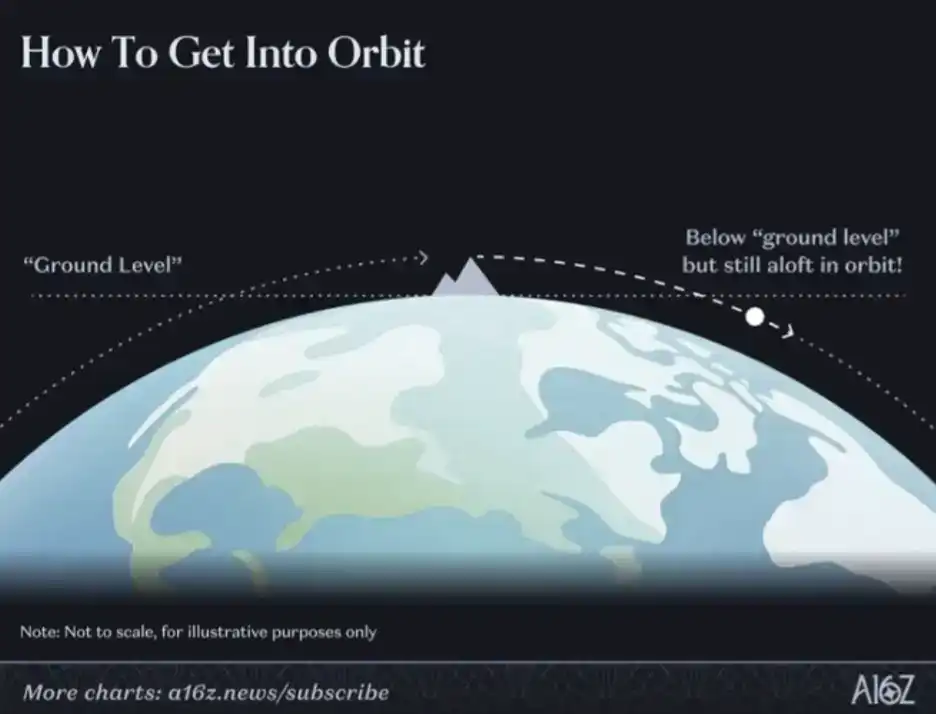
This threshold typically requires a delta-v of about 9.4 km/s. How much mass one can reliably place into orbit determines a nation's capacity to deploy satellites, the amount of fuel, sensors, protection, and redundancy they can carry.

Traditional satellites are often large and expensive because every gram is scarce, and design must be highly optimized. However, such "precious large satellites" become high-value targets in war. The more functions a single satellite carries, the greater the loss if it is blinded, jammed, or destroyed. Insufficient maneuverability and redundancy also make it harder to evade threats.

Orbital space itself is not as spacious as imagined. LEO constellations operate at different altitudes and inclinations, and their orbital planes intersect. Geostationary orbit, while at 36,000 km altitude, is essentially a limited resource line of longitude above the equator for communication satellites. Spectrum is similarly scarce; communication resources like the Ka-band require coordination. Space is vast physically but limited in operational resources.

An even greater nuisance is debris. Kinetic anti-satellite weapons, upon shattering a target, can create thousands of high-speed debris fragments. These fragments do not disappear but continue to orbit, repeatedly crossing relevant areas in the future, threatening other satellites. If collisions trigger more collisions, some orbits may become unusable for extended periods.

The US Has Scale Advantage, But Advantage Does Not Equal Safety

Judging from launch data, the US remains in a leading position. According to statistics from sources like Ill-Defined Space, the US had approximately 192 successful orbital launches in 2025, China about 90 successful out of 93 attempts, and Russia 17. Different agencies have slight variations in their definitions of "success" and "attempt," but the US lead is clear.
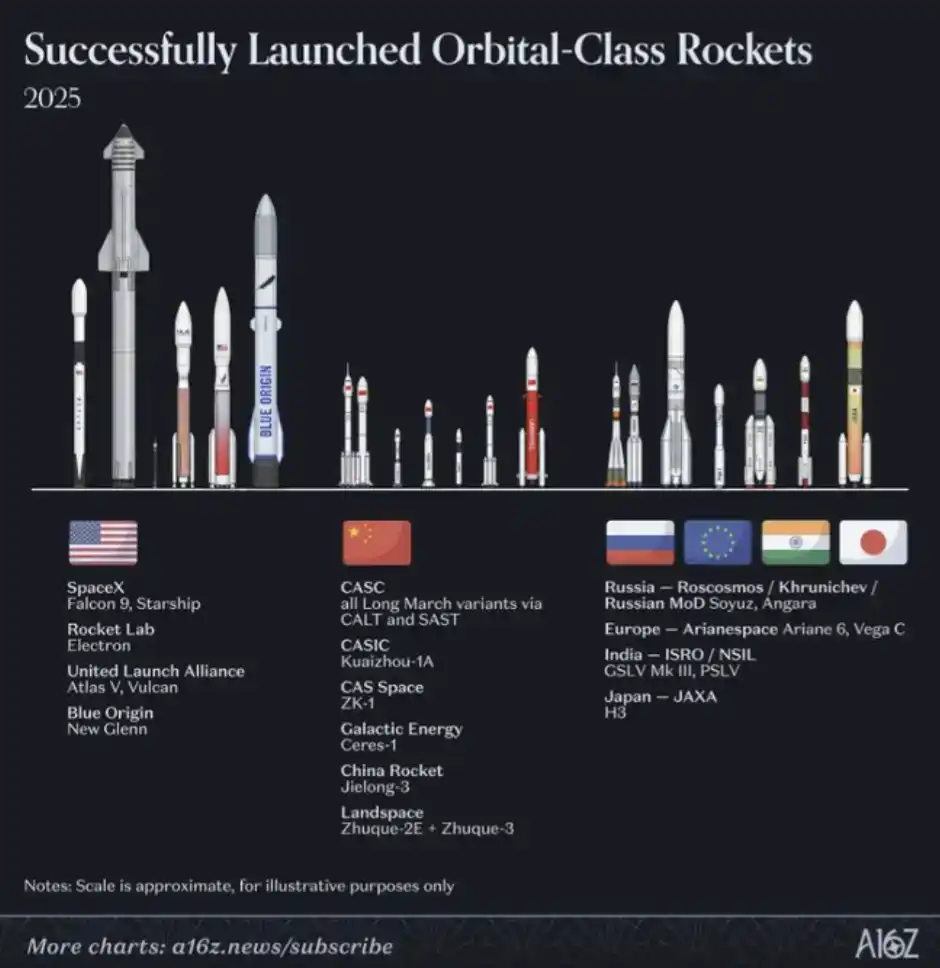
This is almost inseparable from SpaceX. In 2025, Falcon 9 launched approximately 165 times. SpaceX is also currently the only company to achieve large-scale reuse of orbital-class boosters. Reusability shifts launch from a scarce, expensive, low-frequency endeavor toward a higher-frequency, more industrialized rhythm. For military space capability, this impacts the speed of replenishment, expansion, generational upgrades, and wartime recovery.

Starlink demonstrates another type of advantage: scale. SpaceX's EU prospectus disclosed on June 5, 2026, shows that as of March 31, 2026, approximately 9,600 Starlink broadband and mobile satellites were operational in orbit. Third-party tracking data from June indicates the active number had exceeded 10,000.

Starlink's use in the Ukraine battlefield proves that commercial constellations can be rapidly transformed into wartime communication infrastructure. Its government version, Starshield, is more directly oriented toward defense needs.

But scale also brings new risks. Adversaries may no longer distinguish between commercial and military, viewing all commercial satellites capable of supporting war as dual-use targets. Russia's close-proximity operations around ICEYE-X36 are a real-world demonstration of this logic.

The US's true vulnerability lies in the fact that if critical missions like high-end reconnaissance, missile warning, and nuclear command communications remain concentrated on a few expensive satellites, even with a large overall satellite count, adversaries might target these few critical nodes. Space superiority cannot be judged solely by "how many satellites" but also by whether the architecture is dispersed, capable of rapid replenishment, whether ground systems are reliable, and whether operations can continue after jamming.

Space Warfare is More Likely to Remain in the Gray Zone

Winning a space war does not mean being the first to destroy more satellites. The real goal is to preserve one's own communication, reconnaissance, positioning, navigation, and timing capabilities, while making the adversary believe that an attack cannot yield decisive gains.

The first layer is launch capability. Whoever can place payloads into orbit faster, cheaper, and on a larger scale possesses wartime recovery capability. Reusable rockets, launch pad capacity, supply chains, and regulatory efficiency all become part of national security capability. Globally active orbital launch pads are few, and launch infrastructure itself becomes a high-value target.

The second layer is satellite manufacturing. Space no longer needs only a few "jewel-grade" satellites but requires large numbers of expendable, replaceable, functionally dispersed constellations. Military satellites need to distribute missions across more platforms so that the loss of a single point does not cripple the system.

The third layer is space domain awareness. In orbit, knowing who is approaching, at what speed, and with what possible intent is more critical than post-event attribution. Satellite jamming, blinding, collision, or internal failure can all manifest as malfunctions, making attribution often difficult. Without sufficient tracking and evidence chains, deterrence is weakened.

The cost of directly shattering satellites is also high. The 1962 US Starfish Prime high-altitude nuclear test detonated a nuclear bomb at about 400 km altitude, creating an artificial radiation belt that lasted for years and damaged or prematurely disabled multiple satellites. By various estimates, affected satellites at the time comprised about one-quarter to one-third of satellites in orbit. Modern orbital asset density is far higher than then, making the consequences of nuclear anti-satellite or large-scale kinetic strikes harder to control.

More realistic space confrontation may long remain within the realms of electronic jamming, GPS spoofing, laser dazzling, cyber attacks, close-proximity maneuvers, spectrum competition, and ground station attacks. China and Russia are developing counter-space capabilities, while the US is promoting more dispersed proliferated military constellations, such as PWSA. The ITU's spectrum and orbital slot rules will also become a field of competition.

The Most Dangerous Thing is Misjudging that Space is Still Peaceful

Space has long been packaged as a realm of peace, science, and commercial expansion, but modern warfare has proven it to be the infrastructure of ground battlefields. Without satellite communications, troops struggle to coordinate. Without remote sensing and navigation, missiles, drones, and artillery lose precision. Without timing systems, finance, power grids, and communication networks are also affected.

The peculiarity of Russia's approach to ICEYE-X36 is that it did not create an explosion but demonstrated the reality of commercial satellites being incorporated into military coercion. Future space warfare may not start with a missile but more likely with an approach, an interference, a spectrum grab, or a difficult-to-attribute failure.

The US's current advantage is real: leading in launch numbers, SpaceX has established a reusable rocket advantage, and Starlink has proven the wartime value of commercial constellations. Blue Origin, Rocket Lab, and Chinese commercial aerospace are catching up, while Russia and China are accumulating co-orbital, electronic warfare, and anti-satellite capabilities. If a few expensive platforms still bear critical missions, the orbital high ground will increasingly resemble a set of tempting targets.

The end goal of space warfare should not be to turn near-Earth orbit into a debris field. A more controllable outcome is to keep orbits usable, allow communications, reconnaissance, and navigation to recover under attack, and make adversaries believe that disrupting order will incur higher costs. Commercial spaceflight has given the US unprecedented scale advantages but also exposed commercial assets to new military risks. The Russian satellite's 500-meter approach is merely the clearest reminder of this stage.


Трендові криптовалюти

Пов'язані питання

QAccording to the article, what specific event in May 2026 does the author consider a key moment for highlighting the vulnerability of commercial satellites in conflict?

AThe author points to Russia's Cosmos satellites maneuvering to within approximately 500 meters of the Ukrainian-supporting ICEYE-X36 commercial radar satellite as a key moment, demonstrating how commercial satellites used for military support can become targets for military coercion or potential attack.

QWhat are the two main advantages the United States holds in space according to the article's analysis?

AThe article identifies two main US advantages: 1) Dominant launch capability, primarily through SpaceX's reusable Falcon 9 rockets enabling frequent, cost-effective access to orbit. 2) Scale of satellite constellations, exemplified by Starlink's thousands of operational satellites, which provide resilient and rapidly deployable infrastructure.

QWhy is a direct kinetic attack (like destroying a satellite with a missile) considered a high-risk option in space warfare?

ADirect kinetic attacks create persistent space debris. The fragments orbit at high speeds for years, posing a long-term collision threat to all satellites in similar orbital regions. This could trigger a chain reaction of collisions (Kessler Syndrome), potentially making certain orbits unusable and harming the attacker's own space assets.

QWhat does the article suggest is a more likely form of space conflict than outright destruction of satellites?

AThe article suggests future space conflict is more likely to occur in a 'gray zone' using non-kinetic or coercive tactics. These include electronic jamming, GPS spoofing, laser dazzling, cyber attacks, close-proximity satellite maneuvers, spectrum interference, and attacks on ground stations.

QWhat is the core strategic goal of space warfare as defined in the article, beyond simply destroying enemy satellites?

AThe core strategic goal is to preserve one's own capabilities for communication, reconnaissance, positioning, navigation, and timing (PNT) while convincing the adversary that an attack would not provide decisive benefits. The aim is to maintain a functioning orbital environment where critical services can survive and recover from disruption.

Пов'язані матеріали

Second Half of U.S. Crypto Policy: The Clarity Act Aims for 60 Votes, CFTC's "One-Person Commission" Becomes Biggest Variable

In a pivotal year for US crypto policy, the "CLARITY Act" is advancing in the Senate but faces a high hurdle, needing 60 votes to pass. Key challenges include bridging partisan divides on ethics and swaying undecided Republican senators within a tight legislative calendar of only about 40 working days. The policy "second half" involves intense negotiations on a broader framework for Web3 and DeFi, including crypto tax reforms and the Blockchain Regulatory Certainty Act. A significant uncertainty is the understaffed CFTC, operating with four commissioner vacancies, which complicates regulatory clarity. Meanwhile, the departure of key "crypto champions"—SEC Commissioner Hester Peirce and Senator Cynthia Lummis—will impact ongoing policy efforts. Industry experts are cautiously optimistic but realistic. Sara K. Weed notes that while progress is being made, CLARITY is unlikely to pass this Congress, pushing agencies like the SEC and CFTC to provide more guidance. Sulolit Mukherjee suggests meaningful crypto tax legislation is more likely to be attached to larger must-pass bills. Rashan Colbert discusses the jurisdictional debate over prediction markets, emphasizing the need for a regulatory framework that fosters their development as financial tools rather than treating them broadly as gambling. The clock is ticking, but opportunities remain for substantive progress through continued bipartisan dialogue and pragmatic efforts.

marsbit14 хв тому

Second Half of U.S. Crypto Policy: The Clarity Act Aims for 60 Votes, CFTC's "One-Person Commission" Becomes Biggest Variable

marsbit14 хв тому

Dan Koe's New Essay: Escaping the Fate of the Wage Slave, How to Survive the AI Replacement Wave?

Dan Koe argues that the true threat in the AI era isn't technology itself, but a reliance on others for one's livelihood and happiness. The core problem is "wage slavery"—spending life on unfulfilling work. To survive and thrive, one must escape this by building their own enterprise. The key is developing five elements: Agency (initiative), Taste (discernment), Persuasion, Persistence, and Iteration. These boil down to problem-solving skills and experiential knowledge, which cannot be learned passively but only through doing your own projects. The solution is to become "unemployable" by shifting your identity. This requires: 1) Radically changing your environment to force growth, 2) Choosing a medium (like content creation) that provides real feedback through trial and error, and 3) Mastering either code or, preferably, media (content). Content creation is more valuable because its subjective nature and need for human perspective create a durable advantage over generic AI output. To start, define your life's work by answering foundational questions about your innate knowledge, unique abilities, and contrarian beliefs. Then, immediately act by publishing your first piece of content. The cycle of creating, receiving feedback, and iterating is the essential path to developing the skills needed for an independent, meaningful career and financial resilience.

marsbit50 хв тому

Dan Koe's New Essay: Escaping the Fate of the Wage Slave, How to Survive the AI Replacement Wave?

marsbit50 хв тому

Research Report Analysis: Morgan Stanley Details SanDisk SNDK, The Truth About Cloud Data Center Pricing Power and AI Inference Benefits

Morgan Stanley raised its price target for SanDisk (SNDK) from $1100 to $1750 on June 22, maintaining an Overweight rating. The upgrade is driven by AI inference demand reshaping the NAND market, particularly for KV Cache and context window storage in cloud data centers. These cloud clients exhibit price inelasticity and sign long-term contracts, granting SanDisk significant pricing power. SanDisk's New Business Model (NBM) agreements, covering over one-third of FY27 bit shipments with 3-5 year terms and fixed price/price collar structures, are crucial. They are projected to sustain gross margins around 80% even at floor prices, providing a buffer against cyclical downturns. Morgan Stanley forecasts gross margins to surge from 30.3% in FY25 to 86.7% in FY27e. With NAND supply expected to remain tight into 2026/2027 and cloud/data centers becoming the largest end-market, SanDisk holds supply-side pricing power. The company targets 15-19% bit growth via technology transitions, not capacity expansion. Revenue is projected to grow ~6.6x from FY25 to FY27, with EPS rising from $2.74 to $14.73, driven by high-margin cloud business. Key upside catalysts include faster enterprise SSD adoption and edge AI growth. Downside risks involve slower industry growth, competitor capex increases, market share loss, and competition from Chinese players like YMTC. The investment thesis rests on AI-driven structural demand, NBM's margin protection, and sustained supply tightness. The $1750 target implies ~28x FY27e P/E.

marsbit1 год тому

Research Report Analysis: Morgan Stanley Details SanDisk SNDK, The Truth About Cloud Data Center Pricing Power and AI Inference Benefits

marsbit1 год тому

A Threefold Performance Leap! NEAR Achieves 200ms Physical Block Time Limit with SPICE

NEAR's core development team, Near One, has announced its next major protocol evolution: SPICE (Separation of Consensus and Execution). Currently in development, SPICE represents the most significant upgrade before the full implementation of Nightshade 3.0. Its core innovation is decoupling the consensus layer, responsible for ordering transactions, from the execution layer, which processes them. This allows the consensus layer to run at full speed without waiting for transaction execution to complete. Once deployed, SPICE is projected to triple NEAR's block production speed, achieving a 200ms block time, which is considered the physical limit due to the speed of light and network latency. This leap will dramatically reduce transaction latency and finality, with transactions confirming in roughly 0.4 seconds—faster than a typical card payment. The upgrade also enables more complex, long-running transactions and significantly improves user experience for applications like NEAR Intents and near.com. Beyond raw speed, SPICE enhances network scalability and security. It enables deeper parallelism, efficiently distributing workload across shards and improving resource utilization. The simpler block structure and lighter contracts also facilitate formal verification and security auditing. Furthermore, SPICE lays the critical groundwork for future Nightshade 3.0 features, most notably atomic cross-shard transactions, which would simplify complex contract logic and eliminate development hurdles caused by asynchronous execution. The Near One team is actively developing SPICE, targeting deployment in the coming months.

Foresight News2 год тому

A Threefold Performance Leap! NEAR Achieves 200ms Physical Block Time Limit with SPICE

Foresight News2 год тому

Торгівля

Спот
Ф'ючерси

Популярні статті

Як купити WAR

Ласкаво просимо до HTX.com! Ми зробили покупку WAR (WAR) простою та зручною. Дотримуйтесь нашої покрокової інструкції, щоб розпочати свою криптовалютну подорож.Крок 1: Створіть обліковий запис на HTXВикористовуйте свою електронну пошту або номер телефону, щоб зареєструвати обліковий запис на HTX безплатно. Пройдіть безпроблемну реєстрацію й отримайте доступ до всіх функцій.ЗареєструватисьКрок 2: Перейдіть до розділу Купити крипту і виберіть спосіб оплатиКредитна/дебетова картка: використовуйте вашу картку Visa або Mastercard, щоб миттєво купити WAR (WAR).Баланс: використовуйте кошти з балансу вашого рахунку HTX для безперешкодної торгівлі.Треті особи: ми додали популярні способи оплати, такі як Google Pay та Apple Pay, щоб підвищити зручність.P2P: Торгуйте безпосередньо з іншими користувачами на HTX.Позабіржова торгівля (OTC): ми пропонуємо індивідуальні послуги та конкурентні обмінні курси для трейдерів.Крок 3: Зберігайте свої WAR (WAR)Після придбання WAR (WAR) збережіть його у своєму обліковому записі на HTX. Крім того, ви можете відправити його в інше місце за допомогою блокчейн-переказу або використовувати його для торгівлі іншими криптовалютами.Крок 4: Торгівля WAR (WAR)Легко торгуйте WAR (WAR) на спотовому ринку HTX. Просто увійдіть до свого облікового запису, виберіть торгову пару, укладайте угоди та спостерігайте за ними в режимі реального часу. Ми пропонуємо зручний досвід як для початківців, так і для досвідчених трейдерів.

268 переглядів усьогоОпубліковано 2024.12.11Оновлено 2026.06.02

Як купити WAR

Обговорення

Ласкаво просимо до спільноти HTX. Тут ви можете бути в курсі останніх подій розвитку платформи та отримати доступ до професійної ринкової інформації. Нижче представлені думки користувачів щодо ціни WAR (WAR).

活动图片