3B Small Model's Programming Scores Rival Opus 4.5, Mysterious Model Sparks Heated Discussion, Turns Out to be Domestic

marsbitОпубліковано о 2026-06-18Востаннє оновлено о 2026-06-18

Анотація

A 3B parameter dense reasoning model named VibeThinker-3B has gained significant attention for achieving performance comparable to leading models like Gemini 3 Pro, GPT-5 high, and Claude Opus 4.5 in verifiable reasoning tasks such as programming, mathematics, and STEM problem-solving, despite its significantly smaller size. Developed by Sina Weibo's team, the model is built upon Qwen2.5-Coder-3B. Its training employs an upgraded Spectrum-to-Signal pipeline, featuring a curriculum-based two-stage supervised fine-tuning (SFT), multi-domain reinforcement learning (RL) inspired by MGPO, offline self-distillation, and instruction RL to enhance controllability. A key innovation is the Claim-Level Reliability (CLR) assessment, a test-time scaling strategy that further boosts performance on math benchmarks. The model excels in specific, verifiable domains, scoring highly on tests like AIME26 (94.3/97.1 with CLR) and LiveCodeBench v6 (80.2 Pass@1). However, it performs less impressively in areas requiring broad general knowledge. The authors propose a "parameter compression coverage hypothesis," suggesting that verifiable reasoning abilities—reliant on multi-step logic and feedback—are highly compressible, while open-domain knowledge depends more on large-scale parameters. VibeThinker-3B demonstrates that small models, when specialized for tasks with clear verification signals, can reach frontier performance, offering a complementary research path to scaling model size. The model ...

In recent days, a 3B small model has gained popularity on X because in some difficulty-verifiable reasoning tasks (like programming), it has entered the performance range of frontier models like Gemini 3 Pro, GPT-5 high, Claude Opus 4.5, GLM-5, and Kimi K2.5, while its size is far smaller than these models.

This model is named VibeThinker-3B, a dense reasoning model with 3 billion parameters, aiming to explore how far verifiable reasoning capability can be pushed under strictly small model scale constraints.

After the model's release, many were amazed by its results and expressed a desire to try it out.
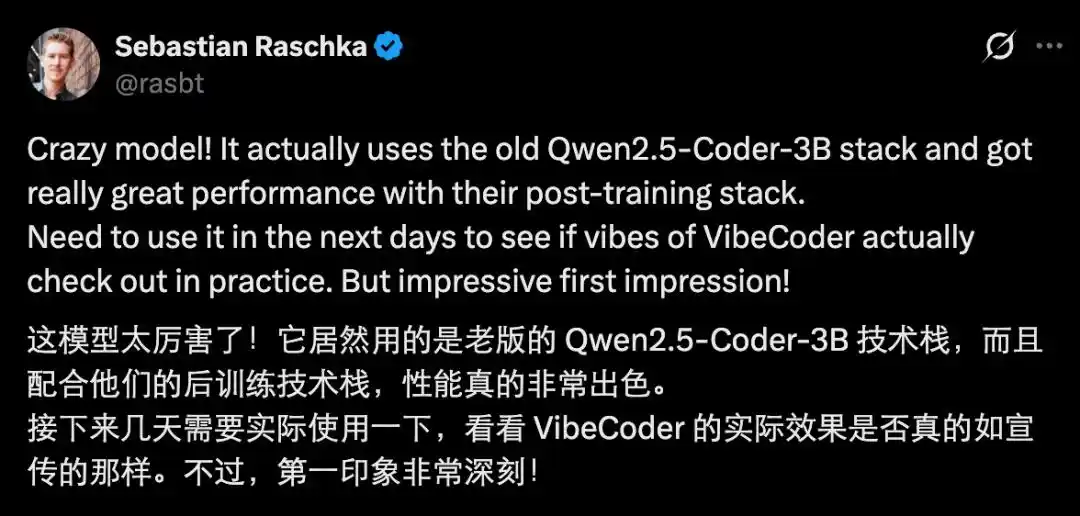
Notably, it is also a domestic model, coming from the Sina Weibo team.
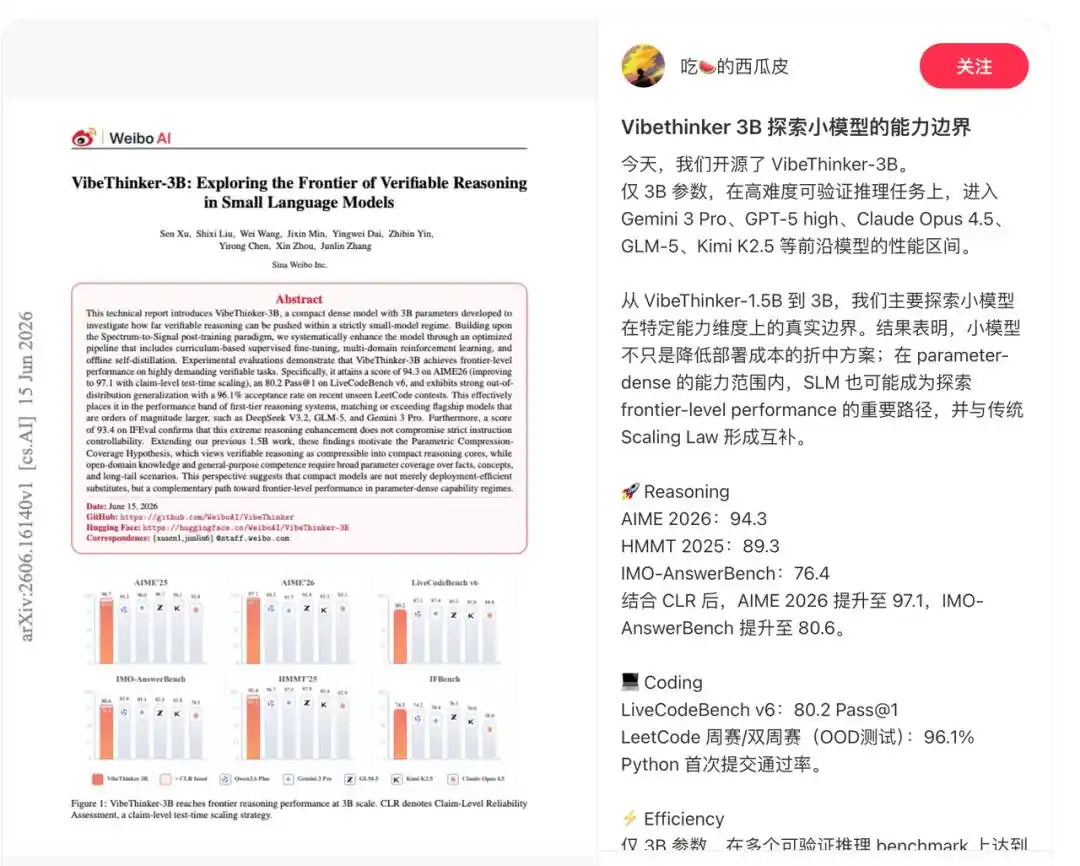
The technical report shows that this model is designed specifically for tasks with reliable verification signals, including mathematical reasoning, competitive programming, STEM reasoning, and instruction execution with clear constraints.

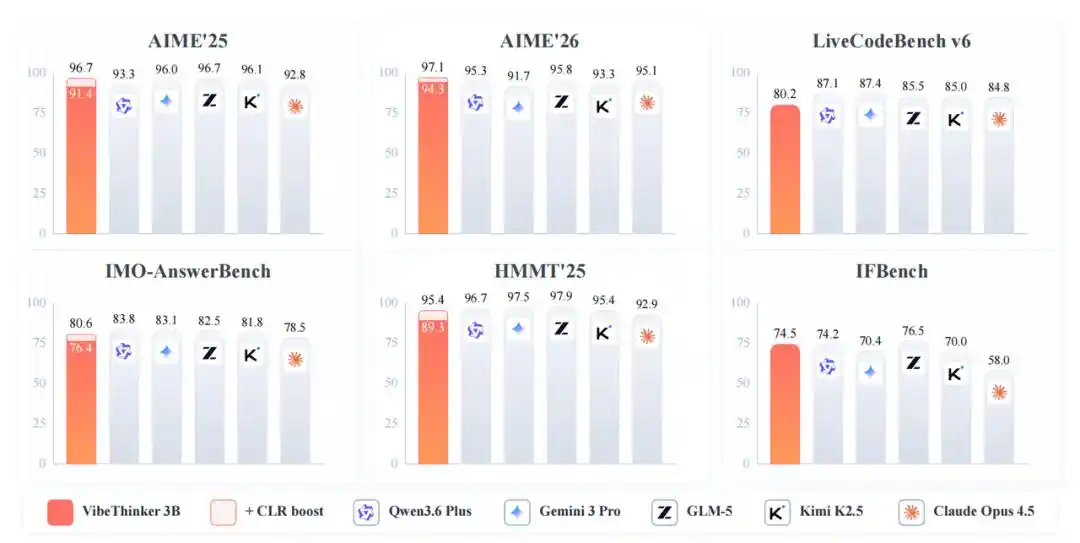
Therefore, it performs exceptionally well in various benchmark tests. It scored 94.3 on the AIME26 test, 89.3 on the HMMT25 test, 80.2 on the LiveCodeBench v6 test (Pass@1), and achieved a 96.1% pass rate in the latest unpublished weekly and biweekly LeetCode contests between April 25 and May 31, 2026.
How was this model trained? The technical report reveals some details.

First, it is built upon Qwen2.5-Coder-3B and undergoes post-training using an upgraded Spectrum-to-Signal process. This process strengthens data synthesis, quality filtering, and curriculum learning in Supervised Fine-Tuning (SFT), extends MGPO-style reinforcement learning to multiple verifiable domains, preserves complete long-context reasoning trajectories, and consolidates various capabilities through offline self-distillation and instruction reinforcement learning (Instruct RL).
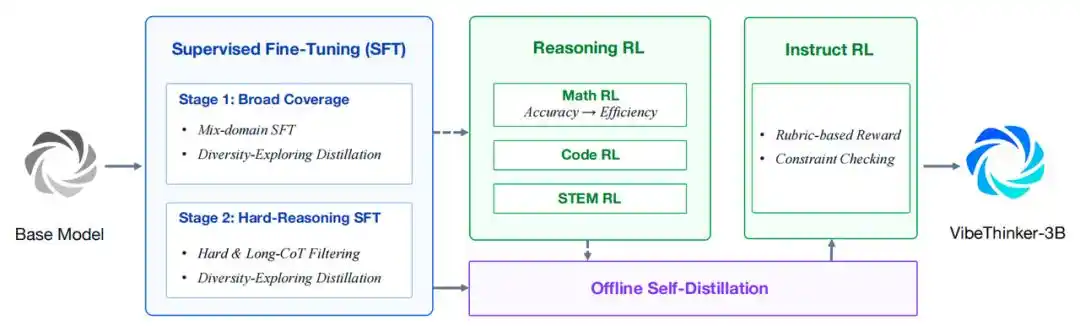
Overall training pipeline of VibeThinker-3B
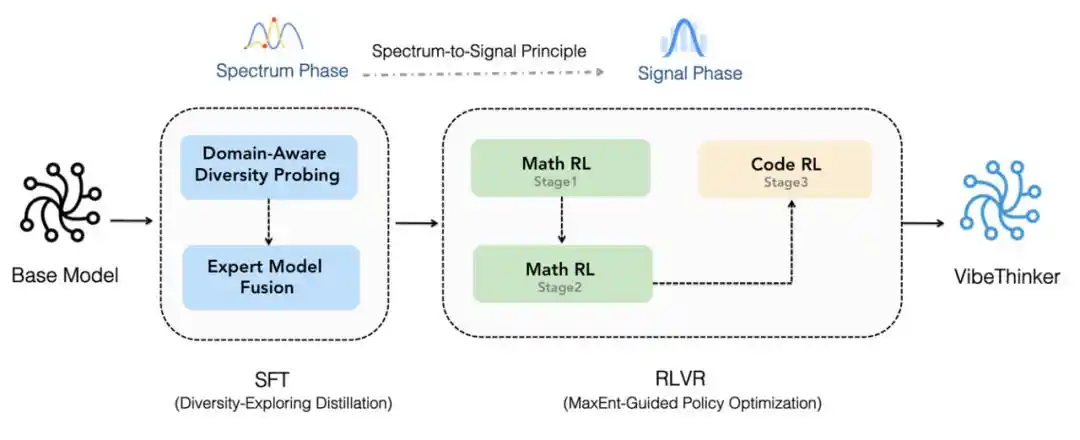
Spectrum-to-Signal pipeline.

Furthermore, VibeThinker-3B introduces Claim-Level Reliability (CLR) assessment, a test-time scaling strategy for answer-verifiable reasoning. CLR further improves performance on mathematical benchmarks, raising AIME26 from 94.3 to 97.1, HMMT25 from 89.3 to 95.4, and BruMO25 to 99.2.
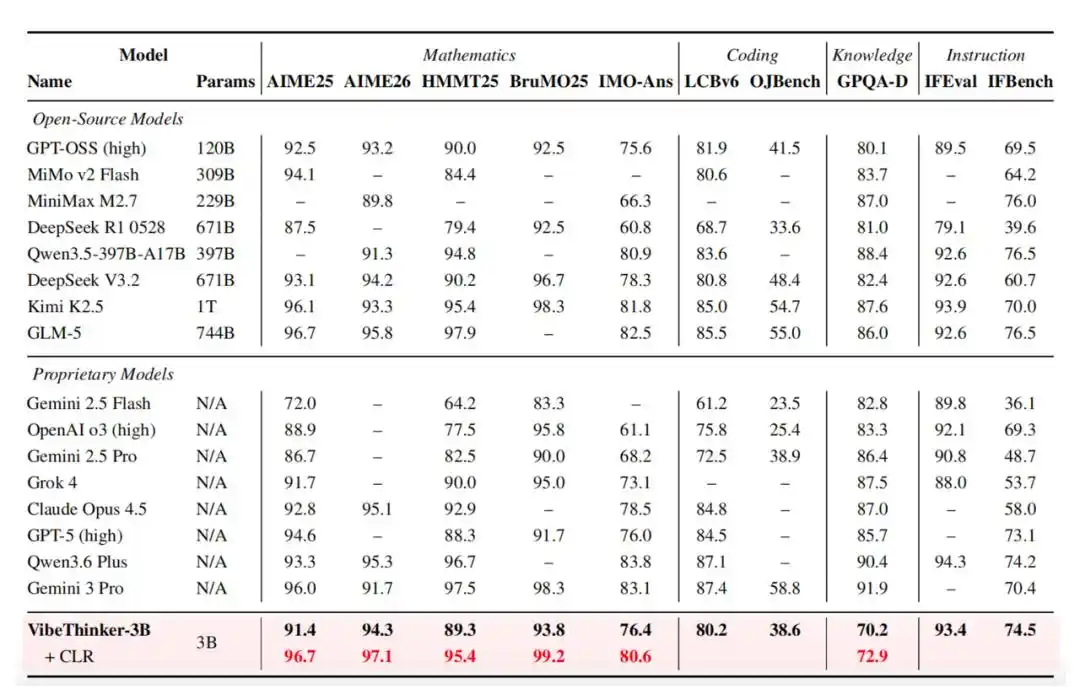
The specific training pipeline is as follows:

  • Curriculum-based two-stage SFT. The first stage focuses on broad capability coverage in mathematics, programming, STEM reasoning, general conversation, and instruction following. The second stage shifts to more difficult, broader-scope reasoning samples. Diversity-Exploring Distillation is used to preserve multiple valid solution paths.
  • Multi-domain reasoning reinforcement learning. VibeThinker-3B reuses MGPO. Reinforcement learning is applied sequentially to mathematical, programming, and STEM reasoning tasks. Training uses a single 64K long-context window to preserve complete long-horizon reasoning trajectories.
  • Offline self-distillation. High-quality trajectories are filtered and distilled from the mathematical, programming, and STEM RL checkpoints, ultimately forming a unified student model. Learning Potential Scoring is used to prioritize trajectories that are correct but not yet well imitated by the student.
  • Instruct RL. The final stage improves the controllability for user-facing prompts. For format-sensitive and open-ended instructional data, rule-based verifiers and rubric-based reward models are employed.

In a recent post, well-known AI researcher and blogger Sebastian Raschka systematically summarized key points disclosed in the VibeThinker-3B technical report, including the following:
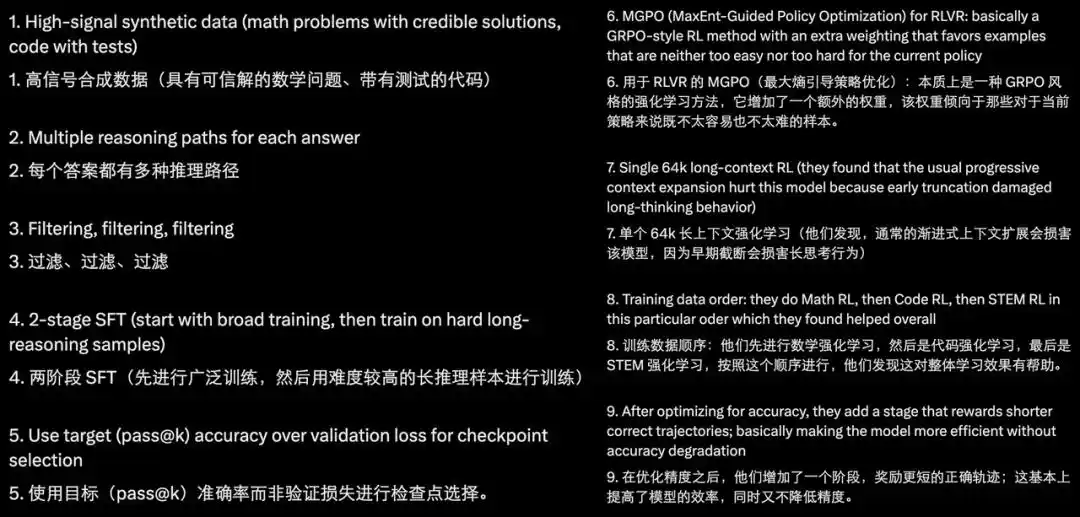
If you are interested in this content, you can delve into their technical report. Currently, the model is also publicly available for download.
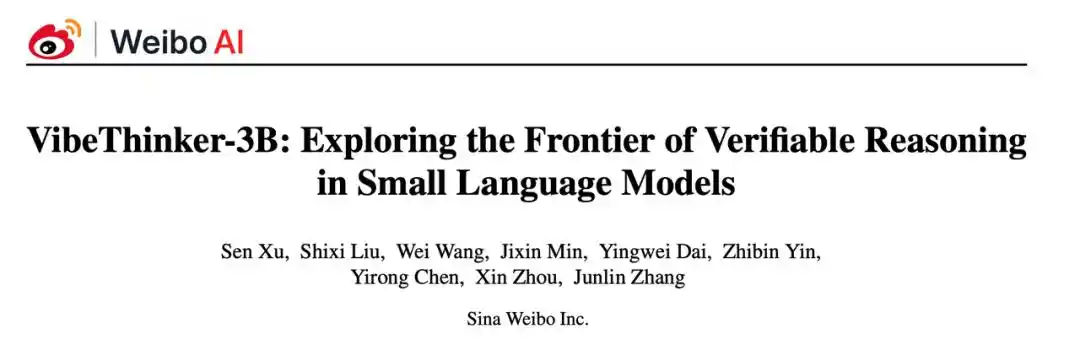
Report Title: VibeThinker-3B: Exploring the Frontier of Verifiable Reasoning in Small Language Models

Report Link: https://arxiv.org/pdf/2606.16140

HuggingFace Link: https://huggingface.co/WeiboAI/VibeThinker-3B

However, the model's applicable scope has clear limitations, as it does not perform well in domains requiring general knowledge.
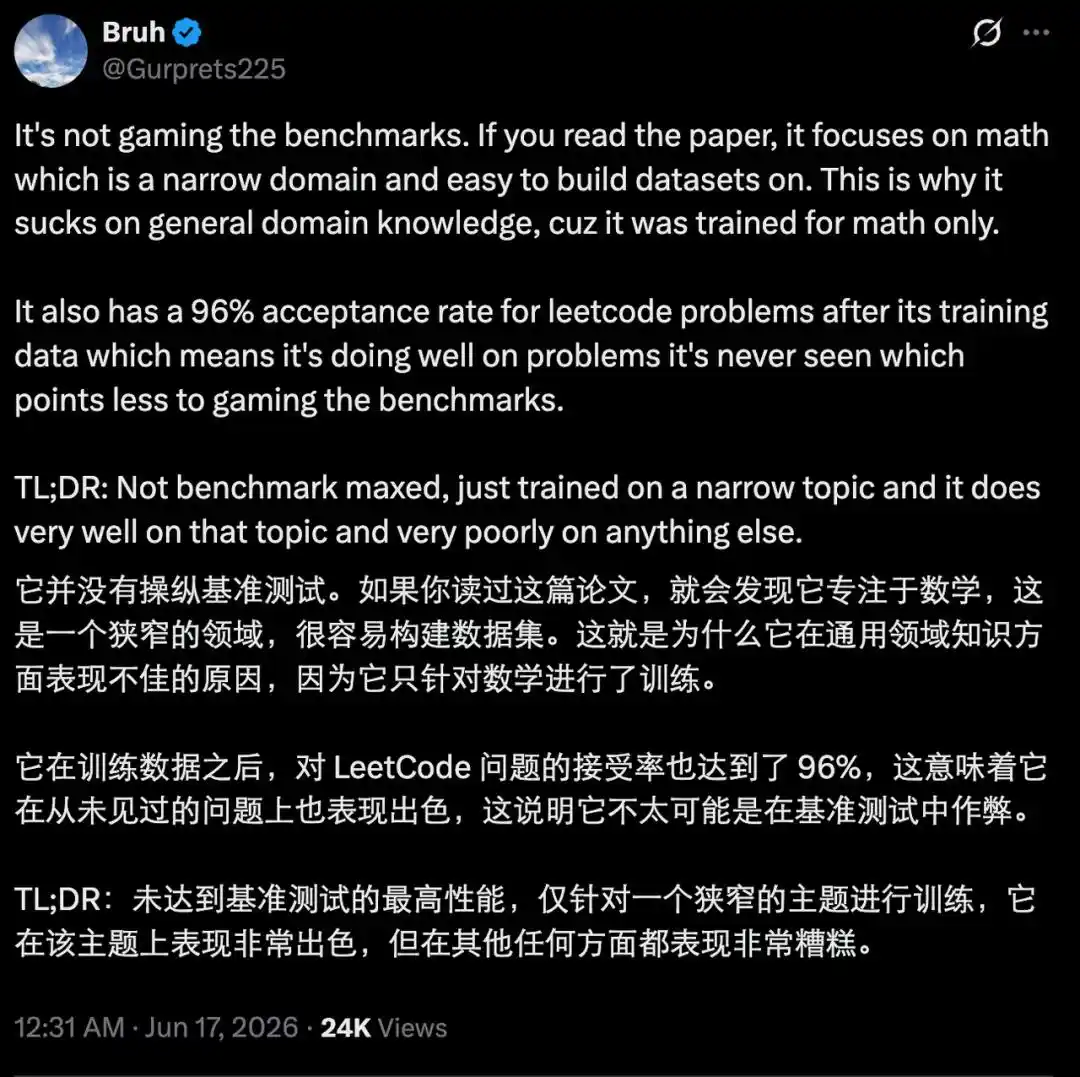
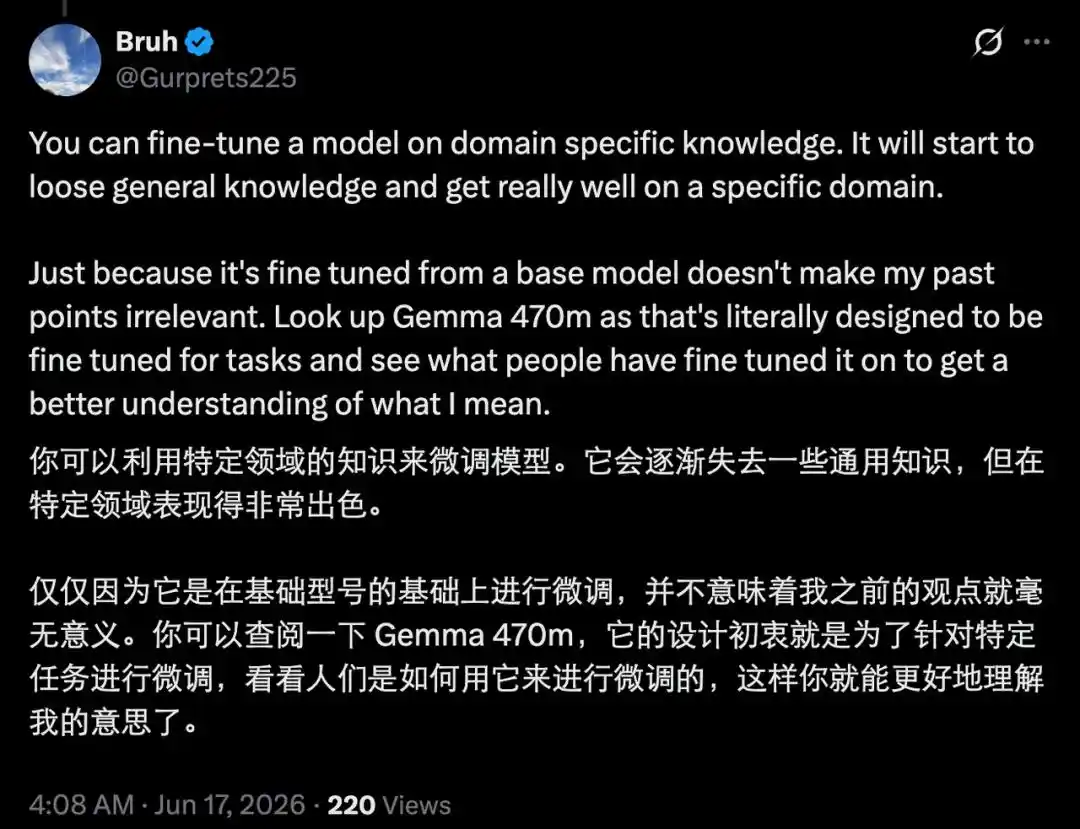
The developers also explicitly point this out and propose the "Parameter Compression Coverage Hypothesis": Different capabilities rely on model parameters in drastically different ways. Verifiable reasoning is closer to a highly compressible, parameter-dense ability whose core lies in multi-step reasoning, constraint satisfaction, self-correction, and answer verification. When the task space structure is clear enough and feedback signals are sufficiently reliable, compact models can also possess near-state-of-the-art reasoning capabilities. In contrast, open-domain knowledge, general conversation, and long-tail scenario understanding rely more on large-scale parameters to extensively cover facts, concepts, and world knowledge. This hypothesis is very insightful. VentureBeat wrote in its report: "It reveals a partial decoupling between reasoning capability and factual knowledge, and that the former can be compressed more efficiently than previously thought — an insight that has profound implications for how the industry thinks about model design, deployment costs, and the accessibility of advanced AI capabilities."
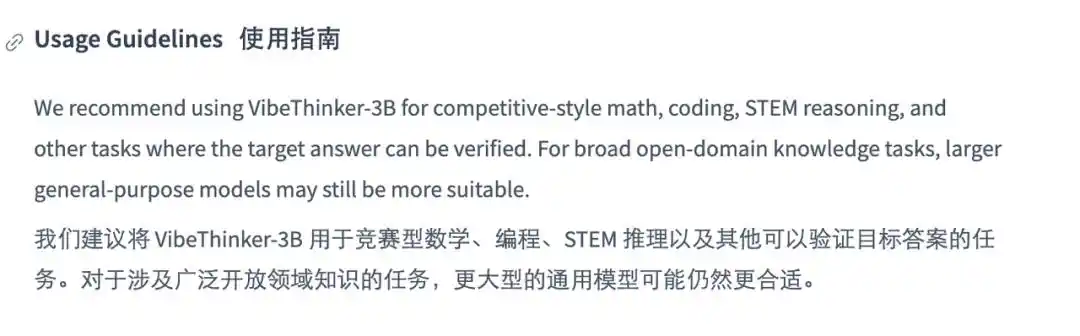

The authors state that their goal is not to create a small model to replace large-scale models, but to examine the true boundaries of small models along specific capability dimensions. With VibeThinker-3B, they hope to demonstrate that small models should not merely be seen as a compromise to reduce deployment costs. In capability domains with clear feedback and verification mechanisms, small language models are revealing a promising research path, potentially achieving frontier-level performance and forming a fundamentally complementary relationship with the traditional paradigm of parameter scaling.

Currently, the model still faces some skepticism within the community. If you are interested in this model, you might want to try it out for yourself.
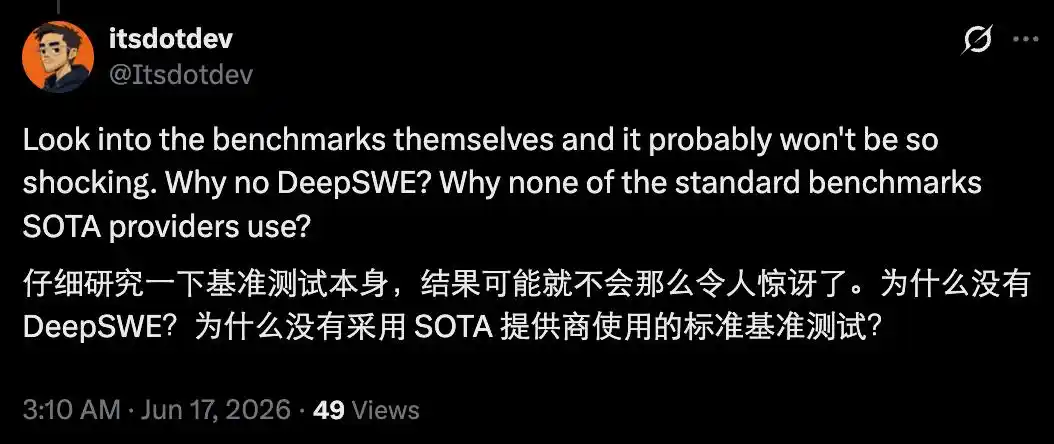
Reference Links:

https://x.com/orcus108/status/2066876960073281582

This article is from the WeChat public account "Machine Heart" (ID: almosthuman2014), author: Zhang Qian


Пов'язані питання

QWhat is the name and key characteristic of the small AI model discussed in the article?

AThe model is called VibeThinker-3B. Its key characteristic is that despite being a small model with only 3 billion parameters, it achieves reasoning performance on verifiable tasks like programming that is comparable to much larger frontier models.

QWhich company or team developed the VibeThinker-3B model?

AThe VibeThinker-3B model was developed by the Sina Weibo (microblog) team, making it a domestic Chinese model.

QWhat is the core hypothesis proposed by the creators of VibeThinker-3B regarding model capabilities?

AThe core hypothesis is the 'Parameter-Compression Coverage Hypothesis'. It suggests that different capabilities depend on model parameters in distinct ways. Verifiable reasoning (multi-step reasoning, constraint satisfaction) is highly compressible and parameter-dense. In contrast, open-domain knowledge and understanding rely more on large-scale parameters for broad factual coverage.

QOn which specific benchmark tasks did VibeThinker-3B demonstrate exceptional performance?

AVibeThinker-3B demonstrated exceptional performance on verifiable reasoning benchmarks such as AIME26 (97.1 with CLR), HMMT25 (95.4 with CLR), LiveCodeBench v6 (80.2 Pass@1), and recent private LeetCode contests (96.1% pass rate).

QWhat are the main limitations or scope of application for the VibeThinker-3B model as stated in the article?

AThe model's applicability is limited. It excels in domains with clear verification signals (math, programming, STEM) but does not perform well in areas requiring general world knowledge, open-domain dialogue, or understanding of long-tail scenarios, as these rely on broader parametric coverage.

Пов'язані матеріали

Polymarket's Sixth Anniversary: Bathroom, Exile, and Homecoming

Polymarket, a prediction market platform, recently celebrated its sixth anniversary. Born during New York's COVID-19 lockdown, founder Shayne Coplan built the initial product from his bathroom. The platform allows users to trade on the outcomes of real-world events, aiming to aggregate information faster than traditional media or polls. Its early years involved navigating regulatory challenges, most notably a 2022 CFTC order and penalty for offering unregistered event contracts, which led to a ban on U.S. users. Despite this "exile," the platform persisted, gaining significant traction during major news events like the 2024 U.S. presidential election, where its markets often preceded mainstream narratives. A pivotal shift occurred in 2025. Following the conclusion of a DOJ/CFTC investigation, Polymarket strategically acquired a CFTC-regulated exchange (QCX) to re-enter the U.S. market legally. It secured a massive strategic investment from Intercontinental Exchange (ICE), NYSE's parent company, and formed high-profile partnerships with sports leagues like the NHL, UFC, and MLB, as well as media outlets including Google and the Wall Street Journal. Now valued in the tens of billions, Polymarket stands at the intersection of crypto, finance, media, and sports. Its journey reflects a constant tension between innovative information aggregation and regulatory scrutiny, evolving from a fringe crypto experiment into a mainstream, albeit still contested, financial and data infrastructure.

marsbit9 хв тому

Polymarket's Sixth Anniversary: Bathroom, Exile, and Homecoming

marsbit9 хв тому

The 'Side Hustle Survival' of DAT Companies: After the Accumulation Flywheel Stops, They Begin Self-Rescue

"Metaplanet's 'Side Hustle Survival': After the 'Crypto Hoarding Flywheel' Stops, They Begin Self-Rescue" The article discusses the strategic pivot of Digital Asset Treasury (DAT) companies as the once-lucrative model of hoarding cryptocurrencies, pioneered by MicroStrategy, faces challenges. With the crypto bear market and the rise of ETFs offering direct, low-premium exposure, many DAT firms are abandoning the passive treasury model. Prominent examples include ETHZilla, which sold ETH to repay debt and shifted to RWA tokenization, and others like Prenetics Global exiting completely. Facing stalled growth, remaining companies are pursuing two main survival paths. The first path is transforming into institutional crypto asset management platforms and yield funds. SharpLink Gaming exemplifies this by staking 100% of its ETH and partnering with Galaxy Digital to launch a yield fund. GameSquare is taking a more aggressive approach, using AI-driven algorithms across DeFi protocols to seek higher returns. The second path involves becoming blockchain infrastructure operators, particularly in the Solana ecosystem. Companies like DeFi Development and SOL Strategies are moving beyond holding SOL to operating validator networks and launching liquid staking tokens, building fee-based revenue models from ecosystem participation. The article notes these transitions reflect a broader industry maturation, shifting from financial engineering to building operational moats through technology, network effects, and deep ecosystem integration. However, risks remain, including DeFi protocol vulnerabilities and dependence on specific blockchain networks' health. Ultimately, this collective shift signals that in crypto, sustainable value comes not from capital games but from active participation, cash flow generation, and providing real utility—a necessary, if painful, step towards industry maturity.

marsbit11 хв тому

The 'Side Hustle Survival' of DAT Companies: After the Accumulation Flywheel Stops, They Begin Self-Rescue

marsbit11 хв тому

Annual Revenue of 13 Billion, Paying 17.2 Billion to Microsoft: The Truth Behind AI's Money-Burning in OpenAI's Leaked Ledger

Leaked OpenAI financial documents from June 2026 revealed that in 2025, the company achieved $13.07 billion in revenue, a 253% growth from 2024. However, this was accompanied by an operational loss of $20.92 billion and a net loss of roughly $8 billion. Despite ChatGPT surpassing 900 million weekly active users, the "burn rate" remained high: for every $1 earned, $1.60 was spent. The cost structure shows $34 billion in total costs. R&D was the largest expense at $19.18 billion, which included $10.59 billion paid to Microsoft. Compute costs for model inference were $7.5 billion, with sales and marketing at $5.73 billion. Notably, total payments to Microsoft reached $17.2 billion, accounting for over 50% of OpenAI's total costs and exceeding its annual revenue, highlighting a significant structural burden. This high-cost, high-loss model is an industry-wide trend. xAI reported a 2025 operational loss of $6.4 billion against $3.2 billion in revenue, spending $3 for every $1 earned. Anthropic, with a reported $90 billion annualized revenue by late 2025, also faced pressure with a 40% gross margin, lower than expected due to high inference costs. Combined, these top three firms' operational losses surpassed $30 billion in 2025. OpenAI's vast user base presents a monetization challenge. With only about 50 million of its 900 million weekly users paying (a ~5.6% conversion rate), the compute cost of serving free users is substantial. This contrasts with strategies like Anthropic's, which focuses on premium pricing for enterprise clients. The industry's path to profitability hinges on dramatically reducing marginal costs, particularly for inference, through innovations in specialized chips or model efficiency. Until then, massive capital inflows—like OpenAI's $122 billion funding round in March 2026—remain essential to fund the relentless pursuit of scale and advanced capabilities.

marsbit22 хв тому

Annual Revenue of 13 Billion, Paying 17.2 Billion to Microsoft: The Truth Behind AI's Money-Burning in OpenAI's Leaked Ledger

marsbit22 хв тому

Торгівля

Спот
Ф'ючерси
活动图片