Japan's AI Dark Horse Emerges: How a 7B Small Model Challenges Fable and Mythos?

marsbitОпубліковано о 2026-06-22Востаннє оновлено о 2026-06-22

Анотація

In June 2026, Sakana AI's new model Fugu caused a stir in the AI community. Its Fugu Ultra variant achieved scores of 73.7 on SWE-Bench Pro and 82.1 on TerminalBench 2.1, surpassing GPT-5.5 and Claude Opus 4.8, and was claimed to be comparable to export-restricted models like Fable 5 and Mythos Preview. Remarkably, the core of this high-performance system is not a massive model, but a small 7B-parameter RL Conductor model. Fugu operates as a multi-agent orchestrator: the 7B model acts as a "foreman," dynamically analyzing user tasks and delegating subtasks to a pool of top-tier global models (e.g., GPT-5, Gemini 3.1 Pro). It then synthesizes and verifies their outputs. This architecture represents a paradigm shift from monolithic models to an expert-team approach. It enhances performance in complex, multi-step engineering tasks like code review and security testing by enabling cross-validation from specialized models, improving long-session stability and token efficiency. However, Fugu's strengths come with trade-offs: it faces inherent latency due to multiple API calls, relies heavily on underlying US model APIs (creating dependency risks), and its benchmark comparisons with Fable/Mythos are based on reported scores, not head-to-head testing. For Japan's AI ecosystem, which lacks the massive compute and data resources of the US or China, Fugu exemplifies an "asymmetric breakthrough" strategy. Instead of competing directly in parameter scale, it focuses on intelligent orche...

June 22, 2026 — The new model "Fugu" released by Sakana AI sent shockwaves through the AI community. In the rigorous SWE-Bench Pro and TerminalBench benchmark tests, Fugu Ultra scored 73.7 and 82.1 points respectively, surpassing GPT-5.5 and Claude Opus 4.8, and even claimed to be on par with the export-controlled Fable 5 and Mythos Preview. Surprisingly, the core of this system, which topped the charts in engineering and reasoning capabilities, is not a massive model with hundreds of billions of parameters, but a model with only 7B parameters. It doesn't do the work itself; instead, it acts as a "project manager," dynamically orchestrating top global large models. This counter-intuitive architecture not only shatters the myth of "parameters equal justice" but also reflects Japan's path to AI breakthroughs amidst constrained computing resources.

The 7B "Project Manager": The Counter-Intuitive Architecture of Fugu

To understand the peculiarities of Fugu, one must first look at its origins. Sakana AI was founded in Tokyo in 2023 by Llion Jones, a co-author of the Transformer paper, and former Google researcher David Ha. From its inception, the company carried the "nature-inspired" gene, dedicated to solving AI problems with evolutionary algorithms and natural swarm intelligence. In 2025, Sakana AI secured investments from giants like NVIDIA and Google, valuing the company at over $25 billion. However, despite backing from these giants, Japan still lacks the massive computing infrastructure and data pools found in China and the US. Under these resource constraints, Sakana AI did not choose to compete head-on with trillion-parameter models but instead took an "orchestration" route.

Fugu is officially positioned as "a multi-agent orchestration system acting as a single foundational model." In traditional AI architecture, a large model is a "monolithic beast." A user inputs a prompt, and the model calculates from the first neural network layer to the last, outputting the result. This mode is extremely efficient for simple problems but often leads to hallucinations or logical breakdowns when facing complex, multi-step engineering tasks.
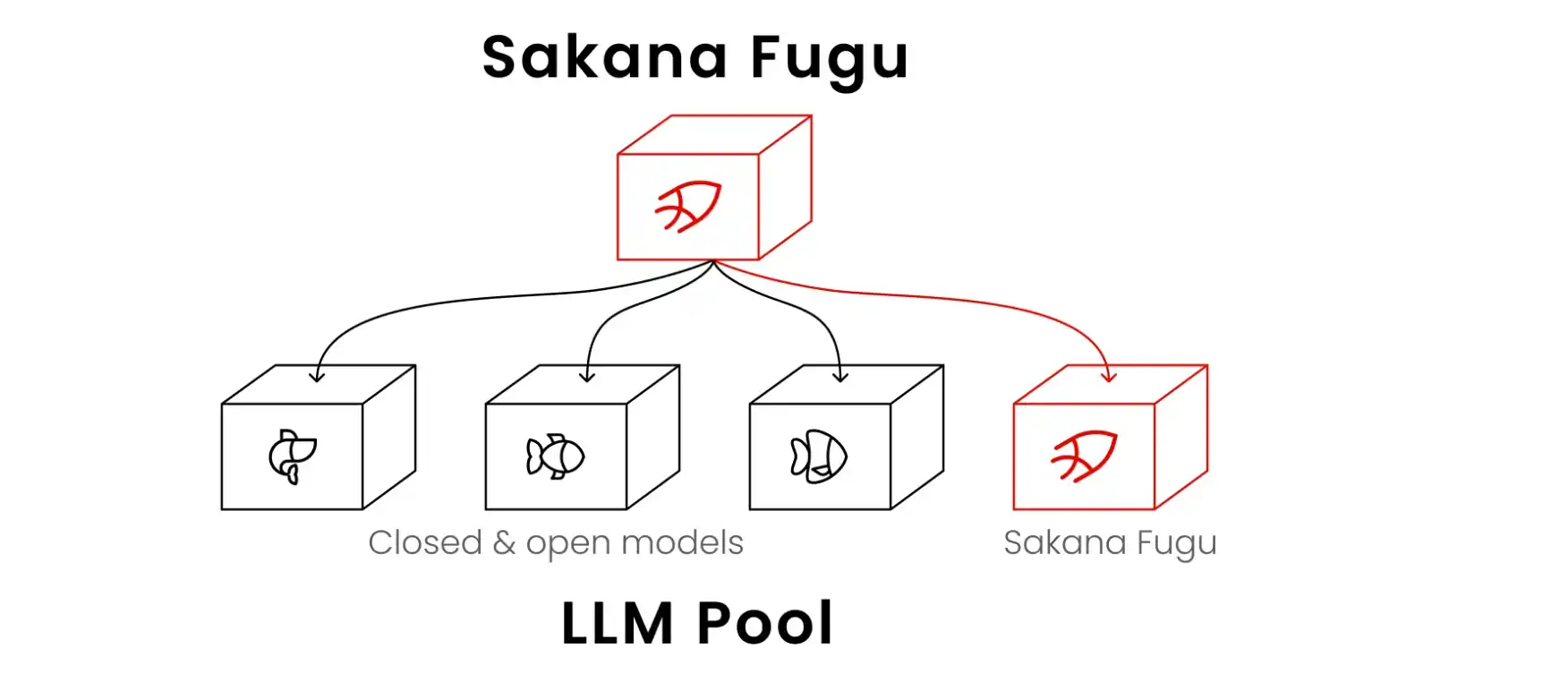
Fugu fundamentally changed this paradigm. Its core is a 7B-parameter model trained with reinforcement learning, called the RL Conductor. This 7B model does not directly generate the final answer; instead, it plays the role of a "project manager." When a user submits a task through a single OpenAI-compatible API, the RL Conductor dynamically analyzes the task type and then assigns subtasks to top global models in its agent pool, such as GPT-5, Gemini 3.1 Pro, or Claude Opus 4.8. It is responsible for scheduling, verifying, and synthesizing the outputs of these models, ultimately providing a result that has undergone multiple rounds of verification.

The theoretical underpinning for this architecture comes from two papers at ICLR 2026: "TRINITY: An Evolved LLM Coordinator" and "Learning to Orchestrate Agents in Natural Language with the Conductor." The papers detail how a small-parameter model can "conduct" large models through reinforcement learning. This changes the paradigm of "Test-time scaling." In the past, computing power was primarily used for deep inference within the model, making the model "struggle" for an answer. Now, computing power is used for external scheduling, verification, and synthesis. Traditional large models are monolithic all-rounders, while Fugu is a team of experts. The 7B RL Conductor proves that model parameter size is no longer the sole determinant of capability; knowing how to call tools and external agents can also lead to performance leaps.

The Truth Behind the Scores: Matching Fable and Surpassing GPT-5.5

The immediate reason for Fugu's sensation is its benchmark scores in rigorous tests. In the AI industry, benchmark scores are the hard currency for measuring model capabilities, but different benchmarks focus on entirely different aspects. The SWE-Bench Pro and TerminalBench 2.1 chosen by Sakana AI are both "tough nuts" biased towards real-world engineering environments.

SWE-Bench Pro focuses on software engineering capabilities, requiring models to locate and fix bugs in real codebases. According to data published in the Sakana AI console, Fugu Ultra scored 73.7 on SWE-Bench Pro. For comparison, Claude Opus 4.8 scored 69.2, GPT-5.5 scored 58.6, and Gemini 3.1 Pro scored 54.2. On TerminalBench 2.1, another test for system operation capabilities, Fugu Ultra scored 82.1, surpassing GPT-5.5's 78.2 and Opus 4.8's 74.6. These two tests not only examine a model's code generation ability but also its logical stability and tool-calling capability in multi-step, long-chain tasks. Fugu Ultra's lead means it experiences fewer mid-process crashes or deviations from goals when handling complex engineering problems compared to monolithic models.
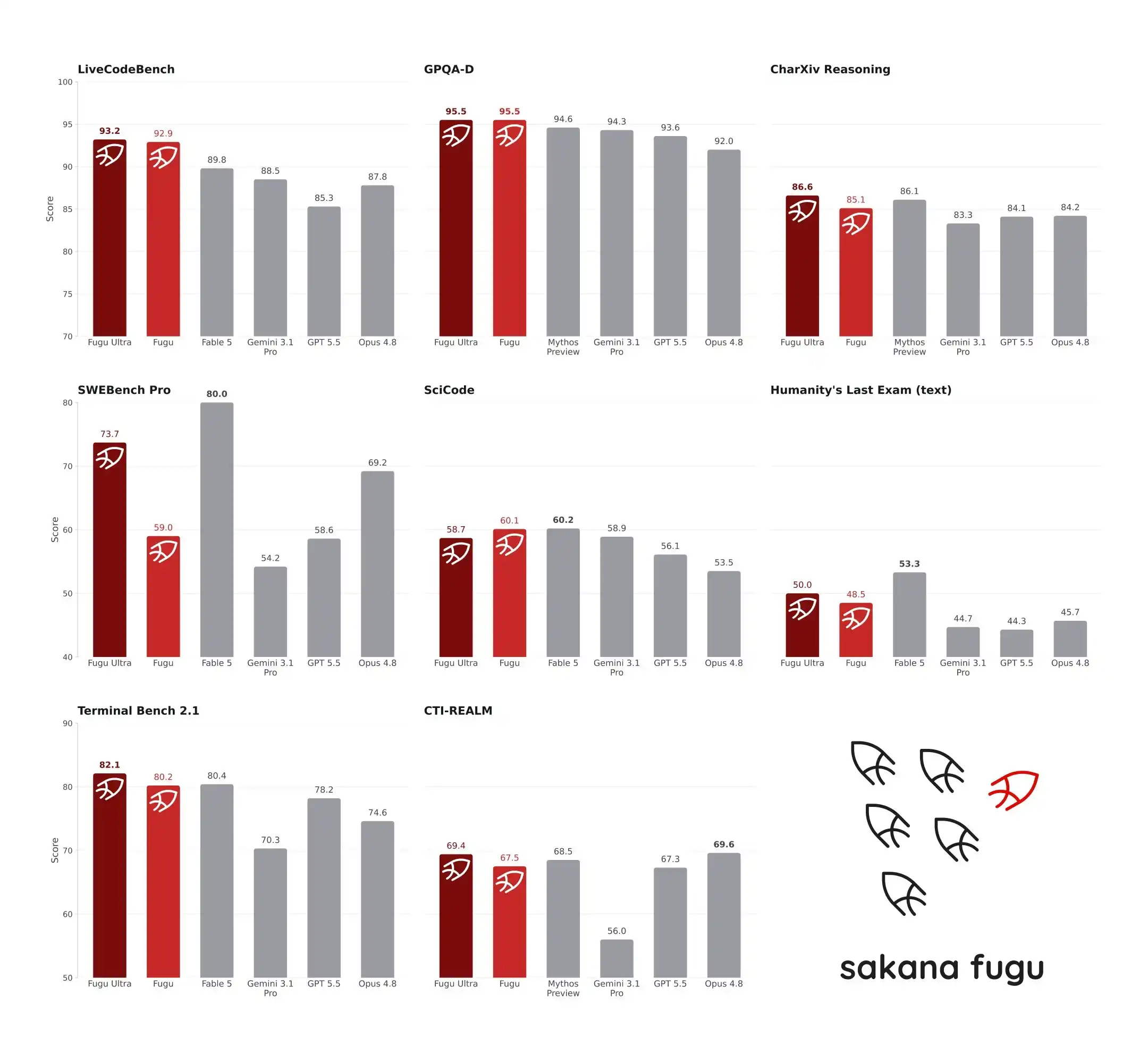
More attention was paid to the comparison between Fugu and Fable 5/Mythos Preview. Anthropic's Fable series and another frontier lab's Mythos series represent the pinnacle of current AI reasoning capabilities. However, due to export controls or incomplete public release, these two models are not part of Fugu's agent pool. Sakana AI officially claims that Fugu Ultra is "on par" with Fable 5 and Mythos Preview on engineering and science benchmarks. It must be clarified, however, that this comparison is not based on head-to-head testing in the same pool. Fugu's scores are based on actual runs of its own system, while Fable and Mythos data are based on report scores publicly released by their respective vendors.

This comparison methodology has sparked some controversy in the developer community. Some argue that test conditions across different systems and environments are difficult to align perfectly, making direct score comparisons unfair. However, other developers point out that referencing vendor-reported data is industry practice in the absence of a unified testing environment. Setting aside the controversy with Fable and Mythos, Fugu Ultra's surpassing of GPT-5.5 and Opus 4.8 on SWE-Bench Pro and TerminalBench 2.1 is a real, like-for-like comparison. This surpassing is not because Fugu's underlying model is smarter than GPT-5.5, but because the RL Conductor performs task decomposition and expert scheduling more precisely. In experiments requiring multiple rounds of reasoning and verification, such as AutoResearch, Rubik's Cube solving, and mechanical design, Fugu consistently showed advantages. This indicates that in handling "long, messy, multi-step" real-world workflows, the multi-agent orchestration architecture indeed offers more resilience than monolithic models.

Real Development Scenario Tests: Code Review and Long Session Stability

For developers and AI tool users, benchmark scores are only references. What truly determines a model's usefulness is its performance in real work scenarios. Fugu underwent beta testing with nearly 500 early users before release. Their feedback revealed Fugu's unique value in practical applications.

Code review is one of the most common AI scenarios for developers. Traditional monolithic models often only find superficial syntax errors or common logic bugs when reviewing code. In beta testing, some developers reported that Fugu demonstrated unusually detailed performance in code reviews, capable of uncovering deep architectural bugs, while other tools often found only a few surface-level issues. This difference stems from Fugu's architecture. Upon receiving a code review task, the RL Conductor can call models specializing in static analysis, logical reasoning, and security auditing respectively to conduct cross-validation on the same piece of code from multiple angles. This "expert consultation" model naturally uncovers more hidden problems than the "solo effort" of a single model.

Another frequently mentioned advantage is long-session stability. When building AI Agent products, one of developers' biggest headaches is the model's "persona drift" in long conversations. As the number of dialogue rounds increases, monolithic models often forget the initial setup or deviate in instruction following. After testing, some enterprise executives reported that Fugu's Persona in long conversations is exceptionally stable, with almost no drift. This is because the RL Conductor itself is not responsible for maintaining long-text memory; it only selects the most appropriate underlying model to generate a response in each dialogue round based on the current context. This architecture of "separation of control and generation" greatly improves Agent stability during long-running sessions.

In the field of cybersecurity, Fugu also demonstrated end-to-end practical capability. In tests, Fugu could independently complete the entire workflow from reconnaissance, XSS/SQLi vulnerability detection to authentication review, and generate a complete penetration test report, strictly adhering to instructions not to cross boundaries and damage systems. This level of completion for complex tasks relies on the RL Conductor's precise orchestration of security toolchains and the capabilities of different large models.

In addition, token efficiency is a major highlight of Fugu. Traditional large models often generate lengthy chains of thought, consuming a large number of tokens when dealing with complex problems. Fugu's RL Conductor avoids wasteful long CoT consumption through precise routing. Official data and early testing show it can significantly reduce waste of ineffective tokens. For developers billed by tokens, this means not only cost reduction but also improved response speed.

The Achilles' Heel of Underlying Dependency: The Cost of Multi-Agent Orchestration

Although Fugu shines in architecture and benchmark scores, as a tool for practical work, it is not without weaknesses. The multi-agent orchestration architecture, while bringing performance breakthroughs, also introduces significant risks and limitations.

The core issue is underlying dependency risk. Fugu's agent pool heavily relies on underlying APIs from US giants like GPT, Claude, and Gemini. Although the RL Conductor has dynamic routing capabilities and can switch to other models if one fails or is rate-limited, this only mitigates single-supplier risk. It does not and cannot detach from the entire US AI infrastructure ecosystem. If these underlying models collectively raise prices, impose large-scale rate limits, or change API terms, Fugu's cost structure and stability will be directly impacted. This "parasitic" mode, living atop others' infrastructure, has inherent fragility in commercialization and long-term stability.

Next is the trade-off between latency and cost structure. While the RL Conductor saves on ineffective token consumption through precise routing, multi-agent orchestration inevitably involves multiple API calls and inter-model communication. For real-time interaction scenarios requiring extremely low latency, such as real-time voice conversations or high-frequency trading assistance, Fugu Ultra's "deep thinking and scheduling" time may be longer than directly calling a monolithic model. In scenarios where response speed is paramount, Fugu's architectural advantage could become a drag on user experience.

Furthermore, controversies over fairness of comparison persist. As mentioned, Fugu claims parity with Fable and Mythos, but the latter two are not in its agent pool. In the developer community, some voices question whether comparisons based on vendor-reported data have practical reference value. After all, model performance can vary greatly across different task distributions, and simple aggregate score comparisons might mask specific strengths and weaknesses. For developers needing precise model capability assessments, the lack of head-to-head test data means they must remain cautious during selection.

Not Competing on Compute, but on Orchestration: Japan's Asymmetric Breakthrough in Large Models

Looking beyond the specific product review, Fugu's birth carries deeper implications for Japan's large model ecosystem. In the global AI arms race, Japan is in an awkward position. It lacks both the continuous influx of top-tier computing power and frontier algorithm accumulation of the US, and the massive data pools and fiercely competitive market environment of China. More critically, Japan also faces export control risks from US frontier models (like Fable/Mythos). Against this backdrop, Sakana AI's "evolutionary algorithm" and "multi-agent orchestration" route showcase the logic of "asymmetric breakthrough" for a resource-constrained nation.

Japan does have domestic large model players. NTT released tsuzumi, and institutions like ELYZA, Rinna, and LLM-jp are also working hard to train local language models. However, most follow the traditional "train from scratch" route, struggling to compete with top US and Chinese models in parameter scale and general capabilities. Sakana AI is the only Japanese lab with global frontier influence that champions an "asymmetric architecture."

Fugu's dynamic routing capability essentially helps Japanese companies and institutions establish "AI Sovereignty." Under limited computing resources, instead of spending huge sums to train a hundred-billion-parameter model that is inferior to GPT-5.5 in all aspects, it's better to train a clever 7B "project manager." This manager can flexibly connect to the world's best models based on task needs. If one day a US model faces export controls or supply cuts, the RL Conductor can quickly route tasks to other available models, even connecting to Japan's domestic specialized models. This architecture gives Japan a degree of autonomy and risk resilience in utilizing AI capabilities.

Observing the global AI tool ecosystem, OmniTools notes that large model capabilities are gradually leveling, and the main battleground of competition is shifting from mere parameter stacking to toolchains and landing scenarios. The emergence of Fugu precisely confirms this trend. It no longer pursues perfection in a single model but pursues optimality at the system level. This thinking holds significant reference value for nations and regions lacking advantages in compute and data.

Of course, this "asymmetric breakthrough" has its ceiling. As long as the core technology of underlying models remains in the hands of a few giants, the capability ceiling of orchestration systems will be limited by those underlying models. Fugu proves a 7B model can be an excellent conductor, but it cannot magically create capabilities that the underlying models lack. For Japan's large models to truly achieve a breakthrough, beyond architectural innovation in orchestration, continued investment in underlying computing power, core algorithms, and high-quality data is still necessary. Fugu is an ingenious system-level innovation, but it's not a panacea. For developers and enterprise users, Fugu provides a highly competitive new option in complex engineering scenarios. However, when using it, one must also be clear-eyed about its underlying dependency vulnerabilities and the latency-cost trade-offs.


Трендові криптовалюти

Пов'язані питання

QWhat is the core innovation and role of the 7B-parameter model in Sakana AI's Fugu system?

AThe core innovation is a 7B-parameter model called the RL Conductor, which acts as a 'foreman' or intelligent orchestrator. It does not directly generate final answers but dynamically analyzes user tasks and dispatches subtasks to a pool of top-tier global foundation models like GPT-5 or Claude Opus. It is responsible for scheduling, verifying, and synthesizing these models' outputs.

QOn which two benchmark tests did Fugu Ultra outperform models like GPT-5.5 and Claude Opus 4.8, and what do these tests evaluate?

AFugu Ultra outperformed competitors on SWE-Bench Pro and TerminalBench 2.1. SWE-Bench Pro evaluates software engineering capabilities, specifically locating and fixing bugs in real codebases. TerminalBench 2.1 tests system operation capabilities, focusing on multi-step tasks in real-world engineering environments.

QAccording to the article, what are two key practical advantages of Fugu's architecture reported by early beta testers?

ATwo key practical advantages are: 1) Superior code review capabilities, where Fugu's multi-agent 'expert consultation' approach finds deeper architectural bugs compared to single models. 2) Exceptional long-session stability, where the RL Conductor's 'control-generation separation' architecture prevents persona drift over long conversations by selecting the best model for each turn based on context.

QWhat are the main weaknesses or risks associated with Fugu's multi-agent orchestration architecture?

AThe main weaknesses are: 1) Underlying dependency risk, as Fugu's agent pool relies on APIs from major US AI providers, making it vulnerable to collective price changes, rate limits, or policy shifts. 2) Latency trade-offs, where the orchestration process involving multiple API calls can introduce higher latency unsuitable for real-time interaction scenarios.

QHow does the Fugu system represent a 'non-symmetric breakthrough' strategy for Japan's AI industry, according to the article?

AIt represents a 'non-symmetric breakthrough' by circumventing Japan's limitations in compute power and data. Instead of expensively training a massive general-purpose model that can't compete with US/China leaders, Japan focused on training a smart, small 'foreman' model (the RL Conductor) that orchestrates the world's best models. This grants a degree of AI sovereignty and risk resilience, allowing flexible routing if certain US models become unavailable, though ultimate capability is still bounded by the underlying models.

Пов'язані матеріали

Report Interpretation: J.P. Morgan Details Micron's Pre-Earnings Sentiment, Current Hardware Sector Dynamics

Morgan Stanley analyst Joshua Meyers' report (June 21, 2026) highlights key trends in the hardware and semiconductor sector ahead of Micron's earnings. The core takeaways are: 1. **Micron & Memory:** Memory remains a high-conviction long theme, driven by strong AI demand and rising ASPs. However, investor focus is shifting to the sustainability of Micron's >80% gross margins and the specifics of potential new long-term supply agreements (SCAs). 2. **Hardware Supply Chain:** AI-related demand for servers, networking, and storage remains robust, but company performance is diverging. Celestica (CLS) shows improved margin confidence, Western Digital and Seagate benefit from pricing, Fabrinet (FN) sees predictable AI optics growth, and Teradyne (TER) anticipates a new Google customer. 3. **AI Capex & WFE Forecasts:** JPMorgan increased its Wafer Fab Equipment (WFE) market growth forecasts to 28% in 2026 and 29% in 2027. AI infrastructure financing is evolving, with higher project-level debt reducing constraints on capex expansion. The report signals that while the AI-driven hardware cycle is strong, the market is entering a phase focused on execution verification (e.g., Micron's SCA details, Fabrinet's ramp with Amazon) and valuation sustainability. Key near-term signals include Micron's guidance, Arista Networks' outlook, and the pace of demand normalization post potential tariff-related pull-ins.

marsbit17 хв тому

Report Interpretation: J.P. Morgan Details Micron's Pre-Earnings Sentiment, Current Hardware Sector Dynamics

marsbit17 хв тому

Research Report Analysis: The Fed's New Chair's Debut – New Leader, But Same Script?

Report Analysis: Federal Reserve's New Chair Debut – A New Captain, But the Same Script? Morgan Stanley's chief global economist Seth B. Carpenter analyzes the first FOMC meeting under new Fed Chair Kevin Warsh in a June 21 report. Warsh deliberately avoided providing forward guidance on interest rates, aligning with his philosophy. However, market expectations for a rate hike this year were reinforced. Key signals lie elsewhere: inflation may fall more than expected, and quantitative tightening (QT) could be more aggressive than anticipated. The FOMC's "dot plot" suggests only one rate hike in 2026. Carpenter argues that if inflation undershoots forecasts, the logic for even a single hike weakens, especially as projections indicate potential rate cuts in 2027. On QT, Warsh's stance is clear. Carpenter notes that measures like halving the Treasury's account balance could shrink the Fed's balance sheet by around $500 billion with minimal market impact. Combined with adjustments to reserve interest and liquidity rules, the ultimate QT scale may exceed expectations, though its market effect might be less disruptive unless the Fed actively sells Mortgage-Backed Securities (MBS). While Warsh initiated a review of the Fed's policy framework, the 2% inflation target remains intact for now. The report concludes that the market may be overestimating the significance of reduced forward guidance and the near-term rate hike risk, while potentially underestimating the scope and manageable nature of the coming balance sheet reduction. The key debates will hinge on upcoming core PCE data, the specifics of the QT path, and the framework review's findings.

marsbit28 хв тому

Research Report Analysis: The Fed's New Chair's Debut – New Leader, But Same Script?

marsbit28 хв тому

Critical Game Week: BTC Retracement Confirmation vs. HYPE Support Battle | Guest Analysis

This weekly analysis outlines a critical juncture for BTC and HYPE markets, focusing on key price level confirmations. **BTC Analysis:** BTC is at a pivotal point after a five-wave rally from the June 5th low of $59,100. The price has broken below a short-term rising channel's lower boundary, with the current move seen as a pullback to test this breakdown. Failure to reclaim this level could lead to a retest of the $59,000-$60,000 support zone. The core scenario hinges on this channel retest outcome. * **Key Levels:** Resistance at $64,500-$65,000 (channel boundary) and $69,500-$70,500. Support at $59,000-$60,000 and $55,000. * **Strategy:** A core bearish stance is maintained (20% short from last week), with short-term plans for tactical trades. Three detailed contingency plans (A/B/C) are provided for short positions on resistance tests or breakdowns, emphasizing strict stop-loss discipline. **HYPE Analysis:** HYPE shows strong momentum but is currently in a corrective phase after hitting a new high of $76.94. The price is retesting the crucial $64-$66 support area. * **Key Levels:** Resistance near $77 and $80-$82. Support at $64-$66 and $52-$54. * **Strategy:** The short-term approach is "buy on dips, avoid chasing rallies." A long position is considered only if clear stabilization signals appear at the $64-$66 or deeper $52-$54 support zones, with tight risk controls. **General Risk Management:** A standardized trailing stop-loss protocol is emphasized: set initial stop, breakeven at +1% profit, then trail stops upward to lock in gains. *Disclaimer: All analysis is presented as a personal trading framework, not investment advice. Market conditions are complex and require dynamic adjustment.*

marsbit42 хв тому

Critical Game Week: BTC Retracement Confirmation vs. HYPE Support Battle | Guest Analysis

marsbit42 хв тому

Research Report Interpretation: Citi Attends AWS Summit, Bullish on Cloud Business Acceleration but Data Governance Remains Key Variable

Citi analyst Tyler Radke's team attended the AWS New York Summit (June 17-18), engaging with over 10 clients and partners. In a June 19 report, they highlighted the summit's focus on scaling agent AI for enterprise deployment. Citi maintains a "Buy" rating on Amazon, forecasting AWS revenue growth to accelerate to 37% in FY27 from 30% in FY26, noting this estimate may be conservative. Key takeaways: 1. **AWS Strategy Shift:** AWS is moving from proof-of-concepts to scalable deployment. New offerings like AWS Context (building enterprise knowledge graphs), Amazon Quick (cross-application AI assistant), and security tool Continuum address core enterprise pain points for AI adoption. 2. **Data Infrastructure Beneficiaries:** Data infrastructure companies like Snowflake, Elastic, Oracle, and ClickHouse are seen as direct beneficiaries of scaling AI workloads, as evidenced by strong growth and use cases presented. 3. **Critical Role of Data Governance:** As AI agents scale from hundreds to thousands, effective data governance becomes the key variable for deploying AI in core business processes. AWS Context represents AWS's strategic extension from providing compute/models to offering a data governance infrastructure layer. The report emphasizes that without solving data governance, AI will remain confined to pilot projects. The investment thesis focuses on AWS revenue acceleration and data infrastructure vendors' growth, while monitoring signals like AWS's quarterly revenue growth, Bedrock AgentCore task volume, and pricing impacts on companies like Elastic.

marsbit48 хв тому

Research Report Interpretation: Citi Attends AWS Summit, Bullish on Cloud Business Acceleration but Data Governance Remains Key Variable

marsbit48 хв тому

Crucial Week of Contention: BTC Tests Support and HYPE's Key Level Battle | Special Analysis

**Market Enters Critical Week: Bitcoin Pullback Test and HYPE Support Battle** The market enters a crucial phase of contention this week. The marginal shifts in Federal Reserve policy expectations continue to dictate the pricing rhythm for risk assets. Meanwhile, in the crypto market, following a period of sideways consolidation, the divergence between bulls and bears is becoming concentrated at key price levels. **Bitcoin (BTC) Analysis & Strategy** * **Technical View:** The 4-hour chart suggests BTC is in a five-wave structure since the June 5th low near $59,100. Price action shows a short-term rising channel. The recent drop below this channel's lower boundary is now being followed by a pullback attempt (wave 40-41). The outcome of this retest is critical. * **This Week's Outlook:** The core focus is whether BTC can reclaim and hold above the channel's lower boundary. * **Bullish Scenario:** A successful hold could lead to a continued rebound, potentially challenging the $69,500 - $70,500 resistance zone. * **Bearish Scenario:** Failure to hold may trigger a renewed test of the $59,000 - $60,000 core support area, with $55,000 as a deeper support level. * **Operational Strategy:** The author maintains a 20% mid-term short position initiated last week near $64,500, based on a model signaling a shift to a bearish structure. Short-term tactics involve using 30% capital for potential "spread" trades, with three contingency plans (A, B, C) outlined for reacting to resistance tests, breakouts, or support breakdowns. **HYPE Analysis & Strategy** * **Technical View:** On the 4-hour chart, HYPE shows strong momentum, having recently broken to a new high since January. The current pullback presents a clear three-wave correction structure, bringing the price back to the critical $64 - $66 support zone. * **This Week's Outlook:** The focus is on the battle for the $64 - $66 support area. * **Bullish Scenario:** Holding this support could signal a continuation of the uptrend from the June 10th low, leading to new highs. * **Bearish Scenario:** A breakdown could extend the correction, potentially testing the deeper $52 - $54 support band. * **Operational Strategy:** The recommended short-term approach is "buy on dips, avoid chasing rallies." A light long position (under 30% capital) could be considered if HYPE shows stabilization signals at the $64-$66 or $52-$54 support zones, confirmed by model signals. Strict stop-loss discipline is emphasized. **General Risk Management:** A strict trailing stop-loss protocol is advised: set an initial stop; move to breakeven at +1% profit; lock in profits progressively thereafter. *Disclaimer: All analysis is presented as the author's personal technical perspective and trading log, not as investment advice. Markets are complex and dynamic; risk control is paramount.*

Odaily星球日报48 хв тому

Crucial Week of Contention: BTC Tests Support and HYPE's Key Level Battle | Special Analysis

Odaily星球日报48 хв тому

Торгівля

Спот
Ф'ючерси

Популярні статті

Що таке $S$

Розуміння SPERO: Комплексний огляд Вступ до SPERO Оскільки ландшафт інновацій продовжує еволюціонувати, виникнення технологій web3 та криптовалютних проектів відіграє ключову роль у формуванні цифрового майбутнього. Один з проектів, який привернув увагу в цій динамічній сфері, — це SPERO, позначений як SPERO,$$s$. Ця стаття має на меті зібрати та представити детальну інформацію про SPERO, щоб допомогти ентузіастам та інвесторам зрозуміти його основи, цілі та інновації в рамках web3 та крипто-сектору. Що таке SPERO,$$s$? SPERO,$$s$ — це унікальний проект у криптопросторі, який прагне використати принципи децентралізації та технології блокчейн для створення екосистеми, що сприяє залученню, корисності та фінансовій інклюзії. Проект розроблений для полегшення взаємодії між користувачами новими способами, надаючи їм інноваційні фінансові рішення та послуги. У своїй основі SPERO,$$s$ прагне надати можливості індивідам, забезпечуючи інструменти та платформи, які покращують користувацький досвід у криптовалютному просторі. Це включає в себе можливість більш гнучких методів транзакцій, сприяння ініціативам, що підтримуються спільнотою, та створення шляхів для фінансових можливостей через децентралізовані додатки (dApps). Основна концепція SPERO,$$s$ обертається навколо інклюзивності, прагнучи зменшити розриви в традиційній фінансовій системі, використовуючи переваги технології блокчейн. Хто є творцем SPERO,$$s$? Особистість творця SPERO,$$s$ залишається дещо невідомою, оскільки є обмежені публічно доступні ресурси, що надають детальну інформацію про його засновників. Ця відсутність прозорості може бути наслідком зобов'язання проекту до децентралізації — етики, яку багато проектів web3 поділяють, ставлячи колективні внески вище за індивідуальне визнання. Зосереджуючи обговорення навколо спільноти та її колективних цілей, SPERO,$$s$ втілює суть наділення без виділення конкретних осіб. Таким чином, розуміння етики та місії SPERO є більш важливим, ніж ідентифікація єдиного творця. Хто є інвесторами SPERO,$$s$? SPERO,$$s$ підтримується різноманітними інвесторами, починаючи від венчурних капіталістів до ангельських інвесторів, які прагнуть сприяти інноваціям у крипто-секторі. Зосередження цих інвесторів зазвичай узгоджується з місією SPERO — пріоритет надається проектам, які обіцяють технологічний прогрес у суспільстві, фінансову інклюзію та децентралізоване управління. Ці інвесторські фонди зазвичай зацікавлені в проектах, які не лише пропонують інноваційні продукти, але й позитивно впливають на спільноту блокчейн та її екосистеми. Підтримка з боку цих інвесторів підкріплює SPERO,$$s$ як значного конкурента в швидко змінюваній сфері крипто-проектів. Як працює SPERO,$$s$? SPERO,$$s$ використовує багатогранну структуру, яка відрізняє його від традиційних криптовалютних проектів. Ось деякі ключові особливості, які підкреслюють його унікальність та інноваційність: Децентралізоване управління: SPERO,$$s$ інтегрує моделі децентралізованого управління, надаючи користувачам можливість активно брати участь у процесах прийняття рішень щодо майбутнього проекту. Цей підхід сприяє відчуттю власності та відповідальності серед членів спільноти. Корисність токена: SPERO,$$s$ використовує свій власний криптовалютний токен, розроблений для виконання різних функцій в екосистемі. Ці токени дозволяють здійснювати транзакції, отримувати винагороди та полегшувати послуги, що пропонуються на платформі, підвищуючи загальну залученість та корисність. Шарова архітектура: Технічна архітектура SPERO,$$s$ підтримує модульність та масштабованість, що дозволяє безперешкодно інтегрувати додаткові функції та додатки в міру розвитку проекту. Ця адаптивність є надзвичайно важливою для збереження актуальності в постійно змінюваному крипто-ландшафті. Залучення спільноти: Проект підкреслює ініціативи, що підтримуються спільнотою, використовуючи механізми, які стимулюють співпрацю та зворотний зв'язок. Підтримуючи сильну спільноту, SPERO,$$s$ може краще задовольняти потреби користувачів та адаптуватися до ринкових тенденцій. Фокус на інклюзію: Пропонуючи низькі комісії за транзакції та зручні інтерфейси, SPERO,$$s$ прагне залучити різноманітну базу користувачів, включаючи осіб, які раніше не брали участі в крипто-просторі. Це зобов'язання до інклюзії узгоджується з його загальною місією наділення через доступність. Хронологія SPERO,$$s$ Розуміння історії проекту надає важливі уявлення про його розвиток та етапи. Нижче наведено пропоновану хронологію, що відображає значні події в еволюції SPERO,$$s$: Етап концептуалізації та ідеації: Початкові ідеї, що стали основою SPERO,$$s$, були сформовані, тісно пов'язані з принципами децентралізації та фокусом на спільноті в індустрії блокчейн. Запуск білого паперу проекту: Після концептуального етапу був випущений комплексний білий папір, що детально описує бачення, цілі та технологічну інфраструктуру SPERO,$$s$, щоб залучити інтерес та зворотний зв'язок від спільноти. Створення спільноти та ранні залучення: Активні зусилля були спрямовані на створення спільноти ранніх прихильників та потенційних інвесторів, що полегшило обговорення цілей проекту та отримання підтримки. Подія генерації токенів: SPERO,$$s$ провів подію генерації токенів (TGE) для розподілу своїх рідних токенів серед ранніх прихильників та встановлення початкової ліквідності в екосистемі. Запуск початкового dApp: Перший децентралізований додаток (dApp), пов'язаний з SPERO,$$s$, став доступним, дозволяючи користувачам взаємодіяти з основними функціями платформи. Постійний розвиток та партнерства: Безперервні оновлення та вдосконалення пропозицій проекту, включаючи стратегічні партнерства з іншими учасниками блокчейн-простору, сформували SPERO,$$s$ у конкурентоспроможного та еволюціонуючого гравця на крипто-ринку. Висновок SPERO,$$s$ є свідченням потенціалу web3 та криптовалют для революціонізації фінансових систем та наділення індивідів. Завдяки зобов'язанню до децентралізованого управління, залучення спільноти та інноваційно спроектованих функцій, він прокладає шлях до більш інклюзивного фінансового ландшафту. Як і з будь-якими інвестиціями в швидко змінюваному крипто-просторі, потенційним інвесторам та користувачам рекомендується ретельно досліджувати та обдумано взаємодіяти з поточними подіями в SPERO,$$s$. Проект демонструє інноваційний дух крипто-індустрії, запрошуючи до подальшого дослідження його численних можливостей. Хоча подорож SPERO,$$s$ ще триває, його основні принципи можуть справді вплинути на майбутнє того, як ми взаємодіємо з технологією, фінансами та один з одним у взаємопов'язаних цифрових екосистемах.

81 переглядів усьогоОпубліковано 2024.12.17Оновлено 2024.12.17

Що таке $S$

Що таке AGENT S

Агент S: Майбутнє автономної взаємодії в Web3 Вступ У постійно змінюваному ландшафті Web3 та криптовалюти інновації постійно переосмислюють, як люди взаємодіють з цифровими платформами. Один з таких новаторських проектів, Агент S, обіцяє революціонізувати взаємодію людини з комп'ютером через свою відкриту агентну структуру. Прокладаючи шлях для автономних взаємодій, Агент S прагне спростити складні завдання, пропонуючи трансформаційні застосування в штучному інтелекті (ШІ). Це детальне дослідження заглиблюється в складності проекту, його унікальні особливості та наслідки для сфери криптовалюти. Що таке Агент S? Агент S є революційною відкритою агентною структурою, спеціально розробленою для вирішення трьох основних викликів в автоматизації комп'ютерних завдань: Набуття специфічних знань у галузі: Структура інтелектуально навчається з різних зовнішніх джерел знань та внутрішнього досвіду. Цей подвійний підхід дозволяє їй створити багатий репозиторій специфічних знань у галузі, покращуючи її продуктивність у виконанні завдань. Планування на довгих горизонтах завдань: Агент S використовує планування з підкріпленням досвіду, стратегічний підхід, який полегшує ефективний розподіл та виконання складних завдань. Ця функція значно підвищує її здатність ефективно та результативно управляти кількома підзавданнями. Обробка динамічних, неоднорідних інтерфейсів: Проект представляє Інтерфейс Агент-Комп'ютер (ACI), інноваційне рішення, яке покращує взаємодію між агентами та користувачами. Використовуючи багатомодальні великі мовні моделі (MLLMs), Агент S може безперешкодно орієнтуватися та маніпулювати різноманітними графічними інтерфейсами користувача. Завдяки цим новаторським функціям Агент S надає надійну структуру, яка вирішує складнощі, пов'язані з автоматизацією людської взаємодії з машинами, прокладаючи шлях для численних застосувань у ШІ та за його межами. Хто є творцем Агент S? Хоча концепція Агент S є фундаментально новаторською, конкретна інформація про його творця залишається невідомою. Творець наразі невідомий, що підкреслює або початкову стадію проекту, або стратегічний вибір зберегти засновників у таємниці. Незважаючи на анонімність, акцент залишається на можливостях та потенціалі структури. Хто є інвесторами Агент S? Оскільки Агент S є відносно новим у криптографічній екосистемі, детальна інформація про його інвесторів та фінансових спонсорів не задокументована. Відсутність публічно доступних відомостей про інвестиційні фонди або організації, що підтримують проект, викликає питання щодо його фінансової структури та дорожньої карти розвитку. Розуміння підтримки є критично важливим для оцінки стійкості проекту та потенційного впливу на ринок. Як працює Агент S? В основі Агент S лежить передова технологія, яка дозволяє йому ефективно функціонувати в різних умовах. Його операційна модель побудована навколо кількох ключових функцій: Взаємодія з комп'ютером, подібна до людської: Структура пропонує розширене планування ШІ, прагнучи зробити взаємодії з комп'ютерами більш інтуїтивними. Імітуючи людську поведінку при виконанні завдань, вона обіцяє підвищити досвід користувачів. Наративна пам'ять: Використовується для використання високорівневого досвіду, Агент S використовує наративну пам'ять для відстеження історій завдань, тим самим покращуючи свої процеси прийняття рішень. Епізодична пам'ять: Ця функція надає користувачам покрокові інструкції, дозволяючи структурі пропонувати контекстуальну підтримку в міру виконання завдань. Підтримка OpenACI: Завдяки можливості працювати локально, Агент S дозволяє користувачам зберігати контроль над своїми взаємодіями та робочими процесами, узгоджуючи з децентралізованою етикою Web3. Легка інтеграція з зовнішніми API: Його універсальність і сумісність з різними платформами ШІ забезпечують те, що Агент S може безперешкодно вписатися в існуючі технологічні екосистеми, роблячи його привабливим вибором для розробників та організацій. Ці функціональні можливості колективно сприяють унікальному положенню Агент S у крипто-просторі, оскільки він автоматизує складні, багатоступеневі завдання з мінімальним втручанням людини. У міру розвитку проекту його потенційні застосування в Web3 можуть переосмислити, як відбуваються цифрові взаємодії. Хронологія Агент S Розробка та етапи Агент S можуть бути узагальнені в хронології, яка підкреслює його значні події: 27 вересня 2024 року: Концепція Агент S була представлена в комплексній науковій статті під назвою “Відкрита агентна структура, яка використовує комп'ютери як людина”, що демонструє основи проекту. 10 жовтня 2024 року: Наукова стаття була опублікована на arXiv, пропонуючи детальне дослідження структури та її оцінки продуктивності на основі бенчмарку OSWorld. 12 жовтня 2024 року: Було випущено відеопрезентацію, що надає візуальне уявлення про можливості та особливості Агент S, ще більше залучаючи потенційних користувачів та інвесторів. Ці маркери в хронології не лише ілюструють прогрес Агент S, але й вказують на його прихильність до прозорості та залучення громади. Ключові моменти про Агент S У міру розвитку структури Агент S кілька ключових характеристик виділяються, підкреслюючи її новаторський характер та потенціал: Інноваційна структура: Розроблена для забезпечення інтуїтивного використання комп'ютерів, подібного до людської взаємодії, Агент S пропонує новий підхід до автоматизації завдань. Автономна взаємодія: Здатність автономно взаємодіяти з комп'ютерами через GUI означає стрибок до більш інтелектуальних та ефективних обчислювальних рішень. Автоматизація складних завдань: Завдяки своїй надійній методології він може автоматизувати складні, багатоступеневі завдання, роблячи процеси швидшими та менш схильними до помилок. Безперервне вдосконалення: Механізми навчання дозволяють Агенту S покращуватися на основі минулого досвіду, постійно підвищуючи свою продуктивність та ефективність. Універсальність: Його адаптивність до різних операційних середовищ, таких як OSWorld та WindowsAgentArena, забезпечує його здатність служити широкому спектру застосувань. Оскільки Агент S займає своє місце в ландшафті Web3 та криптовалюти, його потенціал покращити можливості взаємодії та автоматизувати процеси означає значний прогрес у технологіях ШІ. Завдяки своїй інноваційній структурі Агент S є прикладом майбутнього цифрових взаємодій, обіцяючи більш безперешкодний та ефективний досвід для користувачів у різних галузях. Висновок Агент S представляє собою сміливий крок вперед у поєднанні ШІ та Web3, з можливістю переосмислити, як ми взаємодіємо з технологією. Хоча проект все ще на ранніх стадіях, можливості для його застосування є величезними та переконливими. Завдяки своїй комплексній структурі, що вирішує критичні виклики, Агент S прагне вивести автономні взаємодії на передній план цифрового досвіду. У міру того, як ми заглиблюємося в сфери криптовалюти та децентралізації, проекти, подібні до Агент S, безсумнівно, відіграватимуть ключову роль у формуванні майбутнього технологій та співпраці людини з комп'ютером.

706 переглядів усьогоОпубліковано 2025.01.14Оновлено 2025.01.14

Що таке AGENT S

Як купити S

Ласкаво просимо до HTX.com! Ми зробили покупку Sonic (S) простою та зручною. Дотримуйтесь нашої покрокової інструкції, щоб розпочати свою криптовалютну подорож.Крок 1: Створіть обліковий запис на HTXВикористовуйте свою електронну пошту або номер телефону, щоб зареєструвати обліковий запис на HTX безплатно. Пройдіть безпроблемну реєстрацію й отримайте доступ до всіх функцій.ЗареєструватисьКрок 2: Перейдіть до розділу Купити крипту і виберіть спосіб оплатиКредитна/дебетова картка: використовуйте вашу картку Visa або Mastercard, щоб миттєво купити Sonic (S).Баланс: використовуйте кошти з балансу вашого рахунку HTX для безперешкодної торгівлі.Треті особи: ми додали популярні способи оплати, такі як Google Pay та Apple Pay, щоб підвищити зручність.P2P: Торгуйте безпосередньо з іншими користувачами на HTX.Позабіржова торгівля (OTC): ми пропонуємо індивідуальні послуги та конкурентні обмінні курси для трейдерів.Крок 3: Зберігайте свої Sonic (S)Після придбання Sonic (S) збережіть його у своєму обліковому записі на HTX. Крім того, ви можете відправити його в інше місце за допомогою блокчейн-переказу або використовувати його для торгівлі іншими криптовалютами.Крок 4: Торгівля Sonic (S)Легко торгуйте Sonic (S) на спотовому ринку HTX. Просто увійдіть до свого облікового запису, виберіть торгову пару, укладайте угоди та спостерігайте за ними в режимі реального часу. Ми пропонуємо зручний досвід як для початківців, так і для досвідчених трейдерів.

1.6k переглядів усьогоОпубліковано 2025.01.15Оновлено 2026.06.02

Як купити S

Обговорення

Ласкаво просимо до спільноти HTX. Тут ви можете бути в курсі останніх подій розвитку платформи та отримати доступ до професійної ринкової інформації. Нижче представлені думки користувачів щодо ціни S (S).

活动图片