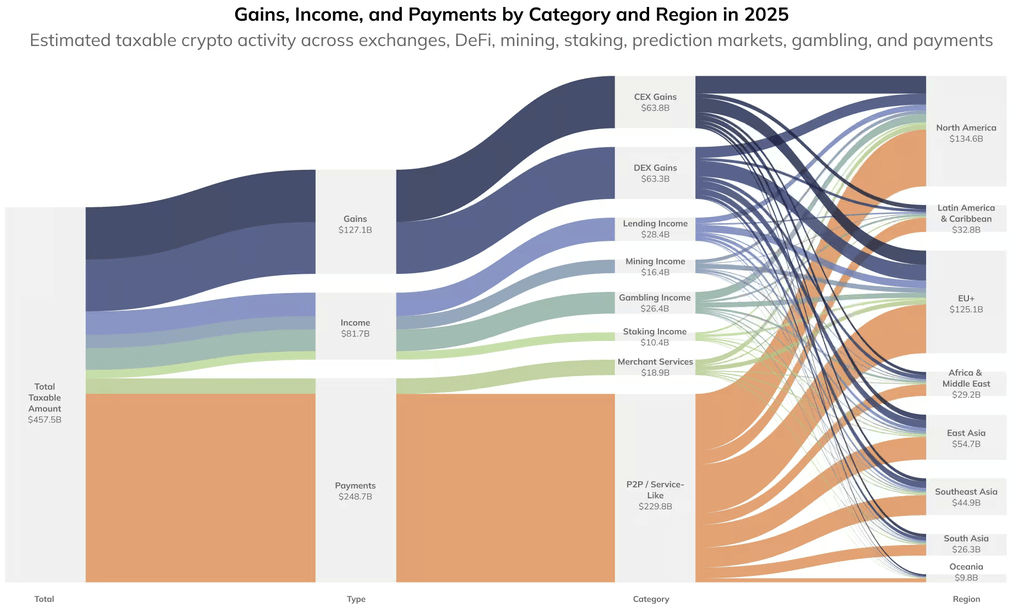
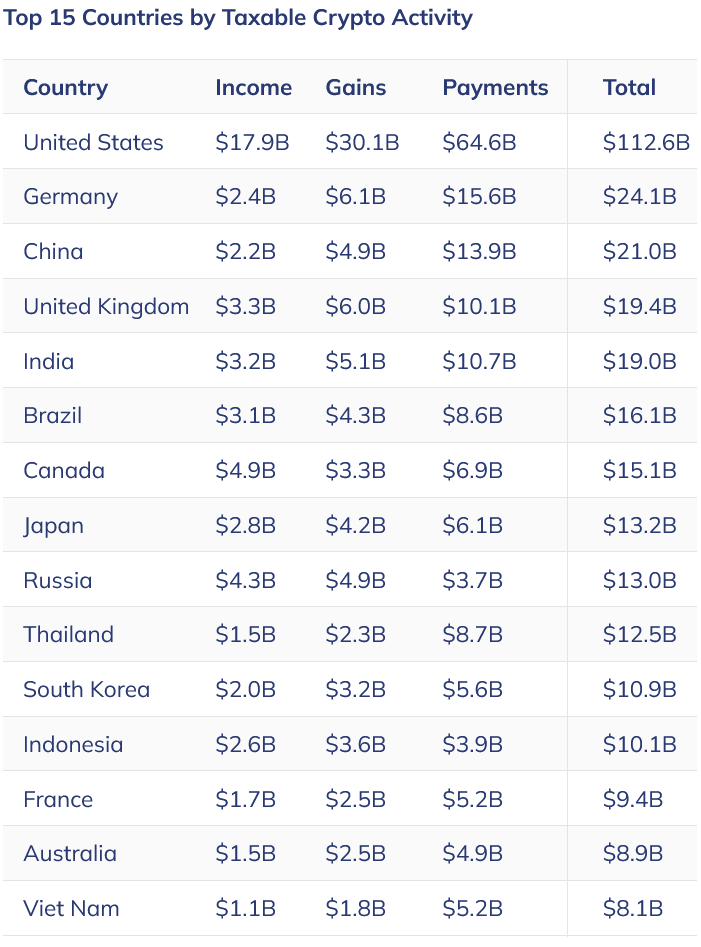
Last year, the volume of potentially taxable global cryptocurrency activity on-chain exceeded $457 billion, according to a new report by blockchain data analytics firm Chainalysis. Of this amount, $125.1 billion was attributable to European countries, $112.6 billion to the United States, and $21 billion to China, where onshore cryptocurrency trading is banned.
These figures, estimated to represent a lower bound, include income from centralized and decentralized exchanges; revenue from mining, staking, lending, and gambling; as well as cryptocurrency-denominated payments. Regarding China, due to the trading ban, it is difficult to assess the total activity of Chinese users as transactions move offshore.
The 86% Gap
In any case, analysts believe that CARF (Crypto-Asset Reporting Framework) — the crypto asset reporting system developed by the OECD and set to take effect next year — covers only 14% of the global volume.
"The remaining 86% — including activity on decentralized exchanges (DEX), peer-to-peer transfers, on-chain revenue flows, and payments — falls outside the practical scope of this system," stated Chainalysis, which sells blockchain tracking tools to governments and companies.
CARF, designed to identify tax-related risks, applies only to centralized exchanges, brokers, retailers, and some wallet providers. At least 46 countries have already committed to implementing this system in 2027 and starting to collect and exchange information about crypto asset users with other jurisdictions. Another 29 countries are expected to join this group in 2028, and the United States in 2029.
What Remains Out of Sight for Now
Blockchain analysts argue that CARF will fail to capture the vast majority of taxable crypto-related income, as it does not account for activity on decentralized exchanges, peer-to-peer transfers, self-custody, mining rewards, staking income, lending income, and many payments for goods and services.
Furthermore, exchanges lack information about crypto assets acquired elsewhere, making accurate profit and loss calculations difficult, and not all countries will participate in CARF. Additionally, the system can report to the tax authority for how much a person sold their crypto assets, but not for how much they acquired them, complicating profit calculation.
Nevertheless, CARF is not the only recent effort to improve tax collection related to crypto assets. In the EU, where the DAC8 directive came into force this January, cryptocurrency exchanges are already collecting sensitive personal data of their clients and will start sharing it with national tax authorities in 2027.
Life-Threatening Dangers of Tax Data Leaks
Cracking down on tax evasion is a double-edged sword, as it also puts crypto asset owners at risk.
This summer, Bull Bitcoin, an exchange dedicated solely to Bitcoin, began a legal battle in France in an attempt to overturn a decree implementing the DAC8 directive into local law. According to the exchange, which also develops the popular multi-feature, privacy-enhancing Bitcoin wallet Bull, the EU directive creates a "massive international 'honey pot' of financial data, linking individuals' legal identities, their home addresses, and cryptocurrency activity, including information absolutely unrelated to taxation."
France has gained notoriety as the country with the highest number of physical attacks against Bitcoin and other crypto asset owners, a situation also fueled by personal data leaks from the national tax authority. According to an open database of recorded physical attacks on crypto asset owners, 36 incidents occurred in the first eight months of this year, a 64% increase compared to the entire year of 2025. The actual number is likely higher, as not all attacks are reported to the police and/or become public knowledge.