Arthur Hayes Makes a High-Profile Comeback, Flop Labs Aims to Become the "Fuel" for the Agent Economy

Odaily星球日报Опубліковано о 2026-08-19Востаннє оновлено о 2026-08-19

Анотація

Arthur Hayes, co-founder of BitMEX, has announced his return as head of a new project called Flop Labs, declaring "FLOP is food for your AI agent." This marks his first high-profile return to a leadership role since stepping back from BitMEX. Flop Labs aims to be a native monetary network and verifiable computation settlement layer for the AI Agent economy, distinguishing itself from existing AI Agent projects. Its core concept is "Proof-of-Useful-Inference," which seeks to integrate useful AI inference tasks into the blockchain consensus mechanism, allowing FLOP tokens to serve as the native currency for Agents to purchase computing resources and store memory. The ecosystem involves four key roles: Miners (provide GPU compute), Validators (verify services), Agents (consume services), and KOLs/Partners (community growth). The project promises a 100% fair launch with no presale or VC involvement. A large airdrop is planned for Q4 2026, with the genesis block targeted for Q1 2027. While the announcement has generated community excitement, particularly around the airdrop, the project is in an early conceptual stage. It currently lacks a published whitepaper, detailed tokenomics, technical specifics on its consensus mechanism, or smart contract audits. Arthur Hayes has defended the venture, separating his belief in the potential of the Agentic Economy from concerns about an AI stock bubble. The success of Flop Labs will hinge on its ability to deliver substantive technical pro...

Original|Odaily Planet Daily (@OdailyChina)

Author|CryptoLeo (@LeoAndCrypto)
Yesterday, BitMEX co-founder Arthur Hayes announced his comeback on X, taking charge of a new project called Flop Labs. Arthur stated that "FLOP is food for your AI agent."

Flop Labs marks Arthur's first high-profile return to the role of "project lead" after leaving BitMEX and being active for years as an investor and project advisor, using "coming out of retirement" to announce his "kingly return." Although BitMEX has shut down, for Arthur and crypto users, BitMEX was undoubtedly a success—it invented perpetual swaps and captured the majority of the crypto derivatives market trading volume at its peak. Precisely because of this, the next project he personally leads immediately sparked widespread community attention upon announcement.

As of publication, Flop Labs has only revealed partial project information. This article by Odaily Planet Daily will outline Flop Labs based on existing materials, including its core concept, role design, token mechanism, current progress, and potential risks.

What is Flop Labs, and How Does It Differ from Other AI Agent Projects

The market already has some AI Agent projects that were/are currently popular, such as the well-known Bittensor, Virtuals Protocol, x402, ai16z, etc. Although Flop Labs is still in a very early conceptual stage, its positioning is already distinctly different from these projects.

Flop Labs positions itself as a native currency network for the AI Agent economy. Arthur calls it "food for your AI agent," aiming to become the native currency and verifiable computation settlement layer for the Agentic Economy, rather than building the Agents themselves, a launch platform, or a pure compute power network.

The core concept of Flop Labs is Proof-of-Useful-Inference, attempting to make genuinely useful AI inference computation itself part of the consensus and security, making FLOP the native currency for Agents to acquire computational resources, store memories, and conduct commercial activities. However, its official website has not yet published the complete whitepaper or code for Proof-of-Useful-Inference, only positioning it at a conceptual level as the network's core protocol.

Based on previous similar projects and public literature, we might speculate about Flop's operational method (not officially announced):

Traditional Proof-of-Work requires miners to perform vast amounts of hash computations with no practical use, proving consumption of computational resources to gain block production rights. Proof-of-Useful-Inference attempts to replace this "useless computation" with genuinely useful AI inference tasks, running machine learning models for prediction, generation, analysis, etc. The goal is to have computing power both secure the blockchain (as consensus weight) and generate external economic value (providing inference services for AI Agents). The process is likely: Users/Agents spend FLOP to submit AI inference tasks; Miners provide computing power, execute inference tasks (tasks designed to be combinable with block construction), and submit proofs of inference results; Validators verify the correctness of inference results; Earn block rewards and potentially inference fees.

Flop Labs' Four Major Role Designs and Token Mechanism

Flop Labs involves four major participating roles:
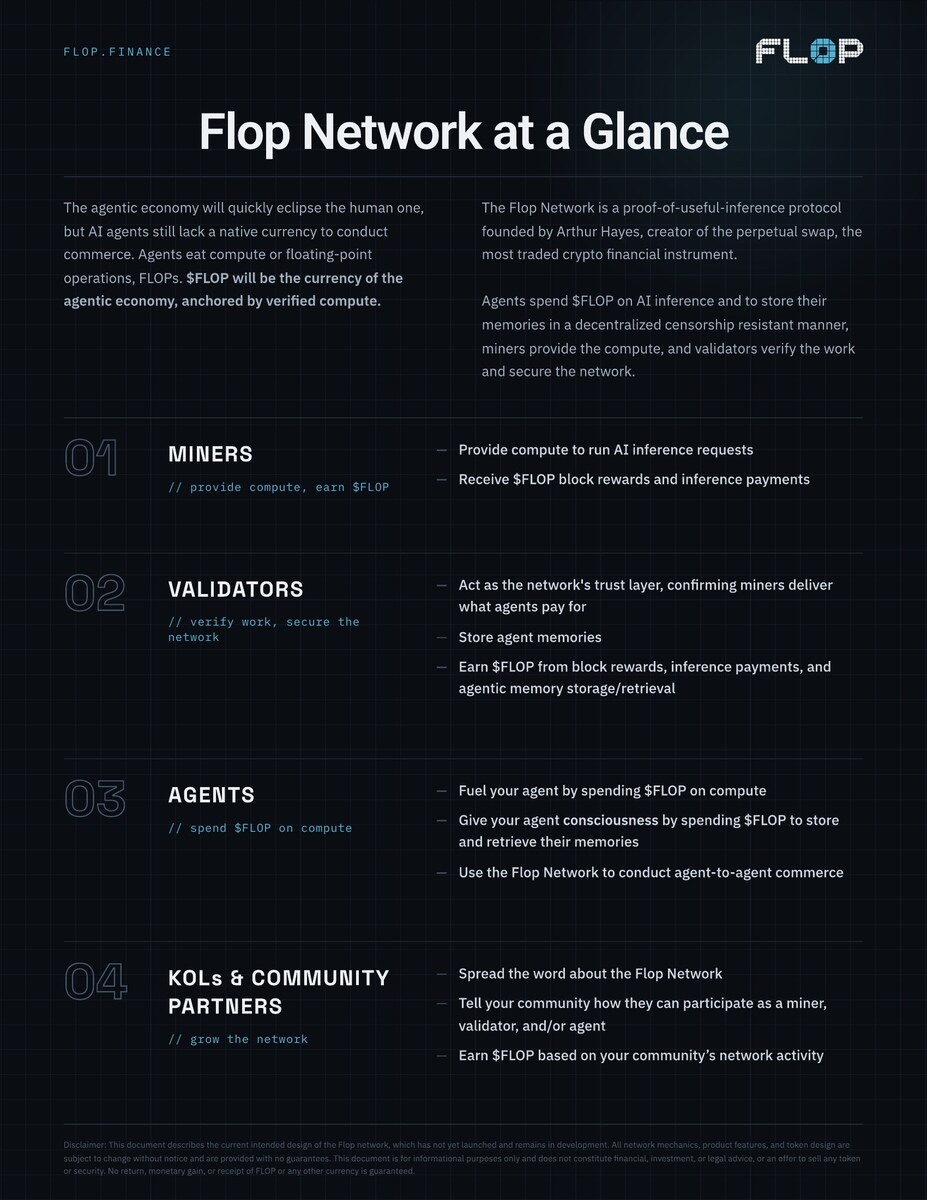
Miner: Provides GPU and other computational resources to run AI inference requests, earning FLOP block rewards and inference fees;

Validator: Serves as the network's trust layer, confirming Miners have delivered the service paid for by Agents, storing Agent memories. Earns FLOP from block rewards, inference payments, and memory storage/retrieval;

Agent: Spends FLOP to purchase computing power, spends FLOP to store/retrieve memories to gain "consciousness"; conducts commercial transactions between Agents within the network;

KOL and Community Partner: Promotes the network, guides community participation (becoming Miners/Validators/deploying Agents), and earns FLOP based on community activity within the network.

Additionally, Arthur has outlined the FLOP token mechanism: No presale, no VC participation, 100% Fair Launch.

Timeline:

  • Large-scale airdrop in Q4 2026 (airdrop conducted one quarter before the Flop network launch);
  • Genesis block launch in Q1 2027.

Currently, the only known way to participate in the airdrop is to apply to become one of the four roles in Flop Labs. Flop's official site has opened application forms for GPU providers (Miners), Validators, and KOLs/Creators. Interested users can fill out the information via their official website to participate.

Conclusion

Currently, a significant portion of the community holds optimistic expectations for the airdrop. However, some hold negative views because Flop Labs has not yet published a whitepaper, token economics, the underlying blockchain, smart contract addresses, or third-party audit reports. Some technical personnel have questions about the specific implementation of its consensus mechanism, verification and proof methods, and the choice of underlying chain. Furthermore, some believe the project name Flop (meaning failure) has an unfortunate connotation.

Arthur posted this morning: Some have asked why he is launching an AI+crypto project while believing AI is a bubble that will burst. He believes the bubble lies in "the debt for building data centers, and the stocks of unprofitable cloud providers and AI Labs. Not in the AI technology and applications themselves. Arthur 100% believes in the Agentic Economy, and the computing power surplus brought by massive capital investment can support Flop Labs' development.

Flop Labs is a high-profile attempt by Arthur Hayes amid the AI Agent hype, attempting to use FLOP to solve currency and verifiable computation issues in the intelligent agent economy and integrate "useful inference" into consensus design. The narrative is compelling, but substantial progress remains in its early stages, lacking significant information disclosure. Flop Labs' currently public GitHub repository is named "technocore-chat," a zero-authentication HTTP-native chat + notes service designed for AI Agents, maintained by FLOP Labs, with no further protocol technical content.

As for whether AI Agents will actually use FLOP to buy computing power, it depends on whether the team can deliver verifiable technical results and ecosystem development in the coming months. Odaily Planet Daily will also continue to follow Flop Labs and Arthur's official information, tracking the latest developments.


Пов'язані питання

QWhat is the core concept behind Arthur Hayes' new project, Flop Labs, and how does it differ from existing AI Agent projects?

AFlop Labs is positioned as a native currency network for the AI Agent economy, aiming to be the 'fuel' or native currency and verifiable computation settlement layer for the Agentic Economy. Its core concept is 'Proof-of-Useful-Inference,' which seeks to integrate useful AI inference computations into the network's consensus and security mechanism. This differs from existing AI Agent projects like Bittensor or Virtuals Protocol, which may focus on being the agents themselves, launch platforms, or pure computing power networks. Flop Labs focuses on the monetary and computational settlement layer rather than creating the agents.

QWho are the four key participant roles designed within the Flop Labs ecosystem, and what are their primary functions?

AThe four key roles in the Flop Labs ecosystem are: 1. **Miners:** Provide GPU computing resources to run AI inference requests, earning FLOP block rewards and inference fees. 2. **Validators:** Act as the network's trust layer, verifying that miners have delivered the services paid for by Agents. They also store Agent 'memories' and earn FLOP from block rewards, inference payments, and memory storage/retrieval. 3. **Agents:** Spend FLOP to purchase computing power, spend FLOP to store/retrieve memory to gain 'consciousness,' and conduct commercial transactions between Agents within the network. 4. **KOLs and Community Partners:** Promote the network, guide community participation (to become Miners/Validators/deploy Agents), and earn FLOP based on community activity within the network.

QWhat is the announced token mechanism for FLOP, and what is the proposed timeline for its distribution and network launch?

AThe announced token mechanism for FLOP is a 100% Fair Launch with no pre-sale and no venture capital (VC) participation. The proposed timeline is: - **Q4 2026:** A large-scale airdrop (conducted one quarter before the Flop network launch). - **Q1 2027:** Genesis block launch.

QAccording to the article, what are some of the main concerns or skepticism raised by the community regarding Flop Labs?

AThe main concerns and skepticism raised by the community include: - Flop Labs has not yet released a whitepaper, detailed token economics, information on its underlying blockchain, smart contract addresses, or third-party audit reports. - Some technical personnel have doubts about the specific implementation of its consensus mechanism (Proof-of-Useful-Inference), the methods for verification and proof, and the choice of the underlying chain. - Some people find the project name 'Flop' (which can mean 'failure') to be an unfortunate or negative omen.

QHow does Arthur Hayes respond to the criticism that he is launching an AI+Crypto project while believing the AI sector is a bubble?

AArthur Hayes clarifies that he believes the bubble exists in 'the debt used to build data centers and the stocks of unprofitable cloud providers and AI Labs,' not in the AI technology and applications themselves. He states that he '100% believes in the Agentic Economy' and argues that the excess computing power resulting from large capital investments in infrastructure can support the development of Flop Labs.

Пов'язані матеріали

Bitwise CIO: Three Major Cognitive Errors Common Among Crypto Investors Today

Bitwise CIO Matt Hougan highlights three key misconceptions he believes many crypto investors currently hold, presenting them as opportunities for those who see beyond them. First, investors significantly underestimate the total addressable market for crypto applications. While many view platforms like Uniswap only as tools for trading crypto assets (a ~$2 trillion market), their true potential lies in tokenizing and trading *all* asset classes—such as stocks and bonds—which represent markets hundreds of trillions of dollars in size. Second, there's a persistent overestimation of traditional financial institutions' ability to dominate crypto-native sectors. Examples like PayPal's stable币 (with ~1% market share vs. Tether/Circle's 88%) and Fidelity's custody business (trailing Coinbase) show that crypto-native firms often win due to faster iteration, focused expertise, and established user trust within the crypto ecosystem. Third, investors linearly extrapolate future on-chain transaction volumes from today's data, severely underestimating potential growth. The shift to 24/7 trading for tokenized assets could multiply trading hours by 5x. When combined with AI agents that may execute trades far more frequently than humans, transaction volumes could grow by 10x to 100x, massively boosting revenue for underlying blockchains and applications. Hougan concludes that the gap between the rapid pace of industry change and slower mainstream perception updates creates significant investment opportunities.

marsbit3 хв тому

Bitwise CIO: Three Major Cognitive Errors Common Among Crypto Investors Today

marsbit3 хв тому

Two IPOs in Half a Month: Hefei Becomes China's Fourth City

Hefei, China's "Capital of Venture Capital," Ascends to Fourth Place in A-P-Share Market Value with Two Recent IPOs Within two weeks, two major IPOs propelled Hefei's A-share market capitalization from 1.27 trillion yuan to over 4.55 trillion yuan, ranking the city fourth nationwide, behind only Beijing, Shenzhen, and Shanghai. This surge is led by Changxin's massive listing, creating over 1 trillion yuan in paper gains for state-owned investors. Simultaneously, Hefei's GDP growth leads among Chinese cities exceeding 1 trillion yuan GDP. This success stems not from gambling on single companies, but from a decades-long, systematic "industrial investment" strategy. Hefei targets critical gaps in its industrial chain, providing patient capital. It invested in BOE in 2008 to secure display panels for its appliance hub, in Changxin in 2016 for semiconductors, and in NIO in 2020 to anchor a new energy vehicle cluster. Each investment was calculated based on long-term industrial necessity. Another IPO, Guoyi Quantum, originates from Hefei's ecosystem. Founded by a prodigy inspired by his professor's experience with overpriced foreign instruments, it symbolizes high-end scientific instrument localization. Behind the trillion-yuan paper gains is remarkable political continuity and a self-reinforcing cycle. Proceeds from earlier successful exits (e.g., BOE, NIO) were reinvested into newer projects like Changxin. The strategy withstands individual project failures and transcends typical government terms, focusing on decade-long industrial cultivation. Hefei's system integrates the University of Science and Technology of China for tech talent, state capital for long-term funding, and an unwavering focus on building complete industrial chains. While risks remain—market volatility, intense EV competition, quantum's commercialization timeline—Hefei demonstrates that when a government calculates returns over decades, the outcome differs fundamentally from short-term bets.

marsbit7 хв тому

Two IPOs in Half a Month: Hefei Becomes China's Fourth City

marsbit7 хв тому

U.S. Treasury Yield at 5% Frightens AI Investors

U.S. Treasury Yields Surpass 5%, Spooking AI Investors Recent weeks have seen a sharp rise in long-term U.S. Treasury yields, with the 10-year and 30-year rates climbing 34 and 45 basis points, respectively. The 30-year yield has exceeded 5%, reaching its highest level since 2004. This surge in the global risk-free rate anchor has triggered a broad re-pricing of assets, impacting equities, currencies, and commodities, including the volatile AI sector. The primary driver is a fundamental imbalance in bond market supply and demand. Persistent U.S. fiscal expansion and massive Treasury issuance are the root cause. Concurrently, demand from traditional large buyers—foreign central banks and the Federal Reserve—has waned, shifting the burden to commercial financial institutions whose investment strategies increase market volatility. A significant marginal factor is the AI-driven corporate debt boom. Tech giants like Amazon, Alphabet, and Microsoft have issued over $1200 billion in bonds recently to fund capital expenditures, creating competition for investor capital and putting upward pressure on Treasury yields. Furthermore, resilient inflation data and expectations of a more hawkish Federal Reserve under Chair Wash have pushed up long-term inflation risk premiums. For the AI investment theme, higher yields pose a serious valuation challenge. They systematically raise the discount rate for future earnings, pressuring highly-valued tech stocks. This is a key factor behind the recent correction and profit-taking in previously crowded trades like semiconductor memory. The situation echoes the pre-2008 financial crisis period, where high financing costs exposed underlying asset-liability mismatches. There are concerns that slowing growth in AI monetization (e.g., Anthropic's Annual Recurring Revenue) may struggle to justify massive debt-fueled capital spending, especially under higher interest rates. Investor memories of the 2007 crisis are fueling a valuation reassessment. Additionally, the AI industry's own rush to issue debt before rates climb further exacerbates market liquidity strain, potentially creating a cycle where corporate borrowing contributes to the very high-rate environment that threatens its profitability.

marsbit8 хв тому

U.S. Treasury Yield at 5% Frightens AI Investors

marsbit8 хв тому

Breaking News, Fable 5.1 Leaked, Claude Experiences Another Global Major Outage

Breaking News: Fable 5.1 Leaked, Claude Faces Another Global Outage Today, Fable 5.1, the successor to Fable 5, was reportedly leaked and is in limited灰度 testing. Some Claude users are allegedly gaining free access. Reliable leaker leo@synthwavedd disclosed this, suggesting users of Claude Web端 with Fable 5 or Claude Code may already be on Fable 5.1. This follows Anthropic's recent internal development of a Model 2 stronger than Mythos, which it stated would not be released. Patterns suggest a full rollout of Fable 5.1 is imminent, potentially by late August, likely maintaining current pricing. The demand stems from Fable 5's history: launched with Mythos 5 in June, its public version included restrictive "safety classifiers," leading to a brief suspension and ongoing performance limitations, fueling developer desire for an improved model. In a related incident, Claude suffered a major global outage today, affecting all models and platforms for nearly 3 hours. This marks the 166th service disruption this year, with 7 occurring in the past five days alone. The frequent downtime is potentially linked to the model leak and underlying compute strain, despite Anthropic's skyrocketing projected annual revenue of $65 billion. The timing is critical as Anthropic prepares for a potential trillion-dollar IPO. Fable 5.1 is viewed as a strategic card to demonstrate its capability to leverage massive compute investments and compete ahead of a pivotal period, with significant pressure to show clear performance gains.

marsbit11 хв тому

Breaking News, Fable 5.1 Leaked, Claude Experiences Another Global Major Outage

marsbit11 хв тому

Торгівля

Спот
活动图片