Behind DeepSeek V4's Stunning Debut: Silicon Valley Is 'Building Walls,' China Is 'Paving Roads'

marsbitОпубліковано о 2026-04-26Востаннє оновлено о 2026-04-26

Анотація

China's AI landscape is witnessing a strategic divergence from Silicon Valley’s closed-source competition to a collaborative open-source ecosystem. On April 24, DeepSeek released V4, a top-ranked open-source model on Hugging Face, featuring breakthroughs like million-token context length with minimal KV cache and native support for domestic chips like Huawei’s Ascend. Similarly, Kimi’s K2.6, released days earlier, also adopted open-source principles. Unlike U.S. giants such as OpenAI and Anthropic—locked in revenue disputes and tactical product clashes—Chinese firms embrace shared innovation. DeepSeek and Kimi openly build on each other’s advances, like the MLA architecture and Muon optimizer, avoiding redundant R&D and driving down costs. DeepSeek V4 focused on pushing base model capabilities, while Kimi specialized in Agent-based applications. Although U.S. firms lead in revenue and valuation, China’s open-source models achieve comparable performance at a fraction of the cost (e.g., DeepSeek V3 trained for $5.58M vs. GPT-5’s $500M+). With token usage growing exponentially, China’s collaborative model promises scalable, affordable AI built on domestic hardware, shaping a more accessible path to AGI.

By Alter

On the morning of April 24th, the long-awaited DeepSeek V4 finally made its appearance.

That same day, DeepSeek-V4-Pro immediately topped the Hugging Face open-source model leaderboard, with two "bombshell innovations" being widely praised:

First, a million-token-level ultra-long context, but with a KV cache only 10% that of V3.2, praised by Amazon engineers as a solution to the HBM shortage problem;

Second, its adaptation to domestic chips, having closely collaborated with Huawei during R&D and promptly adapted to domestic chips like Ascend and Cambricon.
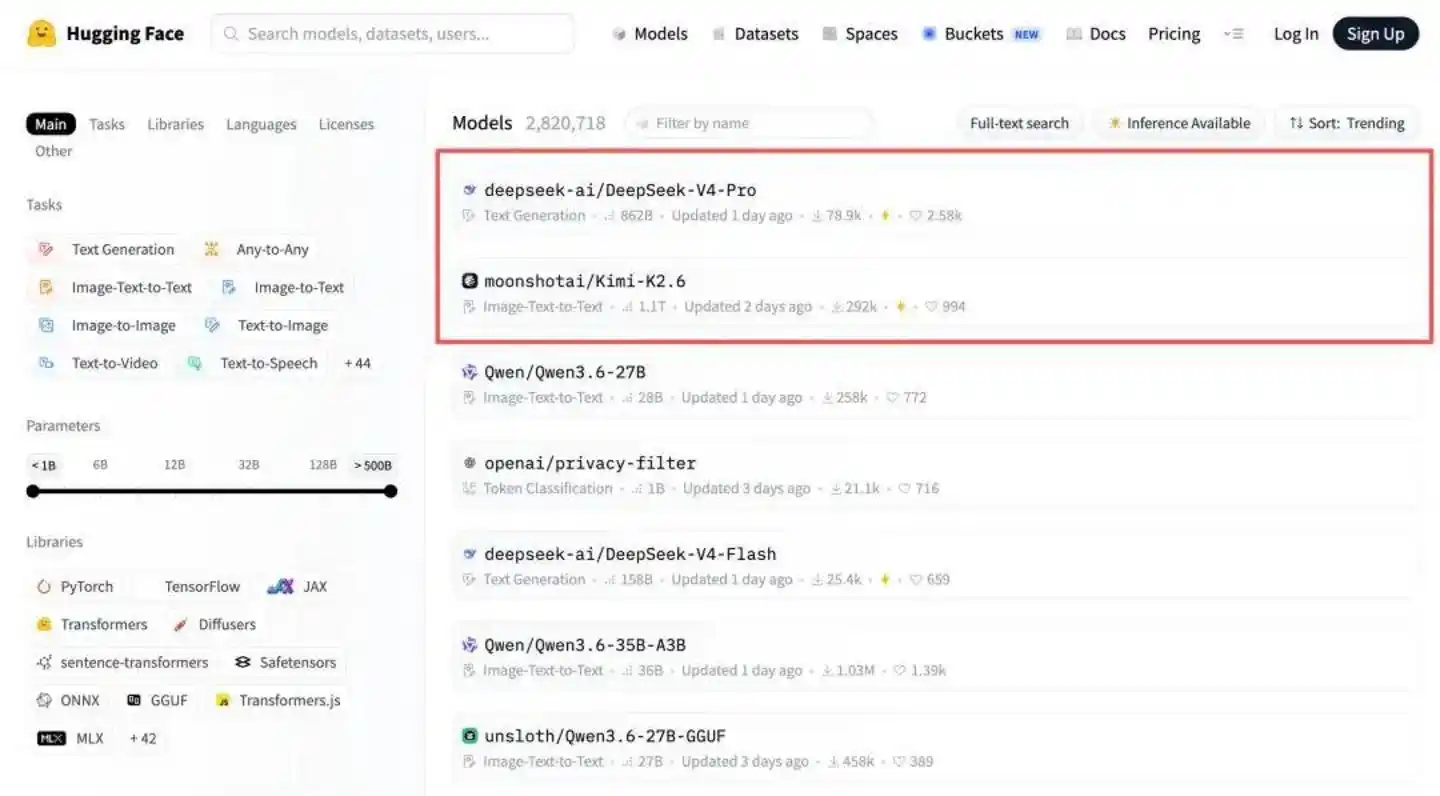
Coincidentally, ranked second on the Hugging Face open-source model leaderboard was Kimi K2.6, which was released and open-sourced late on April 20th.

If this were happening across the Pacific, the "clash" of two trillion-parameter models would inevitably lead to mutual attacks over valuations and commercial territories. Domestically, however, a completely different scene unfolded: there was no drama of exposing each other's secrets, no undercurrents of PR warfare, and even a "swap" at the technical foundation.

Behind this "unusual" situation lies a divergence in AI technology paths between China and the U.S.: Silicon Valley is frantically "erecting high walls," trying to protect vested interests through closed-source models; Chinese large model vendors, however, are choosing to "tear down the walls," moving toward collaborative evolution on the soil of open source.

01 Silicon Valley Trapped in a "Game of Thrones"

Unlike the open-source approach flourishing domestically, Silicon Valley's AI leaders—OpenAI, Anthropic, and Google's Gemini—are all staunch advocates of closed-source models.

As cutting-edge technological innovations are locked away in their respective data centers, under the pressure of computing costs and market expectations, the "Silicon Valley spirit" known for openness and collaboration is gradually fading. Players inevitably find themselves in a zero-sum "game of thrones."

Over the past two years, technical "shadow wars" have evolved into public spats. The most typical tactic is mutual "spotlight stealing": quickly unveiling their own major updates at competitors' key product launch moments to curb the other's momentum has become a routine operation in Silicon Valley.

As early as May 2024, OpenAI and Google simultaneously released new AI products, one claiming GPT-4o was globally leading, the other touting the Gemini family's coverage of the entire ecosystem and path. Eventually, the CEOs of both companies couldn't sit still, publicly mocking each other on social media.

It's not just a "tangle" with Google; the rivalry between OpenAI and Anthropic has also intensified: on April 16th, just after Anthropic released its new model Claude Opus 4.7, OpenAI announced a major update to Codex over two hours later, proclaiming "Codex for (almost) everything." It was clear to everyone that the timing was no coincidence but a carefully planned "snipe" by OpenAI against Anthropic.

Beyond the "cultural fights" in the court of public opinion, "military fights" of mutual "exposure" have also become the norm in Silicon Valley.

Anthropic proudly announced on April 7th that its annualized revenue had reached $30 billion, successfully surpassing OpenAI's $25 billion.

A week later, OpenAI's Chief Revenue Officer stated bluntly in an internal letter to all employees: Anthropic's claimed $30 billion in annualized revenue was seriously inflated because it used the "gross method," fully counting the share given to cloud service providers like Amazon and Google into its total revenue, resulting in an overestimation of about $8 billion.

The practice of undermining competitors in internal letters is uncommon in the tech industry, aiming无非是告诉投资人——Anthropic's growth myth is inflated.

And once hostility breeds, it permeates every decision.

After Anthropic "fell out" with the Pentagon for refusing to delete specific security clauses from a contract, OpenAI announced within hours that it had reached a cooperation agreement with the U.S. Department of Defense.

During the 2026 Super Bowl, Anthropic heavily advertised with a commercial whose content was "Advertising is entering the AI field, but it won't enter Claude." This was essentially a direct challenge to OpenAI, which had just begun testing ad features.......

Why have former "brothers-in-arms" come to such loggerheads?

The root lies in the inherent logic of the closed-source business model: the survival foundation of closed source is building moats, and the prerequisite for building moats is blocking technology diffusion, monopolizing the most advanced productivity. Coupled with incompatible technical routes and opposing product narratives, it naturally forms a Nash equilibrium: whoever "ceases fire" first will see their brand narrative collapse, ultimately sinking deeper into the quagmire of internal consumption.

02 The "Collaborative Evolution" of the Open-Source Camp

Turning the focus back to China, the script unfolds completely differently.

Rewind to over a year ago, the emergence of DeepSeek-R1 slammed the brakes on the狂奔的大模型创业赛 (frantic large model startup race), with the finalist large model "Six Little Tigers" being the first affected. The biggest difference from Silicon Valley is that DeepSeek did not play the role of a "shark" eating all the fish in the pond, but rather acted like a catfish that activated the entire Chinese large model ecosystem, leading everyone to embrace open source.

A direct example is Moonlight (Yue Zhi An Mian - 月之暗面), whose growth trajectory highly overlaps with DeepSeek's: both are startup teams that began in 2023, both maintain extremely small teams with high talent concentration, and both are firm believers in Scaling Law.

In July 2025, Moonlight released the world's first trillion-parameter open-source model, Kimi K2, openly stating in its technical report that it adopted the MLA architecture open-sourced by DeepSeek. For large models, the biggest nightmare of processing ultra-long text is the memory wall. The disruptive nature of the MLA architecture lies in its clever achievement of a staggering over 93% compression rate for KV Cache.

With the "industry standard" contributed by DeepSeek, large model teams like Moonlight no longer needed to reinvent the wheel, quickly reducing inference costs.

The story didn't stop there.

Looking through the DeepSeek V4 technical documentation, it details the model's architecture. One important upgrade was switching the optimizer for most modules from AdamW to Muon, achieving faster convergence speed and better training stability.
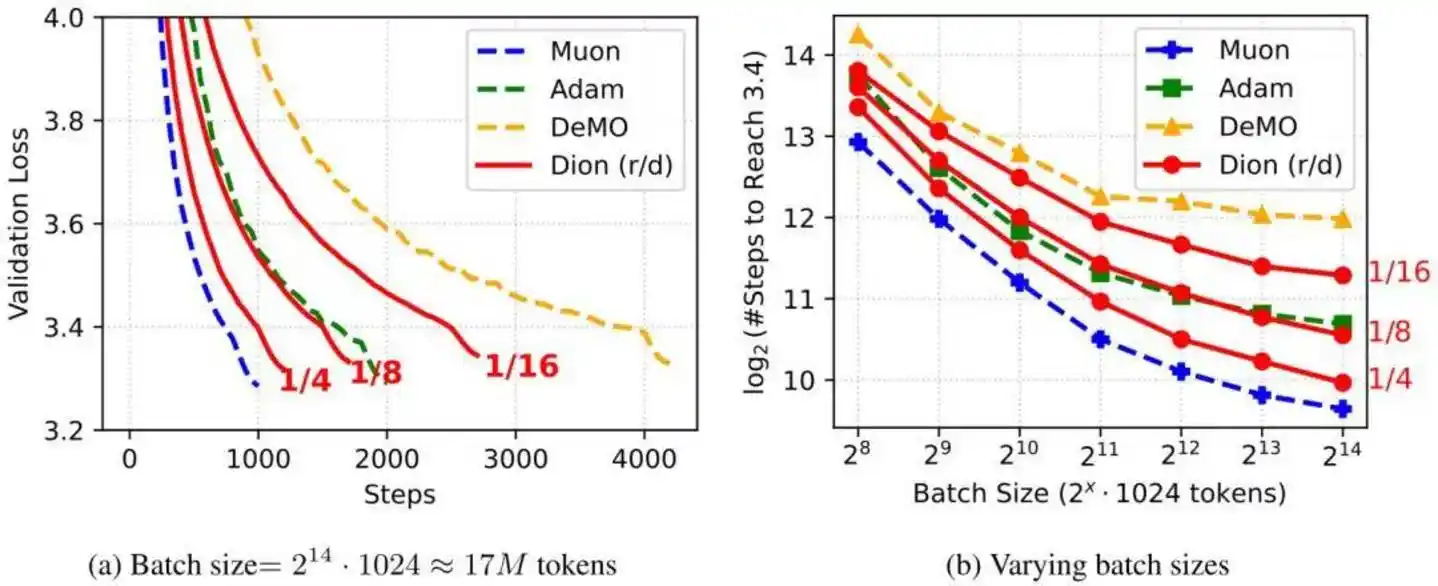
In the Kimi K2.6 technical documentation, the Muon optimizer is also mentioned, achieving a 2x efficiency improvement under the same training volume.

The Muon optimizer, mentioned by both models, was first proposed by independent researcher Keller Jordan in a blog post in late 2024. The Moonlight team, also troubled by AdamW, made key engineering improvements to Muon in early 2025, adding capabilities like Weight Decay and RMS control, and named it MuonClip.

Moonlight率先 validated the stability of the Muon optimizer on Kimi K2, achieving "zero Loss Spike" throughout pre-training. DeepSeek also adopted the validated Muon optimizer when training the V4 large model.

It's important to note that the "collaborative evolution" of open-source large models has not fallen into homogeneity but is moving towards a path of "harmony in diversity."

For example, DeepSeek-V4 focuses on core capabilities攻坚 of the base model, further solidifying the global open-source large model performance ceiling and providing the entire industry with a base foundation rivaling closed-source flagships; Kimi K2.6深耕 Agent engineering and落地, solving the pain points of long-range autonomous execution for large models, and打通关键路径 for large models to enter real production scenarios.

Throughout this process, there were no protracted商业谈判, no tense patent battles. In the open-source camp, technological innovation flows freely like water; whoever does it well, everyone uses it.

Absorbing nutrients from the open-source ecosystem, complementing each other in technical routes. China's large model vendors are demonstrating to the world another possibility beyond Silicon Valley through action.

03 The U.S. Is "Building Walls," China Is "Paving Roads"

While marveling at the collaborative evolution of open source, one must face a商业现实 squarely.

Currently, OpenAI and Anthropic's annualized revenues have both reached the tens of billions of USD, while the revenue of domestic leading large model vendors has just crossed the threshold of annualized $100 million.

OpenAI's valuation in the secondary market is about $880 billion, Anthropic's valuation has soared to around $1 trillion, while the valuations for Kimi and DeepSeek's latest funding rounds are $18 billion and $20 billion respectively.

Some exclaim that Chinese large model vendors are undervalued, while others believe: "The ability to translate technical reputation into real money is a life-and-death test facing Chinese companies." For a time, discussions about the "cost-effectiveness" of open source are rampant.

To see the endgame, one might start from the competition stages of large models:
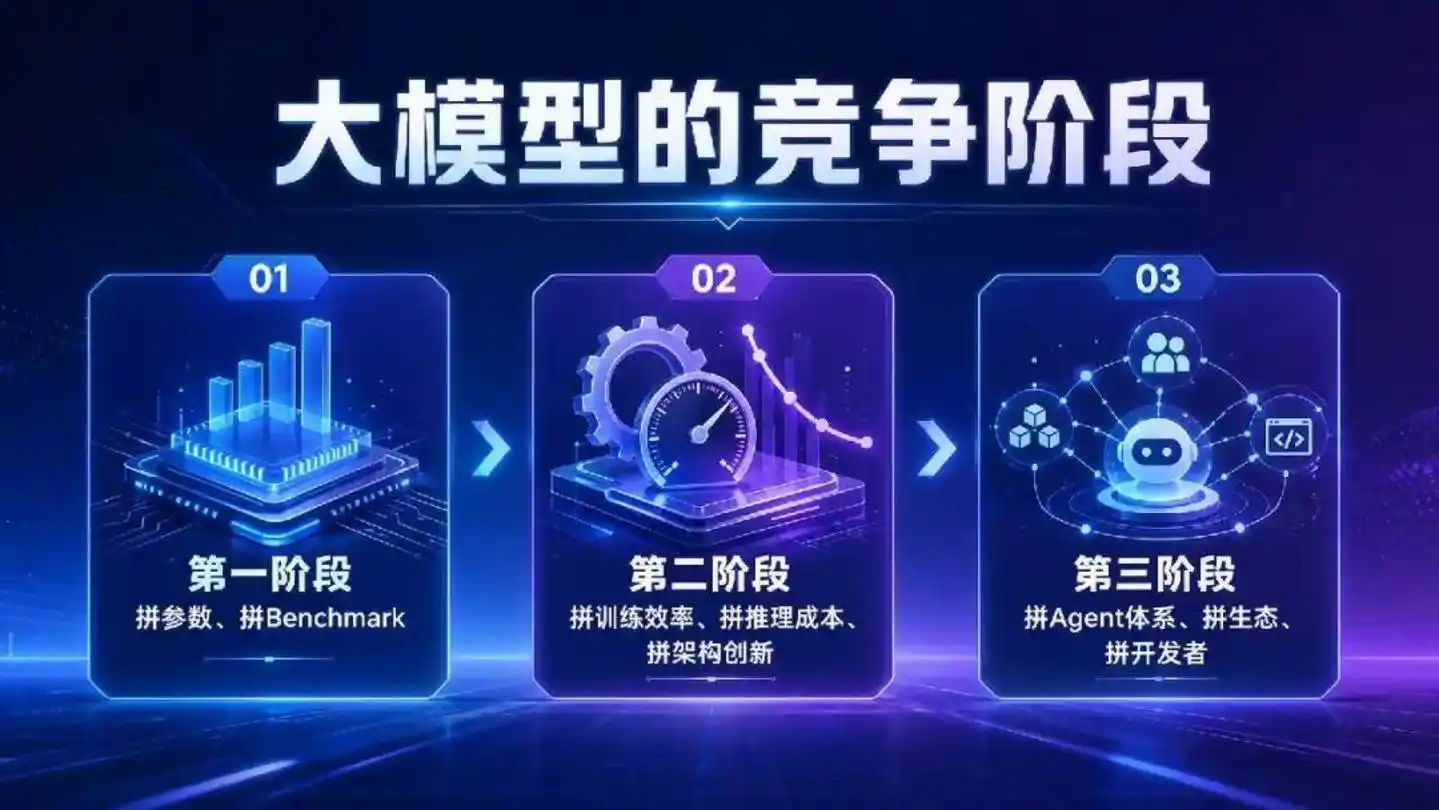
The first stage was "competing on parameters, competing on Benchmark." By the end of April 2026, this stage is basically over, as scores on leaderboards can no longer create substantial gaps.

The second stage is "competing on training efficiency, competing on inference cost, competing on architectural innovation." This is the current segment, also an inevitable result forced by computing cost pressures.

The third stage will be "competing on Agent systems, competing on ecosystem, competing on developers." When Tokens change from free traffic to "fuel" for executing tasks, the prosperity of the ecosystem will determine survival.

What is the ecological niche of domestic open-source large models? We found two sets of直观的对比数据 (intuitive comparative data).

One is training cost.

GPT-5, released in August 2025, had a training cost exceeding $500 million; Kimi K2 Thinking around the same time cost about $4.6 million to train; DeepSeek did not公布 the training cost of the V4 series models, but the V3 model cost only $5.576 million... Domestic large model vendors used resources amounting to less than pocket change for OpenAI to train models of comparable level.

The other is call volume.

After entering 2026, data from the multi-model aggregation platform OpenRouter shows: driven by Agent products represented by OpenClaw, global Token consumption has shown exponential growth. China's "Open-Source Dream Team,"凭借 "好用又便宜"的口碑 (relying on a reputation for being "user-friendly and cheap"), has seen its volume连续多周超越美国 (surpass that of the U.S. for multiple consecutive weeks).

The reason isn't hard to explain.

China's open-source camp has already successfully run a "positive feedback flywheel": Company A open-sources underlying technology, Company B adopts and performs engineering optimizations, then feeds the optimization results and experiences back to the entire ecosystem. If the evolution of closed-source models is linear growth built on massive computing power stacking, what awaits the open-source route is the exponential diffusion brought by the collision of technological innovations.

According to J.P. Morgan's research report, China's AI inference token consumption will achieve a compound annual growth rate (CAGR) of about 330% between 2025 and 2030,激增 (soaring) from 10 trillion tokens in 2025 to 3900 trillion tokens in 2030, a growth scale of 370 times.

This means that 2026 is still in the early stages of the AI explosion, with hundreds of times more growth opportunities in the next 5 years—far from the time for a final verdict.

Precisely because of confidence in long-term opportunities, while Silicon Valley giants are desperately building walls, Chinese large model vendors are choosing to use collaborative positioning to continuously solidify the road to AGI.

04 In Conclusion

In this轰轰烈烈的AI浪潮 (grand AI wave), who will have the last laugh? The answer concerns not only the models but also the autonomous controllability of computing power. If models are compared to "atomic bombs," then domestic computing power, free from external technological blockades, is the "rocket" that sends the atomic bomb into the sky.

It is gratifying that the integration of domestic models and domestic computing power is becoming increasingly close: in the DeepSeek V4 technical documentation, Ascend NPU is listed alongside NVIDIA GPU in the hardware verification list; Moonlight's latest论文 (paper) runs large model inference's prefill and decoding on different chips, opening the door for domestic chips to participate in model inference on a large scale.

In early 2025, DeepSeek R1 secured a seat at the table for domestic large models; by 2026, China's open-source large model camp is continuously creating more定义牌桌规则的硬资本 (hard capital that defines the rules of the table) through collaboration.


Пов'язані питання

QWhat are the two major innovations of DeepSeek V4 mentioned in the article?

AThe two major innovations are: 1) A million-level ultra-long context with only 10% of the KV cache of V3.2, praised by Amazon engineers for solving HBM shortage issues; 2) Adaptation to domestic chips, with close collaboration with Huawei and immediate support for Ascend and Cambricon chips.

QHow does the AI development approach in Silicon Valley differ from that in China according to the article?

ASilicon Valley AI leaders like OpenAI, Anthropic, and Google Gemini advocate for closed-source models, leading to zero-sum games and internal conflicts. In contrast, Chinese AI companies embrace open-source collaboration, promoting synergistic evolution and shared technological advancements.

QWhat is the significance of the Muon optimizer in the development of DeepSeek V4 and Kimi K2.6?

AThe Muon optimizer, improved by Moonshot AI and adopted by DeepSeek, replaced AdamW in most modules, achieving faster convergence speeds and better training stability. It contributed to a 2x efficiency improvement with the same training volume in Kimi K2.6.

QWhat are the three stages of AI model competition as described in the article?

AThe three stages are: 1) Competing on parameters and benchmark performance; 2) Competing on training efficiency, inference cost, and architectural innovation; 3) Competing on Agent systems, ecosystem, and developer support.

QHow does the article characterize the relationship between Chinese open-source AI models and domestic computing hardware?

AThe article highlights a tight integration, where Chinese AI models like DeepSeek V4 and Kimi K2.6 actively adapt to and validate domestic chips such as Huawei's Ascend and Cambricon, reducing reliance on external technology and enhancing autonomous controllability of computing power.

Пов'язані матеріали

How Many Tokens Away Is Yang Zhilin from the 'Moon Chasing the Light'?

The article explores the intense competition between two leading Chinese AI companies, DeepSeek and Kimi (Moon Dark Side), and the mounting pressure on Yang Zhilin, the founder of Kimi. While DeepSeek re-emerged after 15 months of silence with its powerful V4 model—boasting 1.6 trillion parameters and low-cost, long-context capabilities—Kimi has been focusing on long-context processing and multi-agent systems with its K2.6 model. Yang faces a threefold challenge: technological rivalry, commercialization pressure, and investor expectations. Despite Kimi’s high valuation (reaching $18 billion), its revenue heavily relies on a single product with low paid conversion rates, while DeepSeek’s strategic silence and open-source influence have strengthened its market position and valuation prospects, now targeting over $20 billion. Both companies reflect broader trends in China’s AI ecosystem: Kimi aims for global influence through open-source contributions and agent-based advancements, while DeepSeek prioritizes foundational innovation and hardware independence, notably shifting to Huawei’s chips. Their competition is seen as vital for China’s AI progress, with the gap between top Chinese and U.S. models narrowing to just 2.7% on the Elo rating scale. Ultimately, the article argues that this rivalry, though anxiety-inducing for leaders like Zhilin, is essential for driving innovation and solidifying China’s role in the global AI landscape.

marsbit5 год тому

How Many Tokens Away Is Yang Zhilin from the 'Moon Chasing the Light'?

marsbit5 год тому

TechFlow Intelligence Bureau: ChatGPT Helps Amateur Mathematician Crack 60-Year-Old Problem, CFTC Sues New York Regulator Over Coinbase and Gemini

An amateur mathematician, with the assistance of ChatGPT, has solved a combinatorial mathematics puzzle originally proposed by Hungarian mathematician Paul Erdős in the 1960s. This marks another milestone in AI-aided mathematical research, demonstrating the evolving capabilities of large language models in formal reasoning. In other AI developments, OpenAI introduced a new privacy filter tool for enterprise API usage, automatically screening sensitive data. Meanwhile, the Qwen3.6-27B model achieved 100 tokens per second on a single RTX 5090 GPU using quantization, significantly lowering the cost barrier for local AI deployment. In crypto and Web3, the U.S. CFTC sued New York’s financial regulator, challenging its oversight of Coinbase and Gemini—a first-of-its-kind federal-state regulatory clash. Following a vulnerability, KelpDAO and major DeFi protocols established a recovery fund. Tether froze $344 million in assets linked to Iran’s central bank upon U.S. Treasury request, highlighting the centralized control risks in stablecoins. Separately, Litecoin underwent a 3-hour chain reorganization to undo a privacy-layer exploit. In the U.S., former President Trump invoked the Defense Production Act to address power grid bottlenecks affecting AI data centers and dismissed the entire National Science Board, raising concerns over research independence. A retail trader gained 250% on a $600k Intel options bet amid AI-related speculation. Xiaomi announced its first performance electric vehicle, targeting rivals like Tesla. Meanwhile, iPhone users reported devices automatically reinstalling a hidden app daily, suspected to be MDM-related. A Chinese securities report noted that A-share institutional crowding has reached its second-longest streak since 2007, signaling high valuations and potential style rotation. The day’s developments reflect a dual narrative: AI is enabling unprecedented individual breakthroughs, while centralized power structures—whether governmental or corporate—are becoming more assertive, underscoring that decentralization is as much a political-economic challenge as a technical one.

marsbit5 год тому

TechFlow Intelligence Bureau: ChatGPT Helps Amateur Mathematician Crack 60-Year-Old Problem, CFTC Sues New York Regulator Over Coinbase and Gemini

marsbit5 год тому

Торгівля

Спот
Ф'ючерси

Популярні статті

Що таке $S$

Розуміння SPERO: Комплексний огляд Вступ до SPERO Оскільки ландшафт інновацій продовжує еволюціонувати, виникнення технологій web3 та криптовалютних проектів відіграє ключову роль у формуванні цифрового майбутнього. Один з проектів, який привернув увагу в цій динамічній сфері, — це SPERO, позначений як SPERO,$$s$. Ця стаття має на меті зібрати та представити детальну інформацію про SPERO, щоб допомогти ентузіастам та інвесторам зрозуміти його основи, цілі та інновації в рамках web3 та крипто-сектору. Що таке SPERO,$$s$? SPERO,$$s$ — це унікальний проект у криптопросторі, який прагне використати принципи децентралізації та технології блокчейн для створення екосистеми, що сприяє залученню, корисності та фінансовій інклюзії. Проект розроблений для полегшення взаємодії між користувачами новими способами, надаючи їм інноваційні фінансові рішення та послуги. У своїй основі SPERO,$$s$ прагне надати можливості індивідам, забезпечуючи інструменти та платформи, які покращують користувацький досвід у криптовалютному просторі. Це включає в себе можливість більш гнучких методів транзакцій, сприяння ініціативам, що підтримуються спільнотою, та створення шляхів для фінансових можливостей через децентралізовані додатки (dApps). Основна концепція SPERO,$$s$ обертається навколо інклюзивності, прагнучи зменшити розриви в традиційній фінансовій системі, використовуючи переваги технології блокчейн. Хто є творцем SPERO,$$s$? Особистість творця SPERO,$$s$ залишається дещо невідомою, оскільки є обмежені публічно доступні ресурси, що надають детальну інформацію про його засновників. Ця відсутність прозорості може бути наслідком зобов'язання проекту до децентралізації — етики, яку багато проектів web3 поділяють, ставлячи колективні внески вище за індивідуальне визнання. Зосереджуючи обговорення навколо спільноти та її колективних цілей, SPERO,$$s$ втілює суть наділення без виділення конкретних осіб. Таким чином, розуміння етики та місії SPERO є більш важливим, ніж ідентифікація єдиного творця. Хто є інвесторами SPERO,$$s$? SPERO,$$s$ підтримується різноманітними інвесторами, починаючи від венчурних капіталістів до ангельських інвесторів, які прагнуть сприяти інноваціям у крипто-секторі. Зосередження цих інвесторів зазвичай узгоджується з місією SPERO — пріоритет надається проектам, які обіцяють технологічний прогрес у суспільстві, фінансову інклюзію та децентралізоване управління. Ці інвесторські фонди зазвичай зацікавлені в проектах, які не лише пропонують інноваційні продукти, але й позитивно впливають на спільноту блокчейн та її екосистеми. Підтримка з боку цих інвесторів підкріплює SPERO,$$s$ як значного конкурента в швидко змінюваній сфері крипто-проектів. Як працює SPERO,$$s$? SPERO,$$s$ використовує багатогранну структуру, яка відрізняє його від традиційних криптовалютних проектів. Ось деякі ключові особливості, які підкреслюють його унікальність та інноваційність: Децентралізоване управління: SPERO,$$s$ інтегрує моделі децентралізованого управління, надаючи користувачам можливість активно брати участь у процесах прийняття рішень щодо майбутнього проекту. Цей підхід сприяє відчуттю власності та відповідальності серед членів спільноти. Корисність токена: SPERO,$$s$ використовує свій власний криптовалютний токен, розроблений для виконання різних функцій в екосистемі. Ці токени дозволяють здійснювати транзакції, отримувати винагороди та полегшувати послуги, що пропонуються на платформі, підвищуючи загальну залученість та корисність. Шарова архітектура: Технічна архітектура SPERO,$$s$ підтримує модульність та масштабованість, що дозволяє безперешкодно інтегрувати додаткові функції та додатки в міру розвитку проекту. Ця адаптивність є надзвичайно важливою для збереження актуальності в постійно змінюваному крипто-ландшафті. Залучення спільноти: Проект підкреслює ініціативи, що підтримуються спільнотою, використовуючи механізми, які стимулюють співпрацю та зворотний зв'язок. Підтримуючи сильну спільноту, SPERO,$$s$ може краще задовольняти потреби користувачів та адаптуватися до ринкових тенденцій. Фокус на інклюзію: Пропонуючи низькі комісії за транзакції та зручні інтерфейси, SPERO,$$s$ прагне залучити різноманітну базу користувачів, включаючи осіб, які раніше не брали участі в крипто-просторі. Це зобов'язання до інклюзії узгоджується з його загальною місією наділення через доступність. Хронологія SPERO,$$s$ Розуміння історії проекту надає важливі уявлення про його розвиток та етапи. Нижче наведено пропоновану хронологію, що відображає значні події в еволюції SPERO,$$s$: Етап концептуалізації та ідеації: Початкові ідеї, що стали основою SPERO,$$s$, були сформовані, тісно пов'язані з принципами децентралізації та фокусом на спільноті в індустрії блокчейн. Запуск білого паперу проекту: Після концептуального етапу був випущений комплексний білий папір, що детально описує бачення, цілі та технологічну інфраструктуру SPERO,$$s$, щоб залучити інтерес та зворотний зв'язок від спільноти. Створення спільноти та ранні залучення: Активні зусилля були спрямовані на створення спільноти ранніх прихильників та потенційних інвесторів, що полегшило обговорення цілей проекту та отримання підтримки. Подія генерації токенів: SPERO,$$s$ провів подію генерації токенів (TGE) для розподілу своїх рідних токенів серед ранніх прихильників та встановлення початкової ліквідності в екосистемі. Запуск початкового dApp: Перший децентралізований додаток (dApp), пов'язаний з SPERO,$$s$, став доступним, дозволяючи користувачам взаємодіяти з основними функціями платформи. Постійний розвиток та партнерства: Безперервні оновлення та вдосконалення пропозицій проекту, включаючи стратегічні партнерства з іншими учасниками блокчейн-простору, сформували SPERO,$$s$ у конкурентоспроможного та еволюціонуючого гравця на крипто-ринку. Висновок SPERO,$$s$ є свідченням потенціалу web3 та криптовалют для революціонізації фінансових систем та наділення індивідів. Завдяки зобов'язанню до децентралізованого управління, залучення спільноти та інноваційно спроектованих функцій, він прокладає шлях до більш інклюзивного фінансового ландшафту. Як і з будь-якими інвестиціями в швидко змінюваному крипто-просторі, потенційним інвесторам та користувачам рекомендується ретельно досліджувати та обдумано взаємодіяти з поточними подіями в SPERO,$$s$. Проект демонструє інноваційний дух крипто-індустрії, запрошуючи до подальшого дослідження його численних можливостей. Хоча подорож SPERO,$$s$ ще триває, його основні принципи можуть справді вплинути на майбутнє того, як ми взаємодіємо з технологією, фінансами та один з одним у взаємопов'язаних цифрових екосистемах.

73 переглядів усьогоОпубліковано 2024.12.17Оновлено 2024.12.17

Що таке $S$

Що таке AGENT S

Агент S: Майбутнє автономної взаємодії в Web3 Вступ У постійно змінюваному ландшафті Web3 та криптовалюти інновації постійно переосмислюють, як люди взаємодіють з цифровими платформами. Один з таких новаторських проектів, Агент S, обіцяє революціонізувати взаємодію людини з комп'ютером через свою відкриту агентну структуру. Прокладаючи шлях для автономних взаємодій, Агент S прагне спростити складні завдання, пропонуючи трансформаційні застосування в штучному інтелекті (ШІ). Це детальне дослідження заглиблюється в складності проекту, його унікальні особливості та наслідки для сфери криптовалюти. Що таке Агент S? Агент S є революційною відкритою агентною структурою, спеціально розробленою для вирішення трьох основних викликів в автоматизації комп'ютерних завдань: Набуття специфічних знань у галузі: Структура інтелектуально навчається з різних зовнішніх джерел знань та внутрішнього досвіду. Цей подвійний підхід дозволяє їй створити багатий репозиторій специфічних знань у галузі, покращуючи її продуктивність у виконанні завдань. Планування на довгих горизонтах завдань: Агент S використовує планування з підкріпленням досвіду, стратегічний підхід, який полегшує ефективний розподіл та виконання складних завдань. Ця функція значно підвищує її здатність ефективно та результативно управляти кількома підзавданнями. Обробка динамічних, неоднорідних інтерфейсів: Проект представляє Інтерфейс Агент-Комп'ютер (ACI), інноваційне рішення, яке покращує взаємодію між агентами та користувачами. Використовуючи багатомодальні великі мовні моделі (MLLMs), Агент S може безперешкодно орієнтуватися та маніпулювати різноманітними графічними інтерфейсами користувача. Завдяки цим новаторським функціям Агент S надає надійну структуру, яка вирішує складнощі, пов'язані з автоматизацією людської взаємодії з машинами, прокладаючи шлях для численних застосувань у ШІ та за його межами. Хто є творцем Агент S? Хоча концепція Агент S є фундаментально новаторською, конкретна інформація про його творця залишається невідомою. Творець наразі невідомий, що підкреслює або початкову стадію проекту, або стратегічний вибір зберегти засновників у таємниці. Незважаючи на анонімність, акцент залишається на можливостях та потенціалі структури. Хто є інвесторами Агент S? Оскільки Агент S є відносно новим у криптографічній екосистемі, детальна інформація про його інвесторів та фінансових спонсорів не задокументована. Відсутність публічно доступних відомостей про інвестиційні фонди або організації, що підтримують проект, викликає питання щодо його фінансової структури та дорожньої карти розвитку. Розуміння підтримки є критично важливим для оцінки стійкості проекту та потенційного впливу на ринок. Як працює Агент S? В основі Агент S лежить передова технологія, яка дозволяє йому ефективно функціонувати в різних умовах. Його операційна модель побудована навколо кількох ключових функцій: Взаємодія з комп'ютером, подібна до людської: Структура пропонує розширене планування ШІ, прагнучи зробити взаємодії з комп'ютерами більш інтуїтивними. Імітуючи людську поведінку при виконанні завдань, вона обіцяє підвищити досвід користувачів. Наративна пам'ять: Використовується для використання високорівневого досвіду, Агент S використовує наративну пам'ять для відстеження історій завдань, тим самим покращуючи свої процеси прийняття рішень. Епізодична пам'ять: Ця функція надає користувачам покрокові інструкції, дозволяючи структурі пропонувати контекстуальну підтримку в міру виконання завдань. Підтримка OpenACI: Завдяки можливості працювати локально, Агент S дозволяє користувачам зберігати контроль над своїми взаємодіями та робочими процесами, узгоджуючи з децентралізованою етикою Web3. Легка інтеграція з зовнішніми API: Його універсальність і сумісність з різними платформами ШІ забезпечують те, що Агент S може безперешкодно вписатися в існуючі технологічні екосистеми, роблячи його привабливим вибором для розробників та організацій. Ці функціональні можливості колективно сприяють унікальному положенню Агент S у крипто-просторі, оскільки він автоматизує складні, багатоступеневі завдання з мінімальним втручанням людини. У міру розвитку проекту його потенційні застосування в Web3 можуть переосмислити, як відбуваються цифрові взаємодії. Хронологія Агент S Розробка та етапи Агент S можуть бути узагальнені в хронології, яка підкреслює його значні події: 27 вересня 2024 року: Концепція Агент S була представлена в комплексній науковій статті під назвою “Відкрита агентна структура, яка використовує комп'ютери як людина”, що демонструє основи проекту. 10 жовтня 2024 року: Наукова стаття була опублікована на arXiv, пропонуючи детальне дослідження структури та її оцінки продуктивності на основі бенчмарку OSWorld. 12 жовтня 2024 року: Було випущено відеопрезентацію, що надає візуальне уявлення про можливості та особливості Агент S, ще більше залучаючи потенційних користувачів та інвесторів. Ці маркери в хронології не лише ілюструють прогрес Агент S, але й вказують на його прихильність до прозорості та залучення громади. Ключові моменти про Агент S У міру розвитку структури Агент S кілька ключових характеристик виділяються, підкреслюючи її новаторський характер та потенціал: Інноваційна структура: Розроблена для забезпечення інтуїтивного використання комп'ютерів, подібного до людської взаємодії, Агент S пропонує новий підхід до автоматизації завдань. Автономна взаємодія: Здатність автономно взаємодіяти з комп'ютерами через GUI означає стрибок до більш інтелектуальних та ефективних обчислювальних рішень. Автоматизація складних завдань: Завдяки своїй надійній методології він може автоматизувати складні, багатоступеневі завдання, роблячи процеси швидшими та менш схильними до помилок. Безперервне вдосконалення: Механізми навчання дозволяють Агенту S покращуватися на основі минулого досвіду, постійно підвищуючи свою продуктивність та ефективність. Універсальність: Його адаптивність до різних операційних середовищ, таких як OSWorld та WindowsAgentArena, забезпечує його здатність служити широкому спектру застосувань. Оскільки Агент S займає своє місце в ландшафті Web3 та криптовалюти, його потенціал покращити можливості взаємодії та автоматизувати процеси означає значний прогрес у технологіях ШІ. Завдяки своїй інноваційній структурі Агент S є прикладом майбутнього цифрових взаємодій, обіцяючи більш безперешкодний та ефективний досвід для користувачів у різних галузях. Висновок Агент S представляє собою сміливий крок вперед у поєднанні ШІ та Web3, з можливістю переосмислити, як ми взаємодіємо з технологією. Хоча проект все ще на ранніх стадіях, можливості для його застосування є величезними та переконливими. Завдяки своїй комплексній структурі, що вирішує критичні виклики, Агент S прагне вивести автономні взаємодії на передній план цифрового досвіду. У міру того, як ми заглиблюємося в сфери криптовалюти та децентралізації, проекти, подібні до Агент S, безсумнівно, відіграватимуть ключову роль у формуванні майбутнього технологій та співпраці людини з комп'ютером.

539 переглядів усьогоОпубліковано 2025.01.14Оновлено 2025.01.14

Що таке AGENT S

Як купити S

Ласкаво просимо до HTX.com! Ми зробили покупку Sonic (S) простою та зручною. Дотримуйтесь нашої покрокової інструкції, щоб розпочати свою криптовалютну подорож.Крок 1: Створіть обліковий запис на HTXВикористовуйте свою електронну пошту або номер телефону, щоб зареєструвати обліковий запис на HTX безплатно. Пройдіть безпроблемну реєстрацію й отримайте доступ до всіх функцій.ЗареєструватисьКрок 2: Перейдіть до розділу Купити крипту і виберіть спосіб оплатиКредитна/дебетова картка: використовуйте вашу картку Visa або Mastercard, щоб миттєво купити Sonic (S).Баланс: використовуйте кошти з балансу вашого рахунку HTX для безперешкодної торгівлі.Треті особи: ми додали популярні способи оплати, такі як Google Pay та Apple Pay, щоб підвищити зручність.P2P: Торгуйте безпосередньо з іншими користувачами на HTX.Позабіржова торгівля (OTC): ми пропонуємо індивідуальні послуги та конкурентні обмінні курси для трейдерів.Крок 3: Зберігайте свої Sonic (S)Після придбання Sonic (S) збережіть його у своєму обліковому записі на HTX. Крім того, ви можете відправити його в інше місце за допомогою блокчейн-переказу або використовувати його для торгівлі іншими криптовалютами.Крок 4: Торгівля Sonic (S)Легко торгуйте Sonic (S) на спотовому ринку HTX. Просто увійдіть до свого облікового запису, виберіть торгову пару, укладайте угоди та спостерігайте за ними в режимі реального часу. Ми пропонуємо зручний досвід як для початківців, так і для досвідчених трейдерів.

1.3k переглядів усьогоОпубліковано 2025.01.15Оновлено 2025.03.21

Як купити S

Обговорення

Ласкаво просимо до спільноти HTX. Тут ви можете бути в курсі останніх подій розвитку платформи та отримати доступ до професійної ринкової інформації. Нижче представлені думки користувачів щодо ціни S (S).

活动图片