This Xiaohongshu Graphic Layout AI Skill Has Found a Route to Bypass AI Labeling for Graphic Generation

marsbitОпубліковано о 2026-05-28Востаннє оновлено о 2026-05-28

Анотація

A new open-source tool called "guizang-social-card-skill" has emerged, offering a unique workaround for AI content labeling rules on platforms like Xiaohongshu. Instead of using AI models to generate images, it employs AI to make layout decisions, then uses HTML/CSS to render the final graphic. Photographic assets are sourced from libraries like Unsplash. The output is a rasterized browser screenshot, not an "AI-generated image." This approach is a direct response to platform policies. In early 2026, Xiaohongshu mandated labeling for AI-generated synthetic content and deployed audio-visual recognition models to detect AI-generated pixels based on statistical patterns. This tool bypasses those pixel-level detectors by not using diffusion or GAN models for image generation. The tool provides 28 predefined layout templates across two visual styles. Users input a topic, and the AI selects a template, positions text, and integrates elements like maps (using OpenStreetMap). The system prioritizes user-uploaded photos before falling back to stock image searches. The article outlines three divergent technical paths for social media graphic tools: 1) AI models directly generating pixels (highest detection risk), 2) API template engines (risk of anti-spam rules for homogeneity), and 3) this HTML-rendering method. The longevity of this workaround depends on whether platforms broaden their definition of "AI-generated content" to include programmatically rendered, AI-designed graphics....

In February 2026, Xiaohongshu issued an announcement requiring AI-generated synthetic content to be proactively labeled; unlabeled content would face distribution restrictions. More than three months later, an open-source project named guizang-social-card-skill appeared on GitHub, specializing in generating Xiaohongshu 3:4 graphics and public account covers. Its technical path had an unusual choice: it doesn't use any AI model to generate image pixels. The entire visual is rendered by HTML+CSS, with supporting images sourced from searches in real photo libraries like Unsplash. What it outputs is not an "AI-generated image" but a web page screenshot rasterized by a browser engine.

This choice corresponds to a specific change. Since 2026, Xiaohongshu has deployed audio-visual recognition models that analyze pixel distribution patterns and audio features to identify AIGC content. During the same period, over 800,000 AI-operated accounts and nearly 150,000 AI-fabricated notes were penalized. For content creators who need to produce graphics frequently, the probability of detection and labeling for images generated by tools like Midjourney or Canva AI is continuously increasing. Developer Cang Shifu's Skill chose another path: let AI handle layout decisions and leave the final pixels to rendering engines and real photo libraries.

This is a conscious technical bypass. However, how far this solution can go depends on the elasticity of the platform's definition of the term "AI-generated synthetic content."

28 Layout Skeletons: AI Handles Layout Logic, Not Drawing

Developer Cang Shifu, real name Gui Zang, previously released guizang-ppt-skill, another AI tool for graphic layout scenarios. This new social-card-skill has a more focused positioning: targeting Xiaohongshu 3:4 graphics, public account 1:1 and 21:9 covers, outputting resolutions of 1080×1440, 1080×1080, and 2100×900 respectively.
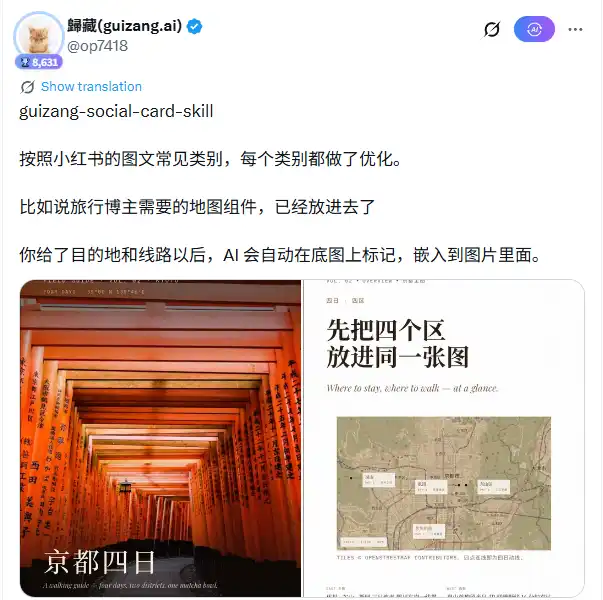

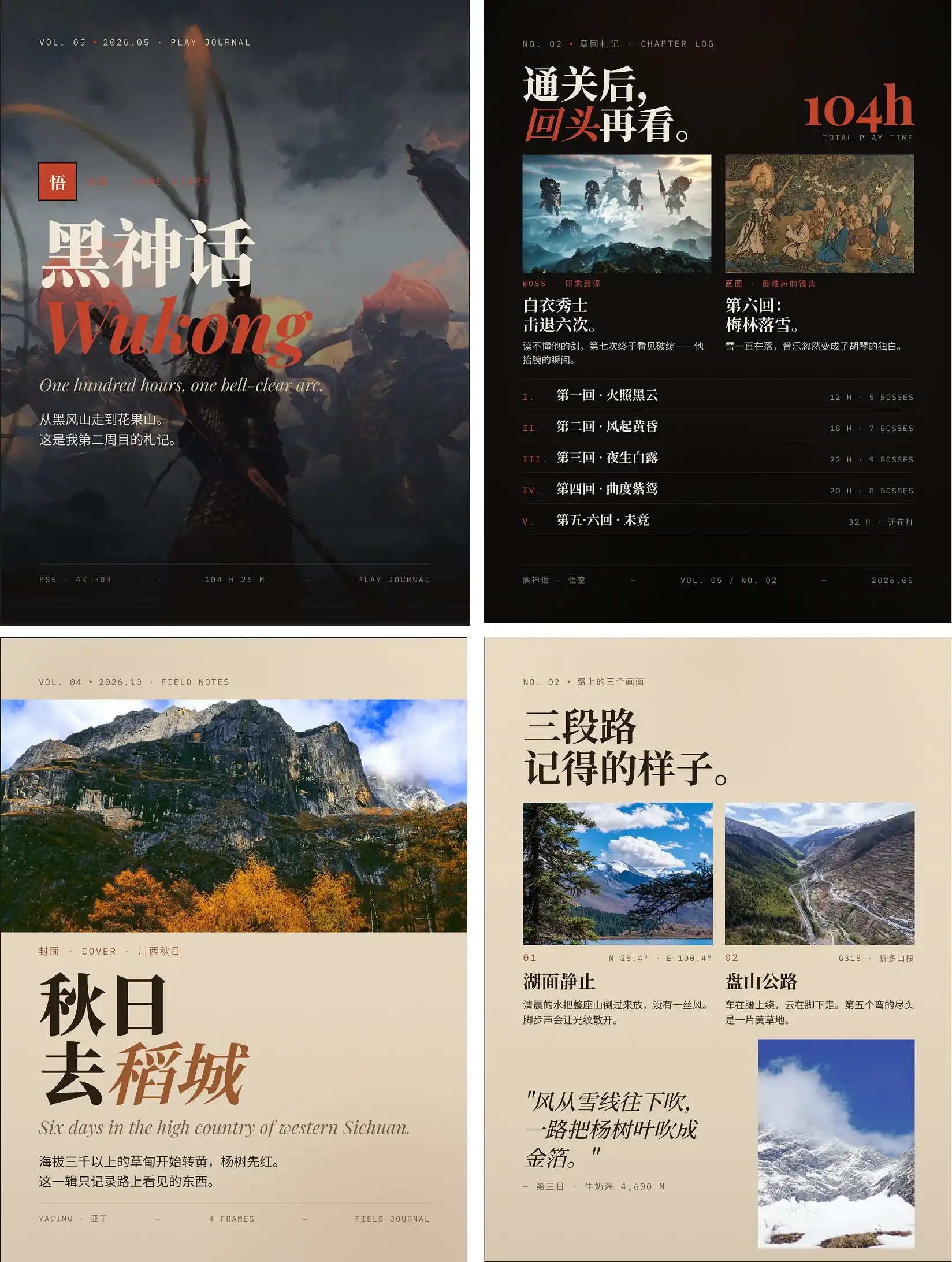
In terms of technical architecture, this Skill has 28 built-in layout skeletons, divided into two visual systems: Editorial (magazine style, 16 layouts) and Swiss (Swiss International Style, 12 layouts), accompanied by 10 preset theme color schemes. After users input a destination, itinerary, or note topic, the AI is responsible for selecting an appropriate layout skeleton, deciding text positioning, processing map annotation parameters, and then writing all design decisions into HTML+CSS. The Playwright rendering engine takes over the subsequent steps, capturing screenshots page by page to output PNGs.

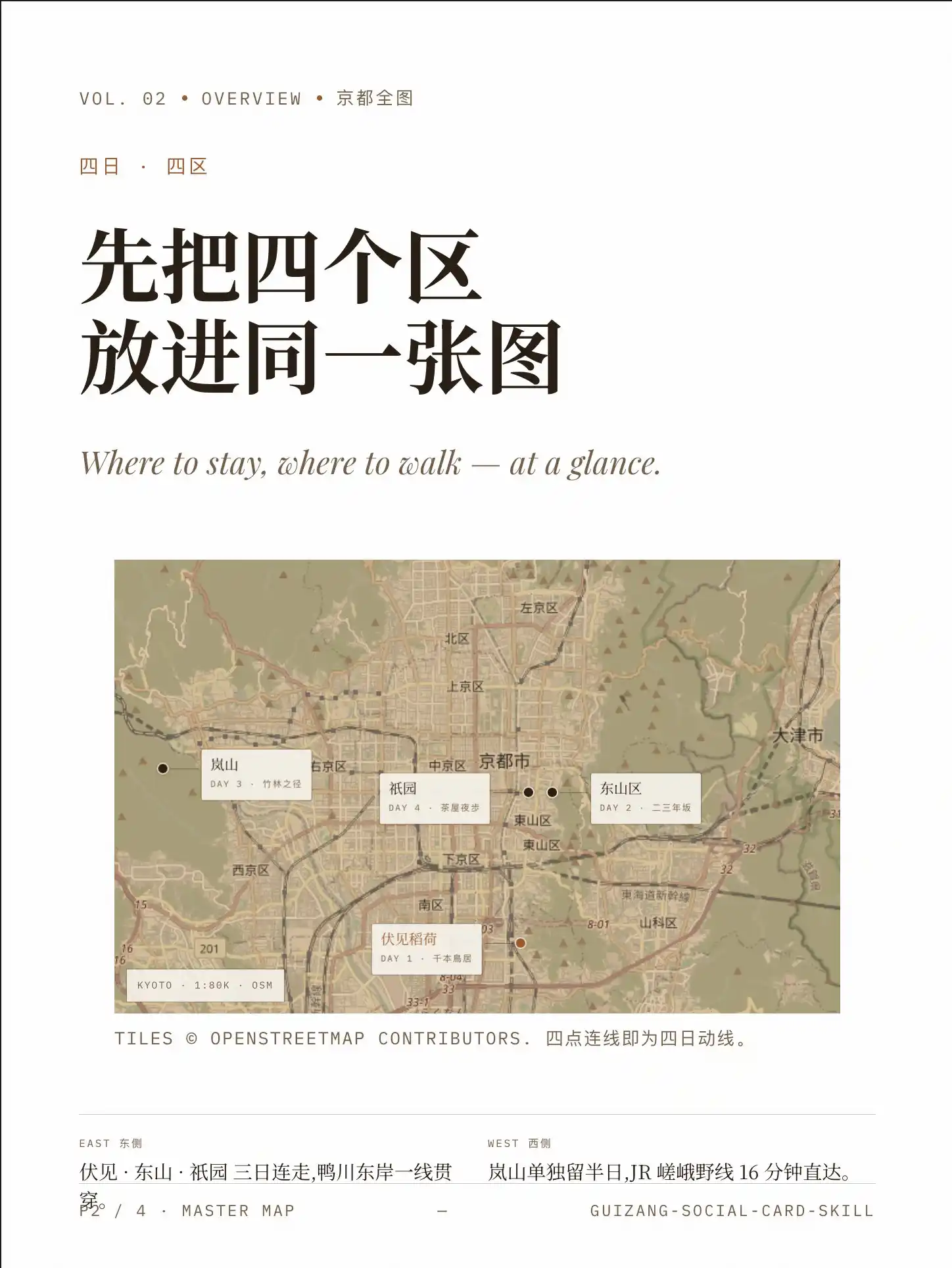
A particularly useful component for travel bloggers is the map module. It uses MapLibre to load real tiles from OpenStreetMap, supporting multiple location markers and connecting lines. Users only need to provide city or attraction names; the AI automatically generates a basemap with annotations and embeds it into the layout. The accompanying image sourcing workflow has a clear priority: user-provided real photos take precedence; when no user images are available, it automatically retrieves supporting images in the order of Unsplash → Pexels → Flickr CC → Wallhaven.

The entire process is executed in seven steps: Intake (receive input) → Style & Theme (determine style and theme) → Layout Selection → Asset Prep (material preparation) → Compose & Render (layout and rendering) → Deliver & Review (output and review) → Iterate (iterative modifications). Each step is recorded in .poster files within the task directory. For batch image generation, run node render.mjs, and Playwright renders them one by one. Another validation script, validate-social-deck.mjs, measures DOM elements in a real browser environment to detect layout issues like text overflow, font size exceeding limits, and footer element collisions.

The design goal of this mechanism is clear: to be as precise and controllable as printing layout software, rather than as free but unpredictable as diffusion models. The cost is that creative freedom is confined to these 28 grids. For creators who rely on personal photography styles, hand-drawn elements, or irregular collages, these layout skeletons provide not efficiency gains, but design constraints.

Regarding the entry barrier: the CLI version requires installing Playwright, Node environment, and obtaining API access for Claude Code or Codex. There's also a web version portal at xiaohongshu.guizang.ai for non-developer users, but there is no public comparison yet on whether its feature completeness matches the CLI version. The developer's several X platform posts and frequently updated README indicate this project is still in rapid iteration.

Pixels Not from Generative Models, But Compliance Doesn't Equal Long-term Safety

Xiaohongshu's AI content detection logic, according to public information and technical analysis, relies primarily on audio-visual recognition models. These models determine whether content originates from AI generative models by analyzing pixel distribution patterns. Diffusion models and GANs leave specific statistical signatures at the pixel level when generating images, which differ from the natural lighting, lens distortion, and noise patterns captured by camera sensors. The training objective of audio-visual recognition models is precisely to capture this inconsistency in statistical patterns.

The evasion logic of Cang Shifu's Skill is based on a key distinction: its output image pixels do not come from any generative model. The HTML rendering engine rasterizes CSS styles, producing pixel distribution characteristics closer to browser interface screenshots or desktop publishing software outputs. The photographic portions come from real human-shot materials in libraries like Unsplash; these images, captured by cameras and manually post-processed, do not carry diffusion model signatures.


However, the validity of this distinction depends on the platform's definition of "AI-generated synthetic content" being precisely drawn at the line of "AI model generating pixels." Xiaohongshu's official announcement uses the term "AI-generated synthetic content," a phrase whose original scope is not narrow. Once the platform expands the definition to include "AI-assisted design programmatically rendered output" or incorporates the browser rendering characteristics of HTML-rasterized images into the training data for its recognition models, the current technical advantage of this solution would disappear.

The platform has both the technical foundation and governance motivation to expand the definition. The audio-visual recognition models themselves are continuously iterating. If training data includes a large number of comparative samples between HTML-rendered images and AI-generated images, models could learn to distinguish "subpixel anti-aliasing features of browser font rendering" from "irregular pixel blocks in GAN-generated text." There's no public information indicating Xiaohongshu has initiated training in this direction yet, but from the perspective of model capability boundaries, such expansion is technically feasible.

More noteworthy are compliance factors related to mini-program/API hosting. Currently, there is no official documentation indicating that this Skill has integrated a model filing number or completed related compliance registration. If the platform adds traceability requirements for the image generation toolchain to its content review process, the lack of filing information could become a new blocking point.

API Template Engines, Platform-specific Tools, and HTML Rendering Are Forging Three Diverging Paths

Observing tools in the market that generate images for social media, one finds they are diverging into three distinct technical routes, each facing a different structure of review risks.

Direct Image Generation by AI Models. The representative of this path is the Magic Design feature released by Canva AI in April 2026, which generates design drafts containing AI visual elements directly from text prompts. Images generated by models like Midjourney, DALL·E also fall into this category. The problem is clear: these images are the primary detection target for audio-visual recognition models. Canva's response is to encourage transparent labeling, not evasion of detection. On Xiaohongshu, there is no public data to confirm whether posts with AI-generated images receive lower recommendation weights after being labeled, but the platform's policy of "restricting distribution of unlabeled AI content" is already established. Each update to diffusion models may change pixel statistical signatures, and the corresponding detection models iterate simultaneously, meaning creators face a continuously moving target.

API Template Engine Rendering. Bannerbear is typical of this route. Users create templates in a designer, modify layer variables by passing JSON data via REST API, and the server renders and outputs PNGs or JPGs. Its core is also "programmatic rendering," not "model-generated pixels," and outputs lack diffusion model signatures. The difference from Cang Shifu's Skill is: Bannerbear's templates rely on manual design; AI doesn't participate in layout decisions. Cang Shifu's Skill lets Claude directly read/write HTML, giving layout selection power to AI. Bannerbear's solution has risks in another dimension: when many accounts use identical templates, colors, and fonts to produce graphics, even if each image isn't AI-generated, it can trigger pattern recognition of "programmatic batch production" on the platform side. The triggers for anti-spam rules aren't identical to AI detection, but for creators operating batch accounts, the result is also restricted distribution.

Platform-specific Custom Generation. Tools like Pin Generator are designed exclusively for Pinterest, automatically generating Pin images that align with the platform's algorithm preferences. The core of this route isn't evasion, but full adaptation—dimensions, visual style, publishing rhythm all conform to platform specifications. The advantage is the lowest review risk; the downside is obvious: tool capabilities are tied to platform rules. When Pinterest adjusts its algorithm or restricts third-party API calls, the tool directly fails. Compared to Cang Shifu's Skill, the former is a platform-exclusive tool, while the latter is a cross-platform general solution. Platform-exclusive is safer but more fragile; cross-platform is more flexible but more complex—a recurring trade-off in the AI tool space.

The three routes have different risk structures. AI generation offers the most freedom but must constantly respond to new detection models with each update. Template engines are most stable but risk being caught by anti-spam rules. HTML rendering walks between the two: layouts are flexibly controlled by AI, pixels are left to the browser and real photos, evading detection at the "AI-generated pixels" layer but unable to counter rule expansions at the platform's semantic level.

The Ceiling of the Layout System Lies Not in Code, But in Content Type

The 28 layout skeletons cover two mainstream visual systems: magazine and Swiss styles. For travel bloggers needing to display map routes, timelines, and multi-day itineraries, this system is a high match. Map annotations and itinerary connections are core information for such notes; the layout skeletons structure this information while maintaining a professional layout aesthetic.

However, Xiaohongshu's content ecosystem is far richer than travel guides. Outfit notes rely on personal photography style and color tone; makeup reviews need high-definition macro photos and product comparisons; lifestyle content heavily uses multi-photo collages and handwritten annotations. The "layout" for these content types isn't about structured information presentation but an expression of personal aesthetics and mood. The 28 layout skeletons are not tools but constraints in such scenarios.

Technical limitations are also real. It currently supports three sizes: 1080×1440 (Xiaohongshu 3:4), 2100×900 (Public Account 21:9), and 1080×1080 (Public Account 1:1). Formats like Douyin's 9:16 vertical cover or Bilibili's 16:9 horizontal cover are not supported. The image libraries rely on Unsplash and Pexels; their material leans towards high-quality photography, suitable for travel, scenery, and urban architecture. However, coverage for high-frequency materials in verticals like food close-ups, cosmetic product flat lays, or fashion items is limited in these libraries. The user-image-first strategy can partially mitigate this, provided creators have sufficient real photo material themselves.

The validation mechanism is a double-edged sword. validate-social-deck.mjs can intercept layout accidents before output, ensuring zero errors in 100 batch renders. This is an efficiency guarantee in operational scenarios requiring dozens of daily graphics. But it also means any design not conforming to preset layout rules will be rejected by the script. Creators wanting to add a slanted text decoration or custom margin within a standard layout cannot simply drag and adjust as in Canva; they need to edit the HTML and CSS source code directly.

The local deployment barrier is another stratification point. Creators capable of running Playwright and Node scripts can dive into layout skeletons and rendering scripts for customization. But for most Xiaohongshu bloggers, what's accessible is likely a functional subset via a web interface. The actual value derived from this Skill differs greatly between these two user groups. The core user base of open-source projects is creators and developers willing to tinker and with technical backgrounds, not the "one-click output" demands of average content producers.

No Universal Answer, But the Divergence of Technical Paths Itself Tells a Story

A Xiaohongshu travel blogger faces three choices: use Midjourney to generate illustration-style itinerary graphics, bearing the risk of labeling and demotion; use Bannerbear to set up templates and batch-fill data daily, bearing the anti-spam risks from template homogeneity; or use Cang Shifu's Skill, letting AI choose the layout and outputting via HTML rendering, bearing the risk of the platform expanding its "synthetic content" definition. There's no safe card, only combinations of different risk structures.

This landscape itself conveys a message: the adversarial iteration between platforms and AI tools has begun. Every time a platform updates its detection model, the technical advantage period for a batch of tools ends. Every time a new tool finds a bypass route, the platform adjusts its strategy. This is not a process that will converge to a stable state. The validity period of the HTML rendering solution depends on whether Xiaohongshu's audio-visual recognition model training continues to focus on "diffusion model pixel features" or expands to "all non-native photographic pixels."

For content creators, distinguishing between "AI-assisted" and "AI-replacement" gains practical significance. The platform's stance is clear: encourage AI as a creative amplifier, oppose using AI to replace humans for low-quality batch production. In Cang Shifu's Skill, AI handles layout decisions, not content generation; photos are real, layouts are preset skeletons by human designers. This precisely falls into the "AI-assisted" zone. Content where everything from copy to images is generated by models is what the platform explicitly aims to crack down on.

Whether this distinction will become an operational standard for platform review is uncertain. But tool developers are already responding to this definition with their technical choices.


Пов'язані питання

QWhat is the main technical approach of the 'guizang-social-card-skill' to bypass AI content labeling on Xiaohongshu?

AThe 'guizang-social-card-skill' does not use AI models to generate image pixels. Instead, it employs AI to make layout decisions and then uses HTML+CSS for visual rendering. The final pixel output is a rasterized screenshot of a webpage generated by a browser engine, with supporting images sourced from real photo libraries like Unsplash.

QWhat are the three main technical paths for social media image generation tools mentioned in the article, and their associated risks?

A1. **AI Model Direct Generation** (e.g., Canva AI, Midjourney): High risk of detection by AI recognition models analyzing pixel patterns. 2. **API Template Engine Rendering** (e.g., Bannerbear): Risk of triggering anti-spam rules due to identical templates, even without AI-generated pixels. 3. **Platform-Specific Custom Generation** (e.g., Pin Generator): Lowest audit risk but highly dependent on and vulnerable to changes in a single platform's rules.

QHow does the article assess the long-term viability of the HTML rendering approach used by the guizang-social-card-skill?

AIts viability depends on how platforms like Xiaohongshu define 'AI-generated synthetic content.' Currently, it avoids detection by not using generative models for pixels. However, if platforms expand their definitions to include 'program-rendered outputs assisted by AI' or train their detection models to recognize browser-rendering features, this technical workaround could lose its effectiveness.

QWhat are the limitations of the guizang-social-card-skill's design system for content creators?

AIts 28 layout templates, while efficient for structured content like travel itineraries, act as constraints for content types that rely on personal aesthetics, such as fashion, makeup, or lifestyle posts. It also has technical limitations: it only supports specific aspect ratios (not 9:16 or 16:9), relies on general-purpose photo libraries lacking niche content, and its validation scripts strictly enforce preset rules, limiting creative customization for non-technical users.

QAccording to the article, what key distinction for content creators is emerging in the context of platform AI policies?

AThe distinction between **'AI assistance'** and **'AI replacement'** is becoming crucial. The guizang-social-card-skill exemplifies 'AI assistance,' where AI handles layout logic but the photos are real and layouts are human-designed templates. This aligns better with platforms' stated goals of encouraging AI as a creative amplifier rather than a tool for low-quality, fully AI-generated bulk production, which is the primary target for platform restrictions.

Пов'язані матеріали

End of the 'Gray Era' for Hong Kong and US Stock Trading Accounts: Where Can Your Money Go Now?

Hong Kong and US stock “grey account opening era” ends, where can your money go? In a coordinated regulatory crackdown starting May 22nd, Hong Kong's SFC and China's securities regulator have targeted the previously common but legally ambiguous practice of mainland Chinese investors opening accounts with Hong Kong brokers to trade Hong Kong and US stocks. The SFC issued a stern circular after a review of 12 brokerages, citing major deficiencies including inadequate due diligence, acceptance of suspicious or forged documents, and weak management of cross-border relationships. New requirements mandate mainland clients to submit a written declaration confirming their investment funds originate from *outside* mainland China, the account has never been closed for using suspicious documents, and agreeing to information disclosure. Brokers must immediately close accounts opened with suspicious documents and dormant accounts. Simultaneously, Chinese authorities launched a two-year campaign to rectify illegal cross-border securities activities. Key internet brokers like Futu, Tiger Brokers, and Longbridge are facing penalties, with existing accounts allowed only to sell/withdraw funds, not add new ones. The impact is immediate. Reports from social media and financial news outlets confirm that individuals traveling to Hong Kong to open accounts are now required to sign the new declaration. However, even after signing, applications are frequently rejected. The declaration shifts compliance responsibility to the client and acts as a filter, as most mainland investors' funds do not legally meet the "from outside China" criterion. Major brokers like Futu and Tiger have stopped accepting new mainland clients. A few, such as uSmart Securities, Fosun Wealth, and Cheerful Investment, still offer limited channels, but approvals have tightened significantly. Crucially, funding must now come exclusively from the investor's own bank account in Hong Kong or a qualified jurisdiction, blocking previous workarounds like using money changers or stablecoins. For mainland investors, compliant pathways still exist but are narrower. Individuals with overseas status (students, work visa holders) and verifiable offshore funds may still qualify. Official channels like Stock Connect, QDII, and the Cross-boundary Wealth Management Connect remain fully compliant options, albeit with product and quota limitations. On-chain alternatives exist but carry their own regulatory uncertainties and often exclude mainland users. The crackdown signals the end of the lax expansion period for Hong Kong brokers targeting mainland clients. While investment opportunities persist, the era of easy, low-compliance access is over. Investors must now carefully assess their eligibility and understand that signing the new declaration carries personal legal liability.

Odaily星球日报12 хв тому

End of the 'Gray Era' for Hong Kong and US Stock Trading Accounts: Where Can Your Money Go Now?

Odaily星球日报12 хв тому

SpaceX's $1.75 Trillion IPO: A Quick Guide to 17 Related Stocks

**Title: SpaceX's $1.75 Trillion IPO: Analysis of 17 Related Stocks** SpaceX is set to IPO on Nasdaq with a $1.75 trillion valuation. The real value driver is Starlink, contributing 61% of Q1 revenue with high margins. Its valuation heavily depends on future execution, including user growth despite falling ARPU. Key stocks have already surged pre-IPO. Tesla (TSLA, +10%) is a primary beneficiary due to deep integration with SpaceX in chip design and AI. Rocket Lab (RKLB, +89%) is seen as a "mini-SpaceX," but faces risk from potential Neutron rocket delays. AST SpaceMobile (ASTS) competes in the same satellite-to-phone market as Starlink. Firefly (FLY, +70%) is a strong government contractor in lunar services. Partners like EchoStar (SATS), Planet Labs (PL), and T-Mobile (TMUS) will see revaluation. Suppliers like Qualcomm (QCOM, +57%) are critical ecosystem "picks and shovels." Investment vehicles like DXYZ (+80%) hold significant SpaceX stakes but trade at high premiums, which may collapse post-IPO. Redwire (RDW) is highlighted as an under-the-radar "pick and shovel" play in space components, with growth in defense contracts and microgravity pharmaceuticals. The article warns that much of the positive news is already priced in, and a post-IPO sell-off is possible. Large IPOs often underperform initially. Key risks include Starship delays, ARPU decline, and unforeseen black swan events affecting Elon Musk or space operations. Investors are advised to focus on companies with solid fundamentals and manage overall sector exposure carefully.

marsbit14 хв тому

SpaceX's $1.75 Trillion IPO: A Quick Guide to 17 Related Stocks

marsbit14 хв тому

Conversation with VanEck CEO: Memory Chip Stocks Are a Bubble, Bitcoin Will Stay but Token Ecosystems Will Disappear

In this podcast, VanEck CEO Jan van Eck discusses his investment outlook centered on three key long-term ("10-year macro") themes: AI-driven compute demand, India's economic rise, and excessive government debt in developed nations. Regarding AI and semiconductors, van Eck believes Nvidia has transformed into a foundational "host" for AI infrastructure, possessing deep moats in software, scale, and power efficiency, making it a core holding. However, he views the recent surge in memory chip stocks as a bubble driven by temporary supply-demand imbalances and pricing power, lacking Nvidia's competitive durability. On asset management, he emphasizes that while ETFs are scale-driven tools, the decisions on which ETFs to own and how to allocate remain highly active. He expresses greatest concern over fixed-income market illiquidity and the risk of a loss of confidence in government debt sustainability. Van Eck is bullish on gold's long-term role as a global monetary alternative and highlights the dramatic policy-driven growth in nuclear energy investment. He is strongly positive on India due to its demographic trends and pro-business reforms. Discussing crypto, he labels 2026 the "year of the corporate-controlled chain," where traditional finance adopts blockchain's best features (like 24/7 operation and programmability) but retains control. He predicts a permanent "crypto winter" for many projects, with only Bitcoin, stablecoins, and the core blockchain concept surviving long-term. He sees the U.S. stablecoin bill as marginally impactful, enabling tech firms to compete with, but not replace, banks. Finally, he views the upcoming SpaceX IPO as a significant, positive liquidity event for markets and advises investors to maintain a long-term, macro perspective when making asset allocation decisions.

marsbit25 хв тому

Conversation with VanEck CEO: Memory Chip Stocks Are a Bubble, Bitcoin Will Stay but Token Ecosystems Will Disappear

marsbit25 хв тому

In the Era of Agent Users, Where Does Crypto Value Flow?

Title: Who Makes Money from Agents? The rise of AI Agents as potential blockchain users raises a crucial question: if they become the next billion users, who will capture the value? Traditional crypto value capture theories—like "fat protocols" (where value accrues to the base layer) and "fat applications" (where value accrues to user-facing apps)—assume human users who value UX, brand, and convenience. Agents, however, operate differently: they interact via APIs, have no brand loyalty, and can switch services with near-zero cost. This shift could disrupt existing value flows. Applications might become "headless," offering their routing and infrastructure as APIs to Agents. Alternatively, Agents might bypass intermediaries entirely, allowing protocols to regain value capture ("fat protocols" reborn). A more extreme scenario is that Agents, being purely rational and cost-sensitive, could commoditize the entire stack, compressing margins toward marginal cost and turning crypto into a low-margin utility. However, Agents may not just amplify existing activities; they could enable entirely new ones—like continuous, sub-penny portfolio rebalancing, machine-to-machine commerce, and new market types only viable at automated speeds. This expands the economic pie rather than just redistributing it. Ultimately, the key question for builders is: what will make an Agent return to your service instead of a cheaper alternative? The answer may not be UX but factors like liquidity, latency, settlement guarantees, or a yet-unnamed business model. As humans and Agents will coexist as users, value capture may split: "fat apps" for human-facing services, and a new, evolving model for the Agent-dominated layer.

marsbit55 хв тому

In the Era of Agent Users, Where Does Crypto Value Flow?

marsbit55 хв тому

Base MCP, The Next Step for x402

Base has officially launched Base MCP, allowing users to connect their Base Account to AI Agents to perform actions like swaps, transfers, portfolio tracking, and transaction history queries through conversational commands. This move aligns with Base's strategic focus on AI, driven by the broader competition in the emerging Agent-to-Agent payment sector. The evolution of Agent payments has accelerated. In late 2024, the primary method involved insecure browser automation. By 2025, solutions like Coinbase's x402 (providing crypto wallets for Agents), Google's AP2, and Visa's token-based system emerged. x402 has since processed 176 million transactions totaling over $70 million, with a median value between $0.01 and $0.10. Stablecoins, particularly USDC, dominate these settlements due to their negligible transaction costs compared to traditional payment fees, which are prohibitive for micro-payments. Coinbase faces competition from Stripe, which has built a comparable infrastructure for Agent payments with its Tempo blockchain, Privy wallets, Bridge routing (acquired for $1.1B), and the recently launched MPP protocol. Both companies are now competing at the application layer. The core reason AI is central to Base's strategy is to expand the scenarios for Agent payments, ensuring more transactions occur on its network. By securing a dominant position and scale advantage in this nascent field, Coinbase aims to capture the future commercial potential of Agent-driven payments. The launch of Base MCP is thus a strategic step in this larger ambition.

marsbit1 год тому

Base MCP, The Next Step for x402

marsbit1 год тому

Торгівля

Спот
Ф'ючерси

Популярні статті

Як купити ROUTE

Ласкаво просимо до HTX.com! Ми зробили покупку Router Protocol (ROUTE) простою та зручною. Дотримуйтесь нашої покрокової інструкції, щоб розпочати свою криптовалютну подорож.Крок 1: Створіть обліковий запис на HTXВикористовуйте свою електронну пошту або номер телефону, щоб зареєструвати обліковий запис на HTX безплатно. Пройдіть безпроблемну реєстрацію й отримайте доступ до всіх функцій.ЗареєструватисьКрок 2: Перейдіть до розділу Купити крипту і виберіть спосіб оплатиКредитна/дебетова картка: використовуйте вашу картку Visa або Mastercard, щоб миттєво купити Router Protocol (ROUTE).Баланс: використовуйте кошти з балансу вашого рахунку HTX для безперешкодної торгівлі.Треті особи: ми додали популярні способи оплати, такі як Google Pay та Apple Pay, щоб підвищити зручність.P2P: Торгуйте безпосередньо з іншими користувачами на HTX.Позабіржова торгівля (OTC): ми пропонуємо індивідуальні послуги та конкурентні обмінні курси для трейдерів.Крок 3: Зберігайте свої Router Protocol (ROUTE)Після придбання Router Protocol (ROUTE) збережіть його у своєму обліковому записі на HTX. Крім того, ви можете відправити його в інше місце за допомогою блокчейн-переказу або використовувати його для торгівлі іншими криптовалютами.Крок 4: Торгівля Router Protocol (ROUTE)Легко торгуйте Router Protocol (ROUTE) на спотовому ринку HTX. Просто увійдіть до свого облікового запису, виберіть торгову пару, укладайте угоди та спостерігайте за ними в режимі реального часу. Ми пропонуємо зручний досвід як для початківців, так і для досвідчених трейдерів.

100 переглядів усьогоОпубліковано 2024.12.11Оновлено 2025.03.21

Як купити ROUTE

Обговорення

Ласкаво просимо до спільноти HTX. Тут ви можете бути в курсі останніх подій розвитку платформи та отримати доступ до професійної ринкової інформації. Нижче представлені думки користувачів щодо ціни ROUTE (ROUTE).

活动图片