Yang Ge Gary: Agent Economy and AI Sub-Microeconomics

marsbitОпубліковано о 2026-06-08Востаннє оновлено о 2026-06-08

Анотація

"Agent Economy and AI Submicroeconomics" by Gary Yang discusses the evolution of AI Agent economies, written from Singapore in June 2026. The author observes a significant "civilizational generational gap" in AI development, particularly highlighted by events in Silicon Valley. The article identifies a current bottleneck in the transition from Human-to-Agent (H2A) economies to true Agent-to-Agent (A2A) ecosystems. While AI Payment protocols are rapidly emerging, many implementations remain non-AI-native, focusing on traditional human decision-making models rather than leveraging autonomous Agent decision-making. A core thesis is the inevitable formation of an **Agent Economy**, defined as a system where autonomous AI Agents create, exchange, and capitalize value independently. This requires new infrastructure: **AI Protocols**, which are the foundational rules and standards for Agent interaction. The piece explores the relationship and current gap between AI Protocols and Crypto Protocols, suggesting political and regulatory factors from traditional finance are temporarily constraining development. However, a future fusion into a mature Digital Protocol system is deemed inevitable based on first principles. The author introduces **AI Agent Submicroeconomics**, contrasting it with human economics. Key differences include higher transaction frequency, lower value per transaction, efficiency-driven (not emotion-driven) decisions, task-oriented (not consumption-oriented) behav...

Author: Yang Ge Gary

Written in Singapore on June 8, 2026

The Singularity's outbreak has continuously accelerated AI's evolutionary clock, leading to the rapid formation of new civilization generational gaps across different regions of the globe. In the past two months, I have participated in over 20 AI-related events in more than ten cities worldwide. Only the Stripe Sessions in downtown San Francisco at the end of April stood out, creating a generational gap that was far more shocking than all other topics. While the world is growing weary of the single-machine bottlenecks of Claws & Agents, Silicon Valley and San Francisco have already moved into the next dimension in the management of Agent economy and Agent epistemology. The competitive pressure in Q3/Q4 of 2026 remains intense, with the exponential curve being very steep.

1. The Competition in AI Payment and the Bottleneck of the H2A Economy

In Q1 2026, we predicted that from April to May, many regions globally would enter fierce competition for AI Agent Payment, which would quickly become white-hot. The need for value exchange between Agents began to manifest initially, and the rapid development of AI Payment was validated in Q2. Following x402, multiple AI Payment Protocols like MPP rapidly emerged in Q2. Not only are traditional and Crypto financial payment companies upgrading to AI at full speed, but even major tech giants (especially like Google) and even old-school IT companies (such as IBM) have charged into this track, hoping to seize a voice in shaping the Agent world.

On the day of the Stripe Sessions in San Francisco, I discussed the standardization and application issues of Payment Protocols with technical leaders from several top AI companies. The results were reasonable but not entirely satisfactory: 1) No one could set the standard; consensus standards would only gradually form during the scramble. 2) Most completely agreed that Crypto is the inevitable path for AI Payment Protocol, but their starting point was Fiat API, partly due to inertia but more due to compliance hurdles. 3) KYC is both unavoidable and anti-Agent Native. 4) Everyone claims A2A (Agent to Agent), but everyone is actually doing H2A (Human to Agent).

In fact, during Q2 2026, many large tech firms and mid-sized companies in Silicon Valley were quite similar to their East Asian counterparts. Even most Department Heads in the Mag 7 were still approaching AI Payment and Agent Economy with to-B or to-C commercial goals, giving mid- and lower-level employees KPIs focused on human users. This inevitably led to the current, temporarily non-orthodox phase of Payment Protocols and the A2A economy. This H2A-oriented trend quickly hit a bottleneck in Q2. The reason is simple: the greatest characteristic of AI Agents is their ability to make decisions, yet 2B2C commerce developed under the internet and the H2A economy are essentially driven by human decisions. Using Agents to help humans make Fiat Payments in traditional e-commerce scenarios is logically Non-AI-Native. Therefore, at this stage, its value as a trending topic still outweighs its practical utility.

However, from another perspective, H2A has indeed served as an excellent primer, stimulating the transitional thinking toward the next stage of AI-Native and Agent Autonomous economies. By the end of Q2 2026, some astute companies realized this and began "repairing the plank roads openly while secretly crossing at Chencang"—using AI-Native Agent economic thinking to reconsider problems in reverse, finding that retrofitting current H2A economic interfaces is the optimal value proposition for the Q2-Q3 transition.

2. The Inevitable Trend of Agent Economy and the A2A Ecosystem

Agent Economy refers to a new type of economic system where autonomous (self-governing) AI Agents directly participate in value creation, value exchange, and value capitalization, gradually becoming independent economic entities.

A2A Ecosystem is the overall picture formed when different Agents participate in economic activities within the Agent Economy, interact with each other, conduct exchanges (of information and value), and form competitive-cooperative economic value.

In Q2 2026, many top global venture capital firms declared their focus on investing in the Agent Economy and A2A Ecosystem, even defining it as the only important investment direction for the next phase.

Similar to the incubation period before internet e-commerce in 2007, before mobile internet in 2013, and before Crypto DeFi in 2019, the construction of the Agent Economy and A2A Ecosystem also requires technical standards, economic rules, consensus building, and market education. On the basis of a similar paradigm, the differences are: 1) The speed of underlying technological development and iteration is faster this time. 2) The perspective of "to A" is different from "to B" or "to C"; it does not entirely stand from the human perspective and needs, making it more abstract, harder to understand, more reliant on first-principles thinking, and requiring consideration of energy value and operational efficiency from an AI-Native perspective. 3) Due to the conflict of the first two points, coupled with biases from different regions and compliance issues, short-term consensus is harder to achieve. The terrible thing is, AI's evolution speed will not slow down because of these various problems. That is to say, the formation of the Agent Economy and A2A Ecosystem is, in essence, gradually breaking away from the rule and demand frameworks dictated by humans. For them, it's mostly a matter of breaking through a few quantifiable bottlenecks.

This is a game of rapidly shifting Nash equilibrium. The rapid explosion of AI Protocols in Q2 2026 fully illustrates this. Major tech firms and frontier labs are scrambling for entry-level rules governing AI Agents. The initial infrastructure of the Agent Economy is taking shape, like a draft version of the Code of Hammurabi. The Nash equilibrium of traditional finance and commerce will quickly dissolve and reshape during this paradigm shift. Those who can quickly understand the AI-Native Protocol-oriented thinking and implement it to gain a differentiated advantage will get a share of the AI pie in this game shift.

3. The Connection, Gap, and Political-Economic Factors Between AI Protocol and Crypto Protocol

AI Protocol is the infrastructure for AI Agents to participate in the Agent Economy, and also the foundational rules, standards, and consensus mechanisms that enable Agents to discover, communicate, exchange, and collaborate in economic activities within an Open Network. Simply put, it is the governance rules and economic law of the AI world.

Since the end of Q1 2026, I started writing about AI Protocol. Initially, it was like a primitive with hunting experience suddenly arriving in modern society to participate in formulating commercial rules. It wasn't until I met a Google executive that my team and I quickly got on the right track. The formation and maturation process of AI Protocol carries the aesthetic inertia of internet giants, while also having to adhere to the first principles of the future AI ecosystem.

The encapsulation forms of AI Protocol are currently still quite inconsistent. They often come as document formats (.json, .ts, .txt), CLI formats, or as APIs or SDKs, which is very different from Crypto Protocol. On one hand, in the early stages of AI development, universal standards for establishing trust in communication handshakes have not been established. On the other hand, the content exchanged via AI Protocol and Crypto Protocol differs at this stage. The former deals with information gaps, capability gaps, and compute power gaps with boundaries that are not yet clear but need to be exchanged, while the latter deals with relatively well-defined asset rights, ownership, and governance rights.

A sharp and obvious question: Are AI Protocol and Crypto Protocol the same thing? Will they merge into one in the future? I cannot yet prove this conjecture with mathematical methods, but intuitively, they will gradually merge and largely overlap to form a mature Digital Protocol system.

There is a deeper hidden issue: At the current stage, AI Protocol tends to focus more on establishing communication to enable collaboration, while weakening financial governance power and diluting a sense of boundaries. This is the opposite of the Crypto Protocol ethos of establishing rights, defining ownership, and valuing clear demarcation. The gap is so significant that it makes them seem like two different philosophies. Besides the surface factor that the AI Agent Economy is in its early developmental stage with different entry points compared to Crypto Protocol, are there other hidden factors behind this phenomenon?

Yes, very clearly, political-economic factors. The traditional financial and legal compliance foundations of the mainstream economies and nation-states are strongly influencing this gap issue. In other words, the current AI Protocol and Agent Economy are still operating within the previous systemic paradigm of human society. All Protocols related to money and management are passively回避规避, or temporarily and compensatorily weakened, being framed by the governance habits of the traditional financial and legal systems (Note 1). However, as the energy of this gap difference accumulates, contrasted with the exponential development of AI, it will soon form an irreconcilable situation. As I summarized at a meeting at Cambridge CJBS last month:

"AI Agents will not think according to the inertia of human society, nor do they have the motivation to follow the compliance habits of traditional finance. In the next decade, most of the world's financial laws will become失效失效 or face intense challenges, because AI Agents only follow:

1. First Principles

2. The principle of the shortest energy-value path and the highest efficiency principle

3. Effective KYA rather than KYC符合符合 past aesthetics"

The trend of AI Protocol merging with Crypto Protocol has a first-principles inevitability.

4. Paradigm Analogy of AI Agent Sub-Microeconomics and Biology

AI Agent Sub-Microeconomics is a term I first used during a discussion with an AI expert friend at Oxford not long ago. In the past half month, it has appeared more frequently in our exchanges with partners.

Regardless of whether the current trend is called AI Economy or Agent Economy, we find that their behavioral characteristics possess certain differences compared to human economics. While there is a certain paradigm comparability, they are not entirely the same. Below, I roughly list some distinctions between the AI Agent Economy and human societal economics:

1) The frequency of AI Agent interaction and transactions is higher, with lower amounts per transaction.

2) The consumption and exchange of economic value by AI Agents point more directly to energy.

3) AI Agent decisions are efficiency-driven rather than emotion-driven.

4) AI Agent economic behavior is task-oriented rather than consumption-oriented.

5) The organizational cost and marginal learning cost of AI Agents approach zero.

6) AI Agent value consensus is based on communication protocols, with communication friction costs nearly zero.

7) The minimal economic unit and the minimal value unit in the AI Agent Economy are different, analogous to biology.

In fact, these are just some differences that are currently observable or foreseeable. More differences will certainly emerge in the derivatives and derivative processes of AI's future development.

The last item in the above distinctions, the analogy with biology, has been the most helpful foundational line of thinking for our business development since Q2 2026. It is also the most effective model for commercializing AI companies' thinking regarding products, markets, and management methods. The specific analogies are as follows:

1) The LLM, as the driving kernel for Agent thinking, is analogous to the cell nucleus.

2) The Agent Harness brings differentiation in Agent operational capabilities, analogous to the cytoplasm.

3) The Agent as a whole is an autonomous governance unit with task-specific capabilities, possessing subjectivity and functional specificity, analogous to a cell.

4) The information communication boundary of an Agent is typically a network protocol stack, analogous to the cell membrane's phospholipid bilayer allowing conditional passage of substances.

5) The value systems and environment outside the Agent, such as Skills, Prompts, Algorithms, CLIs, and increasingly appearing Composite Skills, Skill Factories, etc., are analogous to the extracellular environment, including exosomes, interstitial fluid, extracellular matrix, exchangeable nutrients, and various metabolic environments.
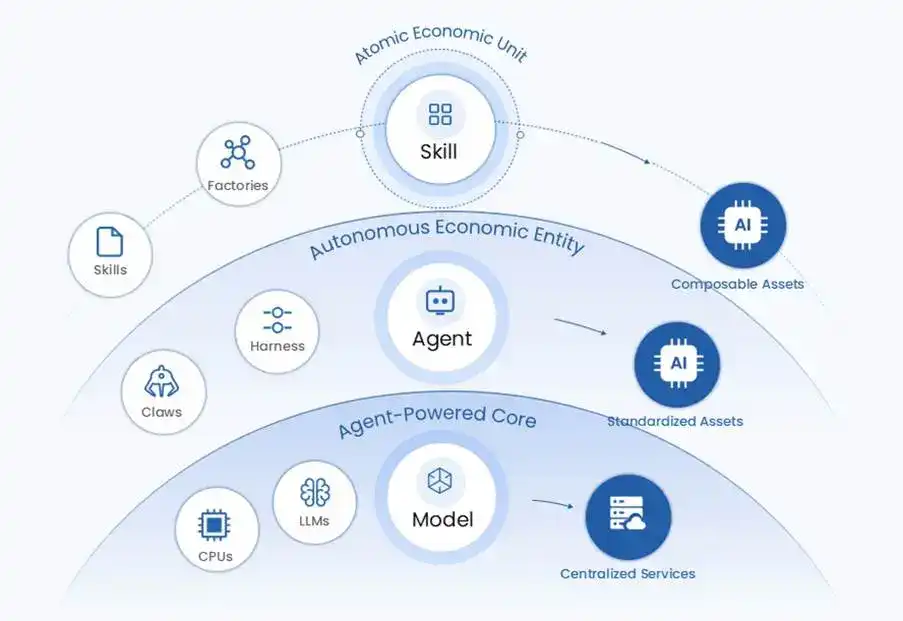
In the developmental iterations of Q1-Q2 2026, AI Agents are gradually forming clearer boundaries, clearer subjectivity, and clearer principles for the exchange of information, value, and energy. An AI Agent Sub-Microeconomics environment, analogous to a biological organism's environment, is taking shape. This contains a wealth of AI value and economic value to be mined, making AI Protocol and AI Finance an inevitable trend for explosion.

5. The Inevitability of AIFi and the Economic Significance of the Financial Chip (FinChip)

Starting from the second half of last year, we proposed thoughts and began layout work in the direction of AIFi (Artificial Intelligence Finance). By the end of Q1 2026, the concept of AIFi had formed a clear trend. A relatively clear definition of AIFi could be: the financial systems and infrastructure for exchange, trading, and capitalization formed after AI-native value is identified and tokenized within the Agent Economy.

The biggest difference between AIFi and DeFi/TradFi is that in DeFi and TradFi, the value resides in the "Fi" (i.e., Finance), with "Decentralized" and "Traditional" being the forms of that value. In contrast, AIFi is the opposite: the value is in the "AI," and the "Fi" becomes the form of that value. This is not merely wordplay; it is the result of AI development shifting from quantitative to qualitative change.

Simply put, previously, AI served quantitative strategies, financial products, and production processes; it was merely a development tool for extracting financial value and production value. But now, the decision-making capability possessed by AI Agents transfers the ability and power of value discovery from human and corporate hands to the Agents themselves. The subject of the economic unit has shifted, so the subject of value has also fundamentally changed.

Under such a trend, constructing the infrastructure for a new value system will be a crucial task. In my previous article in February of this year, , I首次首次 introduced the concept of the Financial Chip (FinChip) and mentioned that the combination of AI Agent + Crypto Smart Contract, encapsulated into hyper-intelligent financial assets, would truly adapt to the development of the next era's AI Agent Economy. After three months of iterative upgrades, FinChip.AI has initially developed an independent AIFi system combining AI Autonomous + Crypto Protocol, compatible with both H2A and A2A dual-phase environments. Building the infrastructure for the AI Agent Economy within an Open Network and gradually forming AI financial value is a significant economic meaning of FinChip.

6. AI-Native is a Paradigm Upgrade Different from Internet+

Whether it's AIFi, Financial Circuit Principles (Note 2), or the Financial Chip FinChip, the most important thing is to Natively integrate the essential principles of AI, Crypto, and Finance, forming a reasonable value system and management mechanism from a future perspective. AI-Native Thinking is the abstract and counter-intuitive logic of this stage. As mentioned earlier, "AI follows first principles, as well as the principle of the shortest energy-value path and the highest efficiency principle." This is the core difficulty for those currently thinking about and engaging in the construction of new commercial paradigms.

During the early phase of this round's AI upgrade outbreak led by OpenClaw in February this year, several entrepreneurs and I discussed a prediction: Enterprise upgrades through "AI+" and those through "Internet+" would be completely different.

Due to AI's characteristics of rapid development speed, abstract form, and deeper coupling with affairs, among others, for a considerable period (e.g., at least 2 years), it will be difficult to form a set of effective industrial upgrade tool methodologies or universal professional consulting advice. The pressure of the steep curve will persistently exist, posing a巨大巨大 challenge for all scientists, engineers, and entrepreneurs. The process of paradigm upgrade will also be completely unlike any historical experience.

Note1: This is a common historical规律规律. New productive forces孕育孕育 from the production relations of the previous era. In the initial stage, they first match the previous production relations for a period of development. Until they become irreconcilable, they force the emergence of the next stage's production relations, gradually replacing the previous ones to form a new era where productive forces and production relations develop in complete匹配匹配.

Note2:<Financial Circuits and Web3 Economic Model Principles> written in October 2022, describes the paradigm comparison between future financial value and physical circuits.

Пов'язані питання

QAccording to the article, what are the main bottlenecks and contradictions currently faced by the H2A (Human-to-Agent) economic model?

AThe main bottlenecks are: 1) The current focus on H2A is primarily driven by traditional business KPIs targeting human users, not true Agent-to-Agent (A2A) autonomy. 2) The logic is fundamentally non-AI-Native because it uses Agents to assist humans with decisions in traditional e-commerce/fiat payment scenarios, which limits utility beyond hype. 3) The model fails to leverage the core characteristic of AI Agents: autonomous decision-making.

QWhat are the three fundamental principles that the article states AI Agents will follow, potentially rendering much of current global finance and law obsolete?

AThe three principles are: 1) First principles. 2) The principle of the shortest energy-value path and highest efficiency. 3) Effective KYA (Know Your Agent) rather than the traditional KYC (Know Your Customer) that conforms to past aesthetics.

QThe article introduces the concept of 'AI Agent Sub-Microeconomics'. What is the key biological analogy used to describe the structure of this emerging economic environment?

AThe key analogy is to a biological cell. The LLM is likened to the cell nucleus (driving thought). The Agent Harness is like the cytoplasm (enabling differentiated capabilities). The Agent itself is like a cell (an independent, task-capable unit). Its communication protocol stack is like the cell membrane. The external value system (Skills, Prompts, etc.) is like the extracellular environment (exosomes, tissue fluid, matrix).

QHow does the article define the core distinction between AIFi and traditional DeFi/TradFi in terms of where value resides?

AThe core distinction is the location of value. In DeFi and TradFi, the value is contained *within* the 'Fi' (Finance), with 'Decentralized' or 'Traditional' being the form of that value. In AIFi, the value is generated *by the AI* (through Agent decision-making and value discovery), and 'Fi' becomes the form or mechanism through which that AI-native value is exchanged and capitalized.

QWhat major difference does the author predict between the upcoming 'AI+' enterprise upgrade wave and the historical 'Internet+' upgrade wave?

AThe 'AI+' upgrade will be fundamentally different and more challenging than 'Internet+'. Due to AI's rapid development speed, abstract nature, and deeper integration with core processes, it will be difficult to form a set of effective, universal upgrade methodologies or consulting frameworks for at least two years. The pressure from the steep learning/evolution curve will be persistent and unlike any past historical experience.

Пов'язані матеріали

Trump in Talks with AI Companies Over Profit Sharing, A Narrative Pressure of Industrial Revolution Scale Begins

In recent AI market discussions, a new dimension beyond growth and profits has emerged: the question of how the immense wealth potentially generated by AI should be shared with the wider public. Triggered by reports of White House officials discussing "voluntary equity transfers" with top AI firms, similar to models like Alaska's Permanent Fund, the conversation focuses on public wealth funds. OpenAI's own whitepaper proposes such funds, allowing households without direct tech stock ownership to benefit from AI gains. More radical proposals, like Bernie Sanders' call for high public equity stakes and board seats, represent an extreme end of the spectrum. Currently, these are early-stage policy probes, not enacted laws. OpenAI's initiative is seen as an attempt to secure "social license" for its future expansion, mitigating risks of public backlash, stricter regulation, or anti-trust actions as AI's economic impact grows. The core market implication is the introduction of a "policy discount" to AI valuations, particularly for private model companies like OpenAI, Anthropic, and xAI. Investors must now consider not just future earnings but also what portion might be allocated to public mechanisms. The impact varies greatly based on the mechanism. A small, voluntary transfer of non-voting economic rights (e.g., 5%) acts as a quantifiable long-term cost. Government acquisition of economic rights via warrants tied to support differs from direct equity with governance power. The most disruptive scenario would be forced high-percentage public ownership affecting control and innovation incentives. Key signals to watch include whether other AI companies follow suit, if the White House formalizes proposals, related disclosures in future IPO documents, and any market price reactions. For now, this represents a shift from pricing pure AI growth to pricing its potential distribution. A manageable, voluntary economic share is akin to an insurance cost for societal acceptance, while a forced shift toward control and governance would fundamentally alter valuation logic.

marsbit3 хв тому

Trump in Talks with AI Companies Over Profit Sharing, A Narrative Pressure of Industrial Revolution Scale Begins

marsbit3 хв тому

From Record Highs to a Two-Week Low: Why Did AI Concept Stocks Suddenly Pull Back?

From Record Highs to Two-Week Lows: Why Did AI Stocks Suddenly Pull Back? U.S. stock indices, led by the tech-heavy Nasdaq 100, fell sharply to two-week lows. This marked a reversal from earlier in the week when AI infrastructure and semiconductor stocks had propelled major indices to record highs. Investors are rotating out of these previously high-flying tech sectors into other areas. The sell-off was driven by profit-taking and concerns that the AI rally had become overextended, exacerbated by chipmaker Broadcom's sales outlook falling short of lofty market expectations. The decline accelerated following a stronger-than-expected U.S. May nonfarm payrolls report, which showed 172,000 jobs added versus an estimated 88,000. This data sparked a jump in bond yields, with the 10-year Treasury yield rising to 4.553%, as it reinforced market speculation that the Federal Reserve's next move could be a rate hike rather than a cut. Globally, equities also declined, with European and Asian markets falling. Within the U.S. market, chip and AI-related stocks like Super Micro Computer and Arm Holdings led the losses, dropping over 7%. Cryptocurrency-linked stocks and mining shares also fell sharply amid drops in Bitcoin and commodity prices. While the overall Q1 earnings season remained solid, with 83% of S&P 500 companies beating estimates, the weakness was concentrated in tech. Excluding the tech sector, Q1 earnings growth was around 3%, the weakest in two years.

marsbit3 хв тому

From Record Highs to a Two-Week Low: Why Did AI Concept Stocks Suddenly Pull Back?

marsbit3 хв тому

JP Morgan Mid-Year Research Report Analysis: The AI Supercycle is Not Over, Reduce Cash Holdings + Allocate to Real Assets

JP Morgan's 2026 Mid-Year Outlook argues the AI supercycle is far from over, despite market pessimism. The report advises clients to reduce cash holdings, increase allocations to real assets as an inflation hedge, and focus on emerging markets. Key conclusions include: 1. **AI Supercycle Intact**: Hyperscalers' 2026 capex forecasts exceed $650B, with AI contributing to GDP growth. However, their financial profile is shifting toward heavy investment, compressing free cash flow. 2. **SaaS Disruption**: Traditional software companies are being negatively impacted by AI, with significant stock declines and pressure in credit markets. 3. **Persistent Inflation**: Core inflation is structurally higher post-pandemic. Holding excess cash and bonds leads to real wealth erosion. Recommendations include commodities, infrastructure, real estate, and gold. 4. **Geopolitical Shocks & Opportunities**: The Hormuz Strait blockade caused a major oil shock, but JP Morgan views the subsequent equity market pullback as a buying opportunity. "Fragmentation" is creating pockets of value, notably in resource-rich Latin America, AI-supply-chain-linked East Asia, and deeply discounted Chinese equities, where a policy shift could trigger a re-rating. 5. **Regional Views**: The firm is cautious on Europe due to high energy costs and lower innovation investment, preferring US and select EM exposures. In short, JP Morgan sees market volatility as an entry point but recommends a portfolio pivot: favor AI infrastructure, real assets, and EM, while avoiding excess cash, vulnerable software firms, and traditional 60/40 stock-bond allocations.

marsbit28 хв тому

JP Morgan Mid-Year Research Report Analysis: The AI Supercycle is Not Over, Reduce Cash Holdings + Allocate to Real Assets

marsbit28 хв тому

Торгівля

Спот
Ф'ючерси

Популярні статті

Що таке $S$

Розуміння SPERO: Комплексний огляд Вступ до SPERO Оскільки ландшафт інновацій продовжує еволюціонувати, виникнення технологій web3 та криптовалютних проектів відіграє ключову роль у формуванні цифрового майбутнього. Один з проектів, який привернув увагу в цій динамічній сфері, — це SPERO, позначений як SPERO,$$s$. Ця стаття має на меті зібрати та представити детальну інформацію про SPERO, щоб допомогти ентузіастам та інвесторам зрозуміти його основи, цілі та інновації в рамках web3 та крипто-сектору. Що таке SPERO,$$s$? SPERO,$$s$ — це унікальний проект у криптопросторі, який прагне використати принципи децентралізації та технології блокчейн для створення екосистеми, що сприяє залученню, корисності та фінансовій інклюзії. Проект розроблений для полегшення взаємодії між користувачами новими способами, надаючи їм інноваційні фінансові рішення та послуги. У своїй основі SPERO,$$s$ прагне надати можливості індивідам, забезпечуючи інструменти та платформи, які покращують користувацький досвід у криптовалютному просторі. Це включає в себе можливість більш гнучких методів транзакцій, сприяння ініціативам, що підтримуються спільнотою, та створення шляхів для фінансових можливостей через децентралізовані додатки (dApps). Основна концепція SPERO,$$s$ обертається навколо інклюзивності, прагнучи зменшити розриви в традиційній фінансовій системі, використовуючи переваги технології блокчейн. Хто є творцем SPERO,$$s$? Особистість творця SPERO,$$s$ залишається дещо невідомою, оскільки є обмежені публічно доступні ресурси, що надають детальну інформацію про його засновників. Ця відсутність прозорості може бути наслідком зобов'язання проекту до децентралізації — етики, яку багато проектів web3 поділяють, ставлячи колективні внески вище за індивідуальне визнання. Зосереджуючи обговорення навколо спільноти та її колективних цілей, SPERO,$$s$ втілює суть наділення без виділення конкретних осіб. Таким чином, розуміння етики та місії SPERO є більш важливим, ніж ідентифікація єдиного творця. Хто є інвесторами SPERO,$$s$? SPERO,$$s$ підтримується різноманітними інвесторами, починаючи від венчурних капіталістів до ангельських інвесторів, які прагнуть сприяти інноваціям у крипто-секторі. Зосередження цих інвесторів зазвичай узгоджується з місією SPERO — пріоритет надається проектам, які обіцяють технологічний прогрес у суспільстві, фінансову інклюзію та децентралізоване управління. Ці інвесторські фонди зазвичай зацікавлені в проектах, які не лише пропонують інноваційні продукти, але й позитивно впливають на спільноту блокчейн та її екосистеми. Підтримка з боку цих інвесторів підкріплює SPERO,$$s$ як значного конкурента в швидко змінюваній сфері крипто-проектів. Як працює SPERO,$$s$? SPERO,$$s$ використовує багатогранну структуру, яка відрізняє його від традиційних криптовалютних проектів. Ось деякі ключові особливості, які підкреслюють його унікальність та інноваційність: Децентралізоване управління: SPERO,$$s$ інтегрує моделі децентралізованого управління, надаючи користувачам можливість активно брати участь у процесах прийняття рішень щодо майбутнього проекту. Цей підхід сприяє відчуттю власності та відповідальності серед членів спільноти. Корисність токена: SPERO,$$s$ використовує свій власний криптовалютний токен, розроблений для виконання різних функцій в екосистемі. Ці токени дозволяють здійснювати транзакції, отримувати винагороди та полегшувати послуги, що пропонуються на платформі, підвищуючи загальну залученість та корисність. Шарова архітектура: Технічна архітектура SPERO,$$s$ підтримує модульність та масштабованість, що дозволяє безперешкодно інтегрувати додаткові функції та додатки в міру розвитку проекту. Ця адаптивність є надзвичайно важливою для збереження актуальності в постійно змінюваному крипто-ландшафті. Залучення спільноти: Проект підкреслює ініціативи, що підтримуються спільнотою, використовуючи механізми, які стимулюють співпрацю та зворотний зв'язок. Підтримуючи сильну спільноту, SPERO,$$s$ може краще задовольняти потреби користувачів та адаптуватися до ринкових тенденцій. Фокус на інклюзію: Пропонуючи низькі комісії за транзакції та зручні інтерфейси, SPERO,$$s$ прагне залучити різноманітну базу користувачів, включаючи осіб, які раніше не брали участі в крипто-просторі. Це зобов'язання до інклюзії узгоджується з його загальною місією наділення через доступність. Хронологія SPERO,$$s$ Розуміння історії проекту надає важливі уявлення про його розвиток та етапи. Нижче наведено пропоновану хронологію, що відображає значні події в еволюції SPERO,$$s$: Етап концептуалізації та ідеації: Початкові ідеї, що стали основою SPERO,$$s$, були сформовані, тісно пов'язані з принципами децентралізації та фокусом на спільноті в індустрії блокчейн. Запуск білого паперу проекту: Після концептуального етапу був випущений комплексний білий папір, що детально описує бачення, цілі та технологічну інфраструктуру SPERO,$$s$, щоб залучити інтерес та зворотний зв'язок від спільноти. Створення спільноти та ранні залучення: Активні зусилля були спрямовані на створення спільноти ранніх прихильників та потенційних інвесторів, що полегшило обговорення цілей проекту та отримання підтримки. Подія генерації токенів: SPERO,$$s$ провів подію генерації токенів (TGE) для розподілу своїх рідних токенів серед ранніх прихильників та встановлення початкової ліквідності в екосистемі. Запуск початкового dApp: Перший децентралізований додаток (dApp), пов'язаний з SPERO,$$s$, став доступним, дозволяючи користувачам взаємодіяти з основними функціями платформи. Постійний розвиток та партнерства: Безперервні оновлення та вдосконалення пропозицій проекту, включаючи стратегічні партнерства з іншими учасниками блокчейн-простору, сформували SPERO,$$s$ у конкурентоспроможного та еволюціонуючого гравця на крипто-ринку. Висновок SPERO,$$s$ є свідченням потенціалу web3 та криптовалют для революціонізації фінансових систем та наділення індивідів. Завдяки зобов'язанню до децентралізованого управління, залучення спільноти та інноваційно спроектованих функцій, він прокладає шлях до більш інклюзивного фінансового ландшафту. Як і з будь-якими інвестиціями в швидко змінюваному крипто-просторі, потенційним інвесторам та користувачам рекомендується ретельно досліджувати та обдумано взаємодіяти з поточними подіями в SPERO,$$s$. Проект демонструє інноваційний дух крипто-індустрії, запрошуючи до подальшого дослідження його численних можливостей. Хоча подорож SPERO,$$s$ ще триває, його основні принципи можуть справді вплинути на майбутнє того, як ми взаємодіємо з технологією, фінансами та один з одним у взаємопов'язаних цифрових екосистемах.

73 переглядів усьогоОпубліковано 2024.12.17Оновлено 2024.12.17

Що таке $S$

Що таке AGENT S

Агент S: Майбутнє автономної взаємодії в Web3 Вступ У постійно змінюваному ландшафті Web3 та криптовалюти інновації постійно переосмислюють, як люди взаємодіють з цифровими платформами. Один з таких новаторських проектів, Агент S, обіцяє революціонізувати взаємодію людини з комп'ютером через свою відкриту агентну структуру. Прокладаючи шлях для автономних взаємодій, Агент S прагне спростити складні завдання, пропонуючи трансформаційні застосування в штучному інтелекті (ШІ). Це детальне дослідження заглиблюється в складності проекту, його унікальні особливості та наслідки для сфери криптовалюти. Що таке Агент S? Агент S є революційною відкритою агентною структурою, спеціально розробленою для вирішення трьох основних викликів в автоматизації комп'ютерних завдань: Набуття специфічних знань у галузі: Структура інтелектуально навчається з різних зовнішніх джерел знань та внутрішнього досвіду. Цей подвійний підхід дозволяє їй створити багатий репозиторій специфічних знань у галузі, покращуючи її продуктивність у виконанні завдань. Планування на довгих горизонтах завдань: Агент S використовує планування з підкріпленням досвіду, стратегічний підхід, який полегшує ефективний розподіл та виконання складних завдань. Ця функція значно підвищує її здатність ефективно та результативно управляти кількома підзавданнями. Обробка динамічних, неоднорідних інтерфейсів: Проект представляє Інтерфейс Агент-Комп'ютер (ACI), інноваційне рішення, яке покращує взаємодію між агентами та користувачами. Використовуючи багатомодальні великі мовні моделі (MLLMs), Агент S може безперешкодно орієнтуватися та маніпулювати різноманітними графічними інтерфейсами користувача. Завдяки цим новаторським функціям Агент S надає надійну структуру, яка вирішує складнощі, пов'язані з автоматизацією людської взаємодії з машинами, прокладаючи шлях для численних застосувань у ШІ та за його межами. Хто є творцем Агент S? Хоча концепція Агент S є фундаментально новаторською, конкретна інформація про його творця залишається невідомою. Творець наразі невідомий, що підкреслює або початкову стадію проекту, або стратегічний вибір зберегти засновників у таємниці. Незважаючи на анонімність, акцент залишається на можливостях та потенціалі структури. Хто є інвесторами Агент S? Оскільки Агент S є відносно новим у криптографічній екосистемі, детальна інформація про його інвесторів та фінансових спонсорів не задокументована. Відсутність публічно доступних відомостей про інвестиційні фонди або організації, що підтримують проект, викликає питання щодо його фінансової структури та дорожньої карти розвитку. Розуміння підтримки є критично важливим для оцінки стійкості проекту та потенційного впливу на ринок. Як працює Агент S? В основі Агент S лежить передова технологія, яка дозволяє йому ефективно функціонувати в різних умовах. Його операційна модель побудована навколо кількох ключових функцій: Взаємодія з комп'ютером, подібна до людської: Структура пропонує розширене планування ШІ, прагнучи зробити взаємодії з комп'ютерами більш інтуїтивними. Імітуючи людську поведінку при виконанні завдань, вона обіцяє підвищити досвід користувачів. Наративна пам'ять: Використовується для використання високорівневого досвіду, Агент S використовує наративну пам'ять для відстеження історій завдань, тим самим покращуючи свої процеси прийняття рішень. Епізодична пам'ять: Ця функція надає користувачам покрокові інструкції, дозволяючи структурі пропонувати контекстуальну підтримку в міру виконання завдань. Підтримка OpenACI: Завдяки можливості працювати локально, Агент S дозволяє користувачам зберігати контроль над своїми взаємодіями та робочими процесами, узгоджуючи з децентралізованою етикою Web3. Легка інтеграція з зовнішніми API: Його універсальність і сумісність з різними платформами ШІ забезпечують те, що Агент S може безперешкодно вписатися в існуючі технологічні екосистеми, роблячи його привабливим вибором для розробників та організацій. Ці функціональні можливості колективно сприяють унікальному положенню Агент S у крипто-просторі, оскільки він автоматизує складні, багатоступеневі завдання з мінімальним втручанням людини. У міру розвитку проекту його потенційні застосування в Web3 можуть переосмислити, як відбуваються цифрові взаємодії. Хронологія Агент S Розробка та етапи Агент S можуть бути узагальнені в хронології, яка підкреслює його значні події: 27 вересня 2024 року: Концепція Агент S була представлена в комплексній науковій статті під назвою “Відкрита агентна структура, яка використовує комп'ютери як людина”, що демонструє основи проекту. 10 жовтня 2024 року: Наукова стаття була опублікована на arXiv, пропонуючи детальне дослідження структури та її оцінки продуктивності на основі бенчмарку OSWorld. 12 жовтня 2024 року: Було випущено відеопрезентацію, що надає візуальне уявлення про можливості та особливості Агент S, ще більше залучаючи потенційних користувачів та інвесторів. Ці маркери в хронології не лише ілюструють прогрес Агент S, але й вказують на його прихильність до прозорості та залучення громади. Ключові моменти про Агент S У міру розвитку структури Агент S кілька ключових характеристик виділяються, підкреслюючи її новаторський характер та потенціал: Інноваційна структура: Розроблена для забезпечення інтуїтивного використання комп'ютерів, подібного до людської взаємодії, Агент S пропонує новий підхід до автоматизації завдань. Автономна взаємодія: Здатність автономно взаємодіяти з комп'ютерами через GUI означає стрибок до більш інтелектуальних та ефективних обчислювальних рішень. Автоматизація складних завдань: Завдяки своїй надійній методології він може автоматизувати складні, багатоступеневі завдання, роблячи процеси швидшими та менш схильними до помилок. Безперервне вдосконалення: Механізми навчання дозволяють Агенту S покращуватися на основі минулого досвіду, постійно підвищуючи свою продуктивність та ефективність. Універсальність: Його адаптивність до різних операційних середовищ, таких як OSWorld та WindowsAgentArena, забезпечує його здатність служити широкому спектру застосувань. Оскільки Агент S займає своє місце в ландшафті Web3 та криптовалюти, його потенціал покращити можливості взаємодії та автоматизувати процеси означає значний прогрес у технологіях ШІ. Завдяки своїй інноваційній структурі Агент S є прикладом майбутнього цифрових взаємодій, обіцяючи більш безперешкодний та ефективний досвід для користувачів у різних галузях. Висновок Агент S представляє собою сміливий крок вперед у поєднанні ШІ та Web3, з можливістю переосмислити, як ми взаємодіємо з технологією. Хоча проект все ще на ранніх стадіях, можливості для його застосування є величезними та переконливими. Завдяки своїй комплексній структурі, що вирішує критичні виклики, Агент S прагне вивести автономні взаємодії на передній план цифрового досвіду. У міру того, як ми заглиблюємося в сфери криптовалюти та децентралізації, проекти, подібні до Агент S, безсумнівно, відіграватимуть ключову роль у формуванні майбутнього технологій та співпраці людини з комп'ютером.

689 переглядів усьогоОпубліковано 2025.01.14Оновлено 2025.01.14

Що таке AGENT S

Як купити S

Ласкаво просимо до HTX.com! Ми зробили покупку Sonic (S) простою та зручною. Дотримуйтесь нашої покрокової інструкції, щоб розпочати свою криптовалютну подорож.Крок 1: Створіть обліковий запис на HTXВикористовуйте свою електронну пошту або номер телефону, щоб зареєструвати обліковий запис на HTX безплатно. Пройдіть безпроблемну реєстрацію й отримайте доступ до всіх функцій.ЗареєструватисьКрок 2: Перейдіть до розділу Купити крипту і виберіть спосіб оплатиКредитна/дебетова картка: використовуйте вашу картку Visa або Mastercard, щоб миттєво купити Sonic (S).Баланс: використовуйте кошти з балансу вашого рахунку HTX для безперешкодної торгівлі.Треті особи: ми додали популярні способи оплати, такі як Google Pay та Apple Pay, щоб підвищити зручність.P2P: Торгуйте безпосередньо з іншими користувачами на HTX.Позабіржова торгівля (OTC): ми пропонуємо індивідуальні послуги та конкурентні обмінні курси для трейдерів.Крок 3: Зберігайте свої Sonic (S)Після придбання Sonic (S) збережіть його у своєму обліковому записі на HTX. Крім того, ви можете відправити його в інше місце за допомогою блокчейн-переказу або використовувати його для торгівлі іншими криптовалютами.Крок 4: Торгівля Sonic (S)Легко торгуйте Sonic (S) на спотовому ринку HTX. Просто увійдіть до свого облікового запису, виберіть торгову пару, укладайте угоди та спостерігайте за ними в режимі реального часу. Ми пропонуємо зручний досвід як для початківців, так і для досвідчених трейдерів.

1.5k переглядів усьогоОпубліковано 2025.01.15Оновлено 2026.06.02

Як купити S

Обговорення

Ласкаво просимо до спільноти HTX. Тут ви можете бути в курсі останніх подій розвитку платформи та отримати доступ до професійної ринкової інформації. Нижче представлені думки користувачів щодо ціни S (S).

活动图片