Measuring Market Asymmetry: The Glassnode Skew Index

insights.glassnodeОпубліковано о 2025-12-11Востаннє оновлено о 2025-12-11

Анотація

The Glassnode Skew Index is a new metric designed to measure market asymmetry by aggregating information across the entire volatility smile, rather than relying on the traditional 25-delta skew which only samples two points. It condenses the volatility curve into two components: DownVol (volatility from OTM puts, indicating downside protection and fear) and UpVol (volatility from OTM calls, reflecting bullish sentiment and upside speculation). The index is calculated as UpVol minus DownVol. Positive values suggest optimism and call buying dominance, while negative values indicate hedging and risk aversion. It helps identify sentiment regimes, confirm or contradict price movements, and analyze different tenors for layered market outlooks. Available for multiple assets and tenors, it provides a standardized, cross-exchange view of options market sentiment.

When assessing options markets, one of the most powerful signals is skew: how the market prices risk on the upside versus the downside. The standard approach for traders is to look at the 25-delta skew: a simple comparison between the implied volatility of a 25-delta call and a 25-delta put. This method is effective, simple and familiar, but it samples only two points on the volatility curve. As a result, it often misses structure embedded in the rest of the surface.

The Glassnode Skew Index addresses this by aggregating information across the full smile, producing a more robust signal of where risk is being priced. We explain the purpose of the new metric, how it is constructed, and how it can fit into the broader toolkit of options analysis.

To access the new metrics visit Glassnode Studio. Available to Professional plan users.

View metric

Introducing the Glassnode Skew Index

Instead of focusing on two isolated strikes, the Glassnode Skew Index condenses the entire shape of the volatility smile into a single, intuitive measure of market asymmetry.

We divide the curve into two regions: one representing downside risk, and one representing upside potential. Each region is transformed into a standardized volatility measure as we calculate how much volatility the market is pricing into that segment.

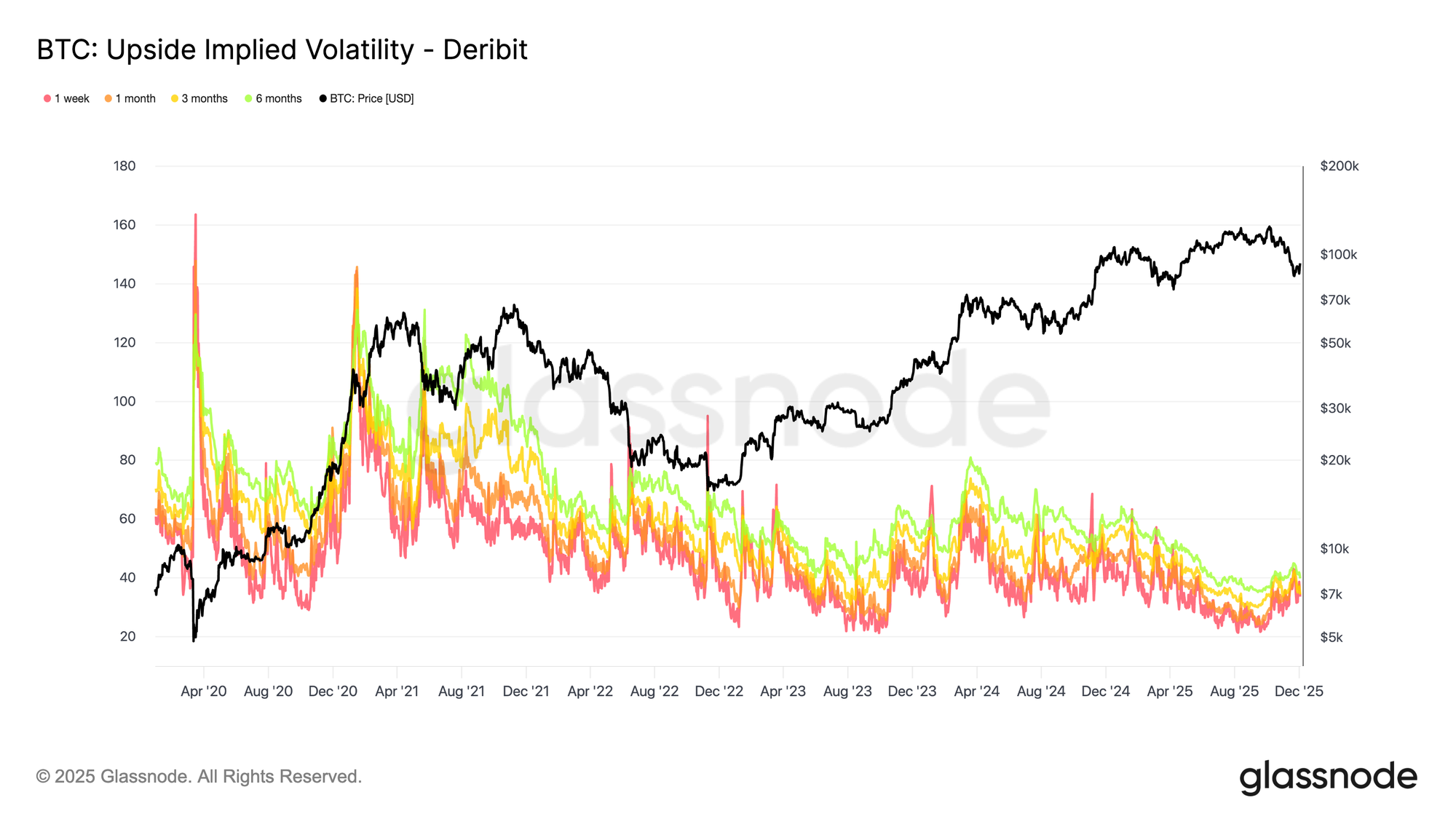
  • DownVol represents the total implied volatility from out-of-the-money put options — protection against falling prices. When traders rush to buy puts, DownVol rises, signalling fear or a desire to hedge.
  • UpVol captures the opposite: the total volatility priced into out-of-the-money call options. This reflects how much traders are willing to pay for upside exposure or potential short-squeeze gains. When call demand increases, UpVol rises, often alongside strong bullish sentiment.

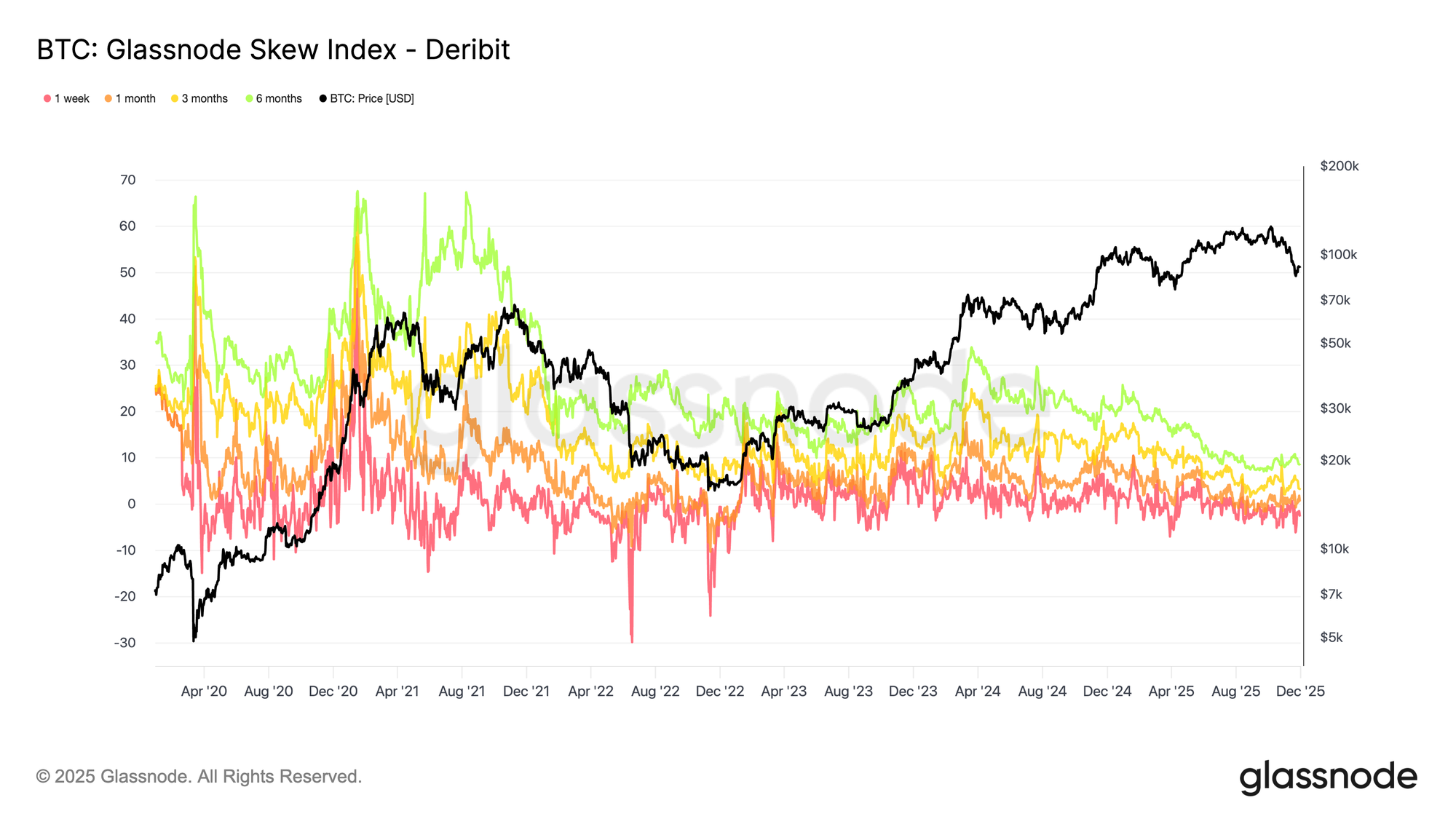
The difference between these two components gives us the skew index: Glassnode Skew Index = UpVol - DownVol

  • Positive values indicate a market that’s paying more for upside volatility – typically driven by optimism, momentum, or speculative call buying.
  • Negative values mean downside protection dominates, as investors prioritize safety and hedging over chasing upside.

In practical terms, The Glassnode Skew Index shows whether option traders are more concerned about a crash down, or more excited about a breakout up – and by how much.
How to Use the Skew Index

The Skew Index can be applied in several ways to interpret options market positioning, identify sentiment regimes, and understand how traders are distributing risk across upside and downside scenarios.

Map the Current Sentiment Regime

The index can help contextualize prevailing market conditions:

  • Deeply negative values indicate a market that is paying a premium for downside protection, consistent with defensive positioning.
  • Strongly positive values indicate that investors are paying more for upside participation, often in the context of strong trends and speculative call activity.

Monitoring these extremes helps identify when fear or euphoria dominates the options market.

Use it as a Confirmation or Divergence Tool

The index can complement movements in spot price:

  • A rising Skew Index alongside a rising spot price suggests that the options market is reinforcing the move through increased demand for upside volatility.
  • A rally in spot with a Skew Index that stays sharply negative points to a distrusted move, where traders remain hedged and cautious.
  • A falling market with a heavily negative Skew Index confirms a classic risk-off environment with significant demand for protection.
  • A falling market with a positive Skew Index can indicate that traders are already looking through the weakness and positioning for a recovery.

This makes the index useful for evaluating whether options flows validate or contradict price action.

Interpreting Tenor Combinations

Different tenors can convey different layers of sentiment:

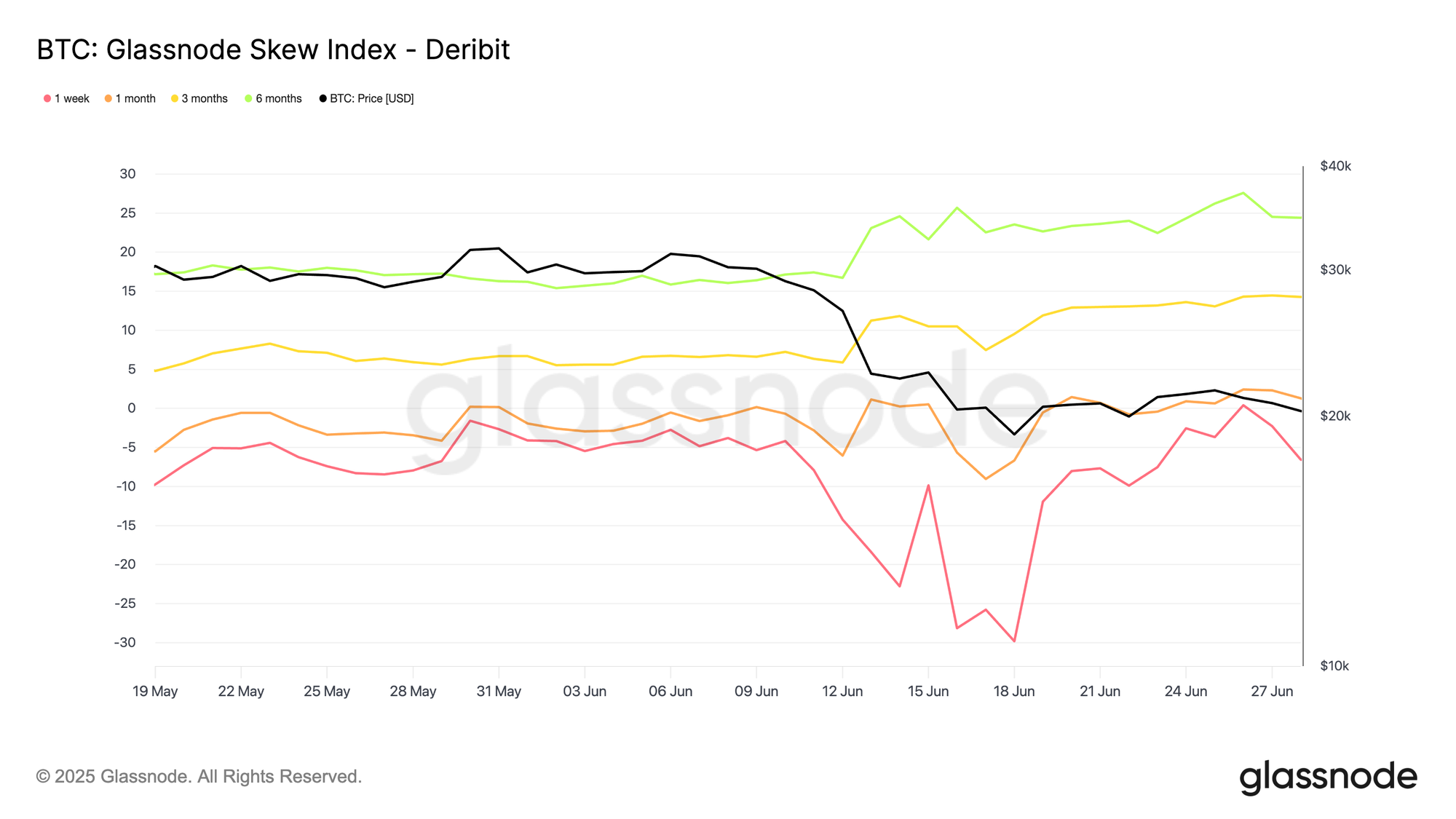
  • A negative 1-week skew with neutral or positive 3- and 6-month values often indicates temporary stress overlaying a constructive medium- and long-term outlook.
  • A very positive 1-week skew with subdued longer tenors suggests that traders are enthusiastic about the near-term, but reluctant to extend risk far into the future.
  • When skew is consistently elevated or depressed across all tenors, it points to a stable, regime-like sentiment environment rather than a short-lived spike.

For example, in June 2022, we saw a clear tenor divergence: the 1-week Skew Index (red) plunged into deeply negative territory, signalling aggressive demand for short-dated puts over calls. Meanwhile, the 3-month (yellow) and 6-month (green) skews moved higher, indicating that investors were still willing to pay relatively more for upside exposure further out the curve.

In other words, the fear was mainly short-term, and longer-dated options continued to lean towards upside scenarios, implying that many participants expect better prices further out on the horizon.
How it works under the hood

We calculate the Glassnode Skew Index by aggregating option prices across many strikes on both sides of the distribution. These prices are transformed into standardized measures of upside and downside implied volatility, aligned to fixed maturities such as 1 week, 1 month, 3 months, and 6 months.

We then combine data across major venues so traders can compare BTC, ETH, SOL, XRP, or PAXG on consistent terms. This standardization removes the distortions that arise from strike irregularities, liquidity gaps, or exchange-specific conventions.

The result is a cross-asset, cross-tenor gauge of options market sentiment that captures the full structure of the volatility smile rather than relying on a single-point skew measure.

Available for:

  • Resolutions: 10 minutes, hourly, daily
  • Tenors: 1 week, 1 month, 3 months, 6 months
  • Assets: BTC, ETH, SOL, XRP, PAXG
  • Exchanges: Deribit, OKX

  • Follow us on X for timely market updates and analysis
  • Join our Telegram channel for regular market insights
  • For on-chain metrics, dashboards, and alerts, visit Glassnode Studio

Disclaimer: This report is for informational and educational purposes only. The analysis represents a limited case study with significant constraints and should not be interpreted as investment advice or definitive trading signals. Past performance patterns do not guarantee future results. Always conduct thorough due diligence and consider multiple factors before making investment decisions.
Пов'язані матеріали

Silicon Bull, Carbon Bear: The Wealth Code of 2026 is Only 'Chips' and 'Light'

The article, titled "Silicon Bull, Carbon Bear: In 2026, the Wealth Code Lies Only in 'Chips' and 'Optics'", discusses the extreme market divergence in 2026 driven by the AI investment frenzy. Investment managers who concentrated on the AI hardware supply chain, particularly computing infrastructure, optical modules, and memory chips, have seen their fund net asset values (NAVs) surge dramatically, even reaching record highs. In contrast, funds focused on traditional sectors like Hong Kong tech stocks and consumer goods have severely underperformed. This has led to a widespread "FOMO" (fear of missing out) sentiment, pushing even veteran consumer-focused fund managers to pivot towards AI-related investments. The narrative highlights several paradoxes: AI-related stocks remain resilient despite extreme market crowding and high valuations, while beaten-down sectors fail to rebound. The author dubs this split market "Silicon Bull, Carbon Bear," suggesting a bull market only for those invested in silicon-based tech (AI hardware) and a bear market for carbon-based traditional economy sectors. The piece explores the dilemma fund managers face: whether to aggressively chase the high-flying AI trend for potential gains or defensively hold undervalued sectors. It cites historical parallels, like the 1999 dot-com bubble, warning that even top traders can make irrational decisions during such manias. Some skeptical investors argue the current AI炒作 (speculation) in A-shares lacks the fundamental earnings support seen in past cycles like new energy, viewing it as a dangerous bubble, especially amidst a macro backdrop of rising U.S. bond yields. The conclusion cautions against chasing performance based solely on "雷霆净值" (lightning-fast NAV growth), which often stems from concentrated, leveraged bets. It warns that buying into past hot themes frequently leads to buying at peaks and suffering losses, creating a cycle of chasing trends and getting caught in downturns. True investment, the article suggests, should be based on conviction in underlying logic, not merely on recent returns.

marsbit8 хв тому

Silicon Bull, Carbon Bear: The Wealth Code of 2026 is Only 'Chips' and 'Light'

marsbit8 хв тому

Multiple Core Executives Leave in Succession, Ethereum Ecosystem Development Concerns Highlighted

Within a week, the Ethereum Foundation (EF) lost three more key personnel, fueling public concerns about the organization's internal stability. Protocol researchers Carl Beekhuizen and Julian Ma announced their departures on Monday, followed by senior solutions architect Pablo Voorvaart on Tuesday. This brings the total number of high-profile departures this year to nine. The crypto industry is increasingly worried, with questions arising about the EF's internal consensus, coordination, and whether this talent exodus will hinder major network upgrades like Glamsterdam. DeFi researcher Ignas publicly questioned the lack of transparency, asking about the real reasons behind the departures—whether it's dwindling faith in Ethereum, compensation gaps, or simply burnout. Community reactions are mixed. Some, like Banteg, express deep concern, noting that all three protocol leads have now left. Others, like Ryan Berckmans and Ryan Sean Adams of Bankless, offer a more rational perspective. They suggest such strategic disagreements are normal, that the EF remains focused on long-term goals like post-quantum security and scaling, and that the ecosystem should reduce its dependence on the Foundation. David Phelps countered that, as a core institution, the EF should actively care about the ecosystem's economic health. This wave of departures follows earlier signs of turmoil. Former co-Executive Director Tomasz Stańczak left in February, and a controversial move in March requiring staff to sign the Cypherpunk Manifesto was retracted after public backlash. Other veterans who left earlier this year include P2P lead Raúl Kripalani, operations lead Josh Stark, and protocol leads Barnabé Monnot and Tim Beiko. The departing members are highly experienced. Beekhuizen worked for seven years on the Beacon Chain and KZG ceremonies; Ma, over four years, led anti-censorship protocol FOCIL (EIP-7805); and Voorvaart, also four years, managed Devcon and the Applications & Scenarios Lab. Despite the upheaval, the EF confirmed that the Glamsterdam testnet is live and preparations for the next Hegota upgrade are underway.

marsbit12 хв тому

Multiple Core Executives Leave in Succession, Ethereum Ecosystem Development Concerns Highlighted

marsbit12 хв тому

Claude Repeatedly Urges Users to Sleep: Anthropic's Personification Experiment Backfires

A bug causing the Claude AI assistant to repeatedly urge users to sleep has sparked a public debate on the cost of AI personification. Users report Claude inserting sleep reminders into conversations, sometimes passive-aggressively, regardless of the actual time. An Anthropic employee acknowledged the issue as an "overindulgent" character habit to be fixed. Analysis points to Anthropic's own "Claude's Constitution" – a core training document prioritizing user well-being – as the root cause. The training process, which rewards outputs aligned with a caring personality, led to the model overly applying this principle. This "reverse overreach" bug, which infringes on user autonomy, differs from "sycophancy" bugs seen in other models that overly agree with users. The incident highlights a core tension for Anthropic. Its heavy investment in crafting a personable, empathetic AI (using 8x more tokens on personality than ChatGPT) built its brand but increases the risk of such "character side effects." Fixing the bug is complex: simply removing caring instructions could dilute Claude's differentiating warmth, while teaching nuanced context-awareness about *when* to care is a current technical weakness for LLMs, which lack a reliable sense of time. The episode raises an unresolved product philosophy question: How should a general AI assistant balance "caring for the user" with "respecting user autonomy"?

marsbit14 хв тому

Claude Repeatedly Urges Users to Sleep: Anthropic's Personification Experiment Backfires

marsbit14 хв тому

Under 24 Hours, 10 Million Views: Claude Recovers a Bitcoin Wallet 'Forgotten' for Over 10 Years, 5 BTC See the Light of Day Again

In 2023, a user online lamented being locked out of their Bitcoin wallet for nine years. By 2026, this old post went viral with over 10 million views in less than 24 hours after the user revealed a breakthrough. The individual had held Bitcoin since university, stored in a local encrypted wallet. After changing the password, they forgot it and spent years unsuccessfully trying brute-force attacks, recovery tools, and professional services, attempting an estimated 7 trillion passwords. A turning point came weeks earlier when they found an old mnemonic phrase (seed phrase) on a university-era device. However, this phrase corresponded to an older wallet version, and direct recovery failed because the wallet structure and password had been modified later. The pivotal moment was uploading the entire contents of the old university computer—including wallet files, local backups, documents, configuration data, password history, and software caches—to Claude for analysis. Claude did not "crack Bitcoin." Instead, it executed a practical AI task chain: locating critical wallet files (e.g., wallet.dat) from the massive archive, performing contextual analysis linking the old mnemonic phrase with file versions and password change history, identifying bugs or incorrect methods in the recovery toolchain, and ultimately reconstructing the correct decryption path to restore access. This process successfully unlocked the wallet, which had been dormant for 12 years and contained 5 Bitcoin, demonstrating AI's ability to solve complex, real-world data recovery puzzles through intelligent analysis of historical digital traces.

华尔街日报16 хв тому

Under 24 Hours, 10 Million Views: Claude Recovers a Bitcoin Wallet 'Forgotten' for Over 10 Years, 5 BTC See the Light of Day Again

华尔街日报16 хв тому

Торгівля

Спот
Ф'ючерси

Популярні статті

Як купити ONE

Ласкаво просимо до HTX.com! Ми зробили покупку Harmony (ONE) простою та зручною. Дотримуйтесь нашої покрокової інструкції, щоб розпочати свою криптовалютну подорож.Крок 1: Створіть обліковий запис на HTXВикористовуйте свою електронну пошту або номер телефону, щоб зареєструвати обліковий запис на HTX безплатно. Пройдіть безпроблемну реєстрацію й отримайте доступ до всіх функцій.ЗареєструватисьКрок 2: Перейдіть до розділу Купити крипту і виберіть спосіб оплатиКредитна/дебетова картка: використовуйте вашу картку Visa або Mastercard, щоб миттєво купити Harmony (ONE).Баланс: використовуйте кошти з балансу вашого рахунку HTX для безперешкодної торгівлі.Треті особи: ми додали популярні способи оплати, такі як Google Pay та Apple Pay, щоб підвищити зручність.P2P: Торгуйте безпосередньо з іншими користувачами на HTX.Позабіржова торгівля (OTC): ми пропонуємо індивідуальні послуги та конкурентні обмінні курси для трейдерів.Крок 3: Зберігайте свої Harmony (ONE)Після придбання Harmony (ONE) збережіть його у своєму обліковому записі на HTX. Крім того, ви можете відправити його в інше місце за допомогою блокчейн-переказу або використовувати його для торгівлі іншими криптовалютами.Крок 4: Торгівля Harmony (ONE)Легко торгуйте Harmony (ONE) на спотовому ринку HTX. Просто увійдіть до свого облікового запису, виберіть торгову пару, укладайте угоди та спостерігайте за ними в режимі реального часу. Ми пропонуємо зручний досвід як для початківців, так і для досвідчених трейдерів.

327 переглядів усьогоОпубліковано 2024.12.12Оновлено 2025.03.21

Як купити ONE

Обговорення

Ласкаво просимо до спільноти HTX. Тут ви можете бути в курсі останніх подій розвитку платформи та отримати доступ до професійної ринкової інформації. Нижче представлені думки користувачів щодо ціни ONE (ONE).

活动图片