China's Export Controls to Japan Create Bottleneck; 'White-Haired Stock God' Serenity Claims South Korea's Foosung to Become a 'Big Winner'

marsbitОпубліковано о 2026-06-15Востаннє оновлено о 2026-06-15

Анотація

China's export controls on tungsten have triggered a supply crisis in the AI memory chip sector. Japan, accounting for 25% of global WF6 (tungsten hexafluoride) production, faces imminent shutdowns due to shortages of tungsten precursor from China. This forces major Korean chipmakers like Samsung and SK Hynix to urgently seek alternatives. Korean suppliers SK Specialty and Foosung are moving to fill the gap. SK Specialty has signed a long-term contract to supply Samsung with 150 tons of WF6 monthly. Foosung has begun certification with China's CSSC Specialty Gases to start large-scale WF6 imports by August. Market analysts, including social media figure "White-Haired Stock God" Serenity, have labeled Foosung a potential "big winner," with its stock rising significantly. The crisis has led to drastic price increases, with 2026 WF6 contract prices set to rise 70-90%. Japanese suppliers warn their key inventories could be depleted by mid-2026. However, the opportunity for Korean firms hinges on continued access to Chinese tungsten powder—a geopolitical choice rather than a permanent technological advantage. The situation highlights the fragility of the concentrated WF6 supply chain and the strategic risks for downstream chip manufacturers.

Author: Ada, Deep Tide TechFlow

The ripple effects of China's tungsten export controls to Japan have now reached the upstream AI memory chip sector.

Japan's 25% share of global WF6 (tungsten hexafluoride) production capacity has entered a countdown to shutdown, forcing Samsung and SK Hynix to urgently seek alternative supplies overnight. South Korea's SK Specialty signed a long-term contract with Samsung for a monthly supply of 150 tons, while Foosung initiated certification with China's CSSC Specialty Gases, aiming for large-scale imports starting August; 2026 WF6 contract prices have been locked in for increases of 70% to 90%. Japanese suppliers warn that key inventories could be depleted by mid-2026. On social platform X, the 'White-Haired Stock God' Serenity singled out Foosung as a 'big winner,' but the inherent risks in this substitution game are equally clear—Korean manufacturers themselves rely on imports for the tungsten powder needed to produce the gas.

Japan's two main WF6 suppliers, Kanto Denka Kogyo and Central Glass, have notified South Korean clients like Samsung, SK Hynix, and DB HiTek that they cannot guarantee supply after May or June. This is a major blow to the downstream memory chip sector following China's implementation of export controls on tungsten-related items in February 2025.
Chain Reaction from China's APT Export Controls, Japan's WF6 Capacity Feels Pressure First

As early as February 2025, China's Ministry of Commerce and the General Administration of Customs jointly announced the inclusion of tungsten-related items into the dual-use items export control list. The impact of this move is now being fully realized over a year later. According to industry analysis firm CTOL Digital, since the controls took effect, Japan's imports of APT (Ammonium Paratungstate, a precursor to tungsten powder) from China on key trade routes plummeted by up to 70%, a figure that directly chokes the supply chain for Japanese WF6 producers.

The pressure arrived faster than the industry anticipated. According to a report on April 3 by South Korean semiconductor media The Elec, citing multiple industry sources, Kanto Denka and Central Glass have begun notifying South Korean chipmakers like Samsung and DB HiTek of potential imminent supply disruptions. One informed source stated, 'Supply can be maintained with existing tungsten inventories in May and June, but the outlook for the second half is unclear.' Japanese producers have suggested their South Korean clients turn to domestic alternatives, SK Specialty and Foosung.

Japan holds about 25% of the global WF6 supply. This means that a production cut by Japanese firms would instantly remove a quarter of the world's tungsten film precursor. According to information agency SunSirs, Samsung and SK Hynix sourced approximately 80% of their WF6 from Japan in the past, placing them squarely on the front lines of the crisis. Among them, Samsung's exposure is significantly higher than SK Hynix's, as the latter's supply portfolio is more diversified, including SK Specialty, Foosung, and China's Peric Special Gases.

SK Specialty Signs 150-ton Monthly Long-Term Supply Deal with Samsung, Korean Leaders Ramp Up Production

In the face of the crisis, South Korean companies demonstrated exceptional execution speed. According to SunSirs, SK Specialty has signed a long-term supply agreement with Samsung for a monthly volume of 150 tons. This scale is unusual under normal circumstances, as WF6 is a high-purity specialty gas, not a bulk commodity that can be easily scaled up.

SK Specialty is South Korea's largest WF6 supplier and benefits from natural group synergy with downstream clients. It belongs to the SK Group, closely tied to SK Hynix within the same group; now, by adding Samsung to its long-term contract list, it essentially secures positions with both of South Korea's top memory manufacturers.

Time is the scarcest resource in this scramble for orders. WF6 is a highly corrosive, hazardous gas requiring purity levels of 5N to 6N (99.999% to 99.9999%). The certification process for new suppliers typically takes 12 to 18 months, covering process testing, yield verification, equipment adaptation, and more. However, according to The Elec, some foundries are 'shortening or skipping parts of the process' for one reason only: urgency.

Foosung Initiates Certification with CSSC Specialty Gases, Targets Large-Scale Imports Starting August

Foosung (Korean code 093370) is taking another route. This South Korean fluorochemical company, with a market cap of about $1.2 billion, is one of SK Hynix's three existing WF6 suppliers, alongside SK Specialty and China's Peric. Beyond WF6, it is also South Korea's sole producer of anhydrous hydrogen fluoride (HF), the country's second-largest WF6 manufacturer, and the sole producer of battery electrolyte salt LiPF6. Its Ulsan plant integrates three fluorochemical production lines, representing highly concentrated technological assets.

According to industry information cited by SunSirs and futunn among other media, Foosung has initiated the certification process with China Shipbuilding Industry Group's CSSC Specialty Gases, aiming to begin large-scale WF6 imports from August. The hidden implication of this move is worth unpacking: Japan halts WF6 production due to tungsten powder shortages, while South Korea's Foosung turns to importing finished WF6 from China. The same tungsten supply chain is segmented by China's export controls into parts that 'restrict Japan' and 'allow South Korea.'

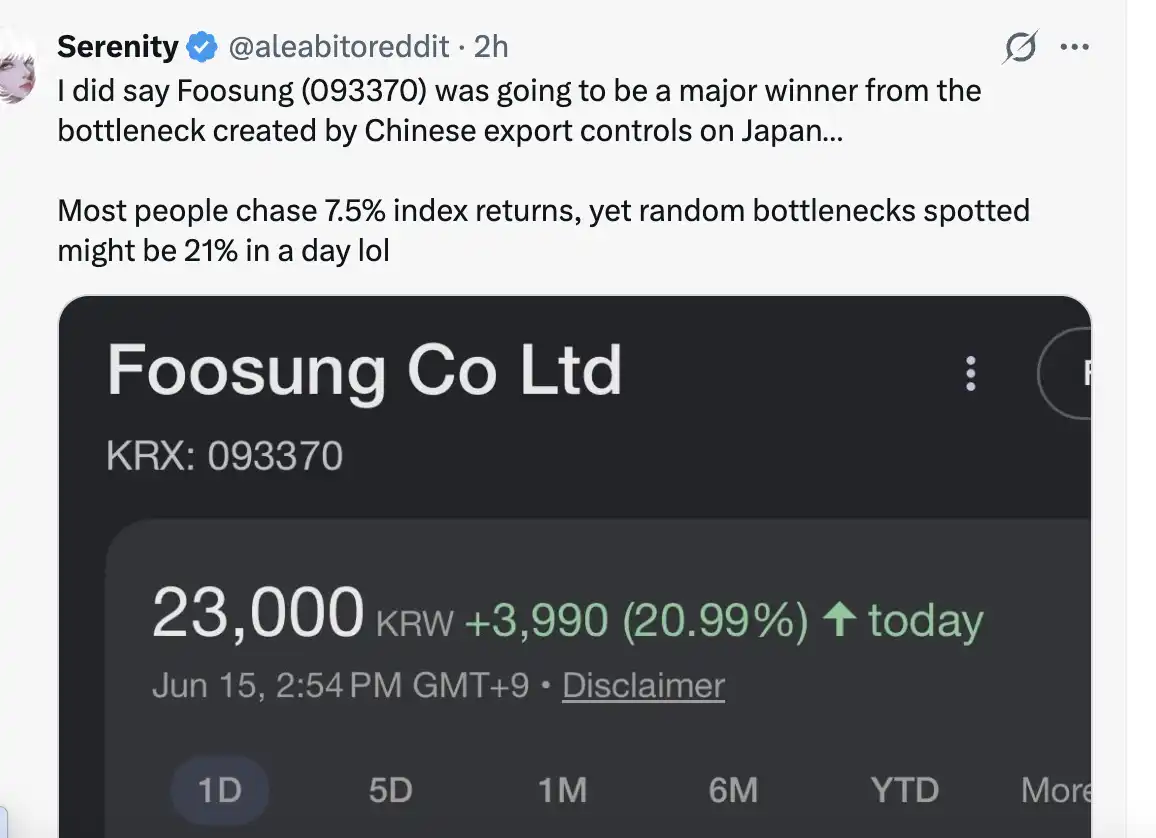
The 'White-Haired Stock God' Serenity on platform X has noted this thread. He posted on June 13, naming Foosung: 'Foosung looks like it will become a huge beneficiary soon. Basically, China's export controls on Japan have caused Japan's WF6 supply chain to collapse, and the 25% of global supply needed by SK Hynix, Samsung, TSMC will have to find alternatives elsewhere.'

The secondary market has already reacted to this logic. According to CTOL Digital, Foosung's stock price has risen approximately 196% over the past 12 months, despite its TTM EPS still being negative.

2026 WF6 Contract Prices to Rise 70% to 90%; Japanese Suppliers Warn of Mid-2026 Inventory Depletion

Price signals at the contract level have already emerged. According to CTOL Digital, South Korea's SK Specialty, Foosung, and Japan's Kanto Denka have formally notified Samsung, SK Hynix, DB HiTek, and Magnachip that 2026 WF6 contract prices will increase by 70% to 90%. This is a collective pricing action within an oligopolistic market, leaving downstream buyers with few alternative options.

An even more cautionary signal comes from the supply side. Also per CTOL Digital, Japanese suppliers have warned that key inventories could be depleted by mid-2026. This implies that even South Korean clients with signed long-term contracts face uncertainty regarding physical deliveries.

The irreplaceability of WF6 is being repriced by the market. Chipmakers cannot simply swap gas cylinders between different suppliers; any deviation in impurities could scrap millions of dollars worth of wafer inventories. This is the fundamental reason for the stringent 12 to 18-month certification process for new suppliers and the underlying logic that sustains the oligopolistic structure.

The stock price reaction is already ahead. According to CTOL Digital, Japan's Kanto Denka's stock price has risen about 374% over the past year, with its market capitalization soaring to 240.3 billion yen and a TTM P/E ratio exceeding 63 times. Foosung's gain in the same period is about 196%, and despite its negative TTM EPS, the market has granted it a significant premium. These valuations reflect not a short-term, event-driven spike but a structural market revaluation of the WF6 oligopoly.

South Korea's Substitution Window Supported by Geopolitics, Not Determined by Technical Barriers

The South Korean companies poised to benefit from Japan's supply disruption are not entirely self-sufficient either. SK Specialty and Foosung, as domestic South Korean WF6 producers, also rely on imported tungsten powder for gas production. The difference so far is that they are being treated differently from their Japanese counterparts. SunSrs states: 'China's export controls have so far primarily targeted Japan. South Korea can still continue importing tungsten powder. This is a geopolitical choice, not a natural outcome of market forces.'

The Chinese domestic supply side is rapidly rising. According to futunn citing industry data, CSSC Specialty Gases will reach a WF6 production capacity of 2,000 tons/year by the end of 2025, with purity reaching 6N levels, and its products have already entered the supply chains of global chipmakers. SunSrs data further indicates that the localization rate of China's fluorine-containing specialty gases has significantly increased to 50% over the past two years.

This reality adds a clear footnote to Foosung's 'winner' narrative. The current window of opportunity is premised on the assumption that 'China continues to allow tungsten powder exports to South Korea,' not locked in by irreplaceable technical barriers. Decision-makers at Samsung and SK Hynix may already be asking themselves the question posed by SunSirs: 'If Japan can be shut down due to raw material shortages, what could prevent South Korea from facing the same fate tomorrow?'

Пов'язані питання

QWhat is WF6 and why is its supply disruption significant for the AI and semiconductor industries?

AWF6 (tungsten hexafluoride) is a high-purity, corrosive specialty gas used as a precursor for tungsten thin films in semiconductor manufacturing, particularly for DRAM and AI memory chips. Its supply disruption is significant because Japan, which accounts for approximately 25% of global WF6 capacity, is facing production shutdowns due to China's export controls on tungsten feedstocks. This directly threatens the supply chains for major memory chipmakers like Samsung and SK Hynix, which heavily rely on Japanese suppliers, potentially causing production bottlenecks and price surges.

QHow are South Korean companies like SK Specialty and Foosung responding to the potential shortage of WF6 from Japan?

ASouth Korean companies are responding by rapidly securing alternative supplies and expanding their roles. SK Specialty has signed a long-term contract with Samsung to supply 150 tons of WF6 per month. Foosung, an existing supplier to SK Hynix, has initiated the qualification process with China's CSSC Specialty Gases to begin large-scale imports of finished WF6 by August 2025. These moves aim to fill the supply gap left by Japanese producers.

QWho is Serenity and what investment thesis did he present regarding Foosung in relation to the supply chain disruption?

ASerenity, a prominent stock commentator known as the 'White-Haired Stock God' on social media platform X, identified South Korean company Foosung as a major potential beneficiary of the supply chain crisis. His thesis is that China's export controls, which crippled Japan's WF6 supply chain, will force major chipmakers (Samsung, SK Hynix, TSMC) to find new sources for the 25% of global WF6 previously supplied by Japan, positioning Foosung to gain significant market share and revenue.

QWhat are the reported projected changes in WF6 contract prices for 2026, and what is driving this increase?

AMajor WF6 suppliers, including SK Specialty, Foosung, and Japan's Kanto Denka, have reportedly notified their customers that contract prices for 2026 will increase by 70% to 90%. This dramatic price hike is driven by the impending supply shortage and the resulting seller's market. With Japanese production shutting down and new supply sources taking time to qualify, the remaining suppliers hold significant pricing power in an oligopolistic market where WF6 is difficult to substitute.

QWhat underlying risk does the article highlight for South Korean companies like Foosung, despite their potential short-term gains?

AThe article highlights that the opportunity for South Korean companies is not based on unassailable technical superiority but on a geopolitical concession. While South Korea can still import tungsten powder from China, Japan cannot. Both SK Specialty and Foosung themselves depend on imported tungsten powder to produce WF6. Therefore, their 'winning' position is contingent on China's continued willingness to supply tungsten to South Korea, making their advantage potentially fragile and subject to future policy shifts by China.

Пов'язані матеріали

Apple Also Has to Pay Rent Now

Apple Pays Rent Too: The Two-Way Flow of "Traffic Tax" and "AI Capability Rent" Between Tech Giants For over two decades, Google has paid Apple an estimated $20 billion annually to remain the default search engine on Safari, a "traffic tax" for a critical user entry point. However, in 2026, the direction of this cash flow partially reversed. Apple agreed to pay Google roughly $1 billion per year to license its Gemini AI models, as Apple's own models reportedly struggled with complex tasks. This creates a unique dynamic: Apple acts as the "landlord" in the established search ecosystem, collecting rent from Google for access. Simultaneously, in the emerging AI arena, Apple becomes the "tenant," paying Google for access to cutting-edge AI capabilities it cannot currently match internally. While Apple claims its new models are "distilled" from Gemini outputs and contain "not a drop" of Google's original code, core dependencies remain. Its knowledge base is refined using Gemini's outputs, and its most powerful cloud model runs on Google's infrastructure. Apple has structured the deal as non-exclusive, allowing it to theoretically switch AI suppliers—a hedge against over-reliance. The future hinges on whether advanced AI models become a commodity (cheap and abundant) or remain a concentrated, scarce resource (expensive and controlled by few). Apple is betting on the former, leveraging its massive device ecosystem to be a powerful, choosy customer. If the latter proves true, its bargaining power could erode. This power dynamic is extending to developers. Apple, Google, and WeChat are all pushing for apps to expose their core functions as standardized "actions" or "intents" that their respective AI assistants (Siri, Gemini, WeChat AI) can directly call. The new scarce resource is no longer just app store visibility, but "being selected by the AI." The currency of "rent" has changed from a 30% revenue share to ceding control over how users interact with an app's functions.

marsbit33 хв тому

Apple Also Has to Pay Rent Now

marsbit33 хв тому

Missed the SpaceX IPO? WEEX's "First Trade Protection" Lets You Experience US Stock Trading Risk-Free.

With the excitement around SpaceX's recent public listing reigniting interest in the US stock market, Chinese investors face significant challenges accessing compliant and convenient trading channels following regulatory actions against major online brokers. This article explores the available options, highlighting their risks and limitations. Traditional paths for US stock investments remain problematic. Qualified Domestic Institutional Investor (QDII) and Listed Open-Ended Fund (LOF) products, while compliant, suffer from high fees, significant purchase premiums, and a very limited selection of assets. Small, unregulated offshore brokers pose substantial risks, including potential insolvency. While secure, VIP accounts at banks in Hong Kong or Singapore require high minimum deposits (often 1-2 million RMB) and in-person visits, placing them out of reach for most retail investors. The article positions cryptocurrency exchanges, specifically their TradFi (traditional finance on-chain) offerings, as a compelling alternative. Platforms like WEEX are noted for providing access to a wide range of US stocks and ETFs, including SpaceX (SPCXON), through tokenized assets. This method offers advantages such as a single account for both crypto and traditional assets, USDT-based settlement avoiding fiat complexities, flexible leverage, and robust risk management. To attract users, WEEX is promoting a "First Trade Guarantee" campaign. Running from June 15 to July 8 (UTC+8), it features a $30,000 prize pool. Users who trade $500 worth of US stock contracts can qualify for a guarantee on their first eligible trade: 100% loss coverage up to $30 or a 20% bonus on profits up to $30. The campaign is presented as a low-risk opportunity for both crypto natives and traditional investors to experience US stock trading.

marsbit34 хв тому

Missed the SpaceX IPO? WEEX's "First Trade Protection" Lets You Experience US Stock Trading Risk-Free.

marsbit34 хв тому

How Difficult is Chip Making? A Division Error Costs 475 Million Dollars

How Hard Is It to Make a Chip? A Division Error Cost $475 Million Chip expert Shi Kan, a researcher at the Chinese Academy of Sciences and a popular tech creator, explains the immense challenges of chip development. Chips are foundational to modern technology, but their creation is extraordinarily difficult. The journey from sand to a functional chip involves complex design and manufacturing, but a critical bottleneck is verification—ensuring the design works flawlessly before costly production. A single, undetected bug can have catastrophic consequences, as illustrated by the infamous 1994 Intel Pentium FDIV bug. A flaw in the floating-point division unit forced a recall costing $475 million. Unlike software, chips cannot be easily patched after manufacture, making "first-time success" paramount. However, industry surveys show only 24% of chip projects achieve this; over three-quarters require at least one costly re-spin due to design flaws. Verification has thus become the dominant phase, consuming up to 70% of the design cycle. The core challenge is a "verification impossible triangle" between high performance, good debuggability, and low cost. Exhaustively verifying a modern CPU core could take 15,000 years with software simulation, or 30 years with advanced hardware emulation—timeframes utterly impractical for development. Despite being essential, verification is often seen as unglamorous "dirty work," receiving less academic attention than fields like AI. Shi and his team are tackling this by developing an agile verification research framework called ENCORE, based on FPGA technology, to improve verification efficiency and debug capability. Beyond research, Shi engages in public science communication through long-form video content, aiming to demystify chip technology, AI, and computer science. He argues for the value of pursuing "hard and long-term" endeavors, whether in the meticulous world of chip verification or in creating substantive educational content, believing such sustained effort is likely the right path forward.

marsbit44 хв тому

How Difficult is Chip Making? A Division Error Costs 475 Million Dollars

marsbit44 хв тому

Blockchain Has Finally Started to Sail into the Mainstream After 18 Years

Blockchain Finds Its True Path After 18 Years: Becoming the Financial Backbone for AI Agents and Autonomy This analysis explores a pivotal shift in the blockchain and crypto investment landscape, driven by the dominance of AI. Major venture capital firms, including Variant, Paradigm, Haun Ventures, and YZi Labs, are moving beyond pure "crypto" investment theses. They are expanding their focus to AI, robotics, and frontier tech, signaling that blockchain is no longer seen as a standalone sector but as an underlying infrastructure layer. The core argument is that blockchain's killer application may not be user-facing apps, but rather providing the economic rails for the coming wave of AI agents, autonomous robots, and automated systems. Key capabilities like self-custody wallets, programmable stablecoins for micropayments, on-chain identity, and verifiable smart contracts are positioned as essential for a future where machines conduct economic activity. The recent $1.4 billion investment by Tether (via its venture arm) in German robotics company NEURA Robotics exemplifies this, aiming to embed Tether's wallet tools directly into robots for autonomous transactions. While many "AI + Crypto" projects remain superficial, the article concludes that true value lies where crypto is a necessary component—enabling machine-to-machine payments, agent autonomy, verifiable data provenance, and open financial settlement for the AI era. For crypto venture capital, this convergence with AI represents both an adaptation to shifting capital flows and a potential path to unlocking the large-scale, non-speculative utility the industry has long sought.

marsbit1 год тому

Blockchain Has Finally Started to Sail into the Mainstream After 18 Years

marsbit1 год тому

Торгівля

Спот
Ф'ючерси

Популярні статті

Що таке $S$

Розуміння SPERO: Комплексний огляд Вступ до SPERO Оскільки ландшафт інновацій продовжує еволюціонувати, виникнення технологій web3 та криптовалютних проектів відіграє ключову роль у формуванні цифрового майбутнього. Один з проектів, який привернув увагу в цій динамічній сфері, — це SPERO, позначений як SPERO,$$s$. Ця стаття має на меті зібрати та представити детальну інформацію про SPERO, щоб допомогти ентузіастам та інвесторам зрозуміти його основи, цілі та інновації в рамках web3 та крипто-сектору. Що таке SPERO,$$s$? SPERO,$$s$ — це унікальний проект у криптопросторі, який прагне використати принципи децентралізації та технології блокчейн для створення екосистеми, що сприяє залученню, корисності та фінансовій інклюзії. Проект розроблений для полегшення взаємодії між користувачами новими способами, надаючи їм інноваційні фінансові рішення та послуги. У своїй основі SPERO,$$s$ прагне надати можливості індивідам, забезпечуючи інструменти та платформи, які покращують користувацький досвід у криптовалютному просторі. Це включає в себе можливість більш гнучких методів транзакцій, сприяння ініціативам, що підтримуються спільнотою, та створення шляхів для фінансових можливостей через децентралізовані додатки (dApps). Основна концепція SPERO,$$s$ обертається навколо інклюзивності, прагнучи зменшити розриви в традиційній фінансовій системі, використовуючи переваги технології блокчейн. Хто є творцем SPERO,$$s$? Особистість творця SPERO,$$s$ залишається дещо невідомою, оскільки є обмежені публічно доступні ресурси, що надають детальну інформацію про його засновників. Ця відсутність прозорості може бути наслідком зобов'язання проекту до децентралізації — етики, яку багато проектів web3 поділяють, ставлячи колективні внески вище за індивідуальне визнання. Зосереджуючи обговорення навколо спільноти та її колективних цілей, SPERO,$$s$ втілює суть наділення без виділення конкретних осіб. Таким чином, розуміння етики та місії SPERO є більш важливим, ніж ідентифікація єдиного творця. Хто є інвесторами SPERO,$$s$? SPERO,$$s$ підтримується різноманітними інвесторами, починаючи від венчурних капіталістів до ангельських інвесторів, які прагнуть сприяти інноваціям у крипто-секторі. Зосередження цих інвесторів зазвичай узгоджується з місією SPERO — пріоритет надається проектам, які обіцяють технологічний прогрес у суспільстві, фінансову інклюзію та децентралізоване управління. Ці інвесторські фонди зазвичай зацікавлені в проектах, які не лише пропонують інноваційні продукти, але й позитивно впливають на спільноту блокчейн та її екосистеми. Підтримка з боку цих інвесторів підкріплює SPERO,$$s$ як значного конкурента в швидко змінюваній сфері крипто-проектів. Як працює SPERO,$$s$? SPERO,$$s$ використовує багатогранну структуру, яка відрізняє його від традиційних криптовалютних проектів. Ось деякі ключові особливості, які підкреслюють його унікальність та інноваційність: Децентралізоване управління: SPERO,$$s$ інтегрує моделі децентралізованого управління, надаючи користувачам можливість активно брати участь у процесах прийняття рішень щодо майбутнього проекту. Цей підхід сприяє відчуттю власності та відповідальності серед членів спільноти. Корисність токена: SPERO,$$s$ використовує свій власний криптовалютний токен, розроблений для виконання різних функцій в екосистемі. Ці токени дозволяють здійснювати транзакції, отримувати винагороди та полегшувати послуги, що пропонуються на платформі, підвищуючи загальну залученість та корисність. Шарова архітектура: Технічна архітектура SPERO,$$s$ підтримує модульність та масштабованість, що дозволяє безперешкодно інтегрувати додаткові функції та додатки в міру розвитку проекту. Ця адаптивність є надзвичайно важливою для збереження актуальності в постійно змінюваному крипто-ландшафті. Залучення спільноти: Проект підкреслює ініціативи, що підтримуються спільнотою, використовуючи механізми, які стимулюють співпрацю та зворотний зв'язок. Підтримуючи сильну спільноту, SPERO,$$s$ може краще задовольняти потреби користувачів та адаптуватися до ринкових тенденцій. Фокус на інклюзію: Пропонуючи низькі комісії за транзакції та зручні інтерфейси, SPERO,$$s$ прагне залучити різноманітну базу користувачів, включаючи осіб, які раніше не брали участі в крипто-просторі. Це зобов'язання до інклюзії узгоджується з його загальною місією наділення через доступність. Хронологія SPERO,$$s$ Розуміння історії проекту надає важливі уявлення про його розвиток та етапи. Нижче наведено пропоновану хронологію, що відображає значні події в еволюції SPERO,$$s$: Етап концептуалізації та ідеації: Початкові ідеї, що стали основою SPERO,$$s$, були сформовані, тісно пов'язані з принципами децентралізації та фокусом на спільноті в індустрії блокчейн. Запуск білого паперу проекту: Після концептуального етапу був випущений комплексний білий папір, що детально описує бачення, цілі та технологічну інфраструктуру SPERO,$$s$, щоб залучити інтерес та зворотний зв'язок від спільноти. Створення спільноти та ранні залучення: Активні зусилля були спрямовані на створення спільноти ранніх прихильників та потенційних інвесторів, що полегшило обговорення цілей проекту та отримання підтримки. Подія генерації токенів: SPERO,$$s$ провів подію генерації токенів (TGE) для розподілу своїх рідних токенів серед ранніх прихильників та встановлення початкової ліквідності в екосистемі. Запуск початкового dApp: Перший децентралізований додаток (dApp), пов'язаний з SPERO,$$s$, став доступним, дозволяючи користувачам взаємодіяти з основними функціями платформи. Постійний розвиток та партнерства: Безперервні оновлення та вдосконалення пропозицій проекту, включаючи стратегічні партнерства з іншими учасниками блокчейн-простору, сформували SPERO,$$s$ у конкурентоспроможного та еволюціонуючого гравця на крипто-ринку. Висновок SPERO,$$s$ є свідченням потенціалу web3 та криптовалют для революціонізації фінансових систем та наділення індивідів. Завдяки зобов'язанню до децентралізованого управління, залучення спільноти та інноваційно спроектованих функцій, він прокладає шлях до більш інклюзивного фінансового ландшафту. Як і з будь-якими інвестиціями в швидко змінюваному крипто-просторі, потенційним інвесторам та користувачам рекомендується ретельно досліджувати та обдумано взаємодіяти з поточними подіями в SPERO,$$s$. Проект демонструє інноваційний дух крипто-індустрії, запрошуючи до подальшого дослідження його численних можливостей. Хоча подорож SPERO,$$s$ ще триває, його основні принципи можуть справді вплинути на майбутнє того, як ми взаємодіємо з технологією, фінансами та один з одним у взаємопов'язаних цифрових екосистемах.

73 переглядів усьогоОпубліковано 2024.12.17Оновлено 2024.12.17

Що таке $S$

Що таке AGENT S

Агент S: Майбутнє автономної взаємодії в Web3 Вступ У постійно змінюваному ландшафті Web3 та криптовалюти інновації постійно переосмислюють, як люди взаємодіють з цифровими платформами. Один з таких новаторських проектів, Агент S, обіцяє революціонізувати взаємодію людини з комп'ютером через свою відкриту агентну структуру. Прокладаючи шлях для автономних взаємодій, Агент S прагне спростити складні завдання, пропонуючи трансформаційні застосування в штучному інтелекті (ШІ). Це детальне дослідження заглиблюється в складності проекту, його унікальні особливості та наслідки для сфери криптовалюти. Що таке Агент S? Агент S є революційною відкритою агентною структурою, спеціально розробленою для вирішення трьох основних викликів в автоматизації комп'ютерних завдань: Набуття специфічних знань у галузі: Структура інтелектуально навчається з різних зовнішніх джерел знань та внутрішнього досвіду. Цей подвійний підхід дозволяє їй створити багатий репозиторій специфічних знань у галузі, покращуючи її продуктивність у виконанні завдань. Планування на довгих горизонтах завдань: Агент S використовує планування з підкріпленням досвіду, стратегічний підхід, який полегшує ефективний розподіл та виконання складних завдань. Ця функція значно підвищує її здатність ефективно та результативно управляти кількома підзавданнями. Обробка динамічних, неоднорідних інтерфейсів: Проект представляє Інтерфейс Агент-Комп'ютер (ACI), інноваційне рішення, яке покращує взаємодію між агентами та користувачами. Використовуючи багатомодальні великі мовні моделі (MLLMs), Агент S може безперешкодно орієнтуватися та маніпулювати різноманітними графічними інтерфейсами користувача. Завдяки цим новаторським функціям Агент S надає надійну структуру, яка вирішує складнощі, пов'язані з автоматизацією людської взаємодії з машинами, прокладаючи шлях для численних застосувань у ШІ та за його межами. Хто є творцем Агент S? Хоча концепція Агент S є фундаментально новаторською, конкретна інформація про його творця залишається невідомою. Творець наразі невідомий, що підкреслює або початкову стадію проекту, або стратегічний вибір зберегти засновників у таємниці. Незважаючи на анонімність, акцент залишається на можливостях та потенціалі структури. Хто є інвесторами Агент S? Оскільки Агент S є відносно новим у криптографічній екосистемі, детальна інформація про його інвесторів та фінансових спонсорів не задокументована. Відсутність публічно доступних відомостей про інвестиційні фонди або організації, що підтримують проект, викликає питання щодо його фінансової структури та дорожньої карти розвитку. Розуміння підтримки є критично важливим для оцінки стійкості проекту та потенційного впливу на ринок. Як працює Агент S? В основі Агент S лежить передова технологія, яка дозволяє йому ефективно функціонувати в різних умовах. Його операційна модель побудована навколо кількох ключових функцій: Взаємодія з комп'ютером, подібна до людської: Структура пропонує розширене планування ШІ, прагнучи зробити взаємодії з комп'ютерами більш інтуїтивними. Імітуючи людську поведінку при виконанні завдань, вона обіцяє підвищити досвід користувачів. Наративна пам'ять: Використовується для використання високорівневого досвіду, Агент S використовує наративну пам'ять для відстеження історій завдань, тим самим покращуючи свої процеси прийняття рішень. Епізодична пам'ять: Ця функція надає користувачам покрокові інструкції, дозволяючи структурі пропонувати контекстуальну підтримку в міру виконання завдань. Підтримка OpenACI: Завдяки можливості працювати локально, Агент S дозволяє користувачам зберігати контроль над своїми взаємодіями та робочими процесами, узгоджуючи з децентралізованою етикою Web3. Легка інтеграція з зовнішніми API: Його універсальність і сумісність з різними платформами ШІ забезпечують те, що Агент S може безперешкодно вписатися в існуючі технологічні екосистеми, роблячи його привабливим вибором для розробників та організацій. Ці функціональні можливості колективно сприяють унікальному положенню Агент S у крипто-просторі, оскільки він автоматизує складні, багатоступеневі завдання з мінімальним втручанням людини. У міру розвитку проекту його потенційні застосування в Web3 можуть переосмислити, як відбуваються цифрові взаємодії. Хронологія Агент S Розробка та етапи Агент S можуть бути узагальнені в хронології, яка підкреслює його значні події: 27 вересня 2024 року: Концепція Агент S була представлена в комплексній науковій статті під назвою “Відкрита агентна структура, яка використовує комп'ютери як людина”, що демонструє основи проекту. 10 жовтня 2024 року: Наукова стаття була опублікована на arXiv, пропонуючи детальне дослідження структури та її оцінки продуктивності на основі бенчмарку OSWorld. 12 жовтня 2024 року: Було випущено відеопрезентацію, що надає візуальне уявлення про можливості та особливості Агент S, ще більше залучаючи потенційних користувачів та інвесторів. Ці маркери в хронології не лише ілюструють прогрес Агент S, але й вказують на його прихильність до прозорості та залучення громади. Ключові моменти про Агент S У міру розвитку структури Агент S кілька ключових характеристик виділяються, підкреслюючи її новаторський характер та потенціал: Інноваційна структура: Розроблена для забезпечення інтуїтивного використання комп'ютерів, подібного до людської взаємодії, Агент S пропонує новий підхід до автоматизації завдань. Автономна взаємодія: Здатність автономно взаємодіяти з комп'ютерами через GUI означає стрибок до більш інтелектуальних та ефективних обчислювальних рішень. Автоматизація складних завдань: Завдяки своїй надійній методології він може автоматизувати складні, багатоступеневі завдання, роблячи процеси швидшими та менш схильними до помилок. Безперервне вдосконалення: Механізми навчання дозволяють Агенту S покращуватися на основі минулого досвіду, постійно підвищуючи свою продуктивність та ефективність. Універсальність: Його адаптивність до різних операційних середовищ, таких як OSWorld та WindowsAgentArena, забезпечує його здатність служити широкому спектру застосувань. Оскільки Агент S займає своє місце в ландшафті Web3 та криптовалюти, його потенціал покращити можливості взаємодії та автоматизувати процеси означає значний прогрес у технологіях ШІ. Завдяки своїй інноваційній структурі Агент S є прикладом майбутнього цифрових взаємодій, обіцяючи більш безперешкодний та ефективний досвід для користувачів у різних галузях. Висновок Агент S представляє собою сміливий крок вперед у поєднанні ШІ та Web3, з можливістю переосмислити, як ми взаємодіємо з технологією. Хоча проект все ще на ранніх стадіях, можливості для його застосування є величезними та переконливими. Завдяки своїй комплексній структурі, що вирішує критичні виклики, Агент S прагне вивести автономні взаємодії на передній план цифрового досвіду. У міру того, як ми заглиблюємося в сфери криптовалюти та децентралізації, проекти, подібні до Агент S, безсумнівно, відіграватимуть ключову роль у формуванні майбутнього технологій та співпраці людини з комп'ютером.

699 переглядів усьогоОпубліковано 2025.01.14Оновлено 2025.01.14

Що таке AGENT S

Як купити S

Ласкаво просимо до HTX.com! Ми зробили покупку Sonic (S) простою та зручною. Дотримуйтесь нашої покрокової інструкції, щоб розпочати свою криптовалютну подорож.Крок 1: Створіть обліковий запис на HTXВикористовуйте свою електронну пошту або номер телефону, щоб зареєструвати обліковий запис на HTX безплатно. Пройдіть безпроблемну реєстрацію й отримайте доступ до всіх функцій.ЗареєструватисьКрок 2: Перейдіть до розділу Купити крипту і виберіть спосіб оплатиКредитна/дебетова картка: використовуйте вашу картку Visa або Mastercard, щоб миттєво купити Sonic (S).Баланс: використовуйте кошти з балансу вашого рахунку HTX для безперешкодної торгівлі.Треті особи: ми додали популярні способи оплати, такі як Google Pay та Apple Pay, щоб підвищити зручність.P2P: Торгуйте безпосередньо з іншими користувачами на HTX.Позабіржова торгівля (OTC): ми пропонуємо індивідуальні послуги та конкурентні обмінні курси для трейдерів.Крок 3: Зберігайте свої Sonic (S)Після придбання Sonic (S) збережіть його у своєму обліковому записі на HTX. Крім того, ви можете відправити його в інше місце за допомогою блокчейн-переказу або використовувати його для торгівлі іншими криптовалютами.Крок 4: Торгівля Sonic (S)Легко торгуйте Sonic (S) на спотовому ринку HTX. Просто увійдіть до свого облікового запису, виберіть торгову пару, укладайте угоди та спостерігайте за ними в режимі реального часу. Ми пропонуємо зручний досвід як для початківців, так і для досвідчених трейдерів.

1.5k переглядів усьогоОпубліковано 2025.01.15Оновлено 2026.06.02

Як купити S

Обговорення

Ласкаво просимо до спільноти HTX. Тут ви можете бути в курсі останніх подій розвитку платформи та отримати доступ до професійної ринкової інформації. Нижче представлені думки користувачів щодо ціни S (S).

活动图片